HAZELNUT DROP COOKIES, Simple, Sleek, Elegant, and Awesome

Simple, sleek, hazelnutty perfection

Imagine the esthetic behind Danish Modern furniture: minimal, sleek, efficient, elegant, useful, classically beautiful, and easy to customize. Now take that esthetic and design a cookie to match. We’ve got you covered.

Minimalist: Six ingredients: nuts, butter, sugar, salt, an egg, and baking powder. No more, no less.

Sleek and Efficient: Beat it all together, divide into balls, and bake. There’s no flour to hydrate, and thus no actual need to chill in advance (though I will admit it makes the dough less sticky).

Elegant: How about we kick up the baking temperature to ensure a golden brown, extra-toasty bottom that enhances the basic nut flavor? Clever! And let’s add just enough baking powder to keep the cookie from ever feeling dense or pasty.

Useful: Unexpected guests? Need a moment of self-reward? I’ve yet to meet a cookie that freezes better, and they’re delicious right out of the chill chest.

Classically Beautiful: This is the girl next door of Cookieville, and you wouldn’t be reading this if you didn’t love the type.

Easy to Customize: Want your cookie textured and noshable? Done. Use ground nuts, and remember to bar your door against the likes of my wife. Want something firm but soft, like a shoulder to rest on? Grate the nuts to meal, and do not bar your door because I may be dropping by for a surprise inspection. Want to go all out, and make something that melts on the tongue like almost-liquid flavor? Pulse the grated meal all the way down to flour. Or play with a different nut. Or a mix of nuts. Or… You get the idea.

(A NOTE FROM KATE: I would like to point out that aside from being naturally gluten-free, this cookie is, with the exception of sugar, a “whole food.” Nuts are good for you, eggs are good for you… and why say no to just a bit of sugar? In fact, I predict that cookies such as these will become a new health food trend!)

NOTES ON PROCESS AND PROCEDURE

There isn’t much to say. This really is as simple as it sounds.

(NOTE FROM KATE: To be fair, I did find that the pre-roasted hazelnuts were just a bit too hard for the rotary grinder. Husband + food processor = easy solution.

Do I really need to roast the nuts…? For heaven’s sake, most stores sell them pre-roasted! But if you bought fresh, unroasted nuts, the answer is yes. Roasting develops the hazelnut flavor, which is what you’re after in the first place. Cookies made with raw nuts will work just fine, but the same can be said of furniture no one’s bothered to varnish.

“I’m so confused? Where do I get ground nuts? Or hazelnut meal? Or hazelnut flour? Who carries that?” [Sigh] Start with whole nuts. Then:

  • For ground, put them in a food processor and pulse until you arrive at rough, finely pebbled, ground-nut sand; i.e., the stage right before they start to turn into nut butter. Remember to scrape the sides of the food processor bowl as you go in order to (a) release any fine particles, and (b) check see if you are getting too close to the nut-butter stage.
  • For nut meal, pull out a rotary grater with a middle-fine wheel. Put the nuts in and proceed until you have a light and fluffy meal. Food process coarsely if you need to break down the whole nuts first.
  • For nut flour, pulse the grated nut-meal a few times in the food processor.

Besides, this ability to customize is part of the fun! Some recipes have no room for wiggle. This recipe has wiggle room built into its bones, which is nothing but a plus if your family is anything like ours.

Kate has a strong preference for using ground nuts. She considers that the purest example of what hazelnuts really are, and a nice change from all the shortbreads of the world that melt in the mouth without thought. Yours truly is a softaholic. “Melt in the mouth” is a good thing for me, though I will grant that this cookie benefits from the rustic appeal of nut meal rather than whole scale flour.

In a pastry shop, for elegant tea time nibbles? Okay, now we’re back to proper nut flour, probably with each cookie halved in size for the sake of proper, lace linen daintiness.

You cannot lose. It’s all about how you choose to win on this particular day, for this particular situation. Asset, not hurdle.

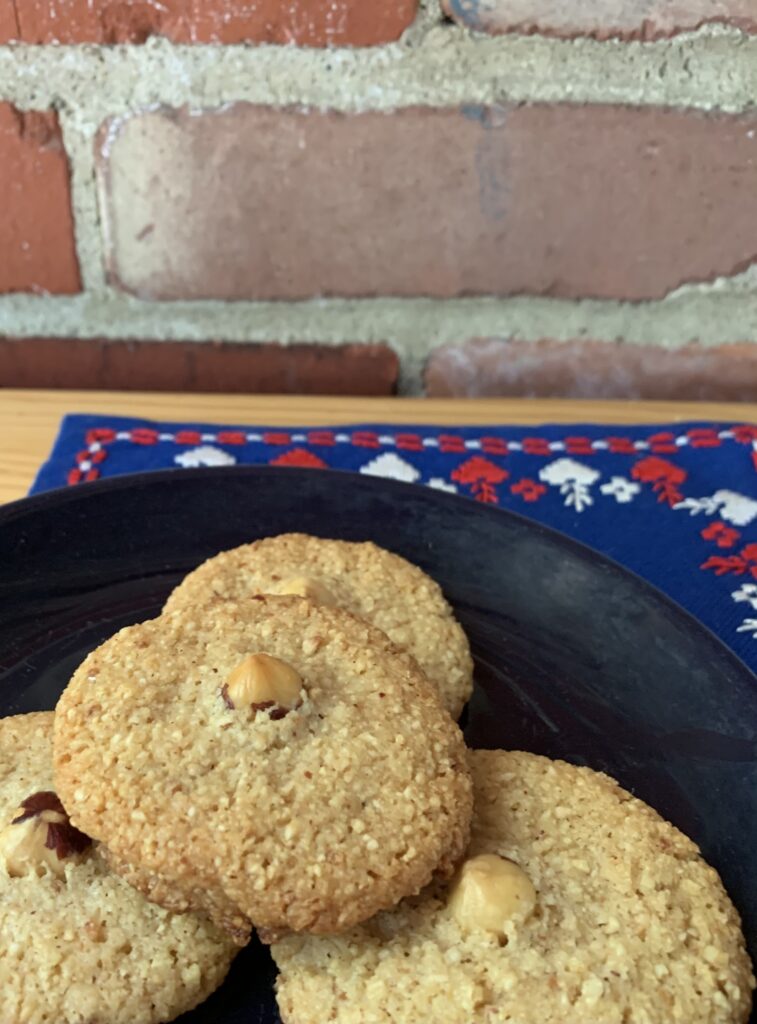
(NOTE FROM KATE: I enjoyed the coarser texture of the machine-ground nuts for its rustic appeal. They look good, and the one hazelnut reserved for the top is very cute, albeit a bit fussy to position nose-up. I admit, however, that fine-textured hazelnut drops would be just as lovely, yet… slightly different.

Here is some good tricks to keep in mind:

  • We don’t use cookie scoops (not enough room in the drawers), so I like to weigh a few dough balls until I have the size right. It keeps a consistent result every time.
  • When forming, give each ball a gentle squish with the heel of your hand to prevent rolling, and garnish with one hazelnut each. These nuts have a pointy “nose,” which I like to aim in the same direction every time.
  • If you want a fine nut meal, start with raw nuts, then toast the flour on a cookie sheet in the oven at 400 degrees Fahrenheit for 4 minutes. Pull out, stir gently, then toast for another few minutes until its scent JUST begins to develop.
  • Unroasted nuts blanch better, so you will have tidier nut toppers. I tried blanching store-bought roasted nuts and almonds, but to my surprise, the skins wouldn’t slip off!

The big note from Scott? At some point you are going to make the dough and then wonder, “Maybe I should add in some vanilla, or spice, or a tough of extract…” You can, and it will be good, but do us a favor and try it straight up the first time. Lilies look best before they’re gilded.

In all honesty, I very seriously considered a preemptive addition of vanilla before our first test batch. After all, vanilla and hazelnut have a historic love affair, and the dough didn’t have as big a flavor hit as I imagined it would. She Who Must Be Heeded prevailed on me not to, and I’m glad to say she was right. The high temperature oven triggers a lot of browning on the bottoms, which adds the exact thing I had been missing.

CONCLUSION

These really are the Danish Modern of cookie baking. Minimal, sleek, efficient, elegant, easy to customize, and absolutely luscious. Plain old cookies just don’t get any better.

Enjoy!

CENTRAL AMERICAN CORN DONUT COOKIES (“Rosquillas de Maiz”)

A staple cookie from Nicaragua and Honduras that acts like a Central American equivalent to Italian Biscotti.

Some countries use more corn than wheat flour as their staff of life, and in those lands you have to expect corn based desserts. Enter Rosquillas de Maiz, a crunchy, mildly sweet cookie meant to accompany a cup of coffee, tea, a drink, or even a fruity dessert soup.

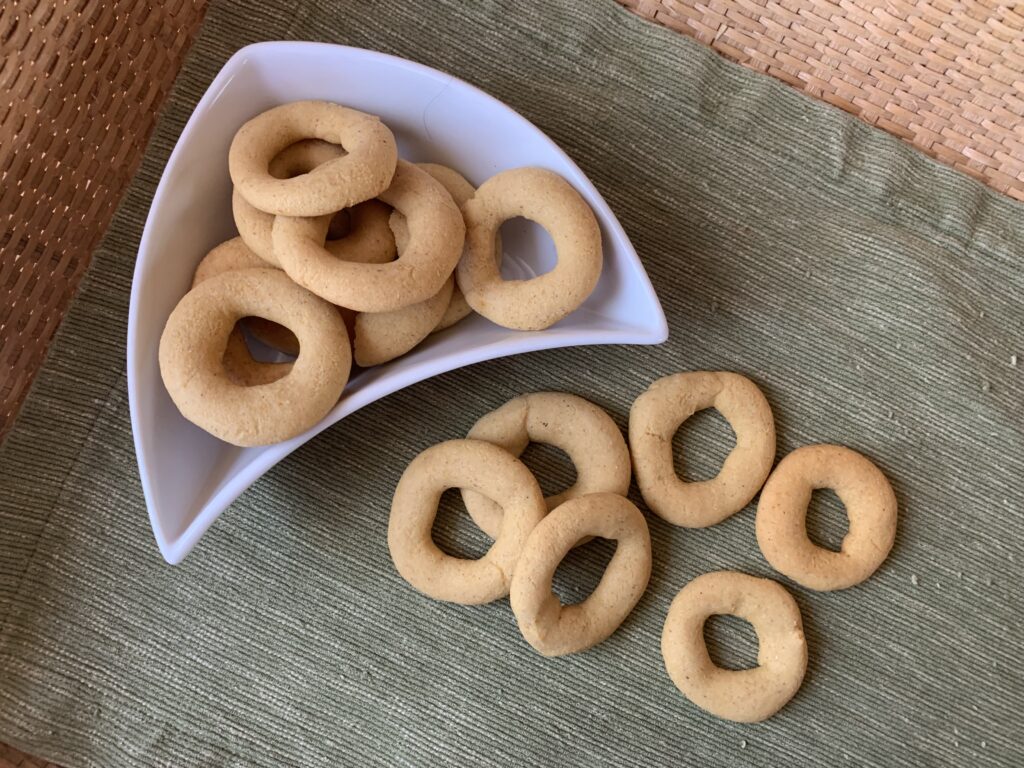
A word to the wise: the word “rosquillas” describes the shape, not the dish, and can include a variety of recipes that can range from our common fried donuts, through ring-shaped breads, tender shortbreads, and in this case, barely-sweet cookies. A native speaker is bound to complain if you use that word alone, just as Norteamericanos would complain if you handed over a bowl of ring shaped breads and called them donuts. Use the adjective, though, and you’re fine. Rosquillas de Maiz means “corn donuts,” and Rosquillas de Nicaragua/Honduras means “donuts from this country.”

NOTE FROM KATE: If this pattern continues, we will never be done testing cookies! What a terrible fate, right? Every time we think our short list got trimmed down to “just a few more,” this happens. Every. Single. Time. However, I have no regrets. This little cookie is easy to make, fun to shape, and expands the repertoire in an entirely unexpected direction! One note of caution: If you toast your corn flour, make sure the flour is cold before you add your leavening agents, especially if you are using hartshorn. (I poured my toasted corn flour into a steel bowl and let it cool in the freezer, for patient I am not.)

An Origin Story For Cookie Sleuths Everywhere

We often get asked “Where do you find all these?!” My best answer is, “They are there waiting to be found if you just take the time to look, and to ask.” This cookie is a case in point.

Kate and I are in the final month of intensive recipe testing before attention turns to getting Volume 2 ready for publication. Sweet Wine Cookies, a ring-shaped treat common from Portugal, Spain, and Italy has been high on our list for some time now. I mean, come on: everybody cooks with wine in their soups and sauces, so it makes total sense that wine growing regions would use their excess wine in baking too. Wine based desserts aren’t exactly rare. Nor are wine based flavors in cakes. Haven’t you come across some version of Champagne Buttercream Frosting for cakes, cupcakes, Macarons, or eclairs? If you haven’t, you’re welcome; that’s good stuff!

I looked around and, sure enough, the wine growing regions in Southern Europe have just such a treat. So I worked up a test recipe, got to where we liked it, and then went searching for native Spaniards to tell me what I needed to tweak. But there I ran into a problem. Our fallback testers include several native Italians (who gave it a big thumbs up), but Spaniards are thin on the ground in Pittsburgh and our Portuguese friend has retired. Thus I wandered into Reyna Foods, a Latin-products grocery store in the Strip District that we have patronized loyally for decades. There’s a lady there who also likes to supply her friends and neighbors with holiday cookies; Latin America was part of the Spanish Empire; and so I hoped that Rosquillas de Vino might have found a sideways path into her repertoire.

No such luck. But there was a lady from Nicaragua in the back who’s reputed to be a fine baker, and her ears perked right up at the word Rosquillas. She doesn’t speak much English, but a coworker agreed to translate my request for feedback.

Her eyes crinkled up in suspicion when I opened the tin of powdered rings. She picked one up with obvious hesitation, gave it a little nibble, and made a face so universal it needs no translation. “No, no, no. No bueno.” It wasn’t quite a blecch! because she didn’t mind the flavor per se, but she was quite firm that these were not the Rosquillas she grew up with. Not even close. Mine were sweet, tender, and had a uniquely wine-tinged aroma. No bueno. Nicaraguan Rosquillas were supposed to barely sweet, very crunchy, and [ahem] untainted.

Then she pulled out her phone, did a quick search, and showed me a photo. Plain, golden rings. “Estas. Estas son Rosquillas.” I scrolled up and saw the title: Rosquillas de Maiz. Wait a second. Maiz? As in “maize?” I.e., corn?

[Pause for translation]. “Of course it is. Rosquillas are made with masa a/k/a corn flour.”

And thus the penny dropped. The basic idea of ring-shaped cookies had indeed traveled the length and breadth of Spain’s former dominion, but not the Spanish recipe. People in the Americas had taken the idea and made it their own.

I looked things up as soon as I got home, and found quite a few examples from Nicaragua and Honduras in particular. It’s a pretty straightforward recipe with a few twists.

Twist #1 – The Basic Formula and Target Result

Research for this cookie quickly ran into a problem: the details were all over the place. Some called for lard (pig fat), some called for tallow (beef fat), some called for butter. Some were leavened, others unleavened. Some had sugar added, some didn’t. Etc. Fortunately, it’s a problem we’ve faced before and we knew what it meant.

This is a peasant recipe enjoyed by the whole society, not a well defined restaurant dish. That means the overarching instruction goes like this: “Use what you have on hand, so long as you keep the basics in place, and achieve the right result.”

Here are those basics, as measured by weight:

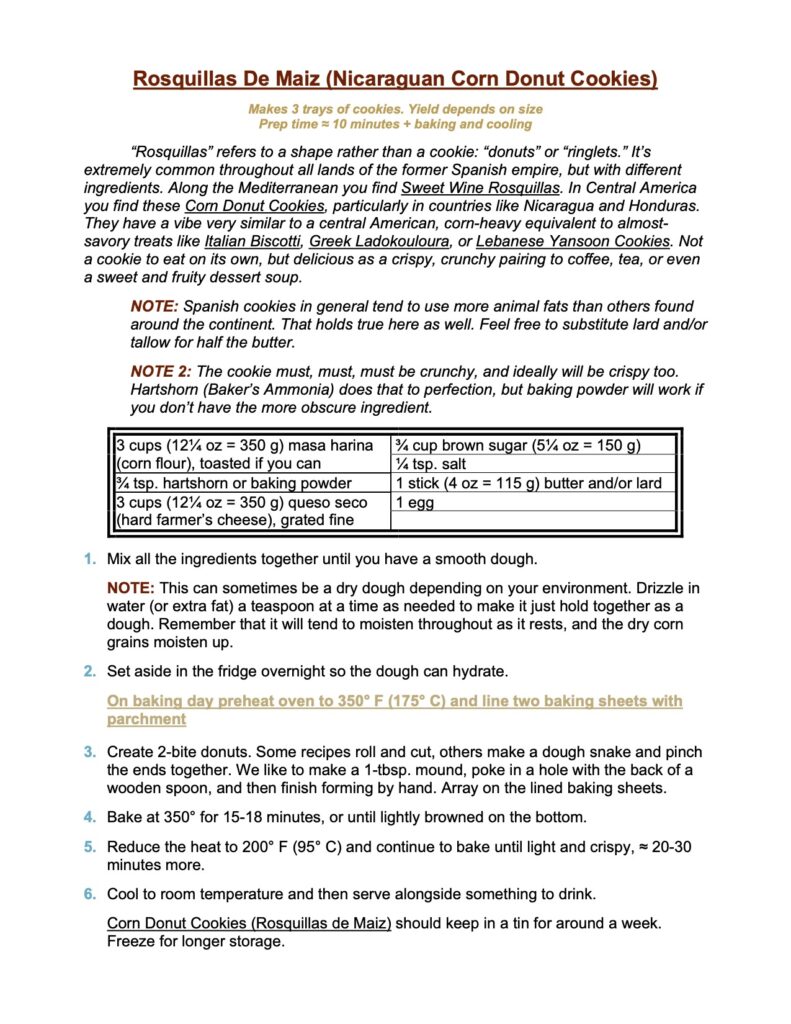
  • 3 parts finely ground cornmeal (masa harina),
  • 3 parts hard, grated farmer’s cheese (queso seco),
  • 1 part fat,
  • an egg to bind it together, and
  • baking time at 350° F (175° C) to get them browned, followed by more baking at 200° F (93° C) to get them completely dry and crunchy.

And here is the target:

  • Nicaraguan Corn Donut Cookies serve the same function as Italian Biscotti: they’re a not-quite-a-cookie intended to accompany coffee, tea, an alcoholic beverage, or a fruity dessert soup. Make that, and you’ve made Rosquillas de Maiz.

Everything after that comes down to refining and perfecting each point.

Baking With Corn Flour And Meal – You May Want To Toast It In A Pan

Central Americans have fresh masa harina on hand, every day and everywhere, waiting to be used. If you’re like us, you probably have a bag of masa tucked away in the back of your pantry, sealed as well as possible to keep out the moths. “Fresh” it is not.

There is an easy solution. Put your somewhat stale corn product into a dry pan over medium heat, and cook it until you can smell the corn flavor rising up. Presto. Ready to go.

That trick may work for fresh masa harina too, but it isn’t in the original recipes. On the other hand, it isn’t all that outside of the recipes either. Spain and its cultural heirs make a series of cookies like Polvorones that are built on a combination of toasted wheat flour and a healthy amount of butter and/or lard. This fits right into that tradition.

The Cheese

Most cultures with a European heritage make a variety of fresh cheeses known by different names around the globe. Quark, tvorog, topfen, etc. They typically come in two basic varieties, wet and hard, and have a mild, creamy flavor. The closest American equivalents would be something like cottage cheese mixed with ricotta, and then drained in cheesecloth until you get the desired texture.

For this recipe you want the driest version of that cheese you can find, grated down to as fine as you can get it. We used tvorog from a local Polish store, drained in a sieve before weighing it out. It’s probably not ideal, but remember that basic instruction up above. It’s peasant food. Use what you have on hand, so long as you keep the basics in place, and achieve the right result.

NOTE: If you only have access to something as wet as cottage cheese, wring it out well before weighing, and then you’ll be fine. The darned cookies get dried at the end of the recipe anyway, and there’s no gluten to develop because they’re made with corn rather than wheat.

The Fat

As noted above, the authentic recipes vary from all butter through all lard, to a mix of butter, lard, and tallow. That isn’t odd for Spanish-heritage cookies. Again, see Polvorones and their U.S. relative Biscochitos. Use what you have on hand. Our favorite was a mix of butter and lard, but it doesn’t really matter from a “heritage” point of view.

This can be a dry dough. Drizzle in water (or extra fat) a teaspoon at a time as needed to make it just hold together as a dough. Remember that it will tend to moisten throughout as it rests, and the dry corn grains moisten up.

The Sugar Content

Authentic recipes varied from no added sugar at all to a small amount (from the perspective of a U.S. sweet tooth). The target is something that will taste like corn in your personal opinion. Season to taste, as they say.

Some recipes also call for obscure (to us) products like loaf sugar. Nicaragua and Honduras are major production centers for sugar cane, and such niceties probably matter to those who live there every bit as much as green peppers versus red peppers do for us, or Apple A versus Apple B. With all due respect, and subject to one exception, it doesn’t matter to you and me. U.S. brown sugar comes from sugar cane, with some of the byproducts (a/k/a molasses) mixed back in. The result should be identical once it dissolves into a cookie dough.

The exception? There is a Rosquillas variation that uses no sugar at all in the dough, but decorates the top of the cookie with sugar shavings from the aforementioned loaf. Consider that an Internet Bonus, because it isn’t in our written recipe. That’s a case where only true loaf sugar will do, because the texture simply can’t be duplicated.

To Salt Or Not To Salt?

That’s simple. Salt. No, it isn’t in the most authentic recipes. But we’ve found that every single baked good we’ve ever tried will taste a little better if you use an invisible pinch or two of salt.

The Leavening Agent

We call for baker’s ammonia if you have it, and there was one recipe I found that incorporated this antique leavening agent. Others use baking powder, with a healthy percentage calling for nothing.

So why did we specify the more obscure one? It comes down to the target. All biscotti are crunchy and dry, but we’ve eaten a lot of them over the years and have come to appreciate the distinction between (i) hard, which is unpleasant until you’re initiated into the cult, (ii) crunchy, which amounts to the introductory level for people not yet beaten into submission; and (iii) crispy, a rarely achieved state of perfection that catches the essence of hard without the dental ramifications of crunchy.

Unleavened Nicaraguan Rosquillas are hard. They’re still okay because we have molars for a reason, and you’re supposed to dip the darned things anyway, but in our opinion one ought to do better. Nicaraguan Rosquillas made with baking powder are crunchy. That’s what a native of the region will expect.

Nicaraguan Rosquillas made with hartshorn a/k/a baker’s ammonia are light and crispy, which made our native tester down at Reyna’s raise an eyebrow with delight. For what it’s worth, I also brought a version made with baking powder only, and that was considered good, but not as good as the lighter and crispier variety.

NOTE: Here’s an Internet-only tip. Hartshorn is a little stronger than baking powder. You may want to increase the amount to a full 1 teaspoon if you use the more common leavening agent.

CONCLUSION

Nicaraguan Corn Donut Cookes (Rosquillas de Maiz) fell into our life by total surprise, and have quickly earned an enduring spot in our hearts. The aren’t a “favorite” per se, because we associate cookies with sweet, tender, dessert-like baked goods such as shortbreads and nut cookies. But that’s taste, not judgment, and these would definitely be in the running if we were making recipes along the lines of Biscotti, Mandelbrot, or even our recent forays into Greek Ladokouloura and Lebanese Yansoon Cookies.

The first two are crunchy, crispy, and nutty-sweet. The next two are crispy and spiced-sweet. Rosquillas de Maiz are crunchy, crispy, and corn-sweet. They fit right in as a peer to the others, and illustrate a special heritage that most of us could stand to know a lot more about.

NOTE FROM KATE: I really enjoy these, and the cheese adds an extra tang. Also, look at the proportions: doesn’t the recipe resemble “Real Food?” The guilt factor is cut by two-thirds at least when you nosh on a barely-sweet, high-protein Rosquillas de Maiz. They are absolutely lovely. Now as you all know, I struggle with fitting into my jeans in this cookie-rich environment. This round little cookie has me all excited, though. Some online recipes cut out all sugar and add a bit of parmesan to the farmer’s cheese. Interesting… I wonder how these would go over as an almost-savory, balanced treat with my afternoon cup of coffee? Try them and decide for yourself!

Enjoy!
ELISENLEBKUCHEN – Flourless honey gingerbread (a/k/a honeycakes) from Nuremberg

The Immortal Queen of Nuremberg Gingerbreads

Here’s a funny but true: we love our classic Lebkuchen recipe so much that we hesitated to work on this one out of pure loyalty. We’ve amassed a great number of honey gingerbread recipes (a/k/a “Honeycakes”), but Lebkuchen remains the a family favorite. Christmas wouldn’t be Christmas if we left them off our tray.

It turned out to be a misplaced loyalty. Elisenlebkuchen bear very little resemblance to regular Lebkuchen when push comes to shove. Our old favorite is a classic built on a flour-based dough that’s jam packed with nuts, fruits, a bit of spice, and a whole lot of honey to act as the binder. Elisenlebkuchen have even more nuts, no flour at all, and instead rely on both honey and a full five (5!) eggs to act as the binder. They are two very different experiences.

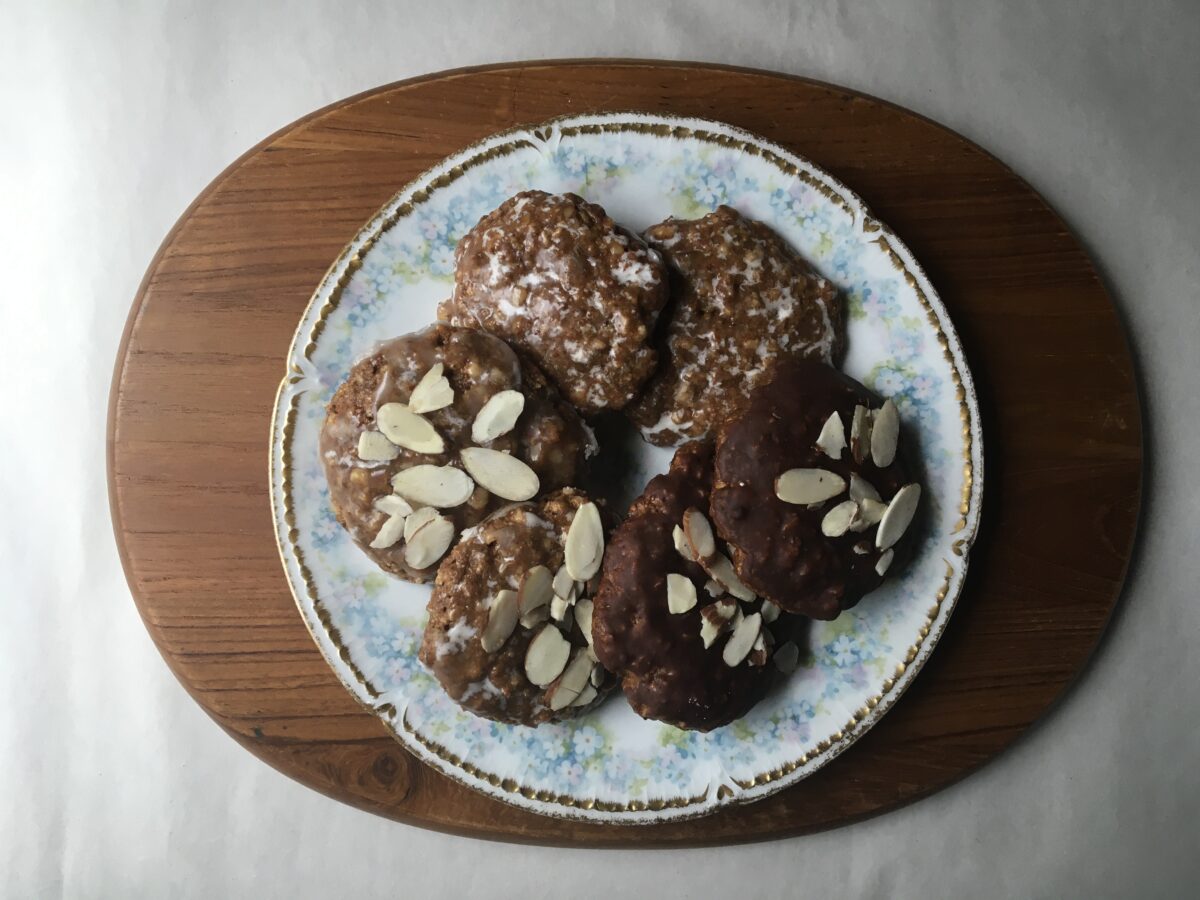
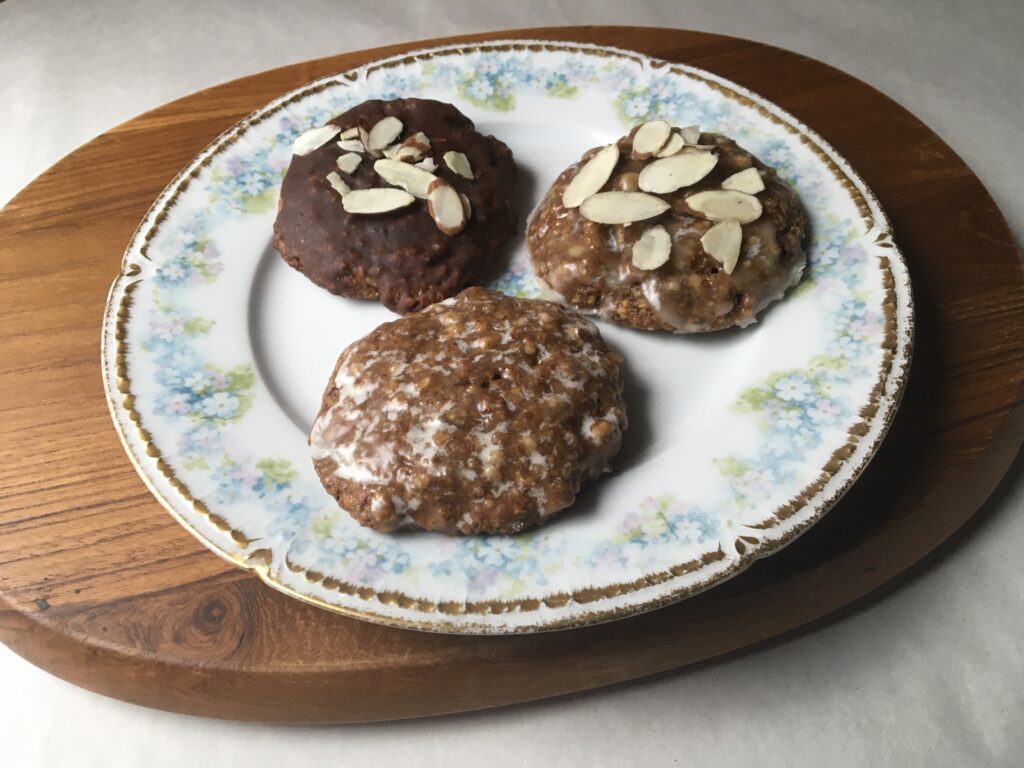
On the Upper Left: chocolate glaze with sliced almonds.
On The Upper Right: vanilla glaze with sliced almonds.
On The Bottom: vanilla glaze only.
Use whichever you think is prettiest.

NOTE FROM KATE: These cookies are horribly deceptive in their overall “goodness.” That is, with the exception of the brown sugar, they are a “whole food,” so what could go wrong, right? I’ll have to do a caloric breakdown one of these days. Let’s just say, they contain more energy than meets the eye. If you were riding across the mountains and had to choose a fabulous, long-lasting food source for the extra space in your saddle bags, these would be it. They remind me of Panforte in their composition, but have eggs for eggstra protein. [Insert eye roll from Scott] The good news? With eggstra protein and the good-for-you fat from the nuts, the sugar in the brown sugar and honey won’t hit your bloodstream too fast. A cookie or two could hold you for hours.

Best of all? Of all our cookies and especially waybreads, these are the closest to the Lembas the elves made famous in the Lord of the Rings. Toss in an apple, and you got yourself a balanced diet for the day! (Shh…don’t tell Scott!)

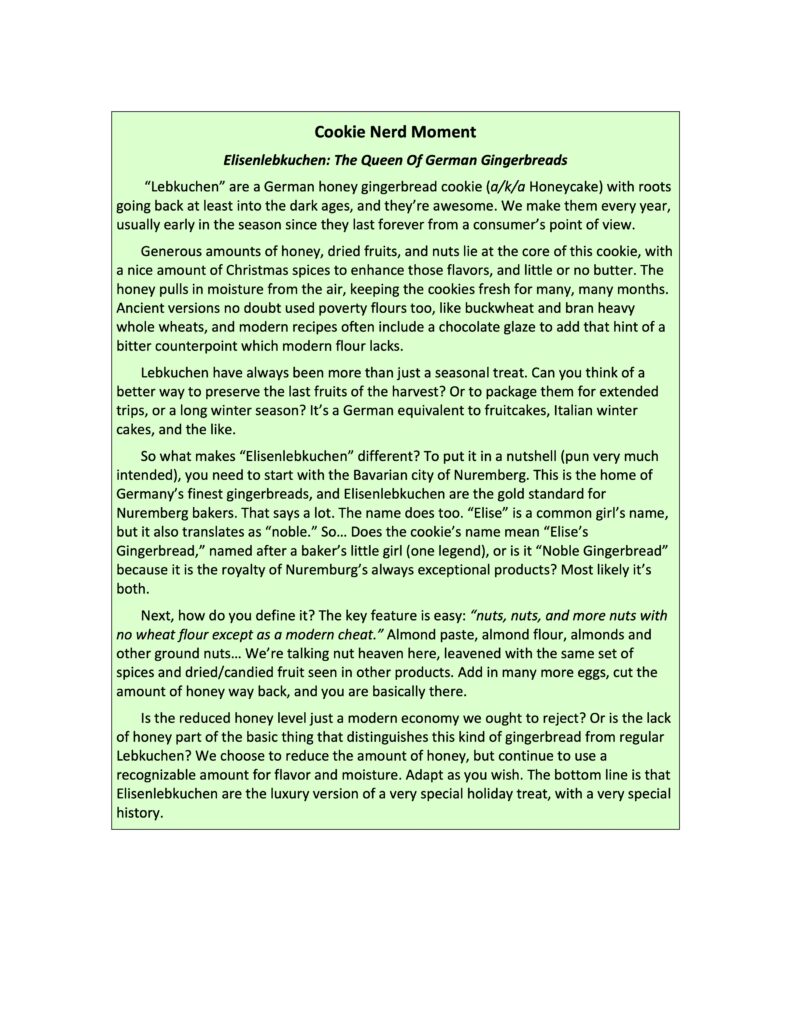
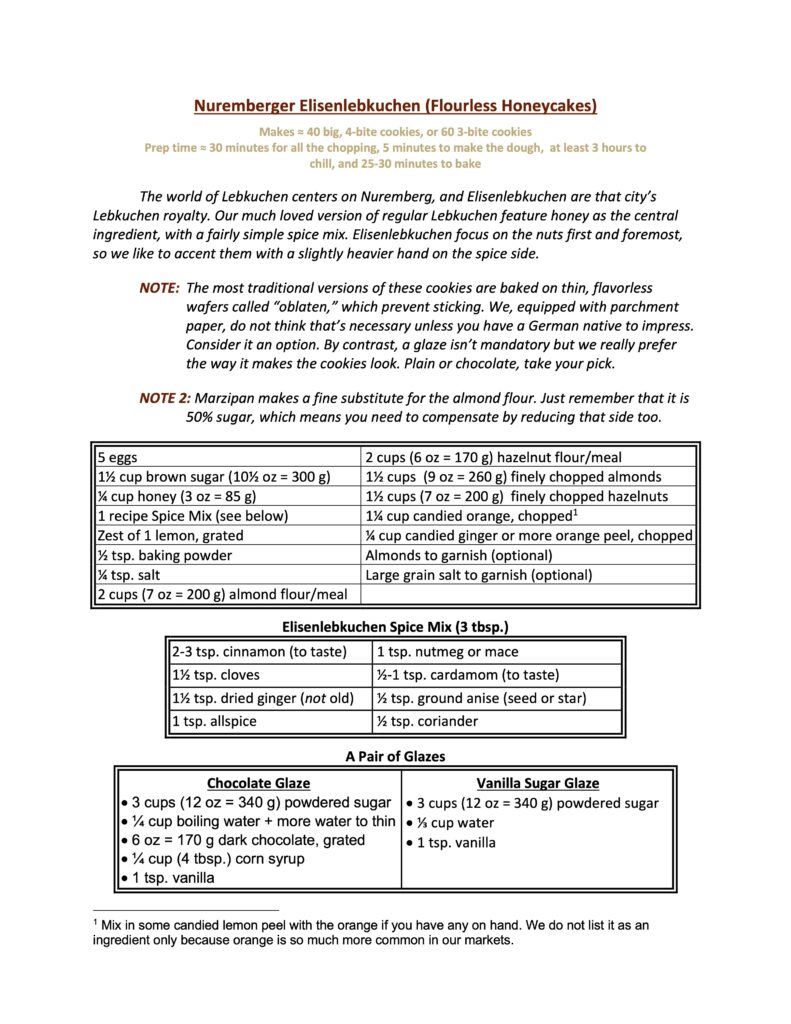
The recipe explains itself, and includes an extensive Cookie Nerd Moment with extra background material, so I will only take the time to discuss a few of the decision points you’ll face when trying this out on your own:

  1. Should I use marzipan or ground nuts? It’s entirely up to you, and makes very little difference. Just remember that Marzipan has almost as much sugar as nuts (our recipe has a ratio of 4:5), and usually has some extra sweetness lurking in the background. If you make this substitution, do it by weight and assume the Marzipan is actually a 50/50 mix. You need to reduce the amount of both almonds and sugar accordingly.
  2. Can I play with the spices? Of course you can! But we do recommend that you (a) stick to the basic, quite generous amount of overall spice, and (b) think of the spices as an accent to bring the best out of your chosen nuts.
  3. Can I substitute in other nuts? Yes, but these are the classics used in Nuremberg. Be aware that you’ll be departing off road from the One True Tradition.
  4. Should I glaze the cookies? Yes. That was easy enough. The glaze definitely enhances the overall look, especially since the bottoms are not glazed.
  5. Should I use the vanilla glaze or the chocolate? Tradition allows for either one, so it’s entirely up to you. Both are thin enough to be only an accent flavor. This cookie is all about the nuts, and even I, a lifelong chocoholic, don’t want to mess with that purity.
  6. Should I add the nut garnish on top? As you wish. They are only there for the sake of appearance and fair warning to anyone who sees them lying there on your tray.
  7. Should I add the optional salt? And why specify “large grain” salt? This is a nontraditional option that we liked so much that we felt obliged to share. Both Kate and I have a strong preference for salted nuts over plain when we snack on them out of hand. The optional salt creates that effect in a light way. We recommend large grain salt sprinkled on top of the glaze because that is the best way to give a salty highlight. The base recipe also contains some salt, but that is more of a bare minimum that the cookie would suffer without.

That’s it folks. Enjoy!

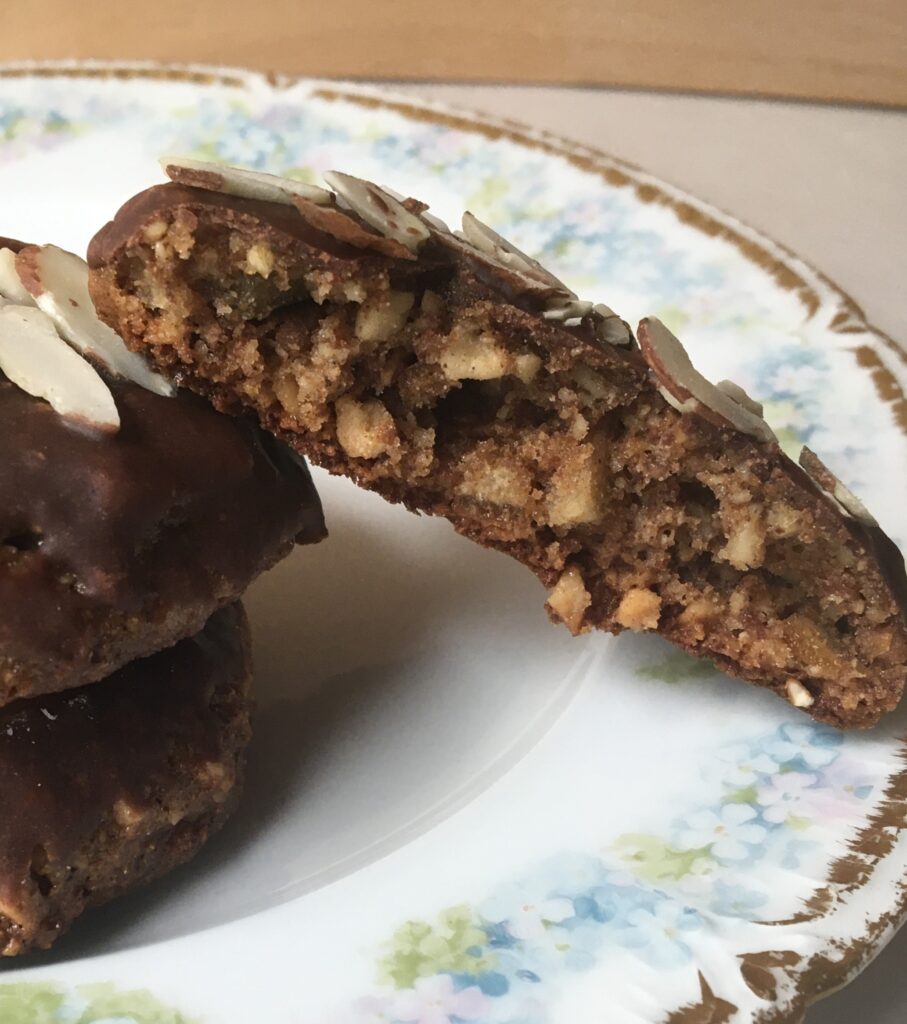
Nuts, nuts, nuts, and fruit. The only other things inside this cookie are honey and eggs as the binder.

MANDELHORNCHEN a/k/a “Almond Horns”

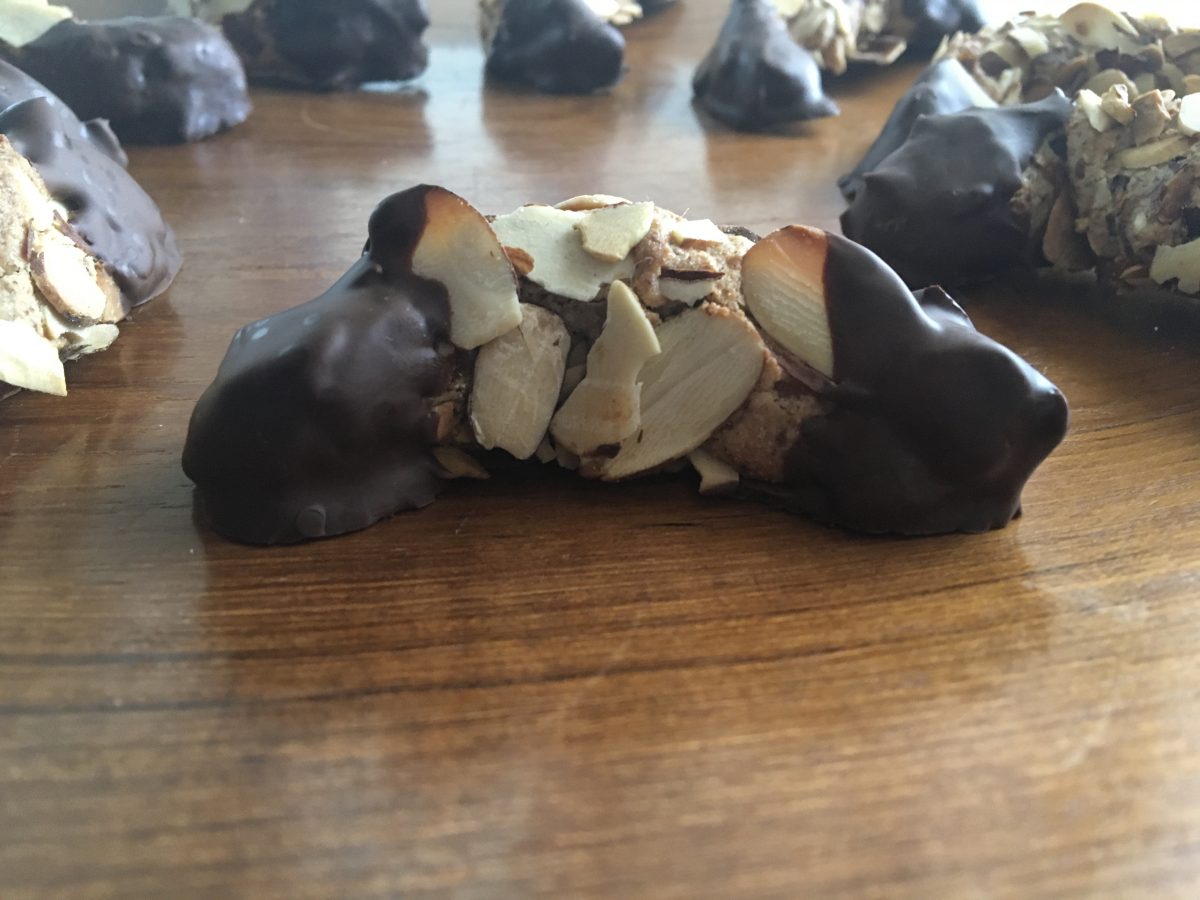
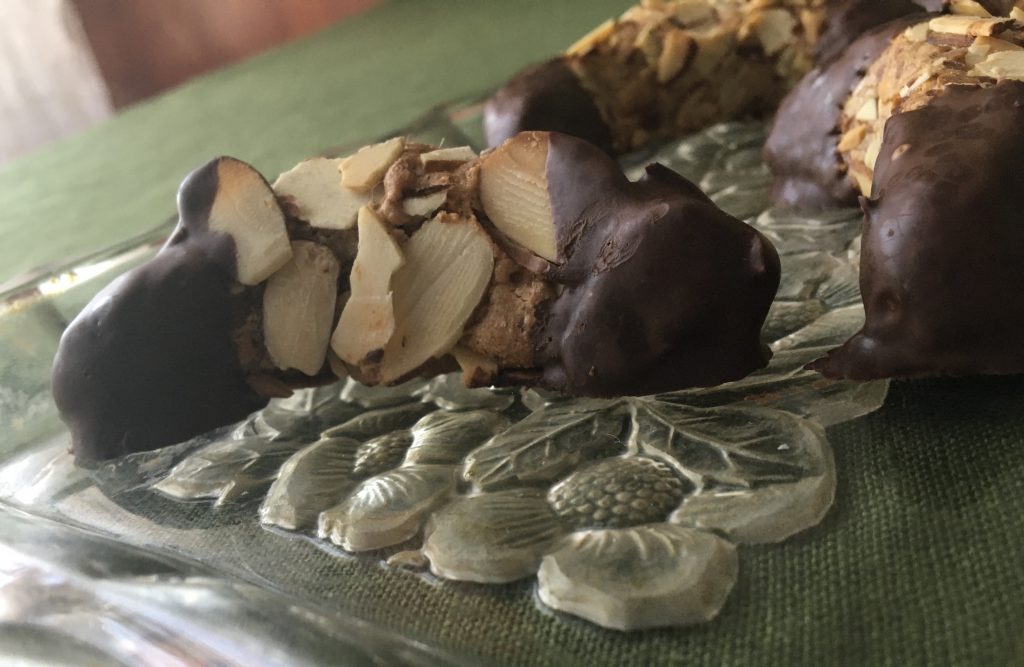
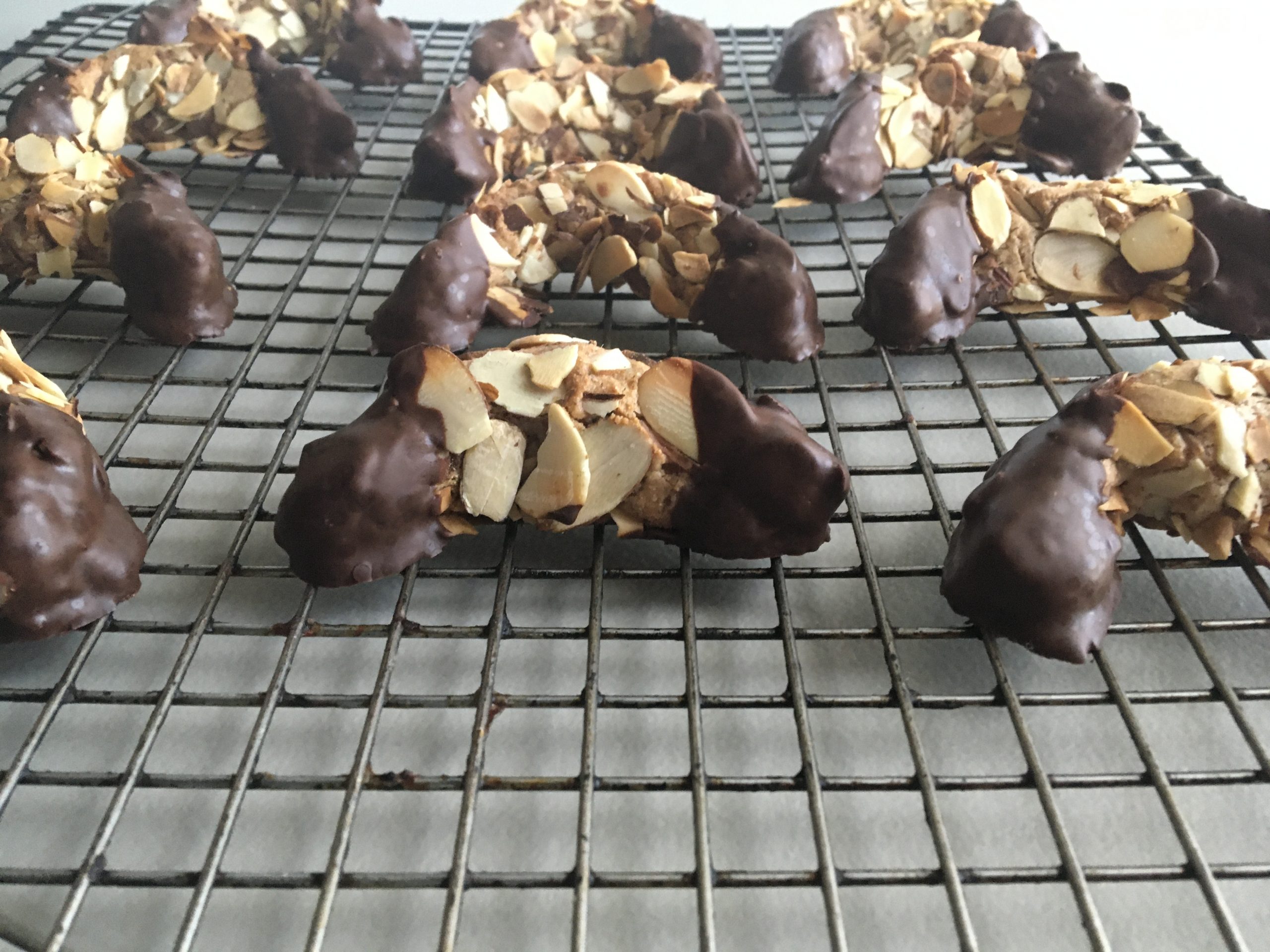
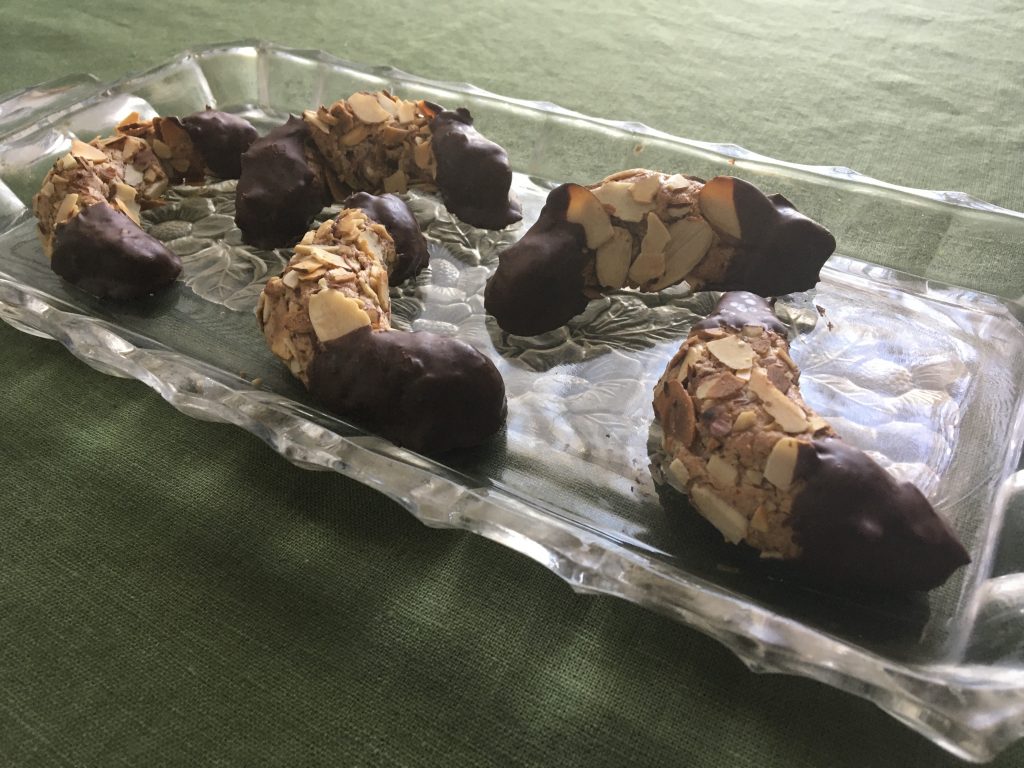
Here’s a recipe that many readers will know because they’re very popular at certain upscale supermarkets. They have a lot going for them, starting with a very pure hit of almond and chocolate (two flavors that love each other), and continuing through the fact that they’re naturally gluten- and dairy-free, which suits a lot of people with allergy problems. They’re also very generous and fairly dense, which means that anyone who’s willing to eat baked goods for breakfast can get by with 2-3 “cookies” and a nice cup of Joe. (A meal that Scott has admittedly enjoyed as he writes this article).

The other benefit? Almond Horns are incredibly easy to make. The basic recipe couldn’t be simpler: (1) put everything in a food processor; (2) grind until it’s smooth and begins to ball up; (3) roll each piece in almond flakes; (4) bake; and (5) coat the horns or bottom with chocolate. The issues come up with the little details that avoid problems in each of those steps.

As always, please skip to the bottom if you are only here for the recipe.

 Step 1 – Choices About Ingredients

Classic European recipes typically start from Marzipan rather than working from scratch. Take Marzipan, blend with egg white(s) to loosen it up, and you’re basically there. Convenience cookies!

Marzipan isn’t as common in the U.S., costs more, and the different brands vary in their dedication to the cult of sugar and the abuse of almond extract. We’re also a nation of people who take food processors for granted. That tool converts Marzipan from a painstaking process into a walk in the park. If cooking from scratch is cheaper, just as easy, more reliable, easier to customize, and lets you use a little less sugar… well, cook from scratch.

We recommend that you start from almond meal because it’s become easy to obtain and ensures an even result. In the ideal world you’d start from whole or slivered almonds, toast them to enhance the natural flavor, and then reduce that to meal during the grinding stage. It’s really up to you. But from one obsessive purist to another? We just get the almond meal. There’s so much extract that the toasted flavors get lost anyway.

Step 2 – Grind It All Together

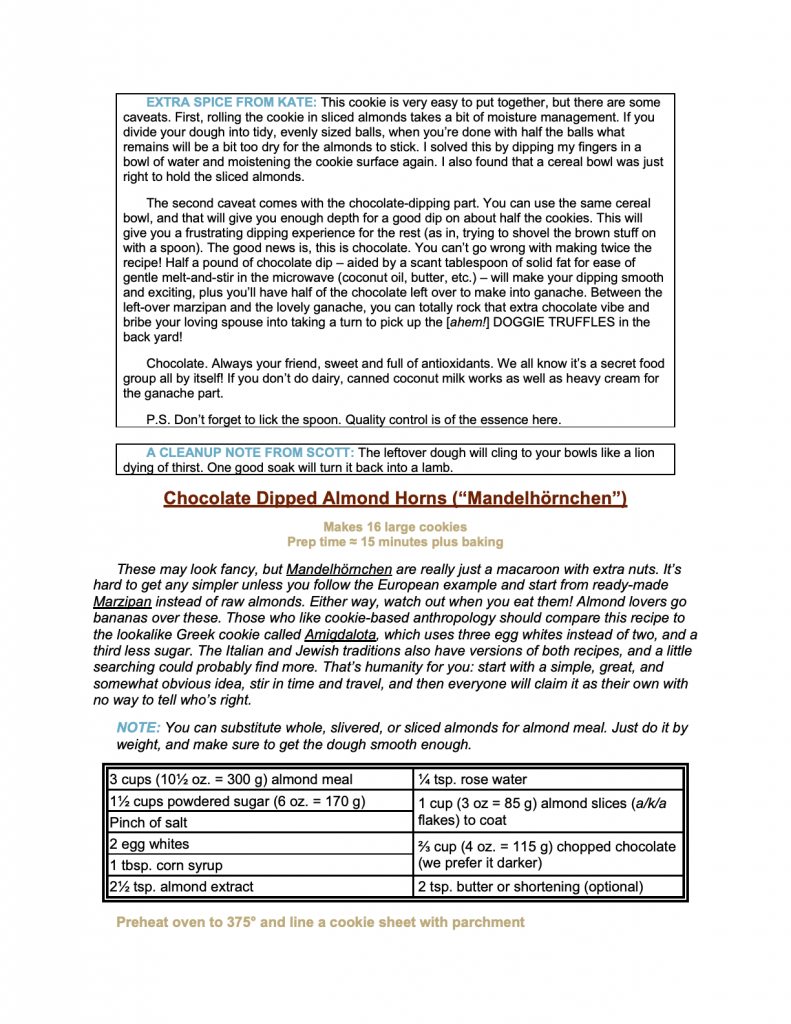
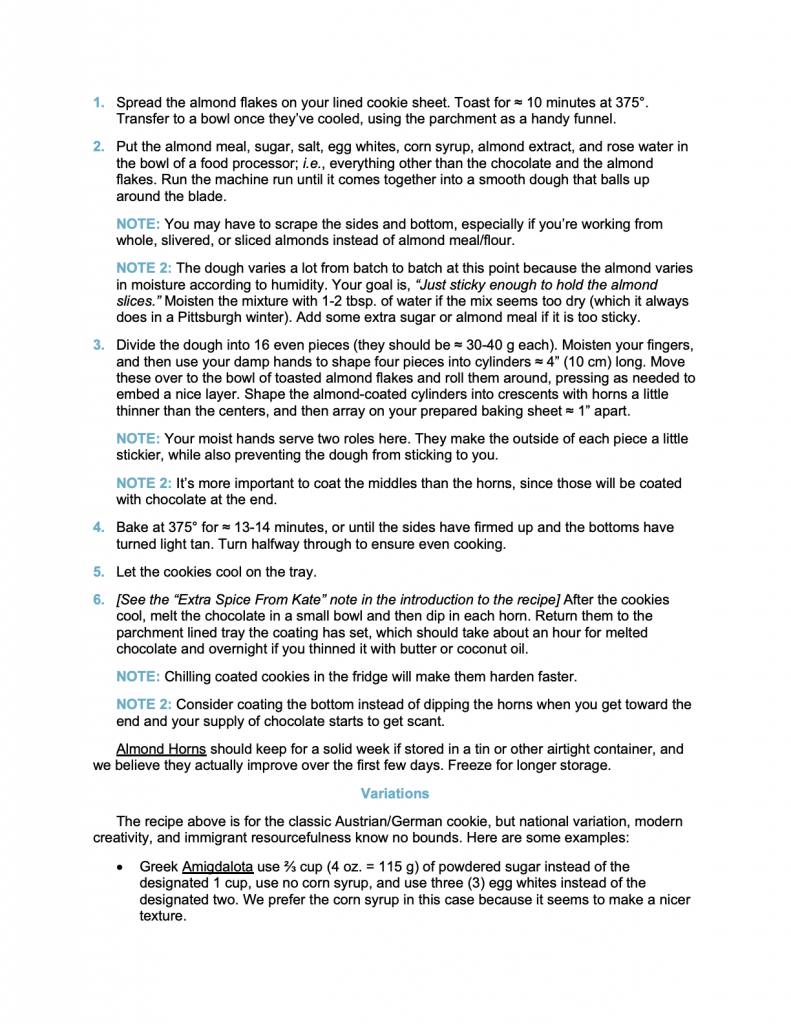
No kidding. That’s all you do. Put everything in the machine except your coatings (toasted almond flakes and chocolate). Process, scraping down the sides from time to time, until it comes together into a smooth dough that balls up around the blade. Done.

That couldn’t be any easier, but there are a couple of tricks because the dough changes with (a) your kitchen’s level of humidity, and (b) whether your Size Large egg whites are closer to mediums or closer to XL’s. They do vary within each range you know. It isn’t a problem if you keep the target in mind: “Dough that is just sticky enough to hold on to toasted almond flakes.” Too sticky and it will be hard to work with. Not sticky enough, and your coating will fall off.

  • If the mixture seems too dry, add in a tablespoon or two of water. This happens every time in a Pittsburgh winter, and almost never in our summers.
  • If the mixture seems too sticky, add a tablespoon or two of extra almond meal. Extra sugar works too.

For what it’s worth, we actually get a kick out of these little customizing steps. They make you feel like a Real Expert who knows the secret cheat codes.

Step 3 – Form the Cookies

A few of those secret codes make this step just as easy.

  • First, remember that most people make these into large, 4-5 bite treats. One recipe makes enough for 16.

That’s not a coincidental number because you get there by cutting the dough in half, then each half in half four more times. If you want smaller cookies, cut the initial piece into thirds and then proceed to halve them over and over. This will get you to 24.

  • Second, moisten your fingers and palms before you form each cookie. That will keep the dough from sticking to your hands, and also make the surface extra sticky for holding on to the almond flakes.

Better for you, and better for the cookies. You’ll need to wet your hands several times before all the pieces are done.

  • Third, form each dough piece into a short, fat sausage as thick as you want the middle of your cookie to be. Roll this cylinder in the toasted almond flakes, and then pinch/curve the ends to form your crescents.

Cylinders are much easier to work with at the rolling stage, and you do not need as many almonds on the ends anyway because they will get coated in chocolate. Yes, you can just make a longer, thinner sausage, roll that, and bend it into a “C”. And yes, it is a little easier. We prefer the result from crescents; they have a texture that changes as you nibble through each treat.

Step 4 – Bake

375° is just hot enough to get a few of the almond edges extra toasty. A nice touch. As always, you want to pay more attention to the aroma and texture than the actual time. They are done when the sides firm up and the bottoms have turned light tan. It’s taken a consistent 13-14 minutes during winter testing in Pittsburgh with our oven. Please let us know if your results vary.

We also encourage you to spin these trays halfway through to ensure even cooking. We usually don’t bother with that step unless we’re dealing with wafers, but for some reason this particular cookie has been sensitive to hot spots.

Step 5 – Coat The Ends With Chocolate

This is the one step in the recipe that creates some frustration. It comes from two problems. First, the chocolate will harden as you work. And second, you won’t have enough chocolate in your bowl to dip the ends when you get to the final few pieces.

You can solve the chocolate problem by either keeping it warm, or mixing in a small amount of fat. Scott prefers to use plain chocolate, and to keep zapping it in the microwave for very short bursts as needed. Kate, who did most of the chocolate work, suggests adulteration – with the proviso that you must use a fat hardens at room temperature. Coconut oil works but can add some flavor. Palm oil has the perfect characteristics but is evil. She recommends butter or shortening, whisked into carefully melted chocolate. The resulting chocolate dip can be extra sticky at room temperature and takes a while to harden, but it is easy to work with. Your mileage may vary.

The problem of what to do toward the end takes more thought, and there is no really good answer. If you want the chocolate supply to end on the final cookie, you won’t have a deep enough pool to actually dip the horns of the last two pieces. Careful work with a spoon can help, but it only goes so far. Either you need to make/waste extra chocolate dip, or you need a cheat code.

Scott offers this workaround: Don’t try to dip the horns on your final piece. Coat the entire bottom with your leftover chocolate instead. It creates a more uniform treat that’s a little less intriguing to look at, and has less contrast when you eat it, but it does have the benefit of giving every bite a little bit of chocolate. Brush all the bottoms with chocolate if you want every piece to be the same.

Kate rolls her eyes at that, and says you should simply make enough chocolate to do the dipping and be done with it. Leftover chocolate makes a wonderful ganache for truffles, or at worst a special treat for the first lucky passerby who can find a spoon. You, of course, are a mature, fully grown person with the control to inflict those treats on someone else.

Cool and Consume – The End… Until Next Time

Mandelhörnchen are one of those treats that become a baker’s signature offering to guests, grandchildren, and drama club bake sales alike. They’re so very big! Physically, in taste, in texture, and in ways that combine to be more than the sum of their parts. They also show off familiar flavors, and they taste exactly like people think they will, except more so. There’s a huge bang for the buck factor.

Plus they’re fun and easy to make once you internalize those little tricks: keep your hands moist when shaping, and accept that there’s only so much chocolate to go around.

This is a marvelous recipe that you’re really going to treasure. We Promise. Enjoy!
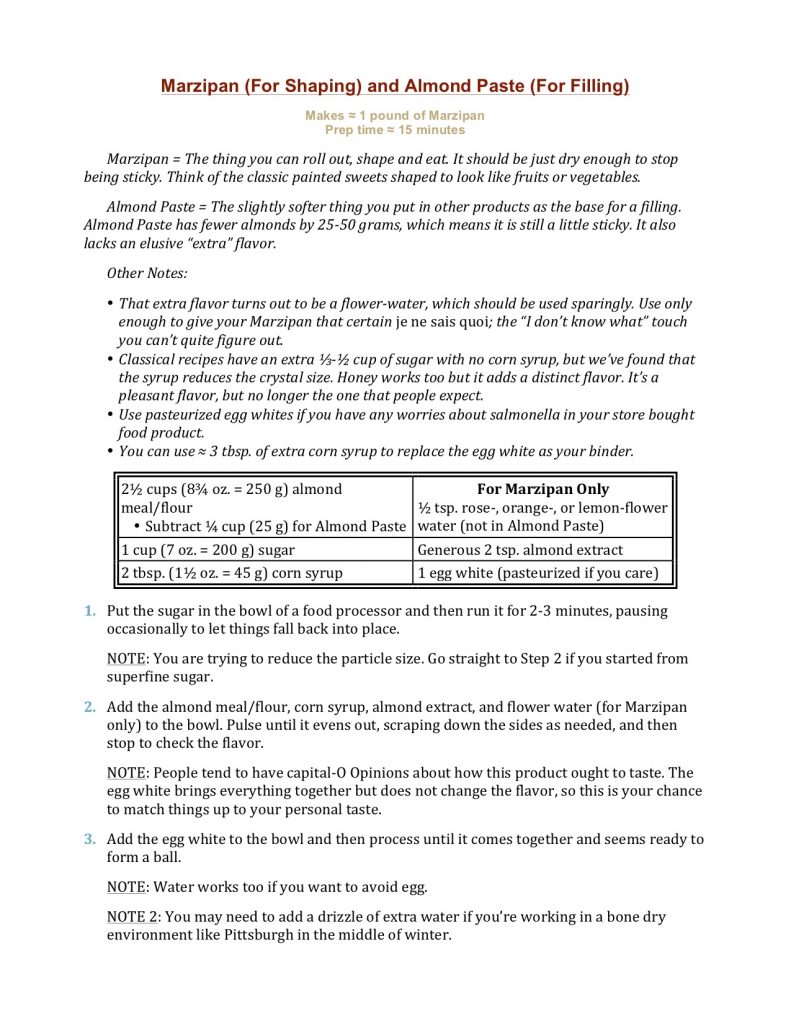
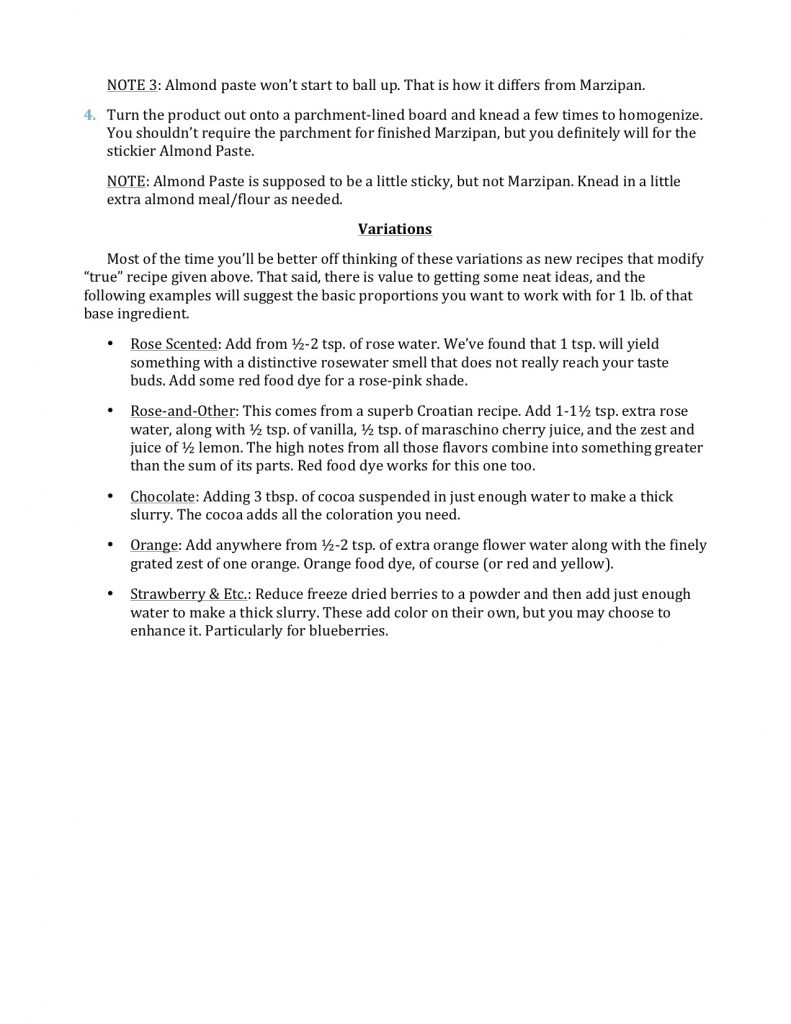
MARZIPAN & ALMOND PASTE – the recipe beneath the recipes

A few weeks ago we put up recipes for a set of Five macaroon recipes we’ve come to love – which could be described as marzipan suspended in an egg white meringue. And I am now working busily on a special Croatian treat called “Rafioli”, which is basically an exotically flavored almond paste wrapped inside a baked pasta shell. [Watch for it!]

German Mandelhörnchen and a Greek equivalent are also on our “to do” list after Kate took an initial whack that wasn’t too far from being right. Those amount to a flavored marzipan or almond paste lightened with fewer egg whites than you’d use for macaroons, formed into crescents, and then dipped in chocolate.

EXTRA SPICE FROM KATE: We have no photos of the Mandelhörnchen because a mysterious cookie gremlin raided our kitchen before anyone could add the chocolate part. Skeptical spouses have wondered if “doppelganger” would be a more accurate than “gremlin,” but I admit nothing. He only suggests such an outrageous thing because they are one of my all time favorites, both tasty and toothsome.

And then… Hmm, a pattern seems to have formed! There are dozens, if not hundreds of baked goods that start with a base of finely ground almonds, mixed with sugar and then bound by egg whites. That ingredient is called “Almond Paste” when left loose and a little sticky, or “Marzipan” when you add enough extra almonds to make it solid. We wouldn’t call either one a “cookie” all on its own. Commercial marzipan is actually marketed more like a not-so-sweet candy (with U.S. and English versions tending to be sweeter), and almond paste as an ingredient. But the basic concept gets used in so many true cookies, and cookie fillings, that it’s only fair to give our version.

Besides, Valentines Day is coming next month and you can earn some major brownie points by making Marzipan treats and forming them into something romantic. And double-besides, the recipe for Marzipan contains a couple of surprises that many people don’t know about, such as a tiny bit of rosewater used as everyone’s not-so-secret ingredient.

Anyway, here is our version for your education, edification, and delight.

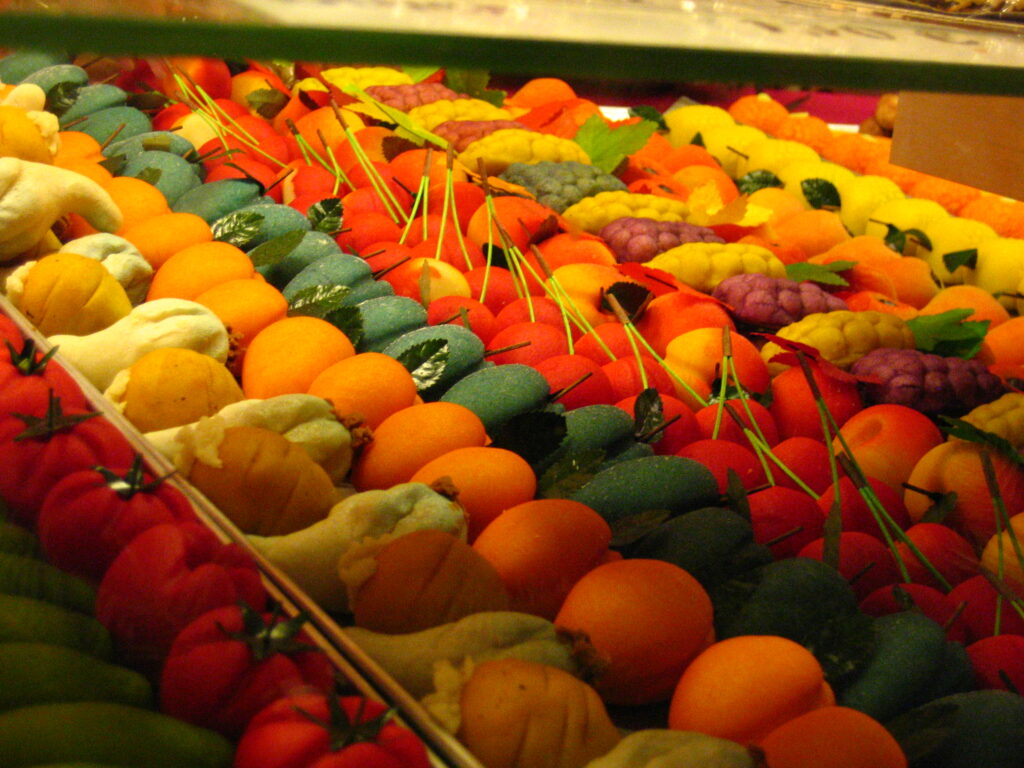
This lovely photo of Marzipan Fruits at the Nuremberg Christmas Market is available under a Creative Commons Attribution-Share alike 2.0 Generic license at the linked website. Many thanks to the author for his or her generosity.

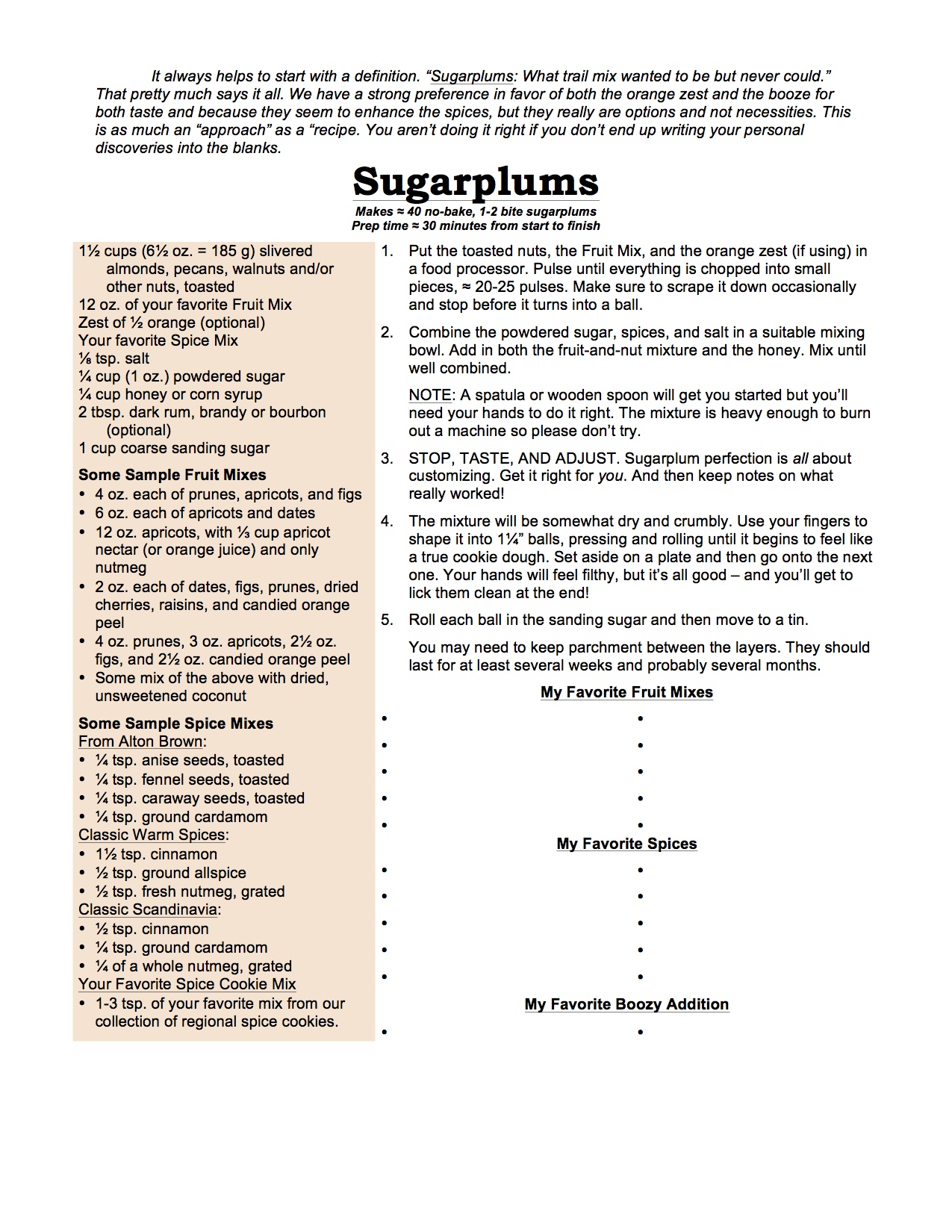
SUGARPLUMS – Kate’s new love. Make them, and make them your own!

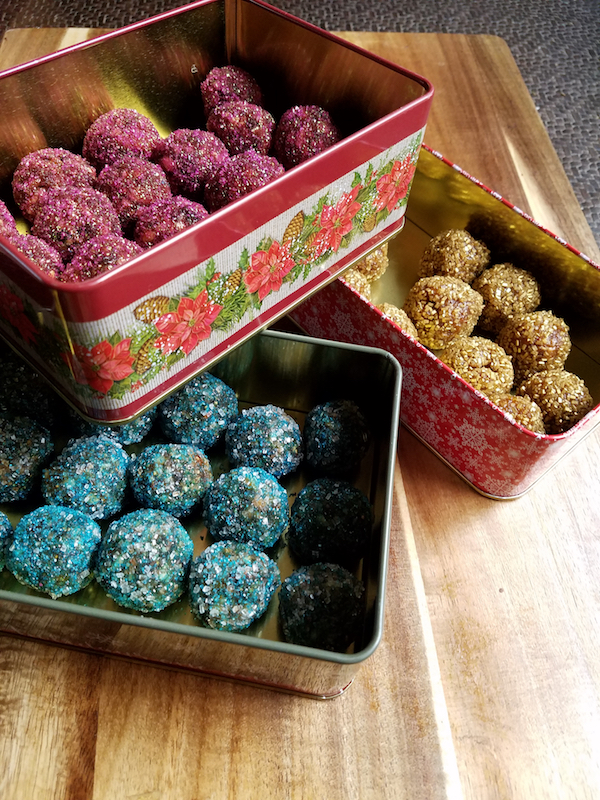
Three different Sugarplums from our 2017 tray. The red ones are made with pecans and almonds for the nuts; 2 oz. each of dried cherries, dates, figs, raisins, and candied orange for the fruit; Kirsch for the booze; and the Warm Spices mix. The gold balls are made with almonds for the nuts; dates, apricots and candied orange peel for the fruit; brandy; and the Scandinavian spice mix. The blue ones have walnuts & almonds; candied ginger, figs and a couple of dates; gin; and a combination of lemon zest, cardamom, and pepper, much less clove, and a touch of cinnamon. Kate got to play!

Kate writes:

“I never took the concept of no-bakes seriously at all until we tried making Sugarplums. Sugarplums! Dried fruit and nuts and spices, tied together with a bit of honey. Highlighted with candied or grated orange zest and a bit of brandy. Coated in sparkling colored sugar, they look as festive as they taste. And if you excuse the sugar coating, which can be substituted by finely chopped nuts, you’ll even get a treat that consists of wholesome ingredients!

Thus it was the humble, ancient sugarplums that turned my eye, changing my mind about the concept of no-bake cookies. Because a cookie can be perfectly delicious despite being easy to make. These are part of our ‘easy’ category.”

Scott adds:

If you don’t have the paper book, I urge you to print this recipe out, put it in a plastic sheet protector, and start keeping annual notes on your various experiments. There is no “right” Sugarplum! That is their basic and most fundamental charm. They are all about what YOU like, and what YOU come up with.

And if you have out paper book, for heaven’s sake feel free to start writing on the pages. It isn’t holy writ! We put those blanks and “My Notes” pages in for a reason. We wrote our book to be that one you will use to death and then pass on to the next generation. How will they be able to reproduce what [Grand] Mom and Dad did if you don’t record your own special tricks and observations?

It’s not like you need our permission, but you have it. Permission and active encouragement. Make that copy your own! Nothing would make the authors happier.

FIVE (5!) MACAROONS – Renaissance recipes for the modern world

It’s hard to get more “heritage” than the early Renaissance, and that’s what we have here: four famous cookies that grew into maturity along with the likes of Leonardo, Michelangelo, Donatello, Botticelli (with whom Leonardo supposedly founded a restaurant), Verrocchio, Raphael, and the rest of them. And Columbus for that matter. What can inspire artistic brilliance more than a really good cookie? The answer is obvious: Nothing!

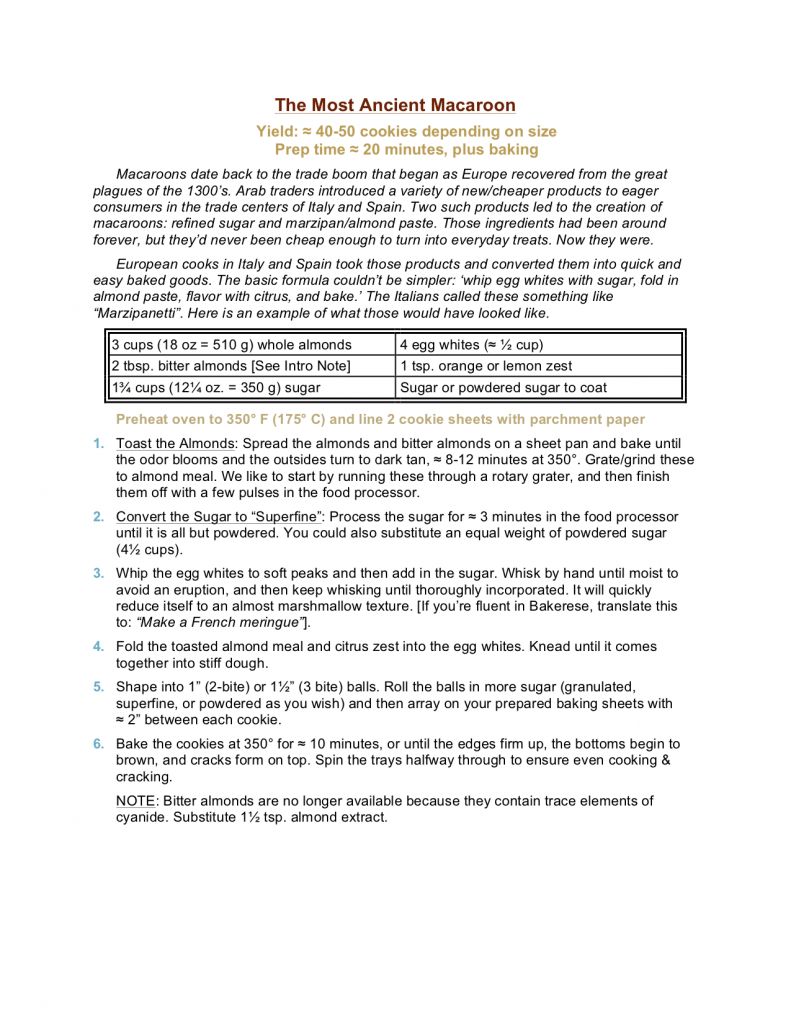
We’re talking about classic macaroons, a cookie dating back to the trade boom that followed the Black Death’s destruction of medieval civilization. Arab traders introduced a variety of products to eager consumers in the trade centers of Italy and Spain. Two main ones in turn led to the creation of macaroons: refined sugar and marzipan a/k/a almond paste. Yes, those ingredients had been around forever, but they’d never been cheap enough to turn into everyday treats. Now they suddenly were, and Renaissance Europe was ready to adopt new ideas their grandparents would have scorned.

Italian and Spanish cooks started the process by incorporating the new ingredients into quick and easy baked goods using methods known since antiquity. The basic formula couldn’t be simpler. First whip some egg whites with sugar to make a meringue, using a more generous amount of sugar than before since it was now more affordable. Fold in some imported almond paste, and then bake. And there you have it! The first macaroons, commonly known as “Marzipanetti in Italy.

Matters evolved from there, with bakers slowly adopting the regional variations that eventually hardened into recipes. We have now worked up four versions of that basic recipe, distinguished by relatively small changes in the way they’re flavored and presented. Here is a table to more-or-less compare the four recipes, normalized to an even one pound of almonds. [NOTE: The different egg sizes occur because those recipes start from a different amount of almonds].

Most Ancient Macaroons

* 450 g almond meal

* 300 g sugar

* 3 XL egg whites

* No zest

* ½-1 tsp. almond extract

* 350° for ≈ 10 minutes
Ricciarelli


* 450 g almond meal

* 300 g sugar or 150 g honey
* 2 egg whites + 1 yolk
* Orange zest

* 2 tsp. almond & vanilla

* 350° for ≈ 12-13 minutes
Alemandrados


* 450 g almond meal

* 265 g sugar

* 1 jumbo egg

* Lemon zest

* ½ tsp. almond extract

* 350° for 8-10 minutes
Amaretti


* 450 g almond meal

* 290 g sugar

* 4 egg whites

* No zest

* 9 tsp. almond extract

* 350° for ≈ 12 minutes
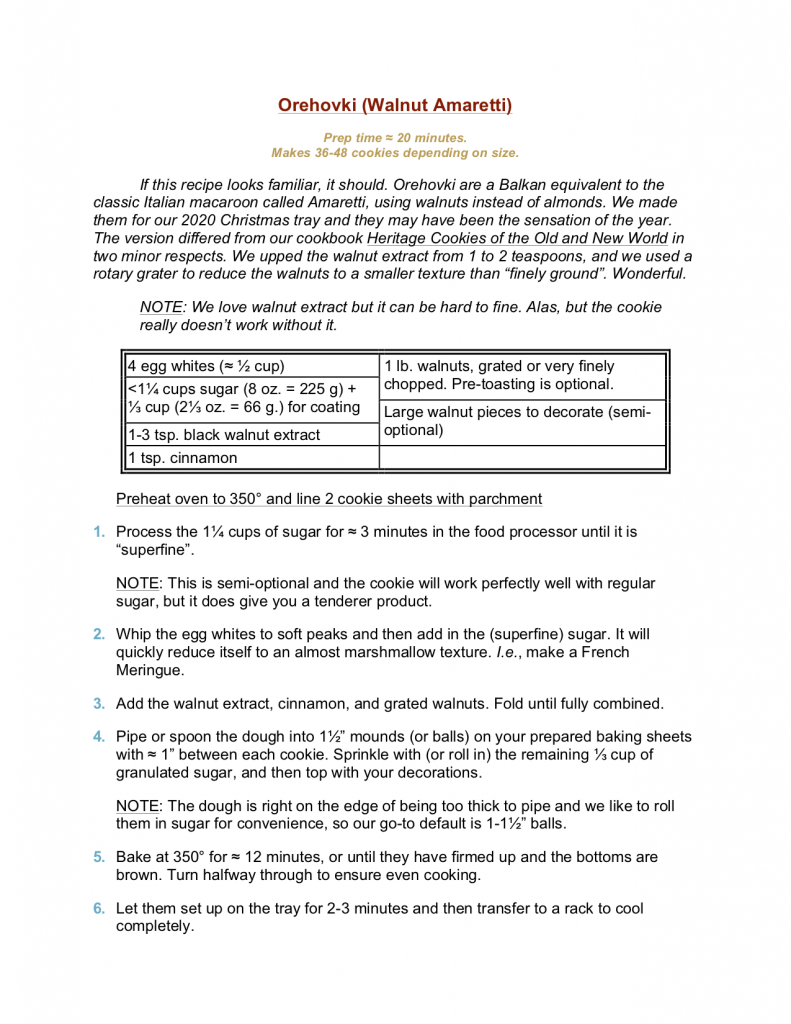
See also the Walnut Macaroon Orehovki

Not a lot of differences, are there?

  • The Most Ancient Macaroon included a hefty amount of sugar and some bitter almonds. We were forced to substitute almond extract for the latter. Bitter almond extract would be even better if you can find it. This cookie is super simple, focused on those new imports, and consistent with the oldest macaroon recipes we could find after a week or two of search. NOTE: Scott believes it may be even more authentic to replace the sugar and almonds with premade almond paste, because that product would have been easier to ship back in the day.
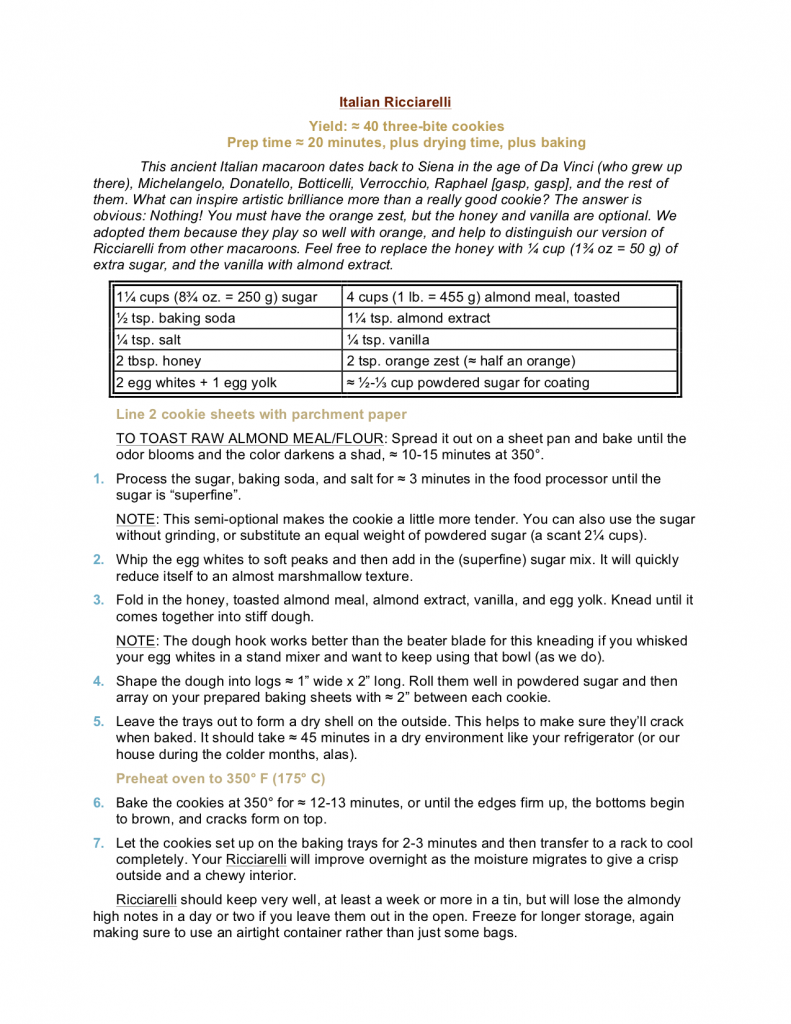
  • Italian Ricciarelli, a specialty of Siena, must have orange zest but vary from there. We reviewed more than a dozen variations before settling on a version that includes an elusive hint of vanilla, some honey to enhance the sugar, and a single egg yolk to give them some richer chew. The cookies would still be Ricciarelli without those additions, but they help to distinguish this cookie from its macaroon peers. And they’re good. We also adopted the trick of adding some baking soda into the dough, because it creates attractive cracks in the powdered sugar crust.
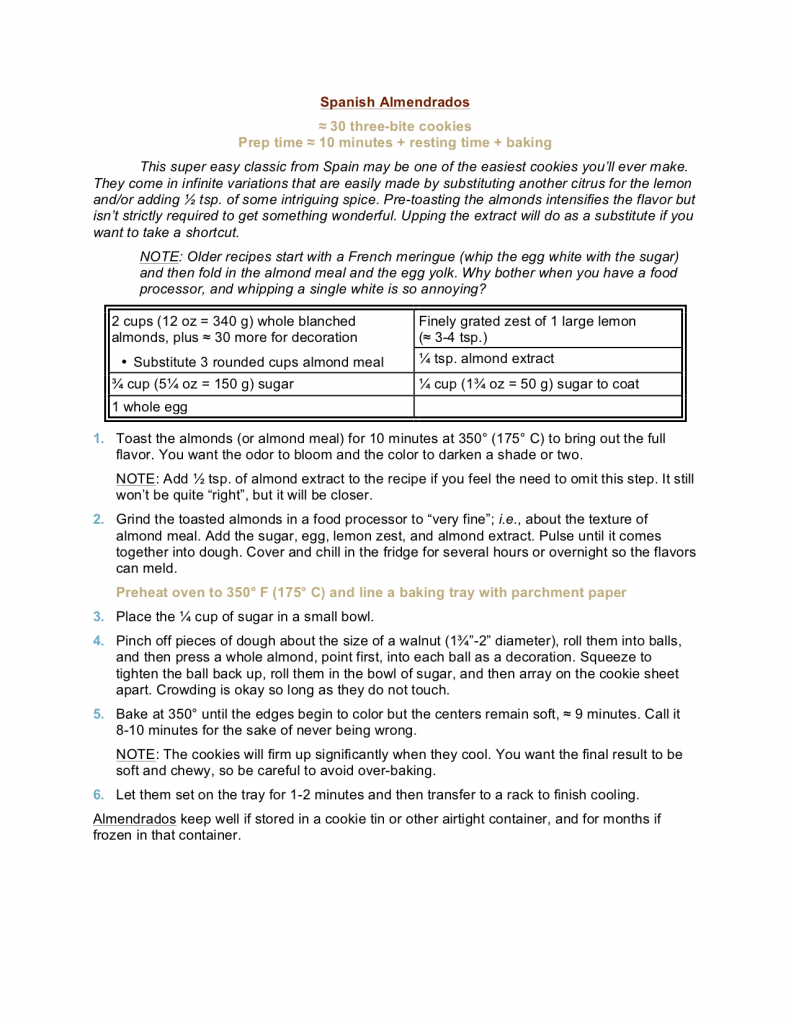
  • Spanish Almendrados add lemon zest instead of orange, use whole eggs, and ignore the initial meringue step. Throw it all in a food processor and go! This methodology, combined with the shorter baking time, gives the cookie a fabulous chew you’ll particularly enjoy. They come with a classic almond-on-top decoration, and a granulated sugar crust.
  • You can find Amaretti in our cookbook, Heritage Cookies of the Old and New World. The recipe looks very similar to the Most Ancient Macaroon except for a monstrous hit of almond extract, and the candied cherry on top. Our reference to “Rudolph’s Nose Cookies” wouldn’t have made much sense in 15th century Italy. Neither would reindeer if you think about it.

Continue your travels around the Mediterranean and you’ll see extremely similar cookies such as those flavored with rose water (a favorite in Turkey), or with walnuts and walnut extract in place of almonds. Move north and things begin to differ more, with roll-and-cut meringues such as Basler Brunsli (mix of almonds and hazelnuts, cocoa powder, and cherry liqueur) or German Zimtsterne (mix of almonds and hazelnuts, cinnamon, other spices, and lemon icing).

But here’s the bottom line. Macaroons go so deep into the roots of modern Europe that there’s really nothing older except the extant waybread recipes. They’re also simple to make and easy to modify into infinite variations. It’s an invitation to play, and we encourage all you creative people to do so!

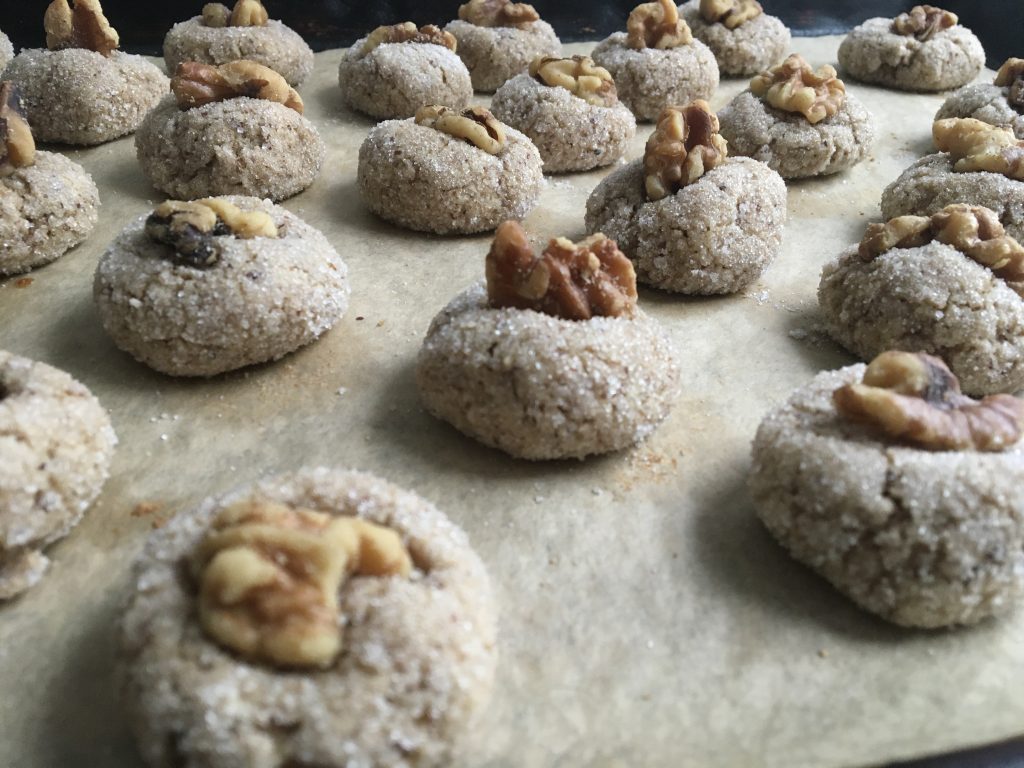
Here are our recipes for all four, plus a bonus recipe from the Balkans: a terrific macaroon based on walnuts instead of almonds.

Enjoy!

Ricciarelli, the ancient macaroon of Sienna, Italy that Leonardo and the rest grew up on
Spanish Alemandrados
Orehovki, a/k/a Walnut Amaretti from the Balkans

CINNAMON STARS (“ZIMTSTERNE”) – Strange, wonderful, & familiar all at once


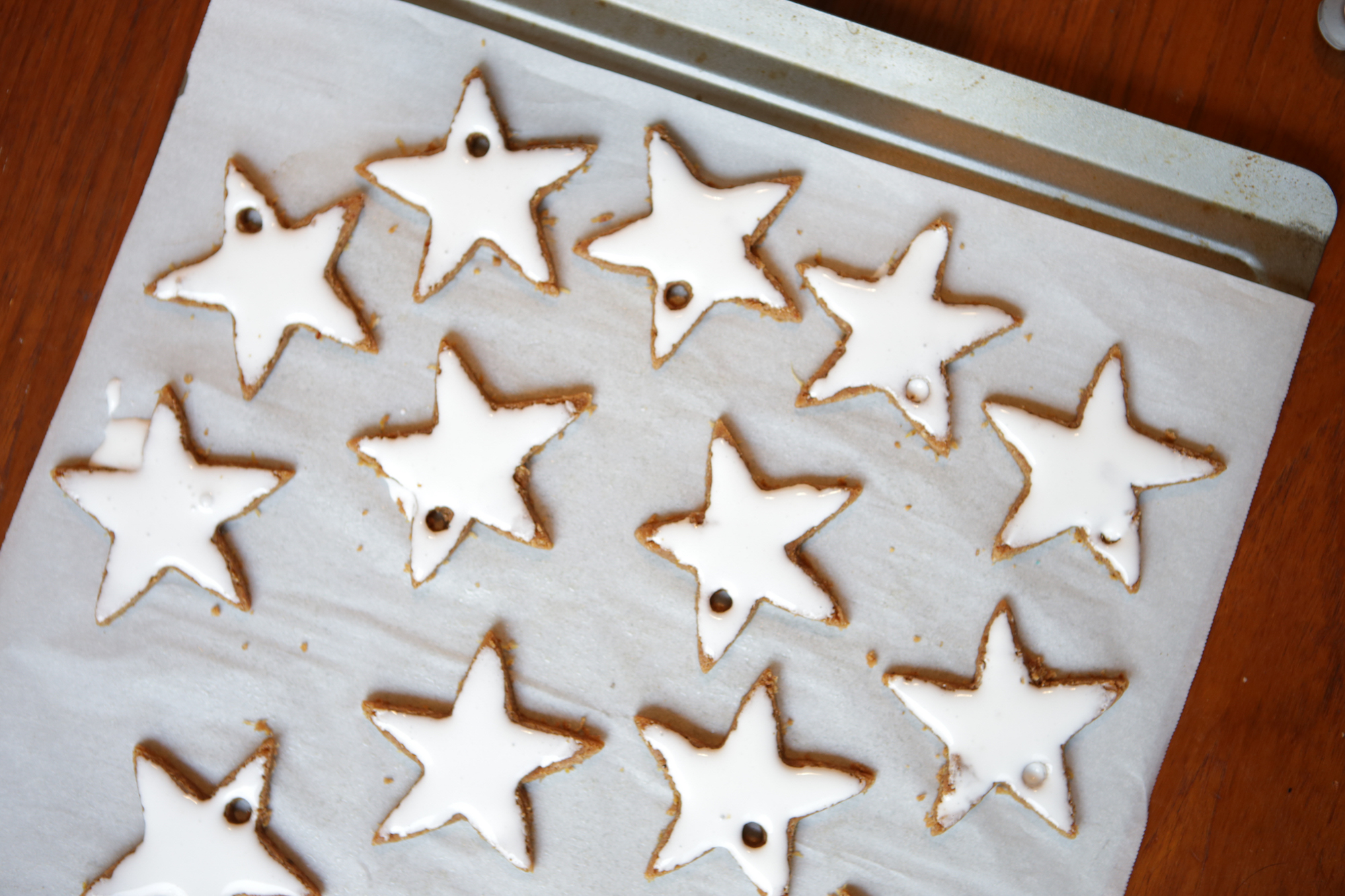
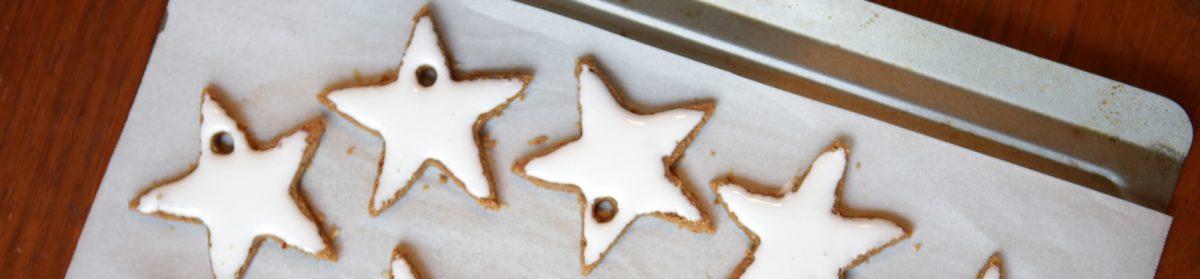
Cinnamon Stars, complete with a hole for hanging them off your tree.


This is the cookie we point to when people ask for an example of what we mean by a “heritage” cookie. There aren’t many Americans who are familiar with Zimtsterne (zimt = cinnamon, sterne = stars), but you’d be hard pressed to find anyone in a German speaking country who does not know them. Or in a country that borders on one of those nations. They are as common and ubiquitous in that part of the world as Chocolate Chip Cookies in the U.S.

The fact that people need to learn about them is one part of the “strange”. The other lies in how the cookies are made.

As always, skip to the bottom if you only want the recipe.

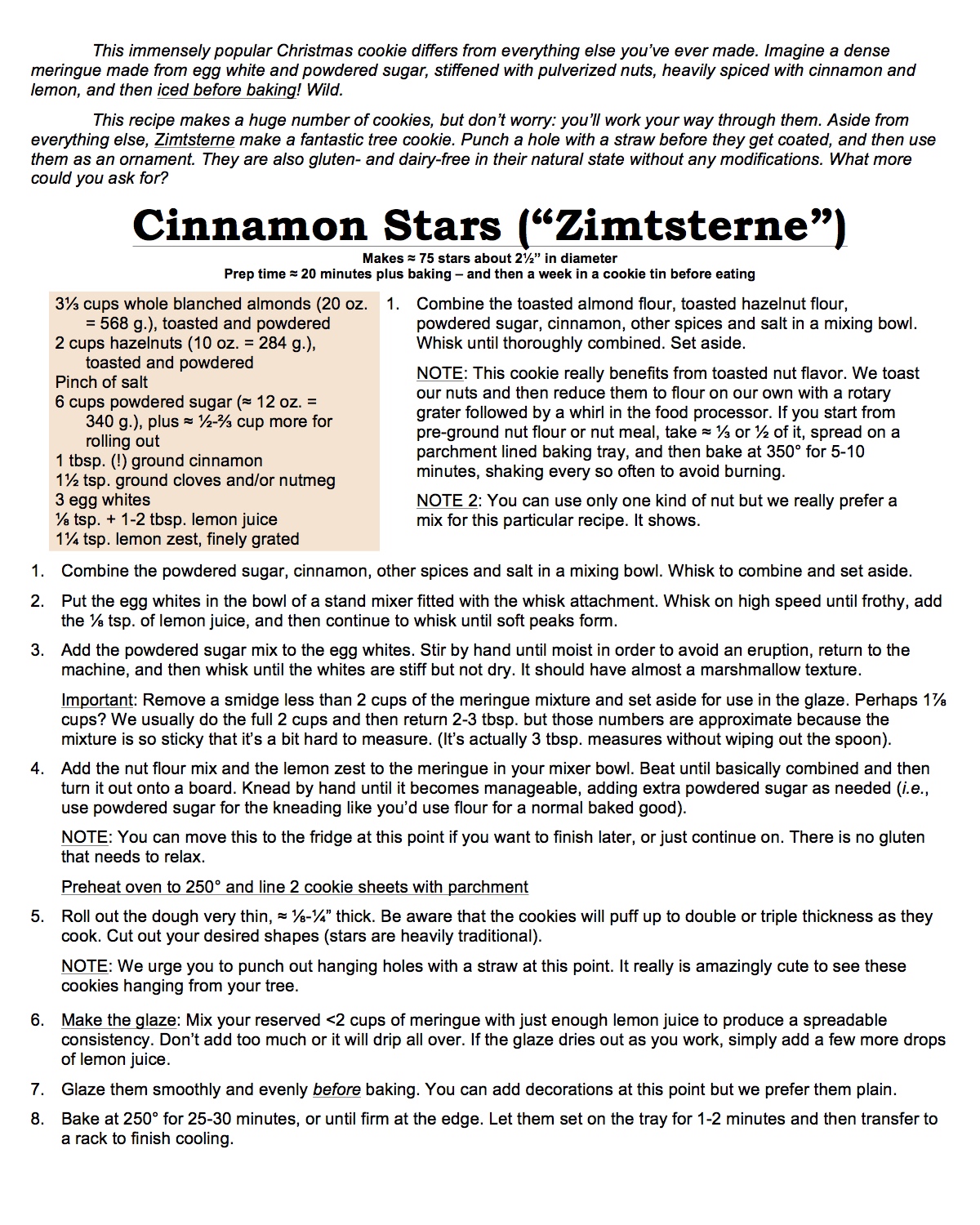
If you’re reading this, we assume that you’re a baker. Have you ever seen, anywhere, a cookie where you bake on the icing? It’s brilliant!

At their core, Cinnamon Stars are nothing more than a very refined version of a dense macaroon. You grind up nuts (in this case using a mixture for added complexity), flavor those nuts (in this case with spices for yet more complexity), mix that with a French meringue (egg whites whipped with superfine or powdered sugar), and then bake (in this case using a very low oven for color and texture. Change the type of meringue with a higher percentage of whites, and you’ll end up with a flavored Macaron. Change the spices to metric ton of almond extract with an average 350 F (175 C) baking temperature, and you’ll have Amaretti. Make that a bit of citrus with almond meal instead of flour, and you’ll get the antique Renaissance versions like Sienese Ricciarelli or Spanish Almendrados.

It’s a simple concept. But… whoever heard of rolling out your macaroon dough before baking? Or baking on the icing?

It works because the icing is just that same French meringue mixed with added lemon juice. Meringue bakes well. Obviously. And that lemon juice works wonders, because being in the icing preserves all the high notes. That is one of the tricks we learned along the way. Lemon zest works great inside a cookie because the zest holds all the essential oils (the perfume of the fruit). But the tang of the lemon juice will disappear. If you want to catch those sharp, acidic notes you need to put them into an icing.

That covers “strange.” Wonderful comes from the overall flavor, and a Northern European tradition we’ve adopted for years: the Tree Of Gifts.

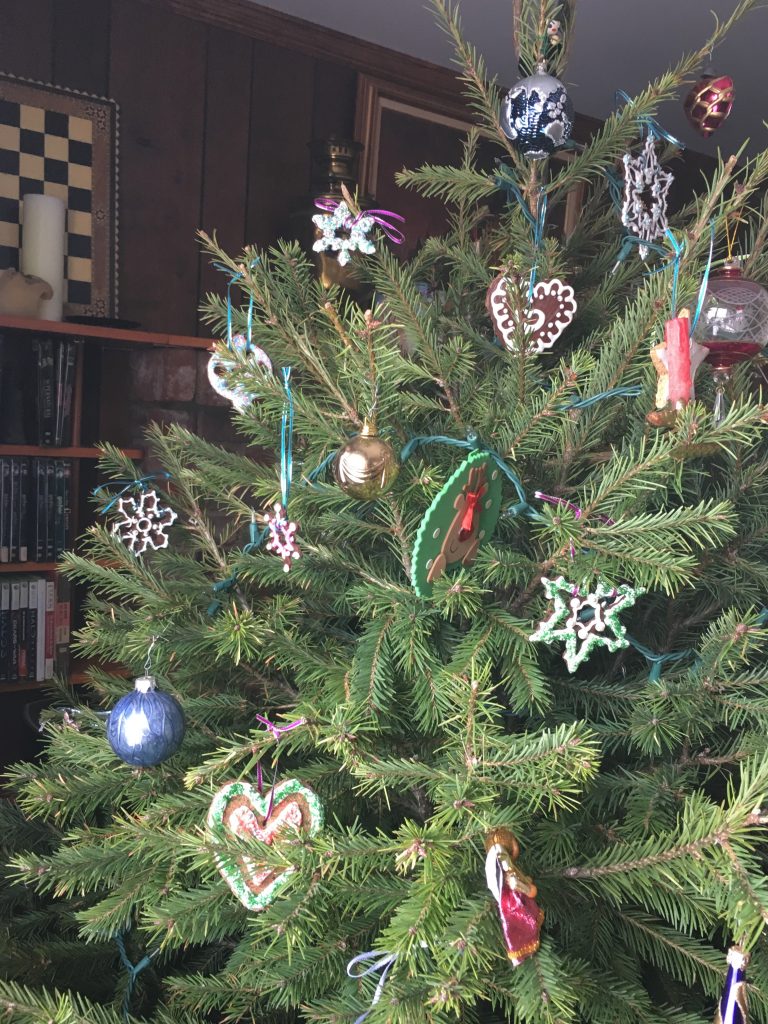
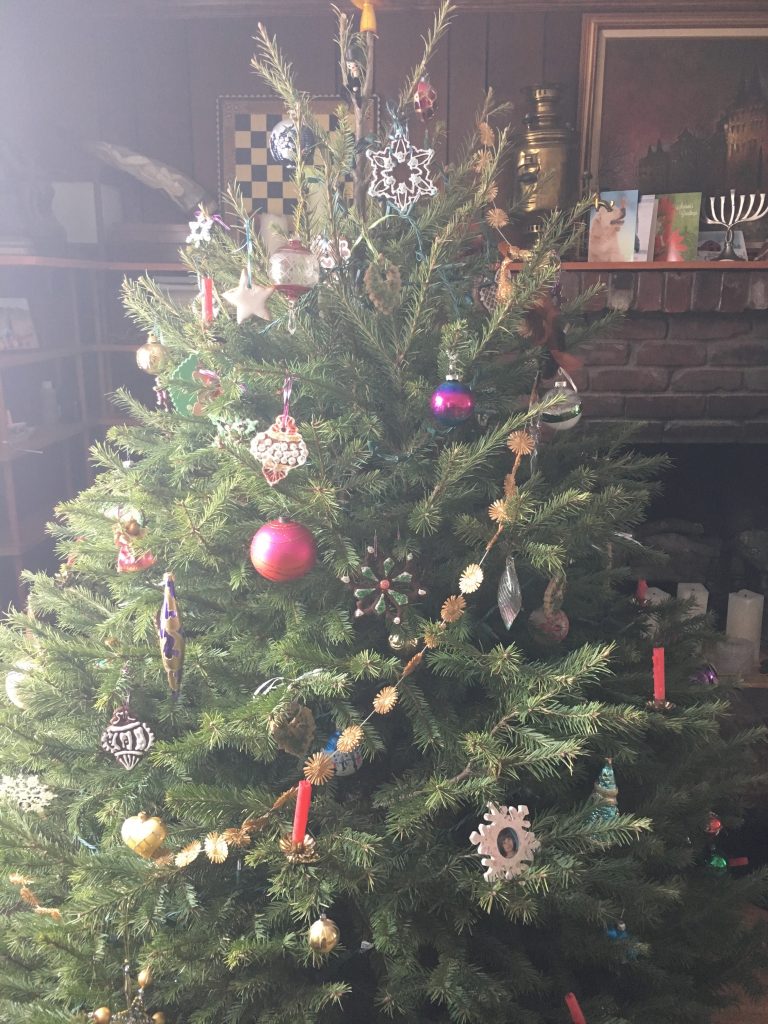
Moravian Snowflakes, Polish Gingerbread (Pierniczki), a chocolate angel (on the bottom), and a Cinnamon Star hiding behind the candle on the upper right.
Another view, with the Cinnamon Star on the upper left. Note that all the cookies are on the upper half of the tree. That’s essential if you have either small children or, in our case, a labrador retriever in residence.

A guest arrives during the holiday season? Invite them in, and say “Please have a treat off the tree!” It captures the spirit of the holiday like nothing else. Tree; decorations; sweets; cookies; and all topped off with hospitality.

Cinnamon Stars make great decorations because they’re sturdy enough to last through the holiday season. Snowflakes have no rival when it comes to appearance, but any humidity in the air will soften them up enough to sag an break through a ribbon. (Don’t even think of hanging them with a metal wire). And gingerbreads tend to be so thick and heavy that they make the branches sag if you aren’t careful. Cinnamon Stars are ideal.

You can decorate Cinnamon Stars by tinting the dough, the icing, or both. Or by standard decorating after they’re baked using royal icing, dragees, luster dust, etc. We tend to keep them plain, but that’s a question of taste.

As for “familiar”, there is absolutely nothing in this cookie that will surprise or offend the most tender of American palates. Cinnamon Stars taste like dense, chewy, lemony Snickerdoodles with a fantastic appearance, and a lot of fragrant nuts. It’s a no risk experiment.

A FINAL BONUS: THREE FREE TIPS THAT AREN’T IN THE BOOK:

  1. The recipe calls for three egg whites. That works, but things get tight when you try to toe the line between reserving what you want for the icing, and still having enough to hold all the nuts. You’ll gain safety margin if you use size XL egg whites instead of the standard U.S. “large”.
  2. Add a tablespoon of molasses to the dough if you want a higher contrast between the base and the bright white icing. It changes the flavor a bit, but not unpleasantly. Our book includes a standard variation on this recipe (Vanilla Sticks), and that is more different than the effect of a little molasses.
  3. Remember that you don’t need to spread your icing all the way to the edge. The cookies look just as good, and arguably better, if you leave a gap between the edge of the icing and the edge of the cookie. To be completely honest, we only avoid that because our decoration skills aren’t up to that level of precision. Baking, yes. Precision artistry? Not so much.

And now, on to the recipe. Enjoy! This was the very first Pavelle addition to the Stoy family collection of every-year cookies. Don’t be at all surprised if it turns out to be mandatory for your family too.
NOTE: If the cookies dry out, put them in a tin with a piece of bread and leave it overnight. Come the next day they’ll be perfect all over again.