Our adventure with this extraordinary cookie began in 2019 when I met an old friend in the local supermarket – a former partner at the firm I joined out of law school. He had a cart full of baking supplies, I had just finished the initial version of our book, and Christmas was in the wind, so you can guess what happened next. I asked a question, he enthused, and we ended up in a discussion about family baking traditions. Who knew that Tom had a reputation going back for decades as the Great Baker of his circle? Birthday cakes, holiday cookies, even the occasional wedding table… just like us.
Tom gave the credit for his skill and passion to his Italian mother and grandmother. And he absolutely *loved* our cookbook project! “That reminds me of the one cookie I never managed to learn,” he said. “I don’t even know the name. It was black, dense, diamond shaped, and filled with chocolate, fruits, and nuts. Never any other shape. I wish I knew what it was.”
You know what? I did. Sort of.
As always, skip to the bottom if you only want the recipe. Most of what follows is the winding process of how we got there, and the tricks we learned along the way.
It Had To Be A Waybread a/k/a Winter Cake
We used to follow a public radio program called The Splendid Table, hosted by a scholar of Italian cooking traditions named Lynn Rosetto Kasper. She had done a segment on something she called “winter cakes;” meal-sized Italian equivalents of what we call “waybreads” in our book. It’s a category populated by dense, ancient treats that your great-to-the-Nth ancestors prepared at two different times: (A) during the holidays, to enjoy in slivers all the way through April, or (B) for a loved one to take on some extended journey. The common denominator? Winter cakes (waybreads) last basically forever from a practical point of view, being packed with so much sweetness, dried fruits, nuts, and often booze that they won’t go stale.
The old English version is fruitcake, inherited into the U.S. tradition with a great deal of snickering and jokes. But other versions abound across Europe, and I knew this had to be one of them. The diamonds gave it away.
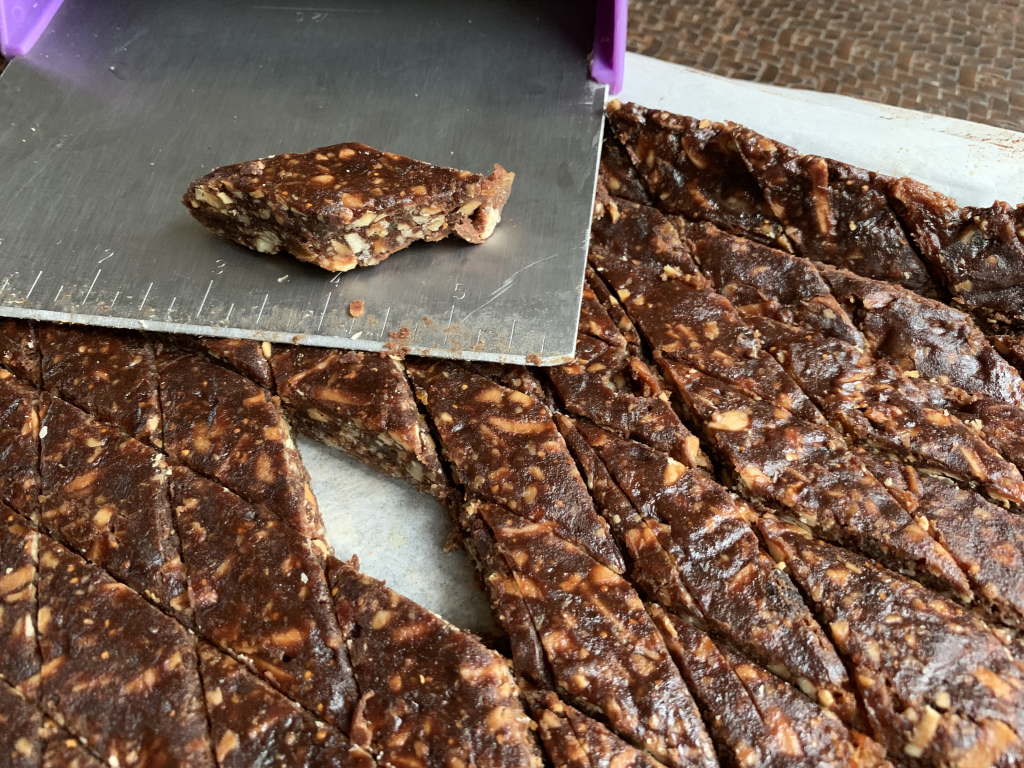
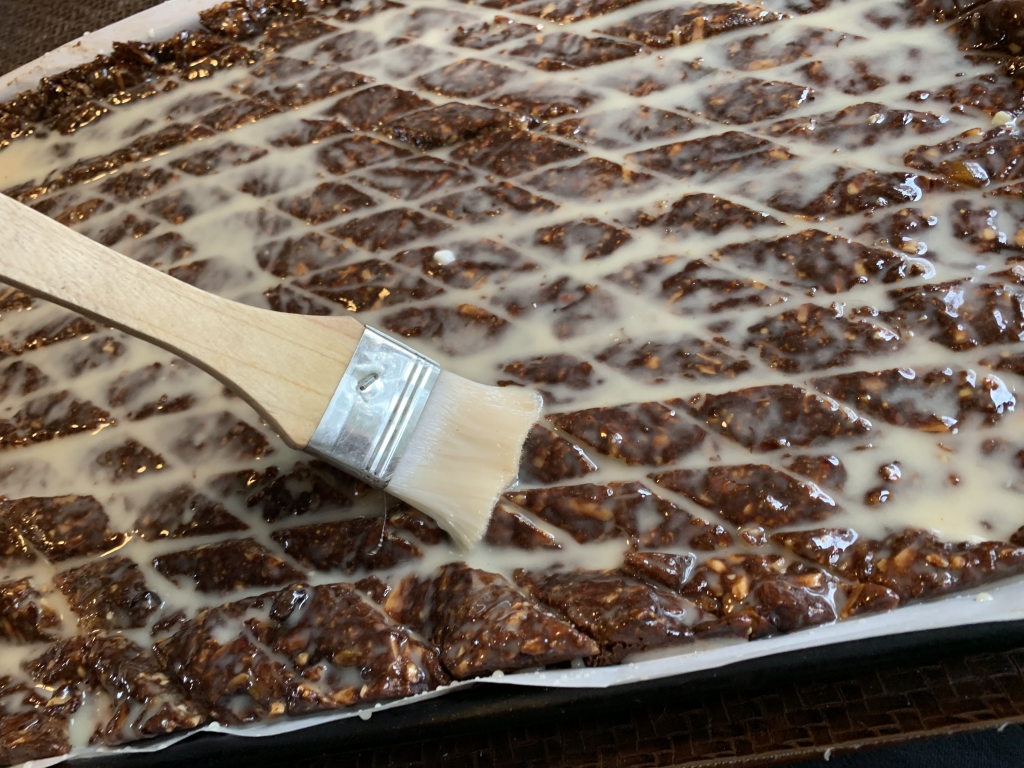
I know from earlier research that American immigrants often adapted their traditional waybreads to the new world by using a standard U.S. sheet pan in place of the specialty cake pans they’d left behind. Cut the sheet-waybread into cookie-sized pieces with a vertical line in one direction and a diagonal in the other, and voila! Diamonds, which are much prettier than little squares, much more “American” than big cake shapes, and have the added bonus of creating a series of little triangles by the edges for the cook and her helpers to “test the bake.”
SIDEBAR: Cookie bits have no calories if you’re nibbling for practical reasons like testing! Everyone knows that, right? Ask your own Baba or Nana or Grandma if you doubt me. Most of them will admit it, and the ones who don’t will huff up in that particular way that lets you know the truth.
So here’s the bottom line. This was some kind of ancient waybread or winter cake. It probably came from Italy, given Tom’s heritage. It was dark to the point of being black. It was heavy and probably unleavened. And the primary ingredients were a mix of various nuts, several fruits, and a solid hit of chocolate.
Which Waybread Was It?
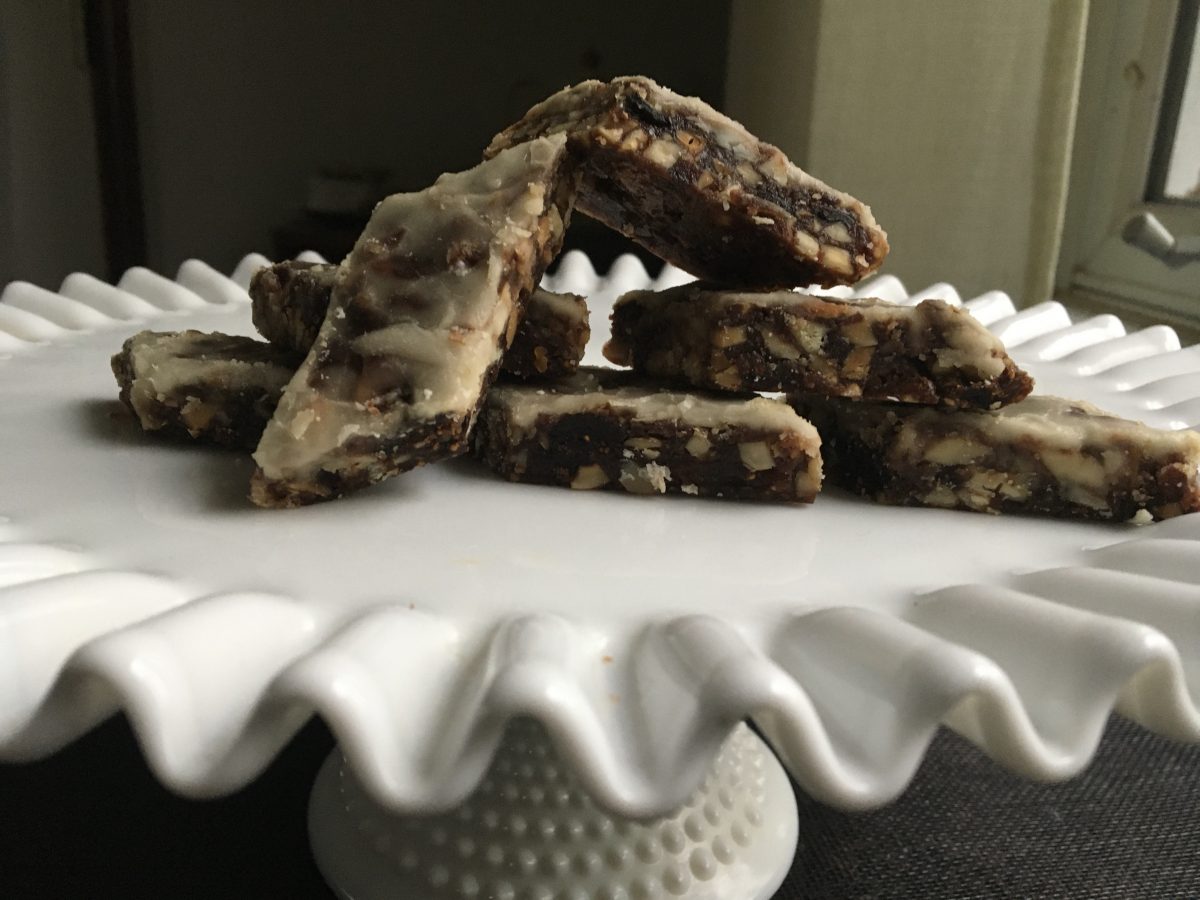
Off to the Internet I went and it wasn’t long before my search returned a long series of hits for something called Panforte; a specialty of the ancient Italian city of Siena, in Tuscany, about an hour by car to the south of Florence. It hit on every category, even down to a series of American photos showing thin, cookie-sized diamonds.
Bullseye!
Our now-familiar development procedure followed after that. First I compiled as many recipes as I could to get a good feel for the variations and the flavor profile. Panforte is pretty common, so I had well over a dozen to choose from.
This research confirmed the mix-of-nuts approach Tom had described, with almonds and hazelnuts being the most common. I balanced the fruit flavors in my head, adding dried apricots as a potential substitute for the surprising presence of candied pineapple in so many recipes. I rejected citron – the bane of fruitcake eaters everywhere! – for the equally common and much better tasting candied orange peel. All pretty standard. Alter as you wish.
The sweetener in the recipe turned out to be a mix of honey cooked together with sugar. No surprise there! One of the best waybreads in Volume I is called Leckerli, a sheet pan cookie centered on walnuts. Northern Italy and Switzerland aren’t that far apart, so it came as no surprise to see parallels in their cookies.ƒ
Next came the spices. These varied hugely, as you might expect. I sifted through a dozen variations and then settled on something more or less in the middle with two minor variations – chili powder and cardamom. Neither was unknown, so this wasn’t a true heresy, but neither were they common. Still, the combination made sense in my head, and offered a side benefit. They gave the flavor profile a little twist compared to all our other recipes. Again, modify as you desire.
Time For Attempt #1, And… Wow.
Mega wow. Ridiculously absurd, over the top, odes-to-the-cookie-gods wow. These darned things were awesome! We almost couldn’t believe it. Were all Panforte this good?
Aye, there’s the rub.
Kate and I can tell good from bad easily enough. And these were certainly good. But how could we tell if they were “right”? Neither of us comes from an Italian background. We had no internal target to aim for.
This, my friends, called for a trip to the Strip District.
Always Find Native Testers
The Strip is a narrow piece of land in Pittsburgh about 2-3 blocks wide and 6-8 blocks long, located just up the Allegheny River from the Downtown triangle where the Al and the Mon meet to form the O. It’s been our favorite part of the city since we moved here because the two main drags (Penn Ave. and Smallman) are lined with wholesale/retail ethnic stores. These include a number of different Italian places with histories going back close to 100 years, and a veritable bevy of first generation immigrants. Just the people to test our new cookie!
First up: Giuseppe at Penn Mac a/k/a the Pennsylvania Macaroni Company. This is our go-to stop for nuts, dried fruit, and other staples, and we bring them a tin every year.
“Giuseppe, we know these are good. That’s obvious. But are they Right? We need someone from the Old Country to give a reality check. Would you mind?”
No, not at all. He took a bite… and then looked at us like we we’d left our brains in the street. “You think there’s something wrong with these? They could be straight from Italia! They’re perfect! Just let me have a couple more pieces before you go… [munch, mumble, mumble, munch].”
Wait a sec. That never happens. Not ever! I had to visit the Strip three different times when I was working up South America’s famous Alfajores, and those are a simple, childhood shortbread. Maybe Giuseppe was just being kind.
No problem. There are other Italian stores in the Strip. On to Enrico’s Biscotti, whose owner, Larry, teaches traditional Italian baking to full houses several times per year. He’s a generous man with both his goods and his knowledge, but also one who believes in sharing the hard truths too.
“They’re perfect! What are you worried about? I especially like that little hint of heat at the end. And that floral note. It’s fantastic [munch, mumble, mumble, munch].”
Chili powder and cardamom: check. Let’s try Colangelo’s around the corner, another wonderful Italian bakery/restaurant.
“You could sell these anywhere in Italy and they’d call them Panforte. And believe me, they’d buy them, too! [munch, mumble, mumble, munch].”
The pattern continues! Sunseri Brothers? Ditto. And on it went, up and down the Strip. The answer was always the same. These weren’t just authentic Panforte, they were among the best Panforte that anyone had ever tasted. Stop worrying. Start bragging. And don’t mess with success. [Munch, mumble, mumble, munch].
Conclusion
I heard back from Tom about a week later.
“You got it! You nailed it! After all these years it’s just like sitting in my mother’s kitchen again.”
I love cookies.
NOTE: You can convert this to the traditional Italian winter cake with a few easy adaptations:
- First, bake it in a tall cake pan instead of a sheet pan.
- Second, sandwich the result between special wafers you can buy online.
- Third, feed the cake version with brandy over time just as people do with fruitcakes; a thin brushing once per week for a month or two.
- And FWIW… We also found an online note suggesting that Tom’s great-to-the-Nth-Nana would have stored her Panforte in chestnut leaves back in the day. How cool is that?
Panforte cakes should be served it in slivers (not slices) as a special treat to enjoy all the way into early Spring. A little goes a long way.