HAZELNUT DROP COOKIES, Simple, Sleek, Elegant, and Awesome

Simple, sleek, hazelnutty perfection

Imagine the esthetic behind Danish Modern furniture: minimal, sleek, efficient, elegant, useful, classically beautiful, and easy to customize. Now take that esthetic and design a cookie to match. We’ve got you covered.
Minimalist: Six ingredients: nuts, butter, sugar, salt, an egg, and baking powder. No more, no less.

Sleek and Efficient: Beat it all together, divide into balls, and bake. There’s no flour to hydrate, and thus no actual need to chill in advance (though I will admit it makes the dough less sticky).

Elegant: How about we kick up the baking temperature to ensure a golden brown, extra-toasty bottom that enhances the basic nut flavor? Clever! And let’s add just enough baking powder to keep the cookie from ever feeling dense or pasty.

Useful: Unexpected guests? Need a moment of self-reward? I’ve yet to meet a cookie that freezes better, and they’re delicious right out of the chill chest.

Classically Beautiful: This is the girl next door of Cookieville, and you wouldn’t be reading this if you didn’t love the type.

Easy to Customize: Want your cookie textured and noshable? Done. Use ground nuts, and remember to bar your door against the likes of my wife. Want something firm but soft, like a shoulder to rest on? Grate the nuts to meal, and do not bar your door because I may be dropping by for a surprise inspection. Want to go all out, and make something that melts on the tongue like almost-liquid flavor? Pulse the grated meal all the way down to flour. Or play with a different nut. Or a mix of nuts. Or… You get the idea.

(A NOTE FROM KATE: I would like to point out that aside from being naturally gluten-free, this cookie is, with the exception of sugar, a “whole food.” Nuts are good for you, eggs are good for you… and why say no to just a bit of sugar? In fact, I predict that cookies such as these will become a new health food trend!)

NOTES ON PROCESS AND PROCEDURE

There isn’t much to say. This really is as simple as it sounds.

(NOTE FROM KATE: To be fair, I did find that the pre-roasted hazelnuts were just a bit too hard for the rotary grinder. Husband + food processor = easy solution.

Do I really need to roast the nuts…? For heaven’s sake, most stores sell them pre-roasted! But if you bought fresh, unroasted nuts, the answer is yes. Roasting develops the hazelnut flavor, which is what you’re after in the first place. Cookies made with raw nuts will work just fine, but the same can be said of furniture no one’s bothered to varnish.

“I’m so confused? Where do I get ground nuts? Or hazelnut meal? Or hazelnut flour? Who carries that?” [Sigh] Start with whole nuts. Then:

  • For ground, put them in a food processor and pulse until you arrive at rough, finely pebbled, ground-nut sand; i.e., the stage right before they start to turn into nut butter. Remember to scrape the sides of the food processor bowl as you go in order to (a) release any fine particles, and (b) check see if you are getting too close to the nut-butter stage.
  • For nut meal, pull out a rotary grater with a middle-fine wheel. Put the nuts in and proceed until you have a light and fluffy meal. Food process coarsely if you need to break down the whole nuts first.
  • For nut flour, pulse the grated nut-meal a few times in the food processor.

Besides, this ability to customize is part of the fun! Some recipes have no room for wiggle. This recipe has wiggle room built into its bones, which is nothing but a plus if your family is anything like ours.

Kate has a strong preference for using ground nuts. She considers that the purest example of what hazelnuts really are, and a nice change from all the shortbreads of the world that melt in the mouth without thought. Yours truly is a softaholic. “Melt in the mouth” is a good thing for me, though I will grant that this cookie benefits from the rustic appeal of nut meal rather than whole scale flour.

In a pastry shop, for elegant tea time nibbles? Okay, now we’re back to proper nut flour, probably with each cookie halved in size for the sake of proper, lace linen daintiness.

You cannot lose. It’s all about how you choose to win on this particular day, for this particular situation. Asset, not hurdle.

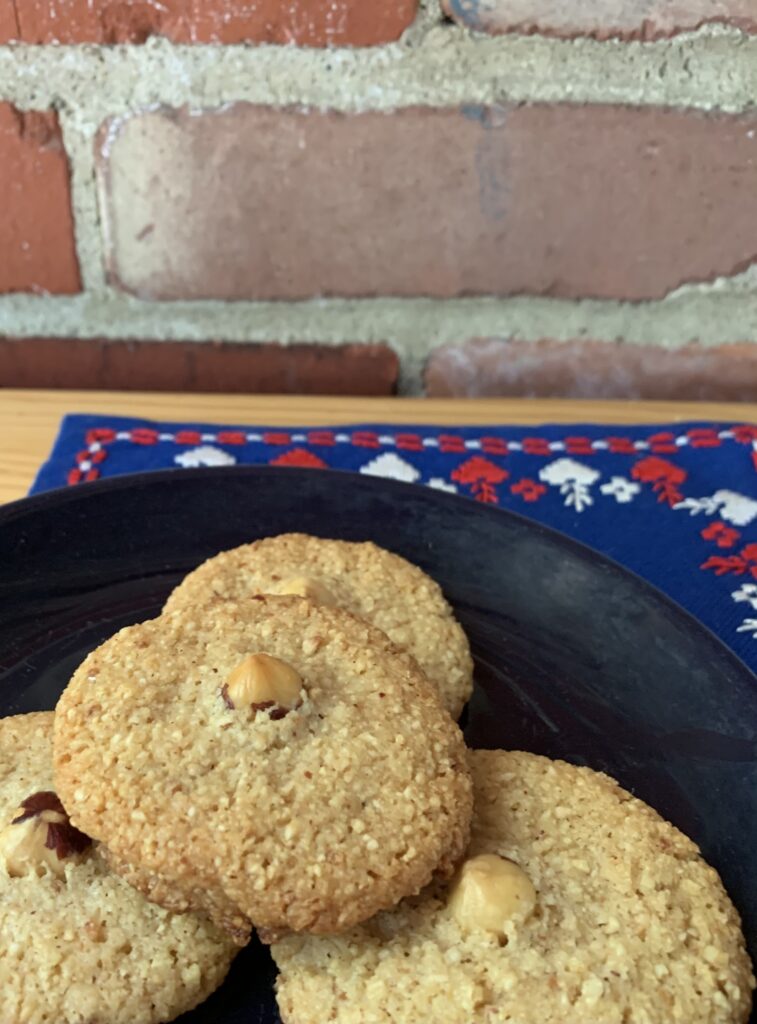
(NOTE FROM KATE: I enjoyed the coarser texture of the machine-ground nuts for its rustic appeal. They look good, and the one hazelnut reserved for the top is very cute, albeit a bit fussy to position nose-up. I admit, however, that fine-textured hazelnut drops would be just as lovely, yet… slightly different.

Here is some good tricks to keep in mind:

  • We don’t use cookie scoops (not enough room in the drawers), so I like to weigh a few dough balls until I have the size right. It keeps a consistent result every time.
  • When forming, give each ball a gentle squish with the heel of your hand to prevent rolling, and garnish with one hazelnut each. These nuts have a pointy “nose,” which I like to aim in the same direction every time.
  • If you want a fine nut meal, start with raw nuts, then toast the flour on a cookie sheet in the oven at 400 degrees Fahrenheit for 4 minutes. Pull out, stir gently, then toast for another few minutes until its scent JUST begins to develop.
  • Unroasted nuts blanch better, so you will have tidier nut toppers. I tried blanching store-bought roasted nuts and almonds, but to my surprise, the skins wouldn’t slip off!

The big note from Scott? At some point you are going to make the dough and then wonder, “Maybe I should add in some vanilla, or spice, or a tough of extract…” You can, and it will be good, but do us a favor and try it straight up the first time. Lilies look best before they’re gilded.

In all honesty, I very seriously considered a preemptive addition of vanilla before our first test batch. After all, vanilla and hazelnut have a historic love affair, and the dough didn’t have as big a flavor hit as I imagined it would. She Who Must Be Heeded prevailed on me not to, and I’m glad to say she was right. The high temperature oven triggers a lot of browning on the bottoms, which adds the exact thing I had been missing.

CONCLUSION

These really are the Danish Modern of cookie baking. Minimal, sleek, efficient, elegant, easy to customize, and absolutely luscious. Plain old cookies just don’t get any better.

Enjoy!

ELISENLEBKUCHEN – Flourless honey gingerbread (a/k/a honeycakes) from Nuremberg

The Immortal Queen of Nuremberg Gingerbreads

Here’s a funny but true: we love our classic Lebkuchen recipe so much that we hesitated to work on this one out of pure loyalty. We’ve amassed a great number of honey gingerbread recipes (a/k/a “Honeycakes”), but Lebkuchen remains the a family favorite. Christmas wouldn’t be Christmas if we left them off our tray.

It turned out to be a misplaced loyalty. Elisenlebkuchen bear very little resemblance to regular Lebkuchen when push comes to shove. Our old favorite is a classic built on a flour-based dough that’s jam packed with nuts, fruits, a bit of spice, and a whole lot of honey to act as the binder. Elisenlebkuchen have even more nuts, no flour at all, and instead rely on both honey and a full five (5!) eggs to act as the binder. They are two very different experiences.

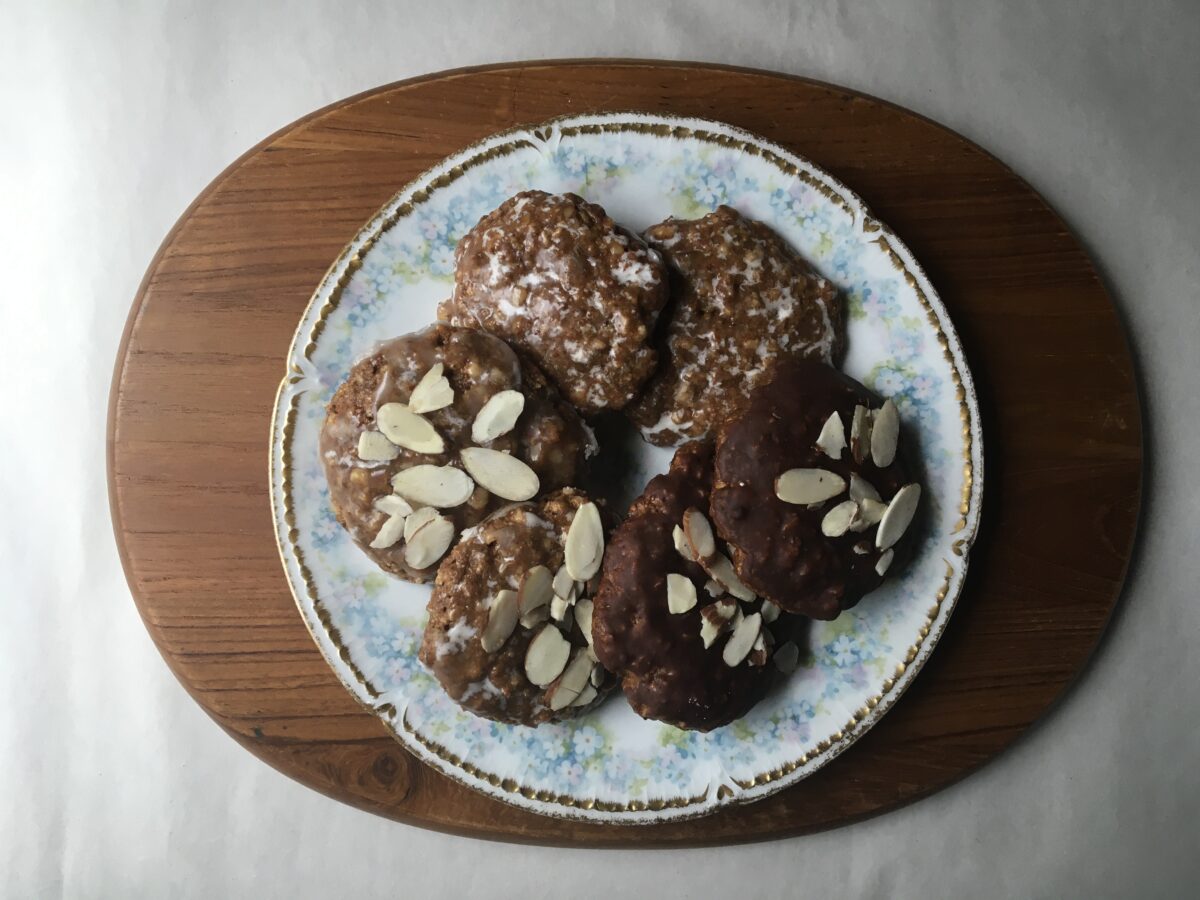
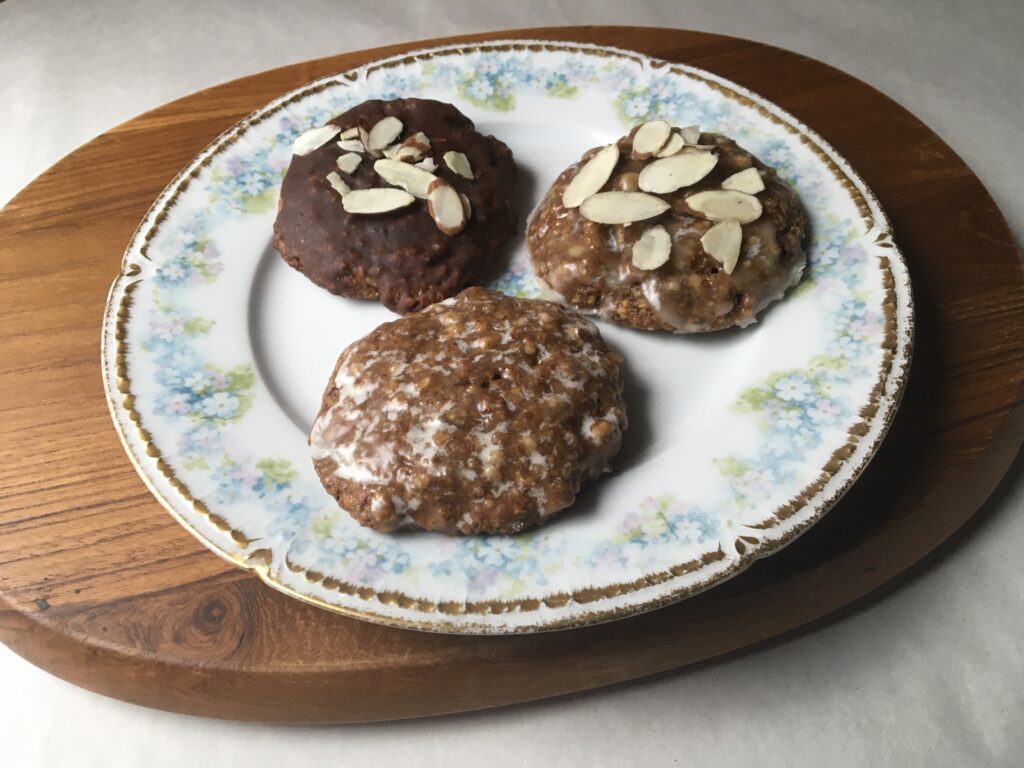
On the Upper Left: chocolate glaze with sliced almonds.
On The Upper Right: vanilla glaze with sliced almonds.
On The Bottom: vanilla glaze only.
Use whichever you think is prettiest.

NOTE FROM KATE: These cookies are horribly deceptive in their overall “goodness.” That is, with the exception of the brown sugar, they are a “whole food,” so what could go wrong, right? I’ll have to do a caloric breakdown one of these days. Let’s just say, they contain more energy than meets the eye. If you were riding across the mountains and had to choose a fabulous, long-lasting food source for the extra space in your saddle bags, these would be it. They remind me of Panforte in their composition, but have eggs for eggstra protein. [Insert eye roll from Scott] The good news? With eggstra protein and the good-for-you fat from the nuts, the sugar in the brown sugar and honey won’t hit your bloodstream too fast. A cookie or two could hold you for hours.

Best of all? Of all our cookies and especially waybreads, these are the closest to the Lembas the elves made famous in the Lord of the Rings. Toss in an apple, and you got yourself a balanced diet for the day! (Shh…don’t tell Scott!)

The recipe explains itself, and includes an extensive Cookie Nerd Moment with extra background material, so I will only take the time to discuss a few of the decision points you’ll face when trying this out on your own:

  1. Should I use marzipan or ground nuts? It’s entirely up to you, and makes very little difference. Just remember that Marzipan has almost as much sugar as nuts (our recipe has a ratio of 4:5), and usually has some extra sweetness lurking in the background. If you make this substitution, do it by weight and assume the Marzipan is actually a 50/50 mix. You need to reduce the amount of both almonds and sugar accordingly.
  2. Can I play with the spices? Of course you can! But we do recommend that you (a) stick to the basic, quite generous amount of overall spice, and (b) think of the spices as an accent to bring the best out of your chosen nuts.
  3. Can I substitute in other nuts? Yes, but these are the classics used in Nuremberg. Be aware that you’ll be departing off road from the One True Tradition.
  4. Should I glaze the cookies? Yes. That was easy enough. The glaze definitely enhances the overall look, especially since the bottoms are not glazed.
  5. Should I use the vanilla glaze or the chocolate? Tradition allows for either one, so it’s entirely up to you. Both are thin enough to be only an accent flavor. This cookie is all about the nuts, and even I, a lifelong chocoholic, don’t want to mess with that purity.
  6. Should I add the nut garnish on top? As you wish. They are only there for the sake of appearance and fair warning to anyone who sees them lying there on your tray.
  7. Should I add the optional salt? And why specify “large grain” salt? This is a nontraditional option that we liked so much that we felt obliged to share. Both Kate and I have a strong preference for salted nuts over plain when we snack on them out of hand. The optional salt creates that effect in a light way. We recommend large grain salt sprinkled on top of the glaze because that is the best way to give a salty highlight. The base recipe also contains some salt, but that is more of a bare minimum that the cookie would suffer without.

That’s it folks. Enjoy!

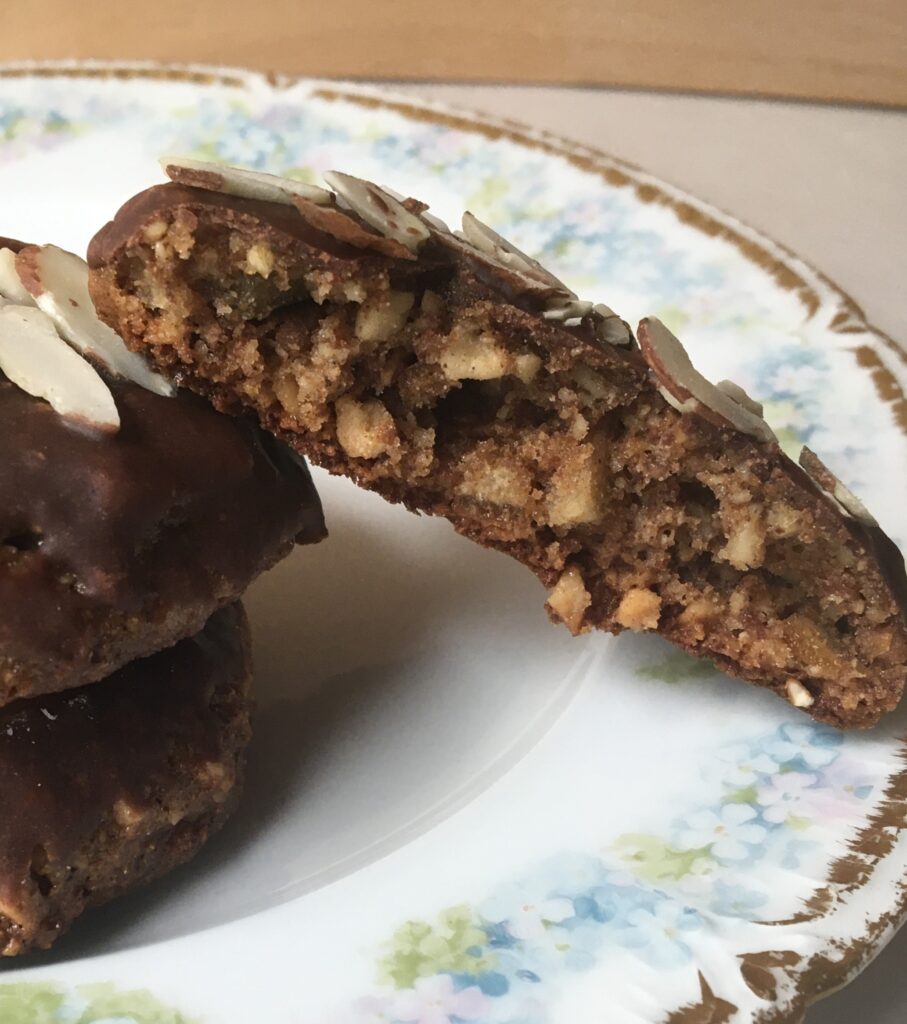
Nuts, nuts, nuts, and fruit. The only other things inside this cookie are honey and eggs as the binder.

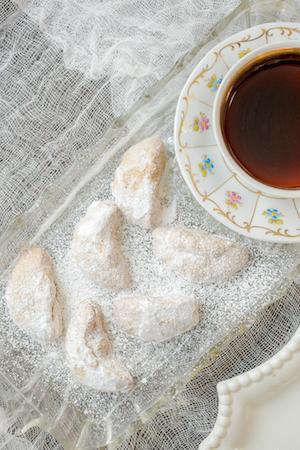
NUT HORNS (a/k/a Kipferl a/k/a Hornchen a/k/a Mexican Wedding Cookies, Russian Wedding Cookies, Italian Wedding Cookies, Greek Kourambiedes, etc.)

This is a sample drawn directly from our book Heritage Cookies of the Old and New World. The first part is our favorate “Cookie Nerd Moment” of the entire tome. This is where we stop and take the time to discuss particular tricks, tips, and historical bits that provide a lot of the “why” behind the recipe’s “what.”

You can skip to the bottom if you really want only the recipe, but this is one case where I need to recommend the full read even if you know what you’re doing. The refresher course on Tips and Tricks never loses its value.

Enjoy,

Scott Pavelle

COOKIE NERD MOMENT

Anyone who makes 20 or 30 different cookies each Christmas gets used to two common questions: “What are your favorite cookies” and “What is the favorite cookie in general?” There is no answer. Everyone has his or her own favorite and there isn’t a single cookie that would touch the 10% mark if we kept track of who voted for what.

You probably could have guessed those two if you’d given it a bit of thought. But the third most common question might surprise you: “Do you know how to make [Nut Horns]?” We put that in brackets because the same basic cookie is loved with fervor and devotion across a huge part of the world with very minor changes. In Central Europe the cookie’s known by some word that translates as either Nut Horns or Nut Crescents (Kipferl in Austria and Hörnchen in Germany are two examples). Eastern European bakers shape them into balls, often with a heavier percentage of walnuts, and call them Russian Tea- or Wedding Cookies. Move south and west and the name turns into Italian Wedding Cookies, also ball shaped but with a tilt toward almonds. The south and east features ball-shaped Greek Kourambiedes, which have slightly fewer nuts but include some brandy. The New World knows them best as Mexican Wedding Cookies, which usually feature pecans. We could go on.

Simplicity plays a big part in the cookie’s charm. It’s all about the nuts, with vanilla to heighten their impact. Powdered sugar goes on top – a heavy coat that may also have a hit of vanilla. The Greeks stand out by adding a single whole clove for decoration.

There’s also a common structural theme: you’re after a cookie so tender that it will shatter to fragments at the slightest excuse, and will dissolve in your mouth with a burst of buttery, nutty goodness. That’s the hard part – getting them just tough enough to wait for an excuse without losing that meltiness.

We spent many years fidgeting and playing with this recipe to get it just right. The final product incorporates a number of subtle tricks that will add up to make the best [Nut Horns] you’ve ever eaten. Better even than Grandma’s!

  • TRICK #1 (for flavor): Toast the nuts in advance. It gives you a longer, deeper flavor.
  • TRICK #2 (for texture): The textures from your nuts matter as much as the flavors. We strongly prefer to mix that texture up to give the full experience from meltingly soft in most parts to recognizable bits sprinkled here and there. We always start by using a rotary grater to reduce at least half the nuts to a point just short of where you’d start calling them “nut flour.” Maybe even a little short of “nut meal.” The other half should be a mix of textures ranging from “finely ground” to “finely chopped”. If push comes to shove we suggest a 50/50 mix of nut flour for the first half and ground nuts for the second. Grandma may have ground all the nuts for convenience but even she would agree that mixing the textures adds something extra.
  • TRICK #3 (for flavor and texture): We also favor a mix of nuts. This particular trick may cause Grandma to start muttering about upstarts and heretics when you mention it, but trust us: a little hint of walnut will make your pecans taste more “pecany”, just as some almond and hazelnuts will make your walnuts more “walnutty.”
  • TRICK #4 (for flavor): A hefty pinch of salt also enhances the nut flavors. Just make sure to use so little that no one can tell it’s there.
  • TRICKS #5.a to 5.c (to counter fragility): Our recipe hovers right on the edge of falling apart into a 50% casualty rate from being too tender. There are several tricks and options designed to pull it back from that horizon. You’re going to need at least one of them:
    • A spoonful of water in the flour adds just enough gluten to hold it together. This trick doubles as a way to customize for your particular kitchen and flour.
    • An egg yolk in the dough works too and is more traditional, but can make the cookies caky if it goes too far. This was the “cheat” that Grandma used in secret because her best friend, the one she wanted to bake like, didn’t need to.
    • Working the dough as you form the crescents can also add a little gluten, but it comes with a real warning: the heat of your hands can melt the butter in your dough, which turns the cookies oily and guarantees they’ll be too tender.
  • TRICKS #6.a to 6.c (to counter toughness): Our recipe uses so many nuts that fragility tends to be the bigger problem, but sometimes you have to go the opposite way. We ran into this when we lived in Boston and used the high protein King Arthur as our house default. Here are some techniques that will add tenderness without changing the basic formula:
    • Remove any extra water or flour from your dough.
    • Refrigerate the cookies on their tray for 30 minutes before baking. This will relax any built-up gluten.
    • Remove a tablespoon of flour from the recipe.
  • TRICK #7 (for flavor): It’s a little counterintuitive but this particular cookie actually tastes better if you narrow the “horns” of your crescents toward the ends. Yes, the easiest way to make a crescent is to form the dough into a rope and then bend it in the middle. Yes, that is a typical way to ensure even baking by creating an even thickness. Yes, you can even treat this as a roll-and-cut cookie with fine results. But this isn’t a typical cookie. Having some parts toastier and others tenderer will only add to the sense that you’re eating something made from [nuts!!!].
  • TRICK #8 (the post-oven danger zone): You must cool these cookies on the tray until they are only warm. They are ridiculously fragile when hot from the oven and will fall apart if you even stare too hard.
  • TRICK #9 (for a final touch): We aren’t big believers in fancy chancy “touches” like scenting the powdered sugar for a few days with a more-expensive-than-gold vanilla bean bought for the purpose. This is the one recipe where we sometimes make an exception. Not always… but sometimes. There’s something about the wafting smell of vanilla that seems to stimulate a person’s specialized nut detector taste buds. [What, you never heard of those? Try a proper Nut Horn and you’ll see the proof for yourself!]
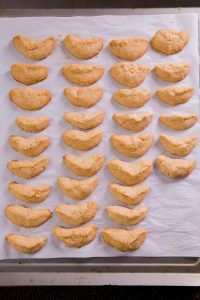
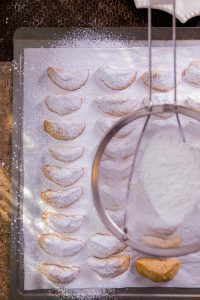
  • TRICK #10 (coating with enough powdered sugar): Warm cookies are fragile cookies, but nevertheless you must coat them with the powdered sugar while they are warm because the outgassing steam helps the sugar to stick. Kate likes to move the whole sheet of parchment onto a cooling rack, dust them there, wait 5 minutes, and then turn them over to dust what had been the bottoms.