Two things happened right after I published our recipe for Oreshki, the Eastern European faux-nut cookie made with a light, crispy shortbread crust and a luscious dulce de leche filling. First, all our Ukrainian, Russian, and other Eastern European friends descended like a pack of starving hyenas on a fat old antelope with a limp. Don’t worry, we got out of the way in time to avoid injury. The show was magnificent!
Second, our Czech, Polish, and other Central European friends said, “Those are really cool, but it’s not the ‘Molded Nut’ cookies I grew up with. You should work on those too!”
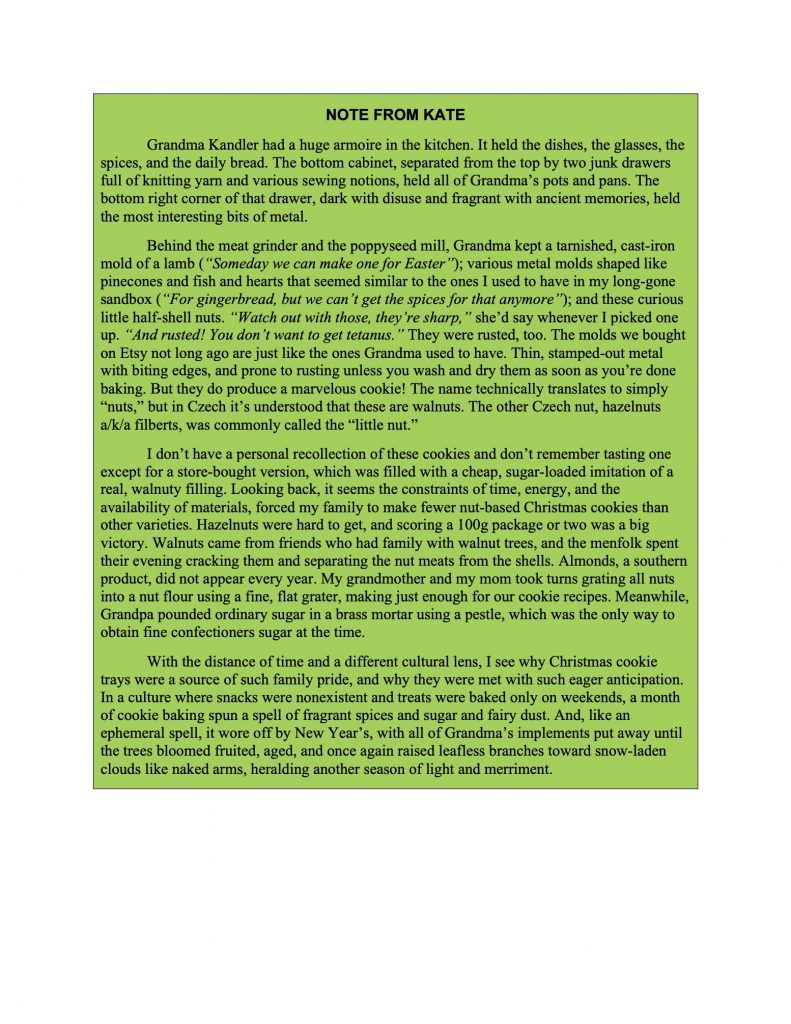
Oh? Kate had only a vague memory of Ořechy from her childhood. Grandma Kandler had the molds, but never made the cookies. “Too much hassle.” So I set to researching and uncovered four – only four! – fairly consistent recipes. It took some tweaking to get them right, but Oh…My…Heavens! We will not have a Christmas tray again that does not feature these ridiculously rich, tender, and flavor filled nutty-mocha treats. They are a hassle, yes. But they are also unique, and unbelievably good.
As always, skip to the bottom if you only want the recipe. But this might not be the best article to do that with. It contains some extremely useful tricks.
First, Know Your Target
NOTE ABOUT THE NAME: The Eastern and Central European faux-nut cookies have the same name, languages and spelling aside. It’s pronounced “OH-RZHE-ch-ee”, more or less, with a rolling “r” and the “zh” combined into a single sound that English doesn’t possess, and the “ch” being that guttural, back of the throat sound like the Yiddish name Chaim. English doesn’t have that sound either. The “ee” sound at the end denotes a plural, like putting an “s” at the end of an English word. It technically translates as plain old “nuts”, but in context it’s understood to mean “walnuts;” and that is the shape of the mold. You’ll get it wrong if you try to pronounce it properly, especially since there are small variations between the different Slavic tongues. But who cares? You’ll get credit for trying, and everyone will know what you mean.
The name is the same; but the two cookies could not be more different. The Eastern European one is plain, crunchy, and child friendly. It rings the same chimes as Alfajores in South America, Millionaire’s Shortbread in England, and Stroopwafels in the Low Countries.
The Central European cookie (this one) is a sophisticated flavor bomb aimed at knocking adults on the seat of their pants in rapture. The shell is a walnut cookie so tender you have no choice but to eat them in one big bite. They’ll crumble under your teeth if you try to stretch it to two. The filling is less “buttercream” than a “whipped, flavored butter” redolent with coffee and rum. It’s so rich that we include an instruction to use it sparingly!
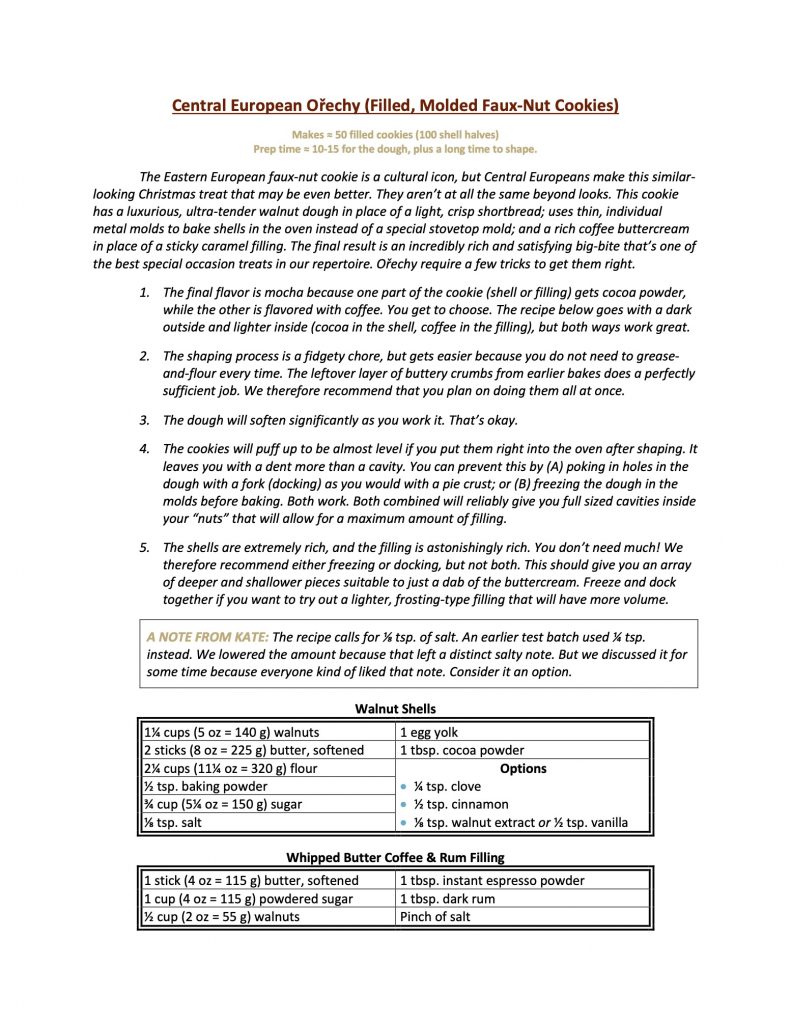
The final flavor becomes mocha because the cocoa in one part and the coffee in the other combine into a single unit in your mouth. It doesn’t matter which part (shell or filling) gets the cocoa powder, and which one gets the coffee, so long as each side is only half the final flavor. The recipe below goes with cocoa in the shell and coffee in the filling, but both ways work great.
The Dough Is Easy; The Molding Takes Patience
The dough is simple to make; a straightforward creaming method approach. Beat together the butter and sugar until light and fluffy, beat in an egg with an optional touch of extract and/or spice, and then mix in the dry ingredients. The only complication is that one of those ingredients is a large amount of grated walnuts. We’ve yet to see walnut meal in a market, but it’s easy enough to make. Toast whole walnuts for 8-10 minutes in a 350° F (175° C) oven until they’re fragrant. Remove, cool, and then grate down to meal.
NOTE: A rotary hand grater is by far the best tool for this task. Food processors get dicey because walnuts go from “chopped” to “nut butter” in a heartbeat, much faster than almonds or even peanuts. On the plus side, it doesn’t need to be flour-fine. Grating them is plenty good enough.
Then comes the filling of the molds, which is indeed a fidgety chore. Where the Eastern European version is baked in a unique stovetop mold, Central European Ořechy get formed in thin, individual metal molds that go in the oven so the cookies will keep their shape. It isn’t hard, just time consuming because you need to go one by one.
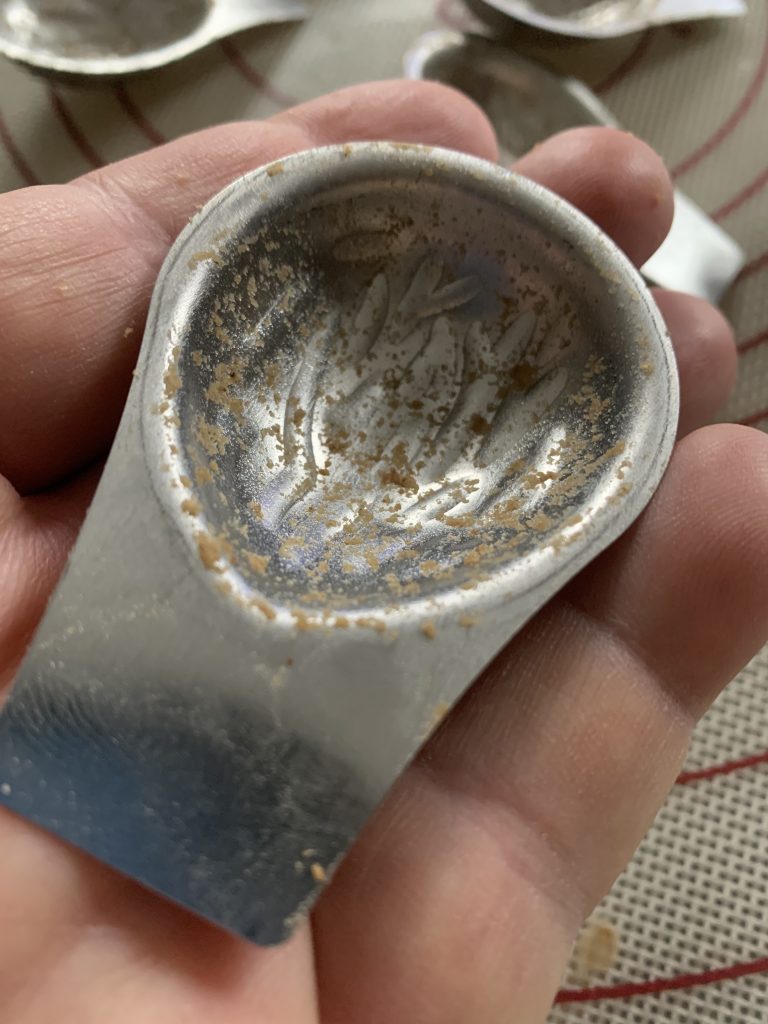
First you coat the inside with a bit of butter, then you dust it with flour, and then you press the dough in with your thumbs until it coats the entire inside of the mold with a layer that’s maybe 1/8″ thick. [NOTE: You only need to butter-and-flour on the first batch. The remaining crumbs from that batch will be enough to prevent sticking on the second, the second for the third, and so on.] Then you scrape off the excess with a flat tool like a metal spatula or bench scraper, and then move onto the next one.
The dough will soften significantly as you work it. That makes the molding easier, and causes no issues. Incredibly tender doughs will do that. The process isn’t hard, just time consuming.
But you aren’t ready to bake just yet!
Trick #1. Freeze or dock the dough baking. We learned the hard way that Ořechy will puff up to be almost level if you put them right into the oven after shaping. It leaves you with a dent more than a cavity.

You can prevent this by (A) poking in holes in the dough with a fork (“docking”) as you would with a pie crust; or (B) freezing the dough in the molds before baking. Both work, and both leave plenty of room in the final product for your incredibly rich filling.
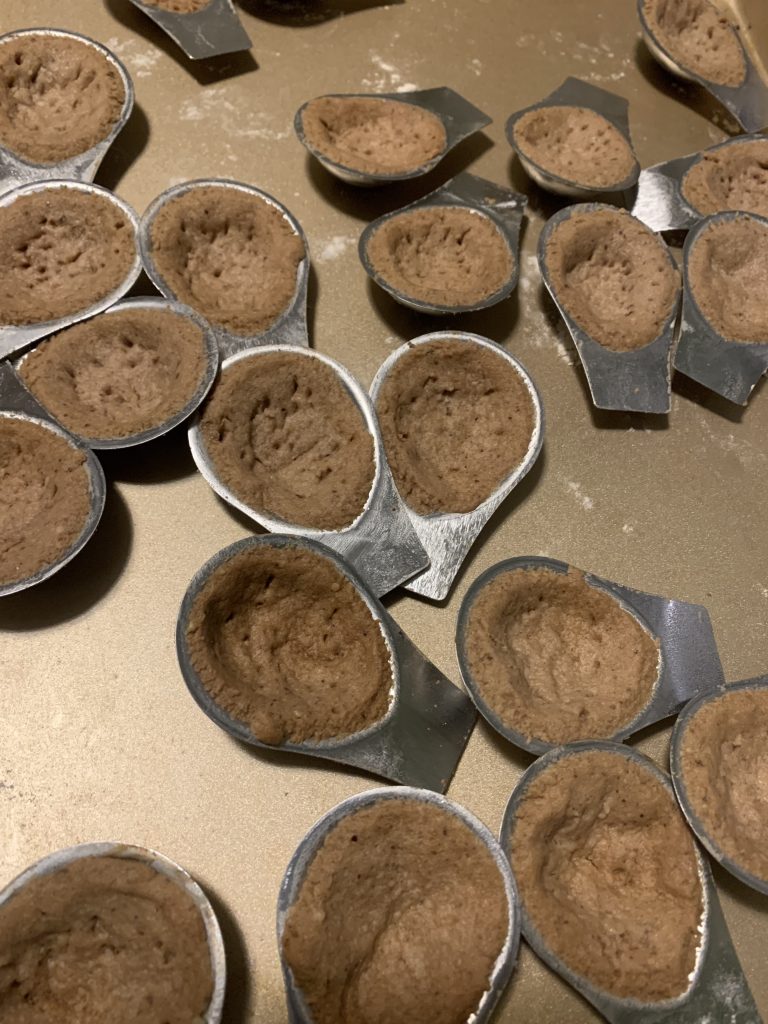
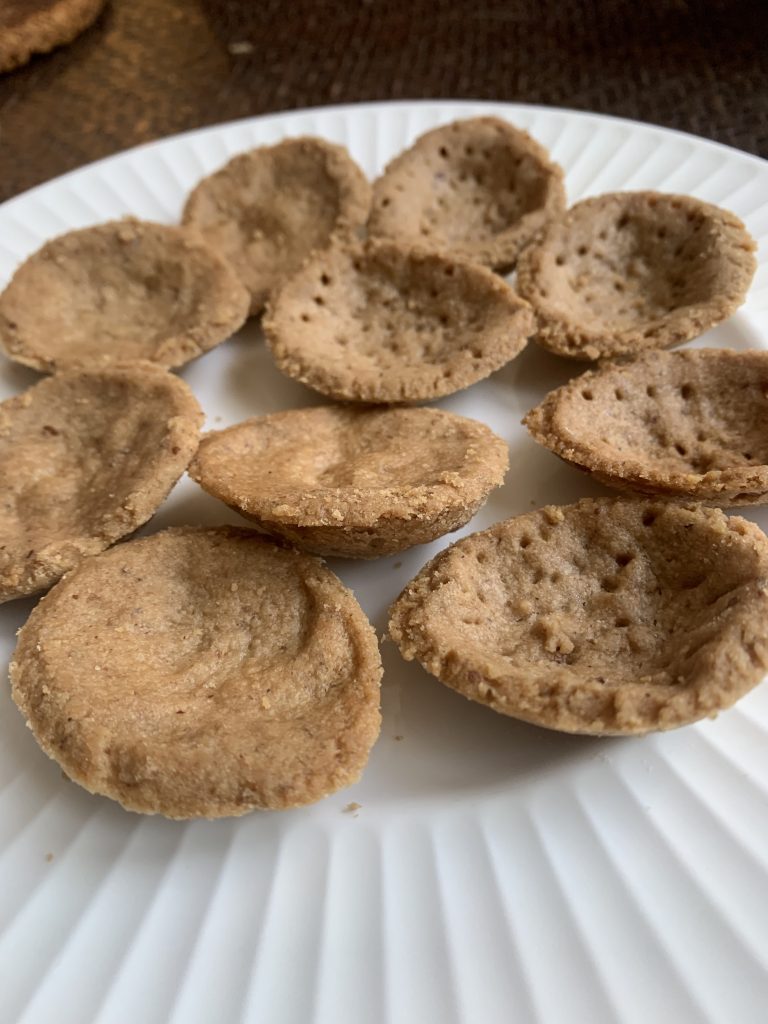
Trick #2. Freeze or dock, but don’t do both. Docking combined with freezing will give you full sized cavities inside your “nuts,” suitable for a normal buttercream, frosting, caramel product, or any other typical filling. Bit the traditional filling for this cookie? A half-teaspoon or so is all you want. As one baker friend said, “a knob the size and shape of an almond.” That’s just about the amount of room that’s left over if you freeze the shells before baking and so nothing else. Docking creates a little bit of extra room. The combination creates too much.
Extra room won’t kill you, of course, The cookies taste just fine with a cavity that’s got some empty space.

Trick #3. Ignore both #1 and #2, and then press a hole in to the flat cookies when they are warm from the oven. So you have molded cookies that puffed up in the oven. You pull them out and say, “Oh no! They have no room for filling!”
Not a disaster. Simply press the warm and still-soft center with your asbestos thumb, and you’ll have a dent you can work with. Yes, it is hot, and yes, you can get a minor burn if you have human skin instead of baker’s asbestos. But beauty can be expensive. Even when it’s only beautiful cookies.
On To the Whipped Butter Filling. This couldn’t be any simpler. Whisk the butter until it’s soft and fluffy, and then whisk in the other ingredients: powdered sugar, more grated walnuts, instant espresso/coffee powder, and a good hit of dark rum. That’s it. What you get is a flavor bomb that carries the essence of Prague. If America is the land of cinnamon and sugar, and Scandinavia of cardamom, Prague’s heart belongs to a mix of mocha, nuts, and rum. Utterly scrumptious. Just use it with care because we aren’t kidding about how rich it really is!
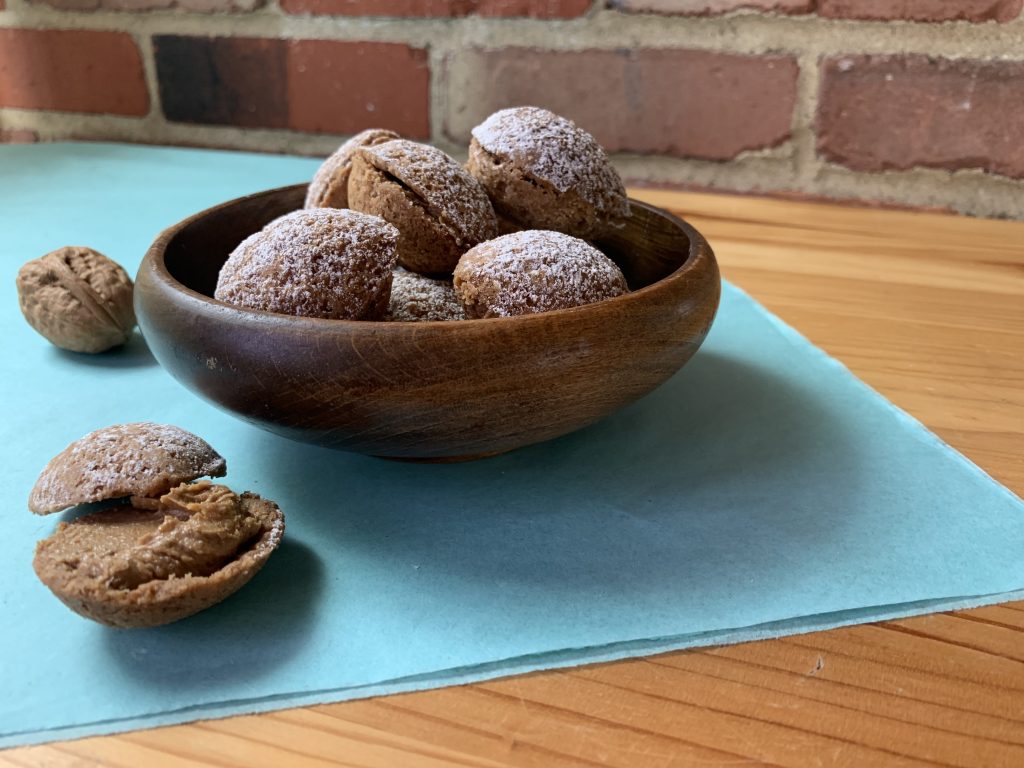
Place an almond-sized piece of whipped butter filling between two shells. Close carefully so you don’t shatter the tender pieces. Dust with powdered sugar to complete the illusion, and enjoy. They will improve overnight, hit their peak on Day 3, and be good for another two days after that.
Be prepared for “Wow!”
CONCLUSION
Ořechy require some patience because the special molds need to be filled one by one, and they only last for a week or so after they get filled. That makes them a special occasion treat. But you know what? They are also spectacular enough to be a star entry on famous dessert trays in any top coffee house of Prague, Warsaw, Vienna, Budapest, or any of the other great cities of central Europe. They’re the sort of food that tourists taste, gape at, and then go home to tell stories about.
We won’t be making them on any kind of a regular basis. Not even for guests. But you’d better believe we’ll be making them for the holiday tray! They’re just too cute and too fantastically delicious to pass by. The whole family would pine at the loss now that they know what we’d be missing.
Yes, they are that good. And cute, too. Wouldn’t you agree?