This is a sample drawn directly from our book Heritage Cookies of the Old and New World. The first part is our favorate “Cookie Nerd Moment” of the entire tome. This is where we stop and take the time to discuss particular tricks, tips, and historical bits that provide a lot of the “why” behind the recipe’s “what.”
You can skip to the bottom if you really want only the recipe, but this is one case where I need to recommend the full read even if you know what you’re doing. The refresher course on Tips and Tricks never loses its value.
Enjoy,
Scott Pavelle
COOKIE NERD MOMENT
Anyone who makes 20 or 30 different cookies each Christmas gets used to two common questions: “What are your favorite cookies” and “What is the favorite cookie in general?” There is no answer. Everyone has his or her own favorite and there isn’t a single cookie that would touch the 10% mark if we kept track of who voted for what.
You probably could have guessed those two if you’d given it a bit of thought. But the third most common question might surprise you: “Do you know how to make [Nut Horns]?” We put that in brackets because the same basic cookie is loved with fervor and devotion across a huge part of the world with very minor changes. In Central Europe the cookie’s known by some word that translates as either Nut Horns or Nut Crescents (Kipferl in Austria and Hörnchen in Germany are two examples). Eastern European bakers shape them into balls, often with a heavier percentage of walnuts, and call them Russian Tea- or Wedding Cookies. Move south and west and the name turns into Italian Wedding Cookies, also ball shaped but with a tilt toward almonds. The south and east features ball-shaped Greek Kourambiedes, which have slightly fewer nuts but include some brandy. The New World knows them best as Mexican Wedding Cookies, which usually feature pecans. We could go on.
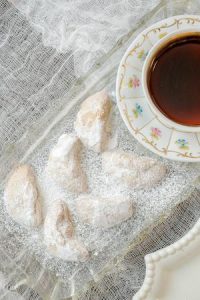
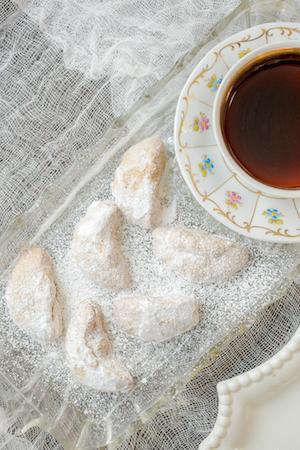
Simplicity plays a big part in the cookie’s charm. It’s all about the nuts, with vanilla to heighten their impact. Powdered sugar goes on top – a heavy coat that may also have a hit of vanilla. The Greeks stand out by adding a single whole clove for decoration.
There’s also a common structural theme: you’re after a cookie so tender that it will shatter to fragments at the slightest excuse, and will dissolve in your mouth with a burst of buttery, nutty goodness. That’s the hard part – getting them just tough enough to wait for an excuse without losing that meltiness.
We spent many years fidgeting and playing with this recipe to get it just right. The final product incorporates a number of subtle tricks that will add up to make the best [Nut Horns] you’ve ever eaten. Better even than Grandma’s!
- TRICK #1 (for flavor): Toast the nuts in advance. It gives you a longer, deeper flavor.
- TRICK #2 (for texture): The textures from your nuts matter as much as the flavors. We strongly prefer to mix that texture up to give the full experience from meltingly soft in most parts to recognizable bits sprinkled here and there. We always start by using a rotary grater to reduce at least half the nuts to a point just short of where you’d start calling them “nut flour.” Maybe even a little short of “nut meal.” The other half should be a mix of textures ranging from “finely ground” to “finely chopped”. If push comes to shove we suggest a 50/50 mix of nut flour for the first half and ground nuts for the second. Grandma may have ground all the nuts for convenience but even she would agree that mixing the textures adds something extra.
- TRICK #3 (for flavor and texture): We also favor a mix of nuts. This particular trick may cause Grandma to start muttering about upstarts and heretics when you mention it, but trust us: a little hint of walnut will make your pecans taste more “pecany”, just as some almond and hazelnuts will make your walnuts more “walnutty.”
- TRICK #4 (for flavor): A hefty pinch of salt also enhances the nut flavors. Just make sure to use so little that no one can tell it’s there.
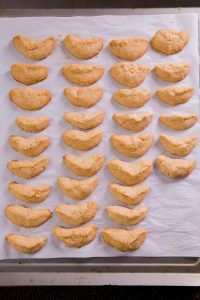
- TRICKS #5.a to 5.c (to counter fragility): Our recipe hovers right on the edge of falling apart into a 50% casualty rate from being too tender. There are several tricks and options designed to pull it back from that horizon. You’re going to need at least one of them:
- A spoonful of water in the flour adds just enough gluten to hold it together. This trick doubles as a way to customize for your particular kitchen and flour.
- An egg yolk in the dough works too and is more traditional, but can make the cookies caky if it goes too far. This was the “cheat” that Grandma used in secret because her best friend, the one she wanted to bake like, didn’t need to.
- Working the dough as you form the crescents can also add a little gluten, but it comes with a real warning: the heat of your hands can melt the butter in your dough, which turns the cookies oily and guarantees they’ll be too tender.
- TRICKS #6.a to 6.c (to counter toughness): Our recipe uses so many nuts that fragility tends to be the bigger problem, but sometimes you have to go the opposite way. We ran into this when we lived in Boston and used the high protein King Arthur as our house default. Here are some techniques that will add tenderness without changing the basic formula:
- Remove any extra water or flour from your dough.
- Refrigerate the cookies on their tray for 30 minutes before baking. This will relax any built-up gluten.
- Remove a tablespoon of flour from the recipe.
- TRICK #7 (for flavor): It’s a little counterintuitive but this particular cookie actually tastes better if you narrow the “horns” of your crescents toward the ends. Yes, the easiest way to make a crescent is to form the dough into a rope and then bend it in the middle. Yes, that is a typical way to ensure even baking by creating an even thickness. Yes, you can even treat this as a roll-and-cut cookie with fine results. But this isn’t a typical cookie. Having some parts toastier and others tenderer will only add to the sense that you’re eating something made from [nuts!!!].
- TRICK #8 (the post-oven danger zone): You must cool these cookies on the tray until they are only warm. They are ridiculously fragile when hot from the oven and will fall apart if you even stare too hard.
- TRICK #9 (for a final touch): We aren’t big believers in fancy chancy “touches” like scenting the powdered sugar for a few days with a more-expensive-than-gold vanilla bean bought for the purpose. This is the one recipe where we sometimes make an exception. Not always… but sometimes. There’s something about the wafting smell of vanilla that seems to stimulate a person’s specialized nut detector taste buds. [What, you never heard of those? Try a proper Nut Horn and you’ll see the proof for yourself!]
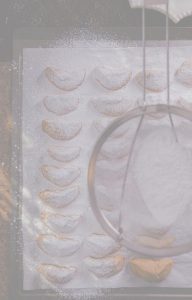
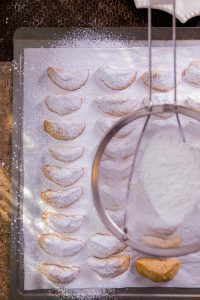
- TRICK #10 (coating with enough powdered sugar): Warm cookies are fragile cookies, but nevertheless you must coat them with the powdered sugar while they are warm because the outgassing steam helps the sugar to stick. Kate likes to move the whole sheet of parchment onto a cooling rack, dust them there, wait 5 minutes, and then turn them over to dust what had been the bottoms.