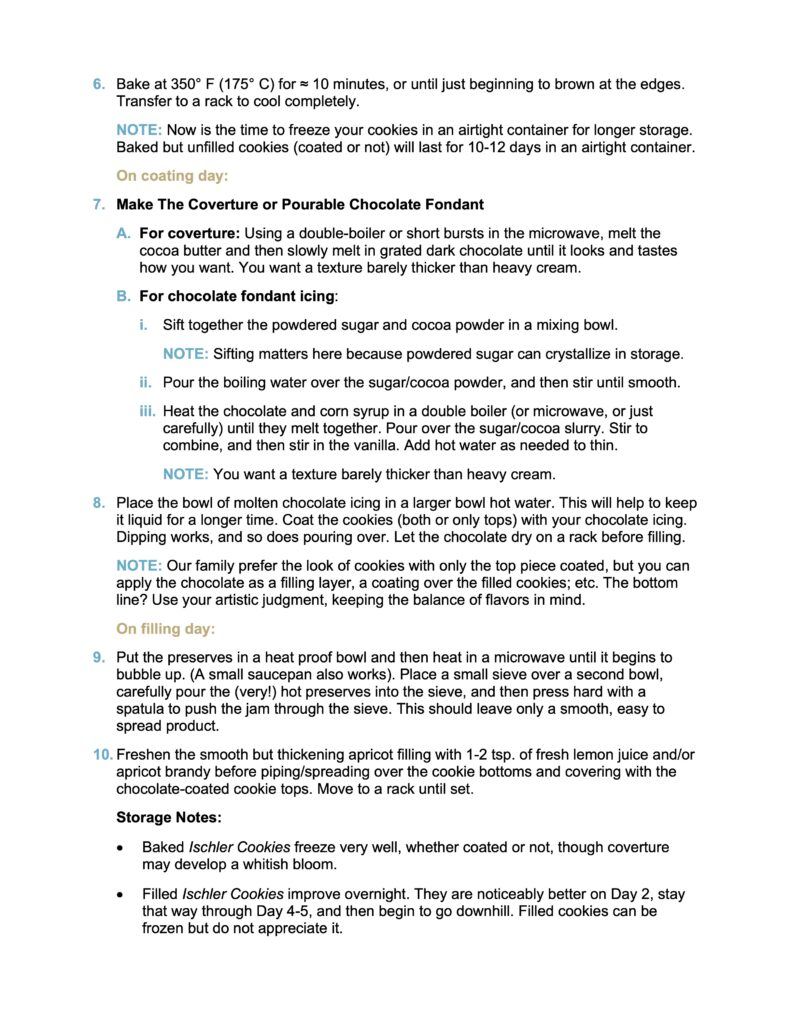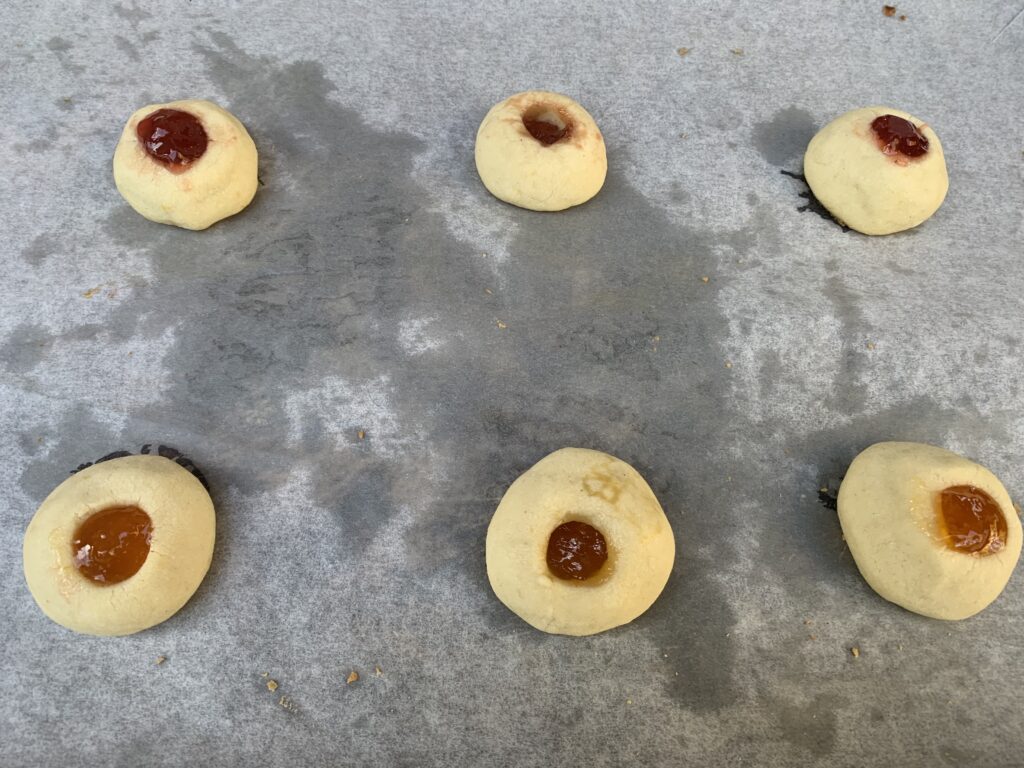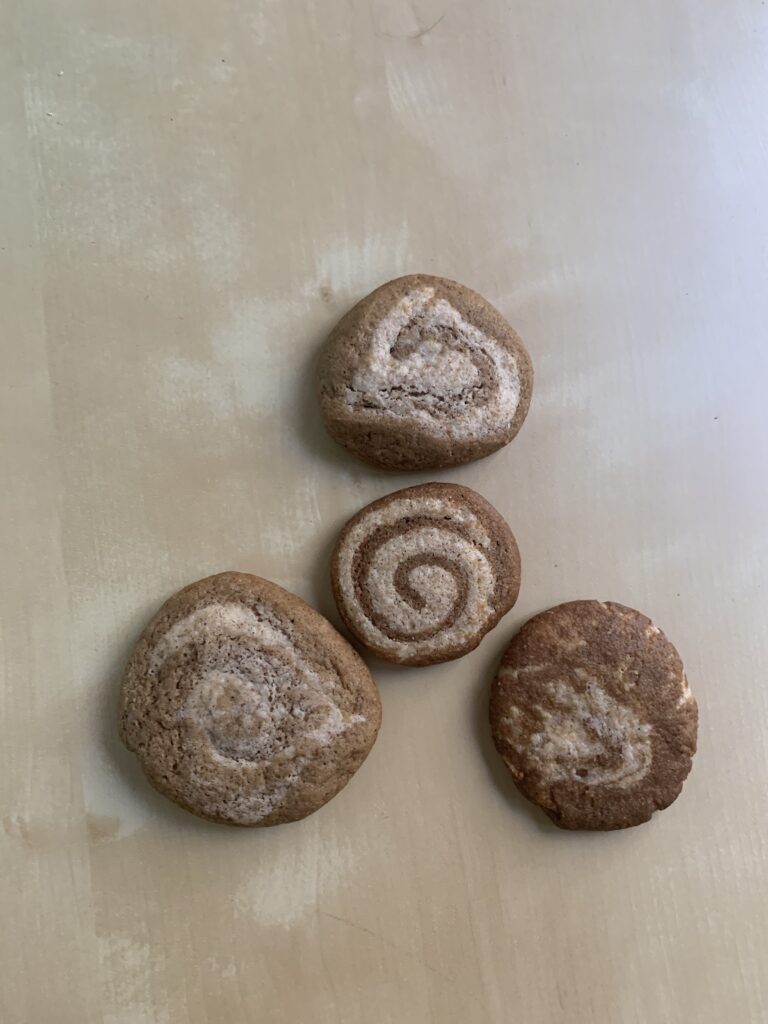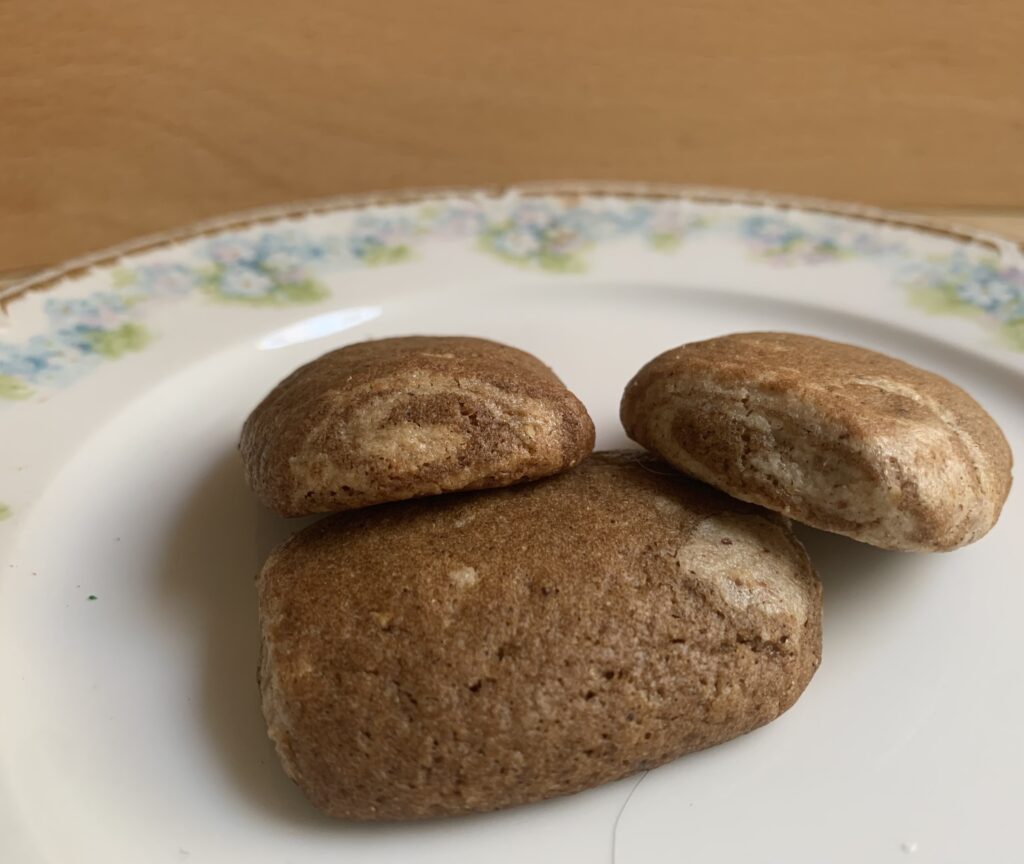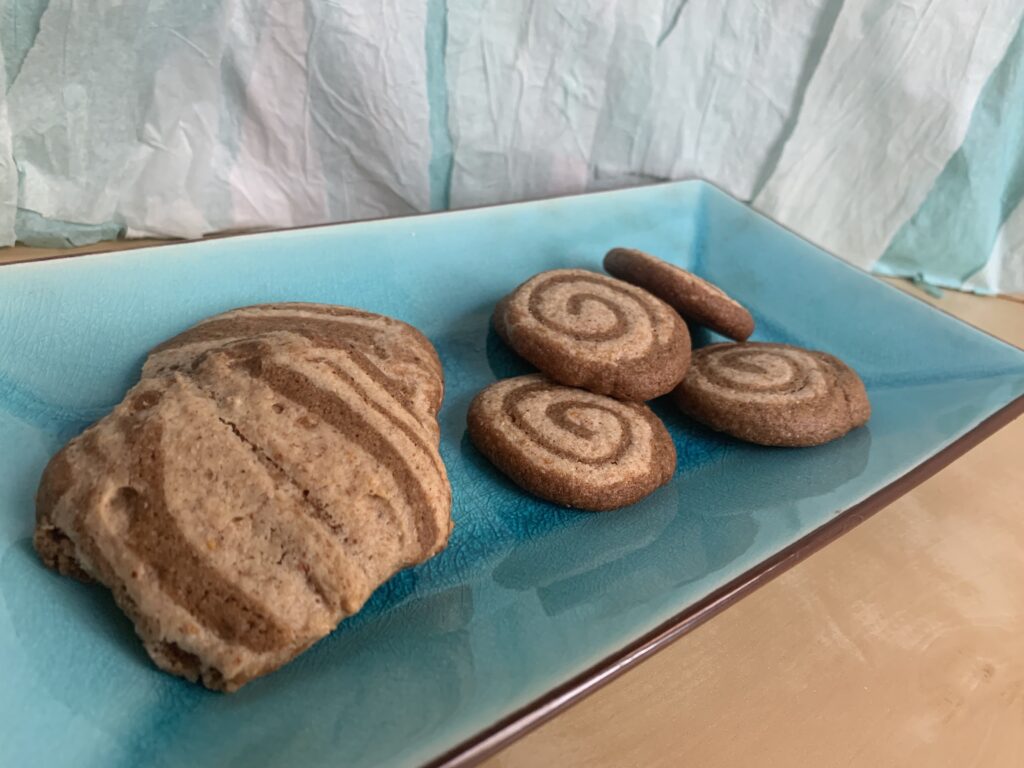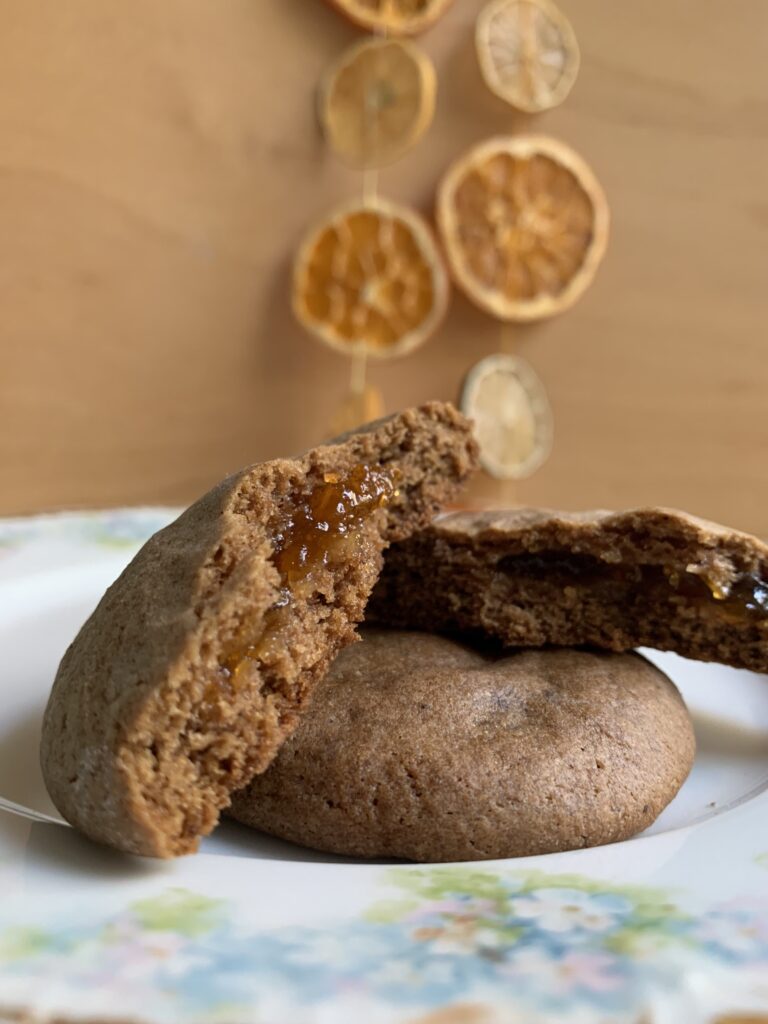
ISCHLER COOKIES – The Blessed Union of Linzer Tarts and Sachertorte

Dense nutty shortbread with an apricot filling and chocolate coating. What’s not to love?

“There is a tide in the affairs of bakers. Which, taken at the flood, leads to cookies of legend.”

Williamnot Shakesthepan, ‘Julius Eater’

The bakers of Imperial Austria were always good, but immortality escaped them until the creation of a series of desserts in the 1800’s. Yes, Linzer Tarts date back to at least the 1600’s. But nailing it? Pre- and post-French Revolution. One example is Sachertorte, created in 1832; a dense, extremely chocolatey layer cake with a generous amount of apricot jam on the inside. Ischler Cookies are another.

This particular cookie was created for Emperor Franz Joseph I in 1849 at the spa town of Bad Ischl. Look with care and you’ll see a marriage of the first two; the buttery, nutty, Linzer shortbread sharing the stage with apricot filling and dark chocolate counterpoints.

Exquisite.

As always, skip to the bottom if you are only here for the recipe. Most of this article concerns the choices we made to get there.

MORE A “PROFILE” THAN A “RECIPE”

A search for “Ischler Cookies Recipe” yields somewhere in the area of 2,000 recipes in English alone, and another 10,000 in German, Czech, Slovak, Hungarian, and any number of other languages. Plus books, of course. I’ve scanned maybe a hundred in all, with close study of several dozen, and all the work done on ours. On that authority I feel confident about the [lack of a] target definition:

  1. A sandwich cookie made from a tender, nut-heavy shortbread;
  2. An apricot filling, which often gets varied in the name of creativity;
  3. And a densely chocolate element, which can take any form that human ingenuity can contrive.

This cookie has been around for more than 170 years, and the recipe now has all but infinite variations. If you insist, I will admit to a belief that the original cookie used a lot of hazelnuts, had an apricot filling, and was enrobed in chocolate, but that is based purely on inference and guesswork. Why hazelnuts? Because it pairs so very well with chocolate. Why enrobed instead of sandwiched? Well, if I was a pastry chef, and I wanted to impress an Emperor, that would be my default.

Sensible? Yes. A statement of fact? Not exactly.

So here’s the bottom line. Our version of this recipe is as good as any, better than most, and is 100%, capital-R Right. But that doesn’t mean that other recipes are capital-letter Wrong. They aren’t. We’re looking at a flavor profile, not a fixed recipe. Everything is “right” so long as it has the nutty shortbread, jam filling, and distinct hit of chocolate.

THE NUTTY SHORTBREAD

I spent years refining the proportions in my nutty Linzer Tart dough to perfection, and there is no reason to mess with success for this one. Here is the basic formula:

  • ≈ 1 cup (7 oz = 185 g) of fine nut meal, ideally from gently toasted nuts;
  • 2 sticks (1 cup = 8 oz = 225 g) of butter;
  • 2 cups (10 oz = 185 g) of flour;
  • One large or XL egg yolk;
  • A small amount of baking powder; and
  • A healthy pinch (¼ tsp.) of salt.

Tests pushed us to add an extra half cup of flour to the dough, plus a little beyond that for oily walnuts, but that’s basically where we ended up.

What Nuts To Use? Any. Most modern American recipes tend toward almonds as the nut of choice. Modern recipes from Austria tend to use hazelnuts (filberts). The Hungarians often favor walnuts. Kate and I usually recommend a mix of nuts, but it had to be tested. We did so. And the result was clear: It doesn’t really matter.

NOTE FROM KATE: I figure the preferred nut may have also been a function of availability. The Hungarian versions favor walnuts, which they grow locally. In Bohemia (and I believe Austria) you can find hazelnuts bushes growing prolifically near every village, much to the delight of both youngsters and squirrels. So they make more sense for where I grew up. That said, the 1924 Sandtnerova cookbook uses almonds for almost everything, including her version of Ischler Cookies, and Austria sat in the middle of all these trade routes during Imperial times. Thus the Bad Ischl bakers would have had ready access to all three.

The photos in this post vary from examples that are pure walnut through pure hazelnut, 2:1 hazelnuts and almonds, and 3:1 hazelnuts and walnuts. They look the same, and while a devoted taster can tell one from the other (especially when the nuts are toasted), every variation was just as delicious as the last. So choose what you wish according to personal taste, budget, and pantry.

“What about oddball nuts like pecans, peanuts, macadamia, etc.?” Yes, that’s valid too. Look at the definition! “Nut meal” it says, and that is all it means. You’ll just be making another of those infinite and delicious variations. The only change is the obvious one: walnuts and other oilier nuts create a looser dough, which you’ll need to compensate for by adding some extra flour during the rolling phase. (NOTE FROM KATE: Macadamias would be interesting. They are the oiliest nut in existence and would produce a very short dough. I can already taste a Hawaiian take on the Ischler, with a tropical jam filling and a white chocolate coating on top!)

What Texture of Nuts? This one is more defined. Use nut meal nut flour, without any significant chunks of the sort you’d want if we used the word “chopped.” Yes, many people prefer to have little pops of crunchy nuts in their cookies. And yes, it adds some texture while also being convenient. After all, that is what you can get from a food processor. It just isn’t capital-R Right, because food processors did not exist in 1849. Bakers used table mounted grinders instead. Kate’s Grandma Kandler had one that looked a lot like this:
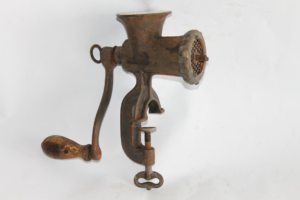
Image shows a 1930’s version from the Czech company Porkert

(NOTE FROM KATE: Scott has this part only half right. Grandma used one like this for poppy seed, and only occasionally for walnuts (which she used in her zimtsterne-like meringue sticks). She didn’t have a nut grinder for hazelnuts or the oh-so-rare almonds. Those she ground on the Czech equivalent of a box grater, one nut at a time, while listening to the radio and cursing. That works fine if you use the small slicing openings, but it’s laborious and does a job on your manicure.

You might ask, “Why didn’t she have the menfolk do it?” The answer is twofold: 1. The menfolk were busy pounding regular sugar into powdered sugar using a brass mortar and pestle. 2. She didn’t trust the menfolk not to eat the nuts. They were hard to obtain during the product shortages of the communist era, and she often had to visit numerous stores with hours-long lines just to get two small baggies of hazelnuts. For a great tool we can use now, keep reading.)

We have gotten by for 30 years with a much smaller and more familiar device:

Image shows the Oxo Rotary Grater, often used for Parmesan cheese but just as effective with nuts.

Both of those grinders inhale whole nuts and breathe out either fine shreds or powder, depending on which grating blade you insert. They do not produce “chopped” nuts. Thus we believe that (a) nut meal is almost certainly the texture used in the 1849 version of this cookie; (b) it’s a texture we prefer to eat; and therefore (c) it is the texture this recipe recommends. [NOTE: Almond flour and meal have started to become available in U.S. markets. Hazelnut and walnut meal are a lot harder to find, at least in 2022.]

As for chocolate inside the dough… see below.

Can I add some spice to the dough? Absolutely! Linzer Tarts have a hint of spice, and these can too. Just be judicious. Ischler Tarts have a strong, three-legged theme that every good recipe needs to balance; nutty shortbread, chocolate, and jam. Spices that enhance this balance do nothing but help. Spices that add a fourth layer will throw things awry. We didn’t do a whole lot of experimenting along these lines, but experience suggests that the best approach would focus on a spice that works with your central nuts. E.g., walnuts love to pair with ground cloves and coffee; vanilla, cinnamon, and nutmeg pair to perfection with hazelnuts; almonds get along cinnamon or an oddball spice like pepper.

THE APRICOT FILLING

Yes, apricot. We defunded the cookie police before publishing this article, so no one’s going to arrest you for using something else. There are, however, a number of reasons to start with this particular fruit:

  • Apricot and chocolate are a classic Austrian combination, as shown by the much loved Sachertorte;
  • Raspberry has its own cookie in Linzer Tarts; and
  • All accounts seem to agree that the original, 1859 recipe did indeed use apricot and not any other fruit.

QED.

Apricot cookie fillings come in two basic versions. The first is slow-cooked puree or compote a/k/a apricot butter, povidla, lekvar, etc. We prefer these fillings for recipes that bake the filling, but with this one – filled after the fact – we recommend the easier route; a modified apricot jam.

Jam fillings present two issues, both of which are easy to solve. #1 is excess moisture that can soak into the cookies and limit their lifespan. #2 is availability, since our stores only carry “apricot preserves,” and that product has enough chunks to detract from your ideal result.

Cookies made with unstrained preserves. See how the bits of fruit hold the two halves apart? It doesn’t hurt the taste at all, but it’s less perfect than what you can do with only a little more effort.
Same cookies, same presentation, but without the chunks of fruit.

We prefer this cookie with a smooth jam instead, and ideally one that’s just a little drier. You can address both concerns by (a) heating preserves until loose, (b) pushing the hot goo through a sieve, and then (c) spiking it with a squeeze of fresh lemon juice or apricot brandy for that certain je ne sais quoi. Apricot perfection with just the texture you want.

I did try to sieve the jam without preheating, hoping to avoid the danger of handling something so hot. Alas, even a coarse sieve wouldn’t do the job. Preserves are just too hefty, and it did nothing about the moisture concern. Thus you are hereby warned about the danger, and we recommend doing it anyway.

THE CHOCOLATE

Yes, a chocolate component is essential. That is what separates this cookie from being a mere variation on Linzer Tarts. Same genus; different species.

What kind of chocolate? That is a matter of some debate. Look at those 12,000 recipes on line and you’ll see that different bakers try to incorporate the chocolate element in every possible way. And I do mean every. We found recipes based on:

  1. Grated or melted chocolate mixed into the dough. This produces a wonderful cookie on its own merits, and it’s the simplest approach. The drawback? It doesn’t have the same ‘Wow’ factor as a chocolate filling or topping, and it adds flavor without texture.
  2. Cocoa powder mixed into the dough. Again, it’s a wonderful cookie on its own, but it lacks in both Wowness and mouthfeel.
  3. A chocolate ganache filling paired with the apricot filling. This is the most common solution in American recipes because it’s simple, tasty, has a great mouthfeel, and is easy to pack. The drawback? It looks good but not great, and too much of either layer will make your filling squirt out the sides.
  4. A ring of chocolate ganache filling with the apricot placed inside. This is a neater variant on #2, because the piping process enforces exactly the sort of filling-discipline you need. The downside? “Piping” is #1, because many people find it fussy and hard. Visual appeal comes in again as #2. There’s nothing wrong with looking at chocolate, but seeing the jam adds a flash of appealing color. #3, I think it messes too much with the balance of flavors, though Kate disagrees. (NOTE FROM KATE: I have a higher tolerance for bitter than Scott, and find the ring of darker chocolate ganache very pleasant. This is especially true for when used with the sweeter chocolate fondant icing – see below. Also, YMMV.)
  5. Chocolate ganache spread or piped over the top. A great compromise, but the ganache can look a little messy if you don’t pay attention, and it makes for a very sticky top. There’s no way at all you could hope to pack it in a tin. Right idea; wrong solution.
  6. Chocolate buttercream cake frosting piped on top. Think of these sandwich cookies as a tiny cupcake made from shortbread instead of batter. Now go ahead and frost that cupcake. Taste: check. Texture: check. Appearance: check. The drawbacks? (A) It moves us away from “cookie” and into “confection,” (B) no one could even dream of packing them in a tin, and (C) there are better answers yet to come.
  7. A chocolate glaze. Looks fine and packs like a charm, but glazes never have the desired mouthfeel, and almost always lack something on the flavor side too.
  8. Melted chocolate a/k/a why get weird? Alas, but the texture is wrong. The cookies wants a coating that feels dry to the fingers, but gives way to the teeth without any effort. The ‘snap’ of actual chocolate turns from asset to issue in this particular case.
  9. Chocolate melted with butter, and then either poured over the top or used as a dip. This is an ideal solution for taste, appearance, and texture, but it also softens at room temperature, which makes it a mess to eat and impossible to ship unless you heroically cut a piece of parchment as protection.
  10. Coverture a/k/a chocolate melted with extra cocoa butter, used as either a coating or a dip. Ding! This is the best solution of all… if you keep cocoa butter on hand, or have access to specialty stores that sell ready made coverture. If you don’t…
  11. A pourable chocolate fondant used as either a coating or a dip. Ding ding! We have finally arrived at our #1 solution for everyday pantries! Looks perfect; thick enough to give an ideal, luscious mouthfeel; dries enough to pack in a tin without worry; and the flavor is exactly as you want, since it can be varied to taste. It’s even pretty easy… or would prove to be after we figured it out.
Want chocolate icing that flows over your cookies, settles into a coating with some heft, is dry to the touch, but melts in your mouth? Pourable fondant is where it’s at.

THE ICING ODYSSEY

You may find this hard to believe, but we really did try every one of the first nine approaches (other than the frosting). See this parallel article on coverture and pourable fondant. Which one do we recommend? It’s chocolate, people! Chocolate wrapped around rich, nutty shortbread that encases a lively hit of bright apricot filling! Don’t stress. This is the very definition of a no-lose situation.

If you keep cocoa butter on hand, go with coverture. If you don’t, whip up a pourable chocolate fondant.

“But should I pour the coating over? Dip the cookies in? Cover only part of the cookies? Apply decorative stripes or some such?

[Sigh] Do what you prefer. We happened to be testing these just in time for Thanksgiving, which led to an extended family vote in favor of coating only the tops with as smooth a layer as possible. Hence the photos. But we can promise that all the others work too. Once again, you cannot lose, so do not stress.

CONCLUSION

Ischler Cookies can hold their own on any cookie tray in the world. They really are that good, and that full of history and heritage.

Are they actually better than all the other cookies in the world? Well, that one’s up to you. They call it taste for a reason, and I cannot speak for yours any more than you can speak for mine. But I can promise you this. Wise men and women will do a lot of careful tasting and re-tasting before reaching any decision.

“I better have just one more to be sure…”

A FEW FINAL NOTES

On storage:

  1. The dough freezes as well as any other so long as you seal it in plastic wrap or an equivalent.
  2. Baked halves keep as well as any others. Just remember that they are fragile, and do best in an airtight container like a cookie tin.
  3. Baked and coated halves freeze well too, but coverture can sometimes develop a whitish bloom (which doesn’t alter the taste, but does detract from their beauty). Fondant made with actual chocolate can do that too, but less so. Fondant made with only cocoa powder doesn’t mind freezing at all.
  4. Filled cookies freeze ‘okay,’ but not ‘well’ because the added moisture of the jam creates a number of potential problems. Better to freeze before filling.

On lifespan:

Ischler Cookies are a little hard if eaten right after they’re filled; remain perfect for up to a week if kept in a tin; and then go downhill.

That’s about it. Enjoy!

The Companion Article On Chocolate Coverture And Pourable Fondant

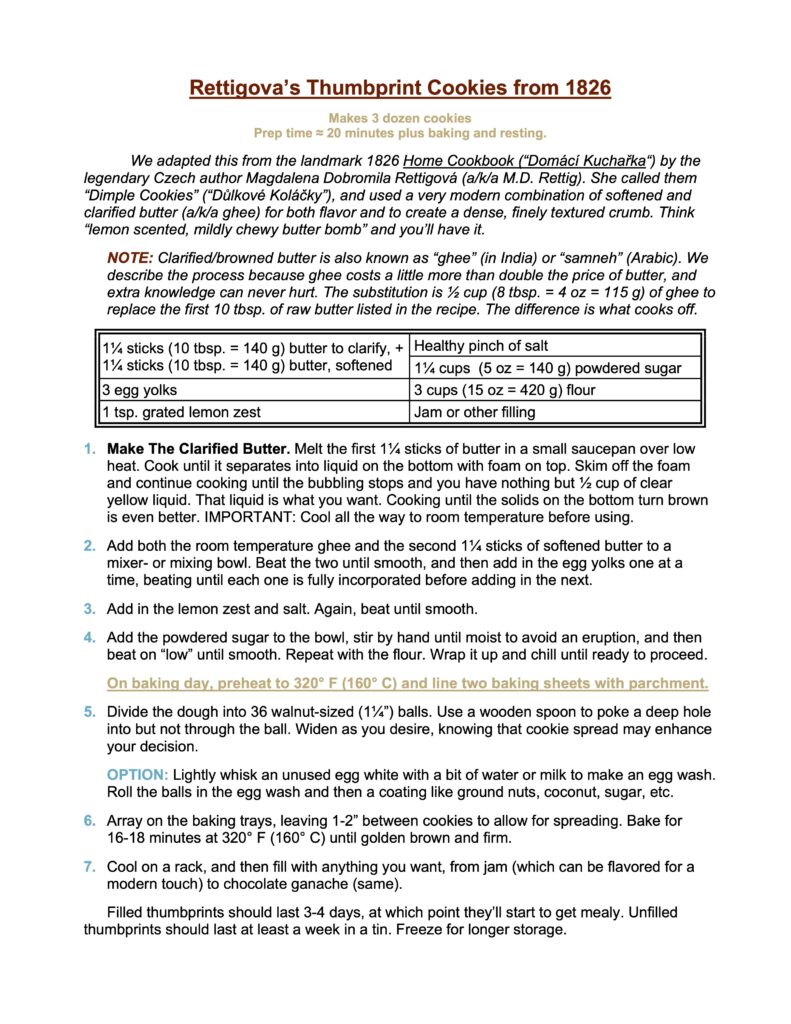
1826 THUMBPRINTS FROM M.D. RETTIGOVA (a/k/a “Dimple Cookies” or “Butter Bombs”)

A recipe direct from the great-grandma of Czech cuisine

Kate grew up in Prague, which explains the Czech accent in so many of our recipes. This one is so utterly Czech that even native Praguers will be a little stunned. Not because of the recipe itself, though it really does make a fantastic, ultra-buttery thumbprint cookie with a unique technical twist. It’s the history that makes this cookie special.

The published recipe dates back to the landmark 1826 book by Magdalena Dobromila Rettigová (a/k/a M.D. Rettig), a name that every Czech knows, but also tends to discount. Non-natives may want to think of her as a much loved national Grandma; the old lady you treasure because she snuck you cookies, held you in her lap, and taught you how to handle pets, children, and husbands with a firm but loving hand. It’s an archetype, right?

But here’s the thing. Mrs. Rettigova has held that role in the cultural heart for 200 years and counting.

Wow.

As always, feel free to skip to the bottom if you only want the recipe. This article, even more than most, will cover ground that isn’t directly related to simply making the cookie.

LET’S START WITH THE COOKIE ITSELF

The key characteristics of a proper Thumbprint Cookie are:

  1. An easygoing flavor that will pair with your jam based filling;
  2. A tender, vaguely chewy, fine grained texture; and
  3. Just enough structure to keep a clear dimple in the center when baked as a ball with a deep hole poked inside.

Mrs. Rettigova’s Dimple Cookies (“důlkové koláčky”) feature exactly the texture and structure you want, but also have a flavor that positively screams of BUTTER!!! Butter that pairs extremely well with fruit flavors of every kind, of course. Or can stand on its own.

The Key Trick: Combine Softened Butter With Clarified Butter

It’s a fairly simple procedure. (1) Beat a generous amount of softened butter with an equal amount of clarified or browned butter until smooth, (2) beat in egg yolks one at a time, and then (3) mix in the dry ingredients. All very simple, and totally brilliant.

Our article on Ghraybee, the Middle Eastern shortbread, details my years of frustration trying to incorporate browned butter into a shortbread cookie. The problem drove me mad, and I finally had to settle for simply using it as an icing. The delicate balancing act of Ghraybee offers one way around that diliemma. This cookie is the European solution I never managed to crack.

Yes, it’s also 200 years old and counting. [Sigh]. Don’t remind me. But look at this way: I’ve got a choice between feeling elated to have the answer, or ashamed that I didn’t think of it myself. Thanks all the same, but I’m going with Door #1.

THE ONLY QUESTION: NARROW HOLES OR WIDER HOLES?

There isn’t much else to add, since we’re offering the recipe basically unchanged from the original Czech. The only issue we found goes to personal choice. What’s the balance you want between cookie part and jam part? Here are the two options (you can also vote for “in between” of course):

Cookies made with a narrow hole by using only the width of a wooden spoon.
Cookies where the spoon hole was widened out before baking to the size of my (Scott’s) thumb.

The wider your holes before baking, the wider and shallower they will be after baking, with the initial difference enhanced by spreading. It really comes down to what you want. I am a jam-first kind of guy. Kate prefers a bit more balance.

(NOTE FROM KATE: I like the fruity notes of jam to pair with my shortbread without overwhelming it. In the past, I’ve removed excess jam out of an otherwise perfect cookie with a spoon. Psst…don’t tell on me.)

Then there is the final option: make a relatively flat topped cookie and then press a dimple in with your asbestos finger when they are hot out of the oven. Yes, it can give you a mild burn on a sensitive thumb tip. Sometimes you pay for beauty. And yes, you can use a tool like the blunt end of a small pestle; if you have one. Just be sure to act quickly! The cookies get delicate as they cool, at which point your effort to push in a dent will start to cause destruction instead.

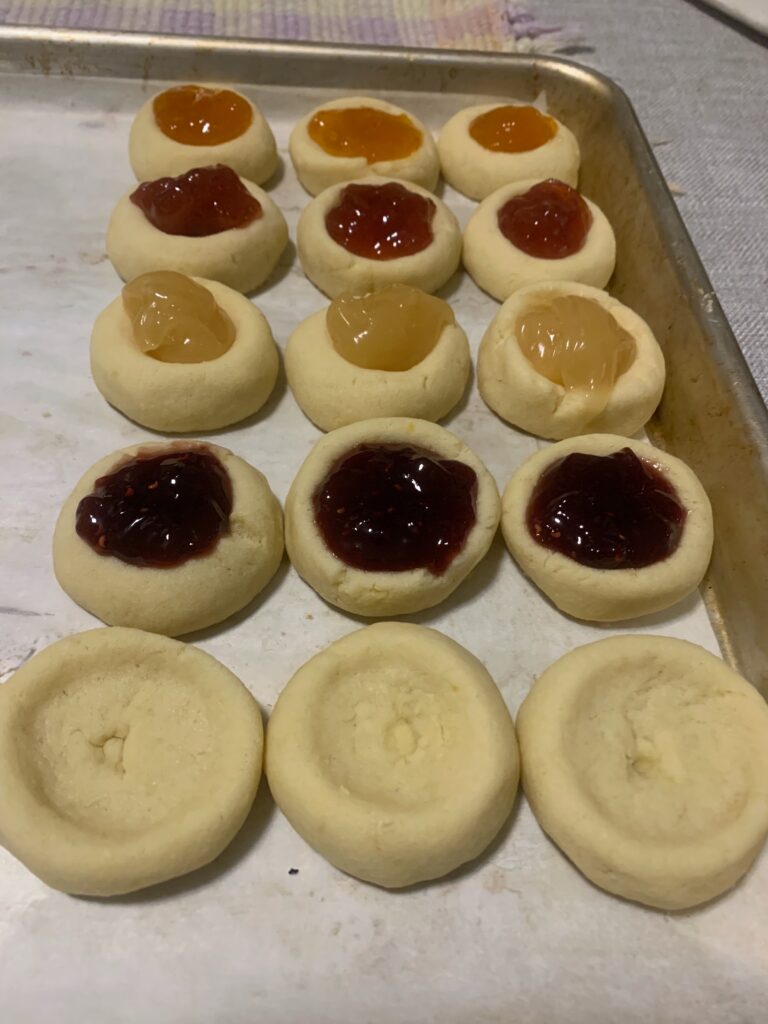
P.S. These are cookies you fill after baking. Yes, you can do it in advance, but it serves no purpose. The jam condenses and shrinks as it bakes, while also losing its high notes. Here’s an example:

From the left, apricot filled after, apricot prefilled, strawberry prefilled, and strawberry filled after

I also believe those high notes matter, at least to my taste. Strawberry jam with a tiny hint of lemon juice or balsamic vinegar? Oh yeah. “How to elevate a childhood favorite into maturity in an instant.”

Apricot with a spice (cardamom!), herb (rosemary!), hint of booze (cognac!), or lemon? 1826, meet 2026. It has no end except the bounds of human creativity.

There are plenty of cookies where a cooked fruit filling is the right way to go, especially if you hope to ship them. This is a different critter. Thumbprints are for eating at home, not shipping out. Though nothing stops you from shipping them empty, of course. Even the most inept, kitchen-phobic bachelor can manage to fill a hole with a bit of his favorite jam!

So much for the actual cookie. Now it’s time for the treasure behind the cookie; an absolutely fascinating bit of history and perspective that most people tend to forget.

Again, head to the bottom if you only want the recipe. What follows is all about history, culture, and why you should go out of your way to give this one a try. It has nothing to do with the actual baking

WHO WAS M.D. RETTIGOVA AND WHY WAS SHE SO IMPORTANT?

(NOTE FROM KATE: Scott doesn’t waste a moment to learn something new from history, and this time period was of great interest to him in college. He’s also a professional storyteller, and thus can’t resist a good opportunity to share an interesting tale. Stories, however, are as important as they are interesting. They teach us much about who came before us, and they help shed light upon the things we do today without even thinking about it. We all stand on the shoulders of giants. For our Czech readers, you’ll note a non-Czech slant to Scott’s view of Czech history. Let’s treat pani Rettigova as one singular dot, and for this time, not worry about the seminal “details” that form the rest of the Czech history puzzle. Enjoy!)

Hmmm… Let’s start by setting the scene.The girl who would grow up to become Mrs. Rettigova was born in 1785 to a German speaking, very assimilated family named Artmann. They lived in a 500-person village located in the northern quarter of Imperial Austria that would later become the Czech Republic.

Austria in 1785 was the world of Mozart’s prime: a country heavy with tradition, and organized around an ancient, universally accepted, divinely inspired social order that began with the Emperor and moved on down. Loyalties were more medieval than modern. The ran to your patron, and from him on up to the imperial person. There were no amorphous concepts like a political state or ethnic group with the sole exception of religion, and the hellish wars of the 1600’s had left so deep a mark that smart people did their very best to avoid it. Citizenship and self image had precious little to do with a common language or a common history. Your “team” was your fellow imperial subjects, plain and simple.

(NOTE FROM KATE: this is what I mean about a non-Czech attitude. Those of us who grew up with Czech history will be saying, “But what about Charles IV, the Holy Roman Emperor and king of Bohemia? What about the Czech lords who elected their own king after the turmoil of the Hussite wars?” Not relevant. In Magdalena’s time, these events were esoteric and forgotten by all but literate historians. That’s the point. If a Czech person wanted to show how worldly and educated they were, they spoke and wrote in German.)

Recall too that Austria, a/k/a the Holy Roman Empire, had been one of Europe’s great powers since the fall of Rome, second only to France and at least the peer of Great Britain. Prussia and Sweden up north had famous armies too, while Spain was a declining but still great power in the far west, and the Ottoman Empire a historic menace to the south. Neither Germany nor Italy existed as a political unit, and no one but wild eyed, fantasizing academics bothered to dream about that kind of unification. They were mere “geographical expressions” as one of the era’s most famous politicians quipped later on.

That was the world this baby was born to enter. The first real stirrings of change occurred in 1792, when she was seven (7) years old. How can I bring home the enormous weight of what was coming down the historical turnpike? Let’s try this:

Imagine what life would be like for a girl in rural Ohio if Communist China suddenly threw off its chains and declared itself to be a new and radical democracy in the model of ancient Athens. That’s a pretty good analogy of what the French Revolution meant to people in the rural villages of central Europe. Or it would be if you could spice that impact up because the current queen and king of “China” happened to be the sister and brother-in-law of your own “President.”

These great events would have been a consuming topic of conversation for the grownups, but only a background noise for our little girl and her daily life. Seven year olds care more about playtime than the storm clouds of war on the horizon.

A few months later the deposed French king and queen tried to flee to Austria, and were recaptured. The revolutionaries had them beheaded in a public square just as she turned five. Monarchs fed to the same guillotine as common peasants! Shocking! But still just loud and urgent grownup talk from her perspective.

Her Emperor immediately declared war on France, Prussia joined in, her local “big kids” started to talk about military careers, and the atmosphere got ever more intense. Children her age would have been sent out of the kitchen, rather than assuming they’d just be bored.

The Reign of Terror began ran from ages 8-9 (the age of a typical American 3rd- to 4th-grader). While that went on, Austria and Prussia used the distraction to launch a joint invasion. It enjoyed enough initial success to make Great Britain and Spain join in for their fair share of the soon-to-be-carcass. Which meant that all of Europe had come together in a loose alliance against divided, self-consuming Revolutionary France. What else could happen but victory, soon and profound?

They all found out as she went the preschoolers started to see her as one of the Big Kids. France rallied enough to bounce the Prussians out of the war, though she managed no more than a desperate draw against Austria. The world went into 1794/95 (age 9-10) with the other Great Powers beginning to close their own nets. Victory still seemed inevitable, however stubborn the French mob had turned out to be. The war’s end, right there on the horizon… only to vanish with the rise of an unknown, undersized, provincial artillery officer who’d grown up on some tiny islet in the sea. Over the next half decade Napoleon Bonaparte took over the French command in Italy, proceeded to disgrace army after army, finally driving on to dethrone the Pope himself. Absolutely historic routs, which kept piling up until a final French triumph at the soul crushing Battle of Marengo in 1800. That year, Magdalena turned 15 and could start to be viewed as marriageable.

From here we can speed up a bit. Her Emperor and the victorious Napoleon declared an uneasy truce. Everyone knew it was more of an ‘armistice’ than a ‘peace,’ however, and so it proved. War renewed a few years later, only to end when she was 20, with Bonaparte’s legions sweeping across the continent to humble, humiliate, and crush the combined armies of Austria, Prussia, Sweden, and Russia. Every king but the Tsar was forced to surrender, and he would have too if Moscow wasn’t 1,200 miles (2,000 km) away from Vienna, off in the middle of nowhere.

(NOTE FROM KATE: it’s well-known that Napoleon’s armies looted a lot of art from Czech castles and churches. It is less known that they had absconded with half the nascent nation’s supply of vowels. This is why Czech has many words with only one vowel in them, and some with none at all! But look at French. They have so many, they can’t decide which ones to keep silent.)

Austria, along with everyone else, became a grudging vassal state, and the tide of revolutionary ideas began to flow from Paris unimpeded. The main treaties establishing a new world order were signed when Magdalena was 22 and 24, respectively. She married at the age of 23.

THE CHANGING LIFE OF THE NEW MAGDALENA D. RETTIGOVA

Magdalena wed an aspiring, politically active attorney named Jan Alois Sudiprav Rettig in 1808. The marriage, even now, seems to have been a love match as well as a deeply felt partnership. Jan had grown up in the same whirl of events as his new bride, and now grew entranced with the world of international thought.

Opponents gave credit for the French victories to Napoleon’s military genius, but the French themselves (including Napoleon) disagreed. They insisted that their true advantage came from the bottom up, not the top down; a hitherto unknown esprit de corps based on their common loyalty to la belle France et la révolution. This, they said, made even amateur French militiamen into better soldiers than any professional troops in service to old fashioned kings.

Intellectuals like Attorney Rettig called it “Nationalism,” and defined it as “loyalty to a nation and its ideals instead of a person.” One pictures the 25 year old Jan sitting in a cafe and pondering all these great events with like minded friends. “If there is a French people and nation, what is mine? It isn’t this defeated emperor of moribund Austria. Aha! My people date back to the great Slavic migrations of the Dark Ages. And who led those? King Lech, who began the people of Poland; his brother Rus, who created an empire from Estonia in the west, to Moscow in the east, and on down to the Ukraine; and finally King Czech, who created Bohemia and Moravia. That must be where I truly belong.”

(NOTE FROM KATE: This is really pushing my Czech buttons. Arrgh!)

Jan Rettig spent the rest of his life working for a renaissance of the old Czech culture, with the wholehearted support and assistance of his loving wife. They became the regional version of what we would call a Power Couple. It began at home, of course. Jan had grown up in a bilingual household. The couple now decided to speak only Czech within their walls. Magdalena learned this new-to-her language quickly, and from then on used her middle name Dobromila (literally “lover of good”) rather than the first name she’d gone by as a girl.

Her “M” period ended, and the “D” period began.

THE WORLD OF M. DOBROMILA RETTIGOVA TO AND AFTER THE FALL OF NAPOLEON

Napoleon’s reign finally came to a conclusive end half a decade later, with the 1815 Battle of Waterloo; an event that took place in the same year that M.D. Rettigova turned 30.

Stop and think about that. Her entire world, from the age of 7-30, had been formed during and by the political and social upheavals wrought by the French Revolution. The years of her childhood playing with dolls; the years of her adolescence; her marriage with a man she loved; and on into motherhood. (She eventually gave birth to 11 children, 3 of whom survived to adulthood).

The wars may have ended in 1815, but the Rettig family had been changed from its roots on up. The fall of France did precious little to weaken their devotion to the idea of a Czech People whose ancient roots predated any allegiance to the rulers of Austria.

Speaking of which… Austria came out of all this history as master of an enormous, polyglot empire more or less comparable to its possessions before the eruptions in France. Austria also wielded dominating international power due to the personal influence of its legendary chancellor, Klemens von Metternich. A man who soon proved to be one of the most brilliantly conservative, backward-looking minds the world has ever known.

(NOTE FROM KATE: While doing research for a book set in the Balkans, I learned that toward the end of WWI the former Yugoslavia was home to at least 33 languages, many of which are now considered dead.)

Metternich created, or at least to codified, the idea of a balance of power across the continent. Under his influence, the larger states agreed to join what he called the “Concert Of Europe”; an alliance aimed at maintaining the status quo. The events of France’s Revolutionary Era had lasted for a bit more than 20 years. Metternich’s repressive counter reaction would go on for more than 30.

[OBSERVATIONS FROM THE FUTURE: the “System of Metternich” inside of Austria persisted until a series of attempted revolutions in 1848. The Hungarians basically won in the east, causing the country to be renamed “Austria-Hungary” with the Emperor being titled as the king of two lands rather than a singular one. The Czech effort at independence failed, and they remained the Kingdom of Bohemia with the Emperor of Austria-Hungary being the automatic King; just as things had been since the Battle of Prague in 1621. Only WWI finally shattered the empire completely.

M.D. Rettigova died in 1845, so these pivotal events all took place after she was gone.]

With Napoleon exiled and Europe acting in concert, Metternich turned his attention to the nagging problem of stability inside the Empire. History shows that for all his flexibility when it came to tactics, there was an overarching principle: he wanted to erase the French Revolution, and turn the clock back to the world as it existed in 1791. Politically and socially. And Chancellor Metternich was willing to do anything – anything at all – to accomplish that goal. His army of secret police was only the tip of the proverbial iceberg.

You can see how much danger this created for a politically active, reform seeking couple like Mr. and Mrs. Rettig. But they were not the types to knuckle under. Mr. Rettig soldiered on, plotting with extreme caution behind the scenes. They could not oppose the political realities. Not with any hope of survival, let alone success. Thus most of his efforts would have turned toward building a groundwork for future changes. He and his fellow radicals began to promote things like academic study into the Czech language and history, promotion of Czech arts, research into Czech folklore, and education of the upcoming generations. Etc. Much the same sort of things, in fact, as the Grimm Brothers were doing in Germany, and others would soon be doing across the continent.

(NOTE FROM KATE: The Bible had been translated into Czech during the Hussite wars, and one of the concessions of the 1621 Hapsburg takeover had been the continuation of sermons in Czech as well as Latin. This made it much easier to resurrect the language that it would’ve been under other circumstances.)

Mrs. Rettigova? She established a school to teach young women “how to keep their husbands happy.” What could satisfy Herr Metternich more than a traditional focus like that? Not much, which is no doubt why the school survived even though the classes were taught in Czech (with German as a fallback), with materials written in Czech, recipes that dutifully used local Czech ingredients, and so on.

It was “soft power” at its finest, and it worked far better than any of the abortive political battles fought by her (no doubt very happy) husband and his friends.

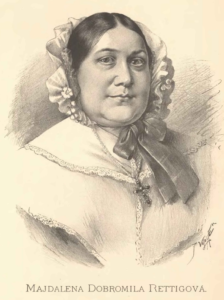
Portrait by Jan Vilimek, 1860-1938. Such a nice, plump, harmless woman. Right? Riiiiight.

Notice those years? The artist painted this a full 40 years after M.D. Rettigova died. Her work carried that much cultural weight.

In 1826, at the age of 41, M.D. Rettigova published her Czech-language treatise “A Household Cookery Book,” which she revised and expanded over decades of later editions. That book served as an essential text for every Czech household in the century that followed, even though her specific advice grew ever more dated. There wasn’t even a remote competitor on the culinary side until the 1920’s, after the nation of Czechoslovakia had come into being, and the impossible dream achieved.

HERITAGE

Modern Czechs view Rettigova (largely known by that single name) as a sort of cartoon exemplar of a bygone and not-so-nostalgic age. “You can’t even use that book anymore! Every recipe starts with a pound of butter and half a dozen eggs. Who eats like that? And come on! ‘How to keep your man happy’? Really? Who wants to push that view of womanhood in the modern world? Haven’t we evolved a bit in the 193 years since she published? M.D. Rettigova was a lovely lady for her time, and my own great-Grandma mother swore by everything she wrote, but we need to look toward the future.”

I won’t disagree with any of that. Times really have changed, and I believe for the better. But I strongly disagree with waving a dismissive hand, and walking away after finishing that statement. It’s unfair, shortsighted, disrespectful, and just plain dumb.

Consider this: Your own beloved Grandma does not control your life. Nor should she. And you certainly wouldn’t agree with all her values and viewpoints, nor she with yours. But did she matter? Does she matter? You’re darned right she does! She and her equally old fashioned peers created the paper and ink you are using to write your own life. There’s no getting around it.

Think on it from this angle too. Are you old enough yet to be into your own parenting and grandparenting years? If so, I’d bet money that you occasionally stop and wonder if you are living up to Grandma’s example. It’s just the way we are.

CONCLUSION

Magdalena Dobromila Rettigova, born a solid quarter-century before Abraham Lincoln, has served as the national Grandma of the modern Czech nation for coming up on 200 years. It’s soft power, not hard. The stuff of homes and community centers more than parliament buildings and cathedrals. But it’s power nonetheless. Power right down at the core of Czech society. Power that has made, and continues to make a difference in hundreds of millions of lives.

She mattered, and mattered a lot. And this is one of her very best recipes. It doesn’t get more “heritage” than that.

Even if it does start out with the better part of a pound of butter and three large egg yolks.

Enjoy!

GEVULDE (FILLED) SPECULAAS – a holiday treat from the Netherlands

Speculaas filled with almond paste? Thank you Mom, can I have another?

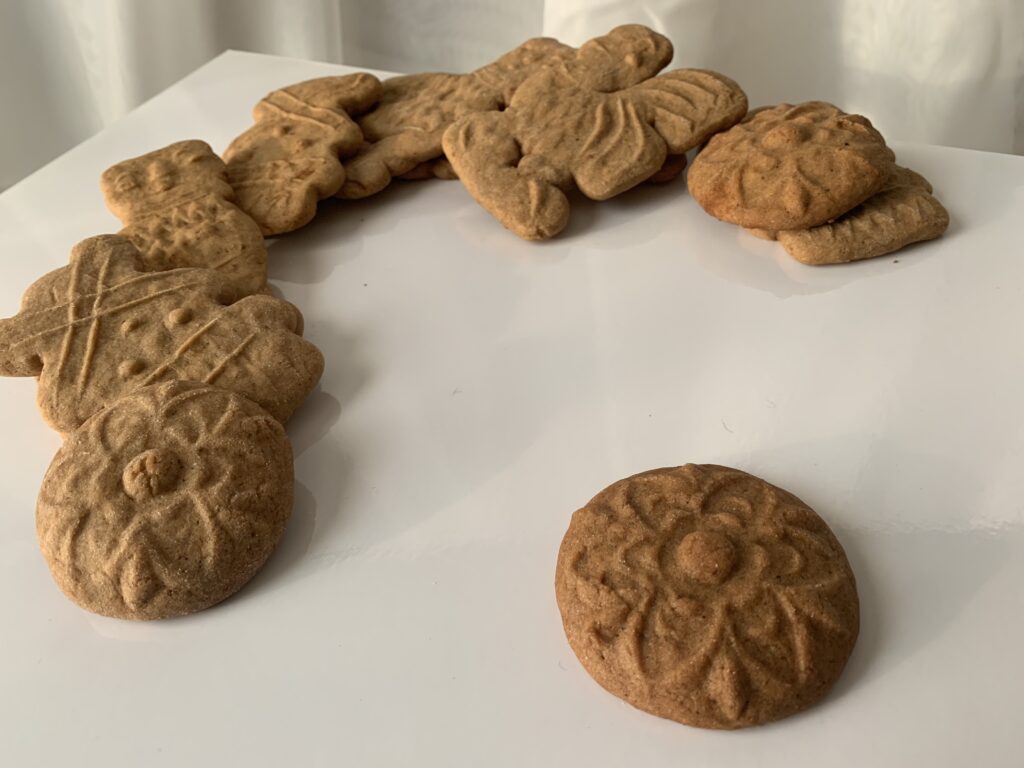
Our published book, Heritage Cookies of the Old and New World, has a wonderful recipe for Nut Dough Speculaas, which offers up a soft, tender version of the famous Dutch spice cookie. This recent article is all about the ultra-authentic, thin-and-crispy version, featuring a recipe straight out of Belgium. Our research for that article accidentally revealed a third style that is immensely popular next door in Holland (a/k/a the Netherlands): Speculaas dough filled with almond paste.

The Nut Dough recipe makes an extra tender version. The 100% Authentic recipe comes out thin and crisp. This is the one in the middle; toothsome, gently spiced, and made with U.S. pantry ingredients. Take that and fill it with homemade almond paste? [Finger Kiss]

As always, you can skip to the bottom if you want the recipe alone. The discussion of our stumbles and revelations along the way is going to take some time.

A SIMPLE, PANTRY-FRIENDLY SPECULAAS DOUGH

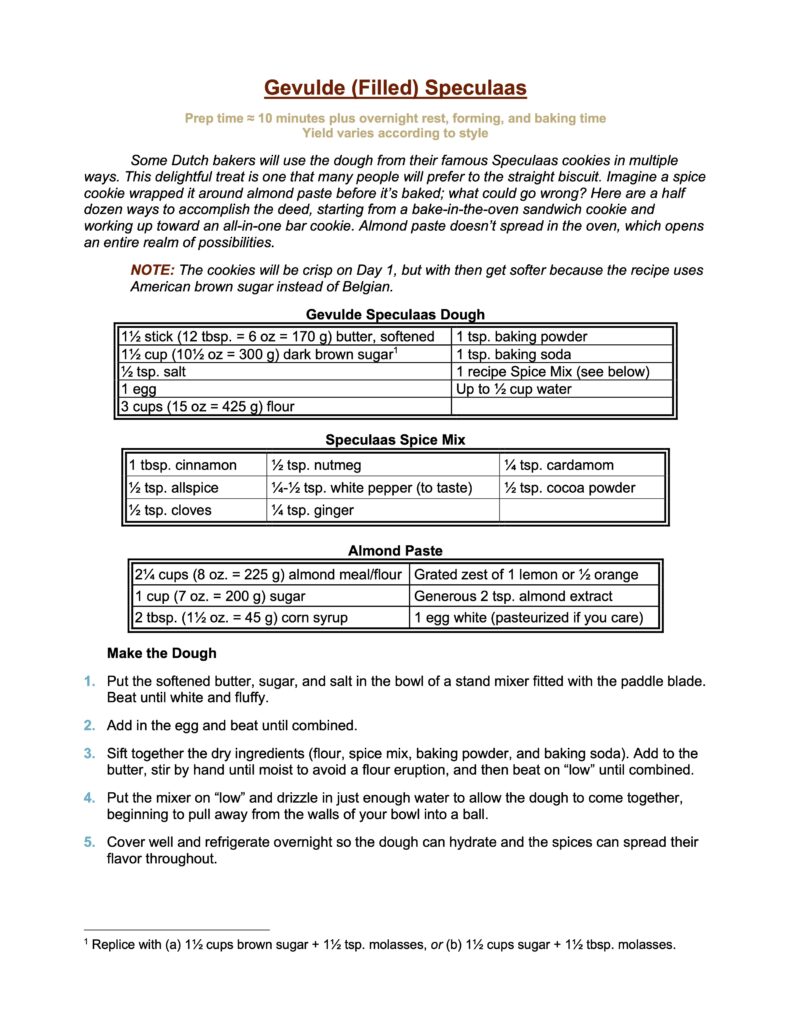
Easy peasy, I promise. Yes, this is a top shelf American version of a very European cookie, but that doesn’t make it complicated. The approach couldn’t be more standard. Cream the butter and sugar, beat in an egg, and then mix in the flour, leavening, and spices. Cover and refrigerate overnight so the flour can hydrate and the spices even out. Form and bake however you wish.

The only potential complication lies in the hydration part. You are after a drier dough with only enough moisture to hold together when squeezed. (the Almond Paste filling will add any richness you think is missing). That means the base recipe is likely to be too dry outside of a humid environment. You solve that by adding extra water a tablespoon or two at a time until it holds when squeezed. One or two is usually enough, though it could take as many as six to eight.

Just go sparingly! It is much easier to add more water in than to take any out. I did one batch with the full eight tablespoons (½ cup), and had to double the batch in order to avoid throwing the whole thing out. Tripling would have worked even better. Fortunately, the recipe has enough flexibility to have saved me from that extreme.

THE ALMOND PASTE FILLING

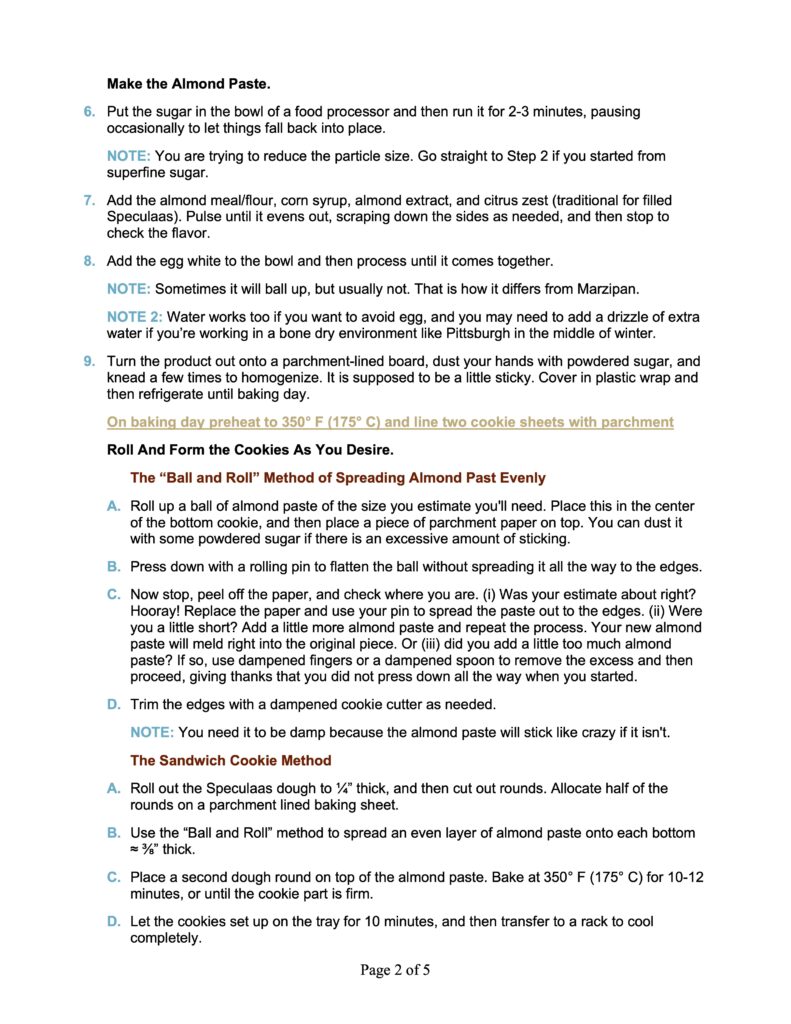
No need to waste a lot of time on this piece either. Almond Paste is super easy to make, and we have a whole discussion of it in the article on Marzipan. The only difference for this purpose is the subtle addition of some citrus zest to help it meet and marry with the flavors of the dough.

We include instructions for the almond paste in the cookie recipe down below. I’ve added our recipe for Marzipan and Almond Paste too, as a free bonus. [NOTE FROM KATE: I love anything resembling marzipan, and the orange notes in this paste have a delicious more-ishness to it. So much so that Scott had to keep chasing me away as I tried to execute numerous rounds of diligent quality control.]

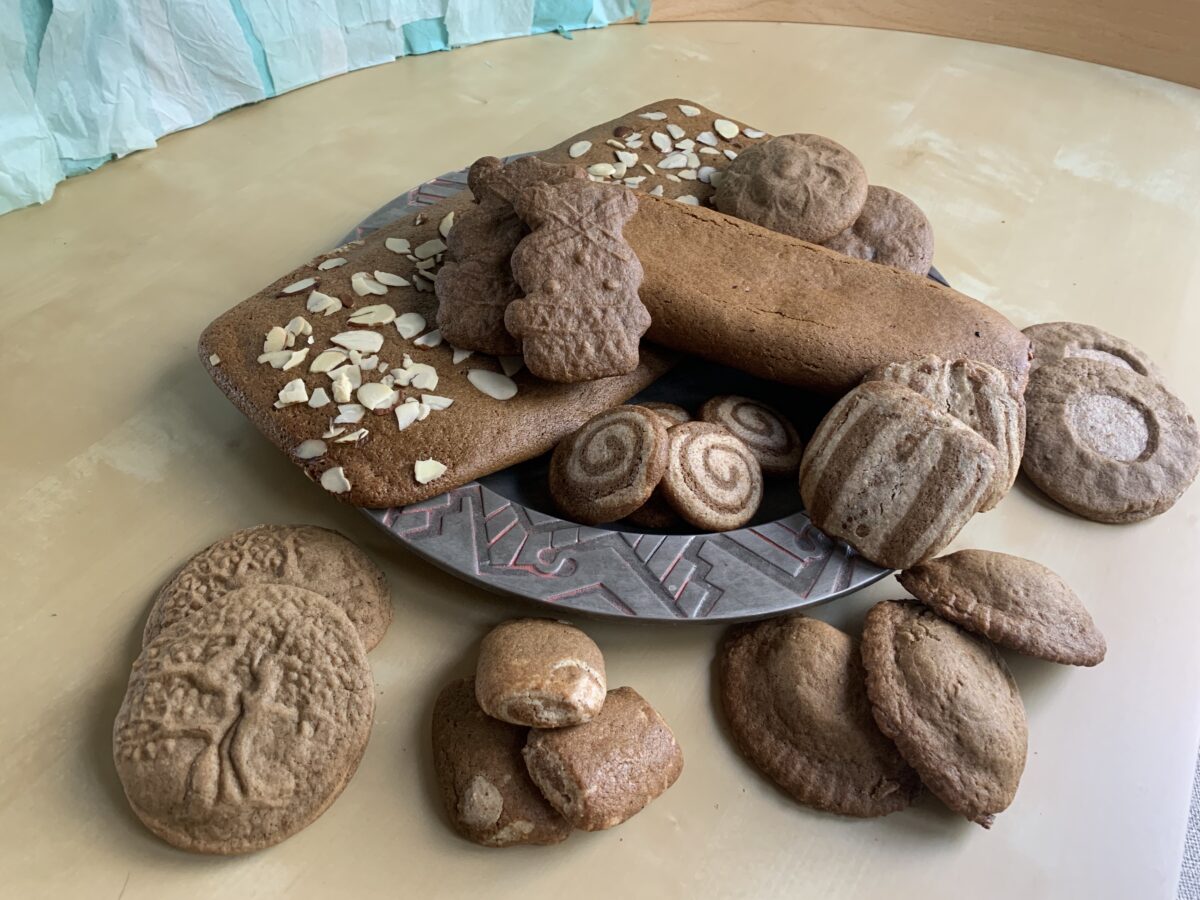
THE MANY DIFFERENT SHAPES

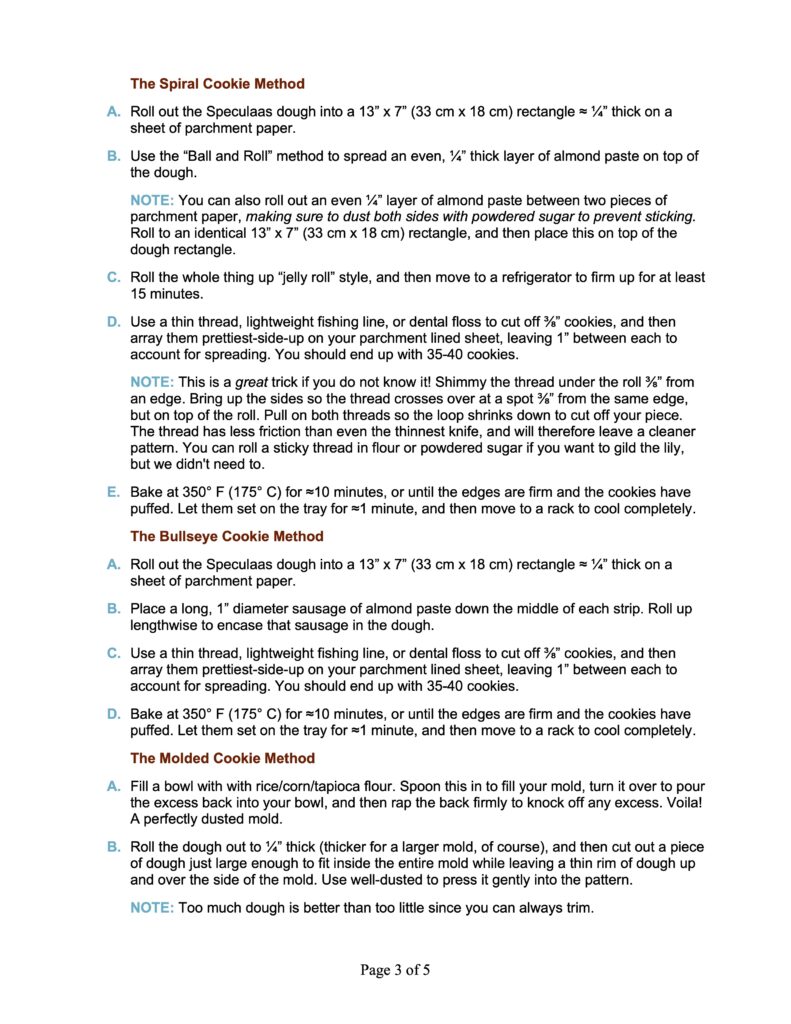
And now we get to the long part. But not because the shaping is hard! It isn’t. The dough is friendly, too, and the techniques are all straightforward. The length comes from the sheer number of options. This article lists a full dozen (12!) possibilities, and you don’t have to stop there. Jam and fruit fillings spread in the oven, searching for any crevice where they can leak out to create black and bitter disaster on your cookie sheet. Almond Paste does not. That feature opens up your options to basically any cookie shape you can imagine.

Bar Cookies? We Don’t Need No Stinking Bar Cookies!

Honesty compels me to admit that most people make Gevulde Speculaas as a bar cookie. You simply coat the bottom of the baking dish with one layer of cookie dough, spread a thick layer of almond paste on top (it should be noticeably thicker than the dough), and then cover that with a second layer of dough. Bake at 350° F (175° C) for about 18-25 minutes, or until the cookie part on top has set by the edges but is still a little soft in the center.

We, however, have a rule: no bar cookies! (Read the article on Chocolate Fudge Cookies if you insist on knowing why). That changes the focus to all those infinitely more interesting options, such as…

Sandwich Cookies!

Roll out the dough to 3/8″ thick. Cut out your choice of shape (we used larger rounds) and mark half of them with whatever you want for the top (we did a cutout for one, and a cookie stamp for a second.

Array the bottoms on a lined baking sheet (or two), keeping 1″ between each piece to account for spreading. Coat the bottom of the cookie with almond paste,* and then place the tops on top. Bake at 350° F (175° C) for about 12-15 minutes, or until the edges have set and the cookie has puffed up.

* Our favorite way to spread the almond paste goes like this:

  1. Roll up a ball of almond paste of the size you estimate you’ll need. Place this in the center of the bottom cookie, and then place a piece of parchment paper on top. You can dust it with some powdered sugar if there is an excessive amount of sticking.
  2. Press down with a rolling pin to evenly flatten the ball without spreading it all the way to the edges.
  3. Now stop, peel off the paper, and check where you are. (A) Was your estimate about right? Hooray! Replace the paper and use your pin to spread the paste out to the edges. (B) Were you a little short? Add a little more almond paste and repeat the process. Your new almond paste will meld right into the original piece. Or (C) did you add a little too much almond paste? If so, use dampened fingers or a dampened spoon to remove the excess and then proceed, giving thanks that you did not press down all the way when you started.
  4. Trim the edges with a dampened cookie cutter as needed. NOTE: You need it to be damp because the almond paste will stick like crazy if it isn’t. [NOTE FROM KATE: I was way too impatient, so I made a ball of almond paste and squished it with the bottom of a wet glass. It’s messier, I admit I had to sop up extra water off a cookie or two. It was fast though, even enough, and got the job done.]

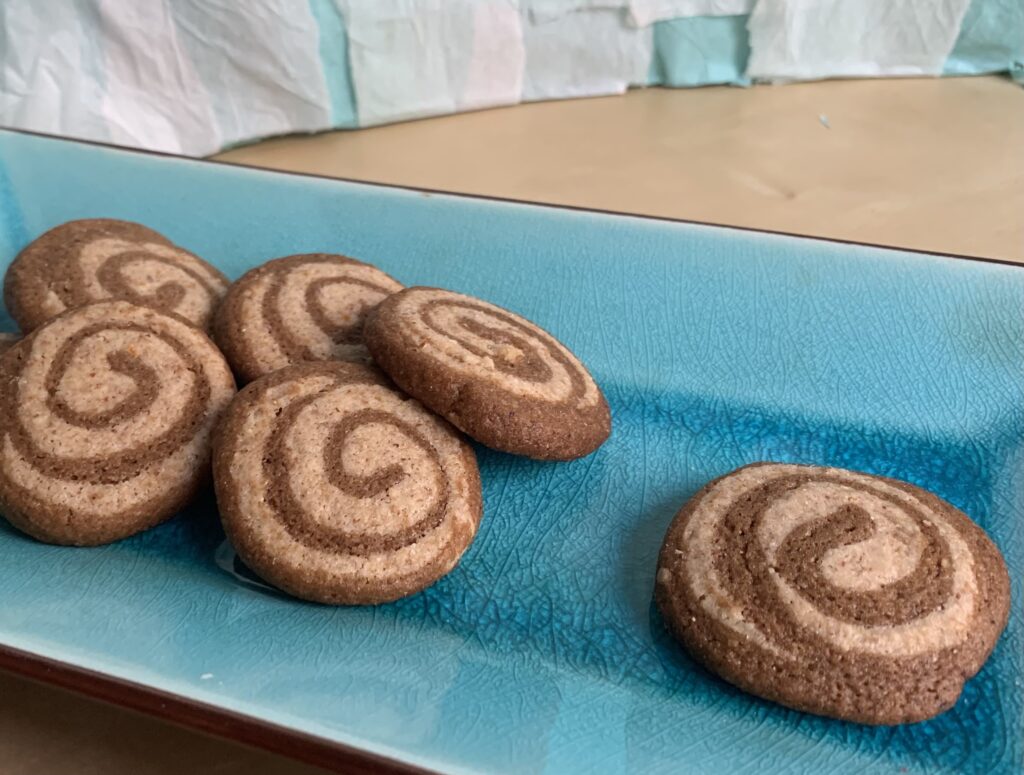
Spiral a/k/a Pinwheel Cookies!

  1. Roll out the Speculaas dough into a 13” x 7” (33 cm x 18 cm) rectangle ≈ ¼” thick.
  2. Use the “balls of almond paste” trick described above in the sandwich cookie section to create an almond layer that is also ¼” thick on top of the dough layer. Making it as even as possible will yield the best patterns in the end.
  3. Roll the whole thing up “jelly roll” style, and then move to a refrigerator to firm up for at least 15 minutes.
  4. Use a thin thread, lightweight fishing line, or dental floss to cut off ⅜” cookies, and then array prettiest-side-up on your parchment lined sheet, leaving 1” between each to account for spreading. You should end up with 35-40 cookies. NOTE: This is a great trick if you do not know it! Shimmy the thread under the roll ⅜” from an edge. Bring up the sides so the thread crosses over at a spot ⅜” from the same edge, but on top of the roll. Pull on both threads so the loop shrinks down to cut off your piece. The thread has less surface area than even the thinnest knife, and will therefore leave a cleaner pattern. You can roll a sticky thread in flour or powdered sugar if you want to gild the lily, but we didn’t need to.
  5. Bake at 350° F (175° C) for ≈10 minutes, or until the edges are firm and the cookies have puffed. Let them set on the tray for ≈1 minute, and then move to a rack to cool completely. NOTE: The baked tops should show a distinct pattern, but the bottoms against the tray will turn into an almost uniform brown.
The ends are never as pretty, especially when you need to press down to flatten the odd shaped pieces out. This shows three end pieces surrounding one middle piece.

Bullseye Cookies! [NO PHOTOS]

  1. Roll out the Speculaas dough into a 13” x 7” (33 cm x 18 cm) rectangle ≈ ¼” thick on a sheet of parchment paper.
  2. Place a long, 1” diameter sausage of almond paste down the middle of each strip. Roll up lengthwise to encase that sausage in the dough.
  3. Use a thin thread, lightweight fishing line, or dental floss to cut off ⅜” cookies, and then array them prettiest-side-up on your parchment lined sheet, leaving 1” between each to account for spreading. You should end up with 35-40 cookies.
  4. Bake at 350° F (175° C) for ≈10 minutes, or until the edges are firm and the cookies have puffed. Let them set on the tray for ≈1 minute, and then move to a rack to cool completely.

Tubes and Lengthwise Lines!

  1. Roll out a thinner spiral and cut it into 2” lengths. Starting with a 13” x 6” (33 cm x 15 cm) rectangle should do it.
  2. For tubes, bake at 350° F (175° C) for ≈11-12 minutes, or until the outside is firm and the cookies have puffed. NOTE: The tubes will settle into being flat on the bottom. We haven’t figured a way around that.
  3. For Horizontal lines, use a thin paring knife or a long thread to cut through the top from end to end. Array these curved side down on the baking sheet. What would have been spirals when viewed from the edge in will appear as lines when the roll is cut lengthwise. NOTE: you can also use the paring knife to cut almost all the way through, leaving only a thin piece at the bottom to connect the two halves. Unfold this like an opening flower and you’ll have a double-width line cookie. Bake these at 350° F (175° C) for ≈9-11 minutes depending on thickness.
  4. Let the baked pieces set on the tray for a few minutes, and then move to a rack to cool completely.
Line cookies on the left, spirals on the right. It’s basically the same pattern, but in one case you cut across to reveal the spiral, and in the other you cut lengthwise to reveal straight lines.

NOTE: You can use the “Bullseye” method here as well, or make the final shape a little thinner and broader by creating a filled rectangle instead of a filled tube.

NOTE #2: For Tube Cookies it’s it’s often worth decorating the top of the tube/cake with slices almonds. See the photos of the “Bake And Slice” method down below.

Molded and Filled Speculaas (Works With Jam Too)!

Apricot jam for the filling worked great, but we lost the pattern on top because I forgot to chill before baking.
Filled and plain Speculaas using the 100% authentic, Belgian Brown Sugar dough instead of this U.S. Brown Sugar dough. That time I did chill before baking.
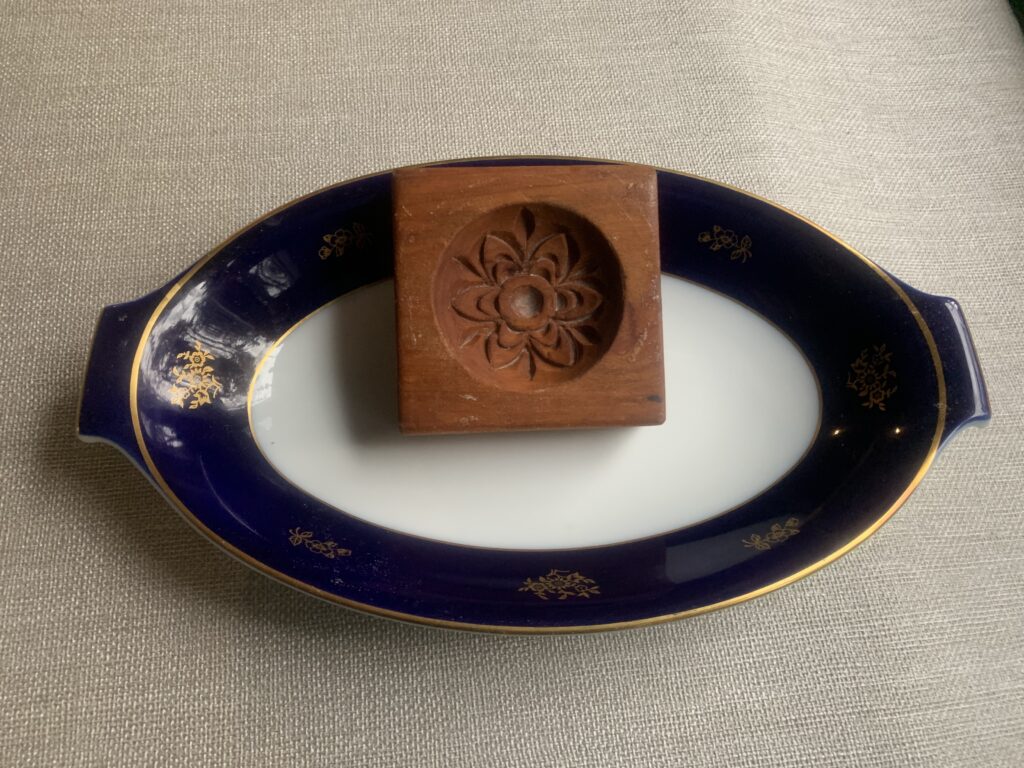
Our favorite mold for individual Filled Speculaas (and gingerbreads of all kinds). We bought it at an actual castle on a trip to visit family in the Czech Republic! It was actually called a “butter mold” rather than a cookie mold, not that it makes any difference.
This Ma’amoul mold would have also worked, but can you imagine the amount of almond paste in each cookie?
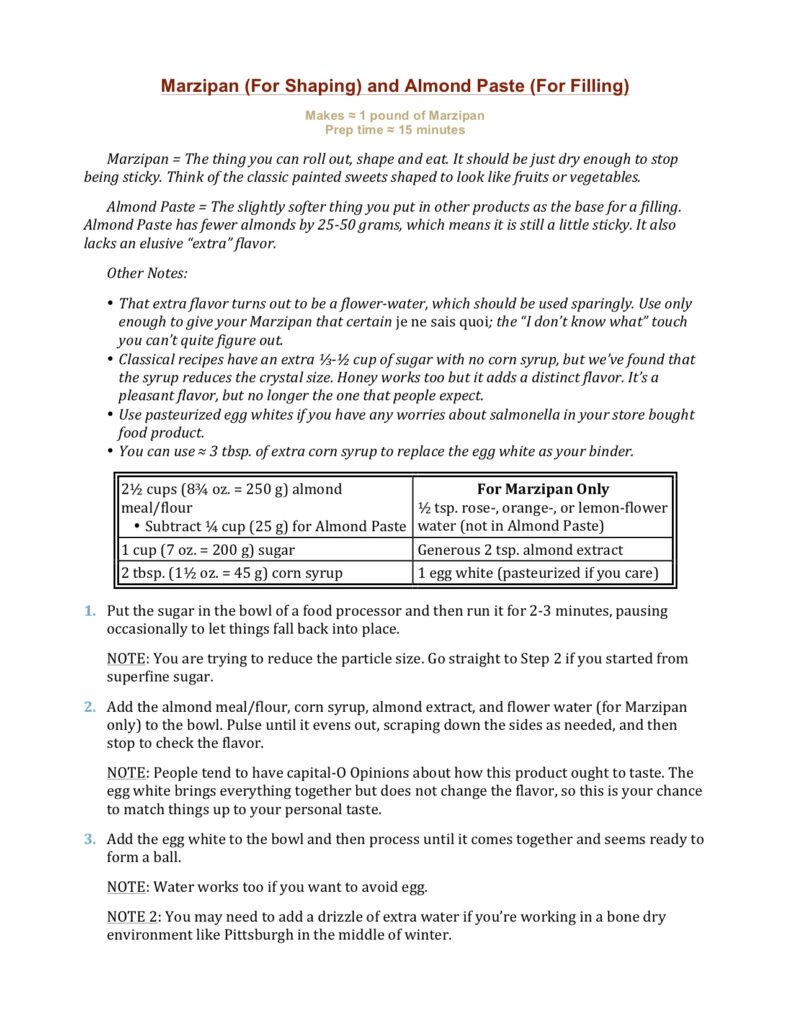
  1. Fill a bowl with with rice/corn/tapioca flour. Spoon this in to fill your mold, turn it over to pour the excess back into your bowl, and then rap the back firmly to knock off any excess. Voila! A perfectly dusted mold. (See the articles on the Speculaas Master Class and Filled Gingerbread cookies for more variations and details). FYI, we used this mold to make individual portions:
  2. Roll the dough out to ¼” thick (thicker for a larger mold, of course), and then cut out a piece of dough just large enough to fit inside the entire mold while leaving a thin rim of dough up and over the side of the mold. Use well-dusted to press it gently into the pattern. NOTE: Too much dough is better than too little since you can always trim. NOTE #2: Holes aren’t a disaster. Patch them by pressing in extra dough with your floured fingertips. It will subtract from the inside space by a smidgen, but no one should see it when the cookies are baked.
  3. Add a filling of your choice to a level that reaches level with the top of the mold. REMEMBER: That does NOT mean the top of your dough rim around the edge! Do that and you’ll have too much filling, which will lead to leaking, bursting, and other bad results.
  4. Roll and cut out a second piece of dough sufficient to cover the filled in mold. Place this on top and then run a rolling pin over the entire thing to join the seams. Tap the filled cookie out with the mold-side up, and then use a paring knife to clean up the edges.
  5. Array on a lined baking sheet, and then chill in the refrigerator for at least 15-30 minutes. This will help to keep the pattern a little sharper.
  6. Bake at 350° F (175° C) until the edges are firm. It took ≈11-12 minutes for our smaller mold, but will obviously vary according to the size and thickness of the one you choose to use.

NOTE: It’s a good idea to precook any jam filling before you use it (simply bring it to a boil in the microwave or a small pan). Raw jam tries very, very hard to find a crack it can seep out of. The precooked jam is much, much less runny and will only seep out if you’ve made a noticeable mistake in sealing things up.

Cookie “Dumplings” and “Ravioli”!

Note the extra thick amount of almond inside
Our handy dandy dumpling press, last used when we were working up the recipe for Croatian Rafioli

NOTE: This method uses a bit more almond paste per piece. It should also work with a pre-cooked fruit filling, but we haven’t tried it.

  1. Roll out the Speculaas dough to ⅜” thick, cut out a circle the right size to fit your handy dandy dumpling press, and then fill it with a football-shaped piece of almond paste. Squeeze gently to seal the edges.
  2. Array on a parchment lined baking sheet as you pop the piece out of the press. Leave 1” between each one to account for spreading.
  3. Bake at 350° F (175° C) until the edges are firm. It took ≈ 10 minutes for ours, but we anted to make sure they were baked all the way through.
  4. Leave the cookies on the tray for 10 minutes and then move to a rack to cool completely.

Thumbprints! [No Photo]

Duh. I can’t believe I didn’t think of this in time to get some done for the photo shoot. Bad baker. Bad, bad, bad. No biscuit for you.

  1. Roll the dough into balls ≈ 1¼” in diameter.
  2. Use the handle of a wooden spoon to poke a deep hole, and then fill that hole with almond paste.
  3. Array on a parchment lined baking sheet, and give each ball a gentle squish to make sure it will stay in position with the almond paste facing up. Keep 1-2” in between each piece to account for spreading.
  4. Bake at 350° F (175° C) for ≈ 10-12 minutes, or until the edges are firm.

Bake-And-Slice Rolls and Rectangles!

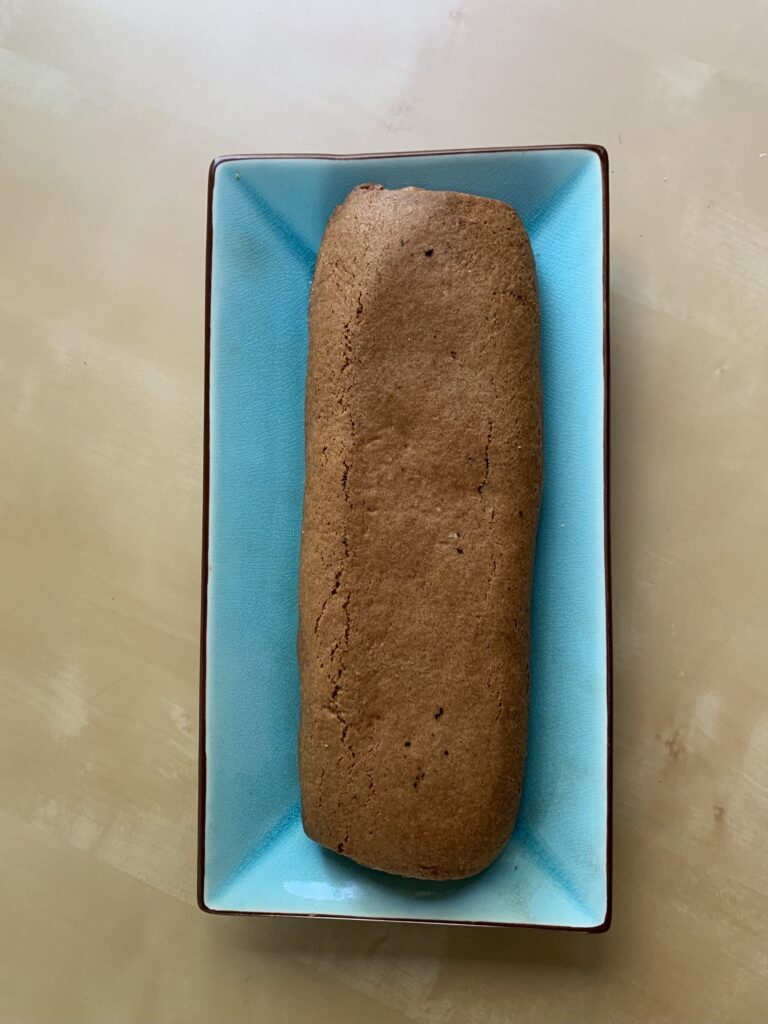
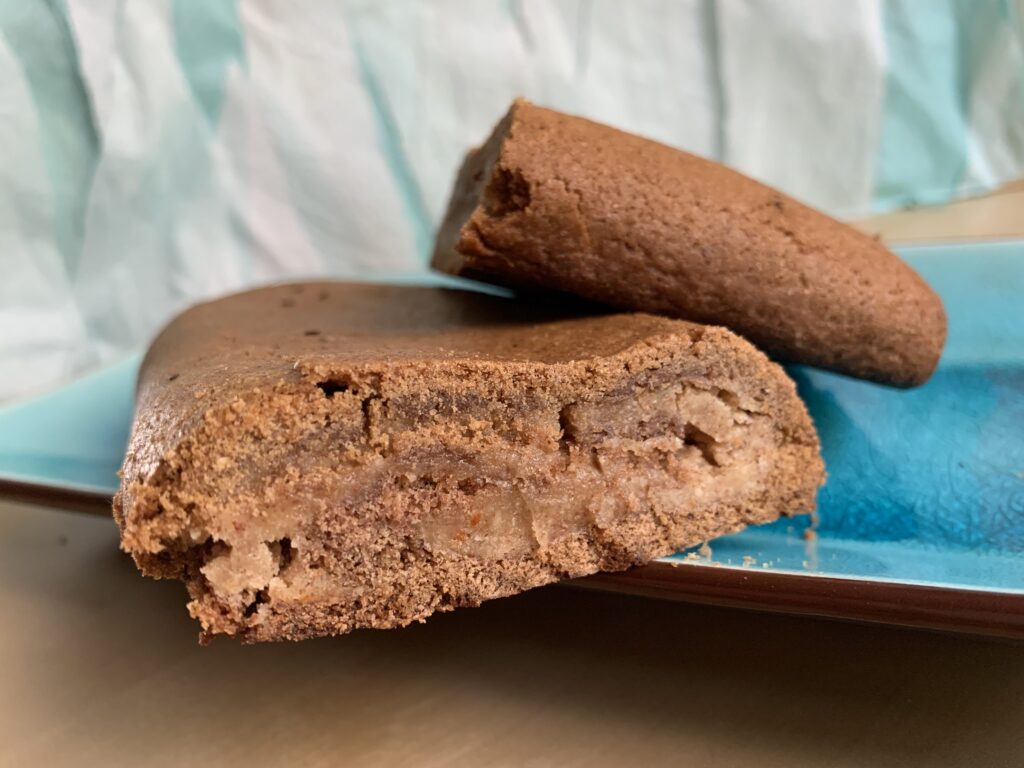
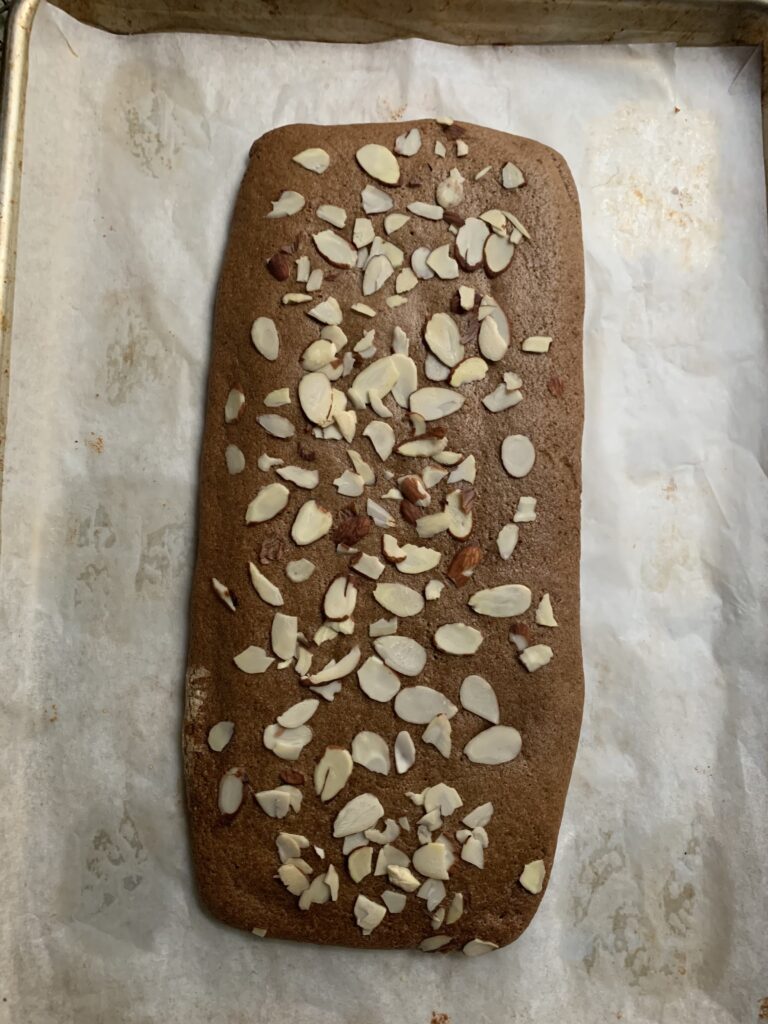
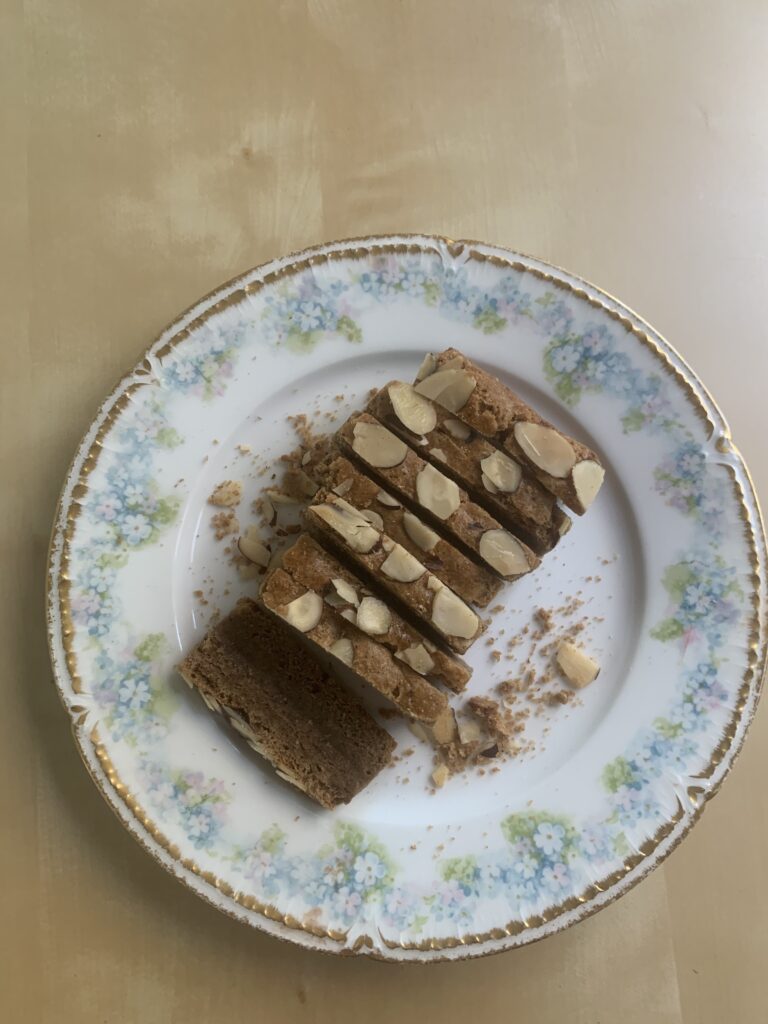
This began it’s life as a Spiral Cookie roll. It was baked before slicing, which allowed it to slump into a rectangle.
The flattened spiral from a baked-before-slicing roll.
  1. Make a roll as described above for Spiral or Bullseye cookies, but a little thicker. You achieve this by starting with a 13” x 8” (33 cm x 21 cm) rectangle.
  2. Bake at 350° F (175° C) for ≈20 minutes, or until the outside is firm, the tube has slumped down into a rectangular “cake”, and cookies have puffed.
  3. Let this set on the tray for ≈5 minute, and then move to a rack to cool completely. Slice with a thin, sharp, serrated knife after it’s completely cool. You will end up with elongated, almost-rectangular spirals.
A “Bullseye Cookie” bar decorated with almond slices. We tried to have this one start as a filled rectangle instead of a roll, but that only enhanced the slumping. Still tasty, and kind of nice if you want the sharper edges in the end.

Don’t Bother To Fill At All

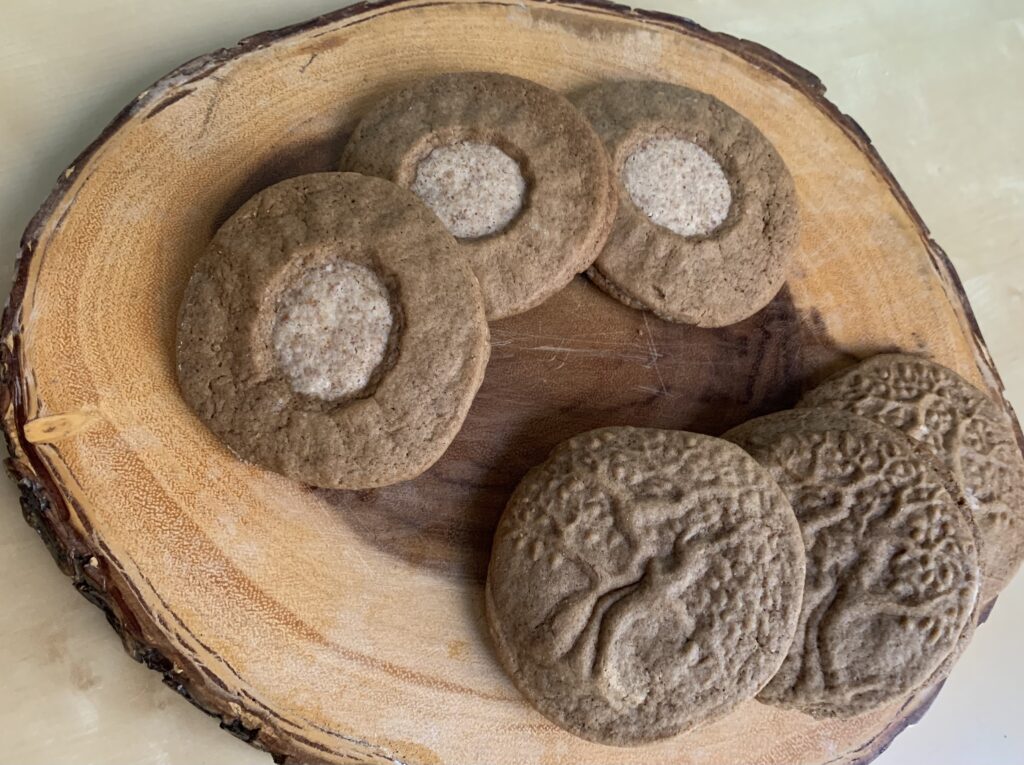
Straight, unfilled Speculaas made from this dough. Not bad, are they?

The dough works fine as a plain old Speculaas cookie pressed into a mold. It doesn’t hold patterns quite as well as the 100% Authentic Speculaas, but it’s pretty darned close. Bake according to the instructions in that article using 350° F (175° C) instead of 375° F (190° C). The molasses in the U.S. brown sugar apparently makes them cook just that little bit faster.

NOTE: You may (may, not will) want to knead in a small amount of extra flour or starch if the dough is particularly soft and sticky. That’s a useful characteristic for the many methods described above, but can result in either sticking or unreliable patterns for straight-out molded cookies. Be judicious, as it won’t take much.

CONCLUSION

The dough is standard and easy. The almond paste is standard and easy. The shaping is fun and interesting once you pick a method (and get used to liking off almond paste from your fingers). And the flavor is just about perfect if you want the world’s friendliest, most accessible, spice cookie treat.

What’s not to love?

We urge you to give it a try. If you do, there’s basically no way it’s ever going to leave your repertoire. They are, as our English friends say, intensely “more-ish.”

Enjoy!

IMPORTANT:
You want to make Almond Paste for Gevulde (Filled) Speculaas, not marzipan

SPECULAAS (a/k/a SPECULOOS) MASTER CLASS – An authentic recipe from a Dutch master

A thin, crispy, addictive, and not-too-sweet spice cookie that everyone will adore.

This will be a long post, so please take our standard suggestion seriously:

As always, skip to the bottom if you are only here for the recipe. The discussion of our stumbles and revelations along the way is going to take some time.

INTRODUCTION

I began this research with a simple enough goal. Heritage Cookies of the Old and New World has a recipe for Nut Dough Speculaas, but doesn’t have one for the light, thin, crispy version. This was because I couldn’t get them right enough to meet our somewhat extreme standards.

That has now been remedied thanks to the Specifically Spectacular Speculaas Facebook Group. What follows is my tale of working through all the details in the 100% authentic recipe shared by one of that group’s guiding stars: a fantastic Dutch baker named Luc Longin.

Luc’s recipe features some hard to find ingredients which actually matter (see below), and has methodologies for both the dough and the shaping that were new to my experience. Still, it was a recipe that’s worked for hundreds of people over dozens, if not hundreds of years. All I had to do was work it through, keeping some careful notes. Right? Yeah. Sure.

This article ends with a slightly adapted version of Luc’s recipe (we had to cut the leavening by a hair), but getting there turned out to be quite the adventure. I had to tweak our much-loved Speculaas spice mix. I had to bone up on my chemistry to understand how Belgian Brown Sugar differed from its peers, and why it acted differently in a cookie. Then came a comparison of Luc’s recipe to those in our book, the America’s Test Kitchen files, the Seriouseats.com formula, and an English version from Yotam Ottolenghi. After that came the study of Luc’s technical tricks. And then developing half a dozen different ways to make Gevulde (Filled) Speculaas; a Dutch (but not Belgian) holiday treat that will get its own article. All while compiling a list of sources for key ingredients and other materials.

Why can’t anything be simple? [Sigh]

That’s the “fair warning” part. The advertisement is this: all of that was absolutely fascinating, a joy to learn, and has made us better bakers. And, of course, produced some decidedly awesome (specifically spectacular?) recipes. So as that other [ahem] hefty man used to say, And awaaay we go!

HOW DO YOU DEFINE “SPECULAAS” IN THE FIRST PLACE?

Speculaas a/k/a Speculoos have a range that centers on Belgium and the Netherlands, and spreads out into the greater Rhineland, parts of northern France, and specialty shops across the continent. The feature a cinnamon-heavy spice mix that can be used in multiple ways, with several commercial versions and even more that are made at home. All those versions differ in their details, but share a common root; they are “friendly,” “accessible,” “easy to like,” and “familiar.” This spice mix explains why Speculaas are the place to start if you want to hook someone on the basic idea of a spice cookie. They are the cookie that doesn’t bite you back.

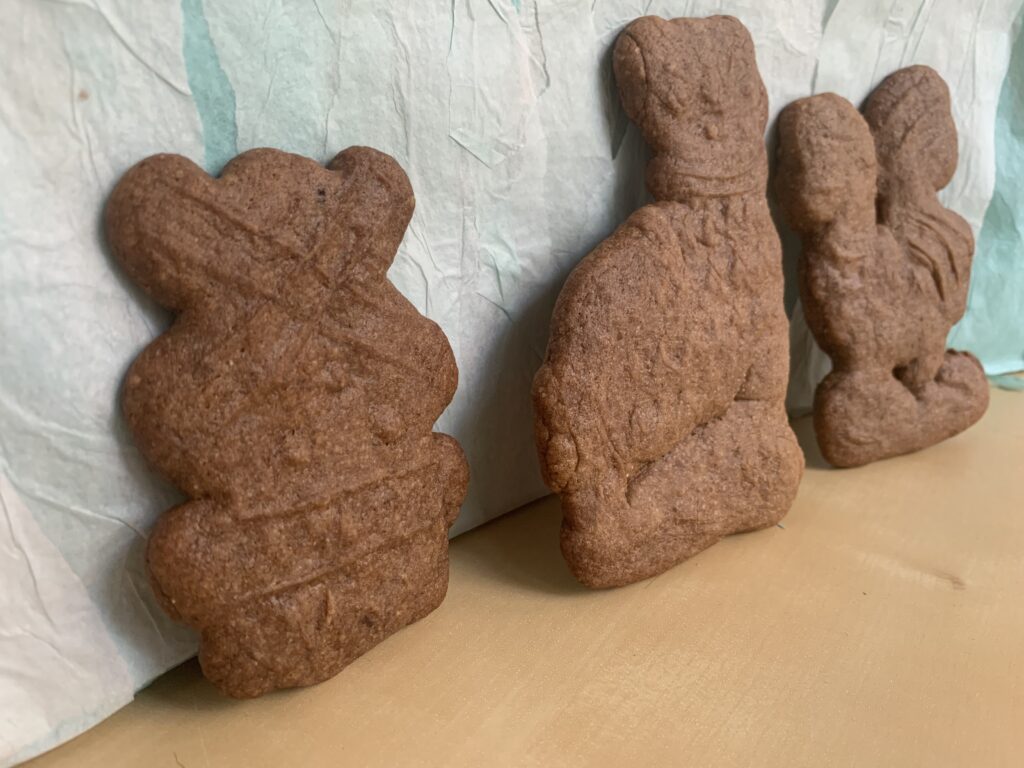
Standard Speculaas (those that don’t require an adjective in the name) are also thin, light, and crispy. Most will be formed in a wooden mold before baking (the name comes from the latin word “speculum,” meaning “mirror”). And those molds are shallower than Springerle molds, tend to be less detailed, and are also relatively large.

Have you ever seen those photos of a child clutching a person-shaped “cookie” almost as big as they are? That will be a Speculaa. Even the normal ones are relatively big. Our pussycat mold (see below) makes a cookie just short of 5″across. You know those “monster sized” chocolate chip cookies that mall stores used to tout? 3″ diameter, or 4″ at the most. OTOH, the actual volume isn’t that high because Speculaas are so thin.

Finally, the dough cannot be overly sweet, and must have some caramel notes. In sum, the purest definition would describe a thin, crisp, only-sweet-enough, child-friendly spice cookie formed in a shallow wooden mold. The tree branches out from there.

Our three molds: the pussycat, the windmill, and the rooster

One easy and common path avoids the molds in favor of a large, thin, roll-and-cut cookie. Try decorating the top with some almond slices held on by egg wash just to fancy them up. Another limb leads off into filled Speculaas, which can be a bar cookie, a sliced roll similar to Fig Bars, something that can be done as a Molded Gingerbread Cookie, or almost any other type of filled cookie. Almond paste does not spread as it bakes, which opens up a vast range of possibilities.

A third branch will shrug and either accept or embrace a soft texture, like the Heritage Cookies recipe that uses regular brown sugar with some nut flour. There are probably fourth and fifth branches too, though I can’t think of them off the top of my head.

The further you get from that light, thin, and crispy molded cookie, the more a purist could complain that you are “wrong.” But we are bakers, not professors! Kate and I will argue that nothing is out of bounds so long as you know where the trunk of the tree lies, and add a description to the name. Chewy Speculaas, Filled Speculaas, Nut Dough Speculaas, and maybe even Cinnamon Spice Speculaas are all legitimate since they give fair warning that you’ve headed out into the suburbs.

LUC LONGIN’S RECIPE

NOTE: This recipe originates with Mssr. Luc Longin of Belgium, and I hope you will join me in a nod of grateful thanks for his generosity. This goes to examples of Luc’s work, including both cookies and specialty molds. Video #1 (multiple small figures) and video #2 (one huge figure) demonstrate the molding tricks I will try to describe in words down below. Luc’s American counterpart, Andrea Hampton, also provided invaluable assistance as both an inspiration and a bouncing board. She owns the Sweet Impressions Bakery in upstate New York, between Rochester and Syracuse to the north of the Finger Lakes. You won’t find anyone on this continent who’s better, and I’m honestly not sure about anyone, anywhere.

You may also want to know that the two of them collect, refurbish, and sell high end, often historic molds. There are plenty of cheap ones out there (like our old tourist pieces), and also some modern knockoffs, but Luc and Andrea are the place to go for potential heirlooms if this article gets you hooked.

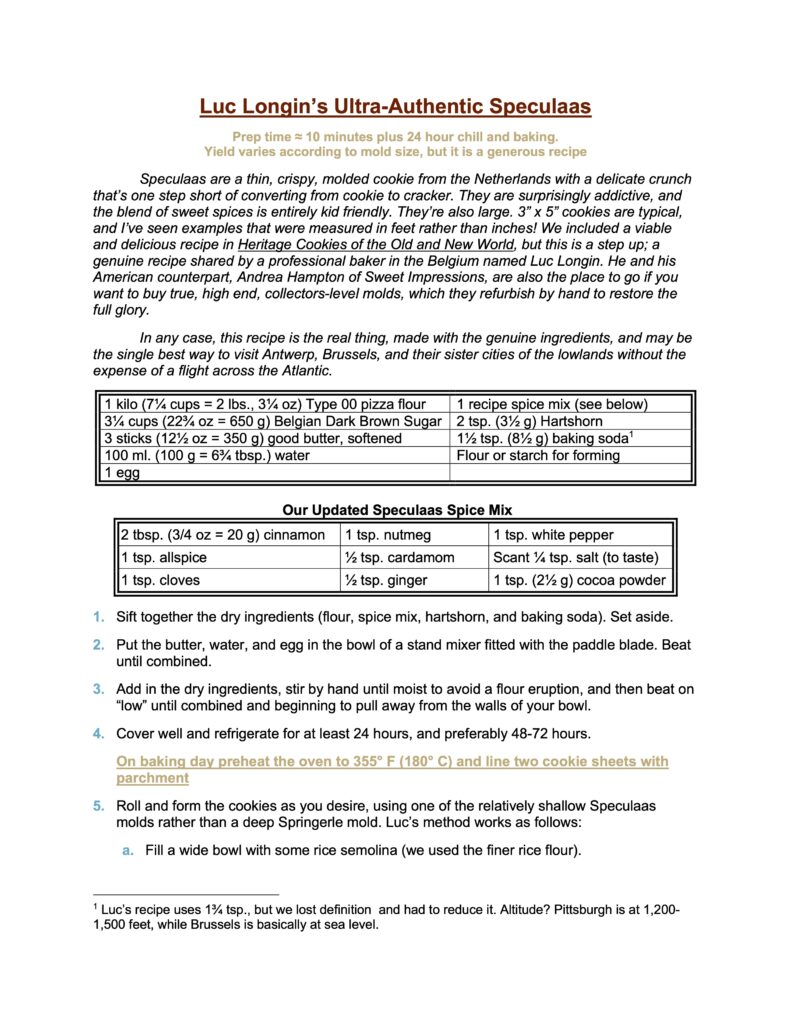
Okay, so here is the original Luc Longin recipe that set me off on this deep dive into the ocean of authenticity:

Read that through and you’ll see a number of ingredients that aren’t exactly common in a U.S. supermarket.

UNDERSTANDING THE INGREDIENTS, AND HOW THEY MATTER

  • “Type 00” flour.

“Type 00” refers to a super-fine grind, not to a protein content. We tested a few different products and found that “Type 00 pizza flour” worked better than “pasta flour”. King Arthur Flour sells a good product that is easy to find online. We bought ours down at Penn Mac in Pittsburgh’s Strip District, which supplies a lot of our Italian community.

All purpose flour will also work until you get to that last 5%. The difference only becomes apparent when you employ a traditional cookie mold. The finer “Type 00” yields slightly sharper features. Just be aware that “Type 00” weighs a little bit less than AP! Substitute by weight, not volume.

ADDITIONAL NOTE: Speculaas fan Carolyn Koss Kasten adds: “Pizza flour is more successful in speculaas than pasta flour due to the use of soft wheat in most commercially available pizza flour blends. Soft wheat has a lot of extensibility without the enhanced elasticity of modern hard wheats. This results in much better impression retention and very little deformation of the cookies as they bake. If you search my name in the [Specifically Spectacular Speculaas] group, you can see some extensive flour testing and discussion about that.

  • Belgian Dark Brown Candi Sugar

This is the elephant in the pantry.

Belgian brown sugar is not the same thing as U.S. brown sugar. The American version is made by adding molasses back into white cane sugar (pure sucrose) at a ratio of 1 tbsp. per cup for light brown sugar, and 2 tbsp. per cup for dark. Belgian brown sugar, a byproduct of the candy making industry, differs in several aspects:

  1. It is made from “invert sugar,” meaning sucrose that has been treated with an acid to break a portion of it down into glucose and fructose. Those two component sugars, added together, end up being a little less sweet than pure sucrose. Reason #1 why Speculaas seem less sugary.
  2. The invert sugar (sucrose, glucose, and fructose) is then caramelized to a medium or dark brown color as desired. The darker the caramel, the deeper the flavor and the lower the level of sweetness. Reason #2. FWIW, Luc recommends the darker brown, least sweet version.
  3. Belgian brown sugar also starts from beet sugar instead of cane, but that becomes an imperceptibly subtle distinction after going through the inversion and caramelization steps.

This link goes to the hard-to-find Couplet brand that Mssr. Longin recommends, while this link goes to the competing Brun Fonce brand that is readily available in U.S. homebrewing stores. True fanatics can also make their own as outlined in this phenomenal article meant for large scale home brewers. (Brewers love Belgian Brown Sugar because it doesn’t make the yeast go nuts, and also leaves residual components to add both flavor and mouthfeel).

‘But Scott, what if I only want to get close enough to the real thing without going to all the effort of finding this kind of specialty ingredient?’

Fair point. We have found three alternatives, in descending order of preference:

  1. The inestimable Stella Parks of Seriouseats.com, a self avowed Speculaas fanatic, likes to make a “toasted sugar” facsimile of Belgian Brown Sugar. Spread your desired weight out on a tray, and roast it at 300°F (150°C) for 4-5 hours, stirring occasionally, until you get the color you want. Grind the result in a food processor to break up the clumps, and proceed. Toasted sugar differs from the real thing because it is caramalized sucrose rather than caramelized invert sugar, but it is the closest alternative we know of.
  2. America’s Test Kitchen suggests ground turbinado sugar as an easier alternative. Chemically, turbinado is the same thing as American light brown sugar with half as much molasses; i.e., 1 tbsp. for two cups of sugar instead of 1:1. It’s also made with vastly larger crystals, a feature that alters the way it behaves in baked goods. The fine folks at ATK found that finely ground turbinado gave the required hit of caramel flavor without making their cookies too soft. We haven’t tried it, but that is a very reliable group of test cooks and I’m willing to take their word for it.
  3. Plain, old brown sugar from the supermarket is the least desirable substitute. Make no mistake: it will make you a truly delicious cookie! There are just two issues. First, it is noticeably sweeter, and this is a cookie that should be only sweet enough. And second, the hygroscopic powers of the molasses will quickly soften the cookies as you store them. In other words, they’ll be crisp when they come out of the oven, but will soften by the next morning. We use brown sugar for Gevulde (Filled) Speculaas and our Nut Dough Speculaas, but cannot recommend it for making the thin and crispy version that requires no disclaimer in the name.

Hartshorn, a/k/a Baker’s Ammonia, a/k/a ammonium chloride, a/k/a smelling salts is an old frenemy we discussed at length in Heritage Cookies Volume 1, our study of the ultra-leavened Hungarian Kvircedli, and most recently in a page on this website devoted to the whats, whens, hows, and whys of chemical leavening agents in general. It makes sense to use it here because hartshorn yields a finer, more even aeration than other chemical leavening agents. Combining it with baking soda yields the exact crumb you want for truly authentic Speculaas.

Baking soda alone will work, but the cookies will lose some definition. Not a problem unless you use a mold, since cookies without Hartshorn will rarely have good, sharp features. Certainly not reliably sharp.

In fact, the only change we recommend to Luc’s recipe is to lower the amount of baking soda by ¼ tsp. It may be altitude (our home sits at around 1,150 feet above sea level), or it may be some other subtlety, but we found that we lost some resolution when using the recommended 1¾ tsp. of baking soda along with 2 tsp. of hartshorn. Cutting back to 1½ tsp. of baking soda fixed that. I would experiment with even lower amounts if we used molds with finer features.

  • Good Butter

Both Andrea and Luc started their advice with a warning that I really, really needed to replace American supermarket butter with a high end European product like Ireland’s Kerrygold brand. Nor were they the only ones! The online community of cookie nerds unanimously echoed the point: Use The Best Butter That Money Can Buy! Still, that is a pretty major expense and so I decided to test it. Would the the luxury product really make a difference? How big a difference?

The experiment went like this. First, I made a single batch of dough containing everything but the butter. I used a scale to divide that dough into three equal parts, all of which were too dry to stick together, and then mixed in different butters to each portion in order to complete the dough. For the first I put in Kerrygold; the second got Land O’Lakes; and the third got Land O’Lakes enhanced by the ¼ tsp. of ghee required to give it exactly the same butterfat content as Kerrygold (¾ tsp. would have been needed for a full recipe).

I baked each batch with a secret, only-known-to-me appearance change, and then asked no less than fifteen (15) taste testers to give me their opinion. Skill levels ranged from expert bakers to cookie consumers who don’t know one end of a baking pan from the other.

The result? Everyone loved the cookie. Speculaas are a huge crowd pleaser! A clear majority also commented on the lack of sweetness, saying it was a relief compared to “normal” cookies. But the butter? No one – not a single person! – could tell any difference. Two people preferred the Kerrygold; two preferred the Land O’Lakes; one preferred the enhanced Land O’Lakes; and ten of the fifteen thought I was playing some kind of trick by giving them identical products. Which may say something about how people view me… but never mind.

Take from that what you will. Experts in the field say that luxury butter makes a very noticeable improvement. Experiments in the field said the opposite. Me? I just want another cookie.

THE TECHNIQUE WAS A REVELATION

Admission time: I tried several things to “improve” on Mssr. Longin’s seemingly blunt instructions. Every single change I made hurt the final product. And I mean those words literally. Every change made an actual difference, and that difference made the cookie a little bit worse in some way or another.

  • How To Make The Dough

Go back and read the recipe. Luc mixes together the butter, egg, and water, and then kneads in the sugar and the dry ingredients. That’s it. Period.

I figured things might work better if I creamed the butter and sugar together before adding in the other ingredients. That’s standard Cookie Making 101, right? Wrong. The cookies came out almost fluffy, with next to no definition, and a distinct lack of the all-important crunch. The experiment earned me nothing but egg on my face rather than egg in the bowl.

On the left, made with creamed butter. On the right, simply mixed.
Same thing. Too much leavening or creamed butter, vs. simply mixed
And a third time. Don’t cream the butter, and don’t add too much leavener!

Do as I say, not as I did. Just get it all combined and proceed from there. Don’t cream the butter first. And don’t even think about cutting in cold butter in some sort of abortive effort to enhance things with crispy layers. Go simple.

I got saved from blunder #2 because I had the smarts to talk about blunder #1 with the experts, Andrea and Luc. When they got done e-snickering, e-chiding, and e-eye rolling at my expense, they dropped a pearl that saved me from another wasted batch. Letting the dough sit in the fridge for 1-3 days is not a matter of convenience, nor of relaxing the gluten. This dough is carefully calibrated to have just enough moisture to hold together with very little more, and it has a lot of flour. That long wait allows the spice flavors to meld, while giving the flour particles a chance to hydrate evenly.

  • How To Use A Speculaas Plank

Blunder #3 came from trying to do a shortcut in the molding process. Luc’s videos start with a wide bowl or tray of rice flour. He uses that to fill the mold all the way up, dumps that powder back into the bowl, and then knocks on the back of the mold to remove the excess. The result? A perfectly dusted mold every time, without any need for buttering or oiling.

It occurred to me that I had extra, powder-fine, “Type 00” flour on hand, and might as well use it up. Efficiency matters, right? [Sigh] Yes, it worked well enough. The figures released with a single whack. Two at the most. But they were just a little… unfocused, even before baking. Their trip through the oven only enhanced that, leaving me with shapes rather than figures.

The next time through I pulled rice flour from the pantry and used that. Presto changeo! The figures came out even more easily, and were that much sharper. I haven’t tested it, but we are convinced that corn starch, tapioca starch, and similar powders should work equally well.

These are Gevulde (Filled) Speculaas, but make the point. The one on the left was done in a flour-dusted mold with extra leavening. The one on the right was dusted with rice starch and the reduced amount of baking soda.

Blunder #4 happened because I am a knife geek. Luc fills each powdered mold with softened dough, rolls it to fill in all the nooks and crannies, and then cuts off the excess to leave the cookie backs exposed. The videos clearly use a serrated slicing knife to cut off the extra dough. Clearly and obviously.

Did you know that every knife is actually a serrated knife? When you get down to the microscopic level, even the keenest blade is actually made of tiny teeth that saw through their target. This is why you use a slicing motion when using a kitchen knife instead of pressing straight down. That motion amounts to pushing and drawing the “saw.”

I keep my knives very, very sharp. The dullest one is the bread knife, because large serrations are that much harder to hone. A nice, thin, extra sharp blade would obviously work even better than the bread knife. Right? It’s nothing but physics in action! Right?

The answer is, “no.” Our thinnest, sharpest blades caught on the dough no matter what, and kept pulling pieces out of the mold. Our serrated bread knife worked far better, especially when used in very small back-and-forth sawing motions.

Some people never learn.

OTHER NOTES

None. Well, almost none. We developed an excellent Speculaas Spice Mix while working on recipes for Heritage Cookies Of the Old And New World. I use it all the time as my “starter mix” when making a spiced cookie for children and other tender palates. With all this testing, however, Kate began to find the mix a little cloying and simplistic. I solved this by doubling the amount of pepper from ½ tsp. up to a generous 1 tsp., and using white pepper instead of black. That gave it just enough bite to satisfy a grownup palate too.

The recipe below includes the higher amount. Feel free to cut it back if you’re targeting younger appetites.

CONCLUSION

This has been an exceptionally long journey for what’s actually a simple cookie. Yes, a lot of that came from experiments to confirm or belie the importance of European ingredients that can be hard to find here in the U.S., and more came from testing out different substitutions. But some of the wasted time came from me trying to gild the lily. Don’t waste time doing anything more than mixing the ingredients together, and don’t look for false economies like using extra fine flour instead of starch when you’re dusting the molds.

Do follow the very simple instructions, including the extended wait time between making the dough and using it.

What you’ll get is a really special cookie that is light, crisp, delicately spiced, and only as sweet as they need to be. Sort of like a big old grin from your favorite Uncle as you pop in for a holiday. You just can’t help but smile back, and that is the magic of genuine, ultra-authentic Speculaas.

A 100% guaranteed crowd pleaser

PART II GEVULDE (FILLED) SPECULAAS

That link will take you to the follow-up article, which includes a recipe for dough made with standard U.S. ingredients, a customized recipe for almond paste filling, and looooong instructions on a full dozen different ways to shape the filled Speculaas to maximum effect. As in…

An array of different Gevulde (Filled) Speculaas