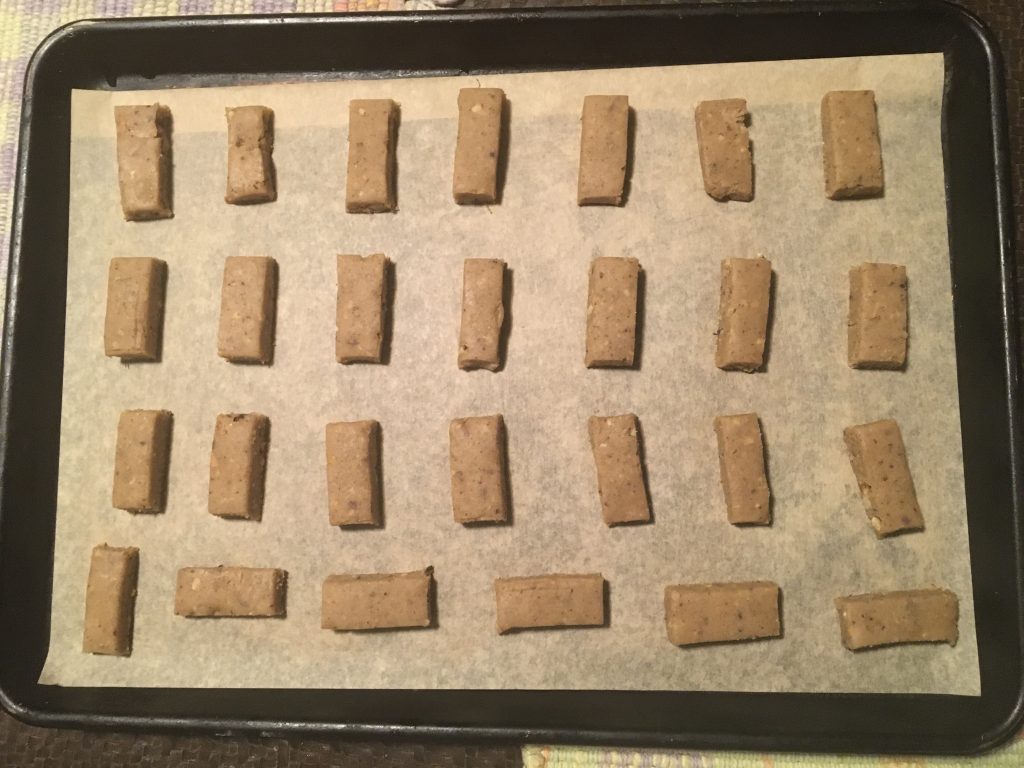
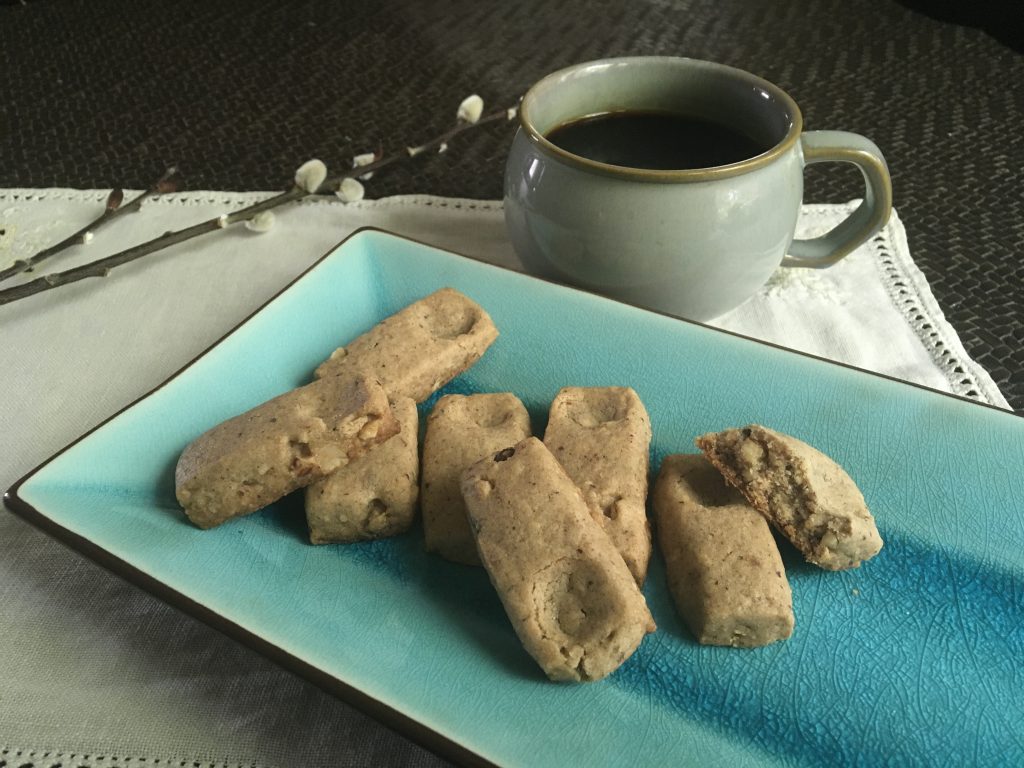
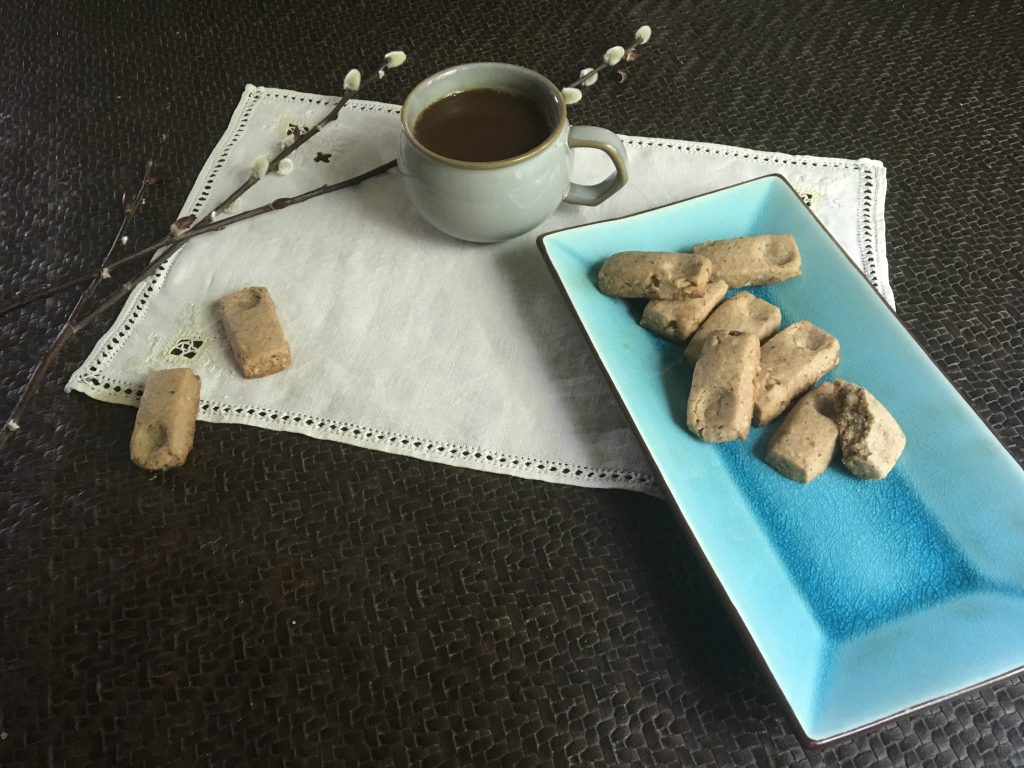
This will be a long post, so please take our standard suggestion seriously:
As always, skip to the bottom if you are only here for the recipe. The discussion of our stumbles and revelations along the way is going to take some time.
INTRODUCTION
I began this research with a simple enough goal. Heritage Cookies of the Old and New World has a recipe for Nut Dough Speculaas, but doesn’t have one for the light, thin, crispy version. This was because I couldn’t get them right enough to meet our somewhat extreme standards.
That has now been remedied thanks to the Specifically Spectacular Speculaas Facebook Group. What follows is my tale of working through all the details in the 100% authentic recipe shared by one of that group’s guiding stars: a fantastic Dutch baker named Luc Longin.
Luc’s recipe features some hard to find ingredients which actually matter (see below), and has methodologies for both the dough and the shaping that were new to my experience. Still, it was a recipe that’s worked for hundreds of people over dozens, if not hundreds of years. All I had to do was work it through, keeping some careful notes. Right? Yeah. Sure.
This article ends with a slightly adapted version of Luc’s recipe (we had to cut the leavening by a hair), but getting there turned out to be quite the adventure. I had to tweak our much-loved Speculaas spice mix. I had to bone up on my chemistry to understand how Belgian Brown Sugar differed from its peers, and why it acted differently in a cookie. Then came a comparison of Luc’s recipe to those in our book, the America’s Test Kitchen files, the Seriouseats.com formula, and an English version from Yotam Ottolenghi. After that came the study of Luc’s technical tricks. And then developing half a dozen different ways to make Gevulde (Filled) Speculaas; a Dutch (but not Belgian) holiday treat that will get its own article. All while compiling a list of sources for key ingredients and other materials.
Why can’t anything be simple? [Sigh]
That’s the “fair warning” part. The advertisement is this: all of that was absolutely fascinating, a joy to learn, and has made us better bakers. And, of course, produced some decidedly awesome (specifically spectacular?) recipes. So as that other [ahem] hefty man used to say, And awaaay we go!
HOW DO YOU DEFINE “SPECULAAS” IN THE FIRST PLACE?

Speculaas a/k/a Speculoos have a range that centers on Belgium and the Netherlands, and spreads out into the greater Rhineland, parts of northern France, and specialty shops across the continent. The feature a cinnamon-heavy spice mix that can be used in multiple ways, with several commercial versions and even more that are made at home. All those versions differ in their details, but share a common root; they are “friendly,” “accessible,” “easy to like,” and “familiar.” This spice mix explains why Speculaas are the place to start if you want to hook someone on the basic idea of a spice cookie. They are the cookie that doesn’t bite you back.
Standard Speculaas (those that don’t require an adjective in the name) are also thin, light, and crispy. Most will be formed in a wooden mold before baking (the name comes from the latin word “speculum,” meaning “mirror”). And those molds are shallower than Springerle molds, tend to be less detailed, and are also relatively large.
Have you ever seen those photos of a child clutching a person-shaped “cookie” almost as big as they are? That will be a Speculaa. Even the normal ones are relatively big. Our pussycat mold (see below) makes a cookie just short of 5″across. You know those “monster sized” chocolate chip cookies that mall stores used to tout? 3″ diameter, or 4″ at the most. OTOH, the actual volume isn’t that high because Speculaas are so thin.
Finally, the dough cannot be overly sweet, and must have some caramel notes. In sum, the purest definition would describe a thin, crisp, only-sweet-enough, child-friendly spice cookie formed in a shallow wooden mold. The tree branches out from there.

One easy and common path avoids the molds in favor of a large, thin, roll-and-cut cookie. Try decorating the top with some almond slices held on by egg wash just to fancy them up. Another limb leads off into filled Speculaas, which can be a bar cookie, a sliced roll similar to Fig Bars, something that can be done as a Molded Gingerbread Cookie, or almost any other type of filled cookie. Almond paste does not spread as it bakes, which opens up a vast range of possibilities.
A third branch will shrug and either accept or embrace a soft texture, like the Heritage Cookies recipe that uses regular brown sugar with some nut flour. There are probably fourth and fifth branches too, though I can’t think of them off the top of my head.
The further you get from that light, thin, and crispy molded cookie, the more a purist could complain that you are “wrong.” But we are bakers, not professors! Kate and I will argue that nothing is out of bounds so long as you know where the trunk of the tree lies, and add a description to the name. Chewy Speculaas, Filled Speculaas, Nut Dough Speculaas, and maybe even Cinnamon Spice Speculaas are all legitimate since they give fair warning that you’ve headed out into the suburbs.
LUC LONGIN’S RECIPE
NOTE: This recipe originates with Mssr. Luc Longin of Belgium, and I hope you will join me in a nod of grateful thanks for his generosity. This goes to examples of Luc’s work, including both cookies and specialty molds. Video #1 (multiple small figures) and video #2 (one huge figure) demonstrate the molding tricks I will try to describe in words down below. Luc’s American counterpart, Andrea Hampton, also provided invaluable assistance as both an inspiration and a bouncing board. She owns the Sweet Impressions Bakery in upstate New York, between Rochester and Syracuse to the north of the Finger Lakes. You won’t find anyone on this continent who’s better, and I’m honestly not sure about anyone, anywhere.
You may also want to know that the two of them collect, refurbish, and sell high end, often historic molds. There are plenty of cheap ones out there (like our old tourist pieces), and also some modern knockoffs, but Luc and Andrea are the place to go for potential heirlooms if this article gets you hooked.
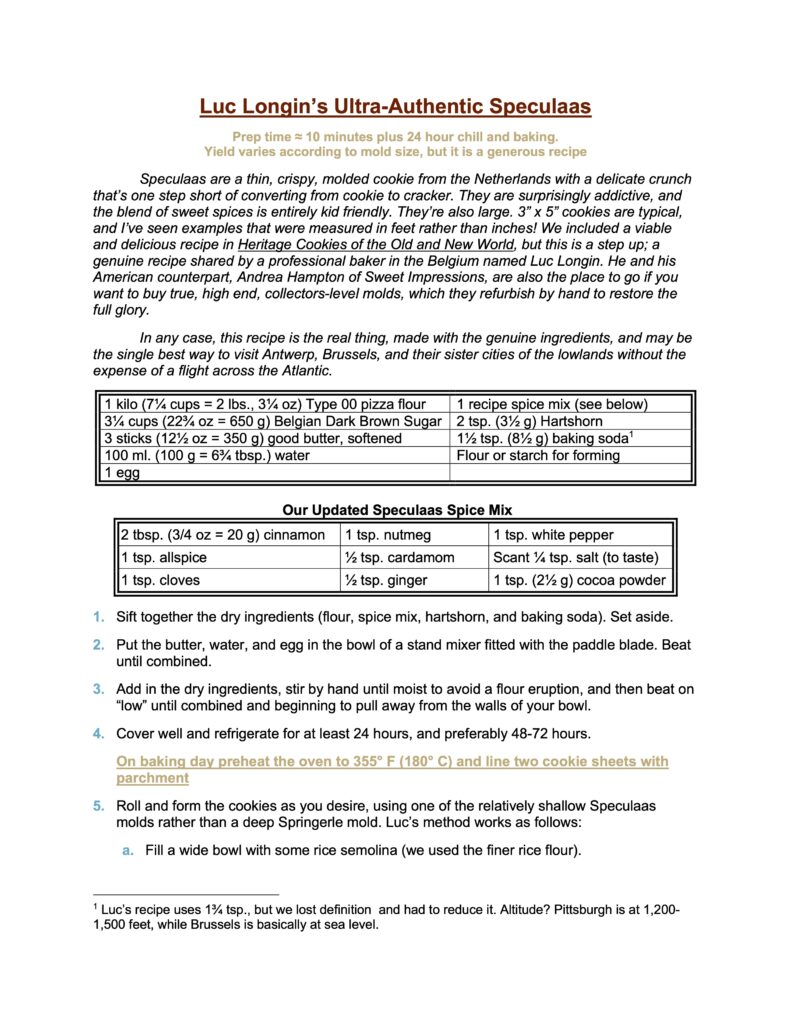
Okay, so here is the original Luc Longin recipe that set me off on this deep dive into the ocean of authenticity:
Read that through and you’ll see a number of ingredients that aren’t exactly common in a U.S. supermarket.
UNDERSTANDING THE INGREDIENTS, AND HOW THEY MATTER
- “Type 00” flour.
“Type 00” refers to a super-fine grind, not to a protein content. We tested a few different products and found that “Type 00 pizza flour” worked better than “pasta flour”. King Arthur Flour sells a good product that is easy to find online. We bought ours down at Penn Mac in Pittsburgh’s Strip District, which supplies a lot of our Italian community.
All purpose flour will also work until you get to that last 5%. The difference only becomes apparent when you employ a traditional cookie mold. The finer “Type 00” yields slightly sharper features. Just be aware that “Type 00” weighs a little bit less than AP! Substitute by weight, not volume.
ADDITIONAL NOTE: Speculaas fan Carolyn Koss Kasten adds: “Pizza flour is more successful in speculaas than pasta flour due to the use of soft wheat in most commercially available pizza flour blends. Soft wheat has a lot of extensibility without the enhanced elasticity of modern hard wheats. This results in much better impression retention and very little deformation of the cookies as they bake. If you search my name in the [Specifically Spectacular Speculaas] group, you can see some extensive flour testing and discussion about that.
- Belgian Dark Brown Candi Sugar
This is the elephant in the pantry.
Belgian brown sugar is not the same thing as U.S. brown sugar. The American version is made by adding molasses back into white cane sugar (pure sucrose) at a ratio of 1 tbsp. per cup for light brown sugar, and 2 tbsp. per cup for dark. Belgian brown sugar, a byproduct of the candy making industry, differs in several aspects:
- It is made from “invert sugar,” meaning sucrose that has been treated with an acid to break a portion of it down into glucose and fructose. Those two component sugars, added together, end up being a little less sweet than pure sucrose. Reason #1 why Speculaas seem less sugary.
- The invert sugar (sucrose, glucose, and fructose) is then caramelized to a medium or dark brown color as desired. The darker the caramel, the deeper the flavor and the lower the level of sweetness. Reason #2. FWIW, Luc recommends the darker brown, least sweet version.
- Belgian brown sugar also starts from beet sugar instead of cane, but that becomes an imperceptibly subtle distinction after going through the inversion and caramelization steps.
This link goes to the hard-to-find Couplet brand that Mssr. Longin recommends, while this link goes to the competing Brun Fonce brand that is readily available in U.S. homebrewing stores. True fanatics can also make their own as outlined in this phenomenal article meant for large scale home brewers. (Brewers love Belgian Brown Sugar because it doesn’t make the yeast go nuts, and also leaves residual components to add both flavor and mouthfeel).
‘But Scott, what if I only want to get close enough to the real thing without going to all the effort of finding this kind of specialty ingredient?’
Fair point. We have found three alternatives, in descending order of preference:
- The inestimable Stella Parks of Seriouseats.com, a self avowed Speculaas fanatic, likes to make a “toasted sugar” facsimile of Belgian Brown Sugar. Spread your desired weight out on a tray, and roast it at 300°F (150°C) for 4-5 hours, stirring occasionally, until you get the color you want. Grind the result in a food processor to break up the clumps, and proceed. Toasted sugar differs from the real thing because it is caramalized sucrose rather than caramelized invert sugar, but it is the closest alternative we know of.
- America’s Test Kitchen suggests ground turbinado sugar as an easier alternative. Chemically, turbinado is the same thing as American light brown sugar with half as much molasses; i.e., 1 tbsp. for two cups of sugar instead of 1:1. It’s also made with vastly larger crystals, a feature that alters the way it behaves in baked goods. The fine folks at ATK found that finely ground turbinado gave the required hit of caramel flavor without making their cookies too soft. We haven’t tried it, but that is a very reliable group of test cooks and I’m willing to take their word for it.
- Plain, old brown sugar from the supermarket is the least desirable substitute. Make no mistake: it will make you a truly delicious cookie! There are just two issues. First, it is noticeably sweeter, and this is a cookie that should be only sweet enough. And second, the hygroscopic powers of the molasses will quickly soften the cookies as you store them. In other words, they’ll be crisp when they come out of the oven, but will soften by the next morning. We use brown sugar for Gevulde (Filled) Speculaas and our Nut Dough Speculaas, but cannot recommend it for making the thin and crispy version that requires no disclaimer in the name.
Hartshorn, a/k/a Baker’s Ammonia, a/k/a ammonium chloride, a/k/a smelling salts is an old frenemy we discussed at length in Heritage Cookies Volume 1, our study of the ultra-leavened Hungarian Kvircedli, and most recently in a page on this website devoted to the whats, whens, hows, and whys of chemical leavening agents in general. It makes sense to use it here because hartshorn yields a finer, more even aeration than other chemical leavening agents. Combining it with baking soda yields the exact crumb you want for truly authentic Speculaas.
Baking soda alone will work, but the cookies will lose some definition. Not a problem unless you use a mold, since cookies without Hartshorn will rarely have good, sharp features. Certainly not reliably sharp.
In fact, the only change we recommend to Luc’s recipe is to lower the amount of baking soda by ¼ tsp. It may be altitude (our home sits at around 1,150 feet above sea level), or it may be some other subtlety, but we found that we lost some resolution when using the recommended 1¾ tsp. of baking soda along with 2 tsp. of hartshorn. Cutting back to 1½ tsp. of baking soda fixed that. I would experiment with even lower amounts if we used molds with finer features.
- Good Butter
Both Andrea and Luc started their advice with a warning that I really, really needed to replace American supermarket butter with a high end European product like Ireland’s Kerrygold brand. Nor were they the only ones! The online community of cookie nerds unanimously echoed the point: Use The Best Butter That Money Can Buy! Still, that is a pretty major expense and so I decided to test it. Would the the luxury product really make a difference? How big a difference?
The experiment went like this. First, I made a single batch of dough containing everything but the butter. I used a scale to divide that dough into three equal parts, all of which were too dry to stick together, and then mixed in different butters to each portion in order to complete the dough. For the first I put in Kerrygold; the second got Land O’Lakes; and the third got Land O’Lakes enhanced by the ¼ tsp. of ghee required to give it exactly the same butterfat content as Kerrygold (¾ tsp. would have been needed for a full recipe).
I baked each batch with a secret, only-known-to-me appearance change, and then asked no less than fifteen (15) taste testers to give me their opinion. Skill levels ranged from expert bakers to cookie consumers who don’t know one end of a baking pan from the other.
The result? Everyone loved the cookie. Speculaas are a huge crowd pleaser! A clear majority also commented on the lack of sweetness, saying it was a relief compared to “normal” cookies. But the butter? No one – not a single person! – could tell any difference. Two people preferred the Kerrygold; two preferred the Land O’Lakes; one preferred the enhanced Land O’Lakes; and ten of the fifteen thought I was playing some kind of trick by giving them identical products. Which may say something about how people view me… but never mind.
Take from that what you will. Experts in the field say that luxury butter makes a very noticeable improvement. Experiments in the field said the opposite. Me? I just want another cookie.
THE TECHNIQUE WAS A REVELATION
Admission time: I tried several things to “improve” on Mssr. Longin’s seemingly blunt instructions. Every single change I made hurt the final product. And I mean those words literally. Every change made an actual difference, and that difference made the cookie a little bit worse in some way or another.
- How To Make The Dough
Go back and read the recipe. Luc mixes together the butter, egg, and water, and then kneads in the sugar and the dry ingredients. That’s it. Period.
I figured things might work better if I creamed the butter and sugar together before adding in the other ingredients. That’s standard Cookie Making 101, right? Wrong. The cookies came out almost fluffy, with next to no definition, and a distinct lack of the all-important crunch. The experiment earned me nothing but egg on my face rather than egg in the bowl.


Do as I say, not as I did. Just get it all combined and proceed from there. Don’t cream the butter first. And don’t even think about cutting in cold butter in some sort of abortive effort to enhance things with crispy layers. Go simple.
I got saved from blunder #2 because I had the smarts to talk about blunder #1 with the experts, Andrea and Luc. When they got done e-snickering, e-chiding, and e-eye rolling at my expense, they dropped a pearl that saved me from another wasted batch. Letting the dough sit in the fridge for 1-3 days is not a matter of convenience, nor of relaxing the gluten. This dough is carefully calibrated to have just enough moisture to hold together with very little more, and it has a lot of flour. That long wait allows the spice flavors to meld, while giving the flour particles a chance to hydrate evenly.
- How To Use A Speculaas Plank
Blunder #3 came from trying to do a shortcut in the molding process. Luc’s videos start with a wide bowl or tray of rice flour. He uses that to fill the mold all the way up, dumps that powder back into the bowl, and then knocks on the back of the mold to remove the excess. The result? A perfectly dusted mold every time, without any need for buttering or oiling.
It occurred to me that I had extra, powder-fine, “Type 00” flour on hand, and might as well use it up. Efficiency matters, right? [Sigh] Yes, it worked well enough. The figures released with a single whack. Two at the most. But they were just a little… unfocused, even before baking. Their trip through the oven only enhanced that, leaving me with shapes rather than figures.
The next time through I pulled rice flour from the pantry and used that. Presto changeo! The figures came out even more easily, and were that much sharper. I haven’t tested it, but we are convinced that corn starch, tapioca starch, and similar powders should work equally well.

Blunder #4 happened because I am a knife geek. Luc fills each powdered mold with softened dough, rolls it to fill in all the nooks and crannies, and then cuts off the excess to leave the cookie backs exposed. The videos clearly use a serrated slicing knife to cut off the extra dough. Clearly and obviously.
Did you know that every knife is actually a serrated knife? When you get down to the microscopic level, even the keenest blade is actually made of tiny teeth that saw through their target. This is why you use a slicing motion when using a kitchen knife instead of pressing straight down. That motion amounts to pushing and drawing the “saw.”
I keep my knives very, very sharp. The dullest one is the bread knife, because large serrations are that much harder to hone. A nice, thin, extra sharp blade would obviously work even better than the bread knife. Right? It’s nothing but physics in action! Right?
The answer is, “no.” Our thinnest, sharpest blades caught on the dough no matter what, and kept pulling pieces out of the mold. Our serrated bread knife worked far better, especially when used in very small back-and-forth sawing motions.
Some people never learn.
OTHER NOTES
None. Well, almost none. We developed an excellent Speculaas Spice Mix while working on recipes for Heritage Cookies Of the Old And New World. I use it all the time as my “starter mix” when making a spiced cookie for children and other tender palates. With all this testing, however, Kate began to find the mix a little cloying and simplistic. I solved this by doubling the amount of pepper from ½ tsp. up to a generous 1 tsp., and using white pepper instead of black. That gave it just enough bite to satisfy a grownup palate too.
The recipe below includes the higher amount. Feel free to cut it back if you’re targeting younger appetites.
CONCLUSION
This has been an exceptionally long journey for what’s actually a simple cookie. Yes, a lot of that came from experiments to confirm or belie the importance of European ingredients that can be hard to find here in the U.S., and more came from testing out different substitutions. But some of the wasted time came from me trying to gild the lily. Don’t waste time doing anything more than mixing the ingredients together, and don’t look for false economies like using extra fine flour instead of starch when you’re dusting the molds.
Do follow the very simple instructions, including the extended wait time between making the dough and using it.
What you’ll get is a really special cookie that is light, crisp, delicately spiced, and only as sweet as they need to be. Sort of like a big old grin from your favorite Uncle as you pop in for a holiday. You just can’t help but smile back, and that is the magic of genuine, ultra-authentic Speculaas.

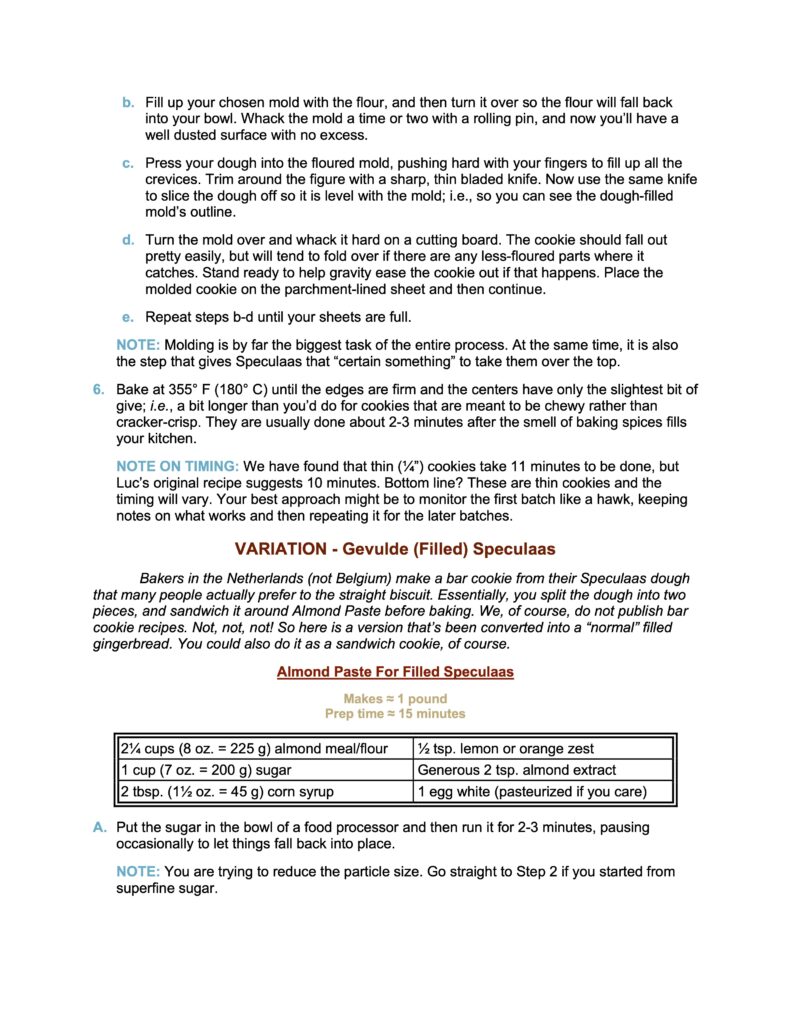
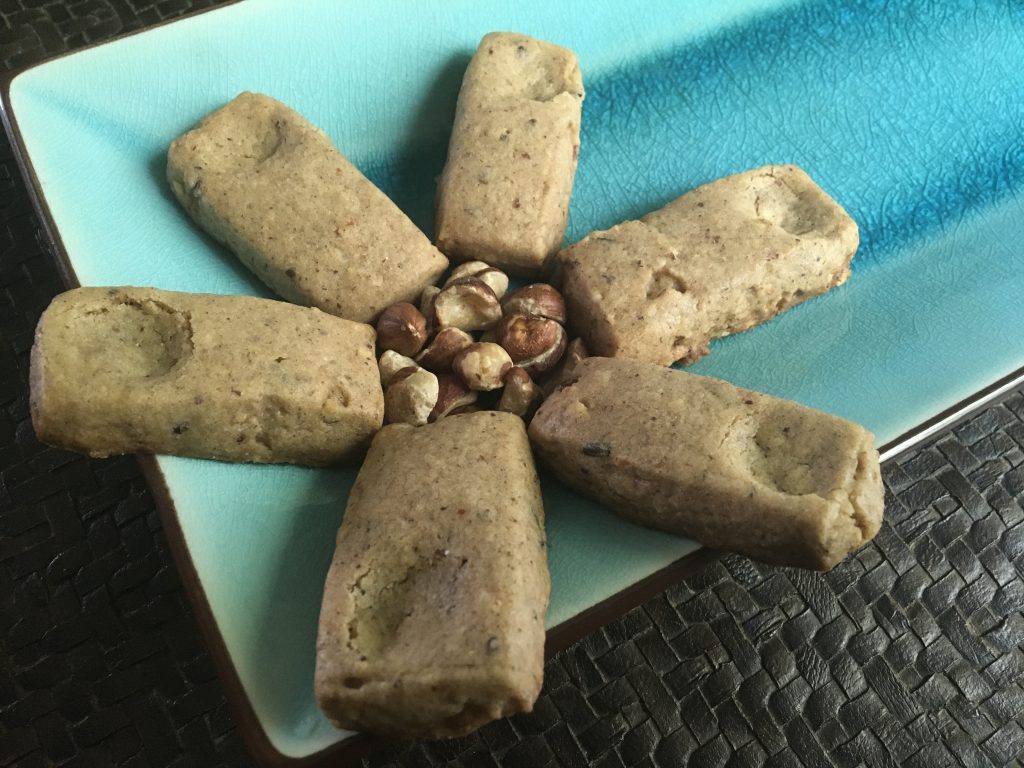
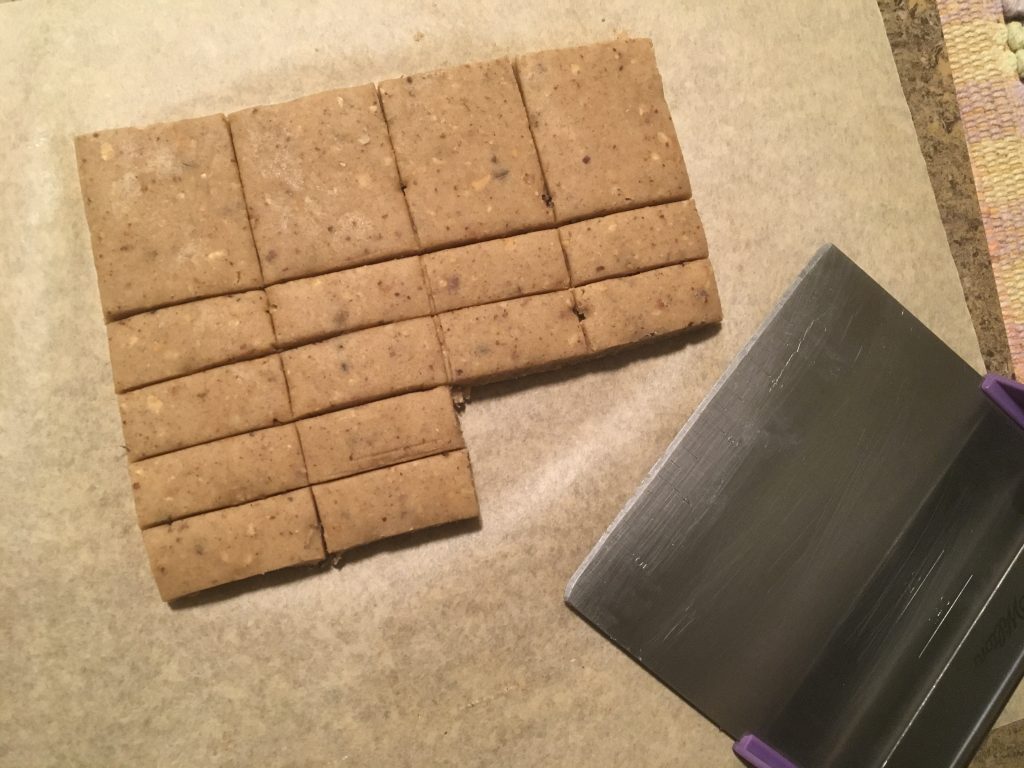
PART II GEVULDE (FILLED) SPECULAAS
That link will take you to the follow-up article, which includes a recipe for dough made with standard U.S. ingredients, a customized recipe for almond paste filling, and looooong instructions on a full dozen different ways to shape the filled Speculaas to maximum effect. As in…