Certain cities around the U.S. have regional cookies that send expats into ecstasies of nostalgia when they come across it again. New York has Black & Whites; our native Pittsburgh has Kauffman Thumbprints; the deep south has Southern Tea Cookies; and Baltimore has this cookie, which was created in 1835 by the immigrant owners of Berger’s Cakes & Cookies.
Regional loyalty commands us to at least make a show of disdaining all things Baltimore, so we need to say this quietly. [*Hushed voice* It’s a darned good cookie.]
NOTE FROM KATE: When I feel like yanking Scott’s chain, I root for the Ravens. He knows that I’m not a hardcore football fan, but he falls for it like Charlie Brown regardless. The Baltimore Ravens are, in fact, a really good team. And these are, against my expectations, really good cookies!

Overview
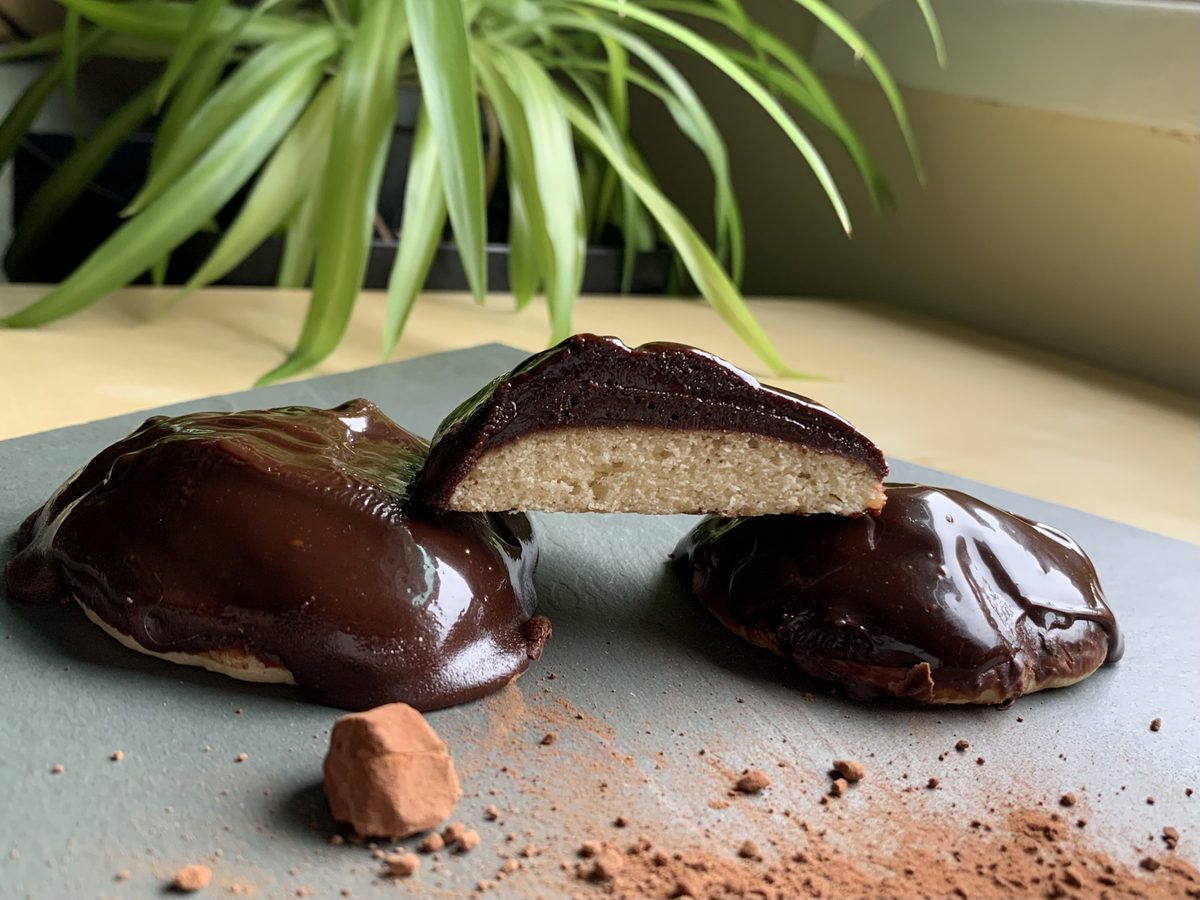
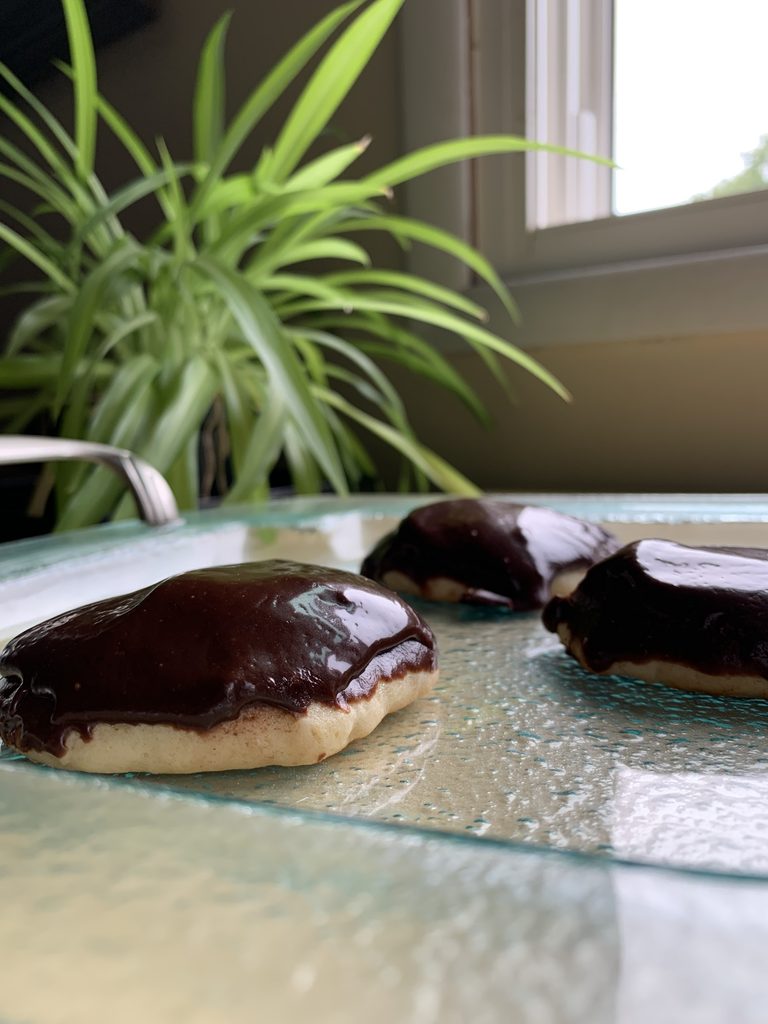
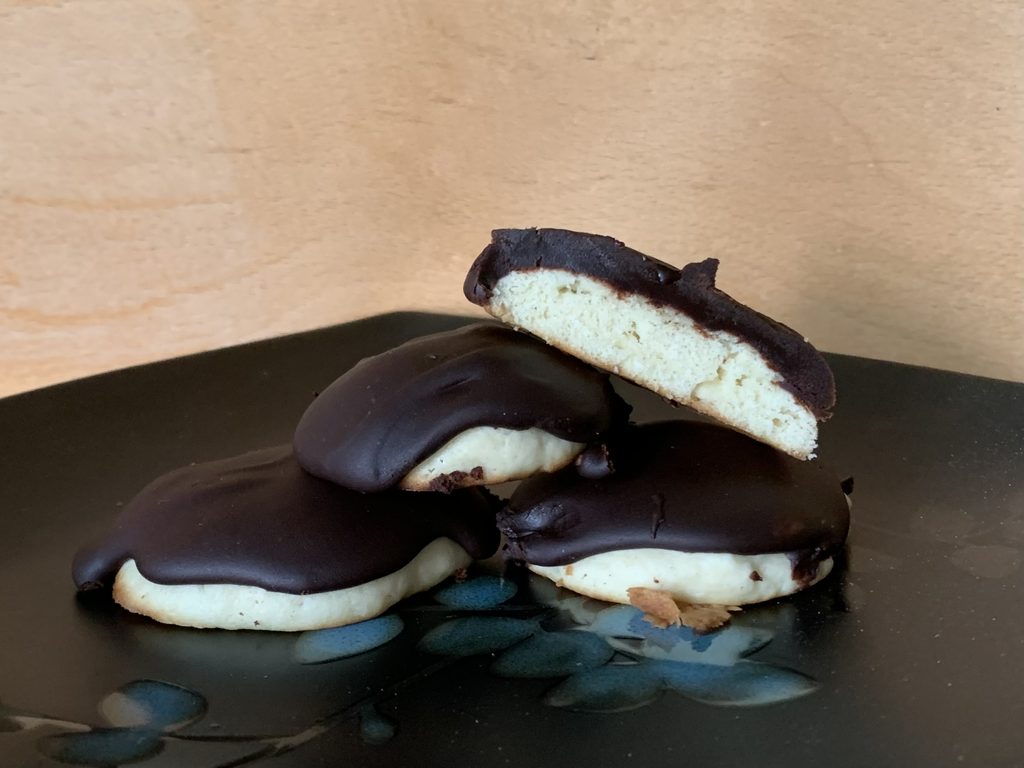
Berger Cookies are easy to describe. Coat a dense, relatively plain, somewhat chewy shortbread with dense, fudgy frosting as deep as the cookie is thick. There you have it! A four-bite treat that sends children of all ages into rapturous sugar highs. Simple, right? It ended up being tougher than it seemed.
Scott compiled an initial test recipe based on a more than a dozen online versions, made it, and… Both of us immediately knew that something wasn’t right. The cookies were good, yes; but only that. They lacked that mysterious extra that could create a 200 year old cult following. We tinkered with a second batch, then a third, and then… Then we called for help from a Baltimore friend. “Could we bother you for a box of the real thing when we meet at next month’s foray?”The whole sorry tale appears down below, but that was the literal aha! moment. “So that’s what these are all about!”
We couldn’t have done it without you Sam!
This Recipe Is Nailed
Every almost-final test you’ll read about below got compared to actual, from-the-store Berger Cookies before we moved on. Where possible they also got tested by Baltimore natives for reality checks beyond our own palates. And then we went to the extra effort of nailing down two versions of the frosting, because online sources split evenly between those approaches.
You won’t find a better version because there isn’t one. This recipe is r.i.g.h.t.
ASIDE FROM SCOTT: The most recent test-by-native happened a few weeks ago at a meeting of our local mushroom club. A request went out for Baltimore natives to please see Scott, because he needed them for an experiment. A hand went hesitantly up, and I hurried over to grab her. A certain amount of caution filled her eyes. “I’m not in trouble, am I?”
I had to laugh. “Exactly the opposite. I just need you to confirm we’ve got this right.” I circled behind the ID table, reached down, and popped the lid on my test-cookie tin. Her eyes grew wide. “BERGER COOKIES!!”
She went from trepidation to glee in a nanosecond, and one of my samples appeared in her hand like a magic trick. Then she took a bite and the expression turned to rapture. “Hello?” I called. No answer. She just stood there, smiling gently like a child in a dream. ‘That’s a good sign,’ I thought. “Hello? Can I call these certified by a local expert?” Her eyes opened at last.
“Oh my god, yes. They’re perfect! I haven’t had a Berger Cookie since…” Two friends looked over her shoulder to ask what was going on. Three more cookies vanished from the tin as they walked away. “When we were kids these were the thing we all…”
She did share them, in case you were wondering. [Laughs] I’m telling you folks. Cookies have a magic like nothing else.
The Cookie Part
The base came together quicker than the frosting, which makes sense because it’s the velvet dais that puts the jewel on display. There were only a few notable features that required attention. First, the cookie base is quite plain, with a surprising amount of browning on the bottom. It also has some vanilla to accent that browning and it’s quite chewy, which distinguishes it from other 4-bite cookies like NYC Black & Whites.
The online recipes provided an admirable jumping-off point that only required a couple of fidgets. We eventually cut the baking powder in half, from 1 tsp. down to ½ tsp. (for more chew); and we increased the oven from 350 F (175 C) to 375 F (190 C), which increased the browning. All the real work went into that all-important layer of fudge on top.
NOTE FROM KATE: This dough handles best with slightly wet hands. Measure out your ball, roll gently, and then squish it onto the parchment. Start from around 1⅓ tablespoon per ball, and aim for around 1½” (4 cm) in diameter). It’s okay to have imperfect and lumpy-looking balls. To me that is a feature, not a bug! You’d almost think the cookies were made by a human and not generated by AI. Besides, those same lumps magically even out as the cookies bake in the oven.
Frosting, Frosting, Who’s Got The Frosting?

NOTE FROM SCOTT: Apologies for the length, but we endured something of a saga filled with not-quite-there moments. I try to touch on each in case you find thm useful. Feel free to skim.
Berger Cookies feature a dense, sweet, and fudgy layer that matches perfectly the almost-chewy cookie base. Online research showed two very separate approaches to getting there. Half the bakers built off a dark, butter-based frosting, and half made a ganache built from chocolate chips melted in cream. The only one exception came from Serious Eats, a source for which we have great respect. They called for evaporated milk. We tried that too, but ended up thinking the more traditional approaches both worked fine.
The Butter-Based Frosting. Translating to bakerese, this approach can be summed up as follows: “Make a dark chocolate cake frosting with a few tweaks, and then…” Simple, right? Not so much.
Around half the online recipes called for maple syrup in the mix. That may sound odd, but our research on old fashioned sweeteners offered a perfect explanation. The original Mr. Berger would have been working with Piloncillo (a/k/a jaggery) in 1835, not modern white or brown sugar. The standard substitute for Piloncillo? You guessed it! A good hit of maple. We tried it, and it worked; especially when enhanced by some espresso powder to make chocolate taste bigger. NOTE FROM SCOTT: Old time bakers didn’t use the coffee trick. That’s why it’s only “recommended” in our final recipe. But trust us: you won’t regret it.
The only problem with frosting #1 came from the butter itself, which muddled the pure chocolate flavor we wanted. That led to experiments with shortening instead of butter (a bit artificial), and then a 50/50 mix of the two. Man oh man, was it delicious! But was it right? It didn’t quite match the cookie photos, and…
Oops. Insert drop-of-penny noise. Four versions in, and only now we realized that we had no real target to aim for? Aaargh! What a rookie blunder.
Insert that cry for help in the form of a box from the actual bakery. NOTE: Thanks again Sam.
Cue The Jeopardy Music, And… Two weeks later we got home from our trip with Sam’s box of genuine, store-bought Berger Cookies. Time to compare.

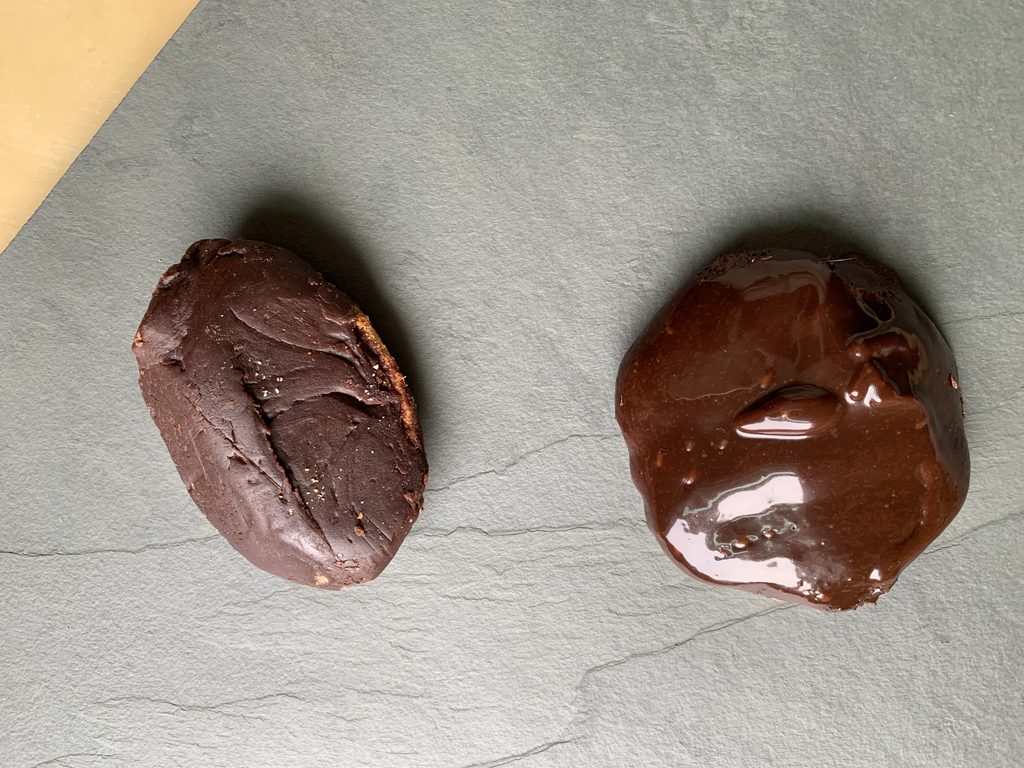
The good news? Our 50/50 frosting tasted exactly like the original. Yay! But the texture wasn’t close. We had a cake frosting, not the extra-thick icing on top of the real deal. But that texture did tell us where to go next. This was the kind of coating an industrial operation will heat to a precise temperature, and then pipe onto production line cookies as thick, oozy lava. Let it cool, et voilà! A dense, somewhat chewy layer of almost-fudge. Our frosting had to be more like a ganache.
Kate, the family chocolatier, suddenly began to see benefits to the idea of that alternate, chocolate chips in cream approach. She’s usually a stickler for quality chopped chocolate rather than commercial chips formulated to have a sturdier melting point. That flaw now turned into an asset. “The right proportion of cream to chocolate chips should harden to just the texture we want, with a lot less fuss.”
Chocolate Chips = Simple? Not So Much. We checked the online recipes for proportions, only to discover the chocolate-to-cream ratio wasn’t the only issue. The recipes were maddeningly far apart! Some had cocoa powder, others didn’t. Some called for maple syrup, others used corn syrup, and some called for both. The specified chips varied from semisweet, down to milk, and then back up to dark. It was so bad that Scott had to compile a table to normalize a full dozen recipes just so we could compare them on an even footing.
Which, thank heaven, yielded some patterns. Darker chips = less cocoa powder, and milk chocolate chips = lots of cocoa powder. Okay, that made sense. Target: dark & fudgy.
As for the syrup, lesson #1 was the fact that every recipe called for some kind of syrup in the first place. Crystallization and graininess must be a real problem! Warning taken. But which one should we choose? The maple recipes described it as an attempt to capture that old-fashioned flavor; perfectly sensible in light of our experience creating the frosting version. Corn syrup recipes all emphasized the need for shine; which was just as sensible because it’s better at reducing crystallization. You might think that leads to an obvious and less expensive compromise, but [insert cosmic buzzer!] Both groups fervently warned against using commercial pancake syrup. [Sigh] So much for the cheap and easy solution.
Our pantry had semisweet chips ready and waiting, so we put together a version using that as a midpoint approach. To this we added a moderate amount of cocoa powder for extra flavor, that ¼ tsp. of espresso powder to round it out, and a mix of both syrups. This yielded an almost-smooth icing that would have a perfect texture if we merely increased the corn syrup a bit. Kate did a second batch, and presto; texture nailed. She declared it done, but Scott demurred.
Yes, she had the right texture. But the butter-based frosting tasted noticeably better. And he had an idea for how to convert cake frosting into cookie-topping fudge. We could simply melt it down!
Melted Frosting? We still had a ton of the airy, butter- or shortening-based frosting. Three batches worth! It was far too tasty to toss, which creates a real problem in our house. We both suffer from a dire medical issue known as, “Just A Taste As I Go By Syndrome.” Heck, our daughters have complained the disease is so contagious they sometimes need to avoid the house! So we detoured back for Scott’s experiment.
He baked another batch of cookies, put some of the 50/50 frosting in a bowl, and popped it into the microwave for a single minute. The result? Effort #1 had bubbled and burned by the time our machine went ding. Doh. Effort #2: try the same thing with 15-second zaps. Still too rough. On to Effort #3: 15-second zaps at 30% power. This product sent Scott running in to the living room to share the good news. “This is pretty close to right. Just a little grainy. I’ll try a new batch from scratch, with melted butter and that corn syrup you added. What do you think about using coconut oil instead? Or maybe some of your carefully hoarded cocoa butter? The ingredients list on the package mentions palm oil…”
She Who Must Be Obeyed had reached the end of her rope. Kate erupted, “I am sick to death of this cookie! There will be one more batch, and only one more batch. Lives may be jeopardized if I have to sample any more than that! I’m on it. You, dear husband, shall get your sorry butt out of my way. And then you will say nice things when I’m done. Get it? Got it? Good.”
An innocent reply began to form, but up went the infamous Warning Finger of Doom; a digit already shaking with life threatening rage. “Take your new samples to the mushroom club meeting along with all those others polluting my waistline [ahem] countertops. Shoo. Out. What are you, deaf?”
NOTE FROM AN ANONYMOUS EDITOR: Scott did write a full and fair description of the scene, but those observations have been deleted wholesale in the name of marital harmony. Plus that gentle, kind hearted, generosity of soul for which he is so well known.
NOTE FROM KATE: I remind y’all that Scott is not only a superb cookie developer, but also an inspired writer of fiction. I shall forgive him for putting a more adventurous spin on my notoriously conflict-averse way of speaking. At least for now. These are good cookies and I have nothing against them.
Scott went off to the mushroom club, enjoyed that scene with the young lady from Baltimore, and came home to find a new, fully completed batch of Kate-made cookies. And a wife holding up a finger (index!) like a 10-year old with a boo boo. “I singed my finger dipping the cookies into the hot chocolate lava. Even worse, I broke off a few edges when it began to cool and thicken up. But I am calling this one done. There’s leftover frosting if you want it.”
Scott duly kissed the finger, and then re-melted the leftover topping. He applied it to the cookies with a spoon instead of dipping, which turned out to be a very good thing because Kate’s dipped-in layer had been thinner than she thought.
NOTE FROM KATE: I made frosting for my final batch by combining all the leftovers in a double-boiler with a scant quarter cup of chocolate chips, a drizzle of corn syrup, and a splash of cream to make up some missing volume. Then I stirred until it all came together. It worked just fine, proving the recipes are mutually compatible.
Kate’s cookies were so close to the store-bought version that everyone was happy. Almost.

Obsessive Bakers Anonymous Should Open A Local Chapter.
Two weeks later the Warning Finger Of Doom had descended, and a pair of questions started to circle their way into family conversations. From Scott, needless to say. First, “I wonder what the temperature should be to get that topping exactly right?” And, “If we’re going to work with a hot coating anyway, why not do a test with that wonderful butter frosting I worked on so hard?”
Kate gave in a week or so later. “Fine. Go ahead and give it a try if you must. But the cookies are going to the dojo, and they *are not* going to stall in this house on their way out the door.”
Not an exclamation point in sight.
So a last and truly final batch went up, with every revision incorporated, additional research performed, and an instant read thermometer on hand. From that we learned the magic temperature for butter-based icing: 175° F (77-80° C). It’s too thick below that, and too thin above. The magic temperature for cream-and-chips ganache is lower, more like 105° F (40° C).
Best. Version. Yet.

The Frosting Takeaways (By Kate)
Use a fat that hardens at room temperature. Either don’t add extra air or moisture, or heat the frosting afterward to remove them. As long as you don’t burn the chocolate, the process is quite forgiving.
Whether cake frosting or ganache based recipe, that dark stuff must be liquid, but thick. I once dipped the cookies while the frosting was still a bit hot, which resulted in that too-thin layer. However, once the frosting set, I reheated what was in the pot, and double-dipped them. That works just fine too. Scott reheated the leftovers later, and applied some extra to the rest of the single-dipped cookies with a spoon, occasionally shaping it with a spatula. I compared them to our last commercial cookie, and you cannot tell the two apart except for the spatula marks.
Taste-wise, I was surprised to prefer the chips-and-cream ganache. It’s so simple, and works at a safer temperature. Someday I’d like to experiment with darker chips and a little less cocoa powder. Most frostings are too sweet for my taste. The ones we developed are, however, true to the sweetness level of the commercial product. It is what it is.
And From Scott…
Both of the frosting approaches will work. I prefer the flavor of the butter-based version. It really is a coin toss call that comes down to taste. Which is why we’ve included instructions for both kinds of frosting in the recipe down below. Take your pick.
The biggest concern comes down to temperature control, and there’s no getting around it. Both versions must be applied when the icing is at that delicate stage between being so thin that you don’t get a proper layer, but not thick enough to require a spatula. The magic moment occurs when the icing looks like an extra-thick caramel sauce; at around 175° F (77° C) for butter-based icing, and 105° F (40° C) for cream-and-chips ganache. We recommend you work with the right temperature from the start, and then gently reheat as needed. Think ahead too. Since you will need to reheat, ice the cookies on a screen placed over parchment paper. Then you can recycle any drippings back into the pot right away.
Dipping works but you will get some broken edges because the cookie part is delicate and the icing is thick. Spooning works better. That’s what we put in the recipe. There’s also the ideal answer: invest a few million dollars in an industrial production line to maintain exactly the right temperature, which will also let you pick the exactly right kind of piping nozzle. Tempting… but I think we can leave that to the pros down in Baltimore.
Conclusion
This recipe will give you a cookie as close to the original as anything you’ll find. Tasters literally couldn’t tell which was which when comparing our version side by side to the last originals in the box. And tasters from Baltimore were so enchanted they really didn’t want to be distracted by such things.
The city’s football team may not hold a candle to our proud Pittsburgh standard. [Go Steelers!] But Baltimore’s city cookie? It’s right up there with our own Kauffman Thumbprints, and that’s high praise indeed.
Enjoy!
Kate’s Final Note
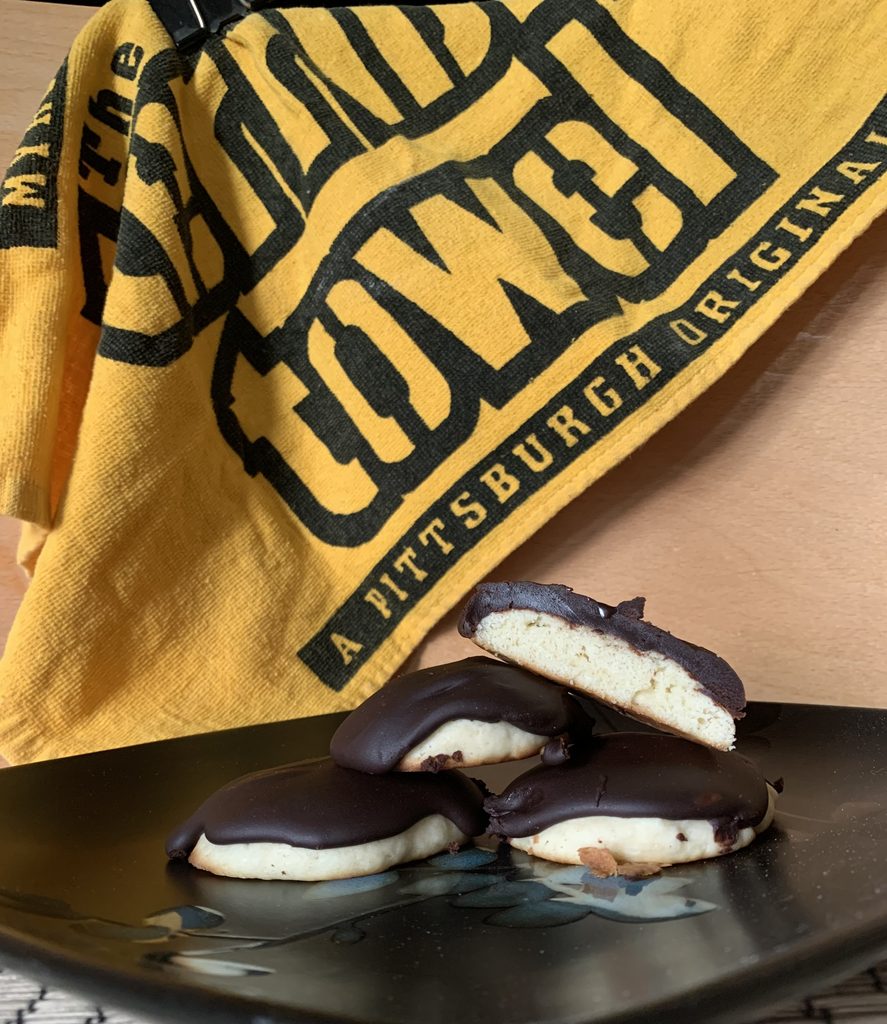
I am not responsible for the Terrible Towel / Baltimore Berger Cookie pairing down below. Scott showed up with the towel in hand, thinking he would help with the props. My eyebrows rose so high, I still have a wrinkle in my forehead! But I tried it, and it worked. Competition on a level playing field brings out the best in both sides.