BEEHIVE COOKIES (Včelí úly), A No-Bake Life Hack For Your Casualties

The best way we know to use up casualties from our holiday baking

Our collected work on Heritage Cookies of the Old and New World, both Volume 1 and the forthcoming Volume 2, can be traced back to the Czech tradition of Vánoční Cukroví: “Christmas Sweets.” Central and Norther Europe abounds with impressive holiday baking traditions, but no one takes it more seriously, or does a better job, than Czechs such as my beloved wife.

The thing is, when you make a lot of cookies, you also end up with a lot of casualties. There’s just no way around it. Beehive N0-Bakes may be the single best way of converting those casualties into something new. Who am I kidding? History contains a lot of ‘Oops!’ moments just to ensure the Beehives get made.

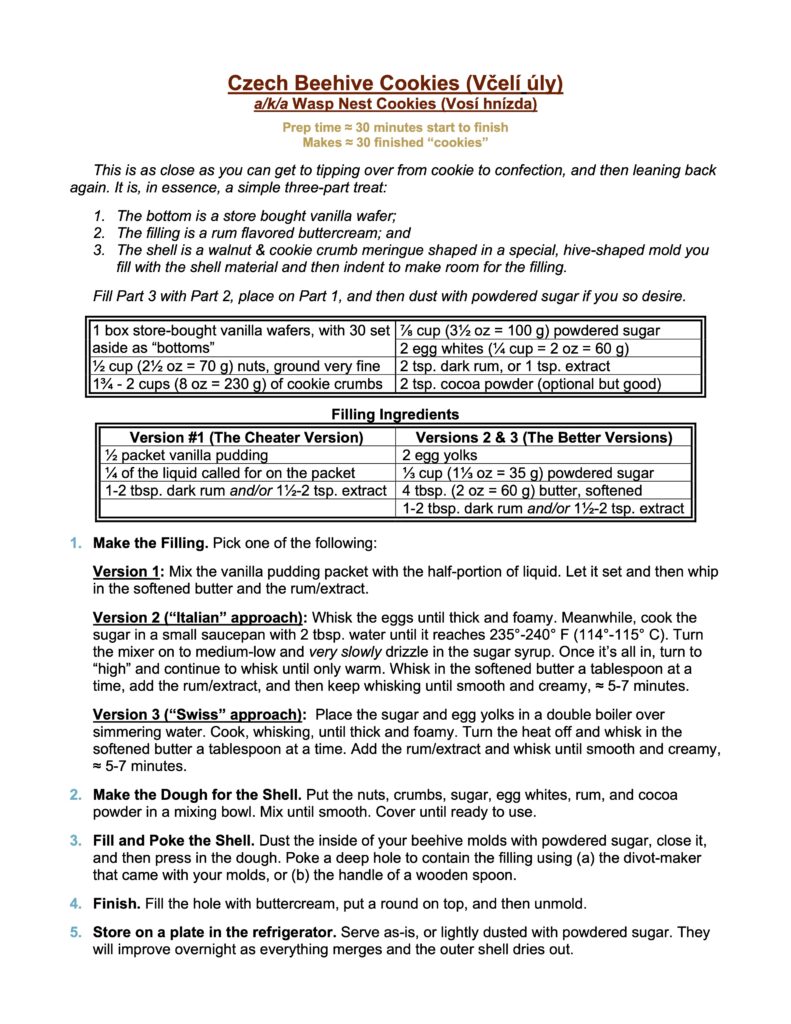
It starts with tiny plastic molds such as this one from the Czech manufacturer Tescoma:
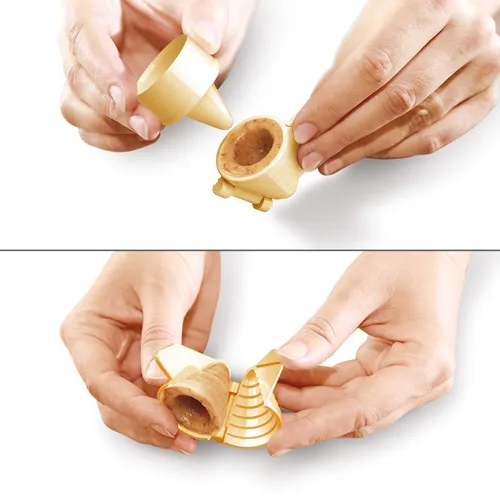
It ends with this:

That picture pretty much says it all. (A) create a dough from leftover cookie crumbs, (b) press it into shape using the plastic form, (C) poke in a hole using the provided stamp, or the handle of a wooden spoon, (D) fill said hole with a stiff, rum-heavy buttercream, and then (E) cover the bottom with a small, round cookie like commercial vanilla wafers.

Quick, easy, fun for children of all ages, and requiring no mandatory baking unless you choose to make a superior buttercream. Or wish to make your own wafers, of course.

Part 1 – Ready The Shell

This is the magic part, and it couldn’t be any easier. Start with your leftover cookie crumbs. Mix in finely ground nuts, a small amount of powdered sugar, and egg white(s) as needed to bind it all together. Most people also add in a bit of rum (or extract) and cocoa powder to round things out, but that can vary with both personal taste and the nature of your casualty crumbs. You can also add spices, depending on the nature of your crumbs. Ground up gingerbread cookies obviously have a different vibe than ground up butter cookies.

NOTE FROM KATE: caution on the casualty cookies. Not all will make good candidates! We had some strongly flavored cocoa bear paws that got recycled into Beehives, and I thought there was a bit much going on. I would’ve preferred a more neutral backdrop to the smooth and delicious filling. If we make them again from the same cookies I will vary from the recipe to accomodate.

Regarding the overall impression, I prefer walls as thin as possible, with a liquidy eggyolk cream filling for contrast. But those would soak the Nilla cookie base over time…so if you’re making a whole bunch, a buttercream might be a longer-lasting option. Due to their egg content, we store Beehives in the refrigerator until serving time.

The only place it could go wrong is the proportions. Sometimes the cookie crumbs will be drier, sometimes wetter, etc. The answer is simple: remember your target. You want a standard, slightly sticky cookie texture. Start with something on the wet side and then add crumbs as needed to get there.

Part 2 – Ready The Filling

This is just as easy even though the recipes can vary drastically from house to house. You are after a rich, thick but not solid filling full of extra rum flavor. How you get there is up to you. The filling texture can vary from thick and boozy liquid eggnog to a firmer, properly flavored buttercream.

Kate’s prefers a cheater-buttercream on the theory, “If you are going to make a life hack recipe out of leftover crumbs, why not make a shortcut buttercream?”

  1. Make an extra-thick, store bought vanilla pudding by using only half the designated amount of liquid.
  2. Finish by whipping in dark rum and/or rum extract to taste.

I prefer to start from a modified pastry cream, otherwise known as a Swiss meringue method using yolks instead of whites:

  1. Whip the leftover egg yolks with some sugar over a hot water bath until thick and foamy.
  2. Remove it from the heat and whip in softened butter piece by piece, waiting each time until the last piece has been fully incorporated.
  3. Finish by whipping in dark rum and/or rum extract to taste.

The third approach is a French Buttercream, otherwise known as an Italian meringue method using yolks instead of whites.:

  1. Whip the yolks off heat until thick and foamy.
  2. Slowly drizzle in a softball-stage sugar syrup (235°-240° F = 114°-115° C), whisking on “high” until the temperature drops back down.
  3. Finish by whipping in dark rum and/or extract to taste.

The Flavor Profile – Does It Need To Be Rum?

We’ve written before that Prague’s secret heart belongs to a combination of nuts, rum and mocha. This recipe has (let’s see…) nuts and cocoa powder in the crust, with rum in both crust and filling. No surprise there!

There is no rule requiring you to stick with that profile, any quick online search will reveal many variations, and you always need to adapt things if your cookie crumbs come from something that has a lot of character. But for plain beehives made from plain cookies, please consider mocha-rum as the home base. That’s what you’d find in the Czech Republic.

NOTE: 100% rum extract starts to taste a bit artificial. We like to mix dark rum and extract together in order to obtain an intense flavor that still has nuance. And a bit of booziness of course!

Part 3 – Construction

Press dough into your little beehive mold:

Finished cookies with an empty mold on the left, and
an unfilled one on the right

Poke a hole in the bottom using either the tool that came with your mold, or the handle of a wooden spoon.
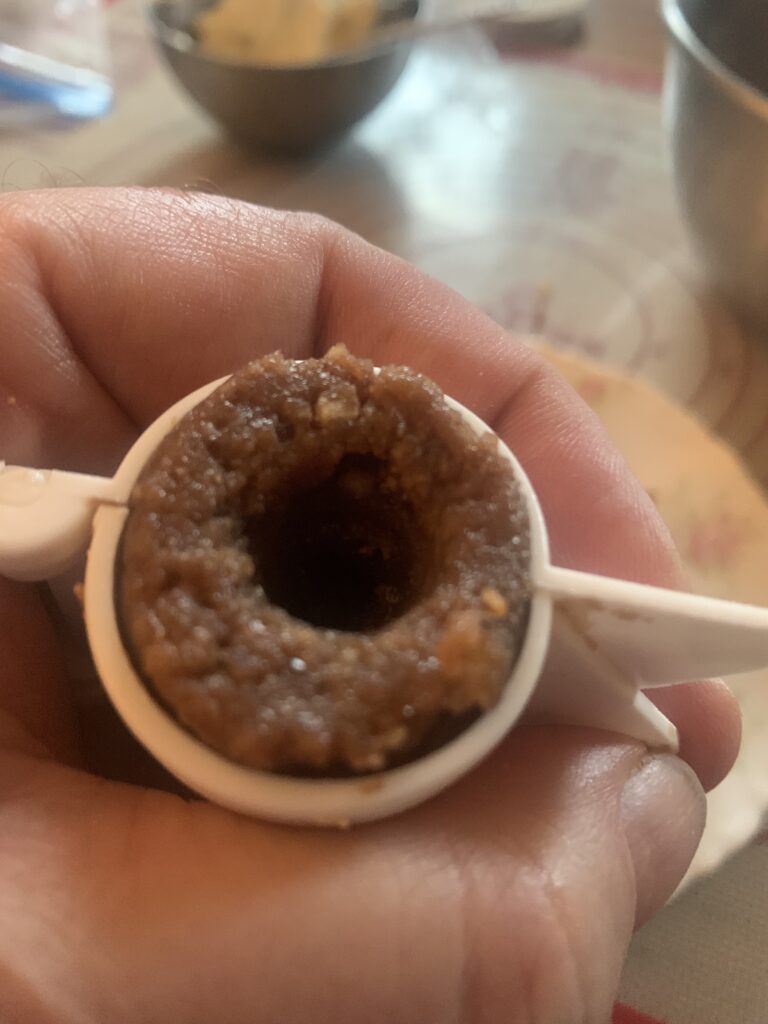
Poke a hole inside

Fill the hole with filling.

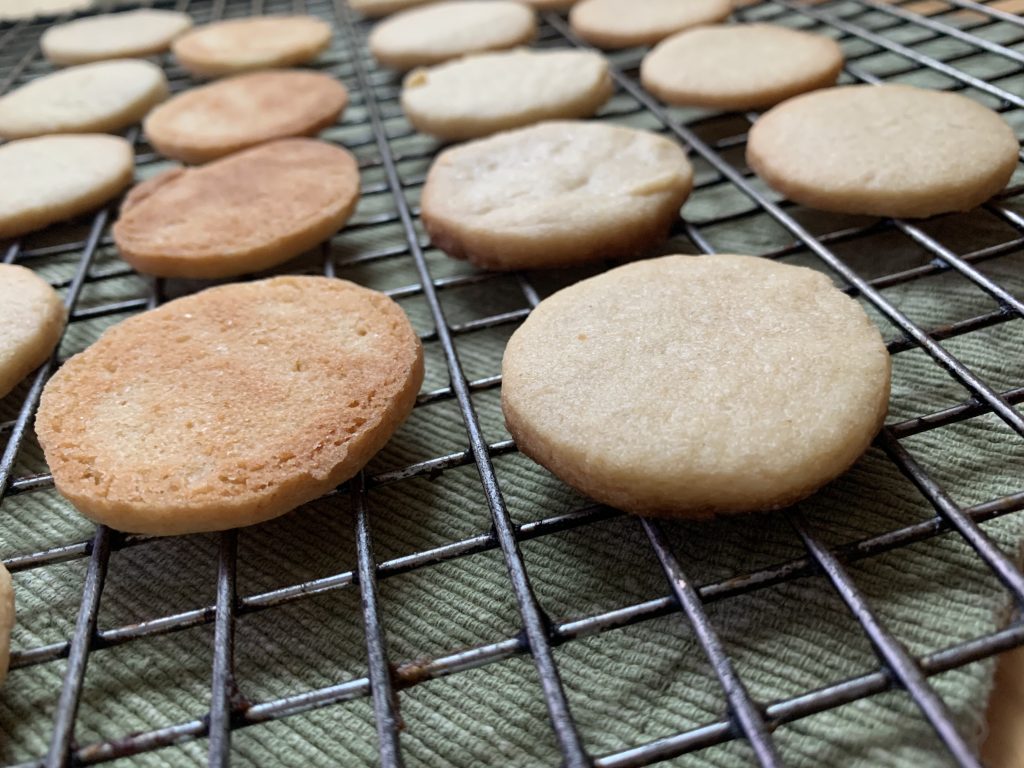
Cover the hole with a small, round cookie. We typically use commercial vanilla wafers from the box.

Bottom on, and ready to be pushed free.

Unmold. One side of the mold will come free easily. Use the cookie on the bottom to help free the other.

Done!

Move your finished Beehive Cookies to the fridge, where they will keep well while the cold, dry air hardens the outer crust and makes them that much more cookie-ish.
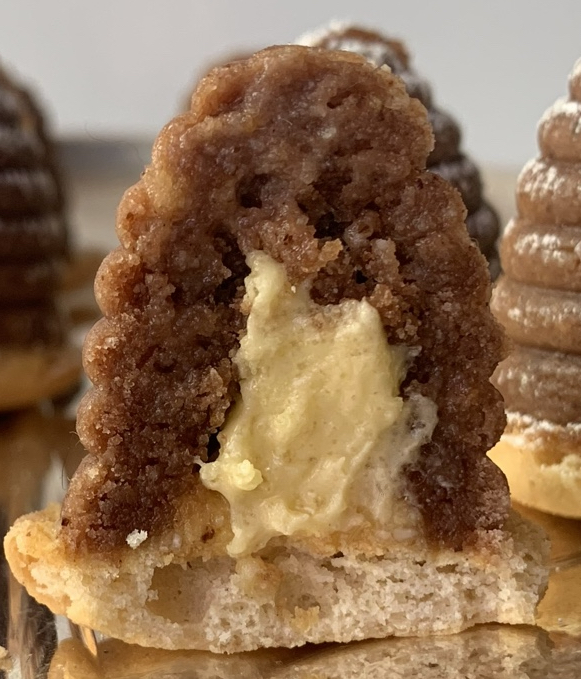
Storage and Conclusion

No-Bake Beehive Cookies:

  • Turn casualties into capital;
  • Look amazing;
  • Have a distinct and often different flavor from everything else on your tray;
  • Taste delicious;
  • Are easy to customize (almost unavoidable);
  • Occupy a distinct part in an important baking culture; and
  • Are fairly easy to make.

Can someone please explain the downside?

okay, yes. You may have to put them into a mental “Not-Quite-A-Cookie” category. And yes, that can cause some family friction about where they belong in your forthcoming cookbook. But they’re good. That is the bottom line.

Ah, the burdens of life…

Enjoy!

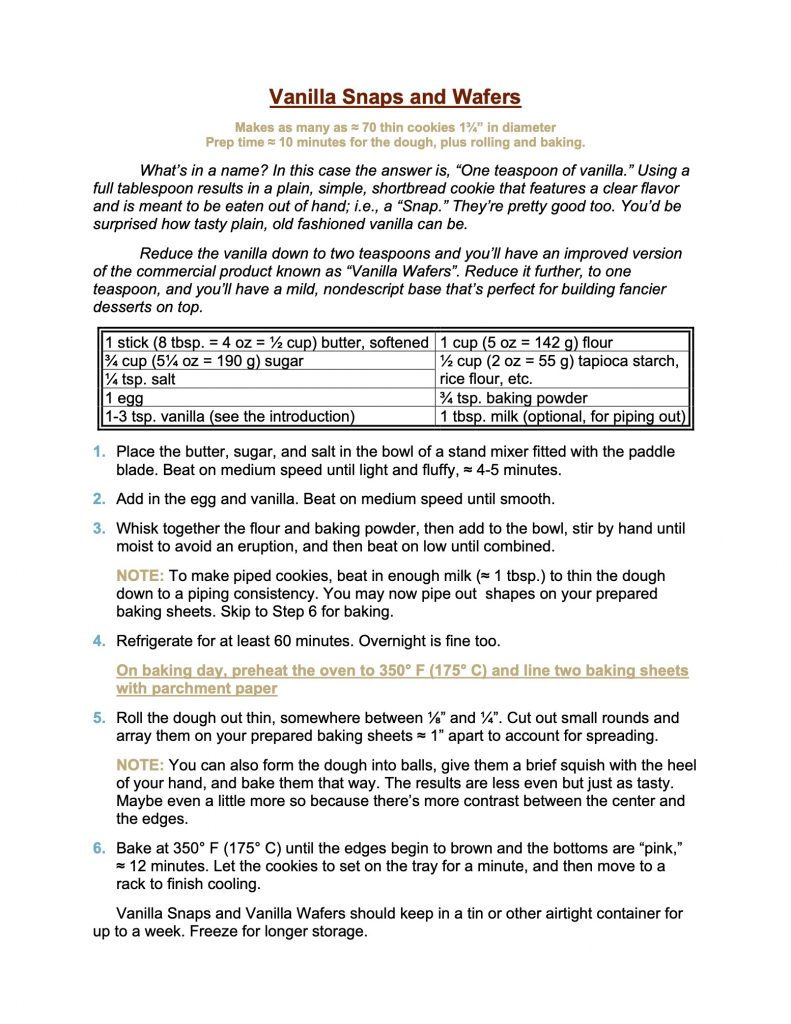
VANILLA SNAPS AND WAFERS – a classic cookie and ingredient

The classic, with versions for eating out of hand or for using in other recipes

Here’s another head smacker cookie really should have gone into Volume I but somehow escaped our notice. It came up now in a sideways fashion. We’ve finally gotten around to working on Chocolate Covered Marshmallow Treats. You know that cookie. Everyone does. It’s the one you loved as a child, with a simple cookie base that has marshmallow on top, and is then coated with a thin chocolate shell.

That cookie has scores and scores of different version around the world, but the most common uses some equivalent to a Nilla Wafer® base. So that meant I should start by making… Doh! I’ve never actually worked up a homemade version of Vanilla Wafers. [Sigh]

The result was all we could have hoped for and more. In fact, we discovered that it isn’t a single cookie. It’s actually three.

  1. Use the full amount of flavor and you’ll get a very pleasant cookie to eat out of hand, that adults will enjoy as much as children.
  2. Use a moderate amount of vanilla, and you’ll make something very close to the commercial product. Just better in every way. Real butter and real love make a real difference. Kate says that toddlers in Prague were fed a similar cookie whenever treats were earned.
  3. Reduce the amount of flavor all the way, and you will get the plain, invisible cookie that’s perfect for all the “other” uses these get purchased for. Banana Pudding; El Cheapo Tiramisu; Chocolate Marshmallow Treats; etc., etc., on and on, and suchforth and suchlike.

As always, skip to the bottom if you only want the recipe

This is a simple cookie, and it’s meant to be a simple cookie, so I’m going to try to keep the discussion brief. There weren’t many issues that needed to be addressed. It was really a matter of focusing on what we wanted the cookie to be.

First the Eggs

I wanted this to be a light, crispy cookie with a fair amount of air, that would taste a little buttery without coming off as rich. Most recipes in our books and online resources called for one whole egg to go with each stick of butter. I tested that, along with one egg white, and one egg yolk.

The whole egg won handily, both for ease and flavor. Yes, you can make a good cookie with both egg white and egg yolk, but the whole egg is simpler and, for this use, better.

Wait; Haven’t We Made This Before?

For crying out loud! Butter cookies. Sugar cookies. Shortbread. Alfajories. Spritz Cookies. Snaps. They’re all pretty much the same, right? Just butter, sugar, flour, starch, and egg in slightly different proportions, plus a hit of flavor. Was this one really different, or just a variation on one of our existing and already-tested recipes?

Well… no. I went back and crunched the numbers. These are in the same family but the proportions are distinct enough to earn their own name. Same for the classic French cookies we plan to work up someday, such as Langue du Chat (“Cat’s Tongues” a/k/a Homemade Milanos®), and Tuiles. Those use several egg whites to create a different species within the same genus.

What’s In A Name?

All that recipe comparison work did clarify one thing that was bugging me. These are not a “wafer”!

I am a lawyer in my real life, and have been for 30 years. So I can speak for my profession when I tell you that virtually every non-criminal problem I see comes down to a variation on the theme of frustrated expectations. Person X thought s/he deserved or would get an “A,” ended up with a “B”, and grew angry at that result. So Person X goes back to Person Y to complain, “where is my A?”, and the situation then grows worse because Person Y insists that s/he meant “B” all along. And most of the time both interpretations fit the actual words.

The solution? Define your bloody terms so you can at least know where you really disagree! Try it the next time someone wants to argue about politics. “Exactly what do you mean when you use that word?” You’ll be shocked at how much of your fight disappears, or at least settles down to the amicable question of how words ought to be used.

In any case, I have spent a lot of years getting frustrated over that stupidity, in both my profession and in politics, so I get a little [ahem] picky about calling things by their proper names. A “wafer” is an extremely thin, usually broad cookie like our different Snowflake variations, Tuilles, or Lace Cookies. You can get to that result in many different ways, but that’s the definition.

This cookie does not meet that definition, and thus it isn’t a “wafer.” This cookie is a “Snap”. Harrumph.

We define Snaps as any plain, simple, round cookie that features a clear and focused flavor. Cardamom, Anise, and Black Pepper Snaps feature a single spice. Ginger snaps feature a spice mix with a touch of molasses. But that is the family group, and that is where this cookie belongs. Harrumph I say again! And harrumph for good measure. Harrumph. Harrumph. Harrumph!

Alas, but the outside world does foolish things on occasion. Sometimes it will even [gasp!] ignore it when some large company mislabels what ought to be a Snap as a Wafer. And a wise man has to know his limits. So let us agree on a simple formula, okay?

First, I am in the right. Harrumph. And that means the world is wrong. And thus equity, justice, and fair play are unanimously on my side.

Next, I am not being petty no matter what certain females in my household may choose to imply. Nor childish. Not, not, not!

And no, this isn’t a fight I’m going to win. So how about a compromise?

Let’s agree to call the eating version of this cookie a Vanilla Snap. That’s the tasty one with a full tablespoon of vanilla, which is going to make people sit up and say, “I never thought I’d say it, but these things are capital-G Good.” The weaker versions, which are intended for use in other recipes anyway, can be called by that other name for the sake of allowing the rest of the world to save some face.

Back to your regularly scheduled programming.

Confirmed Again: “Other” Starches Work Better Than Corn Starch

Is the cookie better with a bit of gluten-free starch to supplement the flour? Yes, it is. Cake flour might work too, but we didn’t test it.

Would corn starch work? Yes… but it isn’t as reliable as rice flour, tapioca flour, arrowroot, etc., because you’ll occasionally get a less-done piece that leaves a gummy sensation in your mouth. It’s an effect we wrote about in our book Heritage Cookies of the Old and New World. Corn starch breaks down at a higher temperature than those others, and thus cookies made with corn starch are more likely to have leftover “uncooked starch” in the final product. That’s the underlying problem; it was confirmed again in these experiments; and there’s simply no reason to fight the science. Vanilla Snaps cook until the bottoms brown, which gives a margin of error, but why make use of that margin if you don’t have to?

We usually bake with tapioca starch because it is cheap and readily available in large quantities at our local oriental market. We have tested rice flour and arrowroot too, and found them to be identical. We have read that potato starch fits in too. Corn starch is the only one that requires a higher baking temperature.

Would A Drop Cookie Work?

We always prefer to write up drop cookie recipes when possible, just because they’re so much easier for new people. Refrigerator slice-and-bakes come in second, followed by roll-and-cut cookies, and then by ones you pipe out. What was the best way to go for this one?

The answer depended on what we wanted to do with them. Drop cookies worked fine from the baking perspective, but I simply couldn’t get them to come out even enough to use as a consistent base for the other project. So here is my verdict:

  • If you’re after the eat-out-of-hand Vanilla Snap version, make a simple drop cookie and be done with it. You don’t need to do it that way, but you can. Kate swears that they also came out a little lighter and crispier than the rolled-and-cut version, though I couldn’t tell the difference.
  • If you’re after a cookie to use in some other role (like the base of a Chocolate Marshmallow Treat), roll them out and use a cookie cutter. These are dead consistent and thus better as an ingredient. The dough is a little on the sticky side, but works fine if you simply dust with flour as needed.
  • If you’re trying to jazz things up, add a bit of milk to thin the dough out to a batter, and then pipe out something fancy. You could even sprinkle it with a bit of sanding sugar. It ought to work with a spritz gun as well.

Bake Until The Bottoms Are Good And Tan

Part of the flavor in this cookie comes from actual browning on the bottom. Most cookies want to come out of the oven when they’re still pale, and the edges feel barely set. Leave these in for the full 12 minutes, or until you can see browning around the edges.

CONCLUSION

That’s about it. One forgets that plain old vanilla isn’t that plain at all. It’s a really delicious spice, and it fully deserves to be just as celebrated in a Snap Cookie of its very own. They are as “heritage” as you can get, and well worth making.