Anzac Day is the Down Under holiday of remembrance to honor “the contribution and suffering of all who have served or died in wars, conflicts, and peacekeeping operations” as part of the Australia New Zealand Army Corps (ANZAC). Squish the U.S. Veterans and Memorial Days into one and you’ll have something close to the importance of Anzac Day: a big deal when every school will close, but not quite up to the 4th of July.
The holiday occurs every April 25th in honor of the men lost in the disastrous WWI invasion of Gallipoli, an event also tied to both of the cookie’s [ahem] biscuit’s contending origin stories. The first goes like this: “These were the cookies that mothers and wives tinned up and mailed to their soldier in the field. Isn’t that romantic?” The second says, “These were the cookies sold by the million at post-war fundraisers to raise money for the boys who came home. Could anything be a better symbol of the love and loyalty that isn’t romantic?” I personally suspect the true answer is “both. The recipe predates the war and was indeed sent overseas, but it boomed in the aftermath when something – anything! – just had to be done.
NOTE FROM KATE: The mention of “our boys” may sound old-fashioned in a world where women comprise close to a fifth of enlisted personnel – the number depends on the country (I checked only US, Australia, New Zealand, and Ukraine.) However, did you know that in WW1, well over 2,000 Australian women served overseas? These biscuits didn’t go out only to our boys but to our girls too, and the holiday expressly covers everyone who served, not only those who saw combat. Cheers!
Origins aside, Anzac Biscuits (the British Commonwealth word for “cookies”) have become more firmly entrenched as an Anzac Day treat than they ever were as one for the actual troops, and by now have stretched far beyond the bounds of a single holiday. This is the national biscuit of both the Aussies and the Kiwis, and the “why” couldn’t be any more clear. They’re flat out delicious. They’re simple. They are an ideal treat to make with kids. The proportions multiply like a charm if you want to feed a whole corps instead of the neighborhood bake sale. And the recipe is as close to bulletproof as we’ve ever seen, as witnessed by the fact that even an unfortunate testing mistake turned out so well that we’ve made it an official variation down at the end.
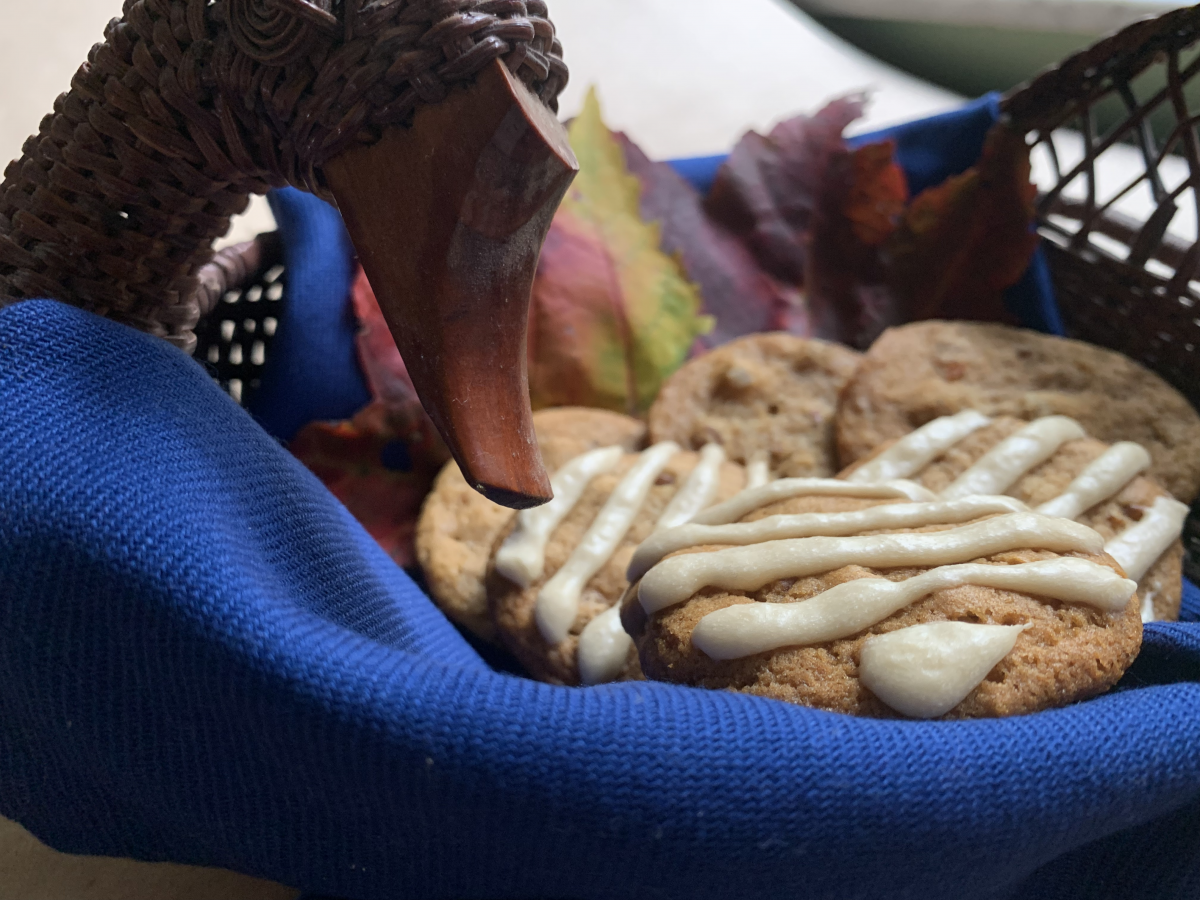
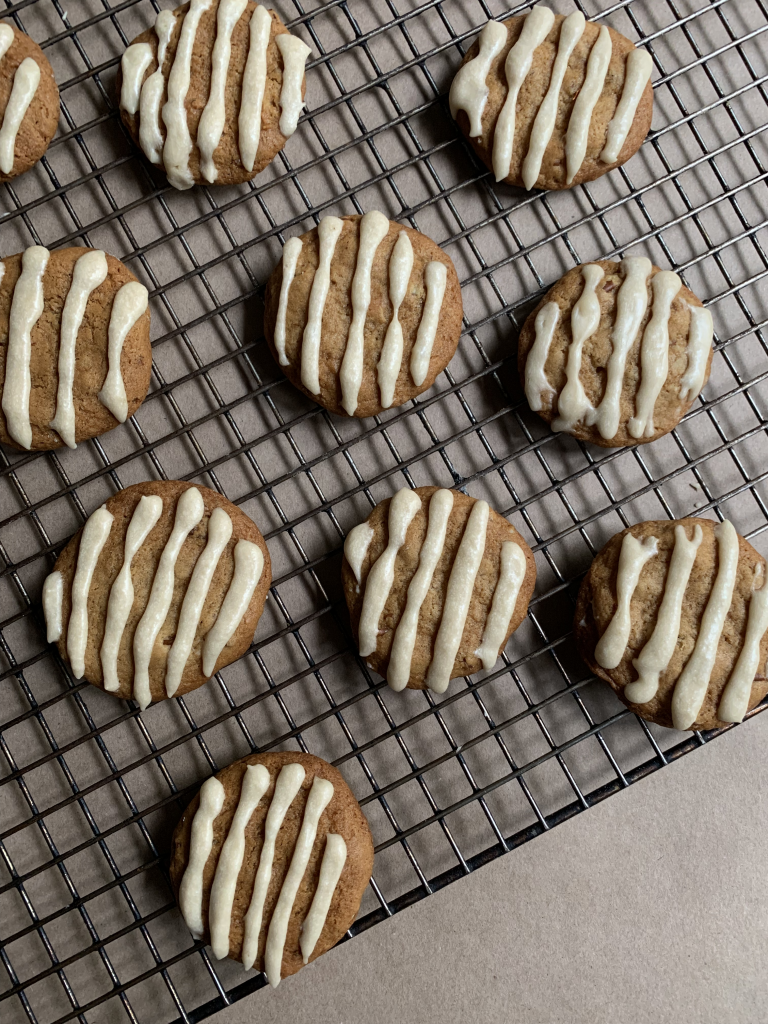
How to describe them… Take a good, solid oatmeal cookie and then give it an elusive hint of coconut that macaroon lovers will adore, and even I (a notorious hater of Demon Hair) can enjoy.

Click here if you only want the recipe without the discussion.
First things first. This cookie is simple, tasty, friendly, lasts well, and is both easy and fun even for bakers who can barely see over the counter. It’s an easy, everyday cookie, not an elegant one, and certainly not extravagant. Don’t lose sight of that essence as I go down all the niggling little details and questions we had to address.

- “Lyle’s Golden Syrup” does not mean “Go and buy a special ingredient”
Golden syrup is a product used across the British Commonwealth in much the same way as Karo corn syrup here in the U.S. They behave exactly the same in baking. The only difference is taste. Corn syrup has an all but invisible, vaguely vanilla flavor, while the British product has a pronounced butterscotch/caramel vibe. We ordered a bottle online as part of our research, for something like twice the cost of cheap, supermarket corn syrup. We enjoyed it too, much more than we expected. It’s a fun thing to try if you want to recreate the genuine Australian flavor. But only if authenticity is your goal.
The true spirit of the cookie has more to do with the flavor of childhood than the flavor of golden syrup, and that memory changes with where you grew up. So ask yourself this. What would remind my boy in the army of Home? Honey? Molasses? Maple Syrup? That taste will give your lad (and your little helpers) the true experience of an Anzac cookie even if it would seem a little off for your visiting friend from Sydney. Still good, but not quite right.
The substitution is simple. A 50/50 mix of corn syrup and maple syrup produces a very similar intensity of flavor. Just add them to the melting butter in place of the Lyle’s, and proceed.
- “Rolled Oats” is all you need to know.
Do some online research and you will find recipes that stress the importance of using “quick oats” versus “old fashioned oats.” We’re here to tell you it makes no material difference. Use what you have on hand.
The two products aren’t all that different in any event. Rolled oats are made by steaming whole oat seeds (“groats”) and then rolling them flat between two steel cylinders while they are soft. They are then dried, packaged, shipped, and sold. Quick oats are made the exact same way but with cylinders aligned a little closer together to squish the groats that much flatter. It reduces the cooking time on a stovetop. It matters not at all in a cookie. Or at least not in this one.
The amount of oats is as flexible as the rest of this recipe. The basic formula here is 1 cup flour to 1 cup sweetened flake coconut, to 1 cup sugar, to slightly more than ½ cup of melted butter, to X cups of rolled oats. X varies from 1 cup to 2 cups depending on who you ask. We settled on 1½ cups. Do as ye will, they all worked fine and were not very easy to distinguish.
NOTE: “Steel cut oats” a/k/a “pinhead oats” are toasted groats cut into thirds to provide a nicer mouthfeel. I love eating them, but it’s a much bigger production that requires you to put them up to soak on the night before cooking. Steel cut oats would not work as a substitute in this recipe.
- There is one weird instruction we still don’t understand
Every recipe we found included a fairly hefty amount of baking soda that has all its lift removed before it goes into the cookie. Some of the recipes mix it with boiling water, which makes it foam up before you add it into with the melted butter and syrup. Others mix it in cold water, and then add the slurry into the pot of still-hot butter and syrup, which makes that foam up instead. [We went with the second because it’s just spectacular enough to delight everyone’s inner child]. Either way, this initial treatment means the baking soda adds basically nothing in terms of lift. So what’s going on?
Theory one was an old trick of using water to dissolve any potential clumps of leavening agent that sifting couldn’t handle, and also ensure the most even distribution possible. But even distribution can’t be the answer in this case because (a) modern baking soda products do not clump, (b) every recipe writer in the world knows enough to specify cold water if you want to make a slurry, and (c) even those who don’t know that rule in advance would get the idea pretty darned quickly once they watched their leavening power fizzle away before the dough ever had a chance to come together.
Could it be a typo, with some particular writer making a mistake? Nope. The same instruction appears in every recipe, including the most up to date ones.
Our current theory has to do with the fact that more alkaline doughs brown a bit better and deeper. And it’s true that Anzac Biscuits have a particularly GBD (chef speak for “golden brown and delicious”) bottom. But even that has some issues, because why go to all that effort for such a relatively minor result?
So it’s still a question without an answer. But do it anyway. It really is fun to watch, and there’s probably a reason even if we haven’t figured it out yet.
- The cookies have an amazing flavor balance that works just as well if you play around with the basic concept.
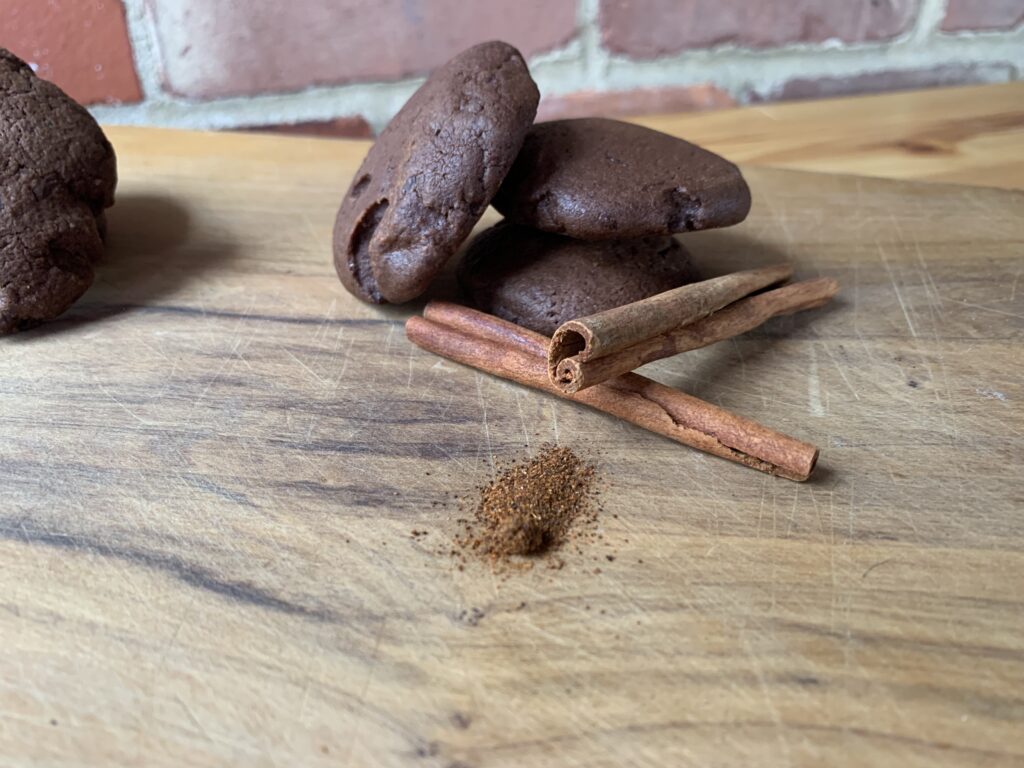
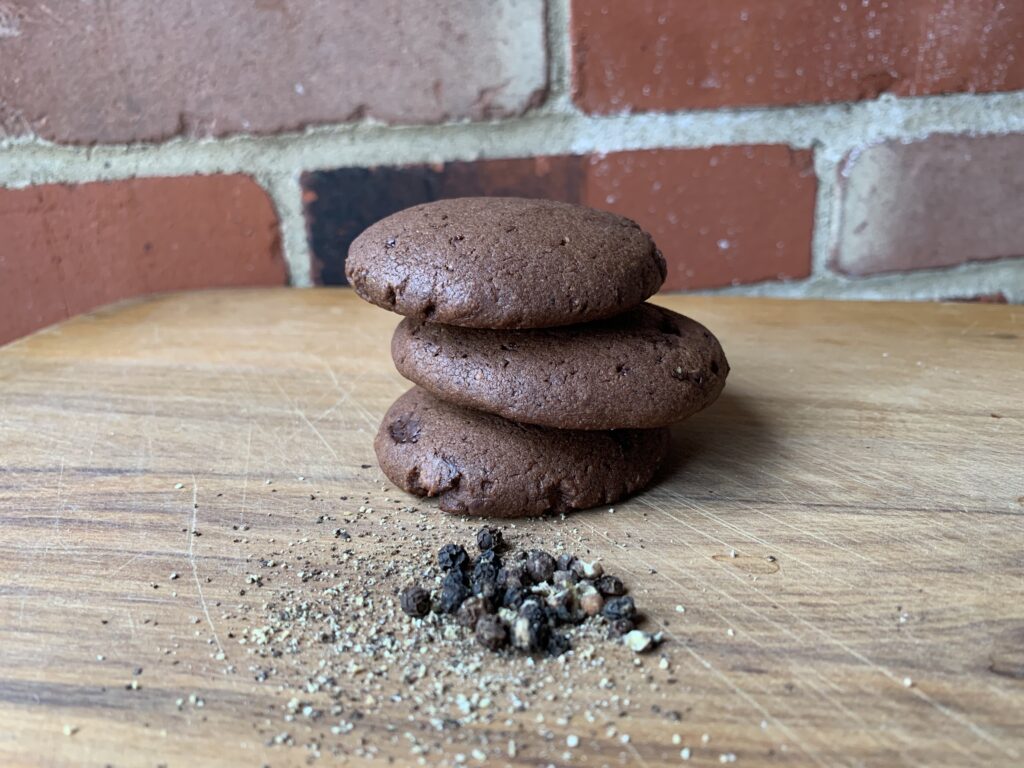
I made a mistake in my first test run. I doubled the amount of butter. Doh! Rookie blunder. The result is the cookie you see on the left:
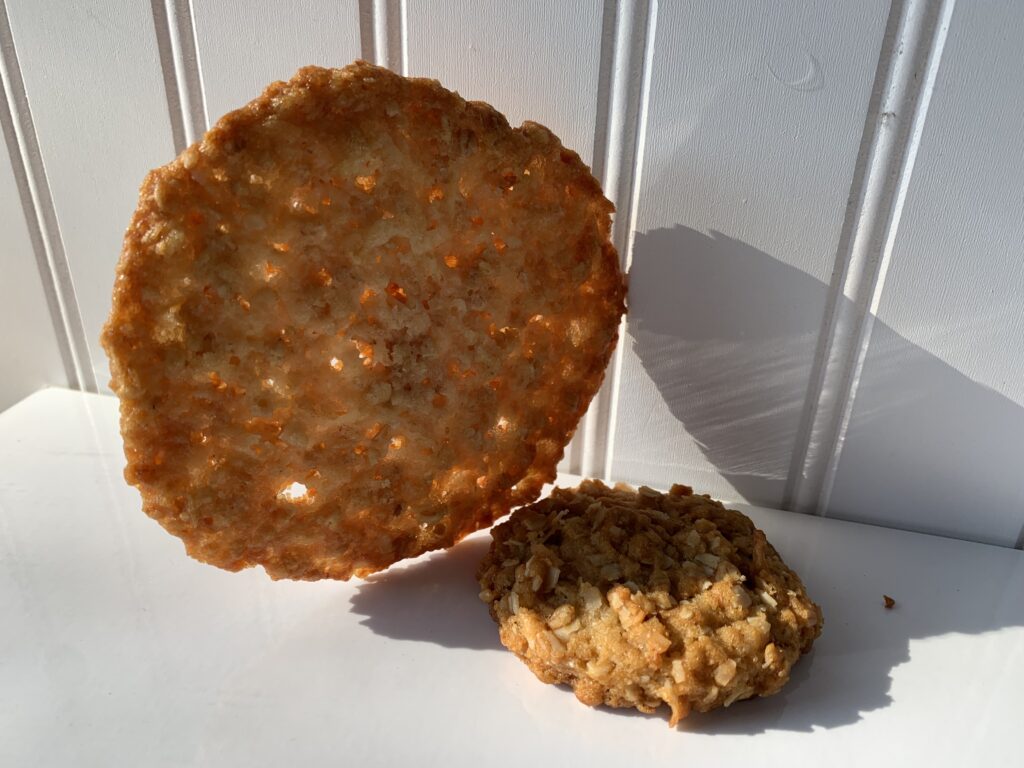
I think I like them even better. It’s basically a lace cookie with lovely bits of oatmeal, scented by a perfect amount of coconut. #Yum.
We added the salt
We’ve yet to see salt in any recipe from a native Aussie or Kiwi. That said, we greatly preferred the cookies with an invisible bit of seasoning to bring the other flavors out. It’s a modern trick, but one so good that we could not leave it out of the actual recipe
The baking temperatures and times vary a lot, but even this seems to make very little difference
Do some reading and you’ll find many recipes that carefully specify a “medium” oven (350° F = 175° C) for 10-12 minutes. Others are just as clear about using a “moderately low” oven (325° F = 163° C) for 15-20 minutes, with a third group insisting on a “gentle” oven (300° F = 150° C) for 20-25 minutes.
We tested all three. The differences among the three were subtle to say the least. We made a careful side by side comparison of the fresh, same-day cookies and found that (a) the 350° result was hint more crispy, (b) the 325° cookies were right in the middle, and (c) the 300° oven made something that was a little more chewy if you squinted real hard and insisted on finding a difference. All those distinctions more or less vanished overnight. What can I say? Bulletproof.
NOTE FROM KATE: This is a very “moreish” cookie, so when I wanted to nibble the next day, I went after the “ruined” batch that mistakenly cooked at 300° for only 18 minutes. They were, after all, too tender to ship on the day of baking. An obvious failure… right? Not so. Their texture came together overnight into a wonderful, chewy texture. Two days later, even these were hard to tell apart from all the others.
P.S. A gentle hint: try nibbling your cookie with a square of dark chocolate in your other hand.
And if you want a truly authentic recipe:
It took some searching, but we did find a native Australian to use as a sounding board. An extremely generous native, who spent way more time on the back and forth than she probably expected, and even shared her favorite, classic recipe from Australian Women’s Weekly. You can recreate that recipe by using ours with only 1 cup of rolled oats, no salt, and applying a baking time of 20 minutes in a “moderately low” oven (325° F = 163° C). But you want to hear something funny? The magazine’s most current, “best ever” recipe has tweaked the recipe in a couple of ways, and now uses a baking time of 12 minutes at 180° C (355° F).
Why be consistent when you’re already bulletproof?
CONCLUSION:
We get asked for recipe recommendations on a fairly regular basis. It always follows the same general pattern. “We have XYZ going on next [date], and I’d like to bake some cookies. What would you suggest?”
We now have more than 300 carefully tested cookie recipes from all over the world, so it’s not that easy to give a straightforward answer, and we end up asking a series of questions in return. “What are your favorite flavors?” “Who is your audience, and what would he/she/they like best?” “What kind of vibe are you looking for?” “How much time/expertise do you have to put into the project?”
The most common scenario looks something like this. “Oh, I just like plain old cookies. Same for [audience]. I’m just looking for something easy, that we wouldn’t already know. And I’d love to bake them with my [child of choice] when we meet next [date].” I’d be hard pressed at this point to recommend anything other than Anzac Biscuits. They are all of that, and have a great story as well.
Enjoy!