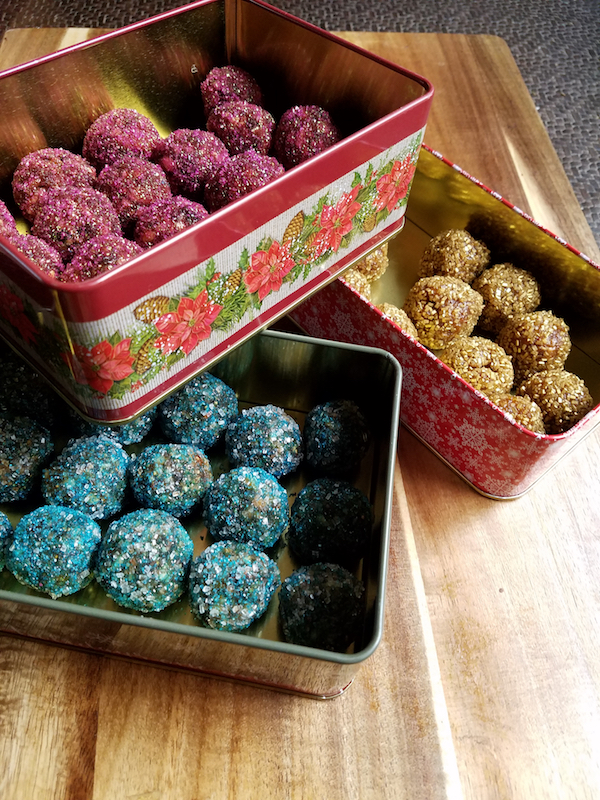
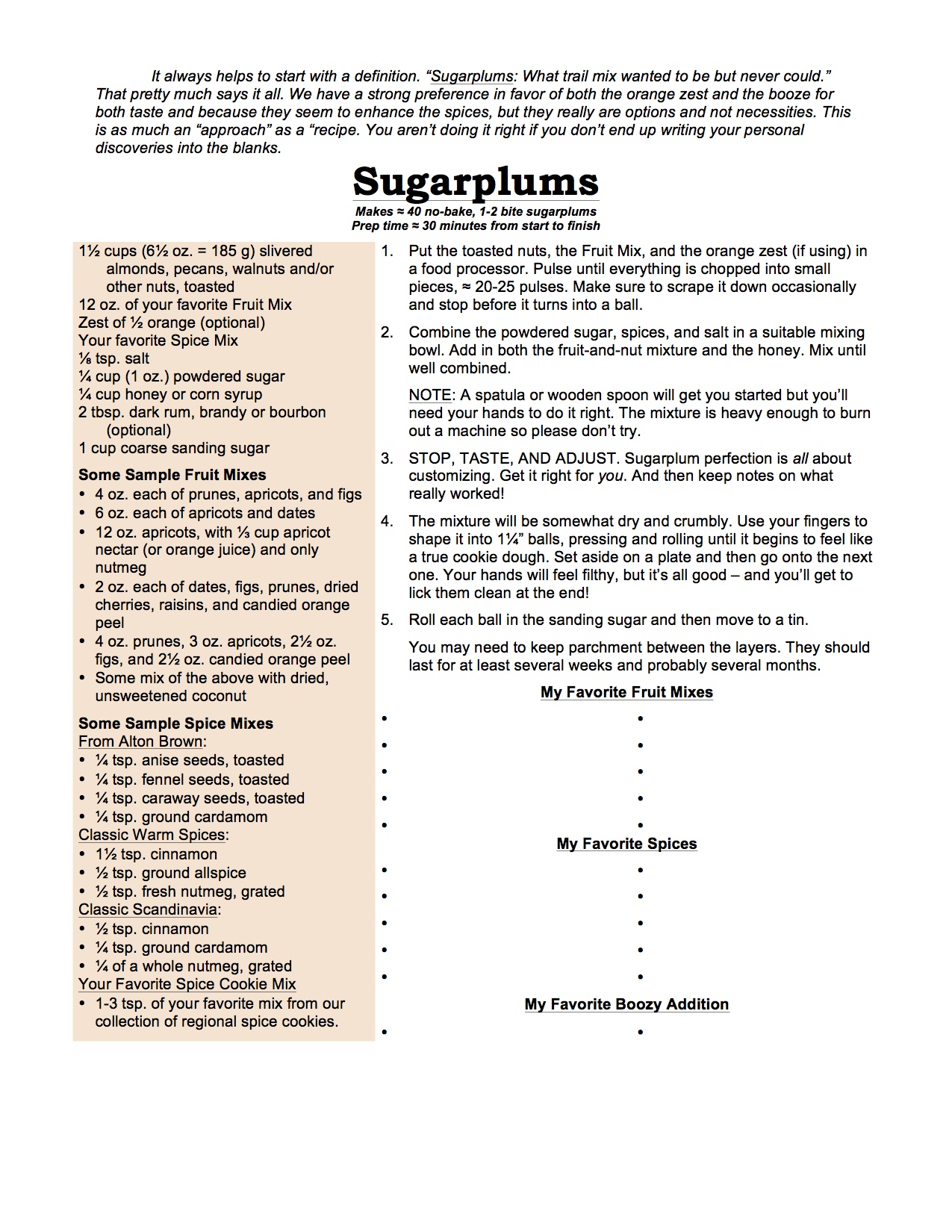
Three different Sugarplums from our 2017 tray. The red ones are made with pecans and almonds for the nuts; 2 oz. each of dried cherries, dates, figs, raisins, and candied orange for the fruit; Kirsch for the booze; and the Warm Spices mix. The gold balls are made with almonds for the nuts; dates, apricots and candied orange peel for the fruit; brandy; and the Scandinavian spice mix. The blue ones have walnuts & almonds; candied ginger, figs and a couple of dates; gin; and a combination of lemon zest, cardamom, and pepper, much less clove, and a touch of cinnamon. Kate got to play!
Kate writes:
“I never took the concept of no-bakes seriously at all until we tried making Sugarplums. Sugarplums! Dried fruit and nuts and spices, tied together with a bit of honey. Highlighted with candied or grated orange zest and a bit of brandy. Coated in sparkling colored sugar, they look as festive as they taste. And if you excuse the sugar coating, which can be substituted by finely chopped nuts, you’ll even get a treat that consists of wholesome ingredients!
Thus it was the humble, ancient sugarplums that turned my eye, changing my mind about the concept of no-bake cookies. Because a cookie can be perfectly delicious despite being easy to make. These are part of our ‘easy’ category.”
Scott adds:
If you don’t have the paper book, I urge you to print this recipe out, put it in a plastic sheet protector, and start keeping annual notes on your various experiments. There is no “right” Sugarplum! That is their basic and most fundamental charm. They are all about what YOU like, and what YOU come up with.
And if you have out paper book, for heaven’s sake feel free to start writing on the pages. It isn’t holy writ! We put those blanks and “My Notes” pages in for a reason. We wrote our book to be that one you will use to death and then pass on to the next generation. How will they be able to reproduce what [Grand] Mom and Dad did if you don’t record your own special tricks and observations?
It’s not like you need our permission, but you have it. Permission and active encouragement. Make that copy your own! Nothing would make the authors happier.
It’s hard to get more “heritage” than the early Renaissance, and that’s what we have here: four famous cookies that grew into maturity along with the likes of Leonardo, Michelangelo, Donatello, Botticelli (with whom Leonardo supposedly founded a restaurant), Verrocchio, Raphael, and the rest of them. And Columbus for that matter. What can inspire artistic brilliance more than a really good cookie? The answer is obvious: Nothing!
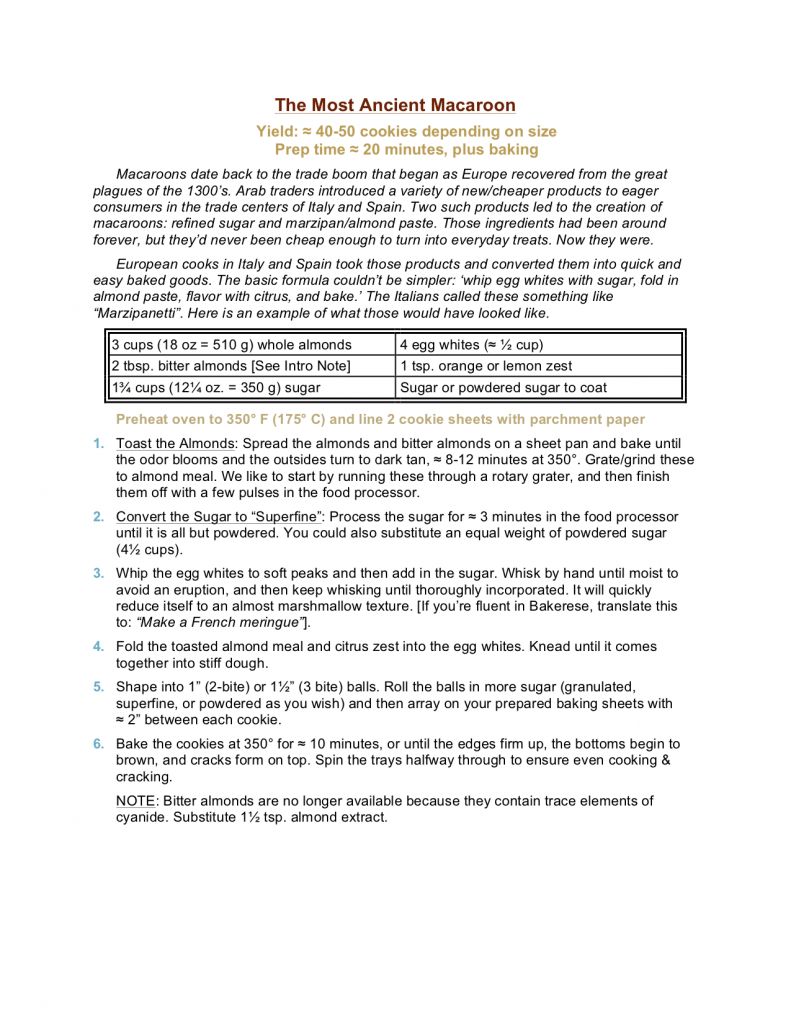
We’re talking about classic macaroons, a cookie dating back to the trade boom that followed the Black Death’s destruction of medieval civilization. Arab traders introduced a variety of products to eager consumers in the trade centers of Italy and Spain. Two main ones in turn led to the creation of macaroons: refined sugar and marzipan a/k/a almond paste. Yes, those ingredients had been around forever, but they’d never been cheap enough to turn into everyday treats. Now they suddenly were, and Renaissance Europe was ready to adopt new ideas their grandparents would have scorned.
Italian and Spanish cooks started the process by incorporating the new ingredients into quick and easy baked goods using methods known since antiquity. The basic formula couldn’t be simpler. First whip some egg whites with sugar to make a meringue, using a more generous amount of sugar than before since it was now more affordable. Fold in some imported almond paste, and then bake. And there you have it! The first macaroons, commonly known as “Marzipanetti in Italy.
Matters evolved from there, with bakers slowly adopting the regional variations that eventually hardened into recipes. We have now worked up four versions of that basic recipe, distinguished by relatively small changes in the way they’re flavored and presented. Here is a table to more-or-less compare the four recipes, normalized to an even one pound of almonds. [NOTE: The different egg sizes occur because those recipes start from a different amount of almonds].
The Most Ancient Macaroon included a hefty amount of sugar and some bitter almonds. We were forced to substitute almond extract for the latter. Bitter almond extract would be even better if you can find it. This cookie is super simple, focused on those new imports, and consistent with the oldest macaroon recipes we could find after a week or two of search. NOTE: Scott believes it may be even more authentic to replace the sugar and almonds with premade almond paste, because that product would have been easier to ship back in the day.
Italian Ricciarelli, a specialty of Siena, must have orange zest but vary from there. We reviewed more than a dozen variations before settling on a version that includes an elusive hint of vanilla, some honey to enhance the sugar, and a single egg yolk to give them some richer chew. The cookies would still be Ricciarelli without those additions, but they help to distinguish this cookie from its macaroon peers. And they’re good. We also adopted the trick of adding some baking soda into the dough, because it creates attractive cracks in the powdered sugar crust.
Spanish Almendrados add lemon zest instead of orange, use whole eggs, and ignore the initial meringue step. Throw it all in a food processor and go! This methodology, combined with the shorter baking time, gives the cookie a fabulous chew you’ll particularly enjoy. They come with a classic almond-on-top decoration, and a granulated sugar crust.
You can find Amaretti in our cookbook, Heritage Cookies of the Old and New World. The recipe looks very similar to the Most Ancient Macaroon except for a monstrous hit of almond extract, and the candied cherry on top. Our reference to “Rudolph’s Nose Cookies” wouldn’t have made much sense in 15th century Italy. Neither would reindeer if you think about it.
Continue your travels around the Mediterranean and you’ll see extremely similar cookies such as those flavored with rose water (a favorite in Turkey), or with walnuts and walnut extract in place of almonds. Move north and things begin to differ more, with roll-and-cut meringues such as Basler Brunsli (mix of almonds and hazelnuts, cocoa powder, and cherry liqueur) or German Zimtsterne (mix of almonds and hazelnuts, cinnamon, other spices, and lemon icing).
But here’s the bottom line. Macaroons go so deep into the roots of modern Europe that there’s really nothing older except the extant waybread recipes. They’re also simple to make and easy to modify into infinite variations. It’s an invitation to play, and we encourage all you creative people to do so!
Here are our recipes for all four, plus a bonus recipe from the Balkans: a terrific macaroon based on walnuts instead of almonds.
Enjoy!
Ricciarelli, the ancient macaroon of Sienna, Italy that Leonardo and the rest grew up on
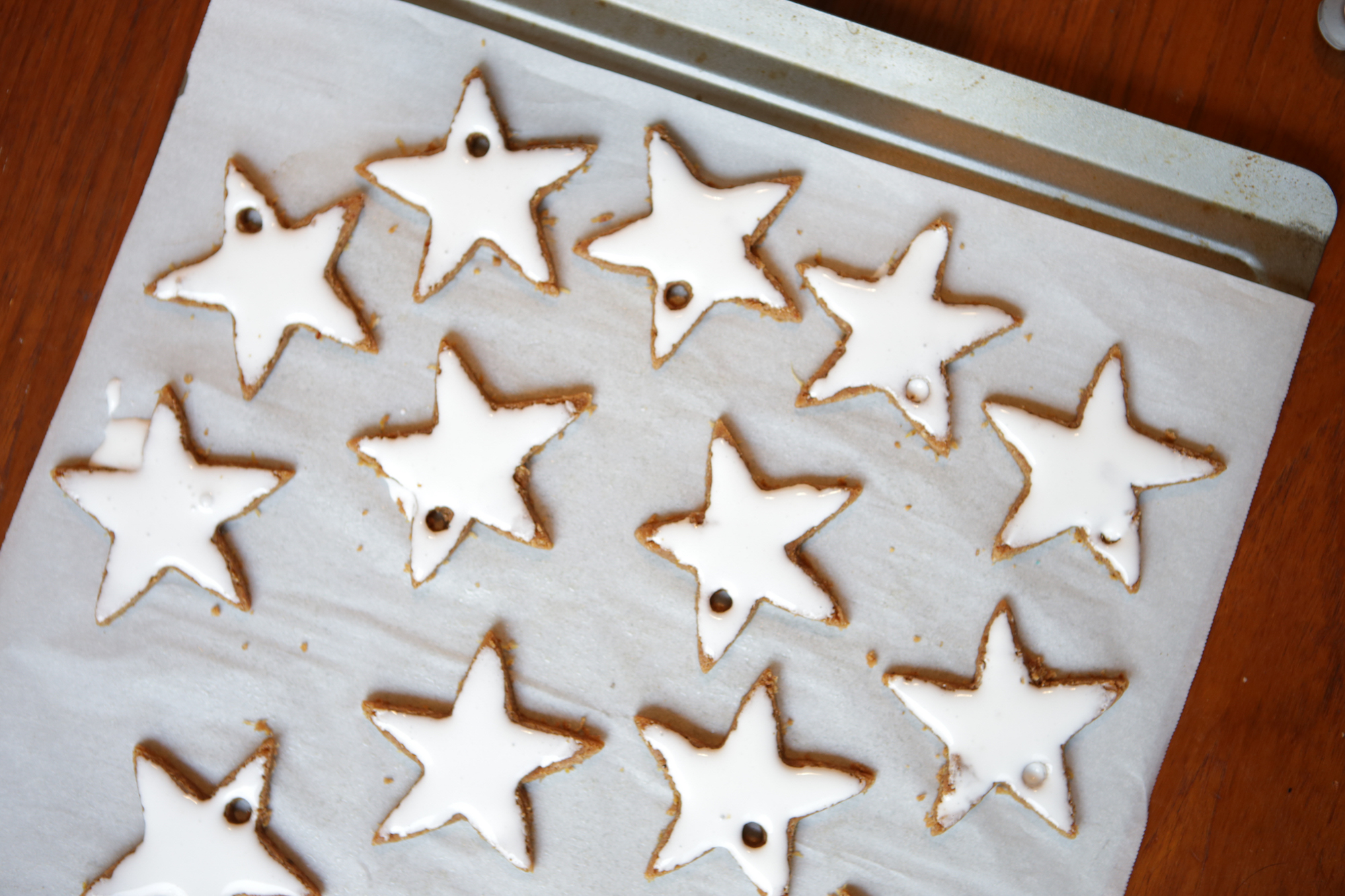
Cinnamon Stars, complete with a hole for hanging them off your tree.
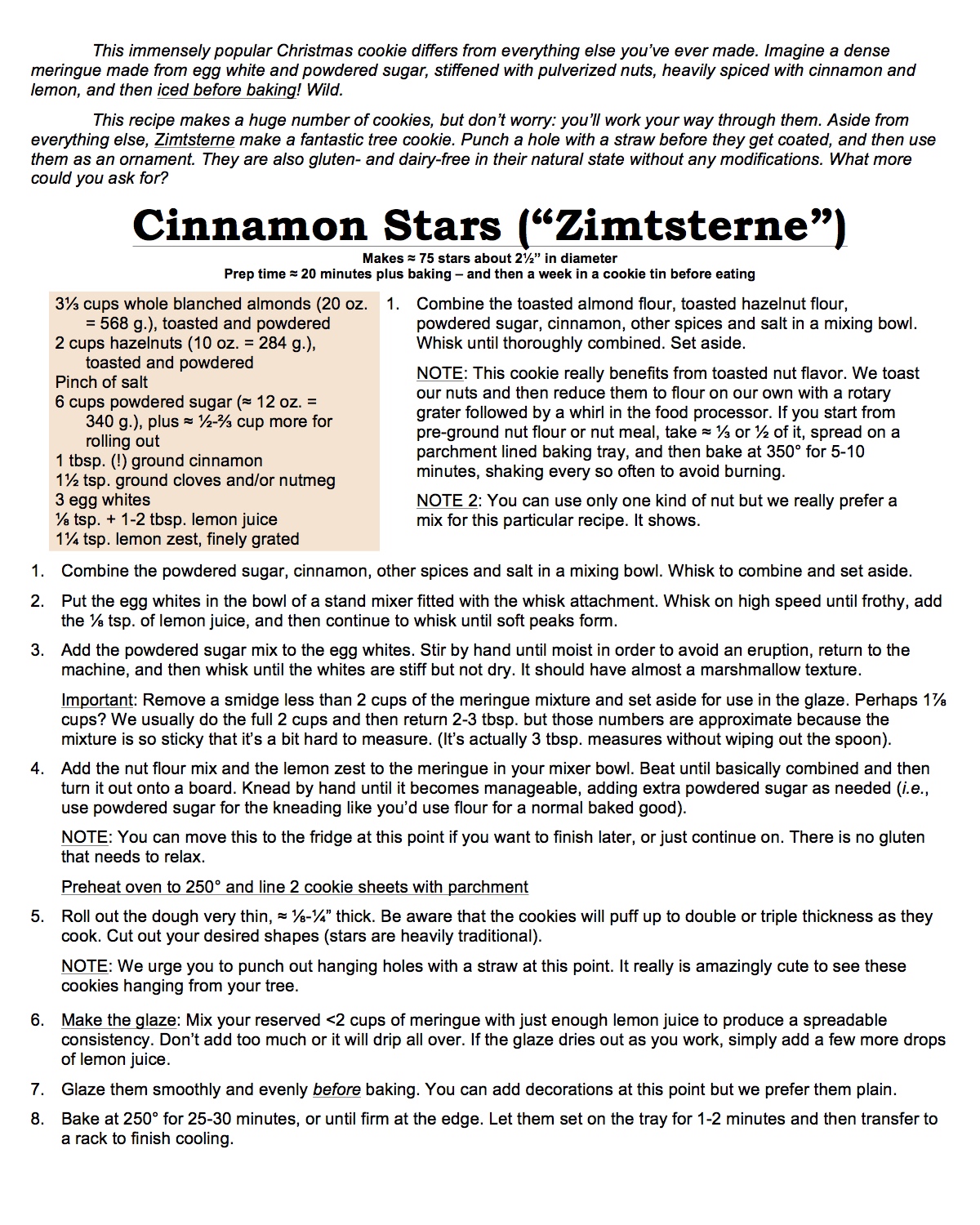
This is the cookie we point to when people ask for an example of what we mean by a “heritage” cookie. There aren’t many Americans who are familiar with Zimtsterne (zimt = cinnamon, sterne = stars), but you’d be hard pressed to find anyone in a German speaking country who does not know them. Or in a country that borders on one of those nations. They are as common and ubiquitous in that part of the world as Chocolate Chip Cookies in the U.S.
The fact that people need to learn about them is one part of the “strange”. The other lies in how the cookies are made.
If you’re reading this, we assume that you’re a baker. Have you ever seen, anywhere, a cookie where you bake on the icing? It’s brilliant!
At their core, Cinnamon Stars are nothing more than a very refined version of a dense macaroon. You grind up nuts (in this case using a mixture for added complexity), flavor those nuts (in this case with spices for yet more complexity), mix that with a French meringue (egg whites whipped with superfine or powdered sugar), and then bake (in this case using a very low oven for color and texture. Change the type of meringue with a higher percentage of whites, and you’ll end up with a flavored Macaron. Change the spices to metric ton of almond extract with an average 350 F (175 C) baking temperature, and you’ll have Amaretti. Make that a bit of citrus with almond meal instead of flour, and you’ll get the antique Renaissance versions like Sienese Ricciarelli or Spanish Almendrados.
It’s a simple concept. But… whoever heard of rolling out your macaroon dough before baking? Or baking on the icing?
It works because the icing is just that same French meringue mixed with added lemon juice. Meringue bakes well. Obviously. And that lemon juice works wonders, because being in the icing preserves all the high notes. That is one of the tricks we learned along the way. Lemon zest works great inside a cookie because the zest holds all the essential oils (the perfume of the fruit). But the tang of the lemon juice will disappear. If you want to catch those sharp, acidic notes you need to put them into an icing.
That covers “strange.” Wonderful comes from the overall flavor, and a Northern European tradition we’ve adopted for years: the Tree Of Gifts.
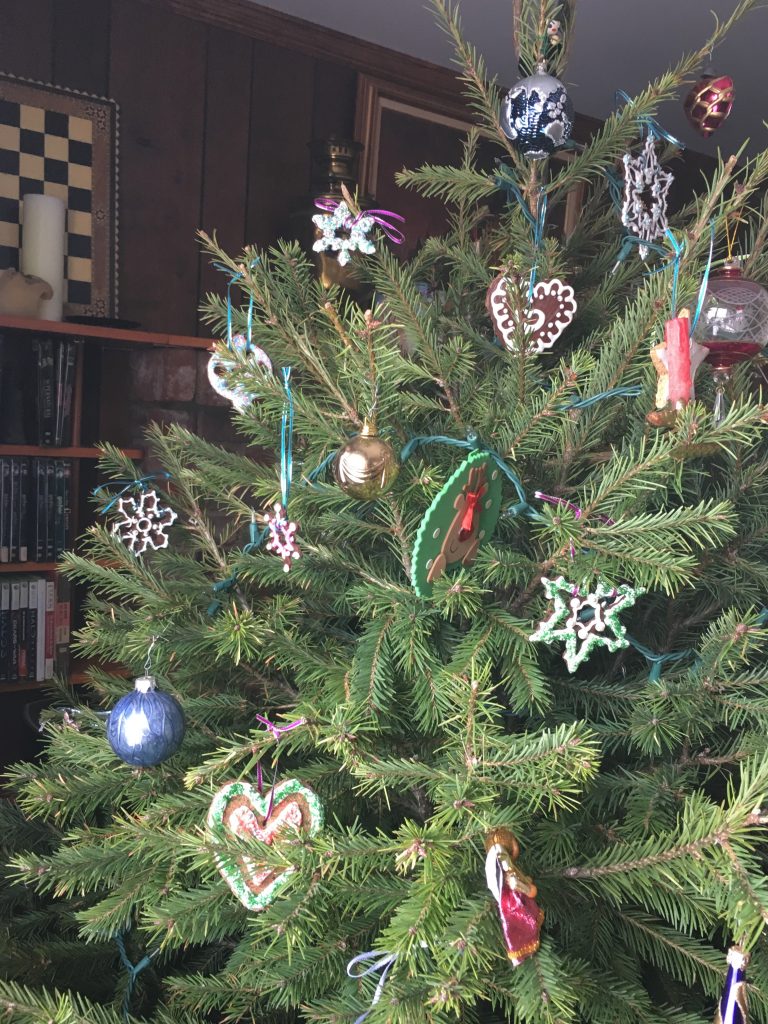
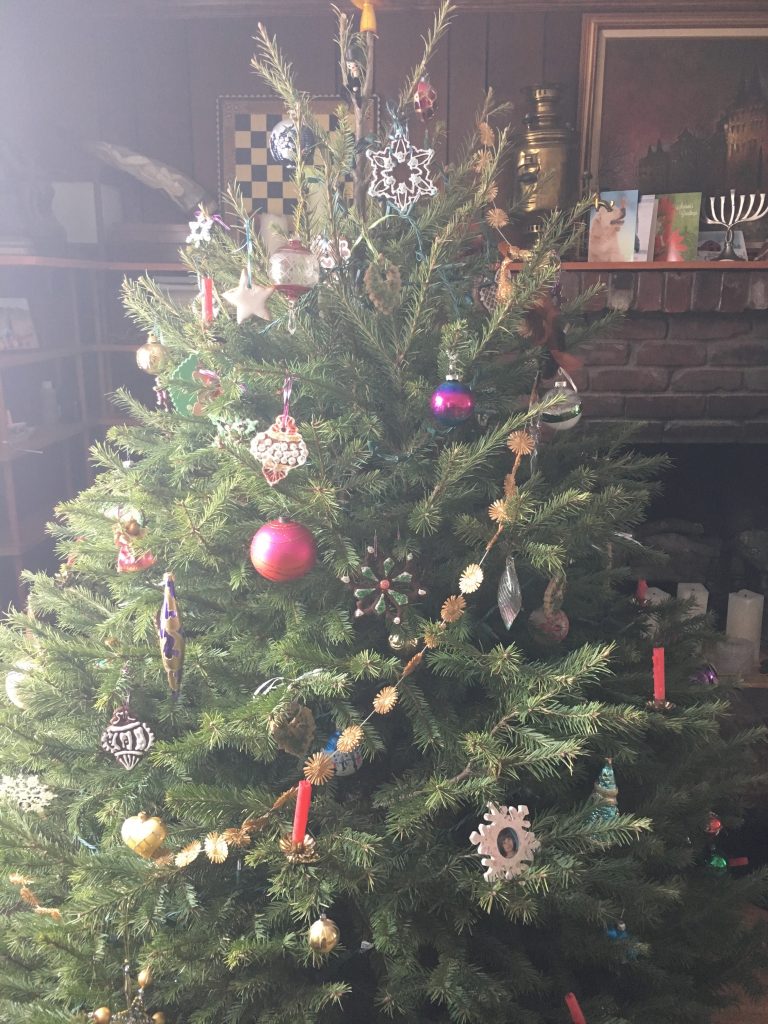
Moravian Snowflakes, Polish Gingerbread (Pierniczki), a chocolate angel (on the bottom), and a Cinnamon Star hiding behind the candle on the upper right.
Another view, with the Cinnamon Star on the upper left. Note that all the cookies are on the upper half of the tree. That’s essential if you have either small children or, in our case, a labrador retriever in residence.
A guest arrives during the holiday season? Invite them in, and say “Please have a treat off the tree!” It captures the spirit of the holiday like nothing else. Tree; decorations; sweets; cookies; and all topped off with hospitality.
Cinnamon Stars make great decorations because they’re sturdy enough to last through the holiday season. Snowflakes have no rival when it comes to appearance, but any humidity in the air will soften them up enough to sag an break through a ribbon. (Don’t even think of hanging them with a metal wire). And gingerbreads tend to be so thick and heavy that they make the branches sag if you aren’t careful. Cinnamon Stars are ideal.
You can decorate Cinnamon Stars by tinting the dough, the icing, or both. Or by standard decorating after they’re baked using royal icing, dragees, luster dust, etc. We tend to keep them plain, but that’s a question of taste.
As for “familiar”, there is absolutely nothing in this cookie that will surprise or offend the most tender of American palates. Cinnamon Stars taste like dense, chewy, lemony Snickerdoodles with a fantastic appearance, and a lot of fragrant nuts. It’s a no risk experiment.
A FINAL BONUS: THREE FREE TIPS THAT AREN’T IN THE BOOK:
The recipe calls for three egg whites. That works, but things get tight when you try to toe the line between reserving what you want for the icing, and still having enough to hold all the nuts. You’ll gain safety margin if you use size XL egg whites instead of the standard U.S. “large”.
Add a tablespoon of molasses to the dough if you want a higher contrast between the base and the bright white icing. It changes the flavor a bit, but not unpleasantly. Our book includes a standard variation on this recipe (Vanilla Sticks), and that is more different than the effect of a little molasses.
Remember that you don’t need to spread your icing all the way to the edge. The cookies look just as good, and arguably better, if you leave a gap between the edge of the icing and the edge of the cookie. To be completely honest, we only avoid that because our decoration skills aren’t up to that level of precision. Baking, yes. Precision artistry? Not so much.
And now, on to the recipe. Enjoy! This was the very first Pavelle addition to the Stoy family collection of every-year cookies. Don’t be at all surprised if it turns out to be mandatory for your family too.
NOTE: If the cookies dry out, put them in a tin with a piece of bread and leave it overnight. Come the next day they’ll be perfect all over again.
When you make as many high quality cookies as we do, you get used to a couple of standard questions. The top two have to be, “What are your favorite cookies?” and “What is the favorite cookie overall?” The answer always disappoints: there are no real, statistical favorites because individual tastes end up dominating. But one thing we can say for sure is this:
People adore filled cookies.
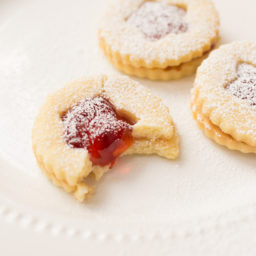
There’s just something very “extra” about treats inside a treat. And that’s extra “extra” for Butter Jellies, because the jam in the middle (a) makes them spectacularly pretty, and (b) adds a series of bright berry flavors that cannot be baked into a dough. Yes, you can now find freeze dried berries in a lot of supermarkets. And yes, they add a bit of true berry flavor into your dough that people can taste even through all the butter and other ingredients. But it isn’t the same because the full berry flavor includes a lot of things that don’t come through, such as all the bright high notes.
Those require either an icing or, as in this case, a filling. The combination of tart/sweet jam and buttery cookie is irresistible. If these aren’t the #1 favorite on our annual tray, they probably count in the top three for a vast majority.
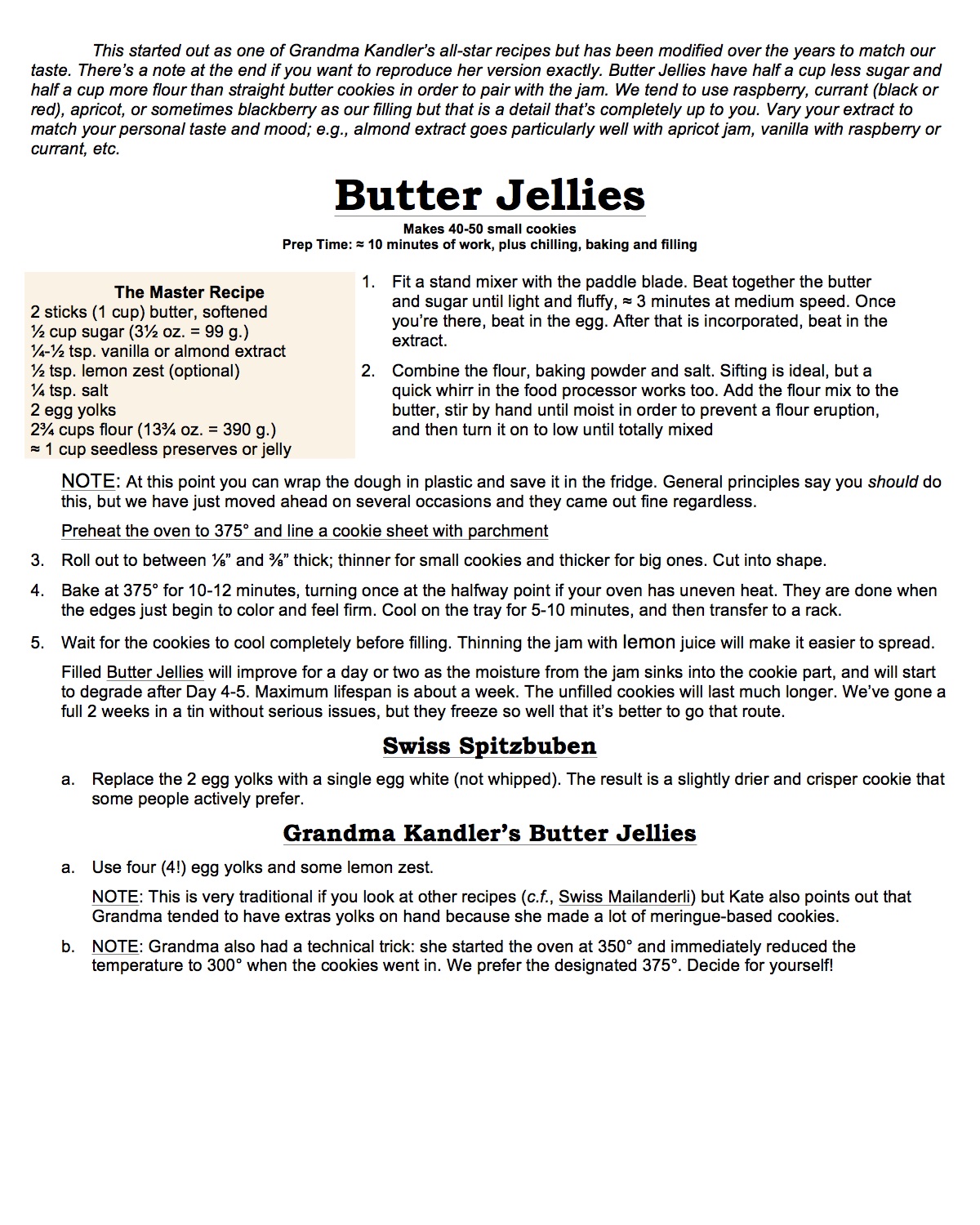
It’s really a simple cookie. Butter Jellies and their variations are a basic, roll-and-cut, shortbread/butter cookie with just enough flour to hold together for a few days after they’re sandwiched around liquidy jam. The variations are subtle, and amount to either more egg yolks (Grandma Kandler’s version, which is known in Switzerland as star shaped Mailanderli), or the use of egg whites instead of yolks for a drier mouthfeel (Swiss Spitzbuben). What about whole eggs? We tested it of course, and they work fine from the sturdiness point of view, but we ended up preferring either the rich chew of yolks alone or the dry counterpoint from using only whites. Your mileage may vary.
The jam is up to you. We used to adore rose hip jam, but it became unavailable 5-10 years ago. Nowadays it’s currant jam or blackberry because we reserve raspberry for Linzer Tarts.
And no! These are not Linzer Tarts! That is a name that comes from a classic, pie-sized Austrian Torte made from a fragrant hazelnut/lemon piecrust. No nuts, no Linzer. Thus Sayeth The Lord! So do not blaspheme. These are Butter Jellies.
Make Linzers too. That’s our solution, and if it’s good enough for our family, it’s good enough for yours!
BONUS FREEBIE! To convert Grandma’s version into true Mailanderli:
Use 3-4 yolks in the dough.
Increase the amount of lemon zest to a full 1-1/2 tsp.
Increase the amount of vanilla to a full 1-1/2 tsp.
Cut the dough into stars
Coat the top before baking with an egg wash made from 1 whole egg thinned with a bit of water.
You can follow Grandma’s cooking technique but we’ve had equal success with a constant 325.° Either way, they will want to cook longer because of the lower temperature. 20-25 minutes should be about right.
One of my favorite bakes is gingerbread, and I especially like the way it comes out of the mold. I know that Scott gave you got a molded cookie in a recent blog, but we tend to start with the hardest ones first. We also start our baking with cookies that need to sit for a while and soften naturally.
Behold the soft plentitude of molasses and spices! The glaze is optional – I like to mix rum or brandy with powdered sugar until it’s thin enough to paint on with a soft, clean paintbrush.
These beauties are raw, the way they come out of the carved wooden mold. Their features dull a little upon baking, but the glaze will bring them back out. Stay tuned for more images later.
Leave the formed cookies out to dry overnight, preferably in the fridge or under a fan. This will create a surface that’s just a little firmer than the bottoms that were resting on your parchment or tray. When the cookies rise during baking, Boyle’s Law says they will tend to have that surface rise up instead of spreading out with the moister, underneath part of the dough.
These are the two main tricks that allow for the creation of super-fine features on Springerle, the smooth caps on Macarons, and all the other cookies that feature a “foot” on the bottom..
And now I’m off to order our special, “we’re releasing our cookbook” tins! We’re not scouring local dollar stores this time. I want all the tins to have a nice, streamlined design and a custom-made label that will echo the branding of the cookbook cover – something I hope to show you next week.