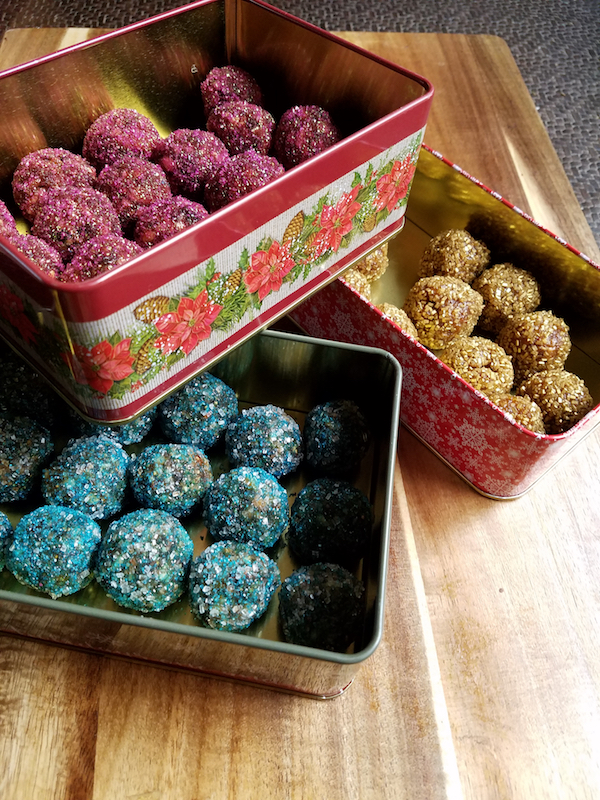

Dairy free and delicious, what’s not to like? This cookie offers a unique flavor profile with a familiar texture somewhere in the slice-and-bake or sugar cookie range. The only unusual part is that title ingredient, and it’s hard to say if that’s really as unusual as people might think.
As always, skip to the bottom if you only want the recipe.
EXTRA SPICE FROM KATE: Okay, hold the phone a sec. My husband’s version of “health consciousness” can sometimes cross that invisible line into “health denial”. Before he continues with his ode to pork, we want to point out that butter, lard, shortening, and all other saturated fats – even bacon [gasp!] – are not good for you. That is why cookies are a treat, not a staple. No, bacon fat is not really any worse than any of those others. Granted. And he’s 100% right that using it in a cookie is “heritage”, not “weird.” But keep the enthusiasm within bounds. This is not a physics-optional cartoon. You may proceed now.
Animal fat cookies are rare in the U.S. for sure, but that is only because we tend to be wastrels and spendthrifts when it comes to leftover fats and drippings. Americans are taught to reach for purified, store-bought fats like butter, shortening, or oil when we cook. But that isn’t how things used to be, and it still isn’t true in professional kitchens, or in any part of the world where people pinch their pennies a little harder. In all those situations the leftover fat, such as drippings from a roast, are treasures to be saved, not waste to be discarded.
That isn’t to say we are holier than thou. Here is our standard method for cooking a few slices of bacon for breakfast: place some slices between several layers of paper towel, put it on a plate, and then microwave for 3-5 minutes until it gets as crispy as you desire. Discard the dirty paper with all that nasty fat.
What could be better? Well… how about not wasting all that fat, which qualifies as “delicious” rather than “nasty” in any other time and place the world has ever known? Sorry to sound all rant-y. We really do use that paper towel trick, and it really does work. But it is sort of embarrassing when you consider the historical perspective.
Try this method instead if you have any plans to use the fat: Place your slices on a rack over a sheet pan (spiced as you desire) and then cook at 375° for 15-25 minutes, depending on thickness. Remove it from the oven when it hits the level of crispy you want. Flip it over with tongs to let any pooled fat drain into the pan, give it a minute, and then dab off any excess with paper towels. Super easy, super reliable, and nothing wasted. Use 350° for chewier bacon and 400° if you like more char and you’re willing to tolerate the smaller safety window before it burns.
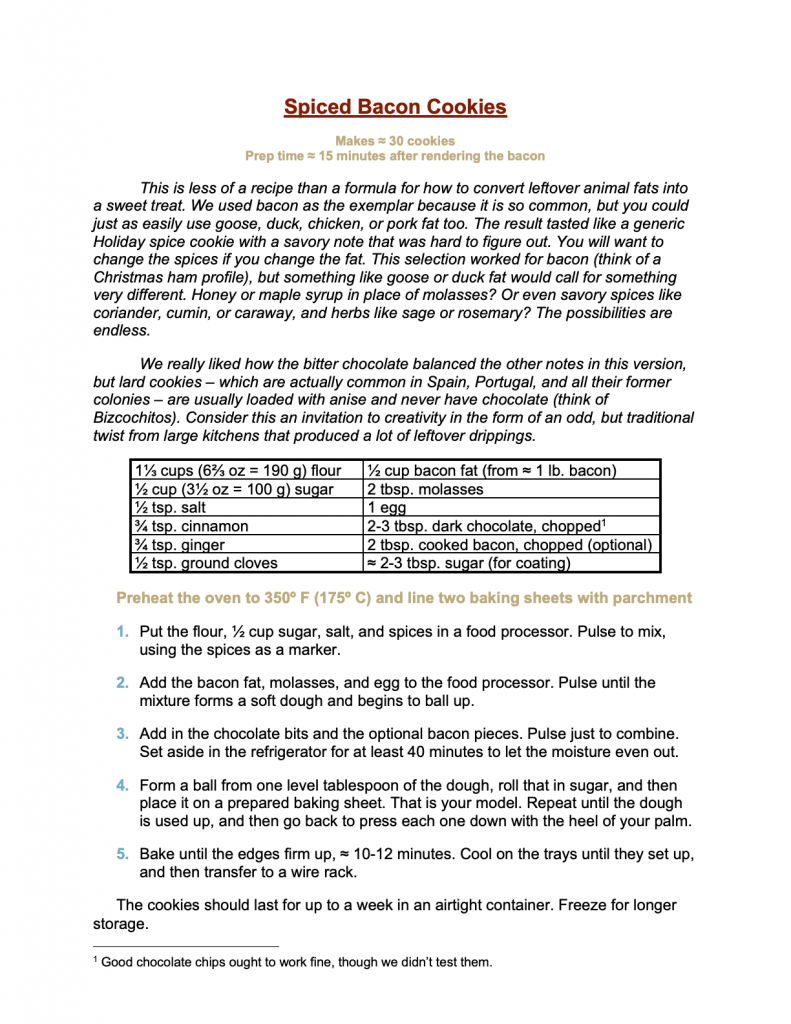
FWIW, this recipe calls for ½ cup of fat, which is almost exactly what you ought to get from rendering a pound (16 oz = 450 g) of bacon. A perfect and thrifty method for whenever you cook large amounts of the Mighty Meat.
Comparison Recipes
Lard (pork fat) has to be the most common cooking fat after butter, shortening, and oil. U.S. bakers adore it for pie crusts and biscuits, but lard is also a common cookie ingredient; particularly in Spain and its colonies. Bizcochitos, the official state cookie of New Mexico, are the best known variation (see Heritage Cookies Volume I for a recipe). Spanish Mantecados are a more tender example, with less flour and a little olive oil added to create a shortbread effect. Look for it in a future blog post.
Bacon fat is nothing more than lard with extra flavor, if you look at it sideways. We’ve found many more savory recipes than sweet ones in the world of baking. There is a German side dish called Speckkuchen (“Bacon Cakes”) that’s definitely worth your attention if this interests you. But this article is about the sweet-treat, cookie versions and they are far from unknown.
Tricks From The Testing
This turned out to be a pretty easy recipe to perfect because the U.S. went through a bacon craze in the early 2000’s that hasn’t quite ended yet. People put bacon into everything! And it kept working, and working, and working again. As we write this in 2021 there’s still a common catchphrase that, “Bacon makes anything better.” Okay, that probably isn’t true in the literal sense. Spend some skull sweat and you’ll probably come up with a few exceptions. But the basic point stands: savory, sweet, smoky bacon goes very well with many, many flavors.
We chose a classic Christmas Ham profile for this recipe, using cinnamon, ginger, cloves, and molasses. Feel free to substitute any spice combination you prefer. Just think of it as something to go with bacon rather than something meant for a cookie. Scott is halfway toward eager in his plans to make an extra-smoky version the next time we have a big, multifamily brunch to cook for.
The cookie itself was just as easy. The proportions fell dead center into the classic sugar cookie and drop cookie range. All those charts in the book before each section? This is where they come in handy.
The only complication came with narrowing things down to the final version. The two of us went back and forth on whether the cookie wanted a bit of crispy texture inside. Translation: should we add in some of the bacon we had lying around from rendering the required fat? In the end we left that as an option. Somewhere around two slices (≈ 2 tbsp. when chopped) is the right amount if you have any extra.
But it still wanted… something. That turned out to be bits of dark chocolate.
You’re in good company if that sounds wrong. Kate almost blanched at the idea, and Scott has to agree that chocolate-dipped bacon was one of the less appealing excesses of that bacon-with-everything craze we described above. But this is the exception that proves the rule. The chocolate sort of widened the flavor, while the textural contrast rounded things out.
CONCLUSION
Bacon tastes good. Everyone agrees on that, and we waste never a crumb.
Bacon fat also tastes good. Everyone agrees there as well, but we waste it all the time. There’s no good reason to do so, and people never did until we grew wealthy enough to value convenience over thrift and flavor. This is just one example of the many, many ways in which you can use this overlooked treasure to make treats that will make you sound like a genius. We’ve seen, tasted, and enjoyed Bacon Ice Cream! If that can work, and we assure you it does, then cookies should be taken in stride.
Enjoy! Here’s the recipe: