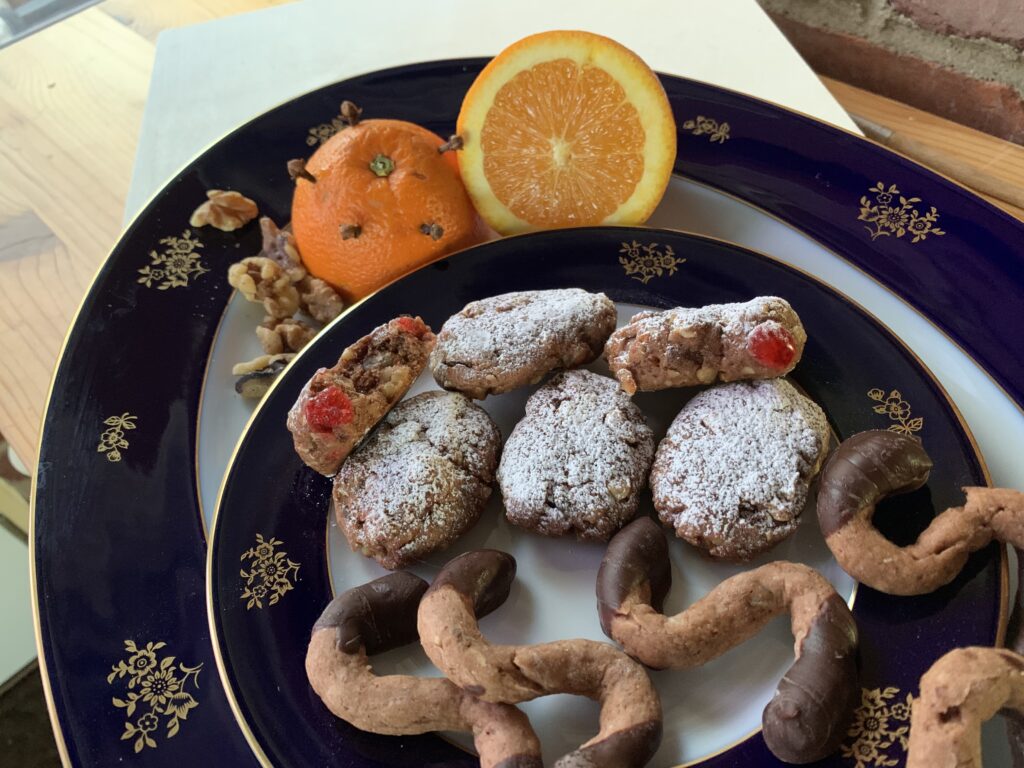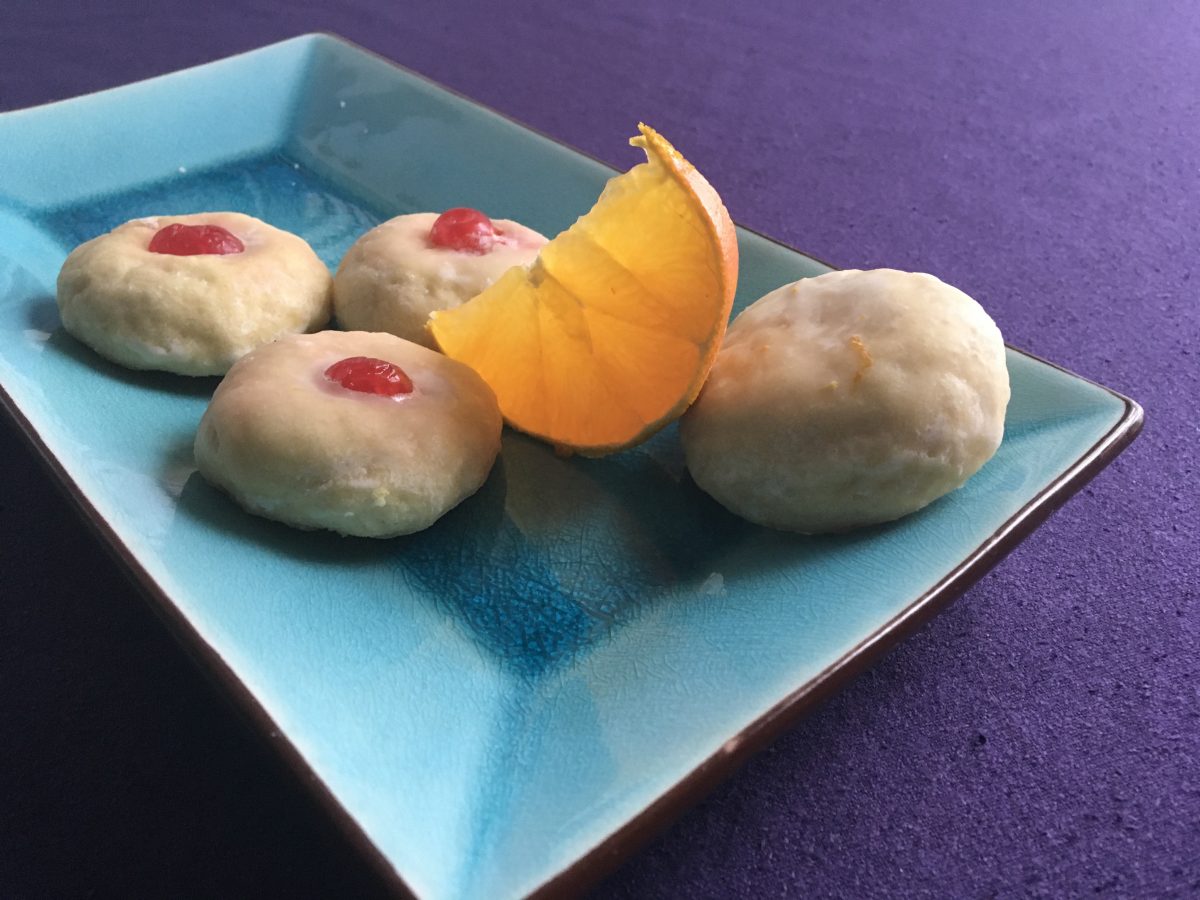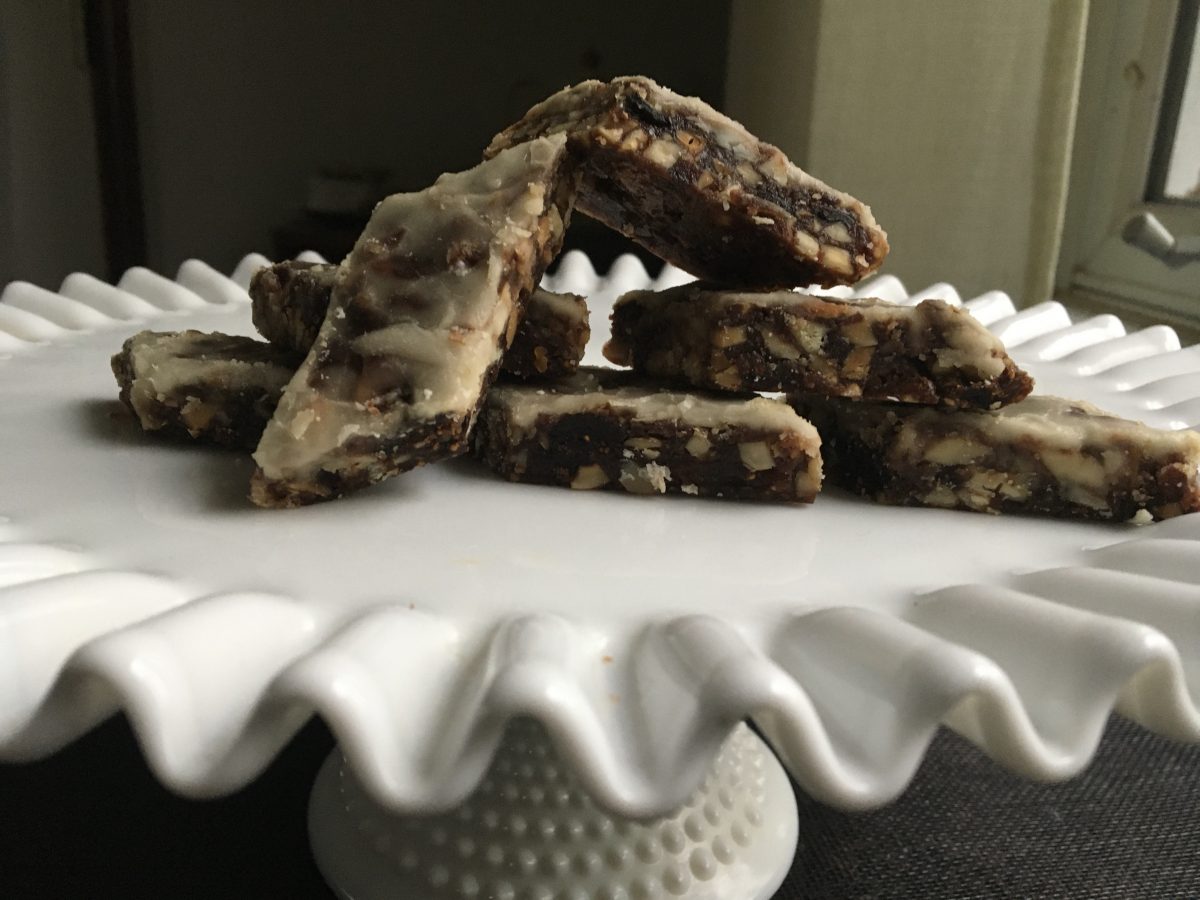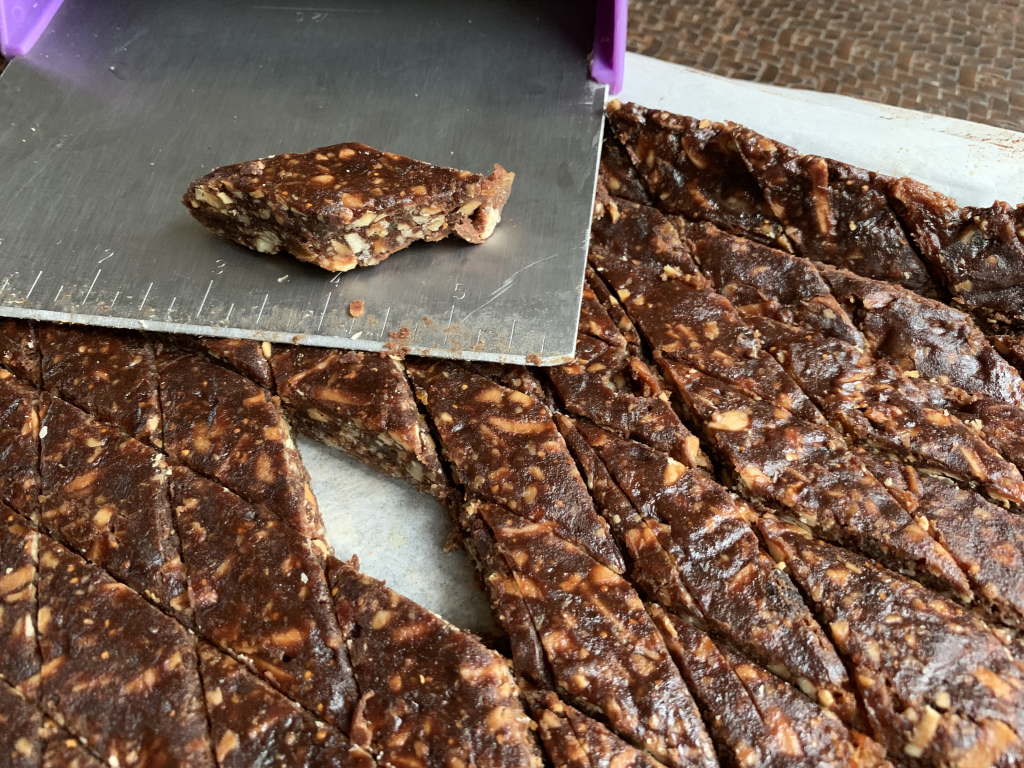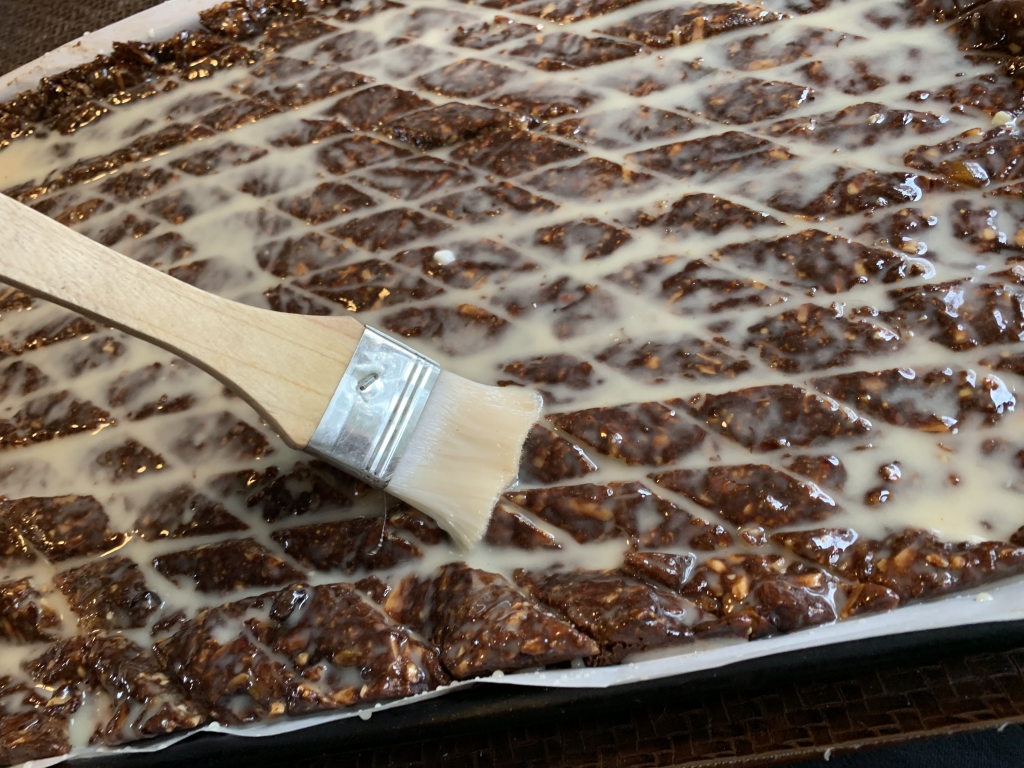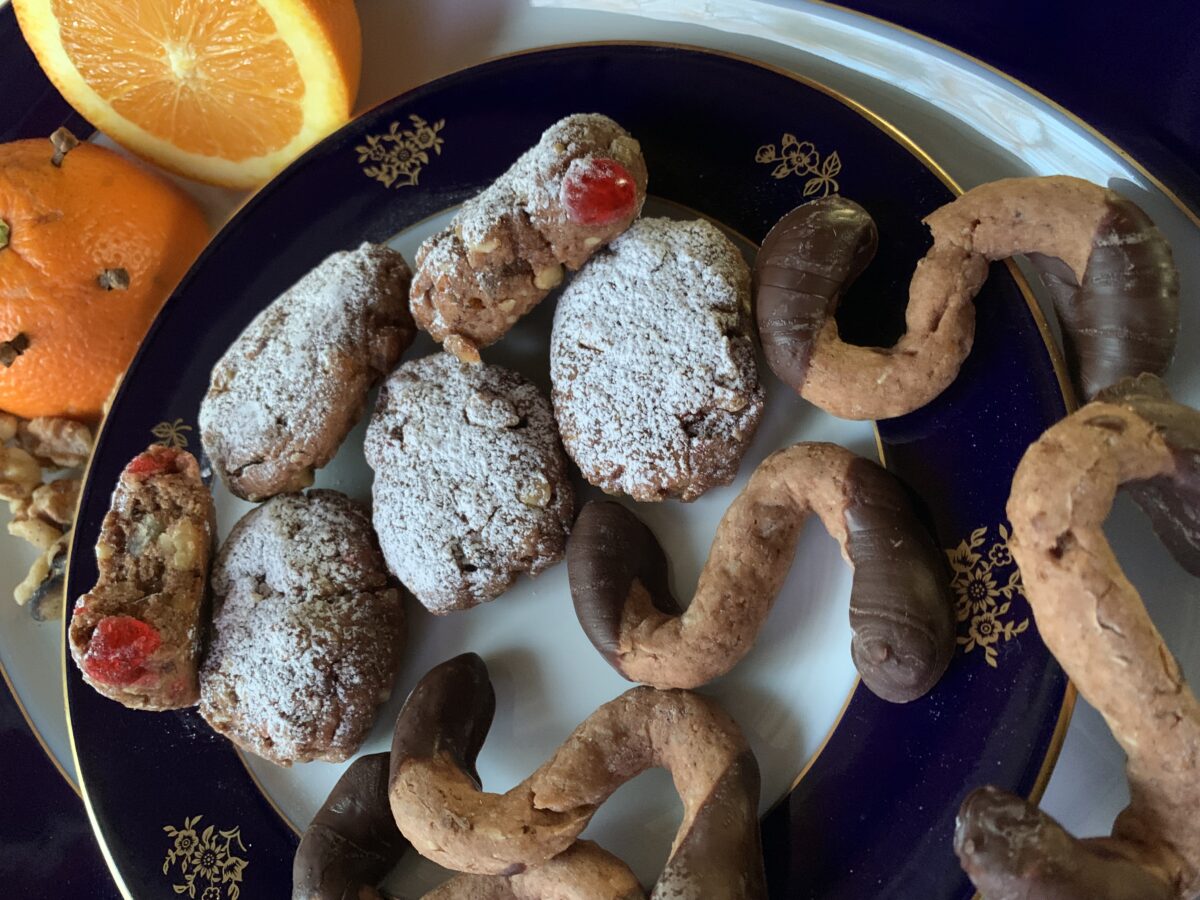
After researching a few recipes from the Eastern shores of the Mediterranean, our attention turned toward an interesting Spanish/Portuguese cookie… only to be diverted again by this much loved Italian cookie from Calabria, the “toe” of Italy right across the straits from Sicily. It’s a fun recipe, in part because there really is no single recipe. Nor any two. Nor any three. It’s basically a fill-in-the-blank name for any cookie made with the classic, southern Italian flavor profile of honey, orange, cinnamon, clove, and nutmeg-or-mace, offset by a bitter element, which can be cocoa powder, a bitter chocolate coating, or some molasses in the dough (a “difference” that typically changes the name from Susumelle to Mostaccioli di Napoli).
Click Here If You Want The Recipe Without The Insight

Can Anyone Define The Term?
Susumelle vary much more than most cookies, ranging from dense and chewy, to light and crispy, and topped with either chocolate or a powdered sugar glaze. But there are a few constants that ought to catch your attention as much as they did ours:
- This is an ancient cookie with roots going back well into medieval times, and it seems to have some connection back to the culture of Greece. I don’t think anyone would be surprised if ancient Roman recipes turned up.
- The main sweetener is honey, which means they have a very, very long shelf life, and did not require the boost from Age of Exploration sugar crops that caused so many new cookies to be born from the 1500’s on.
- Most versions include neither eggs nor fat, which makes them much less tender than other cookies. We’re told that some versions are crunchy enough to use as teething biscuits for babies! [See the safety note at the bottom of this article] But this isn’t a rule. Some recipes do include eggs, and others have oil, though we’ve yet to find any with butter.
- Almost every version includes some orange in the dough; zest for sure and often juice, but this can vary off to liqueurs, water, or even wine. Orange and honey! That’s a winning combination every time! Especially when paired with…
- A healthy amount of cinnamon, a small touch of clove, and usually an equally small touch of nutmeg or mace. This combination is everywhere in what used to be called the Kingdom of Naples from the 1200’s into the 1800’s. Think “Italy south of Rome and the papal states.”
- A bitter counterpart to offset the sweet honey. Cocoa powder is extremely common, and the one used in this recipe. Regions nearer to Naples tend to use molasses instead, with a name change to “Mostaccioli.”
- Finally, Susumelle always get coated in something, but that can range from dark chocolate (the most common), to white chocolate, to a powdered sugar glaze, to simple powdered sugar (especially for unleavened versions).
After that you get to the endless variations. And I do mean endless. Hundreds of years of variation yield more differences than consistency. It gets even more confusing as you go back in time! According to this tourist website, back in the old days natives acknowledged three separate categories of Susumelle based on the type of flour: white flour for the wealthy, poverty flours like whole wheat and acorn for the commoners, and “a third called ‘del buon cammino,’ made with good ingredients and destined for priest and friars.”
Does The Name “Susumelle” Provide Any Clues?
Well… not really. First, the word itself means multiple things in modern Italy. If you say “un Susumelle,” you almost can’t be wrong. It means anything that fits the broad category of a dessert made with honey, cinnamon, and clove. If you say “real/proper/etc. Susumelle,” or just “Susumelle” with no adjective, it means either (a) the cookie that Grandma made, with yours and everyone else’s being an abomination, or (b) a commercial version totally unlike Grandma’s but nevertheless real because you can see it in a store.
That same tourist website offers two potential name origins. The first is a combination of the Greek words sesamum (sesame) and mel (honey), which makes more sense than you might think because Calabria is right on the ancient trade routes, and there is are extremely common Levantine and Greek cookie/biscuit recipes with that profile. The other theory also traces to Greek, but is based on the word “susumeda,” meaning food that had gone bad that was given to the poor as charity. It is a Christmas cookie after all…
But that’s not all. Another theory says the name has to do with a local word for ‘una carezz’ (a caress). And I’ve even seen websites and videos claiming the name comes from the often-traditional “S” shape.
Then there’s the eternal category, “all of the above.” When many names work, people love to make puns that can work from multiple directions. And then they love to argue about it even more… but that’s a whole other story.
Does that sound vague, maddening, and designed to make researchers “wrong” no matter what they do? Welcome to my world, friends. Welcome to my world.
Wait A Second… Isn’t This A Waybread?
Frustrated? Me? Heck yeah. But then I realized that this particular kind of frustration rang some bells.
Isn’t exactly the same thing true for Lebkuchen recipes in German-speaking countries? Indeed it is! And for Molasses Gingerbread recipes across Northern Europe? Y’know, that’s true too. Honeycakes/Honey-Gingerbreads in Central and Eastern Europe? A pattern emerges.
And aren’t all those cookies remarkably similar in the big picture, being ancient recipes made with lots of honey, a spice mix, and often a healthy portion of dried fruits and/or nuts? Aha! The penny drops. This is the Southern Italian honey based waybread cookie, with every bit as much variation as its northern cousins.
Time To Treat It As A Master Recipe
After breaking my brain with no less than seven (7!) test versions, I finally realized the problem. I was trying to use one name for at least four different cookies. For our purposes we can break them up into the following variations:
- Super hard, use-your-molars crispy examples. These typically have no additions to the basic dough except ground nuts, which only appear on occasion anyway. Molars-hard Susumelle usually include a moderate amount of the ancient leavening agent Hartshorn a/k/a Baker’s Ammonia, and are almost always (a) coated with chocolate, (b) shaped into “S” cookies, or (c) left uncoated for baby to teethe on.
- Hard, light, and crispy eating cookies formed into ropes for an “S” shape, or rolled to normal (around ¼”) thickness and then cut. This version has a lot of hartshorn, but baking powder works too because they cook until fully hardened. Nuts are almost required (powdered, chopped, or coarsely chopped), but may be replaced with sesame seed. Light-and-crispy Susumelle always get a chocolate coat, usually dark but also ranging through milk and down to white.
- A hard and crispy biscotti version. Take #2 and form it into a single rectangle. Bake for a long time (25 minutes is typical), and then slice into biscotti-shaped pieces. The pieces can be baked a second time, but many don’t bother.
- Moderately crispy eating cookies, which can be either hand formed or treated as an extra-thick (around ½”) roll-and-cut. The same as #2 yet again, but with something added to interrupt the texture. That ‘something’ usually includes (a) baking powder rather than hartshorn, supplemented by (b) chopped, candied fruit, (c) chopped, dried fruit, (d) coarsely chopped nuts, and/or (e) eggs or oil added into the dough. This version also requires a coating, but it can vary from any kind of chocolate all the way through any kind of powdered sugar glaze.
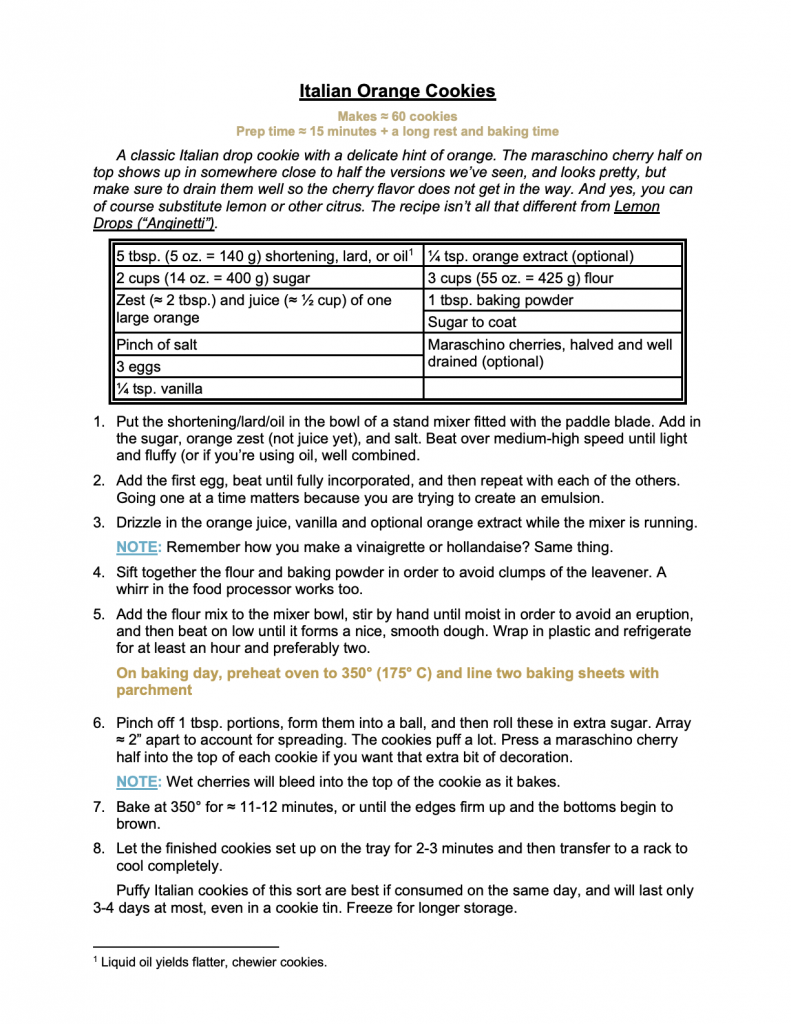
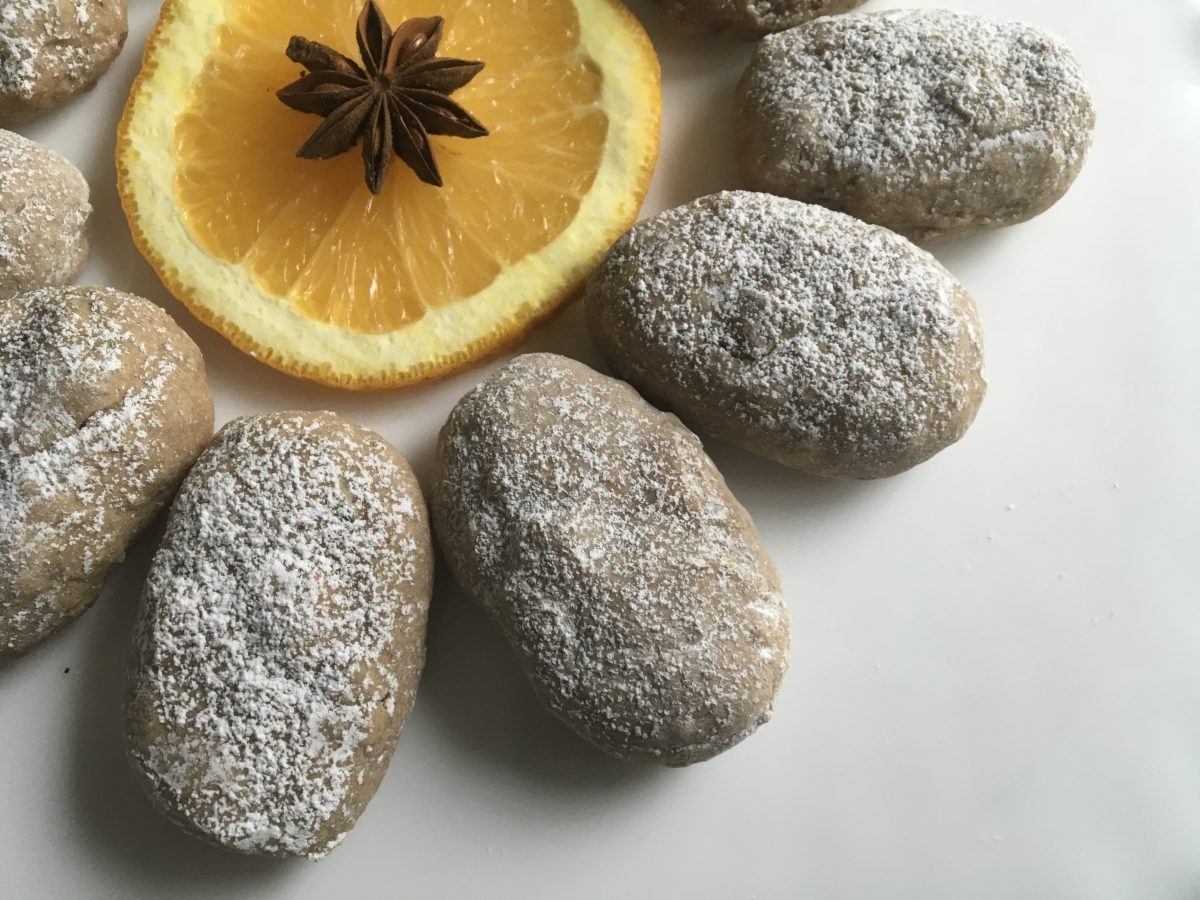
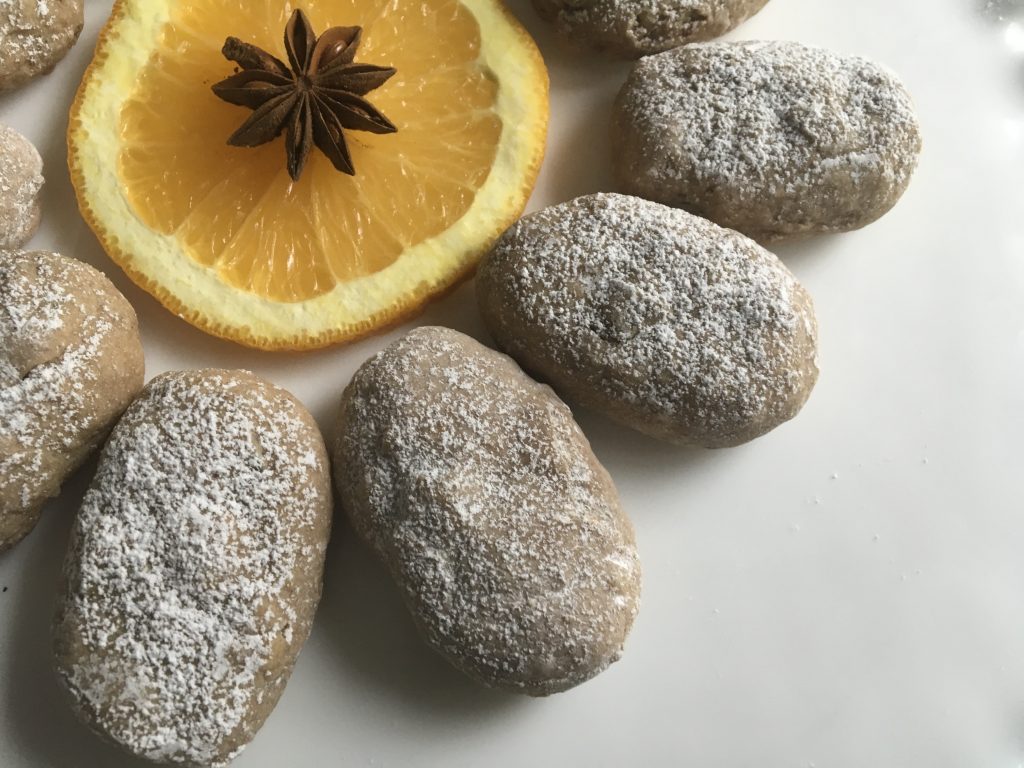
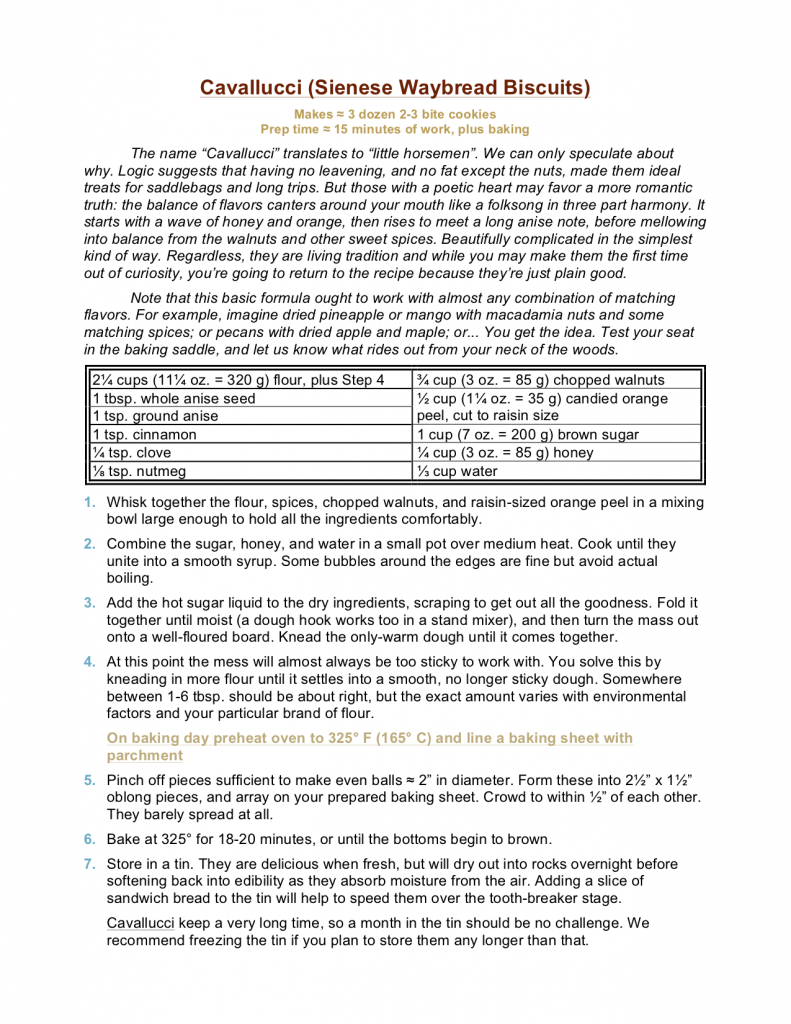
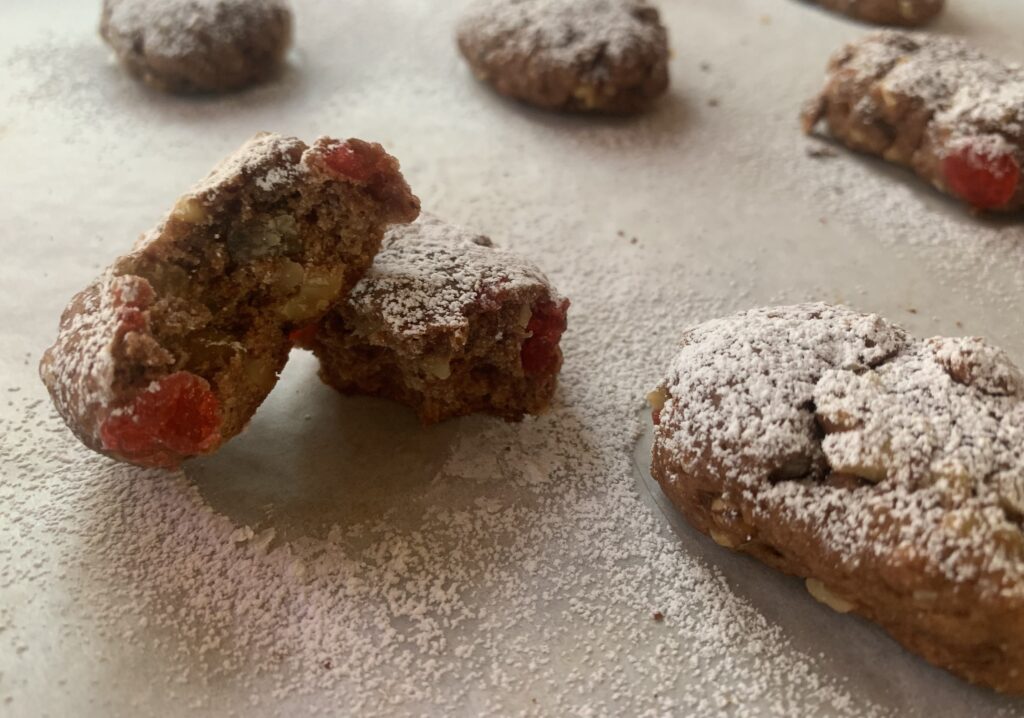
- Chewy waybread cookies comparable to Siennese Cavallucci. This version usually has little to no leavening, and is loaded with chopped fruit (candied or dried) and/or nuts. They’re also at least ½” thick, and large enough to be 3-4 bites each. Look for (a) large, roll-and-cut ovals, (b) hand formed egg shapes that settle into ovals inside the oven, or (c) thick ropes formed into an “S” shape. All three shapes are always served with powdered sugar on top.

A Rose By Any Other Name
We published a basic version of a cookie called Mostaccioli in Heritage Cookies of the Old and New World Volume 1. It’s a straightforward combination of chocolate and clove.
The research for this cookie shows that Mostaccioli is actually a broader category than we thought, and amounts to the slightly-more-northern version of Susumelle common in Campania (the shin) and Apulia (the heel) rather than Calabria (the toe) or Sicily (the stone being kicked). You can convert Susumelle to Mostaccioli by reducing the amount of honey, increasing the amount of sugar to compensate, and adding a significant portion of molasses and/or chocolate into the dough as a bitter counter-element. After that it’s the same orange/cinnamon/clove/nutmeg core, with infinite variations. [NOTE FROM SCOTT: I should probably work on a revised version of that recipe…]
Then there’s a third cookie, or more properly a Not Quite A Cookie, called Rame di Napoli; an extra-thick chocolate cake batter with the same basic flavor profile. These get baked in egg-sized mounds, coated in dark chocolate, and sprinkled with chopped pistachios. It’s a specialty of the city itself (Naples), and baked for Italy’s version of Halloween. If you’re interested, the word “rame” means “copper,” and the “cookie” is supposed to resemble an old Neapolitan copper coin. The pistachios represent green oxidation.
NOTE FROM KATE: when Scott develops a recipe, we can generally agree the point at which I can reserve cookies for the photo shoot. This time, the cookies kept arriving. I did enrobe a few of them in chocolate, but I never took photos. Too many variations, and too many baking variables, kept tripping up our decision-making process and every time Scott consulted either blogs or people, more local variations came out of the woodwork!
Now that he has his several varieties sussed out, it’s time to set up a project chart. Variety names, leavening status, textural additions, spice combinations, textures, glazes, shapes. Phylogenetically speaking, it’s as though Sussumelle was a cookie genus, and all these varieties were separate species. I care about the shapes and the glazes more than he does. As our mycologist friends like to insist, species concepts really work better when they are morphologically distinct.

CONCLUSION
Our recipes tend to focus on cookies with a story. Susumelle turned out to be a saga. Batch, after batch, after batch, trying to find the essence beneath all the recipes. We’ve rarely worked on a more frustrating project, until the penny finally dropped and we realized that something close to half a dozen different cookies all go by the same name, with only the main ingredients (honey, cocoa, cinnamon, clove, and nutmeg) as the unifying principle. That may sound mad at first, but only until you realize that much the same holds true for the similarly ancient honey-and-spice waybreads in Central and Northern Europe. Time and popularity equal endless variations.
Which is our personal favorite? Kate can vote for herself, and none are bad, but mine would be the one with no leavening at all, and all those beautiful bits and bobs inside. It’s a Lebkuchen or Honeycake done Southern Style, with a delicious flavor palate unique to these particular regions.
Of course, that opinion might change if we still had teething babies around!
A NOTE ON FEEDING HONEY TO BABIES: The bottom line is this: don’t. Honey harbors a bacteria called “Clostridium” that can on rare occasions cause infant botulism. Bad juju! The risk diminishes as the infant grows, becoming less dangerous around 6 months, safer still after 9 months, and more or less safe after 12; at least according to Doctor Internet. Babies usually start to teeth around 6 months, though some start earlier.
Susumelle recipes cook the honey and the sugar, which you’d think would reduce the risk, but it doesn’t eliminate it. So tradition be damned. Follow your doctor’s advice. The fact that people with no concept of germ theory almost always got away with the risks does not make it the smart thing to do. Do you really want to be the exception?
NOTE FROM KATE: look up the USDA guidelines for killing Clostridium botulinum, compare the temperature and time requirements, and let your comfort level be your guide. Now look up sugar, carb, and oral health guidelines for young children. Seriously dude, teething on hard biscuits is a dentist’s nightmare! The whole idea reminds me of a “teething remedy” my grandmothers used to employ: unripe poppy seeds simmered in sweetened milk, and then used as a soaking liquid for soft bread wrapped in a handkerchief and tied off with string. “It helps the babies slept better,” they both said, “but don’t use it all the time. Poppy makes kids stupid, so it’s a last-resort option.”