ITALIAN ORANGE COOKIES

Italy has a fascinating cookie tradition that is broad, deep, and very distinct from the rest of Europe. That’s particularly true for the citrus cookie genus. North and central European countries tend to make a buttery shortbread or sugar cookie base, which they’ll kick up with a sharply flavored glaze. The Lemon-Lime Cookies from HERITAGE COOKIES OF THE OLD AND NEW WORLD are a perfect example.

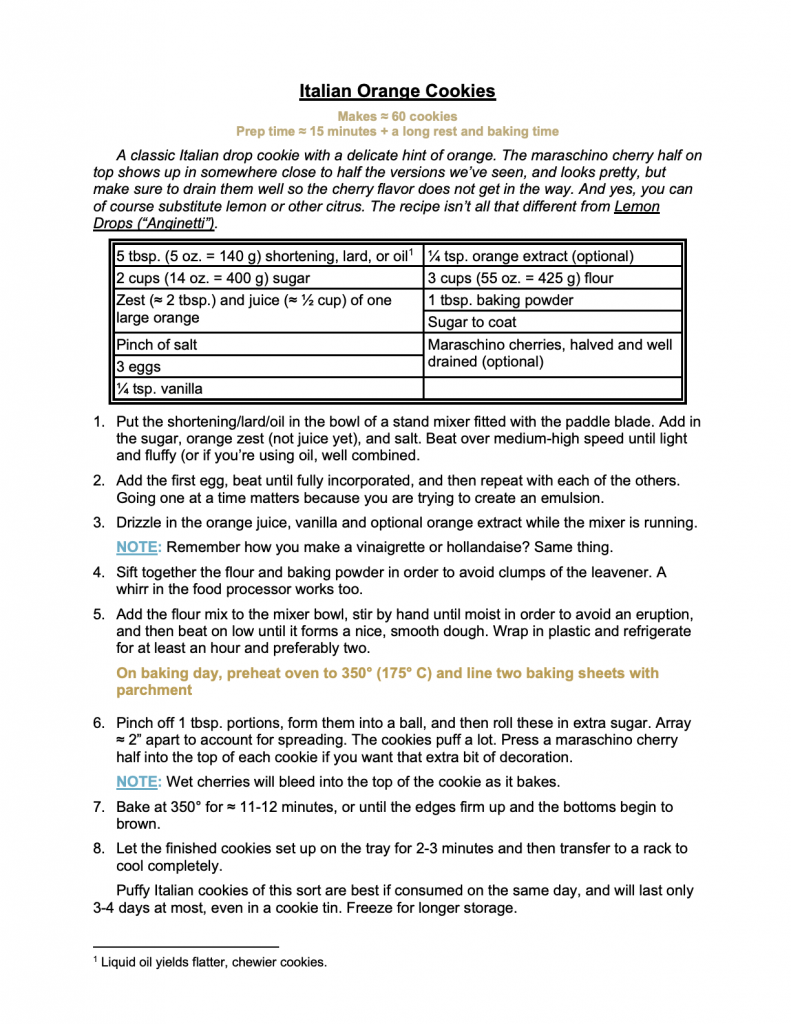
Italians tend to make their cookies vastly more puffy by adding copious amounts of baking powder, with thinner and often optional icings, and a lot of orange or lemon zest in the dough. Many recipes reinforce the zest with some citrus oil or extract. But that’s not all. There’s also a very different philosophy when it comes to the fat. Shortbreads and sugar cookies are built on butter, but Italian cookies will often play around with that aspect. The Ricotta Cookies in our book use butter, but lighten everything up with cheese to create a unique experience. Lemon Drops a/k/a Lemon Knots a/k/a Anginetti use liquid oil. This recipe uses shortening, or in older versions, lard.

Butter is wonderful stuff. Extraordinary stuff. There’s a reason why simple butter cookies like French Sablés, American Meltaways, Middle Eastern Ghorayeba, and the ubiquitous Spritz Cookies fill bakery and market shelves alike. They’re good. Nor will we deny that butter and citrus marry extremely well. They do. But the offspring of butter and citrus tends to be a pleasing, 50/50 combination of the two. Neutral fats like shortening or oil are the way to go if you want a purified hit of citrus essence (or of chocolate for that matter).

Enter Italian Orange Cookies.

NOTES ON THE RECIPE:

There is no surprising technique required to make this cookie. It hardly takes any attention if you have the basics down. (1) Whisk or sift together the dry ingredients to evenly distribute the baking powder. (2) Cream together the shortening/lard, sugar, orange zest, and extract(s) so the fat can absorb the citrus and vanilla flavors. (3) Add in the eggs, taking care to go one at a time in order to create an emulsion. (4) Thin with some fresh orange juice from the one you zested, which is slightly unusual. And then (5) mix in the dry ingredients, taking care to avoid a flour eruption.

The only odd ingredients are the sheer quantity of eggs (three of them, when most recipes will use just one) and baking powder (a whopping tablespoon of baking powder where most recipes would use just a half-teaspoon).

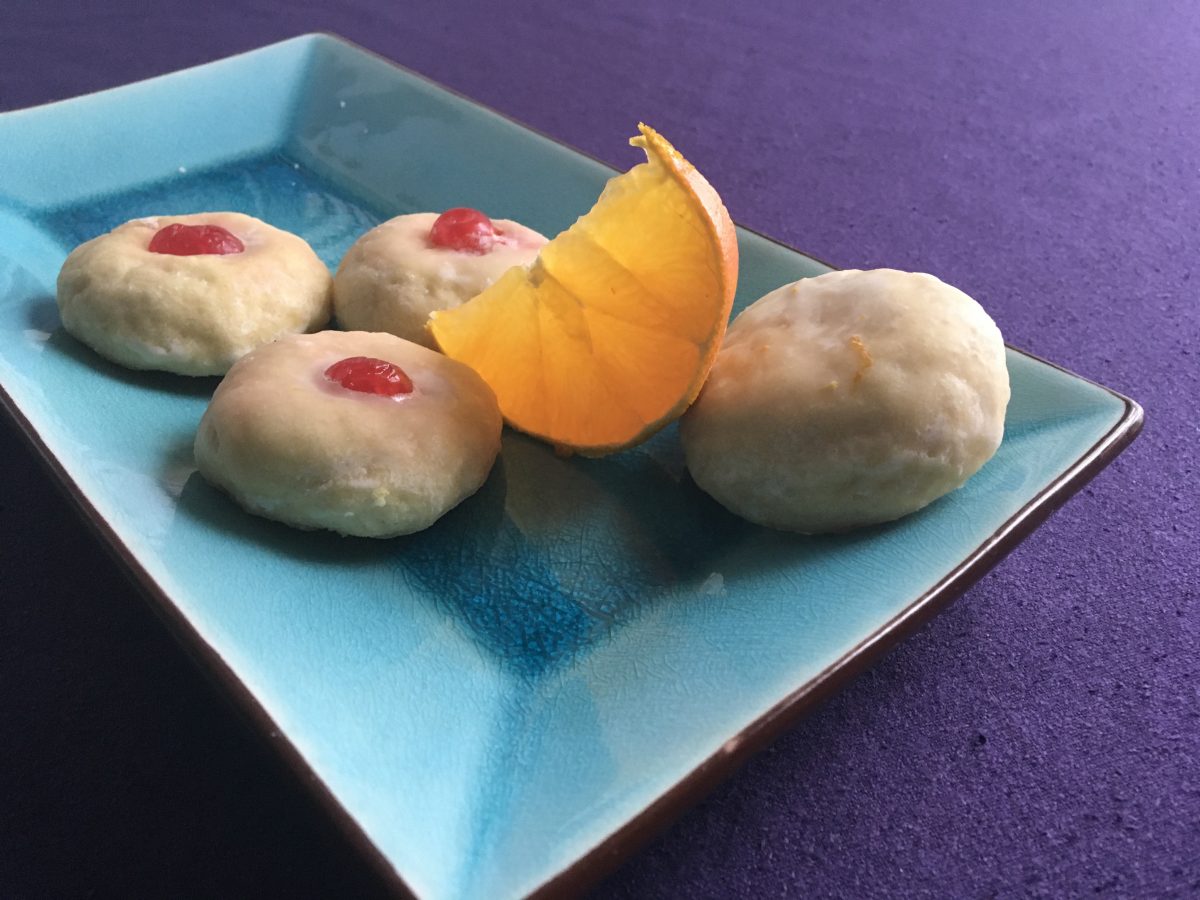
And the only odd decoration part is the very common use of half a maraschino cherry to create a “Rudolph’s Nose” effect like you see with Amaretti (a macaroon rather than a drop cookie). We were tempted to ignore that cherry in favor of an orange glaze (see the photo below), but it turned out to be a nice touch. Maraschino cherries add nothing to an ice cream sundae beyond a neon-red flash of color, but their almond-laced flavor makes a real difference on this scale. They create an odd counterpoint that actually enhances the orange flavor rather than competing with it.
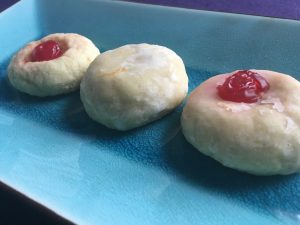
(1) Rolled in sugar with a cherry on top, (2) With an orange glaze, and (3) Cherry on top coated with orange glaze. All three are delicious, so choose the one that you like best.

In the end we decided to leave the decorations in the recipe as an option.

  • First option: roll the dough in sugar before baking, and then press in a well drained maraschino cherry that’s been patted dry with a paper towel.
  • Second option: coat the baked cookies with a quick orange glaze made from extra OJ and powdered sugar, plus grated orange peel if you wish.
  • Third option: bake with the cherry and then coat with the glaze.

All three work fine. Just make sure to dry the cherries well. Scott forgot to be careful enough in the test batch, which led to that unfortunate pink stain you can see in the photo. (He was going to do a second batch to make them look perfect, but Kate put her foot down and pointed out that showing the problem offers more value to readers than just giving the warning).

Limited Life Span

These puffy, super-leavened cookies have a particular charm but they do come with a downside: they’re going to go stale in no more than a day or two.

The word “stale” actually refers to a series of small effects that are all caused by oxidation. Sitting out in the open gives the oxygen in your air a chance to do its evil work. Cookie tins slow the process down by limiting the O2 levels to just the amount that was in the container when you sealed the lid. Freezing reduces oxidation even more by slowing down the chemical process. This is why freezing in a vacuum provides the best of all worlds for preserving your food, though that isn’t really practical for delicate cookies.

Leaveners like baking powder work by expanding in the oven to create CO2 bubbles in the dough, which rapidly get replaced by plain old air as the cookies finish baking and then cool off. Well leavened cookies feel and taste “light” because they quite literally are: they’re puffed full of air on the inside. Air that will turn them stale from the inside out if you give them any time at all.

So we’re afraid there’s no way around it. Italian Orange Cookies are made to be eaten, and eaten on the day they’re baked. Have your cup of tea handy (even Scott admits they are fabulous with a cup of tea), and your cookie-hunting spouses and children on standby.

Conclusion

This is a simple, happy and cheerful cookie. They’re simple to bake, a joy to behold, and pack a clear orange flavor that’s certain to make you smile. They’re also an absolute classic that shows why Italian bakeries thrived so well and spread so quickly as the immigrants flooded through Ellis Island in the late 19th and early 20th centuries.

Scott had a lot of fun making them. Kate had a lot of fun making the photos. And you’re going to have a lot of fun with the recipe for many years to come.

Enjoy!
CAVALLUCCI – A Honey Biscuit from the mountains of Tuscany

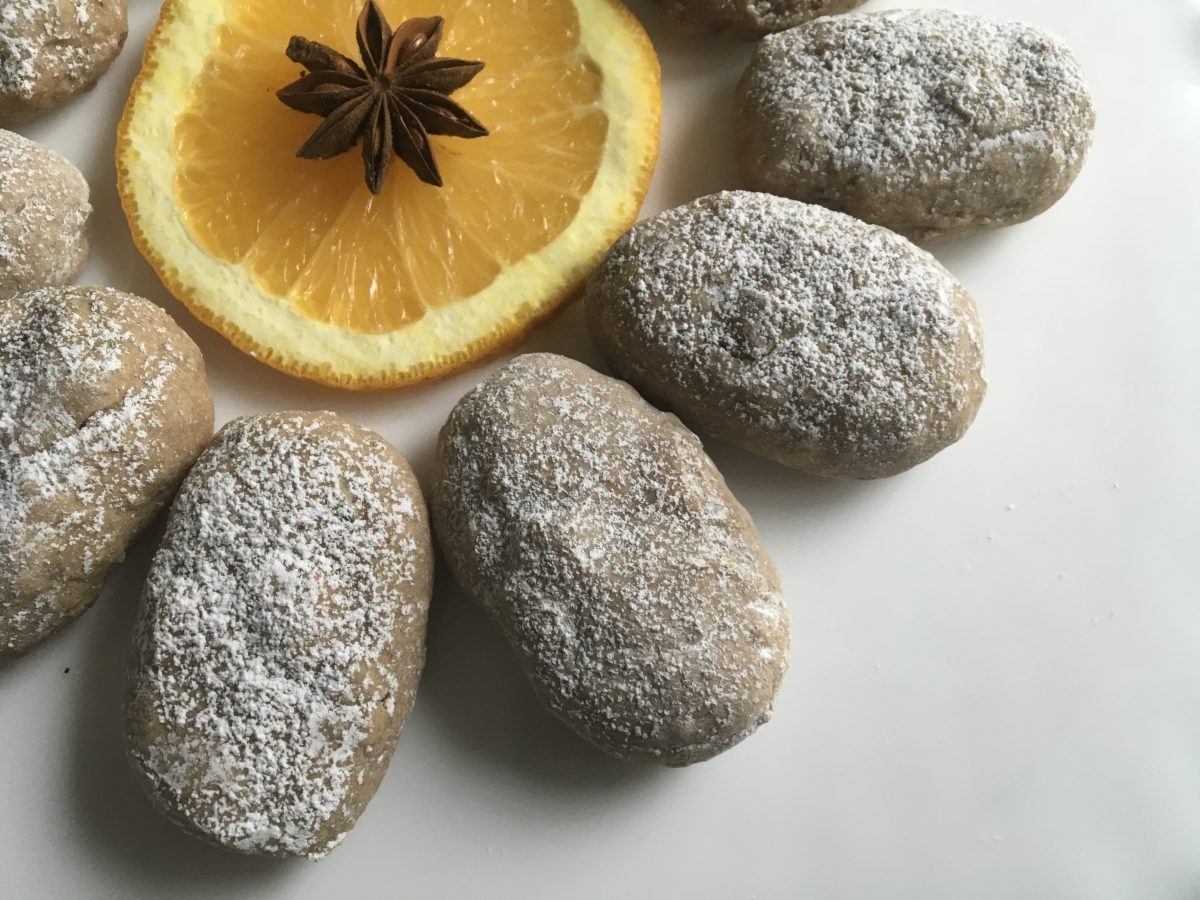
Okay, yes. That is star anise from China rather than regular anise from Italy. Live with it. This makes the prettier picture.

Such a romantic name for such a plain little critter! “Cavallucci” translates to “little horsemen,” which I suspect comes from the fact that having no leavening, and no fat except the nuts, made them ideal treats for horsemen riding through the Tuscan hills. Probably in search of some well grown evergreens, where the elusive porcini can be found. I’m sold right there.

But Cavallucci also have some modern romance. This, and its soft almond lookalike Ricciarelli, are the treats of Sienna, a smaller city about 50 miles south of Florence. You will not escape a visit without getting to experience the unique, chewy balance of honey, orange, anise, and other spice that these are all about. So why not visit from the comfort of your own home kitchen?

As always, skip to the bottom if you want the recipe without any discussion

It’s All About Balance

Moving on, it’s that key word – “balance” – that catches the essence of what these are really about. Our friends and family will attest that your humble authors are better as cooks than we are as bakers. Especially me. Kate does cakes too, but my baking really begins and ends with three categories: (1) heritage cookies, (2) lemon curd, and (3) anything made with chocolate.

Both of us find Northern Italian cuisine particularly intriguing because it’s such a challenge. There’s such delight to be found in achieving perfection through skill and nuance alone. Think of recipes like scaloppini or piccata. They have what, three or four ingredients plus salt and pepper? And yet the results can vary from shlock to divine. It’s a culinary balance beam trick. Impressive as heck if you get the balance right, and embarrassing if you don’t.

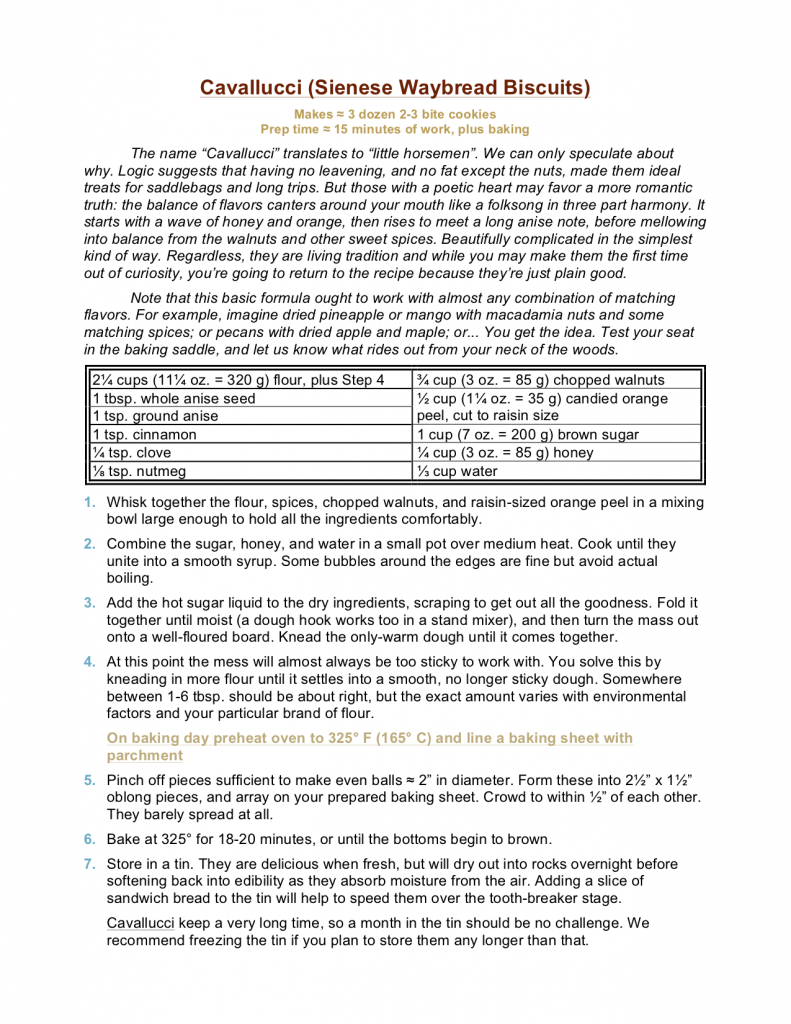
Cavallucci should be approached with that same sensitivity. The core of the recipe is little more than flour held together with lots of honey, plus orange peel and walnuts with a healthy shot of anise. Honey, orange, and anise; three flavors that love each other. So what could go wrong? Lots, as it turns out. You’ve got to get the balance right, and that balance has to include texture as well as flavor.

Balancing The Texture

This cookie begins with a trick you see often when honey gets used in bulk. You don’t use the raw material on its own. Rather, you mix it with some added sugar, thin it with some water, and then simmer until everything comes together into a syrup. Candies take it a little further, cooking the sugary liquid up toward the soft-crack, hard-crack, and caramel stages depending on what you intend to do. No need to worry about that here. All you’re after is a nice, smooth syrup. It’s a trick we first learned with German Lebkuchen and Swiss Leckerli. It seemed strange and special at the time, but by now it’s become a standard part of the toolkit. Every one of the dozen or so Cavallucci recipes we looked at started in just that way.

The texture then expands in both directions – chewier and lighter – with the addition of candied orange peel and larger bits of walnut. Nothing to it, right? But it’s easier to fall off the balance beam than it is to stay erect.

A VALUABLE NOTE: There wasn’t enough room in the recipe to emphasize how important it is to get the size of your pieces right. That may sound obsessive but it isn’t. Balance, balance, balance! Candied orange peel has a stick-to-your-molars texture that totally takes over if you let the pieces get any bigger than a raisin, and that disappears in between your teeth if you cut it down to peppercorn size. Both can be annoying. As for the walnuts, they just vanish if you get them down to “finely chopped,” and break the product into sections if you leave them whole. Again, chopped just to raisin size is the perfect compromise.

Balancing The Flavor

That covers the texture. Next up, flavor. What have we got already? Honey (yum) and orange (yum). Two flavors that love each other. But… they’re obvious. No style. That slight bit of bitterness in the walnuts just isn’t enough to round things out. There are a lot of ways you could handle this in theory. Bakers in the walnut loving Balkans and Black Sea regions might grind up a great, big handful of walnuts to use as a bitter nut flour. Health conscious bakers might try substituting in a bit of whole wheat flour. The most common trick in Siena, and the cheapest for American bakers, is to round out the honey with a small hit of molasses.

NOTE: Our favorite page in the entire book – the conversion table! – should can be your friend here. One cup of white sugar plus one tablespoon of molasses equals light brown sugar. Two tablespoons of molasses equals dark brown sugar. We specify light brown sugar in the recipe, but every baker deserves to claim each cookie as his or her own. Those numbers tell you the basic amounts you’re working with, and should empower you to adjust as your palate suggests. The textural properties of molasses will not be an issue because they overlap with the honey. Knowledge is power!

So now the honey works, and the texture is right. The next element to turn these into true Sienese Cavalluci comes from the anise. This recipe contains a whopping four (4) teaspoons of anise seed. Holy. Friggin. Cow. That, however, isn’t strange for the region. Italians adore anise in the same way that Americans love cinnamon. But that much… well, it is another case where you need to work on the balance.

Fortunately enough, the native bakers agree. I do not think we saw a recipe that did not try to soften the licorice flavor with a bit of this and a bit of that. We ended up with a background mixture of other sweet spices, led by cinnamon of course since we are, after all, Americans.

The bottom line here is a waybread biscuit (they aren’t pretty enough to deserve the exalted title of “cookies”) with a distinctive, chewy texture and a sweet, addictive flavor that hits you in waves. It starts with the honey and orange, and then evolves to include the anise. All those rounding-out touches (the walnuts, molasses, and other spices) keep any of those three from dominating the composition, and show up on their own in the aftertaste.

Conclusion

It really is like a good Veal Scaloppini, or Chicken Marsala. Simple food, done very well, and adding up to more than the sum of it’s parts. Serve with coffee, tea, or an aperitif that can handle the sweetness. They are better when they’re not alone, at least in our opinion. But you won’t be disappointed regardless, and a plateful of Cavallucci is much less expensive than a ticket overseas.

A FINAL NOTE: Cavallucci fall in the category of waybreads because all that honey acts as a preservative. They may dry out but they aren’t going to get stale or go rancid unless you lock them in a drawer and forget about them for more time than any of us care to imagine. There is also an easy fix if they do dry out. Put the little bricks in a tin or other tightly sealed container with a slice of sandwich bread. Wait a day or two, and the moisture will move out of the bread and into the cookies; drawn there by the hygroscopic (water loving) power of the honey. Hey presto, Bob’s your uncle. Repeat as needed.

A REALLY, TRULY FINAL NOTE: We haven’t tried it, but this is pretty obviously a formula recipe that ought to work with almost any combination of matching flavors. Honey, orange, and anise typify northern Italy. Do something with dried pineapple or mango, and macadamia nuts, and you ought to get a wonderful treat for drinks on the lanai. Pecans, dried apple, and maple would pair well with a hoppy ale or hard cider on a front porch rocker. Or maybe… You get the idea. We tend to focus on cookies that come with deep historical roots, and a story to match. But there is nothing more American than taking a great idea from the old country and turning it into something new, and maybe even better. So please: test your seat in the baking saddle, and let us know what rides out from your neck of the woods.