SOUTHERN TEA CAKES, The Most Genteel Of Cookies

The great cookie of the antebellum south

Kate and I recently put out a call to food writers and bloggers around the country for information about any cookie tied to the soul of their city or region. This was the first cookie we heard about, courtesy of Mr. Stacey Little of Southernbite.com. And a worthy cookie it proved to be!

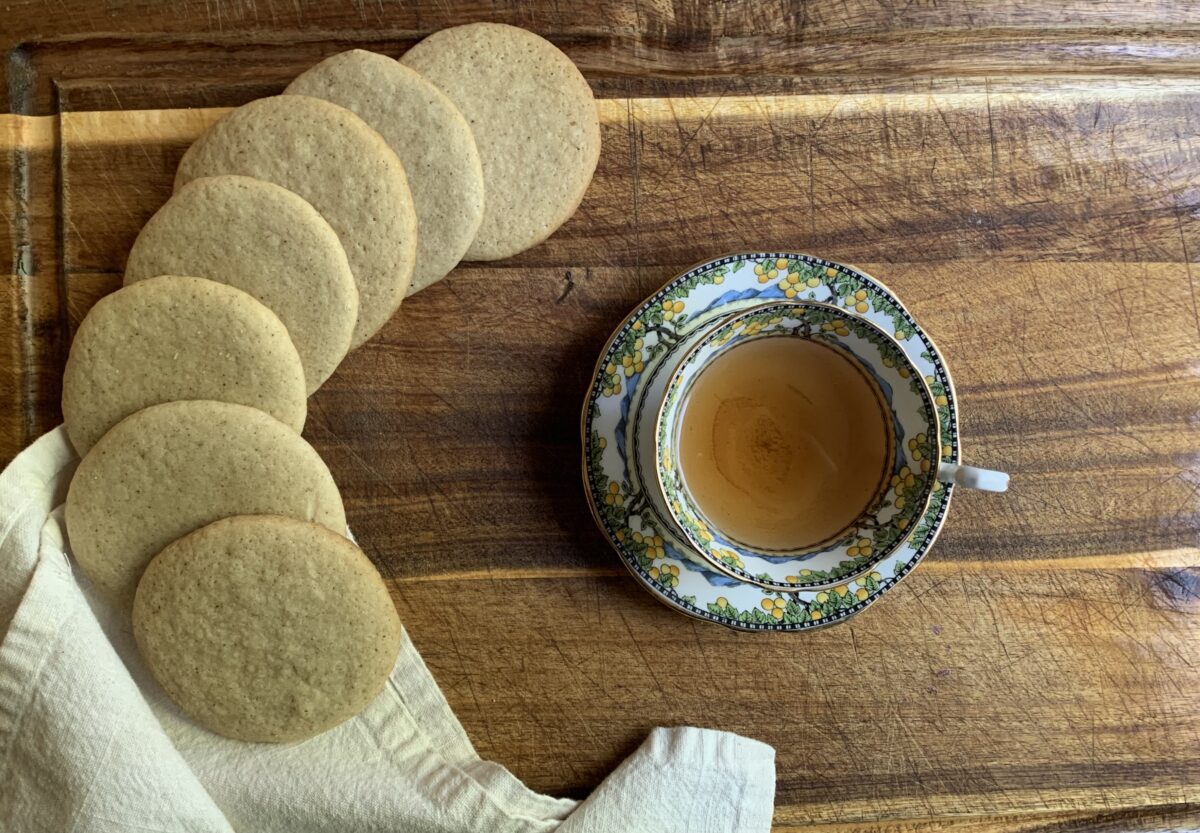
The Tea Cakes tradition goes back to the antebellum south, entrenched so deeply that even today it can be hard to find a church social, teatime, or other gathering that lacks some plates for guests to enjoy. The flavor matches up to that history. Kate and I agreed on “genteel” as the right adjective to describe how these feel when you eat them. They’re at the heart of that tradition called genteel Southern hospitality.

I am a northerner and Kate an immigrant, so neither of us had ever heard of or experienced this cookie. That sent me to Dr. Internet for second-hand experience to start the process.
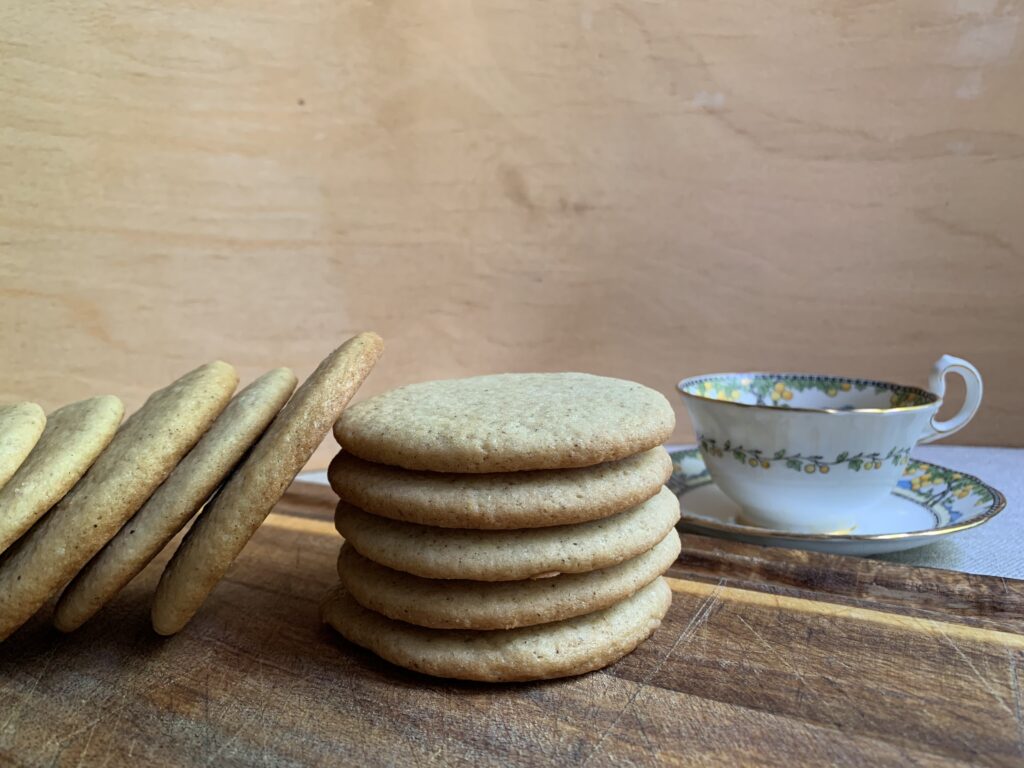
Recipes abound, with virtually every one describing their version as “just like Grandma’s.” As in 90-95%. Anyone who hasn’t done such research may not appreciate how amazing that consistency is. I found 20 recipes to start with, all of them written independently by people striving to be different while caring enough to honor their heritage as well as they could. What does it take for 20 different people to end up focused on that single image of Grandma proudly presenting the treat she’d learned from her own? It shows how deep the cultural roots really are.

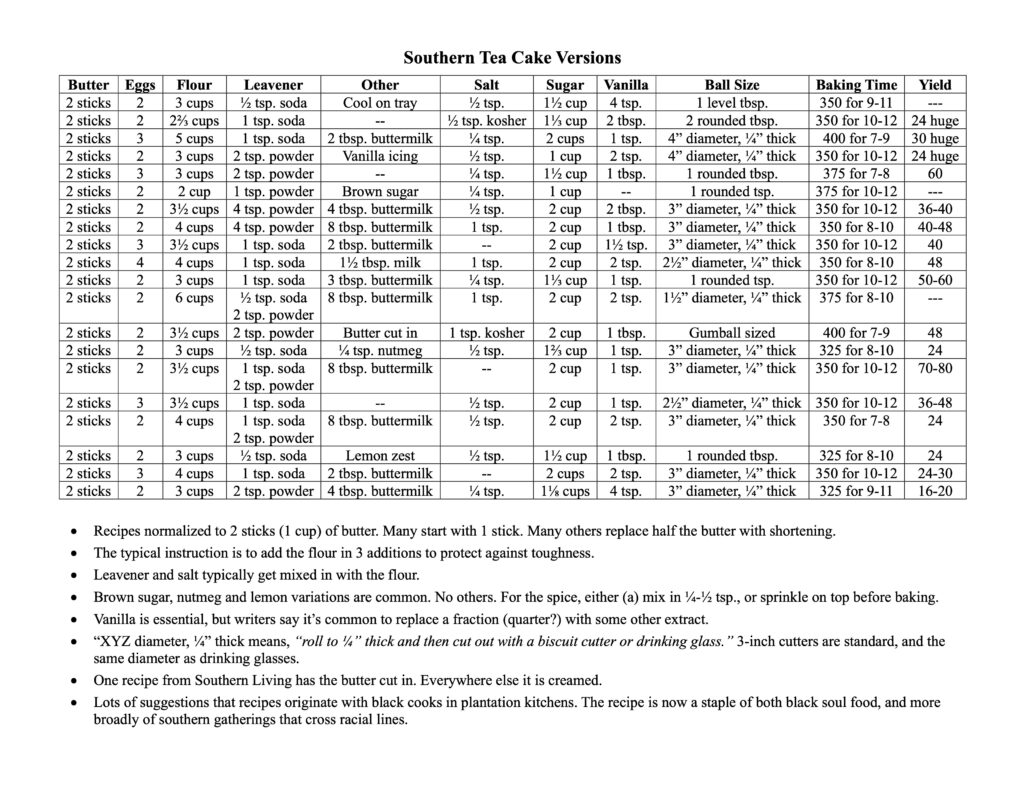
Me being me, I compiled a table of ingredients normalized to two sticks of butter. Then I stepped back to look for an underlying formula.
Choices to Make: Roll or Cut

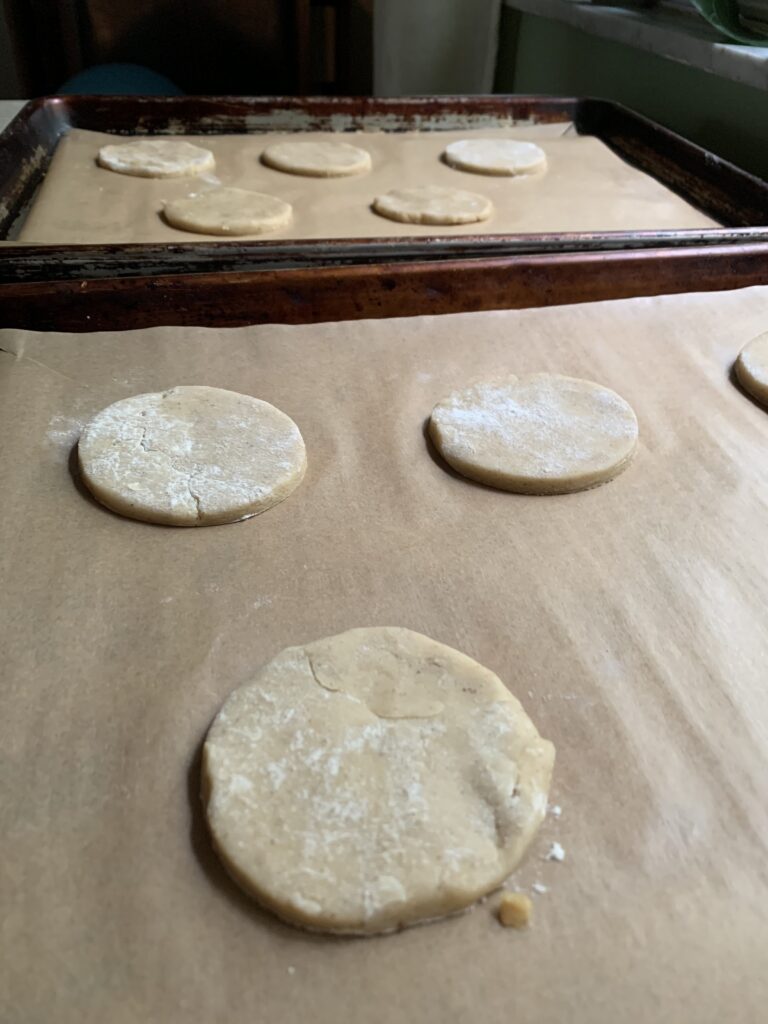
A few patterns leapt right off the page. First, the writers split more or less evenly on whether to do a drop cookie or a cut out. We chose the roll-and-cut method for our initial version, driven by two reasons. First, most of the recipes call for extra large cookies, as do the array of photos that popped up in my search. Cookies of that size either spread uncontrollably – which conflicted with the possibility of cutting the dough out – or else need some help to stay under control. Second, the idea of large, buttery dough in the American South immediately sent my imagination spinning toward the famous tradition of southern biscuits. How much more “heritage” could you get? And wouldn’t a cookie version of biscuits make sense?

I couldn’t say yes or no either way, but it was a good place to start.

Then I went back to fill in details. Did you know that typical drinking glasses have a diameter of 3″, which not coincidentally pairs exactly to a standard biscuit cutter? Many of the roll-and-cut writers said to use “a round cutter or drinking glass” for the job. The same instruction appears in biscuit recipes. Fair enough. That would be our starting point.

NOTE: Testing proved that I agonized far too much over this choice. Tea Cake dough will ball-and-squish just as well as it rolls-and-cuts. That’s what I did with the leftover scraps, and we found it hard to distinguish the two outside of size and regularity.
Choices to Make: Buttermilk?

Second question: Many writers add in buttermilk. It’s a readily available ingredient, if one we don’t keep in the house as a staple. Was it worth a trip to the market? You bet it was! Remember that analogy to southern biscuits? Southern buttermilk biscuits? This was a gimme. Besides, some buttermilk tang would help to distinguish this recipe from all the other butter cookies we’ve researched over the years.

It proved to be the right choice. That flavor really does matter.

Catching the Vibe: Variations That Really Aren’t

Everyone agrees that Southern Tea Cakes are, first and foremost, all about the texture. They’re supposed to straddle the line between cake and cookie. The universal instruction to bake until the edges start to brown supports that. It shows there’s also a required contrast between the cookie rim and center. So that was a mandatory target. But what about the flavor?

How many variations are there? Buttermilk, which I’d already decided to try. Then there’s lemon; brown sugar instead of white; nutmeg (but no other spices); and… Wait a second! Those aren’t true variations!

You can make faux buttermilk by mixing lemon into whole milk or half-and-half, often with a fleeting hint of nutmeg. (Nutmeg and dairy love each other, as shown by classic examples such as béchamel sauce). For that matter, many dairy-centric baking recipes also use brown sugar, because a very gentle molasses flavor helps to enhance the base flavor. These recipes weren’t showing different targets. They were just different methods to home in on the same target: a cookie with a profound taste of old fashioned, intensely flavored, aged or mildly fermented butter.

Suddenly it all made perfect sense. And the simple fact that everything aims to the same goal shows yet again how much the culture cares about getting this particular cookie right. We tested all of those tricks and came to the following conclusions:

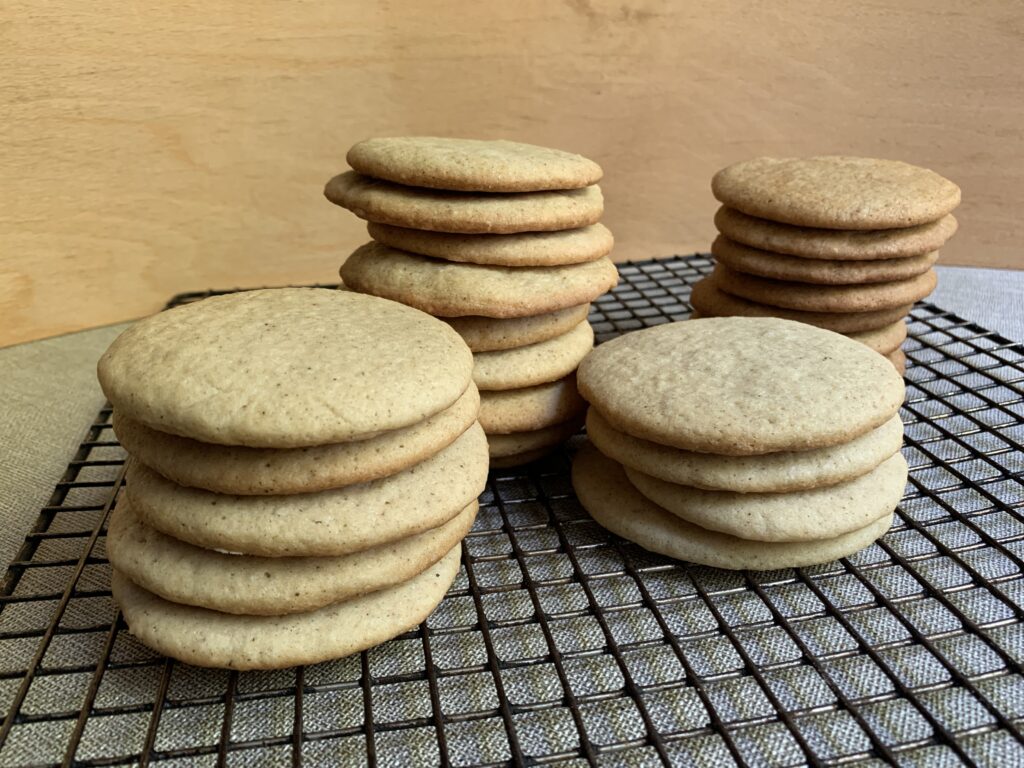
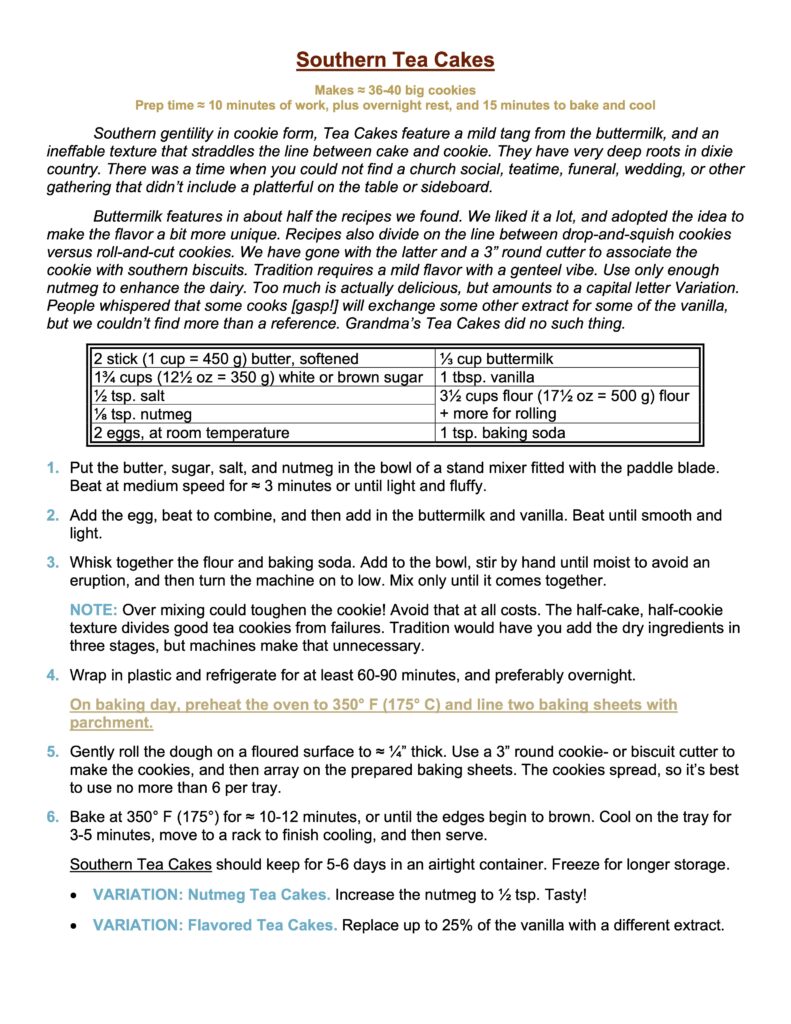
  • Buttermilk: Oh my, yes. It helps in endless ways, and makes the cookie different. We settled on ⅓ cup, right in between the ¼ cup of many examples, and the ½ cup of many more. Modify at will, making up for the extra (or missing) liquid by adjusting the amount of flour.
  • Brown Sugar: An extremely subtle difference in flavor. Someone who cared could argue us into liking it better. Someone who cared the other way could argue us back.
  • Lemon Zest: Disappointing if you use enough to taste it, because it comes across as a failure from both directions. You could convert this to a proper lemon cookie by using 2-3 lemons worth of zest with a sharp glaze made from the juice. Anything short of that left us feeling cheated, until the level drops down low enough to satisfy the anchovy rule: anchovies make food taste better until you can taste them. Then they work in reverse.
  • Nutmeg: See the anchovy rule yet again. A barely discernible hint – no more than ⅛ teaspoon – kicks the whole thing up. Any more than that yields a nutmeg cookie. Really good nutmeg cookies, yes; but a different product when all is said and done. We’ve included the larger amount as a true variation worth trying on its own merits.
  • Other Extract: Do as you like. We prefer to stay true to the original target and intent.
Lemon Molasses
Nutmeg Plain

Vanilla Is Mandatory

Go back and look at that table. Every recipe – 100 % – includes an extremely generous amount of vanilla. We settled on three teaspoons of extract (a/k/a one tablespoon), but this is a case where your taste matters more. Try the recipe as written, take notes, and then adapt it as you wish. Or not.

Roll With Flour, Which Can Be Plain All Purpose

Liquid buttermilk makes this a sticky dough. Like biscuits yet again! Rolling the cookies out on a floured board solved the problem. Just don’t work it over and over, because that could make the cookies tough. Remember: good Tea Cakes have that on-the-line texture, and bad Tea Cakes got too tough.

DIGRESSION: We worried needlessly about whether the texture challenge would require a different flour. It’s a big deal for buttermilk biscuits. Would it matter for Tea Cakes too? I hit the e-books again and found that some people actually tested this. The answer is “No, the flour doesn’t make a difference.” We can also tell you that our cookies came out with the perfect texture using King Arthur all-purpose flour; a brand notorious for its high protein content.

Testing The Cookie: We Have a Winner!

So… I baked the cookies in four batches to cover all the variations. They had a nice flavor. They weren’t just another butter cookie. The texture fit all those descriptions. So they were capital-g Good. But were they capital-r Right?
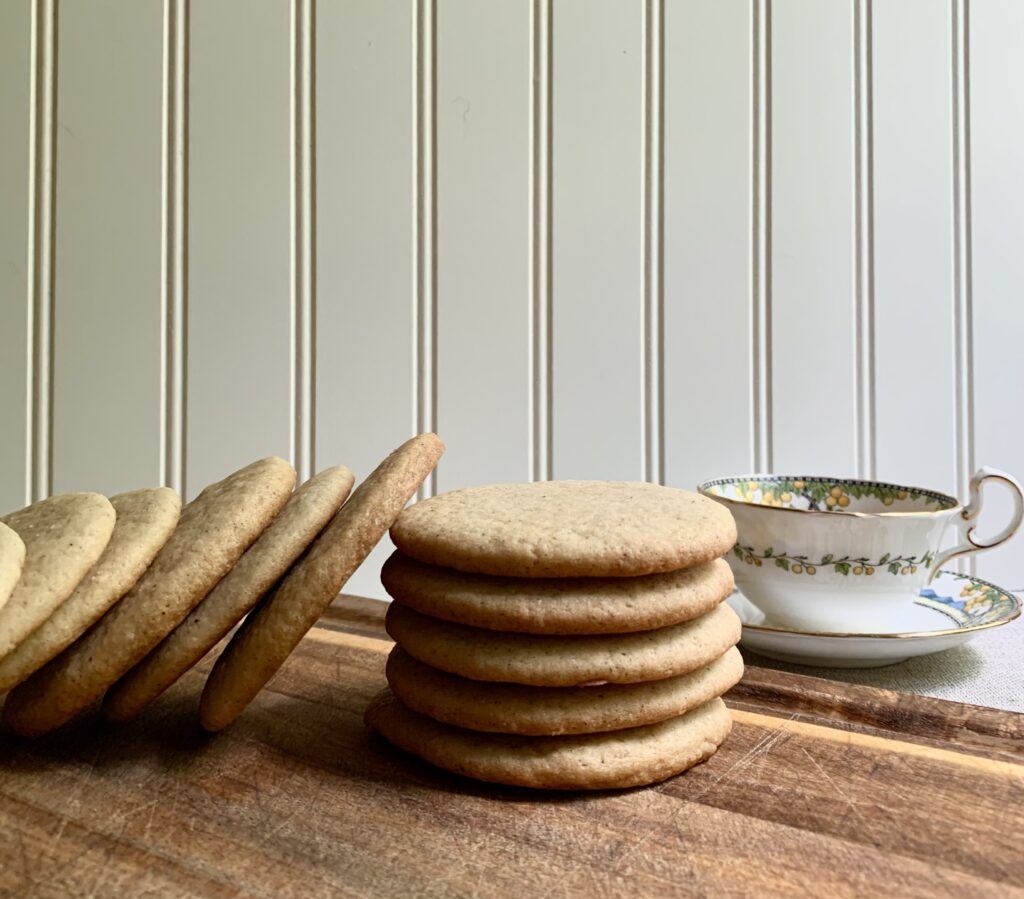
I took a tin of samples and headed for a soul food restaurant on the North Side. Those owners would know for sure!

Closed. And not just for the day. Grr.

But I wasn’t going to give up! I stopped a pair of local street people on my way back to the car, and asked if they could direct me to some other local spot where I could find someone who grew up in the south. “Somewhere like Alabama, Louisiana, Georgia, Tennessee, or the like.”

Instant suspicion! “Why do you want to know?”

After all these years I’ve got that answer down to an art form. You wouldn’t believe how many people think I’m peddling hash brownies or the like. Free cookies = ulterior motives. So I come prepared with both evidence and explanations. Show book; explain that I’m the author; explain about research; explain about the cookie; show the recipe; and then explain that “I can tell if it’s good. That’s easy. But I need native testers to tell me if I’ve got it Right.”

They reacted the same as everyone else, with that head cocked, ‘I guess that makes sense’ look. The one in heavy dreadlocks mumbled something. His friend translated. “He wants you to know that he’s from Alabama.”

I looked at the man and asked, “Do you know Tea Cakes? The cookie? That’s what I’m working on.”

His eyes lit up before he turned to look at the street. He mumbled something to acknowledge a small experience or two.

“Would you mind tasting one of these, and telling me if I’ve got it Right?”

He took the cookie, gave it a good nibble, and got a bit misty eyed. Then he turned his back. Nibble. Grab with both hands instead of one. Nibble more. Munch. Followed by munch, munch, and more munch, grabbing up crumbs until the cookie was gone. Then he gave me a thumbs-up, still turned away.

“That means you got it right,” his friend said.

“Do you want one? Take your pick. There’s another for him too if he’d like.” Another turned-away thumbs up. Then they vanished up an alley to who knows where or what, heads together and talking.

But I still had some cookies to dispose of. Kate would not approve if I returned to the house with dietary sin still in hand. Besides, one tester – however enthusiastic – is still just one.

We’d been standing outside the local public library, so why not? I made my way in, found the young man at the desk, and went through the story again. “Did anyone here grow up in the south? Somewhere like Alabama, Louisiana, Georgia, Tennessee?”

“No, I’m afraid not. I grew up in North Carolina, and that’s as close as you’re going to get.”

“Oh,” I said. “That’s too bad. But… would you happen to know a cookie called Tea Cakes?” His face lit up.

“Of course I do!”

“Care to test one for me?” Book up; recipe shown; explanation made; etc.

“Sure, I’d love to.” One bite and he came close to misting up too. “Y’know, it’s weird how tasting something from your childhood can bring up so many emotions. I didn’t expect that.”

What could I say except to agree? Cookies have a magic, and that’s a big part.

The last cookie went to his fellow librarian at the end of the counter. She was from somewhere just outside the city. “These are really good! I never heard of them before.”

I left as he began to enthuse about growing up in Tea Cake Land. That’s another part of the magic.
Conclusion

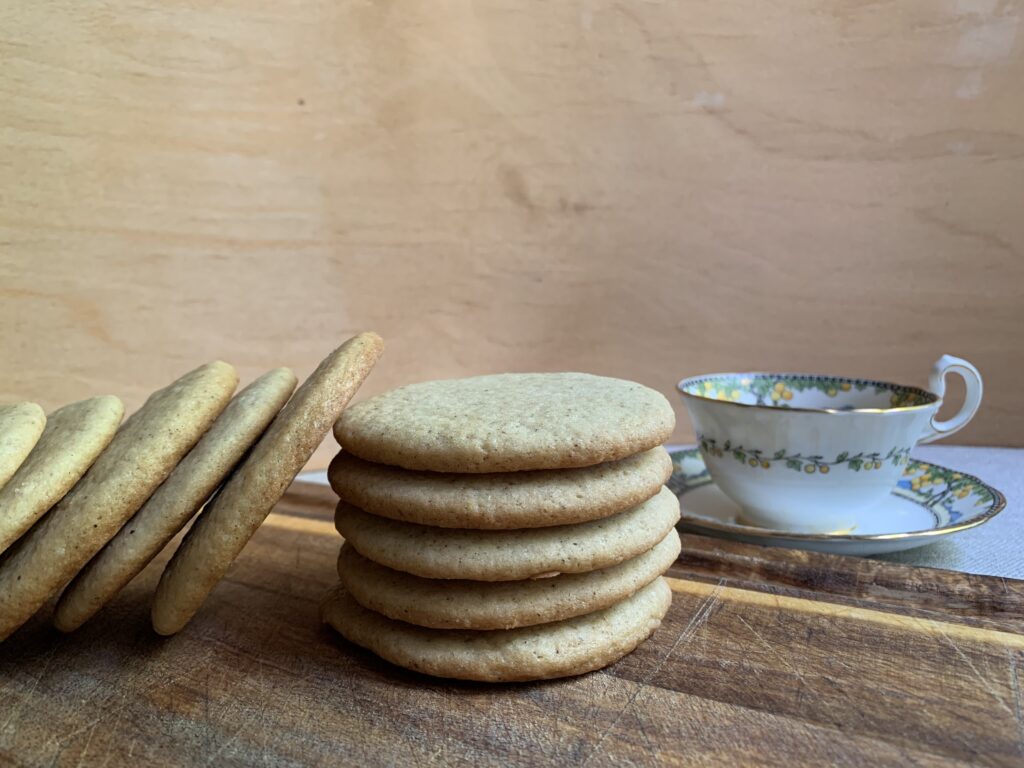
Southern Tea Cakes fit every category of “heritage” you could ever imagine. Right down to embodying a proud part of the culture itself. They really are genteel Southern hospitality incarnate. Homey and a little sweet, with nothing strange except an oddly familiar tang to the dairy flavor, and a remarkable texture right on the line between cake and cookie.

We wholeheartedly approve.

And now I’m off to confirm those findings. Again. I am a loyal husband, after all, and protecting my wife from regret comes with the job. If that means I must throw myself on the fork, so be it.

Enjoy!

NOTE FROM KATE: I agree that Southern Tea Cakes came as a happy surprise. They are pleasantly soft on the day of baking, but harden a bit on the second day. I expressed my mild disappointment with the lemon zest ones, so we talked it over. Yes, it’s there for butter support. No, this is not meant to be a lemon cookie. We have plenty of lemon cookie recipes, and this one isn’t one of them. Scott pretty much said what needed to be said. As for his valiant defense of my waistline, all I can say is, there are risks that come with being around cookies – especially when photographing them. Even though I enjoy some as part of the creative process, it really helps to get them out of the house!
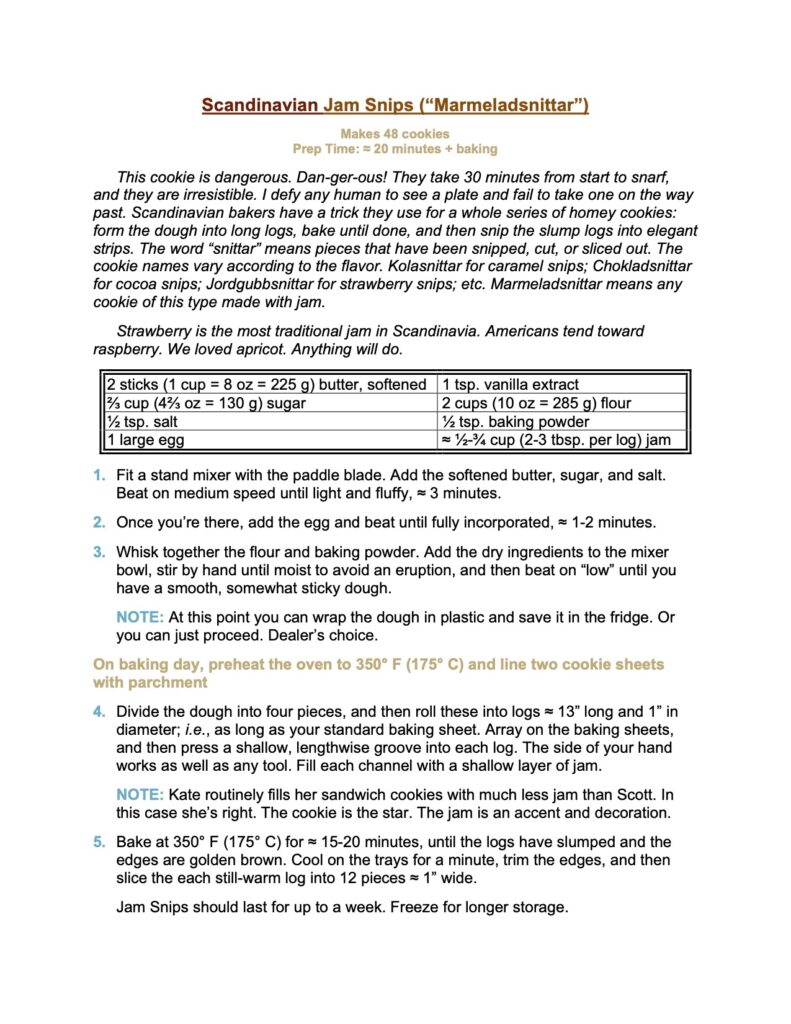
SCANDINAVIAN JAM SNIPS (“MARMELADSNITTAR”), A Class One Addictive Substance

An utterly delicious cookie from Scandinavia suitable for bakers of all skill levels.

There’s a cookie-baker archetype that goes like this: People are always popping in and out, and every time they do s/he whips up a quick batch of cookies and… And a secondary archetype for the young baker: S/he will get an urge, and vanish into the kitchen on his/her own to whip of a quick batch of…

In America those are almost always Chocolate Chip Cookies. In Australia and New Zealand it’s Anzac Cookies. In Scandinavia it’s these utterly addictive, 30 minute start-to-snarf treats that vary in infinite ways according to the jam in your fridge. I defy any human to see a plate and fail to take one on the way past.

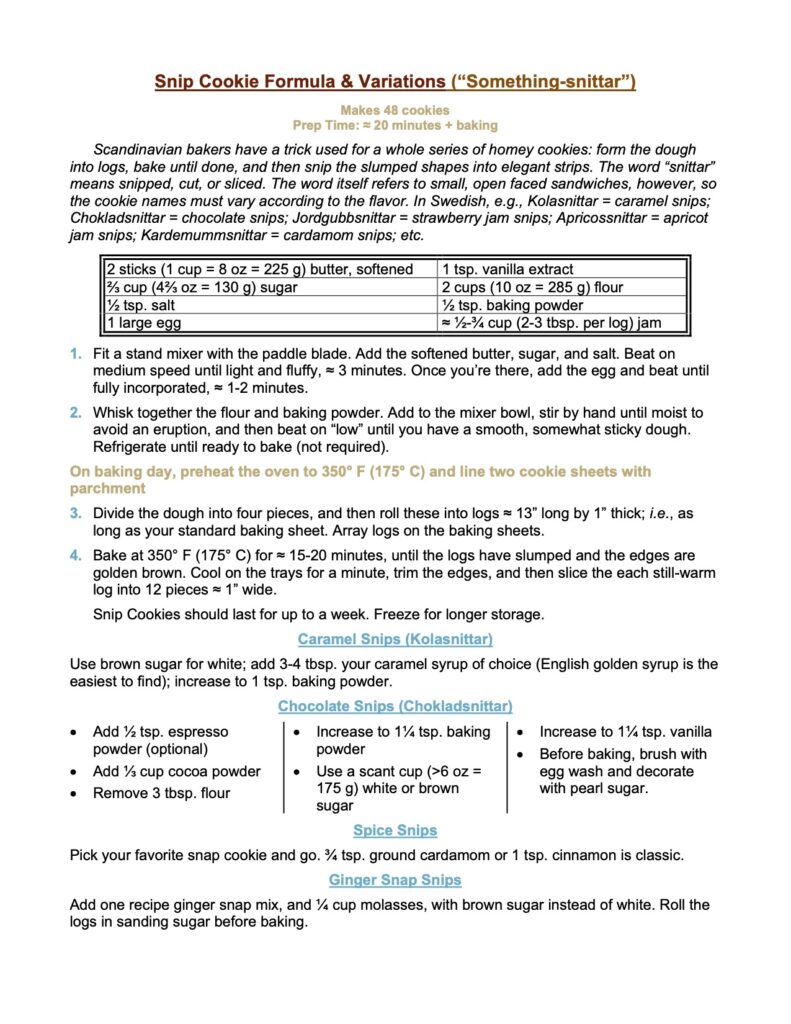
Scandinavian bakers have a trick they use for a whole series of homey cookies: form the dough into long logs, bake until done, and then snip the slump logs into elegant strips. The word “snittar” means pieces that have been snipped, cut, or sliced out. The cookie names vary according to the flavor. Kolasnittar for caramel snips; Chokladsnittar for cocoa snips; Jordgubbsnittar for strawberry snips; Kardemummasnittar for cardamom snips; etc. Marmeladsnittar would mean any cookie of this type made with jam. The online translations almost always use “cuts” or “slices,” but we thought “snips” captured the image best in colloquial English.

Strawberry is the most traditional jam in Scandinavia. Americans tend toward raspberry. We loved apricot. Anything will do. And best of all? Every variation earns its own name! So you can fill a book with “different” recipes simply by changing from one jam to another, or by adding an ingredient to the dough. Or you could in Sweden. We’re stuck with English. Drat.

This is the most basic recipe for all the “snittar” group; a light, vaguely crispy, addictively perfect butter cookie from which you can create all those thousands of variations.

Tricks Of The Trade

There really aren’t any, more’s the shame. I would feel much safer if there were. But here are a few observations to help explain the big picture.

  • Speaking Bakerese, this is a simple creaming method cookie. Cream the butter and sugar, beat in the egg, flavor, and then work in the flour and baking powder.
  • The recipe calls for slightly less flour than roll-and-cut cookies because it’s designed to slump and spread a bit in the oven. Which, of course, makes them taste extra light and buttery.
  • One recipe makes four logs the length of a standard baking tray. It’s hard to divide because of the single egg, but the dough can be wrapped and frozen for another day.
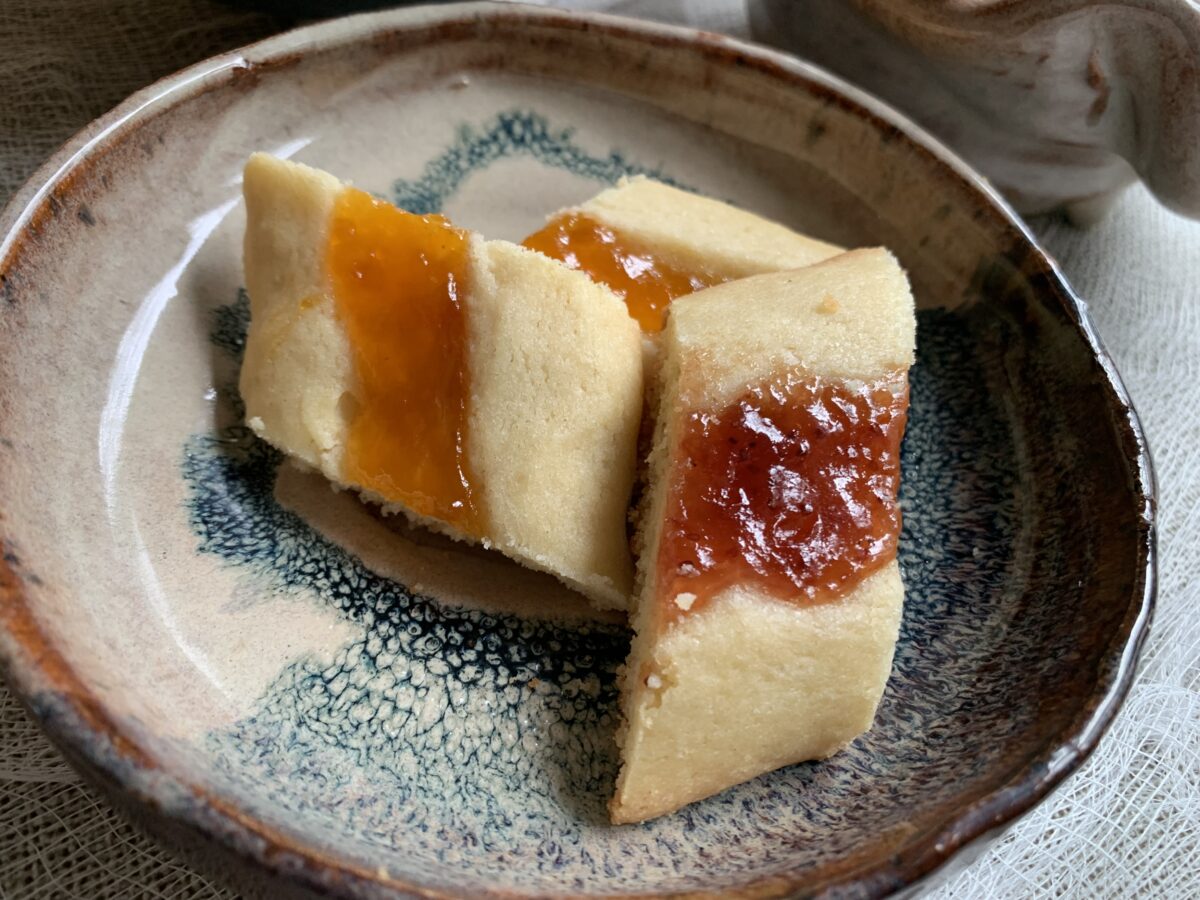
  • Do not press in a deep channel, or your cookies will be so thin in the middle that they’ll break in that spot. You want a nice, lengthwise dent to keep the jam oriented. No more.
  • Don’t use too much jam. Scott usually argues that more jam in cookie is that much more delicious. Kate prefers scarcity. In this case she’s right. The butter cookie is the star, and the jam is an accent.
  • Let the cookies set on the baking tray for a few minutes in order to set up, and then slice while warm. A bench scraper works every bit as well as a knife for this, and maybe better.
  • Diagonal slices look a little more elegant.

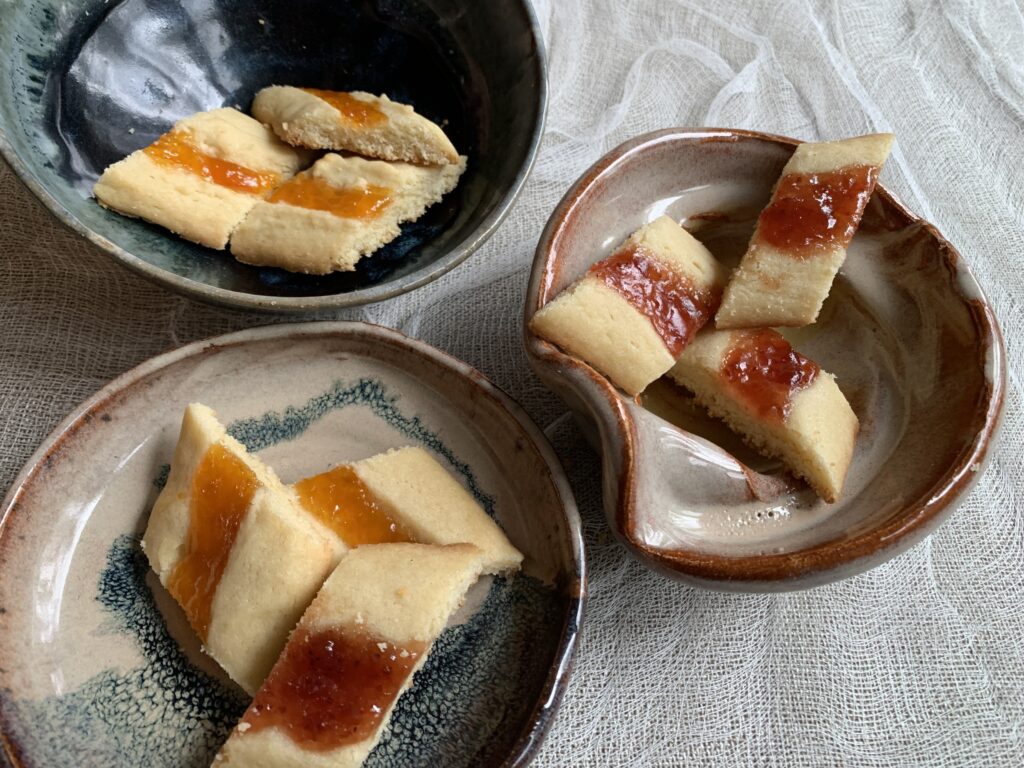
NOTE FROM KATE: regarding the jam amount, I applied the apricot jam using a piping bag, whilst Scott used a spoonfor the strawberry jam. [FROM SCOTT: My apologies. We’ve been watching too many British mysteries] You can see them both in the photo above. Honestly? I like his better. That thin line doesn’t spread as wildly, and makes it look like I tried too hard. Which I did. Go wild!

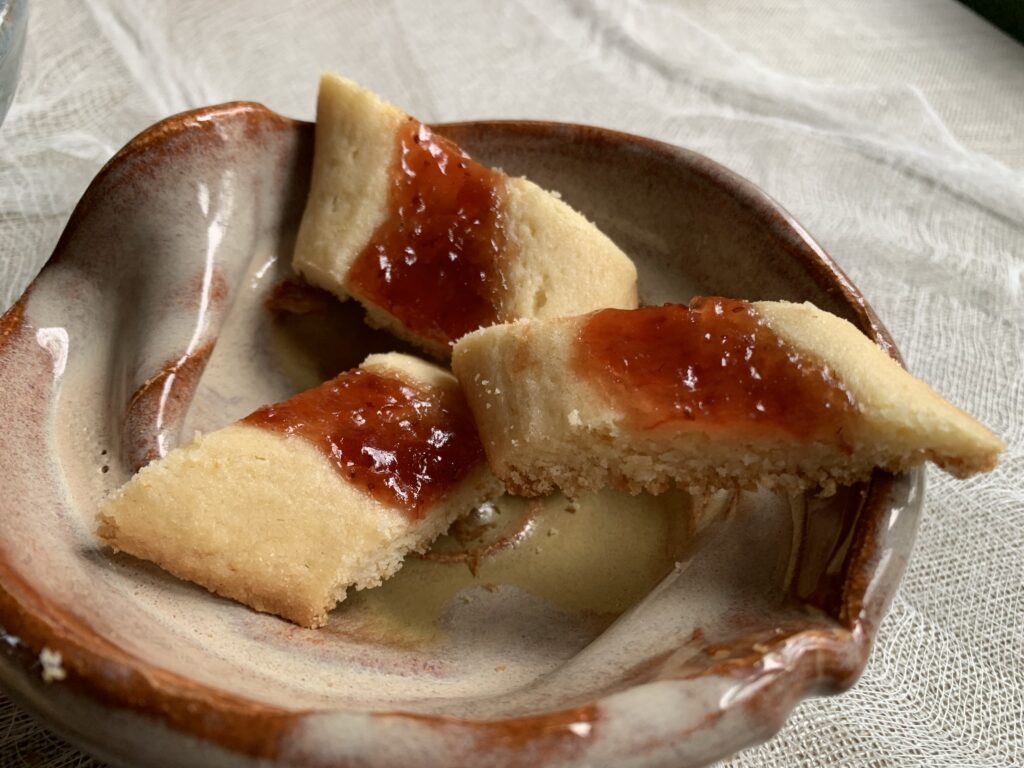
(The bowl below isn’t precision pottery, either. I made it, a beginner’s effort, and I allowed it to slump on the wheel to see what happens. If I can get away with making pottery that has “character,” the same goes for these cookies! ) And now I want to try them with a poppyseed filling. Poor Scott, that’s so not his thing.

Enjoy!

ONE FINAL NOTE: Please don’t blame us for what happens as these cookies migrate from house to hips, and platter to paunch. These are a Class One Addictive Substance! You have been warned!

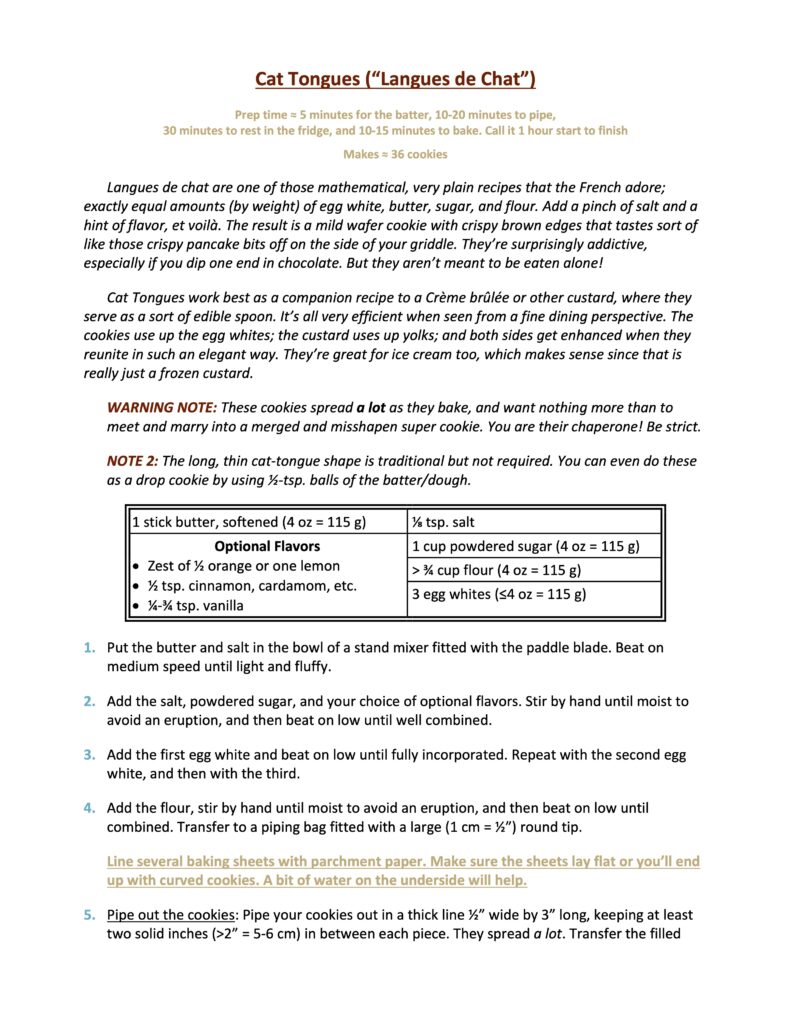
CAT TONGUES (“Langues de Chat”) – crème brûlée’s best friend ever

Did you know? This world famous cookie with the evocative name is actually part of a pair

This is one of those classic recipes I’ve been meaning to try for ages because it has the world’s most evocative name, but kept putting off because it looked too easy. I have seen many dozens of recipes, maybe hundreds of recipes, and they are basically all the same. What could I possibly have to add? Yes, the formalities had to be observed. We really do bake every recipe we publish, over and over until we have it right, so I knew that sooner or later I’d have to go through the motions. But I will admit that Cat Tongues fell into that rare group where my inner Scrooge kept insisting, “Why bother?”

Was he ever wrong! It took me several different batches to penetrate the subtleties behind this cookie, and then an explanation from our extremely French friend before I finally got the underlying point: Cat Tongues aren’t a standalone cookie at all, but rather something new that I’ve never played around with before.

So there was a lot of reason to bother. I only regret that I waited this long.

As always, skip to the bottom if you only want the recipe. What follows is a discussion of the tips, tricks, and stumbles along the way.

How Often Do You See A Mathematically Perfect Recipe?

The French are a very orderly people, at least on the cooking side, and few things show that more than the traditional recipe for Langues de Chat:

  • Equal weight of butter;
  • Equal weight of powdered sugar;
  • Equal weight of egg white;
  • Equal weight of flour; and
  • A hint of salt with a touch of some aromatic “extra” such as citrus zest, spice, or vanilla.

That’s it. A kitchen scale should let you multiply the recipe up or down with no effort at all.

Note To [Shall Not Be Named]: Yes, I really do mean “no effort at all.” Start with the bowl for your mixer. Put that on your scale, tare to zero, and then add the butter. Make a note of the weight, which should be 115 grams for a single stick, give or take. Set the mixing bowl aside, and put a new, smaller bowl on the scale. Tare to zero, and crack in your egg whites, saving the yolks for the custard you’re making alongside. Get to that same weight or below, and then set this aside too (as discussed below, there is no issue if the egg whites come in underweight). Repeat with a bowl for the powdered sugar, and then again for the flour. A,B,C and alakazam: you are ready to go.

Problem #1: The Egg Whites Did Not Cooperate

For our testing I chose to normalize around the weight of a standard U.S. stick of butter, which is 4 oz = 115 g. The conversion tables may say that equates to around three (3) egg whites, but that is only true if they’re Jumbos. The regular Size Large whites from our local supermarkets averaged out to more like 32-33 grams apiece, meaning that three was too little (about 95-100 g), but four was too many (≈ 125-130 g).

I solved this by using four and spooning off the excess, but there’s no need to be that compulsively precise. I’ve since learned (see below) that professional bakers often like to control the amount of spreading by cutting back on the egg whites. Et voilà! Don’t be like me. Be like the pros. Use three whites per stick of butter, and tell anyone who asks that you departed from mathematical perfection on purpose.

Problem #2: The Order Of Addition

Here’s another case where I outsmarted myself by trying to be too precise. The typical “creaming method” approach says to (1) beat the butter until it is fluffy and white, (2) beat in the sugar and flavoring until smooth, (3) beat in the eggs one at a time until fully combined, and then (4) beat in the flour until just combined. The order matters for chemistry reasons. Several of the Cat Tongue recipes reverse #3 and #4, which got me all angsty. Was it a hidden trick? Or a typo?

After testing both I can tell you that it makes no difference. If you add the flour first (i.e., at step 3), you need to take extra care to avoid an eruption from the mixing bowl, but the advance warning should be enough. There is no real buildup of gluten to worry about. If you add the egg whites first, you never get them fully incorporated into the butter because there are just too many, but it will still come together nicely when the flour comes in later on, and you won’t need to deal with “are you sure this order is right?” question marks as you bake.

It’s a batter, my friends, not a dough. Very forgiving. Laugh at me so you won’t have to laugh at yourself, and then do whatever feels best. [But do remember to laugh. These are cookies, after all. They’re supposed to be fun.]

Problem #3: What “Extra” Flavors Work Best?

The answer turns out to be just as simple as those for the first two so-called problems: “Whatever suits your fancy of the moment so long as it’s only a hint.” That said, I should probably describe what happened during the testing in order to give you some context.

My first batch followed an online formula suggesting ¼ tsp. of vanilla for each egg white. Uhm, no. Or rather, NOOOOOO! That was at least triple the required amount, and it also hit us squarely in the [yawn] button. Plain and buttery, sure. Character free? No thank you.

The next experiments involved cinnamon and cardamom, two favorites, and those worked fine so long as I stuck to sharply limited amounts. You want only enough for tasters to know the “extra” flavor is there. You do not want to make extra-flavor Cat Tongues.

Hmm. That might be a little vague. Let me try this a different way. When our daughter tasted the final batch, she reacted by saying this:

“Darn it, these remind me of something but I just can’t think of what it is. Wait a sec… I know! They taste like the toasted pancake bits off at the side of the griddle. You know, those little spots and strings that happen when batter drips off your ladle by accident? Don’t tell anyone, but I love those.”

She nailed it, and I hereby promise to keep the admission in confidence. From now on, at least. I need to share it here because it explains one of the two main reasons why you want such a light hand with the flavorings. The primary Cat Tongue flavor needs to come from that crispy, toasted, butter-infused browning at the edges and the bottoms of each piece. Adding too much “extra” flavor hides that, and thereby subtracts more than it adds.

What’s the second reason? Read on.

The Inside Story Brought It All Together

Both Kate and I had grown a little frustrated by the time I got a few batches in. The cookies tasted nice enough, but they just didn’t deserve all the treasured memories we read about online. Sure, everyone loves toasted buttery goodness, but these weren’t all of that. I can make something even better with a standard butter or spritz cookie that won’t require fussing around with a piping bag. Same thing for the texture. Yes, they were delightfully crispy when fresh out of the oven, but they quickly toughened up and no amount of dunking could change it. If anything, we thought the cookies were downright dunk-resistant because all those egg whites seem to provide some insulation. Given a tray with an array of Cat Tongues alongside any of the butter cookie variations from Volume 1, the Cat Tongues would soon be lonely orphans.

I had to be missing something, so I took the most recent (cinnamon) batch out in search of a native tester. Where was I going wrong?

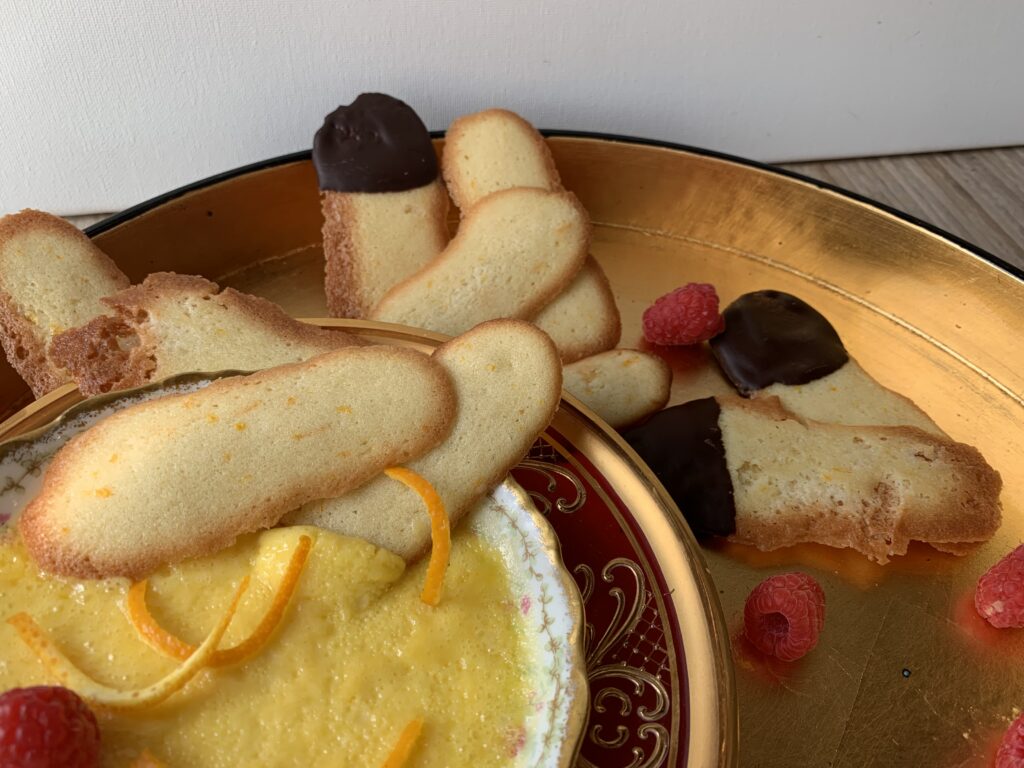
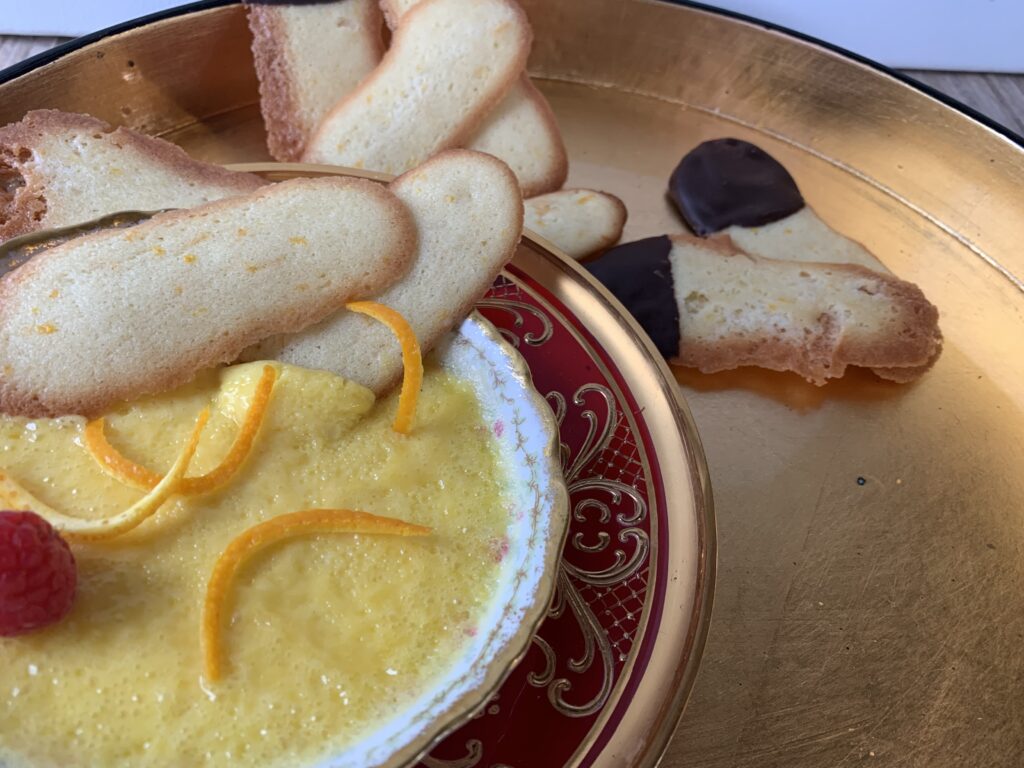
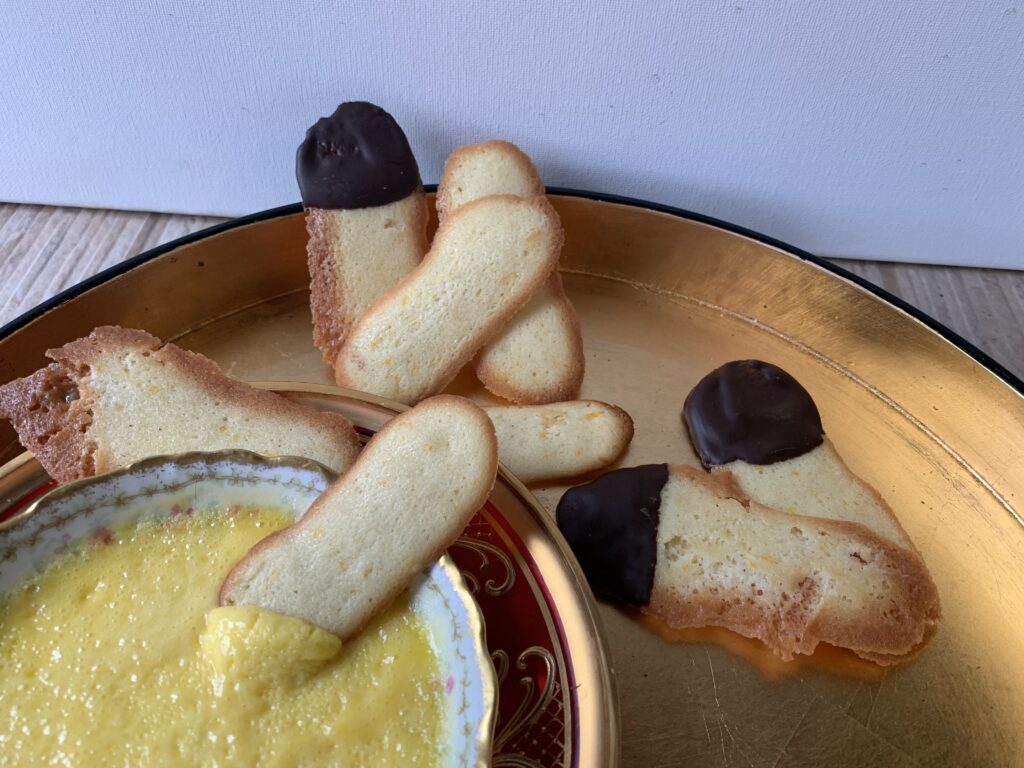
NOTE FROM KATE: I was really happy with this particular series of photos, until I noticed that the custard was frowning!
NOTE FROM KATE: But once I flipped the offending sliver of orange peel, the entire composition brightened the cheerful glow I knew was hiding there somewhere! (That’s what you get when you anthropomorphize custard…)

Fortunately enough, we have an old friend who is not only a native of France but also a professional baker of extraordinary skill. Jean-Marc does not share America’s obsession with cinnamon, but even he approved the light hint contained in the batch I brought over. Then he ventured a polite suggestion:

“It works, but I still miss the orange. We always made our Langues de Chat with orange zest so it would pair with the crème brûlée.”

I’m sorry, what? That off-hand comment led to a conversation that finally flipped on that proverbial, cartoon light bulb in my head. It comes down to a simple, basic realization:

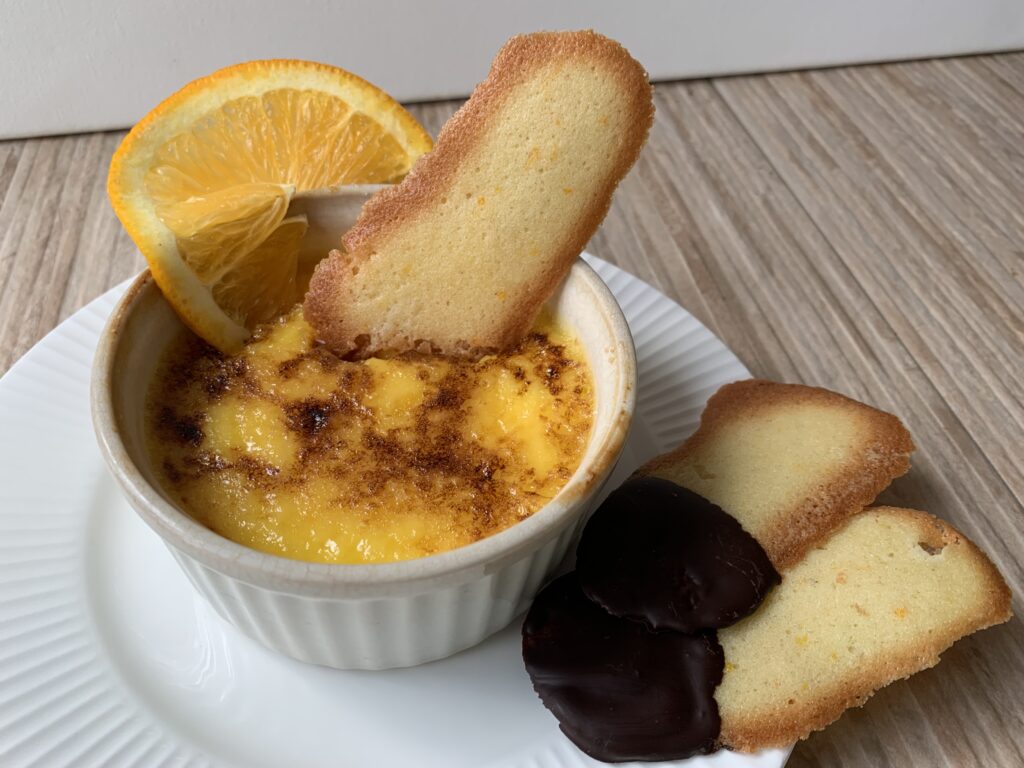
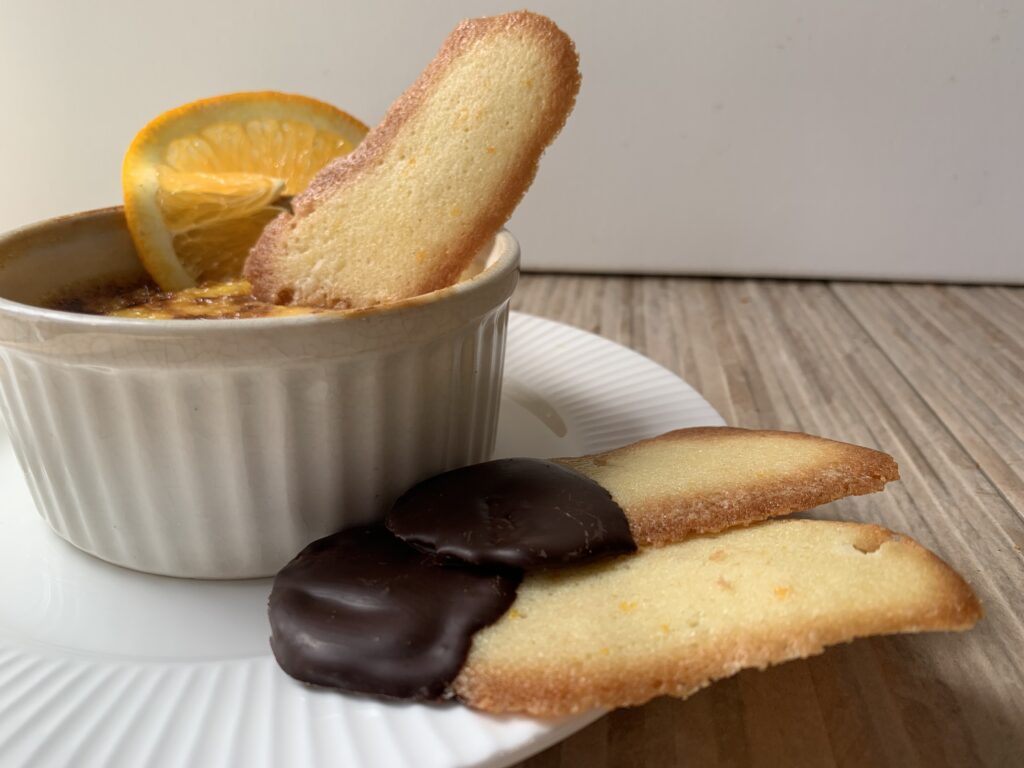
Cat Tongues do not compete with butter cookies, because they are not a standalone cookie to begin with. They are designed and intended to be served as an accompaniment to custard desserts like Jean-Marc’s crème brûlée, crème caramel, ice cream, etc. The cookies use up extra egg whites; the custards use up extra yolks; and both sides get enhanced when they reunite with the cookie being used in place of a spoon.

Aha! Gotcha! My expectations needed a sideways shift. Cat Tongues wouldn’t be lonely orphans on that tray, because they wouldn’t be there alone. They’d be sticking up out of a crème brûlée like the ultimate edible spoon, and that, my friends, would not be the last survivor. Langues de Chat are a co-star, not a lead; an elegant and efficient way for fine dining establishments to transform another dessert from delicious treat into memorable experience; and thus they stand in a category all their own.

That makes sense. It explains the hype, the romantic memories, and even the dunk-resistant texture. It also explains why keeping isn’t an issue, especially since they are easy to refresh with a quick pop in the oven prior to serving. And it made me much more excited than I’d been before. These are truly a Heritage Cookie.

But wait, there’s more. Jean-Marc had another casual bombshell to drop. “If the spreading gets too bad you can always cut back on the egg whites.”

I’m sorry, what? “But I thought the whole thing starts from that 1:1:1:1 ratio.”

“It does,” he said. “But it’s still just the start. The recipe still works if you’re a little short on the whites, and sometimes we did it on purpose when they were coming out too thin.”

Damn but that man is good. Consider me a swine who appreciates the pearls. So much for adding a fourth egg white and then spooning off the extra. Please don’t tell him that I was crazy enough to do such a thing. Jean-Marc shakes his head at our lack of sanity every time he sees those Christmas Snowflake Cookies. No need to reinforce the suspicion, right?

The Final Problem: Time And Temperature

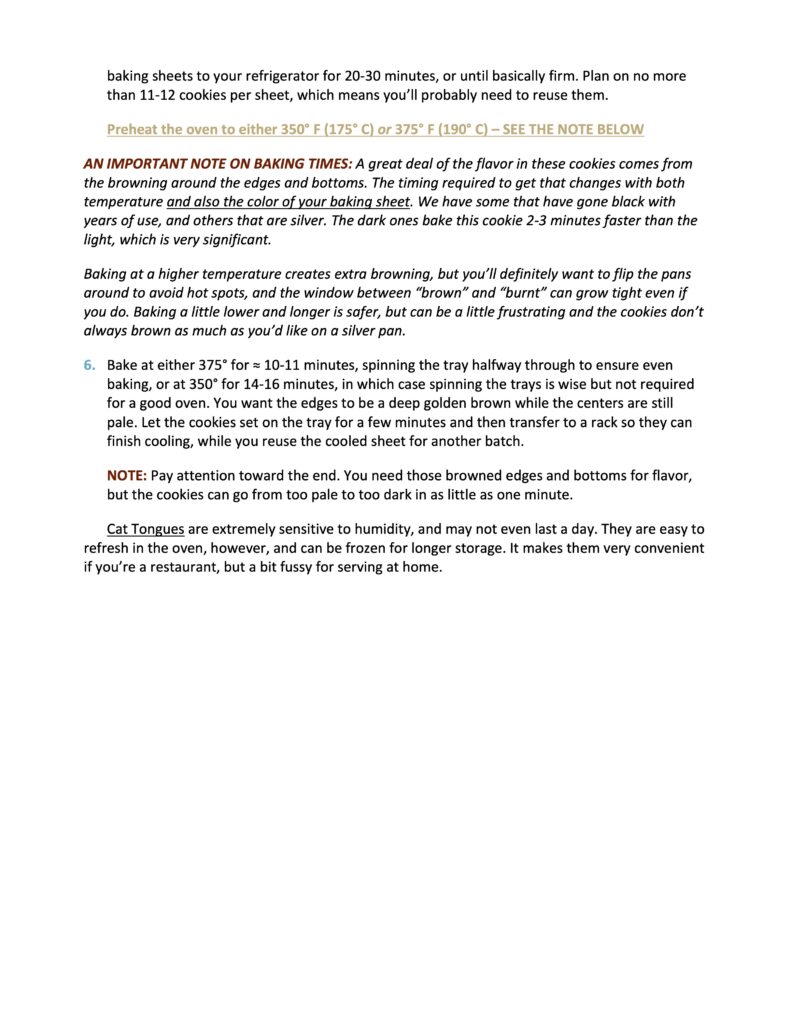
Do the research and you’ll see two different approaches to the baking time for Langues de Chat. Either 375° for ≈ 10 minutes, with strict instructions to spin the tray halfway through, or else ≈ 15 minutes at 350°, with cautions to think about spinning the trays if your oven has hot spots.

I tested both, and found that it really comes down to elusive differences in the amount and depth of the browning around the edges. 375° gives faster and deeper browning with a slightly better array of colors, but the window between “brown” and “burnt” can grow kind of tight. That is why spinning the trays becomes vital, and why you also need to stand around for occasional checks as the cooking time comes to a close. 350° takes a little longer and produces more of a uniform brown than the intriguing range of dark-to-tan, but it also requires less in the way of babysitting. The choice is entirely up to you. The distinctions are subtle at best.

Just be aware that time and temperature aren’t the only factors. This is one of those recipes where the color of your cookie sheet can make a real difference.

Over the years we have amassed a collection of five different sheets, which now range from two that have gone black with years of use, one that is now blued steel, one that is gold-toned, and one that is still pure silver. The dark ones bake this cookie almost 3 minutes faster (at both temperatures) than the lightest one. That is a very significant difference! Account for that factor with your own baking sheets as you set forth on this journey.

Two Final Cautions – They Really Do Spread That Much, And Thus Your Piping Skills Will Matter

The photos in this post show cookies that may be as wide as 2″ across (5 cm) at their broadest spots. Every one of them started with an even ½” (125 mm) bead from the piping tip. Do the math… No. Don’t bother. Let me summarize.

Cat Tongues spread way more than you’d ever believe, they do it to all directions, and they are magnetically attracted to each other in a demon-powered effort to meet, marry, and merge into a single, good for nothing mega-cookie.

Plan accordingly. Keep them well and truly separated. If you can only fit nine or ten on a cookie sheet, so be it. You are the cookie chaperone! Keep those little, grasping, would-be elopers well and truly apart. There is no such thing as a chaste little kiss. The tongues will lock and entwine.

The only thing that really helps is good, even piping. Cookie gremlins view bumps or bulges as an open dare to see if there’s enough material to race off in some unexpected direction. My daughter Lee gets full credit for these clean-looking specimens because she possesses those skills. She got the piping bag because I do not possess those skills. The gremlins have my number. There’s nothing I can do beyond striking back at the evil, cookie destroying imps here, on paper. Vengeance is mine! Bwah-ha-ha-ha…

Extra Spice From Kate: These cookies really explode to their full potential when paired with custard, ice cream, or even a good yogurt with a bit of honey. For crème brûlée, follow your favorite recipe. After a bit of fussing, I found that an even mix of white and brown sugar, broiled for one minute, worked best. As for the chocolate, it’s a matter of taste. Scott says he would love the chocolate accent with the “right” custard, but I find I prefer the crisp cookie plain. I compared store-bought meltaways with our usual semisweet chocolate amended by a bit of cocoa butter, and in this application they performed comparably.)

…You have been warned. Jean Marc said the wicked things feed on extra egg whites, so the reduced amount may help, but I’m telling you: there’s something supernatural behind all this. You’ve got to be ready for their tricks!

CONCLUSION

Cat Tongues a/k/a Langues de Chat are a special purpose cookie designed and intended to be a sort of edible spoon for custards such as crème brûlée or a luscious homemade ice cream. Nothing on earth can match them for that targeted role. They’re also easy if you have some basic competence with a piping bag. Or a competent and draftable daughter.

Keep the flavors subtle, and by all means pair them up to match the accompanying dessert. And remember that the browned edges and bottoms are what you’re really after. If you keep that goal in mind, and follow those simple guidelines, you’ll be more than happy with the results. There really is something elevated and elegant about serving Langues de Chat alongside their companion treat.

Enjoy!

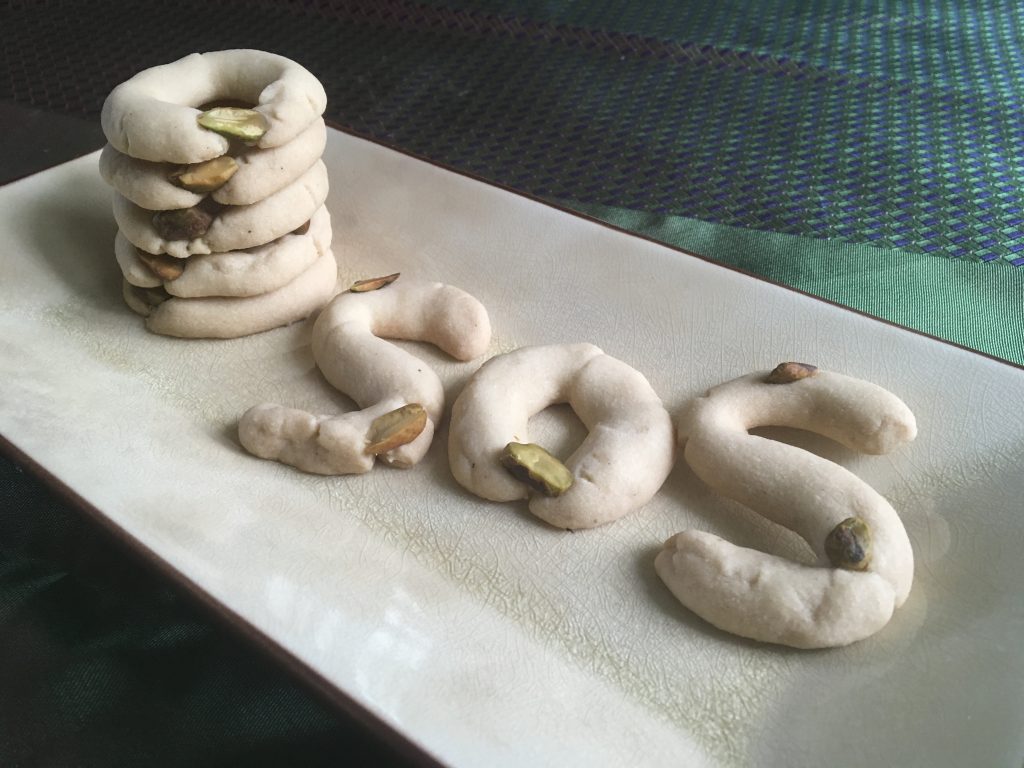
GHRAYBEE – The Great Middle Eastern Shortbread

Also known as: “Adventures In The Land Of Butter”

NOTE: There are at least a dozen different ways to spell the name of this cookie even though everyone seems to agree on the pronunciation. For the first syllable-and-a-half, imagine the word “gray”, pronounced with an extra-hard “G” in a Cockney accent to sound almost like “g-rye”. The second syllable is pronounced “bee,” like the insect. The efforts to turn that into letters has somehow resulted in “Ghorayebah,” “Graybah,” “Ghrybi,” “Gorabee”, and several others you’ll find with any quick search online. We went with the spelling that seemed closest to the pronunciation: “Ghraybee”. But of course, so did every other writer… [Sigh].

As always, please skip to the bottom if you are only here for the recipe. The rest of this article covers the all-important “why” behind the “what.”

It might be best to start with some definitions:

Clarified Butter: To make one (1) cup of clarified butter, start with 1¼ cups of raw butter (i.e., 25% more than you want to end up with) and then cook it on medium-low heat until melted. Skim off the foam, and then spoon out the golden goodness, leaving behind the water and the solids on the bottom. That goodness is pure butter fat, a/k/a clarified butter. It tastes just like regular butter, but is pure butterfat that will handle differently when cooked.

Ghee/Samneh: Don’t just melt the butter, but instead continue to cook on medium-low until the major bubbling stops, which indicates that all the water has been cooked out. Spoon or pour out the remaining liquid, leaving any remaining solids behind. It has a slightly more intense flavor that clarified butter because the fat absorbs the flavor of the now-cooked butter solids. Ghee has become available by the jar at various markets and is easy to find in any that are oriented toward Indian food. Indian Ghee and Arabic Samneh are basically identical, subject to minor differences in brand that in turn alter the cooking time or temperature, and the original milk sources (butter from different cows has a subtly different flavor).

Browned Butter: Follow the procedure to make Ghee but keep on cooking at medium-low until the solids at the bottom turn nut brown and heaven’s own aroma sings through your kitchen. This is the end of the line. Go any further and the solids will blacken and burn, infusing a bitter flavor instead of Ultimate Butter.

Put another way, clarified butter is pure butterfat; browned butter is clarified butter flavored with toasted butter solids; and ghee is halfway between the two. All three appear in more savory recipes than baked goods because removing the solids significantly raises the “smoke point” of the fat; i.e., the temperature when your cooking fat begins to burn and turn bitter. Most cooking oils have a smoke point between 400° and 450° F. Regular butter begins to smoke at 302°. These clarified butter fats have a smoke point all the way up to 482°! Higher temperature cooking yields more browning, which equals more flavor, and so forth. None of which matters for us, of course.

What matters for Ghraybee is the extra flavor and tenderness that come from using purified butter fat instead of regular butter.

Help! I have Butter Overload Syndrome and need to be consumed by a photographer with a sense of humor!

NOTE: As always, I recommend skipping to the bottom if you’re only after the recipe. The bulk of what follows is about the process of getting there and what we learned along the way.

Initial Failures and Discovering Ghraybee

I’ve been working for years on the idea of a shortbread cookie made with browned butter instead of regular butter. Why? Because I adore browned butter! Butter is always good, but browned butter sits at a whole new flavor level. I started the effort with a straight butter cookie recipe but found that the shapes wouldn’t hold when I used browned butter in place of plain. The cookies also came out exceptionally rich, almost too much so, and the outsides felt a bit greasy. Then I tried adding some egg yolks to create an emulsion. Still didn’t work. Then I tried adding back the 25% water that I cooked off to brown the butter in the first place. No dice. Same with milk instead of water. Arrrgh! Finally, I cheated by making a straight butter cookie and adding a browned butter frosting. Okay, that worked well enough to ease my frustration even though it wasn’t worth the effort. But it was enough to let me move on to other projects that at least satisfied my interest in heritage recipes over creative ones. Someday, maybe…

You can imagine my excitement when, a few years later, I came across a recipe for Ghraybee, a famous and much-loved cookie with a fantastic history that was made from clarified (or browned!) butter. I’d missed it for all these years because my focus has been on Europe, and this is a purely Middle Eastern treat.

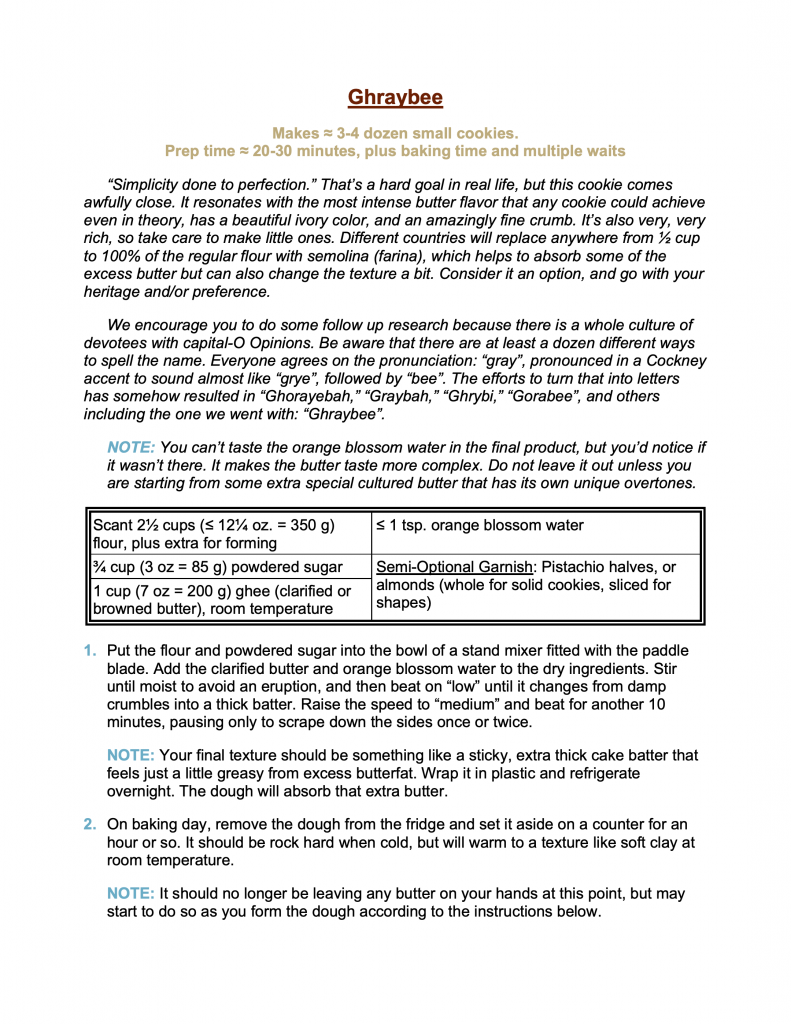
I dove right in to the research, and you know what? Ghraybee bakers suffer from the same problems that I ran into but have a few centuries of experience and advice on how to overcome them. The first thing I noticed surprised me. Ghraybee contain no eggs, nor any of the vanilla you see in basically every European butter cookie. Quite the opposite. Ghraybee are a stripped down, essentials-only recipe made from nothing except flour, sugar, butter, and a tiny bit of orange blossom water to make the butter taste more interesting. The tricks are all about technique, experience, and understanding what’s going on.

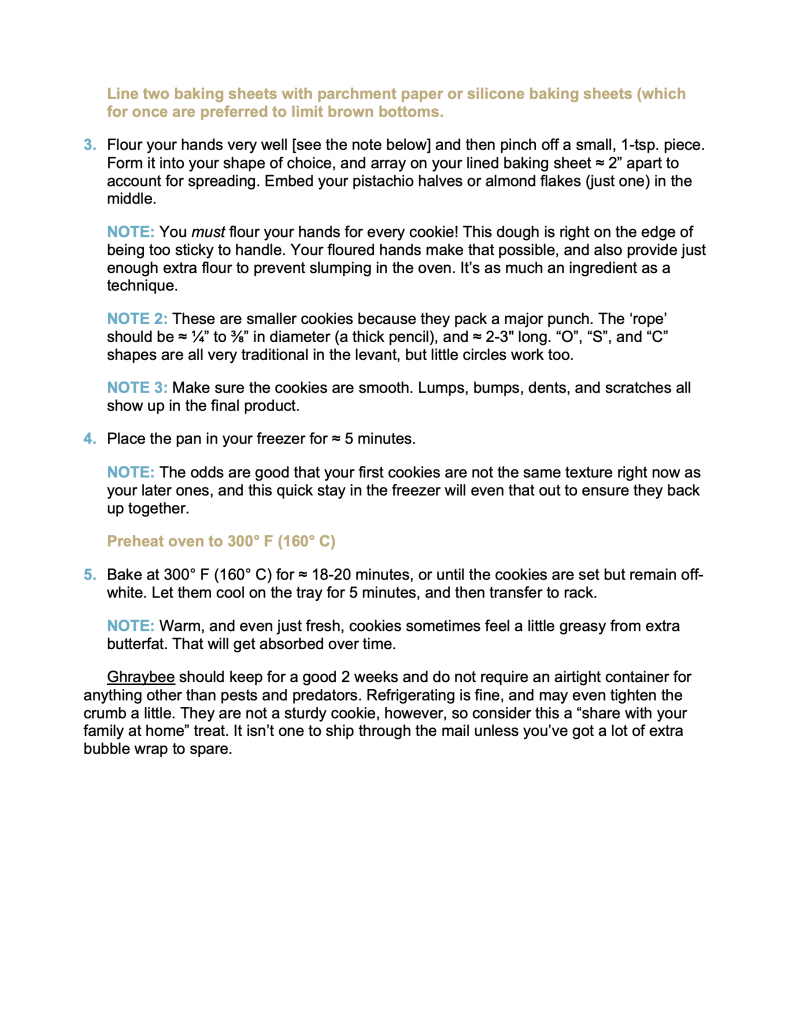
First and foremost, you need to understand that the cookie is designed and intended to hold the greatest possible amount of butter. This means that you will often get excess butter oozing out – greasiness – at every stage, particularly if the dough gets too warm. What solves that is time. Let the dough rest overnight, and it will absorb the greasiness back inside. Let the shaped cookies rest in the fridge or freezer, and ditto. Same thing for the cookies when they come out of the oven. They should feel a little greasy. It’s a sign you’ve done it right. The sensation will vanish as the cookies age.

I’d been on the right track from the beginning. I just hadn’t been patient enough.

Mix Very Well Indeed

Second, you want to beat the dough for a very long time. The first recipe I found (from Egypt) suggests a three-stage mixing effort at low, then medium high, then low again for 5 minutes each. (You can find this recipe online under the name “Perfect Ghorayebah”). That worked, and you could see visible changes over the first 5-10 minutes; but to be perfectly honest, we saw no changes at all over the final 5 minutes, and after a great deal of testing we think the whole rigamarole is excessive. Ten minutes on medium is all the mixing you need. It’s still much more than one usually sees.

It does make a difference, at least for consistency. The one batch we tried with minimal mixing behaved differently at the forming stage, and lost several cookies to fractures in the oven. So that is out. But why a full 10 minutes instead of just 4-5? We’ve wracked our brains and our research sources alike, and have no good answer. We can only speculate based on our semi-informed understanding of food chemistry.

What the beating process does not do is build up gluten. Gluten forms when two proteins in flour (gliadin and glutenin) combine in the presence of water. Beating the flour makes that happen faster, and helps the gluten molecules combine into long sheets. Ghraybee dough has no material amount of water, and thus you should get no gluten regardless of how long you beat the dough. It isn’t about gluten.

Could the long beating be an attempt to remove air bubbles created when the butterfat gets softened in the mixer? Maybe… but if so, why not use a melted product instead of whipping it in the first place? We tried that too. The cookies tasted right but crossed the line into being a bit too tender.

That’s left us with only two hypotheses. First, the long beating time ensures absolutely uniform distribution of all the ingredients. This is emphatically not one of those cookies where you want identifiable bits of pure butter surrounded by dough. Second, we think it may force some of the butterfat into the granules of flour. Recall that Ghraybee repeatedly hover on the edge of that point when they’ll turn greasy because a butter slick escaped from the binding flour, but then reabsorb that extra butter fat when you give the dough (and later the cookies) several hours to do so. It makes some intuitive sense that the totally dry flour might benefit from a kickstart at the beginning in the form of extended time in the mixer. Especially since the dough felt a little greasy even after that long beating time, but then felt fine after a night in the fridge and time on the counter to soften.

Is the extra-long beating time essential? Maybe not. Most Ghraybee say no more than, “mix very well.” That Egyptian recipe was the only one I found that made a religion out of the process. We’ve specified the time and speed only because “very well” is a little vague, 10 minutes works, and why mess with success? Let us know if you try a shortcut approach. We’d be curious to hear your results, both good and less so.

Semolina? Who do you plan to share with? This is a cultural icon.

The next trick is more controversial and dips you into the murky world of Middle Eastern politics: adding in some semolina flour a/k/a farina. The bakers I spoke with (American immigrants) told me that semolina is a thirstier flour that will hold the butterfat a little tighter. The downside is a change in texture. Semolina makes the cookies a little sandier. Is that bad? The answer, it turned out, was all in the eye of the beholder. If you grew up with semolina versions (common in Syria and other places), that sandy texture is part of the experience, and the cookies won’t be “right” if it’s missing. If you grew up in Lebanon or Egypt, semolina is anathema because the ultra-fine crumb is part of what makes the Ghraybee – you guessed it – “right”. Though it might be more accurate to say that everyone views the alternative approaches as “wrong…” and will care about that even though it’s said with an obligatory, self-deprecating laugh.

It iss a little hard to come up with a cultural equivalent for the U.S., but let’s try this: Think of your perfect brownie. Got it? Now imagine that someone comes and proudly shares their favorite recipe… and it isn’t all of that. The product may be good when taken on its own merits, but no argument in the world will dent your conviction that someone has failed to grok the One True Way. Maybe it’s too fudgy, or not fudgy enough. Maybe it’s too soft, or too crispy, or too thin, or too puffy. Maybe it has chips, or chips that are too big or too small. Or nuts, or no nuts. Maybe the chocolate flavor is too pronounced or too attenuated. But the fact is, it won’t be right.

No one is saying that your friend will suffer eternal damnation for the trivial sin of misunderstanding these culinary truths. But a few years of penance? Maybe. It’s certainly not going to help his/her case up at the pearly gates. [Insert self-deprecating laugh.]

We all know these are matters of taste. People are allowed to prefer one type of brownie over another. It may even be a good thing in the broader picture. But that doesn’t change the fact that brownies are supposed to be smooth and fudgy, not cakey, and those who disagree are just plain wrong. And don’t even get me started on the Whipped Cream Heretics who waste those extra egg whites in a Key Lime Pie instead of using them for meringue as the good Lord intended. That’s got to cost them at least a decade in purgatory, scrubbing some heavenly pots and pans.

That is the culture of Ghraybee in a nutshell. People love this cookie so much that they genuinely care when it isn’t “right,” even if all parties understand that it all comes down to what you grew up with. There’s even a modern tradition of bakers who make “improved” Ghraybee by such adventurous risks as adding ground almonds or pistachios to the dough. Everyone loves those if said baker takes the time to put a modifier on the name: “Pistachio Ghraybee”, “Ghraybee with nuts,” etc. Just don’t get caught describing an “A” when someone else will think it’s a “B.” Not unless you’re willing to argue about the reality that there are as many Ghraybee versions across the Middle East as there are for butter cookies across the nations of Europe.

Dealing With The Richness

Why fight what ought to be embraced? One of my early testers took me into the aisles of his Middle Eastern grocery to point out packages of commercial Ghraybee. They came in several shapes – but not several sizes. Every single cookie one was very small compared to what we usually make; no more than 1¼” to 1½” across (325-350 mm). Aha!

The cookie packs an oversized wallop of butter? Make a smaller cookie. They do, and you should.

Dealing With The Shapes

Simple shapes work best.

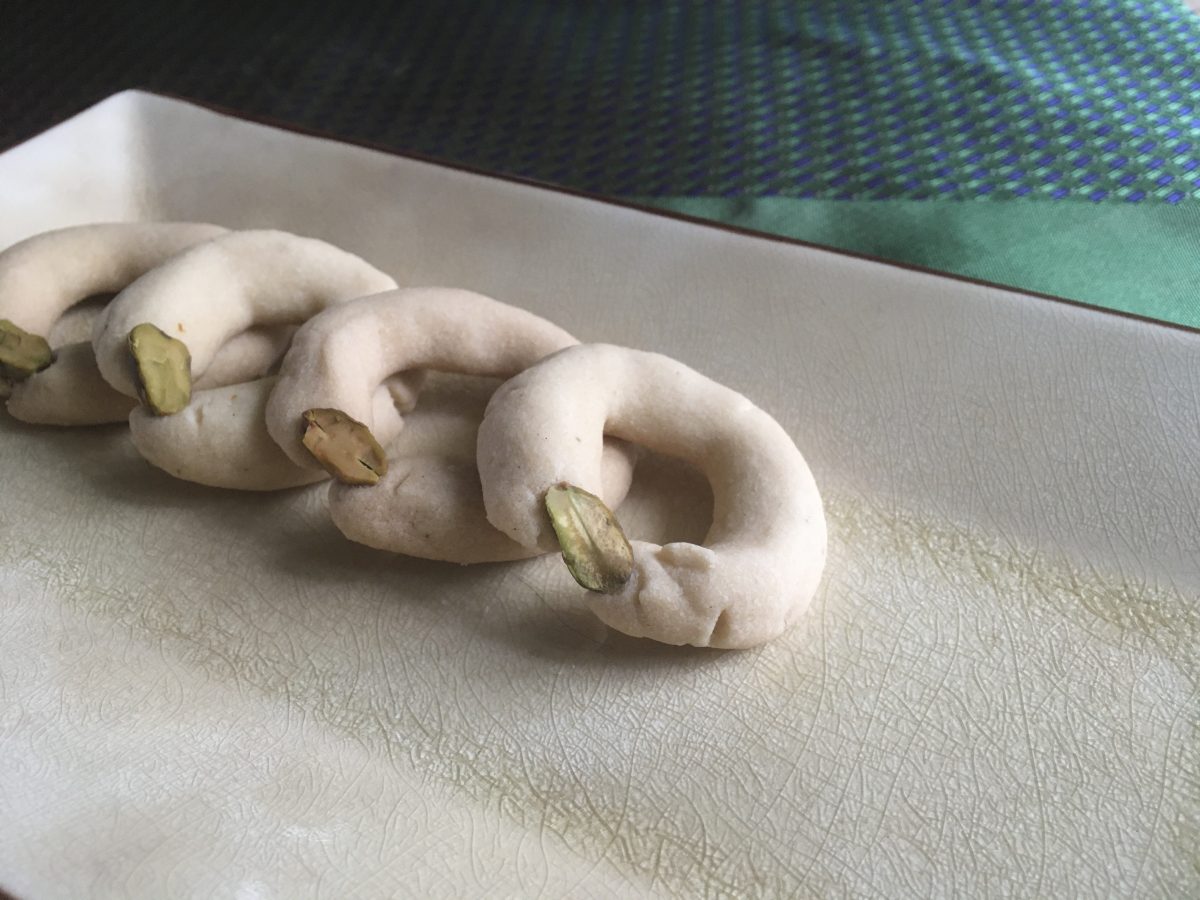
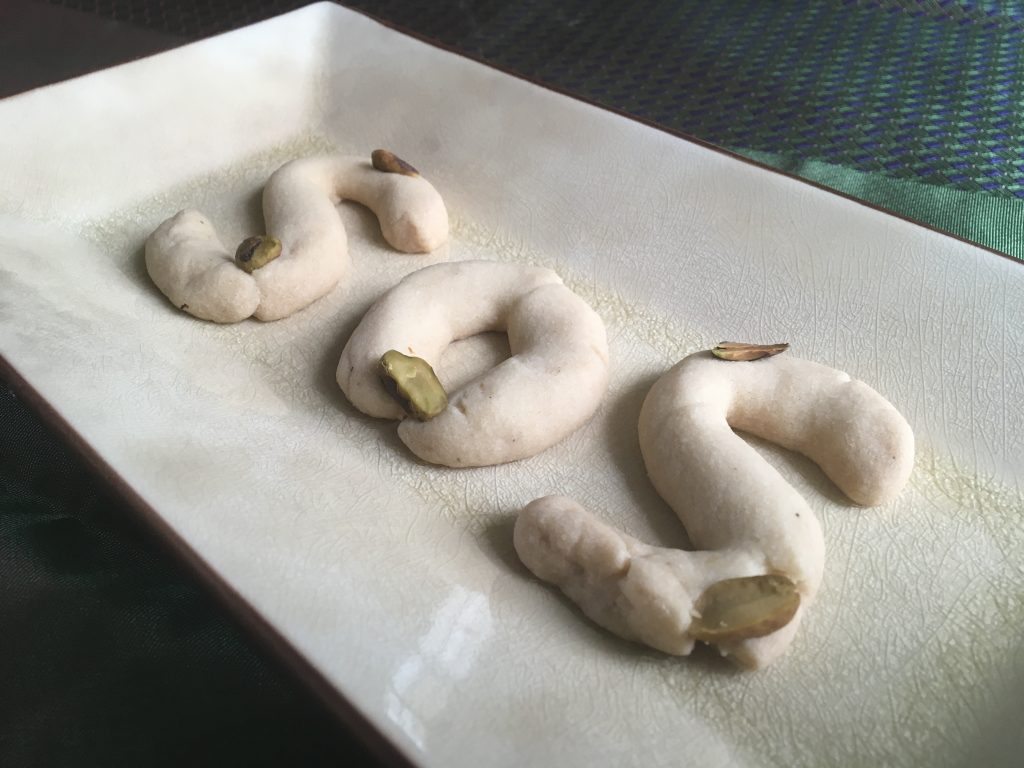
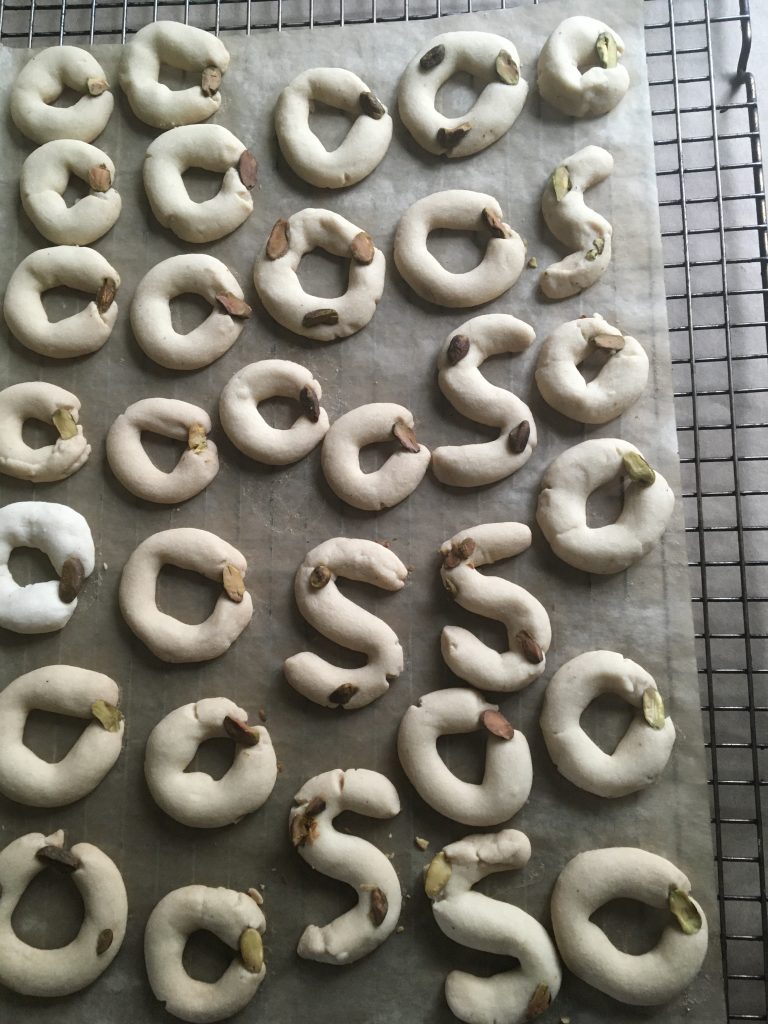
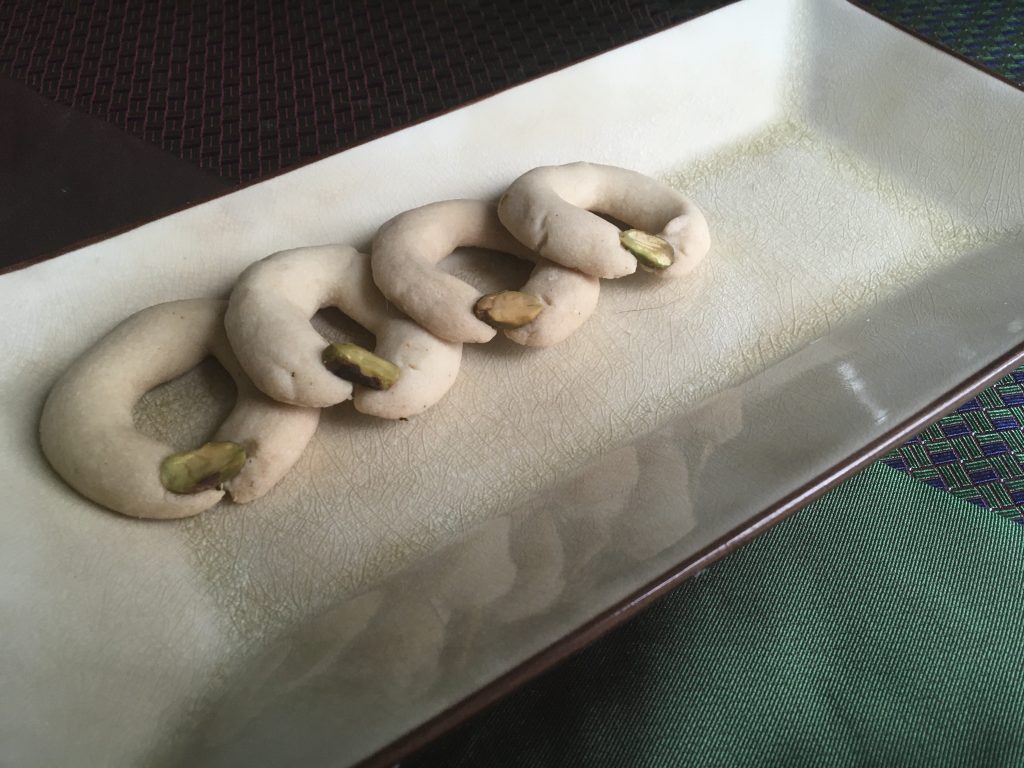
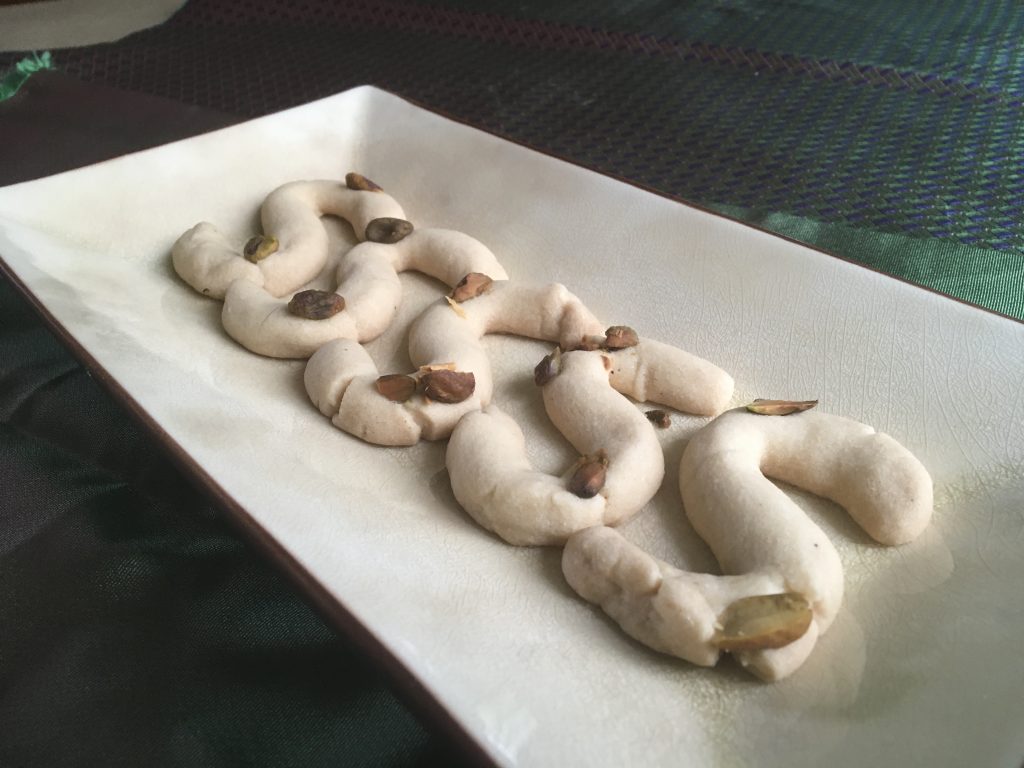
Every source we’ve read or consulted had the same advice: keep it simple. Most Ghraybee are shaped into a small O, C, or S shape, with a single flaked almond or pistachio half as an ornament. We think the pistachios look better, but your mileage may vary. A minority of recipes just went with drop cookies by squashing small balls, with an almond or pistachio pressed in the center. Again, do as you wish. But we do urge you to use some kind of nut as a decoration because it provides some contrasting texture. Salted nuts add in interesting pop of extra flavor, but preferences vary.

We also feel obliged to note that shaping the cookies can be a midlevel chore depending on whether you’re one of those people who are blessed with cool hands versus hot hands. We are in the latter category, and found to our chagrin that the dough came out of the fridge rock hard, and then fought us at every stage by (a) sticking to our palms like crazy, and (b) softening into paste before we finished up. Imagine shaping cold butter in your hands and you’ll understand what’s going on.

We solved the sticking problem by dusting our hands with a little flour. It works perfectly so long as you expect to have the problem, and keep a little bowl by your side.

We solved the softening problem by working quickly and returning any too-soft pieces to the fridge for a few minutes.

We also learned that our trays of shaped cookies come out more regular if we put them in the freezer for 5-10 minutes, or the fridge for 10-20. That brought everything back to the same temperature and ensured even baking.

SHAPING NOTE #1: Interviews with experienced Ghraybee makers show that those problems are a personal thing more than a technical one. Some people run into difficulty with the shaping, and others do not. We really do think it’s a question of cold hands versus hot hands, rather than anything to do with the recipe. You see the same thing with pie crusts sometimes. The cookies come out just as well regardless.

SHAPING NOTE #2: Kate did an experiment where she put those too-soft pieces in a piping bag and used that to make the cookies instead of rolling the pieces in our hands. It worked – the dough really does get soft enough to pipe – but the results were similar to cookies made from liquid butterfat. They crossed the line into being too tender, and fell apart even on the cookie sheets.

About the Sugar…

American bakers have such a legendary sweet tooth that it has become a common joke in every immigrant community we’ve explored. And, sure enough, the base recipe I put together from various English-language sources came out a bit too sweet for the palate of those who knew this cookie from childhood. Citizens who grew up in the States loved them, of course. I have deferred to tradition in the recipe that follows, and made the cookie to Middle Eastern standards by using 3 ounces (85g) of powdered sugar. If you want to adapt it to the tastes of American children, increase the sugar to 4 ounces (115 g).

Final Thanks

Additional thanks go out to Barbara Pabotoy, a fine baker we met on Facebook who shared her mother’s Lebanese version of the cookie (“Ghraybeh”). I get the feeling that she’s confused about how long it took us to feel comfortable in sharing a recipe that’s second nature for her and her family. I can only answer with the words “pie crust” and “omelet.” And the snide, totally unworthy observation that I’m betting she has nice, cool hands for dealing with the shaping process.

Some things are so simple that they take some practice to master. Those same things usually end up being some of the best exemplars of the larger craft. Ghraybee fall in both of those categories. Don’t be surprised if it takes you a little fussing before the process suddenly becomes easy. But stick with it! Oh yes, definitely do that. This may be the most buttery cookie that it’s possible to make, even in theory. It’s certainly the biggest butter bomb that we’ve ever made, and it won’t be a stranger in the house moving forward. These are a true, close-your-eyes, omigod-where-have-you-been-all-my-life experience to treasure.

Enjoy!

It’s all about the flavor, plain and simple.

Butter Overload Syndrome on its way!