A delightful, aromatic, not-too-sweet cookie adored across the entire Middle East
This classic, crispy Middle Eastern tea cookie appears all over the levant, but those from Lebanon are acknowledged to as the best even in this famously competitive part of the baking world. So we set out with a question: what features make them so special, and how do they differ from all the other anise cookies that dominate the Mediterranean shores?
Have oil or clarified butter in the dough rather than plain butter; and
Have a dry, crispy, but well spiced flavor that pairs up perfectly with a cup of potent tea or coffee.
Ladokouloura are the Greek version. They feature olive oil, sesame, and orange. These Yansoon Cookies are all about the anise (“yansoon” = anise in Arabic) with sesame as the supporting note and a mysterious other lurking behind. Kate remains torn, but I like this one better.
NOTE FROM KATE: I love anise. My grandma used to make a low-butter type shortbread that had to age well before being served, and those were possibly my most favorite Christmas cookies. They never caught on with Scott. He fell in love with richer fare, so I never bothered making the “anyzky” just for myself. But maybe I should’ve, because this recipe has reminded me what I’ve been missing! These, too, are leaner than your standard butter cookies, but you won’t miss the fat because of their crispy texture. If anise is your jam, definitely give these a try!
What Do You Need For A Great Yansoon Cookie?
My research uncovered three main points:
Hartshorn a/k/a baker’s ammonia makes a major difference because it creates a unique texture that particularly suits cookies in this category (tea- and coffee biscuits intended for dunking.
Yes, there are online recipes that use baking powder instead, but the authors almost always say that with regret because it just isn’t the same. The baking powder versions lack that characteristic, next-level crispiness.
See that crisp, honeycomb inside? The magic of hartshorn
Vast amounts of anise, and a generous amount of sesame seeds.
Multiple tablespoons seemed like a lot, but testing proved they achieved a nice, balanced flavor – particularly with the mix both ground and whole anise.
NOTE FROM KATE: I believe the amount of air inside this cookie tends to dilute the flavor, which explains why even this level of spice won’t feel excessive.
Variation rules more than consistency after the sesame and anise, but every recipe includes a gentle touch of some aromatic extras to create roundness and nuance.
Which “extras” work best? Sorry folks, but that is the sort of question that generates outright feuds among proud grandmas across the region. I’ve been married for long enough to keep my nose faaaaar away from that kind of debate! Besides, it doesn’t seem to really matter so long as they amount to just an evocative murmur in the background.
Our recipe includes 10 separate ideas for mixing-and-matching, but in the end it’s the sort of thing you should customize to taste.
NOTE FROM KATE: Don’t be afraid of “weird” spices. When I was making my test batch, I opted for a slightly savory take on this cookie: All the anise and lemon oil, but also black caraway (nigella) and cumin. The latter two gave the cookie an earthier, slightly savory vibe. It’s my favorite combination so far. Who knows what you will discover?
Any Shape Will Do
In the end we liked the simpler shapes best. The sticks were amazingly snackable. The rings are just so classic. And others work too if you want to get fancy.
An early test with complicated shapes (and no nigella seed)
The Testing
This recipe involved a huge amount of online research, but our initial recipe was almost dead on point. Testing provoked only one real change: my first effort split the leavening agent 50/50 between hartshorn and baking powder. It was good – very good! – but Kate and I agreed that hartshorn alone worked even better because it creates a more pleasant and crispier texture.
FWIW, the Extra Touch Flavors in that first effort were ⅛ tsp. of orange oil, ⅛ tsp. of lemon oil, and ½ tsp. each of almond and vanilla extract. Why those? I had no citrus on hand for zesting (hence the oils), and no mahlab on hand for roundness (hence the extracts). Native testers confirmed both authenticity and delectability… though Grandma’s were of course said to be better.
Kate went savory with our next batch by adding a 1 tablespoon of nigella seed and ½ tsp. of cumin. The cookies tasted good, but were far too savory, and the main flavors got buried. The updated recipe reduces those amounts to 1 tsp. and ⅛ tsp. respectively. Remember: background hints and murmurs.
The Sugar Level
Read the recipe carefully and you will note a surprisingly low amount of sugar. It’s not a typo, and in fact it is typical of the region. Sweetness gradually increases as you travel from Lebanon up to Greece, increases more as you go west over to southern Italy, and then goes up yet again as you enter into the Italian mountains. It’s a matter of regional taste as much as anything else.
But there’s an added factor for Yansoon Cookies. Think about it: doesn’t anise have a sweet note to go along with its aromatics? Just like citrus flavors, almond flavors, and vanilla? Lebanese bakers acknowledge this by cutting back on the sugar in favor of those more ephemeral equivalents. Trust me on this one. Lebanese Yansoon Cookies are supposed to have relatively little sugar compared to other treats. Don’t mess with this aspect until you have made them as intended. After that it’s baker’s choice.
Brown on top, or brown on the bottom, there must be brown
Crispy, toasty, anise & sesame goodness
Bake Until Brown
The cookie crisps up nicely in 15 minutes, but we liked them better with a bit of browning on top. That meant 17-20, which left them a little too dark on the bottoms. We plan to bake future batches on a silicone mat instead of parchment, or with doubled sheet pans to provide some insulation.
Spinning the trays halfway through helps to prevent distinctive differences between top and bottom, and from side to side. We don’t usually bother, but this time it makes a difference.
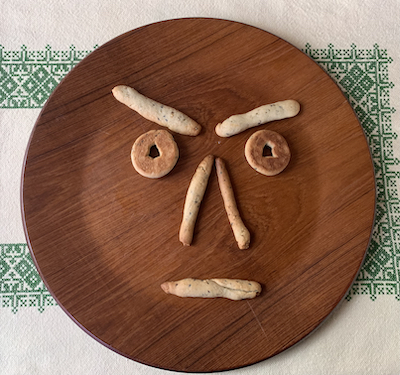
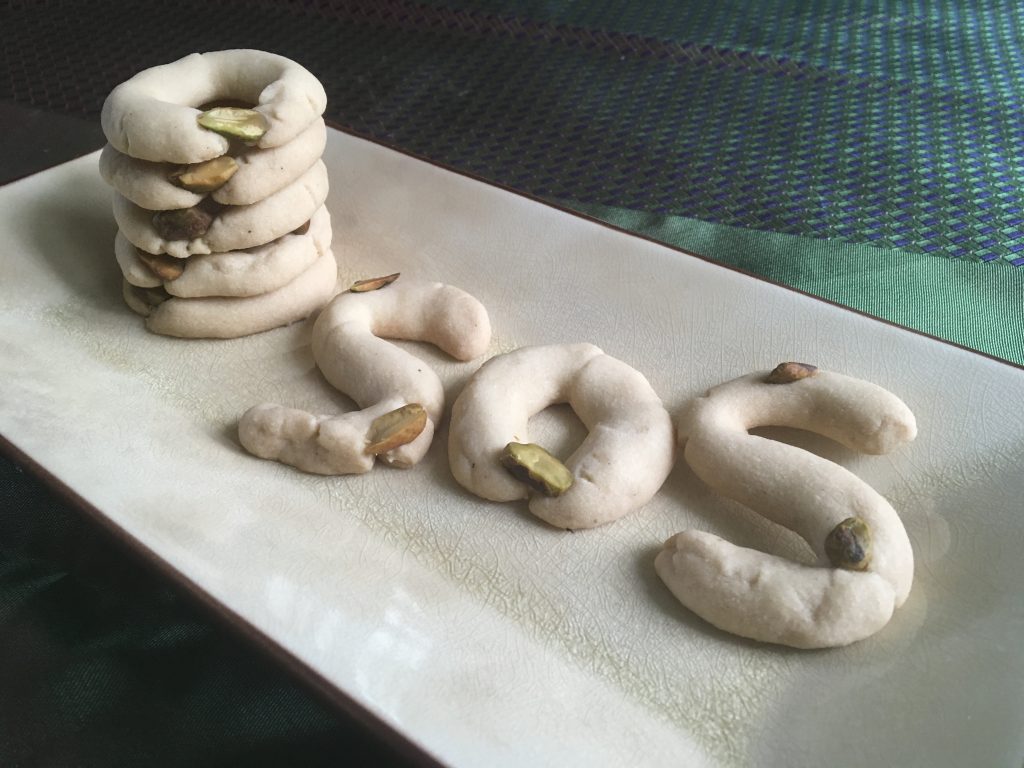
A PHOTOGRAPHIC NOTE FROM KATE: One rule of food photography is to never look for the faces. Once you see a face in your photo, you cannot unsee it, and this will force you to change your whole setup. It can add hours of work. However, once you get done shooting your cookies, and just a few are left, and there’s a round, wooden plate, sometimes the cookies just insist. How could I not use this golden opportunity to have some fun? If you’re not having fun, you’re doing it wrong.
FUN FACT: Poor Scott expected me to AirDrop him a batch of cookbook-worthy Yansoon Cookie photos. I sent him a batch of cookie emojis first! (No worries, the more appropriate images soon followed.)
Conclusion
Kate and I both like anise in general, but neither of us would qualify as special enthusiasts. I feel the same about sesame (Kate is a bigger fan). And yet we couldn’t be any happier with this new recipe despite the copious use of both. Yansoon Cookies will feature prominently if we’re ever asked to cater a tea party, and won’t be rare in the household cookie jar at any time of the year.
NOTE: There are at least a dozen different ways to spell the name of this cookie even though everyone seems to agree on the pronunciation. For the first syllable-and-a-half, imagine the word “gray”, pronounced with an extra-hard “G” in a Cockney accent to sound almost like “g-rye”. The second syllable is pronounced “bee,” like the insect. The efforts to turn that into letters has somehow resulted in “Ghorayebah,” “Graybah,” “Ghrybi,” “Gorabee”, and several others you’ll find with any quick search online. We went with the spelling that seemed closest to the pronunciation: “Ghraybee”. But of course, so did every other writer… [Sigh].
Clarified Butter: To make one (1) cup of clarified butter, start with 1¼ cups of raw butter (i.e., 25% more than you want to end up with) and then cook it on medium-low heat until melted. Skim off the foam, and then spoon out the golden goodness, leaving behind the water and the solids on the bottom. That goodness is pure butter fat, a/k/a clarified butter. It tastes just like regular butter, but is pure butterfat that will handle differently when cooked.
Ghee/Samneh: Don’t just melt the butter, but instead continue to cook on medium-low until the major bubbling stops, which indicates that all the water has been cooked out. Spoon or pour out the remaining liquid, leaving any remaining solids behind. It has a slightly more intense flavor that clarified butter because the fat absorbs the flavor of the now-cooked butter solids. Ghee has become available by the jar at various markets and is easy to find in any that are oriented toward Indian food. Indian Ghee and Arabic Samneh are basically identical, subject to minor differences in brand that in turn alter the cooking time or temperature, and the original milk sources (butter from different cows has a subtly different flavor).
Browned Butter: Follow the procedure to make Ghee but keep on cooking at medium-low until the solids at the bottom turn nut brown and heaven’s own aroma sings through your kitchen. This is the end of the line. Go any further and the solids will blacken and burn, infusing a bitter flavor instead of Ultimate Butter.
Put another way, clarified butter is pure butterfat; browned butter is clarified butter flavored with toasted butter solids; and ghee is halfway between the two. All three appear in more savory recipes than baked goods because removing the solids significantly raises the “smoke point” of the fat; i.e., the temperature when your cooking fat begins to burn and turn bitter. Most cooking oils have a smoke point between 400° and 450° F. Regular butter begins to smoke at 302°. These clarified butter fats have a smoke point all the way up to 482°! Higher temperature cooking yields more browning, which equals more flavor, and so forth. None of which matters for us, of course.
What matters for Ghraybee is the extra flavor and tenderness that come from using purified butter fat instead of regular butter.
Help! I have Butter Overload Syndrome and need to be consumed by a photographer with a sense of humor!
NOTE: As always, I recommend skipping to the bottom if you’re only after the recipe. The bulk of what follows is about the process of getting there and what we learned along the way.
Initial Failures and Discovering Ghraybee
I’ve been working for years on the idea of a shortbread cookie made with browned butter instead of regular butter. Why? Because I adore browned butter! Butter is always good, but browned butter sits at a whole new flavor level. I started the effort with a straight butter cookie recipe but found that the shapes wouldn’t hold when I used browned butter in place of plain. The cookies also came out exceptionally rich, almost too much so, and the outsides felt a bit greasy. Then I tried adding some egg yolks to create an emulsion. Still didn’t work. Then I tried adding back the 25% water that I cooked off to brown the butter in the first place. No dice. Same with milk instead of water. Arrrgh! Finally, I cheated by making a straight butter cookie and adding a browned butter frosting. Okay, that worked well enough to ease my frustration even though it wasn’t worth the effort. But it was enough to let me move on to other projects that at least satisfied my interest in heritage recipes over creative ones. Someday, maybe…
You can imagine my excitement when, a few years later, I came across a recipe for Ghraybee, a famous and much-loved cookie with a fantastic history that was made from clarified (or browned!) butter. I’d missed it for all these years because my focus has been on Europe, and this is a purely Middle Eastern treat.
I dove right in to the research, and you know what? Ghraybee bakers suffer from the same problems that I ran into but have a few centuries of experience and advice on how to overcome them. The first thing I noticed surprised me. Ghraybee contain no eggs, nor any of the vanilla you see in basically every European butter cookie. Quite the opposite. Ghraybee are a stripped down, essentials-only recipe made from nothing except flour, sugar, butter, and a tiny bit of orange blossom water to make the butter taste more interesting. The tricks are all about technique, experience, and understanding what’s going on.
First and foremost, you need to understand that the cookie is designed and intended to hold the greatest possible amount of butter. This means that you will often get excess butter oozing out – greasiness – at every stage, particularly if the dough gets too warm. What solves that is time. Let the dough rest overnight, and it will absorb the greasiness back inside. Let the shaped cookies rest in the fridge or freezer, and ditto. Same thing for the cookies when they come out of the oven. They should feel a little greasy. It’s a sign you’ve done it right. The sensation will vanish as the cookies age.
I’d been on the right track from the beginning. I just hadn’t been patient enough.
Mix Very Well Indeed
Second, you want to beat the dough for a very long time. The first recipe I found (from Egypt) suggests a three-stage mixing effort at low, then medium high, then low again for 5 minutes each. (You can find this recipe online under the name “Perfect Ghorayebah”). That worked, and you could see visible changes over the first 5-10 minutes; but to be perfectly honest, we saw no changes at all over the final 5 minutes, and after a great deal of testing we think the whole rigamarole is excessive. Ten minutes on medium is all the mixing you need. It’s still much more than one usually sees.
It does make a difference, at least for consistency. The one batch we tried with minimal mixing behaved differently at the forming stage, and lost several cookies to fractures in the oven. So that is out. But why a full 10 minutes instead of just 4-5? We’ve wracked our brains and our research sources alike, and have no good answer. We can only speculate based on our semi-informed understanding of food chemistry.
What the beating process does not do is build up gluten. Gluten forms when two proteins in flour (gliadin and glutenin) combine in the presence of water. Beating the flour makes that happen faster, and helps the gluten molecules combine into long sheets. Ghraybee dough has no material amount of water, and thus you should get no gluten regardless of how long you beat the dough. It isn’t about gluten.
Could the long beating be an attempt to remove air bubbles created when the butterfat gets softened in the mixer? Maybe… but if so, why not use a melted product instead of whipping it in the first place? We tried that too. The cookies tasted right but crossed the line into being a bit too tender.
That’s left us with only two hypotheses. First, the long beating time ensures absolutely uniform distribution of all the ingredients. This is emphatically not one of those cookies where you want identifiable bits of pure butter surrounded by dough. Second, we think it may force some of the butterfat into the granules of flour. Recall that Ghraybee repeatedly hover on the edge of that point when they’ll turn greasy because a butter slick escaped from the binding flour, but then reabsorb that extra butter fat when you give the dough (and later the cookies) several hours to do so. It makes some intuitive sense that the totally dry flour might benefit from a kickstart at the beginning in the form of extended time in the mixer. Especially since the dough felt a little greasy even after that long beating time, but then felt fine after a night in the fridge and time on the counter to soften.
Is the extra-long beating time essential? Maybe not. Most Ghraybee say no more than, “mix very well.” That Egyptian recipe was the only one I found that made a religion out of the process. We’ve specified the time and speed only because “very well” is a little vague, 10 minutes works, and why mess with success? Let us know if you try a shortcut approach. We’d be curious to hear your results, both good and less so.
Semolina? Who do you plan to share with? This is a cultural icon.
The next trick is more controversial and dips you into the murky world of Middle Eastern politics: adding in some semolina flour a/k/a farina. The bakers I spoke with (American immigrants) told me that semolina is a thirstier flour that will hold the butterfat a little tighter. The downside is a change in texture. Semolina makes the cookies a little sandier. Is that bad? The answer, it turned out, was all in the eye of the beholder. If you grew up with semolina versions (common in Syria and other places), that sandy texture is part of the experience, and the cookies won’t be “right” if it’s missing. If you grew up in Lebanon or Egypt, semolina is anathema because the ultra-fine crumb is part of what makes the Ghraybee – you guessed it – “right”. Though it might be more accurate to say that everyone views the alternative approaches as “wrong…” and will care about that even though it’s said with an obligatory, self-deprecating laugh.
It iss a little hard to come up with a cultural equivalent for the U.S., but let’s try this: Think of your perfect brownie. Got it? Now imagine that someone comes and proudly shares their favorite recipe… and it isn’t all of that. The product may be good when taken on its own merits, but no argument in the world will dent your conviction that someone has failed to grok the One True Way. Maybe it’s too fudgy, or not fudgy enough. Maybe it’s too soft, or too crispy, or too thin, or too puffy. Maybe it has chips, or chips that are too big or too small. Or nuts, or no nuts. Maybe the chocolate flavor is too pronounced or too attenuated. But the fact is, it won’t be right.
No one is saying that your friend will suffer eternal damnation for the trivial sin of misunderstanding these culinary truths. But a few years of penance? Maybe. It’s certainly not going to help his/her case up at the pearly gates. [Insert self-deprecating laugh.]
We all know these are matters of taste. People are allowed to prefer one type of brownie over another. It may even be a good thing in the broader picture. But that doesn’t change the fact that brownies are supposed to be smooth and fudgy, not cakey, and those who disagree are just plain wrong. And don’t even get me started on the Whipped Cream Heretics who waste those extra egg whites in a Key Lime Pie instead of using them for meringue as the good Lord intended. That’s got to cost them at least a decade in purgatory, scrubbing some heavenly pots and pans.
That is the culture of Ghraybee in a nutshell. People love this cookie so much that they genuinely care when it isn’t “right,” even if all parties understand that it all comes down to what you grew up with. There’s even a modern tradition of bakers who make “improved” Ghraybee by such adventurous risks as adding ground almonds or pistachios to the dough. Everyone loves those if said baker takes the time to put a modifier on the name: “Pistachio Ghraybee”, “Ghraybee with nuts,” etc. Just don’t get caught describing an “A” when someone else will think it’s a “B.” Not unless you’re willing to argue about the reality that there are as many Ghraybee versions across the Middle East as there are for butter cookies across the nations of Europe.
Dealing With The Richness
Why fight what ought to be embraced? One of my early testers took me into the aisles of his Middle Eastern grocery to point out packages of commercial Ghraybee. They came in several shapes – but not several sizes. Every single cookie one was very small compared to what we usually make; no more than 1¼” to 1½” across (325-350 mm). Aha!
The cookie packs an oversized wallop of butter? Make a smaller cookie. They do, and you should.
Dealing With The Shapes
Simple shapes work best.
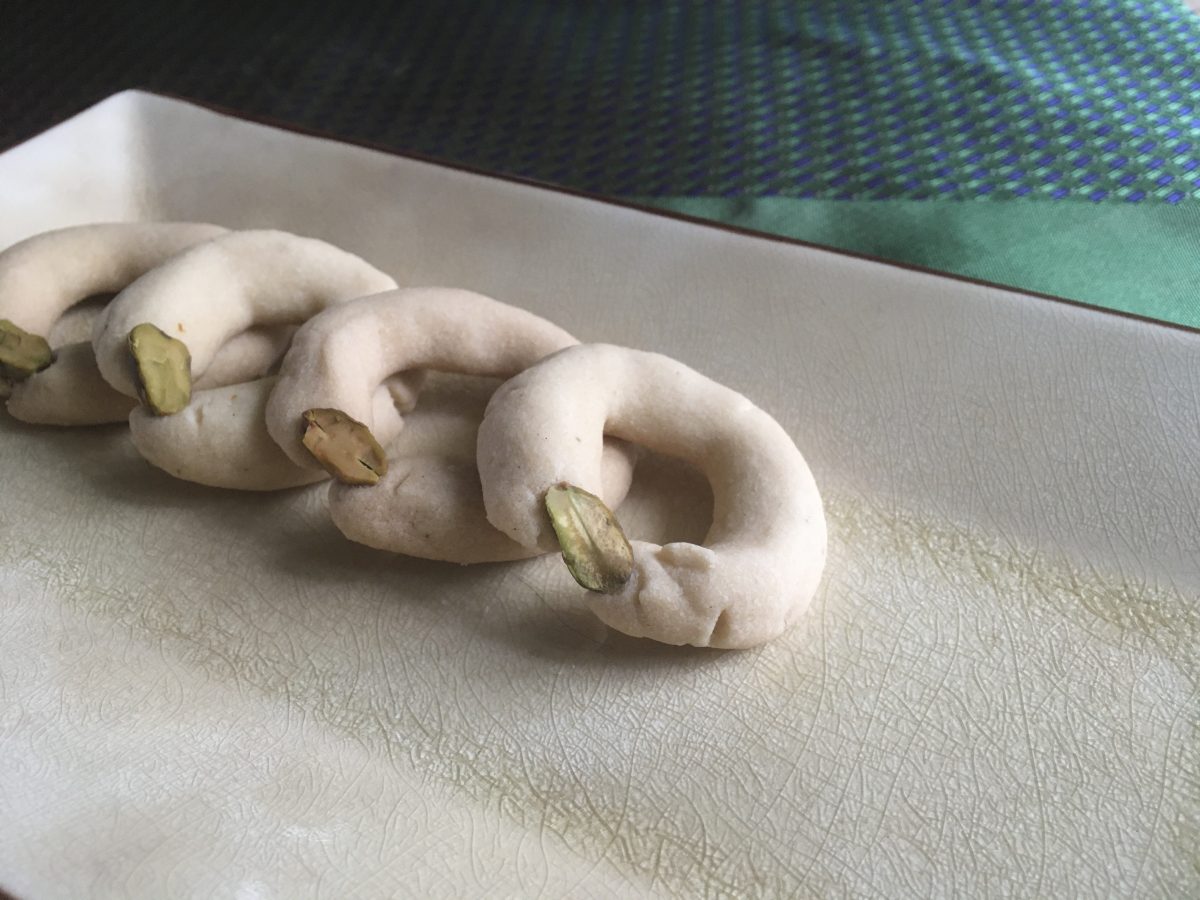
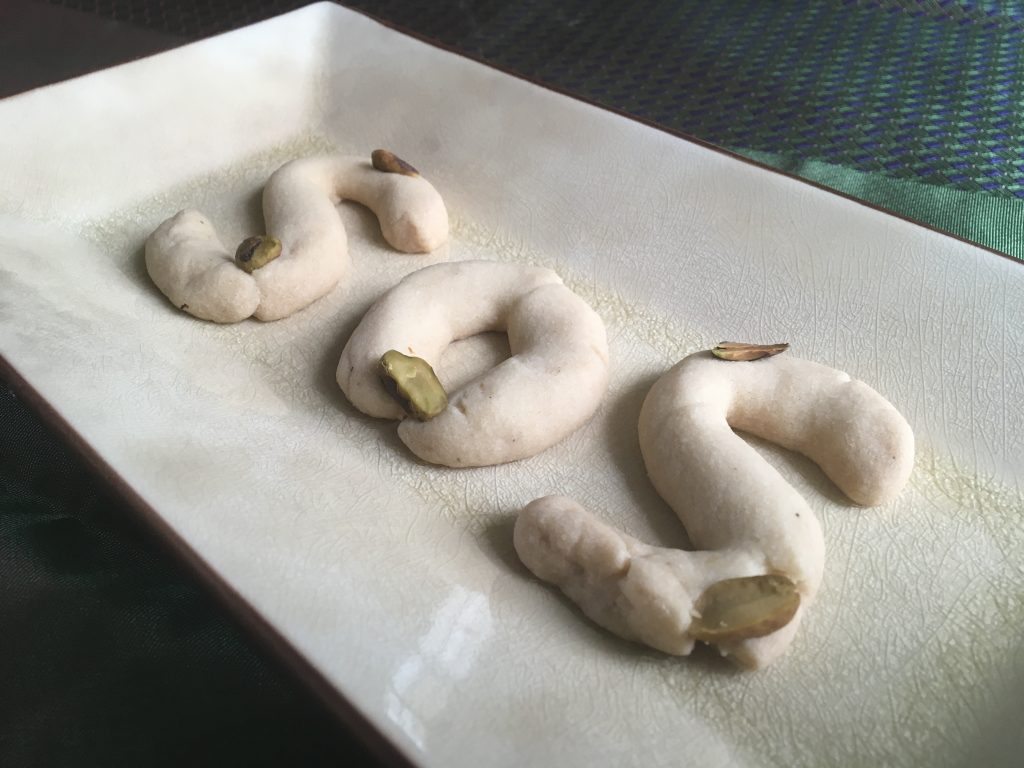
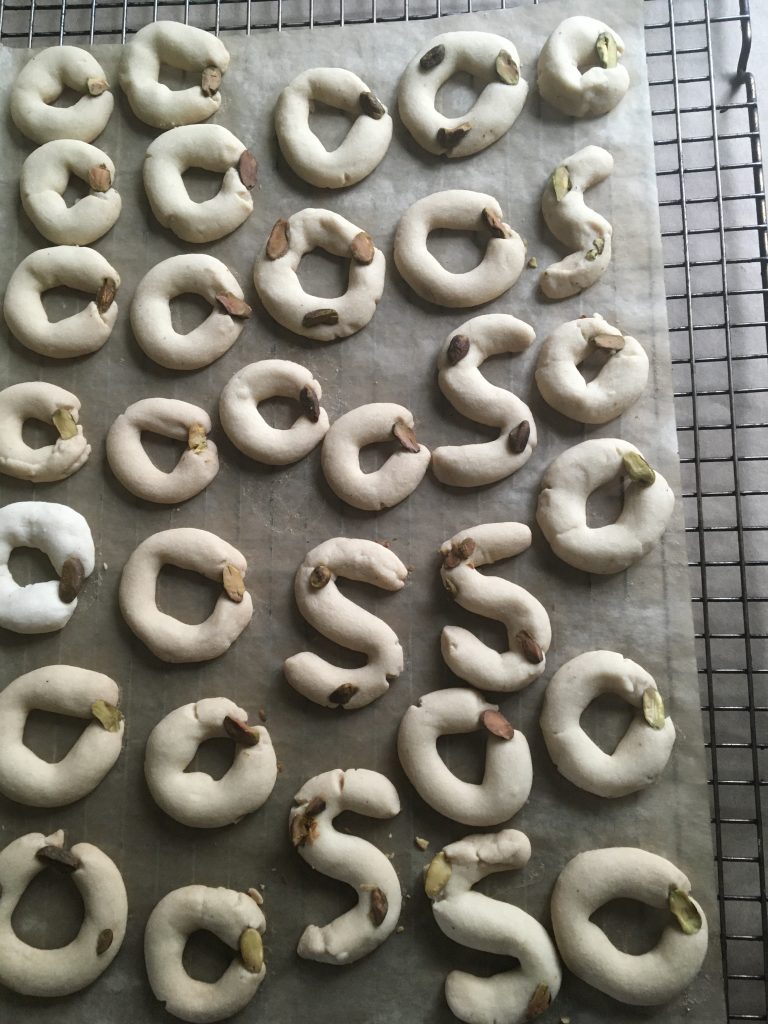
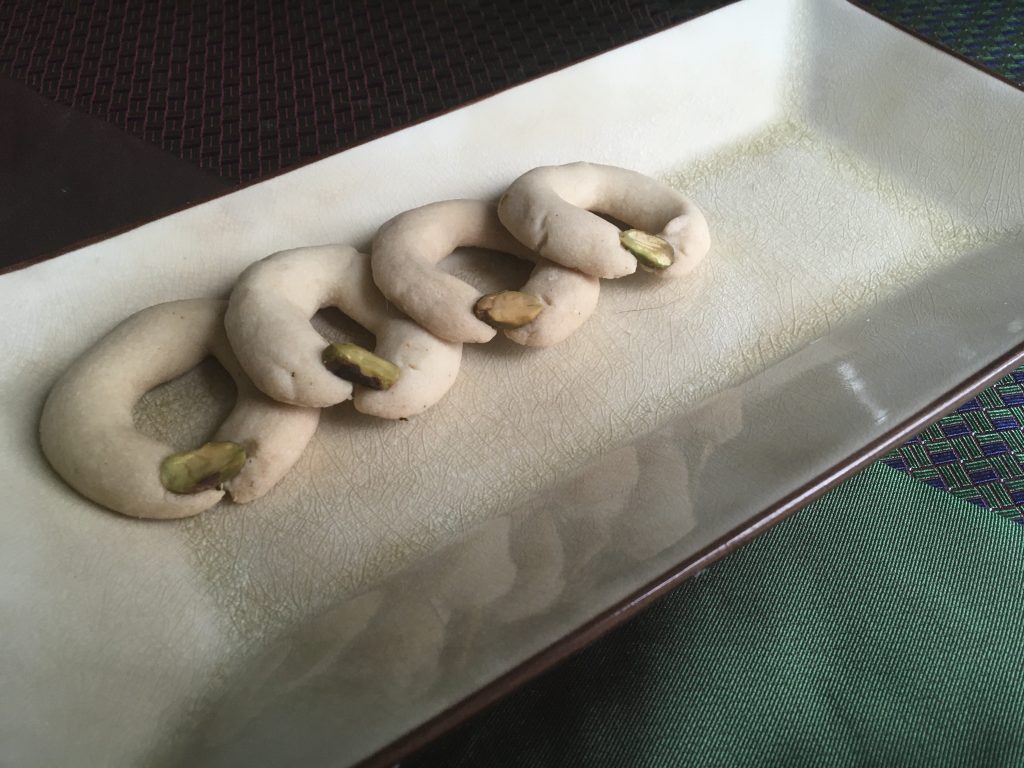
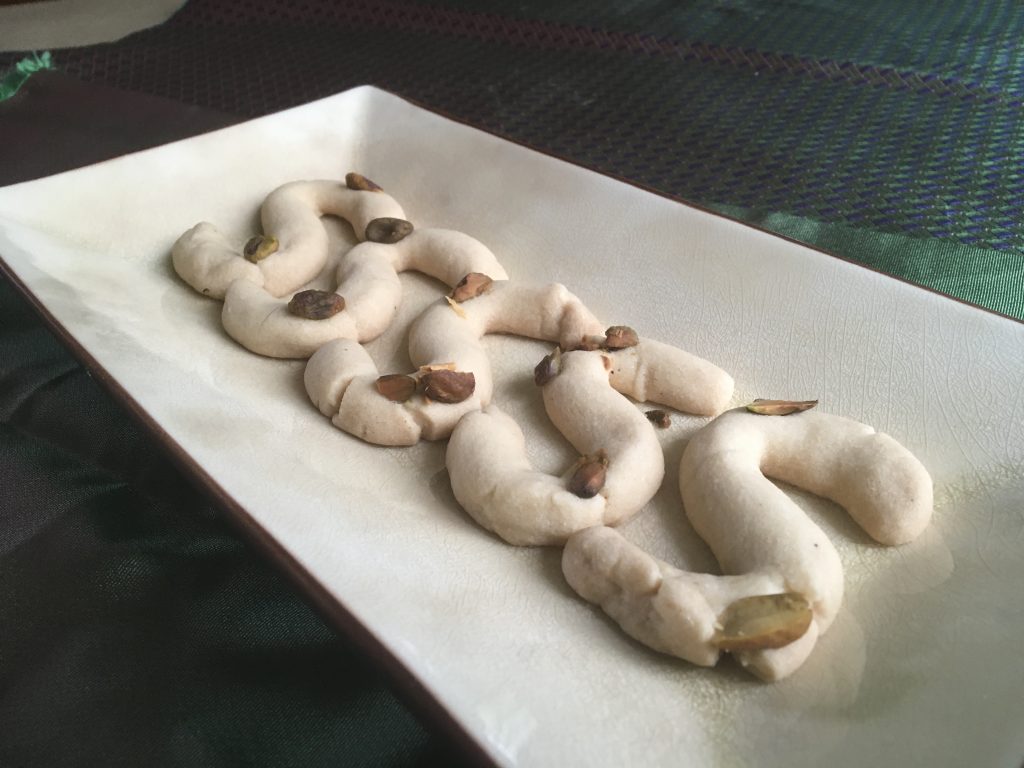
Every source we’ve read or consulted had the same advice: keep it simple. Most Ghraybee are shaped into a small O, C, or S shape, with a single flaked almond or pistachio half as an ornament. We think the pistachios look better, but your mileage may vary. A minority of recipes just went with drop cookies by squashing small balls, with an almond or pistachio pressed in the center. Again, do as you wish. But we do urge you to use some kind of nut as a decoration because it provides some contrasting texture. Salted nuts add in interesting pop of extra flavor, but preferences vary.
We also feel obliged to note that shaping the cookies can be a midlevel chore depending on whether you’re one of those people who are blessed with cool hands versus hot hands. We are in the latter category, and found to our chagrin that the dough came out of the fridge rock hard, and then fought us at every stage by (a) sticking to our palms like crazy, and (b) softening into paste before we finished up. Imagine shaping cold butter in your hands and you’ll understand what’s going on.
We solved the sticking problem by dusting our hands with a little flour. It works perfectly so long as you expect to have the problem, and keep a little bowl by your side.
We solved the softening problem by working quickly and returning any too-soft pieces to the fridge for a few minutes.
We also learned that our trays of shaped cookies come out more regular if we put them in the freezer for 5-10 minutes, or the fridge for 10-20. That brought everything back to the same temperature and ensured even baking.
SHAPING NOTE #1: Interviews with experienced Ghraybee makers show that those problems are a personal thing more than a technical one. Some people run into difficulty with the shaping, and others do not. We really do think it’s a question of cold hands versus hot hands, rather than anything to do with the recipe. You see the same thing with pie crusts sometimes. The cookies come out just as well regardless.
SHAPING NOTE #2: Kate did an experiment where she put those too-soft pieces in a piping bag and used that to make the cookies instead of rolling the pieces in our hands. It worked – the dough really does get soft enough to pipe – but the results were similar to cookies made from liquid butterfat. They crossed the line into being too tender, and fell apart even on the cookie sheets.
About the Sugar…
American bakers have such a legendary sweet tooth that it has become a common joke in every immigrant community we’ve explored. And, sure enough, the base recipe I put together from various English-language sources came out a bit too sweet for the palate of those who knew this cookie from childhood. Citizens who grew up in the States loved them, of course. I have deferred to tradition in the recipe that follows, and made the cookie to Middle Eastern standards by using 3 ounces (85g) of powdered sugar. If you want to adapt it to the tastes of American children, increase the sugar to 4 ounces (115 g).
Final Thanks
Additional thanks go out to Barbara Pabotoy, a fine baker we met on Facebook who shared her mother’s Lebanese version of the cookie (“Ghraybeh”). I get the feeling that she’s confused about how long it took us to feel comfortable in sharing a recipe that’s second nature for her and her family. I can only answer with the words “pie crust” and “omelet.” And the snide, totally unworthy observation that I’m betting she has nice, cool hands for dealing with the shaping process.
Some things are so simple that they take some practice to master. Those same things usually end up being some of the best exemplars of the larger craft. Ghraybee fall in both of those categories. Don’t be surprised if it takes you a little fussing before the process suddenly becomes easy. But stick with it! Oh yes, definitely do that. This may be the most buttery cookie that it’s possible to make, even in theory. It’s certainly the biggest butter bomb that we’ve ever made, and it won’t be a stranger in the house moving forward. These are a true, close-your-eyes, omigod-where-have-you-been-all-my-life experience to treasure.