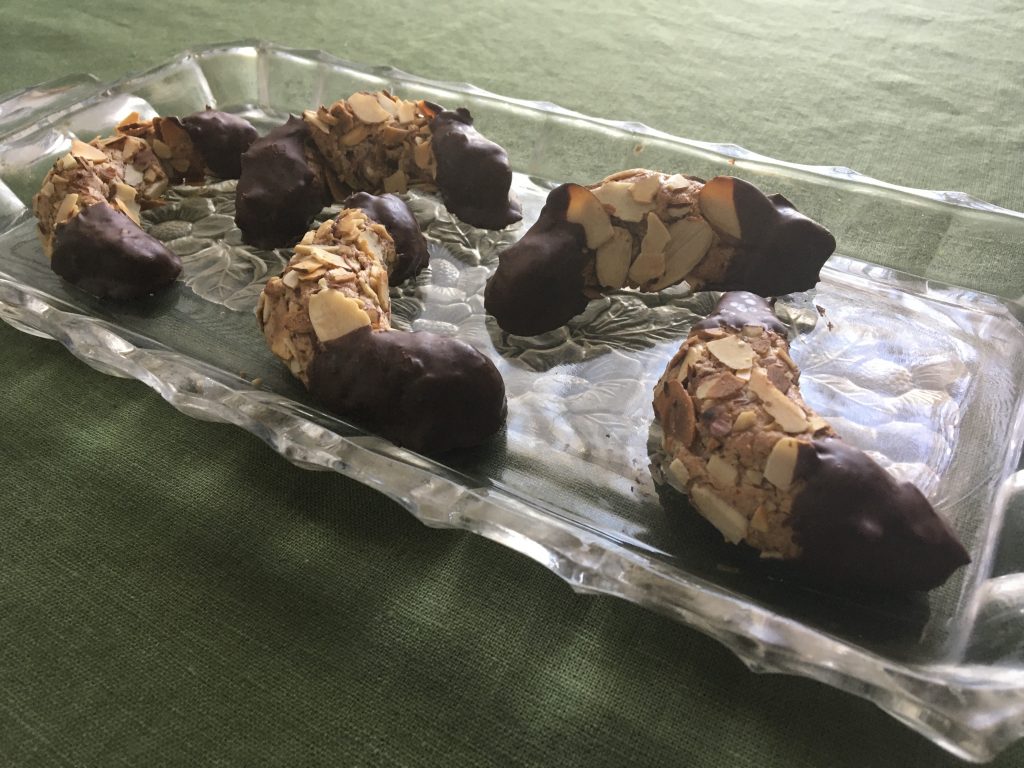
MANDELHORNCHEN a/k/a “Almond Horns”

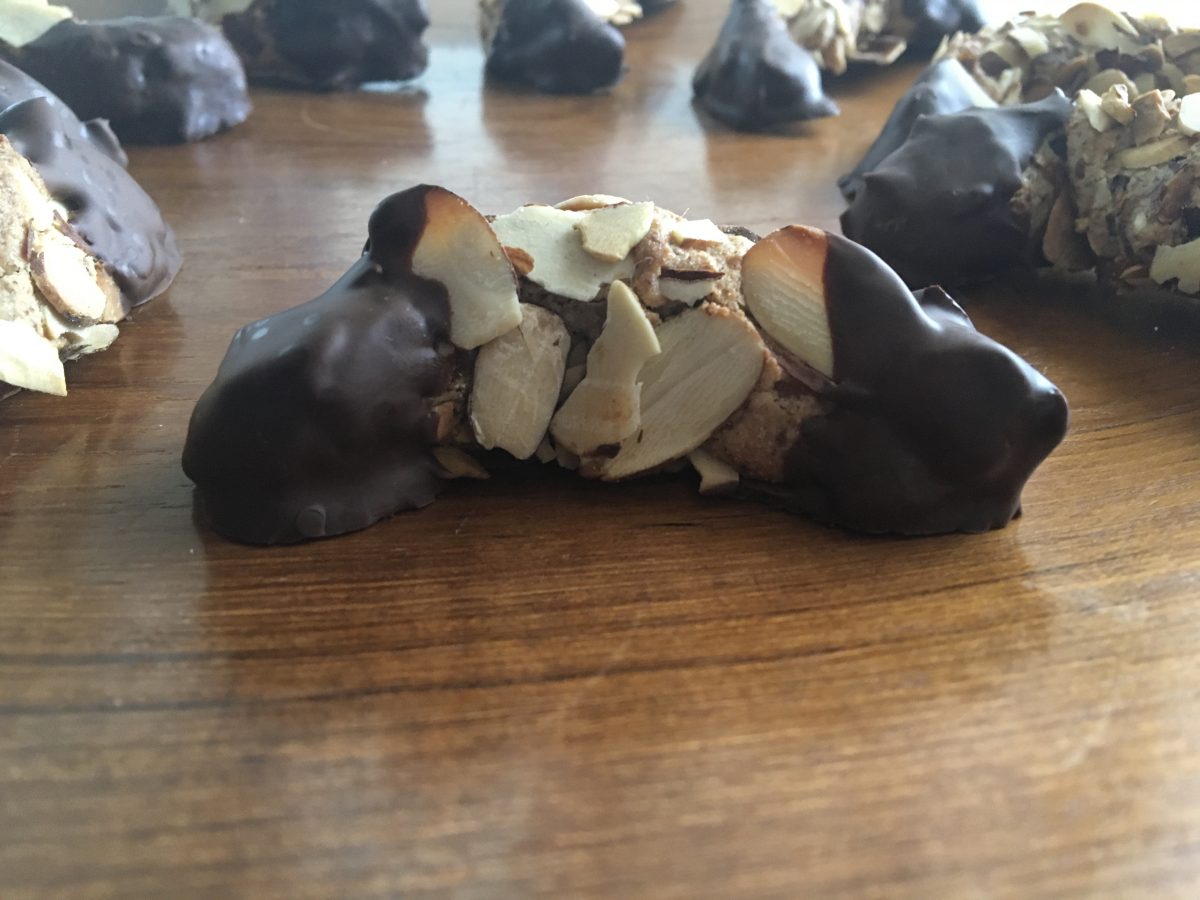
Here’s a recipe that many readers will know because they’re very popular at certain upscale supermarkets. They have a lot going for them, starting with a very pure hit of almond and chocolate (two flavors that love each other), and continuing through the fact that they’re naturally gluten- and dairy-free, which suits a lot of people with allergy problems. They’re also very generous and fairly dense, which means that anyone who’s willing to eat baked goods for breakfast can get by with 2-3 “cookies” and a nice cup of Joe. (A meal that Scott has admittedly enjoyed as he writes this article).

The other benefit? Almond Horns are incredibly easy to make. The basic recipe couldn’t be simpler: (1) put everything in a food processor; (2) grind until it’s smooth and begins to ball up; (3) roll each piece in almond flakes; (4) bake; and (5) coat the horns or bottom with chocolate. The issues come up with the little details that avoid problems in each of those steps.

As always, please skip to the bottom if you are only here for the recipe.
 Step 1 – Choices About Ingredients

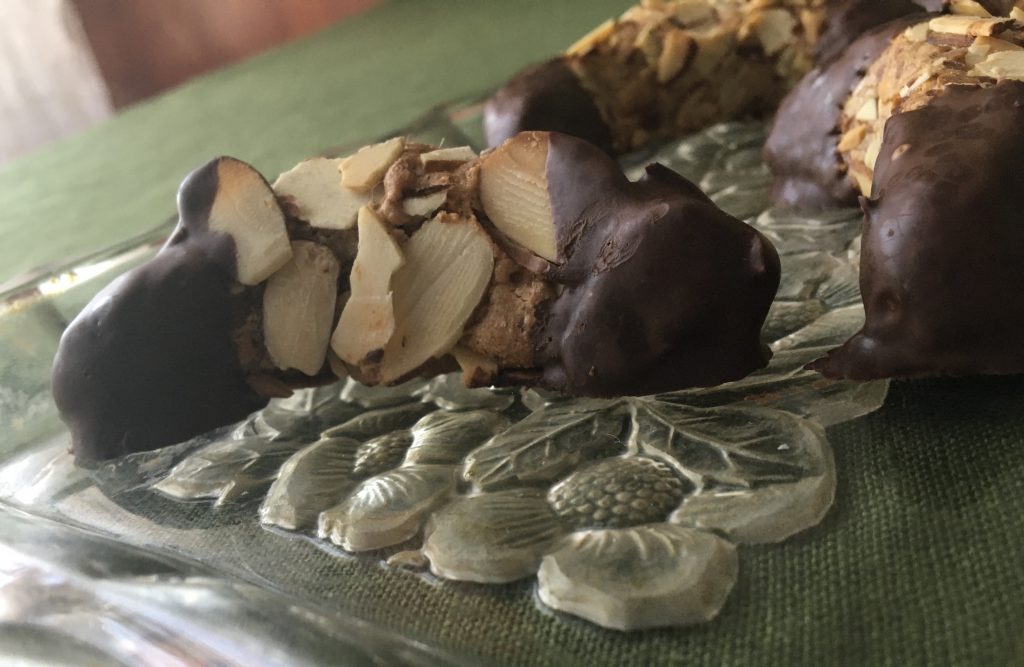
Classic European recipes typically start from Marzipan rather than working from scratch. Take Marzipan, blend with egg white(s) to loosen it up, and you’re basically there. Convenience cookies!

Marzipan isn’t as common in the U.S., costs more, and the different brands vary in their dedication to the cult of sugar and the abuse of almond extract. We’re also a nation of people who take food processors for granted. That tool converts Marzipan from a painstaking process into a walk in the park. If cooking from scratch is cheaper, just as easy, more reliable, easier to customize, and lets you use a little less sugar… well, cook from scratch.

We recommend that you start from almond meal because it’s become easy to obtain and ensures an even result. In the ideal world you’d start from whole or slivered almonds, toast them to enhance the natural flavor, and then reduce that to meal during the grinding stage. It’s really up to you. But from one obsessive purist to another? We just get the almond meal. There’s so much extract that the toasted flavors get lost anyway.

Step 2 – Grind It All Together

No kidding. That’s all you do. Put everything in the machine except your coatings (toasted almond flakes and chocolate). Process, scraping down the sides from time to time, until it comes together into a smooth dough that balls up around the blade. Done.

That couldn’t be any easier, but there are a couple of tricks because the dough changes with (a) your kitchen’s level of humidity, and (b) whether your Size Large egg whites are closer to mediums or closer to XL’s. They do vary within each range you know. It isn’t a problem if you keep the target in mind: “Dough that is just sticky enough to hold on to toasted almond flakes.” Too sticky and it will be hard to work with. Not sticky enough, and your coating will fall off.

  • If the mixture seems too dry, add in a tablespoon or two of water. This happens every time in a Pittsburgh winter, and almost never in our summers.
  • If the mixture seems too sticky, add a tablespoon or two of extra almond meal. Extra sugar works too.

For what it’s worth, we actually get a kick out of these little customizing steps. They make you feel like a Real Expert who knows the secret cheat codes.

Step 3 – Form the Cookies

A few of those secret codes make this step just as easy.

  • First, remember that most people make these into large, 4-5 bite treats. One recipe makes enough for 16.

That’s not a coincidental number because you get there by cutting the dough in half, then each half in half four more times. If you want smaller cookies, cut the initial piece into thirds and then proceed to halve them over and over. This will get you to 24.

  • Second, moisten your fingers and palms before you form each cookie. That will keep the dough from sticking to your hands, and also make the surface extra sticky for holding on to the almond flakes.

Better for you, and better for the cookies. You’ll need to wet your hands several times before all the pieces are done.

  • Third, form each dough piece into a short, fat sausage as thick as you want the middle of your cookie to be. Roll this cylinder in the toasted almond flakes, and then pinch/curve the ends to form your crescents.

Cylinders are much easier to work with at the rolling stage, and you do not need as many almonds on the ends anyway because they will get coated in chocolate. Yes, you can just make a longer, thinner sausage, roll that, and bend it into a “C”. And yes, it is a little easier. We prefer the result from crescents; they have a texture that changes as you nibble through each treat.

Step 4 – Bake

375° is just hot enough to get a few of the almond edges extra toasty. A nice touch. As always, you want to pay more attention to the aroma and texture than the actual time. They are done when the sides firm up and the bottoms have turned light tan. It’s taken a consistent 13-14 minutes during winter testing in Pittsburgh with our oven. Please let us know if your results vary.

We also encourage you to spin these trays halfway through to ensure even cooking. We usually don’t bother with that step unless we’re dealing with wafers, but for some reason this particular cookie has been sensitive to hot spots.

Step 5 – Coat The Ends With Chocolate

This is the one step in the recipe that creates some frustration. It comes from two problems. First, the chocolate will harden as you work. And second, you won’t have enough chocolate in your bowl to dip the ends when you get to the final few pieces.

You can solve the chocolate problem by either keeping it warm, or mixing in a small amount of fat. Scott prefers to use plain chocolate, and to keep zapping it in the microwave for very short bursts as needed. Kate, who did most of the chocolate work, suggests adulteration – with the proviso that you must use a fat hardens at room temperature. Coconut oil works but can add some flavor. Palm oil has the perfect characteristics but is evil. She recommends butter or shortening, whisked into carefully melted chocolate. The resulting chocolate dip can be extra sticky at room temperature and takes a while to harden, but it is easy to work with. Your mileage may vary.

The problem of what to do toward the end takes more thought, and there is no really good answer. If you want the chocolate supply to end on the final cookie, you won’t have a deep enough pool to actually dip the horns of the last two pieces. Careful work with a spoon can help, but it only goes so far. Either you need to make/waste extra chocolate dip, or you need a cheat code.

Scott offers this workaround: Don’t try to dip the horns on your final piece. Coat the entire bottom with your leftover chocolate instead. It creates a more uniform treat that’s a little less intriguing to look at, and has less contrast when you eat it, but it does have the benefit of giving every bite a little bit of chocolate. Brush all the bottoms with chocolate if you want every piece to be the same.

Kate rolls her eyes at that, and says you should simply make enough chocolate to do the dipping and be done with it. Leftover chocolate makes a wonderful ganache for truffles, or at worst a special treat for the first lucky passerby who can find a spoon. You, of course, are a mature, fully grown person with the control to inflict those treats on someone else.
Cool and Consume – The End… Until Next Time

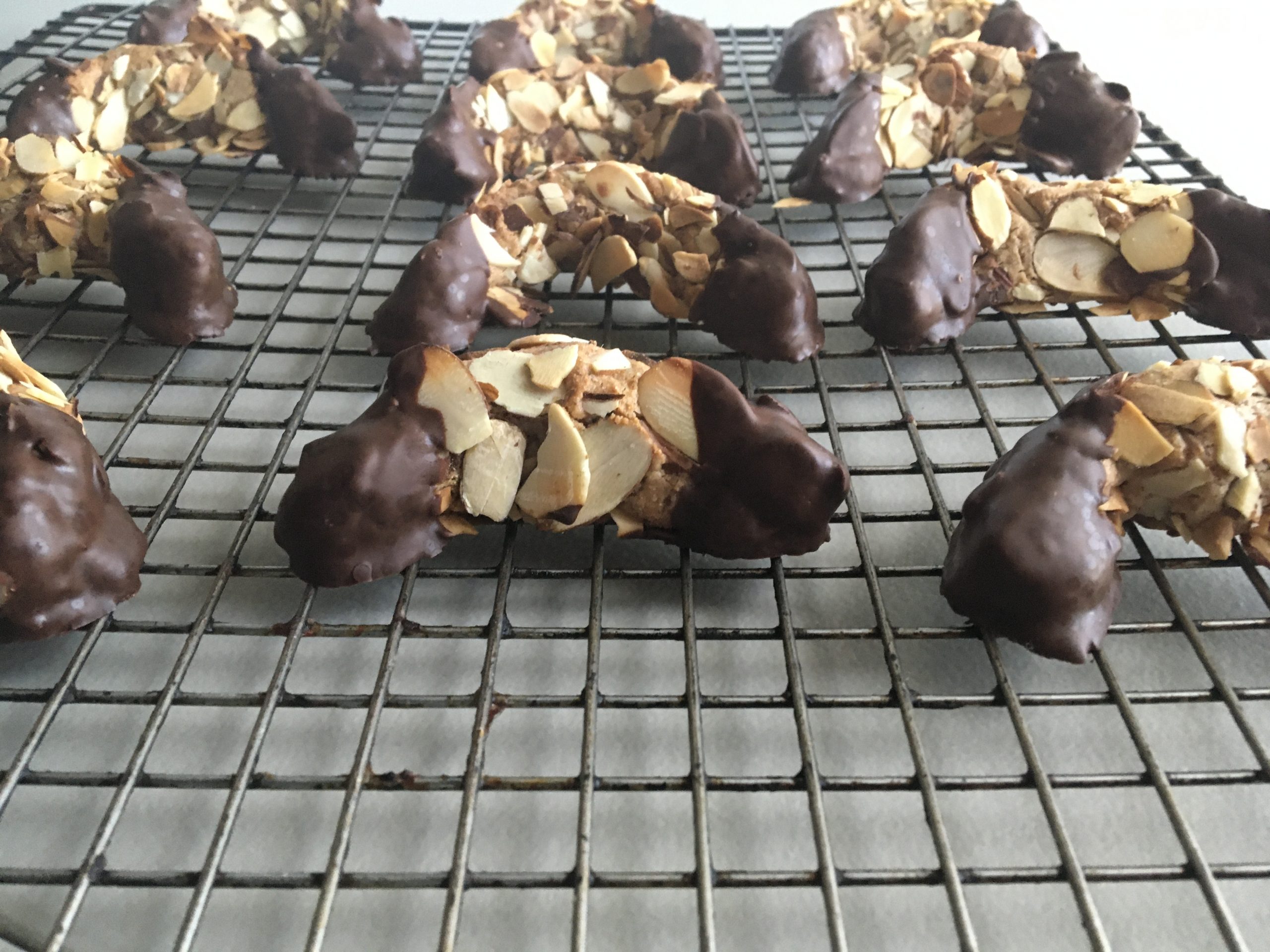
Mandelhörnchen are one of those treats that become a baker’s signature offering to guests, grandchildren, and drama club bake sales alike. They’re so very big! Physically, in taste, in texture, and in ways that combine to be more than the sum of their parts. They also show off familiar flavors, and they taste exactly like people think they will, except more so. There’s a huge bang for the buck factor.

Plus they’re fun and easy to make once you internalize those little tricks: keep your hands moist when shaping, and accept that there’s only so much chocolate to go around.

This is a marvelous recipe that you’re really going to treasure. We Promise. Enjoy!
ITALIAN ORANGE COOKIES

Italy has a fascinating cookie tradition that is broad, deep, and very distinct from the rest of Europe. That’s particularly true for the citrus cookie genus. North and central European countries tend to make a buttery shortbread or sugar cookie base, which they’ll kick up with a sharply flavored glaze. The Lemon-Lime Cookies from HERITAGE COOKIES OF THE OLD AND NEW WORLD are a perfect example.

Italians tend to make their cookies vastly more puffy by adding copious amounts of baking powder, with thinner and often optional icings, and a lot of orange or lemon zest in the dough. Many recipes reinforce the zest with some citrus oil or extract. But that’s not all. There’s also a very different philosophy when it comes to the fat. Shortbreads and sugar cookies are built on butter, but Italian cookies will often play around with that aspect. The Ricotta Cookies in our book use butter, but lighten everything up with cheese to create a unique experience. Lemon Drops a/k/a Lemon Knots a/k/a Anginetti use liquid oil. This recipe uses shortening, or in older versions, lard.

Butter is wonderful stuff. Extraordinary stuff. There’s a reason why simple butter cookies like French Sablés, American Meltaways, Middle Eastern Ghorayeba, and the ubiquitous Spritz Cookies fill bakery and market shelves alike. They’re good. Nor will we deny that butter and citrus marry extremely well. They do. But the offspring of butter and citrus tends to be a pleasing, 50/50 combination of the two. Neutral fats like shortening or oil are the way to go if you want a purified hit of citrus essence (or of chocolate for that matter).

Enter Italian Orange Cookies.

NOTES ON THE RECIPE:

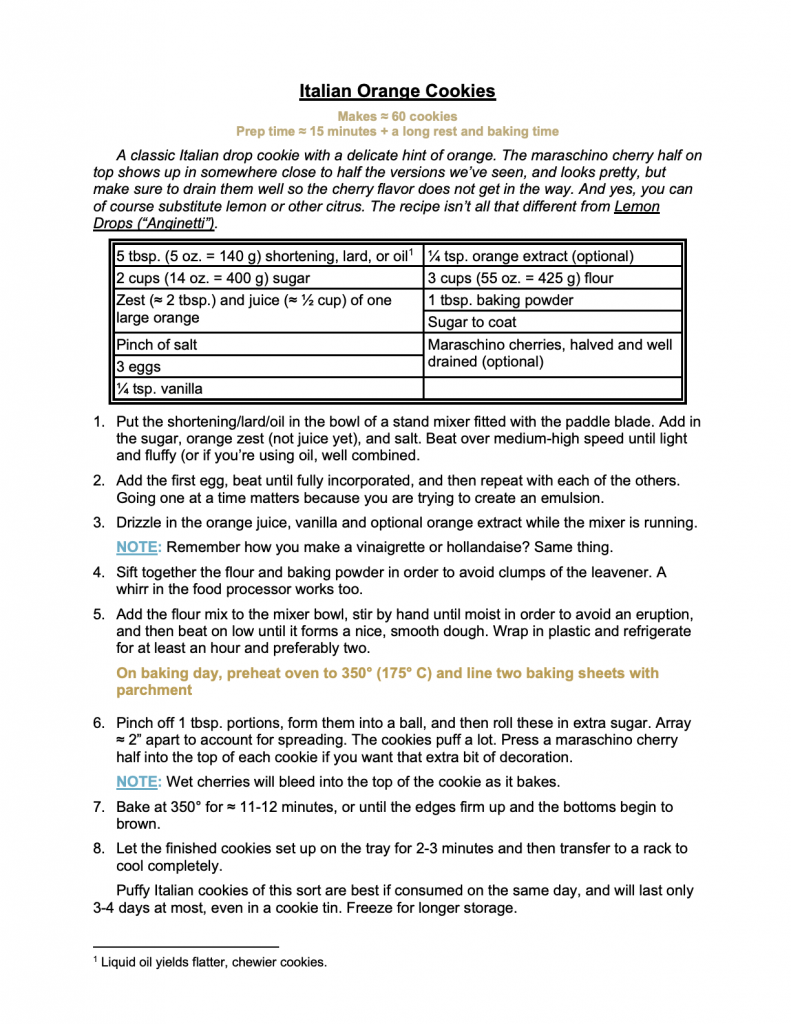
There is no surprising technique required to make this cookie. It hardly takes any attention if you have the basics down. (1) Whisk or sift together the dry ingredients to evenly distribute the baking powder. (2) Cream together the shortening/lard, sugar, orange zest, and extract(s) so the fat can absorb the citrus and vanilla flavors. (3) Add in the eggs, taking care to go one at a time in order to create an emulsion. (4) Thin with some fresh orange juice from the one you zested, which is slightly unusual. And then (5) mix in the dry ingredients, taking care to avoid a flour eruption.

The only odd ingredients are the sheer quantity of eggs (three of them, when most recipes will use just one) and baking powder (a whopping tablespoon of baking powder where most recipes would use just a half-teaspoon).

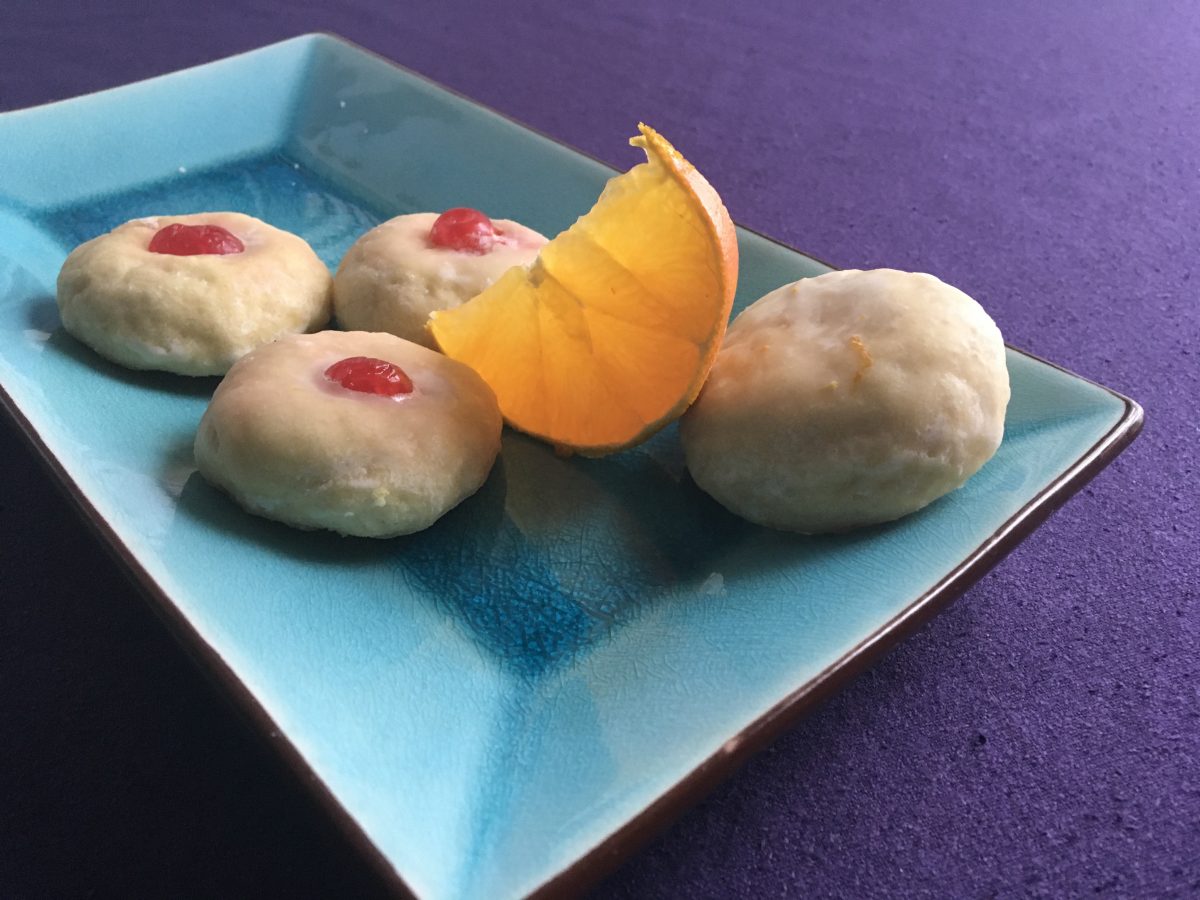
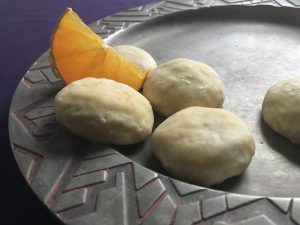
And the only odd decoration part is the very common use of half a maraschino cherry to create a “Rudolph’s Nose” effect like you see with Amaretti (a macaroon rather than a drop cookie). We were tempted to ignore that cherry in favor of an orange glaze (see the photo below), but it turned out to be a nice touch. Maraschino cherries add nothing to an ice cream sundae beyond a neon-red flash of color, but their almond-laced flavor makes a real difference on this scale. They create an odd counterpoint that actually enhances the orange flavor rather than competing with it.

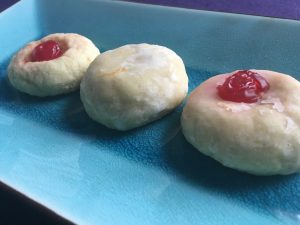
(1) Rolled in sugar with a cherry on top, (2) With an orange glaze, and (3) Cherry on top coated with orange glaze. All three are delicious, so choose the one that you like best.

In the end we decided to leave the decorations in the recipe as an option.

  • First option: roll the dough in sugar before baking, and then press in a well drained maraschino cherry that’s been patted dry with a paper towel.
  • Second option: coat the baked cookies with a quick orange glaze made from extra OJ and powdered sugar, plus grated orange peel if you wish.
  • Third option: bake with the cherry and then coat with the glaze.

All three work fine. Just make sure to dry the cherries well. Scott forgot to be careful enough in the test batch, which led to that unfortunate pink stain you can see in the photo. (He was going to do a second batch to make them look perfect, but Kate put her foot down and pointed out that showing the problem offers more value to readers than just giving the warning).

Limited Life Span

These puffy, super-leavened cookies have a particular charm but they do come with a downside: they’re going to go stale in no more than a day or two.

The word “stale” actually refers to a series of small effects that are all caused by oxidation. Sitting out in the open gives the oxygen in your air a chance to do its evil work. Cookie tins slow the process down by limiting the O2 levels to just the amount that was in the container when you sealed the lid. Freezing reduces oxidation even more by slowing down the chemical process. This is why freezing in a vacuum provides the best of all worlds for preserving your food, though that isn’t really practical for delicate cookies.

Leaveners like baking powder work by expanding in the oven to create CO2 bubbles in the dough, which rapidly get replaced by plain old air as the cookies finish baking and then cool off. Well leavened cookies feel and taste “light” because they quite literally are: they’re puffed full of air on the inside. Air that will turn them stale from the inside out if you give them any time at all.

So we’re afraid there’s no way around it. Italian Orange Cookies are made to be eaten, and eaten on the day they’re baked. Have your cup of tea handy (even Scott admits they are fabulous with a cup of tea), and your cookie-hunting spouses and children on standby.

Conclusion

This is a simple, happy and cheerful cookie. They’re simple to bake, a joy to behold, and pack a clear orange flavor that’s certain to make you smile. They’re also an absolute classic that shows why Italian bakeries thrived so well and spread so quickly as the immigrants flooded through Ellis Island in the late 19th and early 20th centuries.

Scott had a lot of fun making them. Kate had a lot of fun making the photos. And you’re going to have a lot of fun with the recipe for many years to come.

Enjoy!
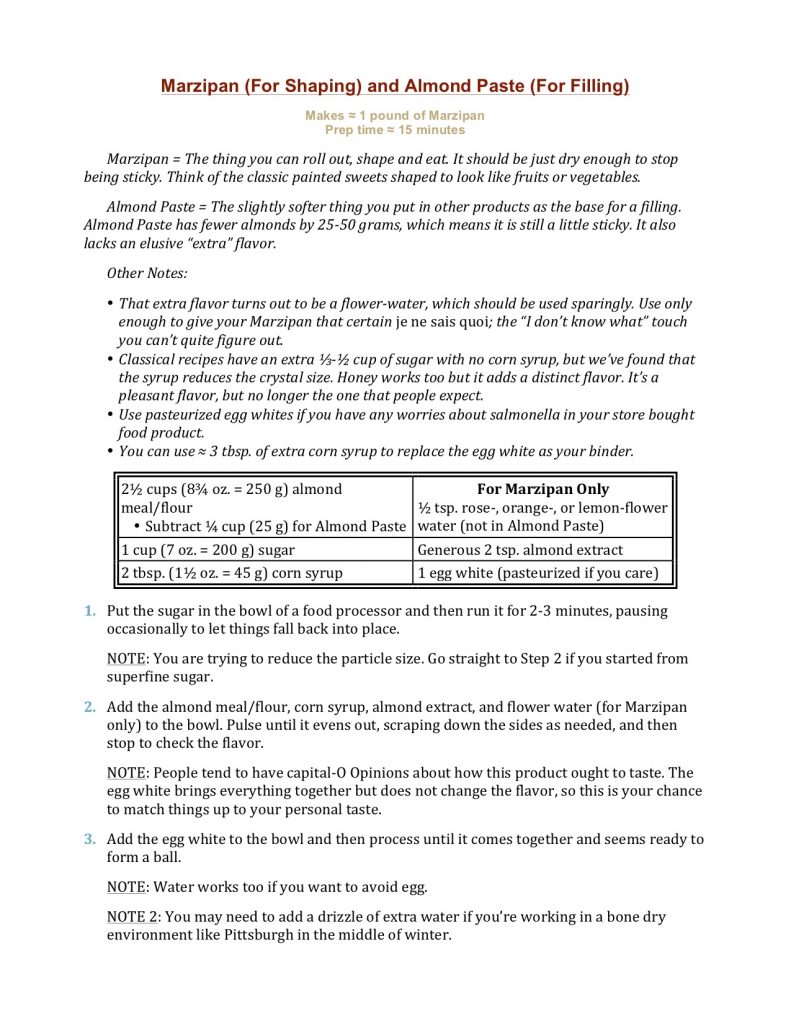
MARZIPAN & ALMOND PASTE – the recipe beneath the recipes

A few weeks ago we put up recipes for a set of Five macaroon recipes we’ve come to love – which could be described as marzipan suspended in an egg white meringue. And I am now working busily on a special Croatian treat called “Rafioli”, which is basically an exotically flavored almond paste wrapped inside a baked pasta shell. [Watch for it!]

German Mandelhörnchen and a Greek equivalent are also on our “to do” list after Kate took an initial whack that wasn’t too far from being right. Those amount to a flavored marzipan or almond paste lightened with fewer egg whites than you’d use for macaroons, formed into crescents, and then dipped in chocolate.

EXTRA SPICE FROM KATE: We have no photos of the Mandelhörnchen because a mysterious cookie gremlin raided our kitchen before anyone could add the chocolate part. Skeptical spouses have wondered if “doppelganger” would be a more accurate than “gremlin,” but I admit nothing. He only suggests such an outrageous thing because they are one of my all time favorites, both tasty and toothsome.

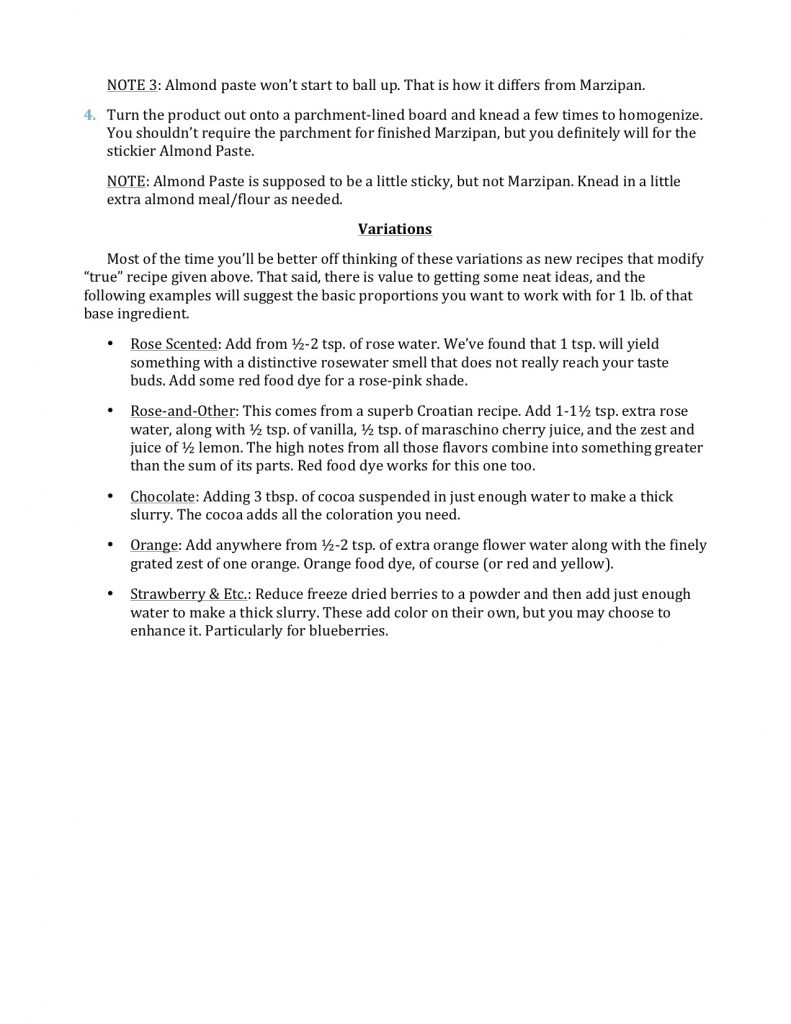
And then… Hmm, a pattern seems to have formed! There are dozens, if not hundreds of baked goods that start with a base of finely ground almonds, mixed with sugar and then bound by egg whites. That ingredient is called “Almond Paste” when left loose and a little sticky, or “Marzipan” when you add enough extra almonds to make it solid. We wouldn’t call either one a “cookie” all on its own. Commercial marzipan is actually marketed more like a not-so-sweet candy (with U.S. and English versions tending to be sweeter), and almond paste as an ingredient. But the basic concept gets used in so many true cookies, and cookie fillings, that it’s only fair to give our version.

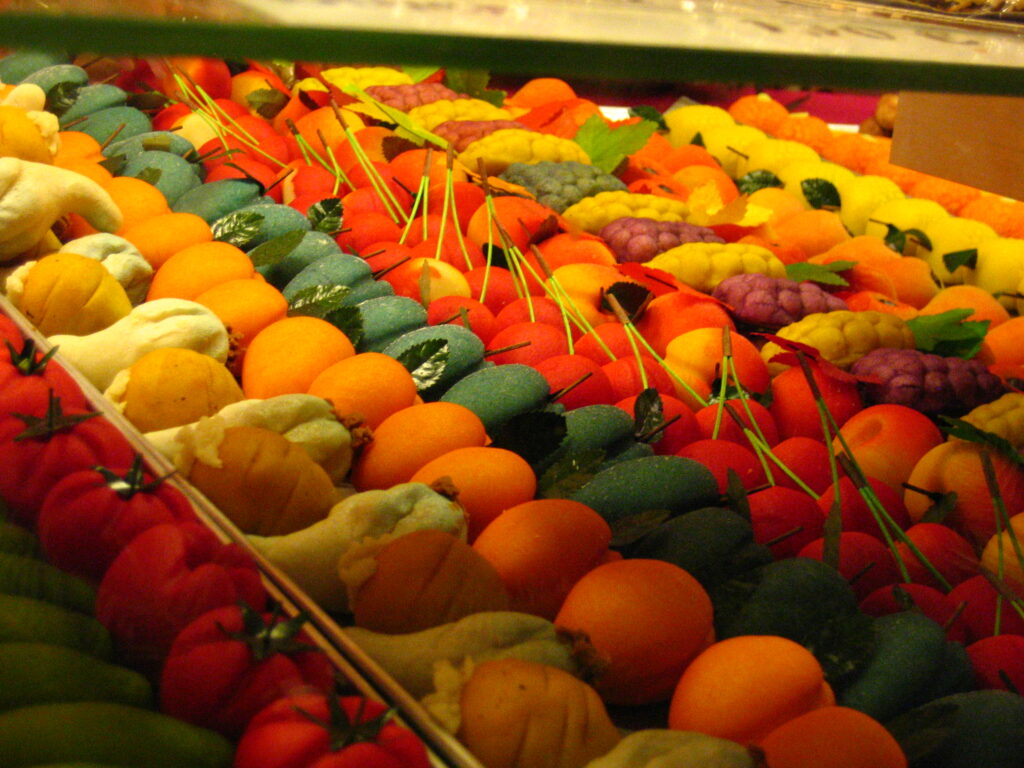
Besides, Valentines Day is coming next month and you can earn some major brownie points by making Marzipan treats and forming them into something romantic. And double-besides, the recipe for Marzipan contains a couple of surprises that many people don’t know about, such as a tiny bit of rosewater used as everyone’s not-so-secret ingredient.

Anyway, here is our version for your education, edification, and delight.

This lovely photo of Marzipan Fruits at the Nuremberg Christmas Market is available under a Creative Commons Attribution-Share alike 2.0 Generic license at the linked website. Many thanks to the author for his or her generosity.

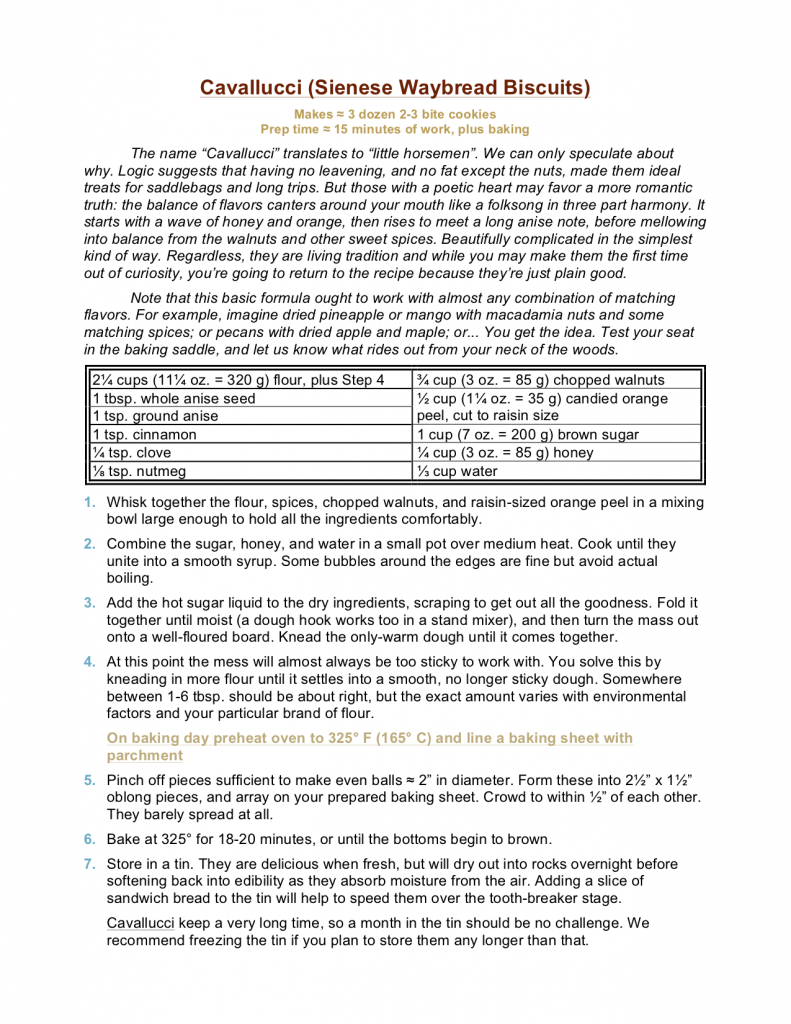
CAVALLUCCI – A Honey Biscuit from the mountains of Tuscany

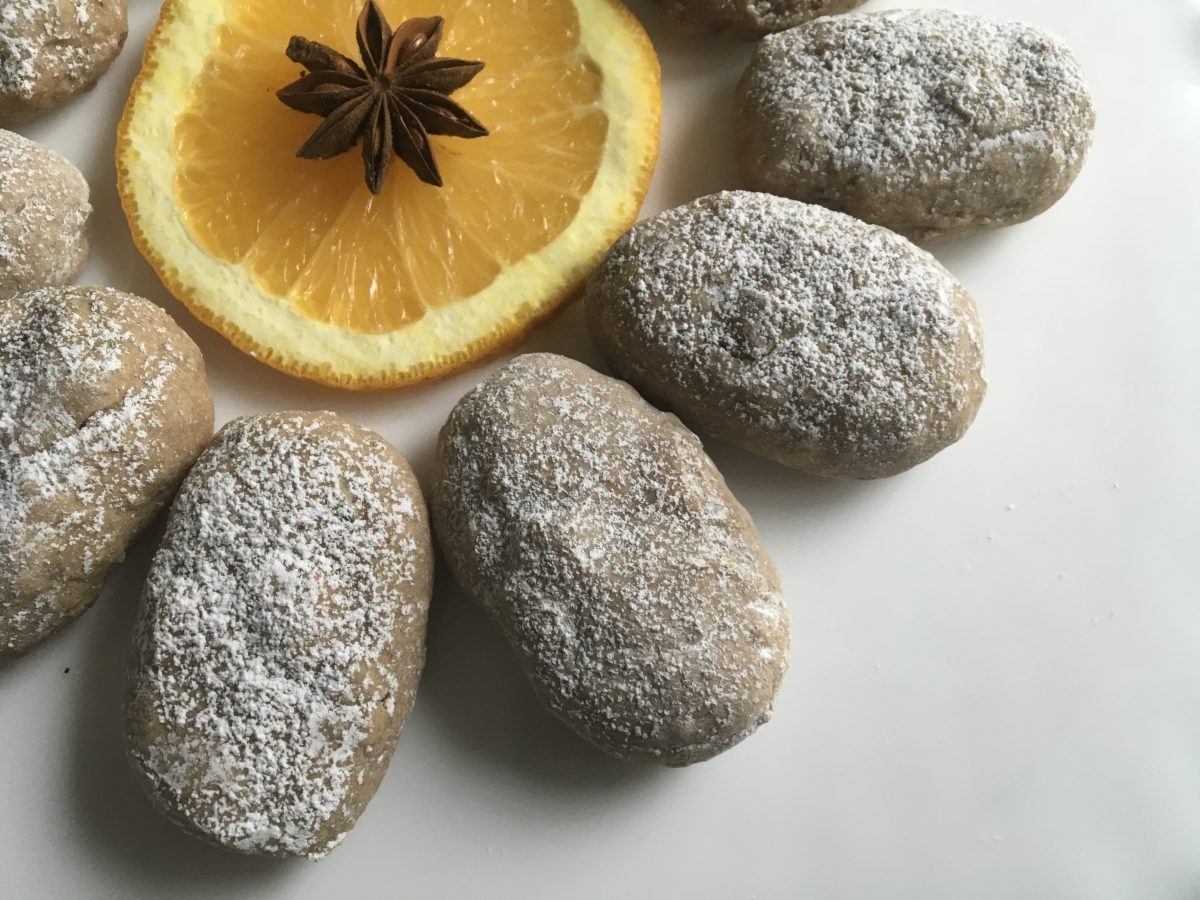
Okay, yes. That is star anise from China rather than regular anise from Italy. Live with it. This makes the prettier picture.

Such a romantic name for such a plain little critter! “Cavallucci” translates to “little horsemen,” which I suspect comes from the fact that having no leavening, and no fat except the nuts, made them ideal treats for horsemen riding through the Tuscan hills. Probably in search of some well grown evergreens, where the elusive porcini can be found. I’m sold right there.

But Cavallucci also have some modern romance. This, and its soft almond lookalike Ricciarelli, are the treats of Sienna, a smaller city about 50 miles south of Florence. You will not escape a visit without getting to experience the unique, chewy balance of honey, orange, anise, and other spice that these are all about. So why not visit from the comfort of your own home kitchen?

As always, skip to the bottom if you want the recipe without any discussion

It’s All About Balance

Moving on, it’s that key word – “balance” – that catches the essence of what these are really about. Our friends and family will attest that your humble authors are better as cooks than we are as bakers. Especially me. Kate does cakes too, but my baking really begins and ends with three categories: (1) heritage cookies, (2) lemon curd, and (3) anything made with chocolate.

Both of us find Northern Italian cuisine particularly intriguing because it’s such a challenge. There’s such delight to be found in achieving perfection through skill and nuance alone. Think of recipes like scaloppini or piccata. They have what, three or four ingredients plus salt and pepper? And yet the results can vary from shlock to divine. It’s a culinary balance beam trick. Impressive as heck if you get the balance right, and embarrassing if you don’t.

Cavallucci should be approached with that same sensitivity. The core of the recipe is little more than flour held together with lots of honey, plus orange peel and walnuts with a healthy shot of anise. Honey, orange, and anise; three flavors that love each other. So what could go wrong? Lots, as it turns out. You’ve got to get the balance right, and that balance has to include texture as well as flavor.

Balancing The Texture

This cookie begins with a trick you see often when honey gets used in bulk. You don’t use the raw material on its own. Rather, you mix it with some added sugar, thin it with some water, and then simmer until everything comes together into a syrup. Candies take it a little further, cooking the sugary liquid up toward the soft-crack, hard-crack, and caramel stages depending on what you intend to do. No need to worry about that here. All you’re after is a nice, smooth syrup. It’s a trick we first learned with German Lebkuchen and Swiss Leckerli. It seemed strange and special at the time, but by now it’s become a standard part of the toolkit. Every one of the dozen or so Cavallucci recipes we looked at started in just that way.

The texture then expands in both directions – chewier and lighter – with the addition of candied orange peel and larger bits of walnut. Nothing to it, right? But it’s easier to fall off the balance beam than it is to stay erect.

A VALUABLE NOTE: There wasn’t enough room in the recipe to emphasize how important it is to get the size of your pieces right. That may sound obsessive but it isn’t. Balance, balance, balance! Candied orange peel has a stick-to-your-molars texture that totally takes over if you let the pieces get any bigger than a raisin, and that disappears in between your teeth if you cut it down to peppercorn size. Both can be annoying. As for the walnuts, they just vanish if you get them down to “finely chopped,” and break the product into sections if you leave them whole. Again, chopped just to raisin size is the perfect compromise.

Balancing The Flavor

That covers the texture. Next up, flavor. What have we got already? Honey (yum) and orange (yum). Two flavors that love each other. But… they’re obvious. No style. That slight bit of bitterness in the walnuts just isn’t enough to round things out. There are a lot of ways you could handle this in theory. Bakers in the walnut loving Balkans and Black Sea regions might grind up a great, big handful of walnuts to use as a bitter nut flour. Health conscious bakers might try substituting in a bit of whole wheat flour. The most common trick in Siena, and the cheapest for American bakers, is to round out the honey with a small hit of molasses.

NOTE: Our favorite page in the entire book – the conversion table! – should can be your friend here. One cup of white sugar plus one tablespoon of molasses equals light brown sugar. Two tablespoons of molasses equals dark brown sugar. We specify light brown sugar in the recipe, but every baker deserves to claim each cookie as his or her own. Those numbers tell you the basic amounts you’re working with, and should empower you to adjust as your palate suggests. The textural properties of molasses will not be an issue because they overlap with the honey. Knowledge is power!

So now the honey works, and the texture is right. The next element to turn these into true Sienese Cavalluci comes from the anise. This recipe contains a whopping four (4) teaspoons of anise seed. Holy. Friggin. Cow. That, however, isn’t strange for the region. Italians adore anise in the same way that Americans love cinnamon. But that much… well, it is another case where you need to work on the balance.

Fortunately enough, the native bakers agree. I do not think we saw a recipe that did not try to soften the licorice flavor with a bit of this and a bit of that. We ended up with a background mixture of other sweet spices, led by cinnamon of course since we are, after all, Americans.

The bottom line here is a waybread biscuit (they aren’t pretty enough to deserve the exalted title of “cookies”) with a distinctive, chewy texture and a sweet, addictive flavor that hits you in waves. It starts with the honey and orange, and then evolves to include the anise. All those rounding-out touches (the walnuts, molasses, and other spices) keep any of those three from dominating the composition, and show up on their own in the aftertaste.

Conclusion

It really is like a good Veal Scaloppini, or Chicken Marsala. Simple food, done very well, and adding up to more than the sum of it’s parts. Serve with coffee, tea, or an aperitif that can handle the sweetness. They are better when they’re not alone, at least in our opinion. But you won’t be disappointed regardless, and a plateful of Cavallucci is much less expensive than a ticket overseas.

A FINAL NOTE: Cavallucci fall in the category of waybreads because all that honey acts as a preservative. They may dry out but they aren’t going to get stale or go rancid unless you lock them in a drawer and forget about them for more time than any of us care to imagine. There is also an easy fix if they do dry out. Put the little bricks in a tin or other tightly sealed container with a slice of sandwich bread. Wait a day or two, and the moisture will move out of the bread and into the cookies; drawn there by the hygroscopic (water loving) power of the honey. Hey presto, Bob’s your uncle. Repeat as needed.

A REALLY, TRULY FINAL NOTE: We haven’t tried it, but this is pretty obviously a formula recipe that ought to work with almost any combination of matching flavors. Honey, orange, and anise typify northern Italy. Do something with dried pineapple or mango, and macadamia nuts, and you ought to get a wonderful treat for drinks on the lanai. Pecans, dried apple, and maple would pair well with a hoppy ale or hard cider on a front porch rocker. Or maybe… You get the idea. We tend to focus on cookies that come with deep historical roots, and a story to match. But there is nothing more American than taking a great idea from the old country and turning it into something new, and maybe even better. So please: test your seat in the baking saddle, and let us know what rides out from your neck of the woods.

FIVE (5!) MACAROONS – Renaissance recipes for the modern world

It’s hard to get more “heritage” than the early Renaissance, and that’s what we have here: four famous cookies that grew into maturity along with the likes of Leonardo, Michelangelo, Donatello, Botticelli (with whom Leonardo supposedly founded a restaurant), Verrocchio, Raphael, and the rest of them. And Columbus for that matter. What can inspire artistic brilliance more than a really good cookie? The answer is obvious: Nothing!

We’re talking about classic macaroons, a cookie dating back to the trade boom that followed the Black Death’s destruction of medieval civilization. Arab traders introduced a variety of products to eager consumers in the trade centers of Italy and Spain. Two main ones in turn led to the creation of macaroons: refined sugar and marzipan a/k/a almond paste. Yes, those ingredients had been around forever, but they’d never been cheap enough to turn into everyday treats. Now they suddenly were, and Renaissance Europe was ready to adopt new ideas their grandparents would have scorned.

Italian and Spanish cooks started the process by incorporating the new ingredients into quick and easy baked goods using methods known since antiquity. The basic formula couldn’t be simpler. First whip some egg whites with sugar to make a meringue, using a more generous amount of sugar than before since it was now more affordable. Fold in some imported almond paste, and then bake. And there you have it! The first macaroons, commonly known as “Marzipanetti in Italy.

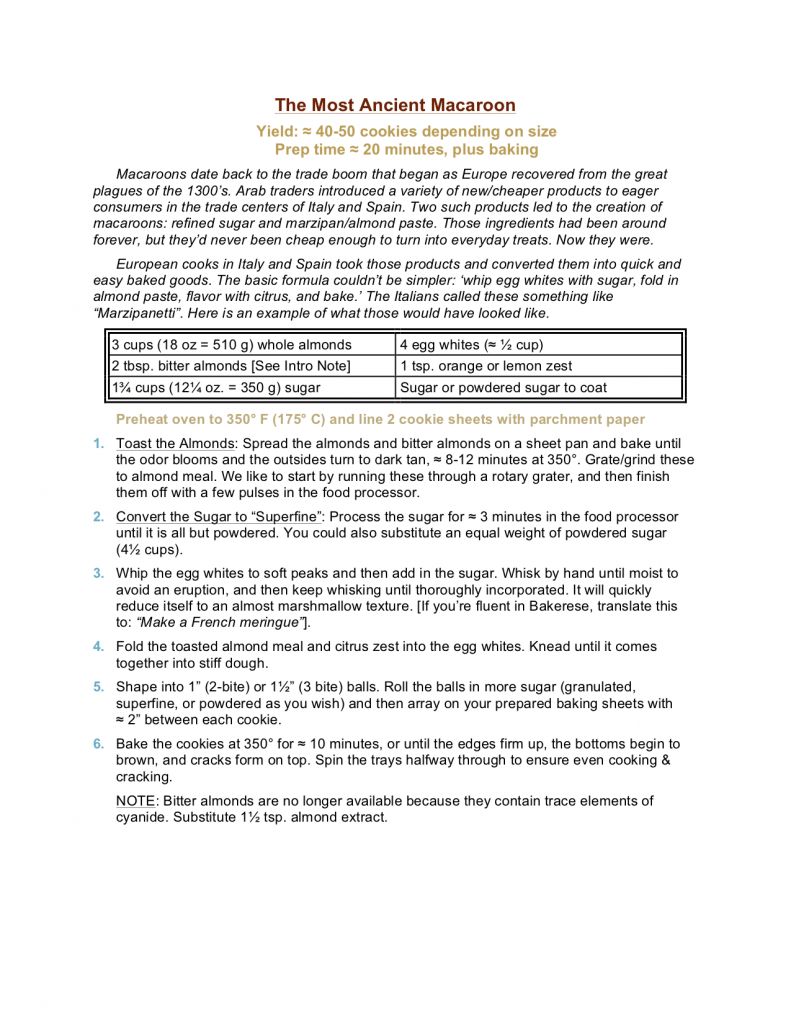
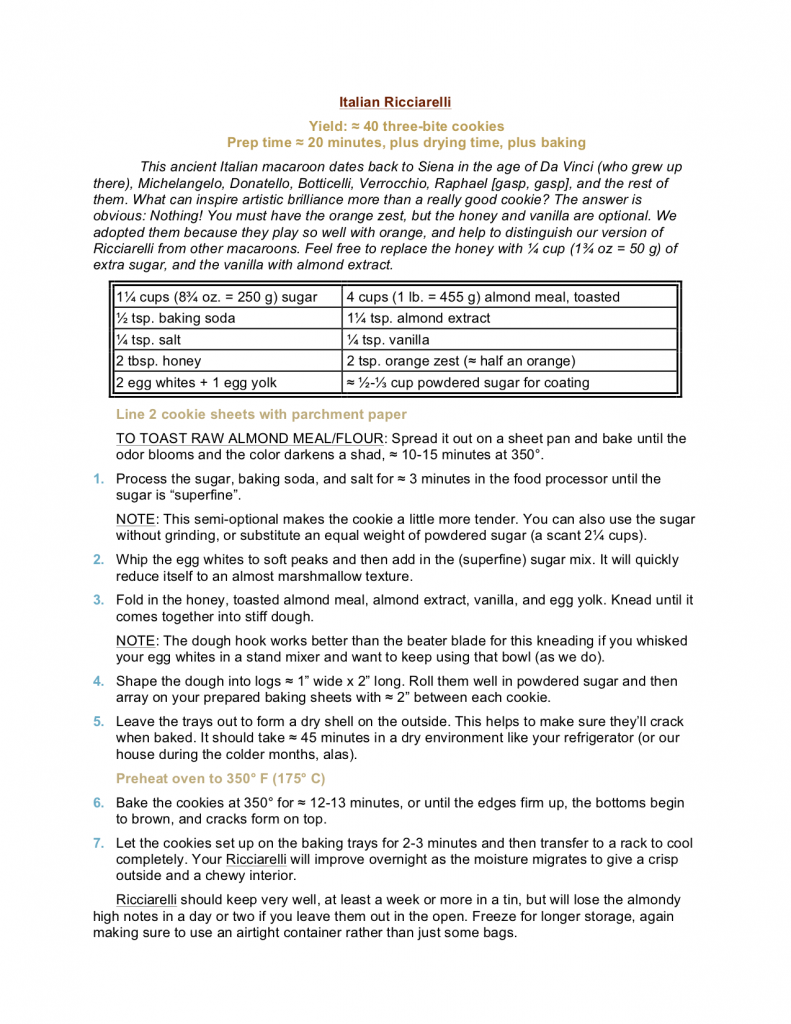
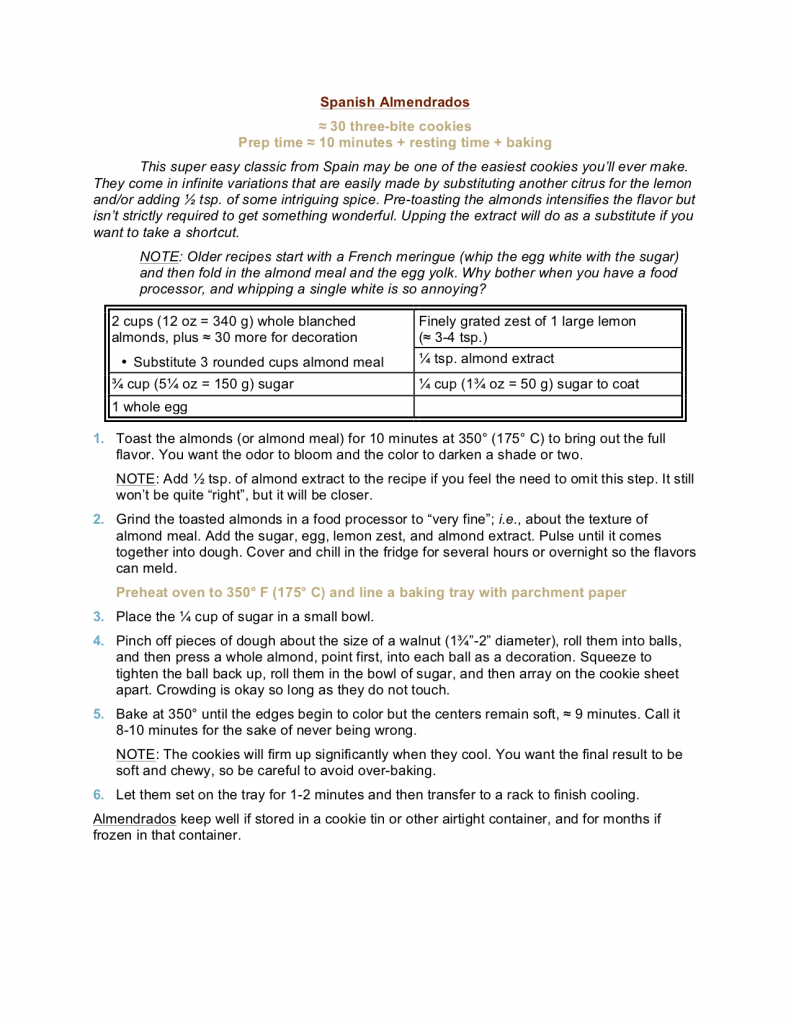
Matters evolved from there, with bakers slowly adopting the regional variations that eventually hardened into recipes. We have now worked up four versions of that basic recipe, distinguished by relatively small changes in the way they’re flavored and presented. Here is a table to more-or-less compare the four recipes, normalized to an even one pound of almonds. [NOTE: The different egg sizes occur because those recipes start from a different amount of almonds].

Most Ancient Macaroons

* 450 g almond meal

* 300 g sugar

* 3 XL egg whites

* No zest

* ½-1 tsp. almond extract

* 350° for ≈ 10 minutes
Ricciarelli


* 450 g almond meal

* 300 g sugar or 150 g honey
* 2 egg whites + 1 yolk
* Orange zest

* 2 tsp. almond & vanilla

* 350° for ≈ 12-13 minutes
Alemandrados


* 450 g almond meal

* 265 g sugar

* 1 jumbo egg

* Lemon zest

* ½ tsp. almond extract

* 350° for 8-10 minutes
Amaretti


* 450 g almond meal

* 290 g sugar

* 4 egg whites

* No zest

* 9 tsp. almond extract

* 350° for ≈ 12 minutes
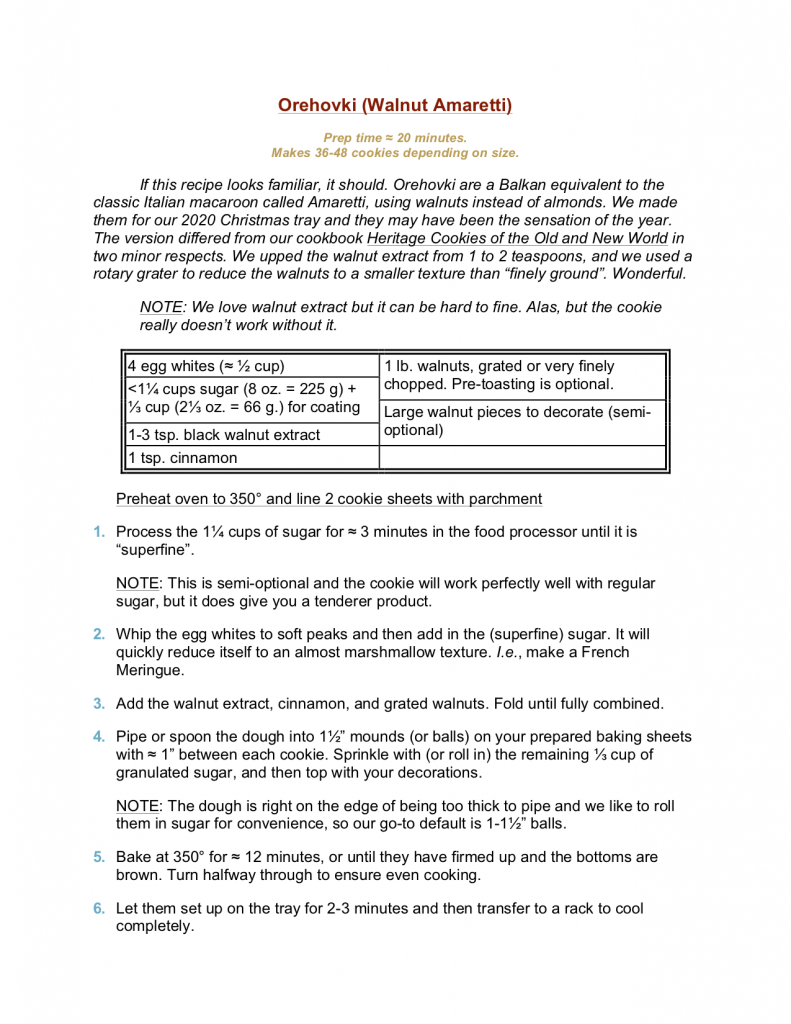
See also the Walnut Macaroon Orehovki

Not a lot of differences, are there?

  • The Most Ancient Macaroon included a hefty amount of sugar and some bitter almonds. We were forced to substitute almond extract for the latter. Bitter almond extract would be even better if you can find it. This cookie is super simple, focused on those new imports, and consistent with the oldest macaroon recipes we could find after a week or two of search. NOTE: Scott believes it may be even more authentic to replace the sugar and almonds with premade almond paste, because that product would have been easier to ship back in the day.
  • Italian Ricciarelli, a specialty of Siena, must have orange zest but vary from there. We reviewed more than a dozen variations before settling on a version that includes an elusive hint of vanilla, some honey to enhance the sugar, and a single egg yolk to give them some richer chew. The cookies would still be Ricciarelli without those additions, but they help to distinguish this cookie from its macaroon peers. And they’re good. We also adopted the trick of adding some baking soda into the dough, because it creates attractive cracks in the powdered sugar crust.
  • Spanish Almendrados add lemon zest instead of orange, use whole eggs, and ignore the initial meringue step. Throw it all in a food processor and go! This methodology, combined with the shorter baking time, gives the cookie a fabulous chew you’ll particularly enjoy. They come with a classic almond-on-top decoration, and a granulated sugar crust.
  • You can find Amaretti in our cookbook, Heritage Cookies of the Old and New World. The recipe looks very similar to the Most Ancient Macaroon except for a monstrous hit of almond extract, and the candied cherry on top. Our reference to “Rudolph’s Nose Cookies” wouldn’t have made much sense in 15th century Italy. Neither would reindeer if you think about it.

Continue your travels around the Mediterranean and you’ll see extremely similar cookies such as those flavored with rose water (a favorite in Turkey), or with walnuts and walnut extract in place of almonds. Move north and things begin to differ more, with roll-and-cut meringues such as Basler Brunsli (mix of almonds and hazelnuts, cocoa powder, and cherry liqueur) or German Zimtsterne (mix of almonds and hazelnuts, cinnamon, other spices, and lemon icing).

But here’s the bottom line. Macaroons go so deep into the roots of modern Europe that there’s really nothing older except the extant waybread recipes. They’re also simple to make and easy to modify into infinite variations. It’s an invitation to play, and we encourage all you creative people to do so!

Here are our recipes for all four, plus a bonus recipe from the Balkans: a terrific macaroon based on walnuts instead of almonds.

Enjoy!

Ricciarelli, the ancient macaroon of Sienna, Italy that Leonardo and the rest grew up on
Spanish Alemandrados
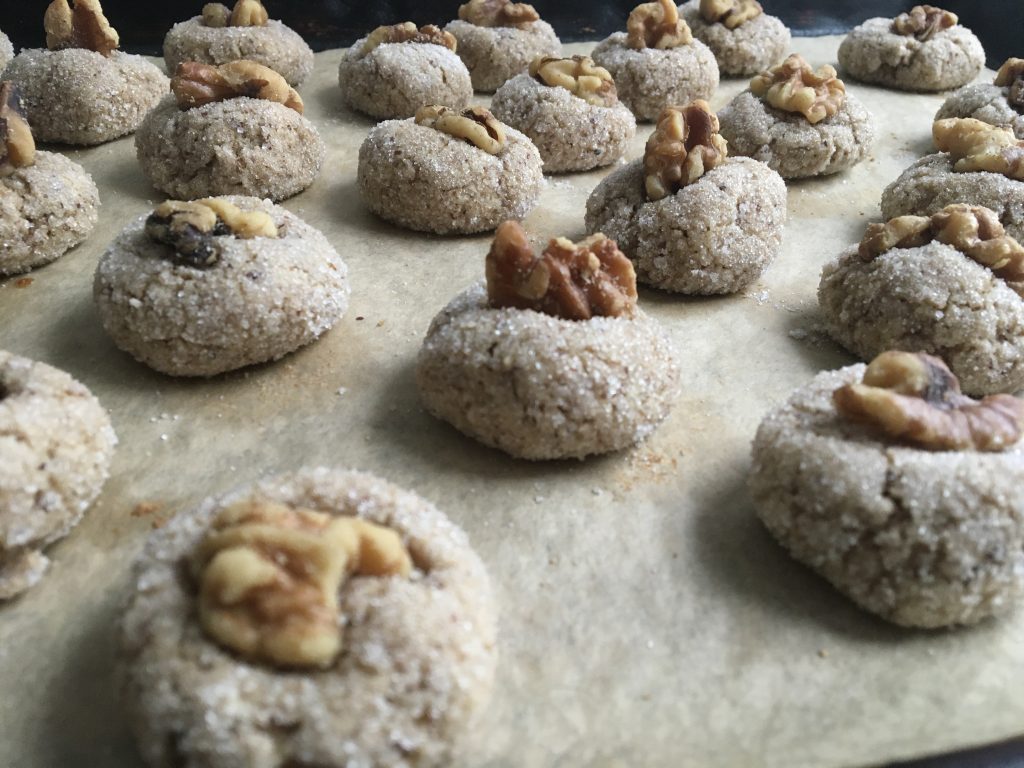
Orehovki, a/k/a Walnut Amaretti from the Balkans

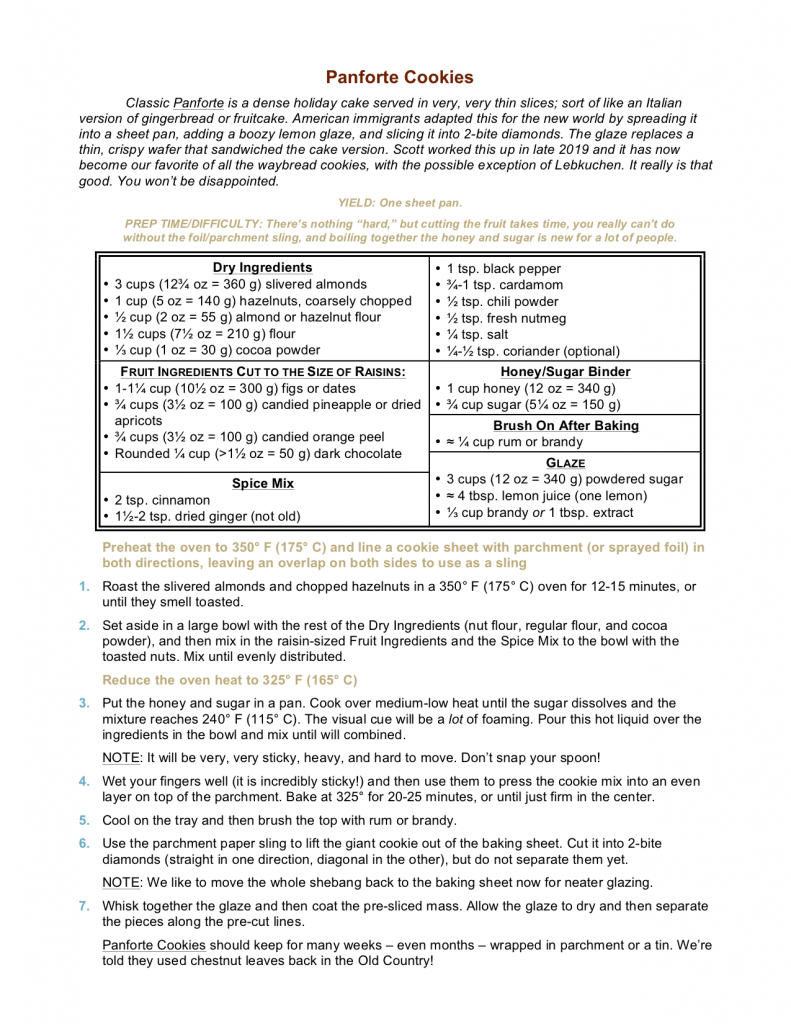
PANFORTE – Sometimes you get it right

Our adventure with this extraordinary cookie began in 2019 when I met an old friend in the local supermarket – a former partner at the firm I joined out of law school. He had a cart full of baking supplies, I had just finished the initial version of our book, and Christmas was in the wind, so you can guess what happened next. I asked a question, he enthused, and we ended up in a discussion about family baking traditions. Who knew that Tom had a reputation going back for decades as the Great Baker of his circle? Birthday cakes, holiday cookies, even the occasional wedding table… just like us.

Tom gave the credit for his skill and passion to his Italian mother and grandmother. And he absolutely *loved* our cookbook project! “That reminds me of the one cookie I never managed to learn,” he said. “I don’t even know the name. It was black, dense, diamond shaped, and filled with chocolate, fruits, and nuts. Never any other shape. I wish I knew what it was.”
You know what? I did. Sort of.

As always, skip to the bottom if you only want the recipe. Most of what follows is the winding process of how we got there, and the tricks we learned along the way.

It Had To Be A Waybread a/k/a Winter Cake

We used to follow a public radio program called The Splendid Table, hosted by a scholar of Italian cooking traditions named Lynn Rosetto Kasper. She had done a segment on something she called “winter cakes;” meal-sized Italian equivalents of what we call “waybreads” in our book. It’s a category populated by dense, ancient treats that your great-to-the-Nth ancestors prepared at two different times: (A) during the holidays, to enjoy in slivers all the way through April, or (B) for a loved one to take on some extended journey. The common denominator? Winter cakes (waybreads) last basically forever from a practical point of view, being packed with so much sweetness, dried fruits, nuts, and often booze that they won’t go stale.

The old English version is fruitcake, inherited into the U.S. tradition with a great deal of snickering and jokes. But other versions abound across Europe, and I knew this had to be one of them. The diamonds gave it away.

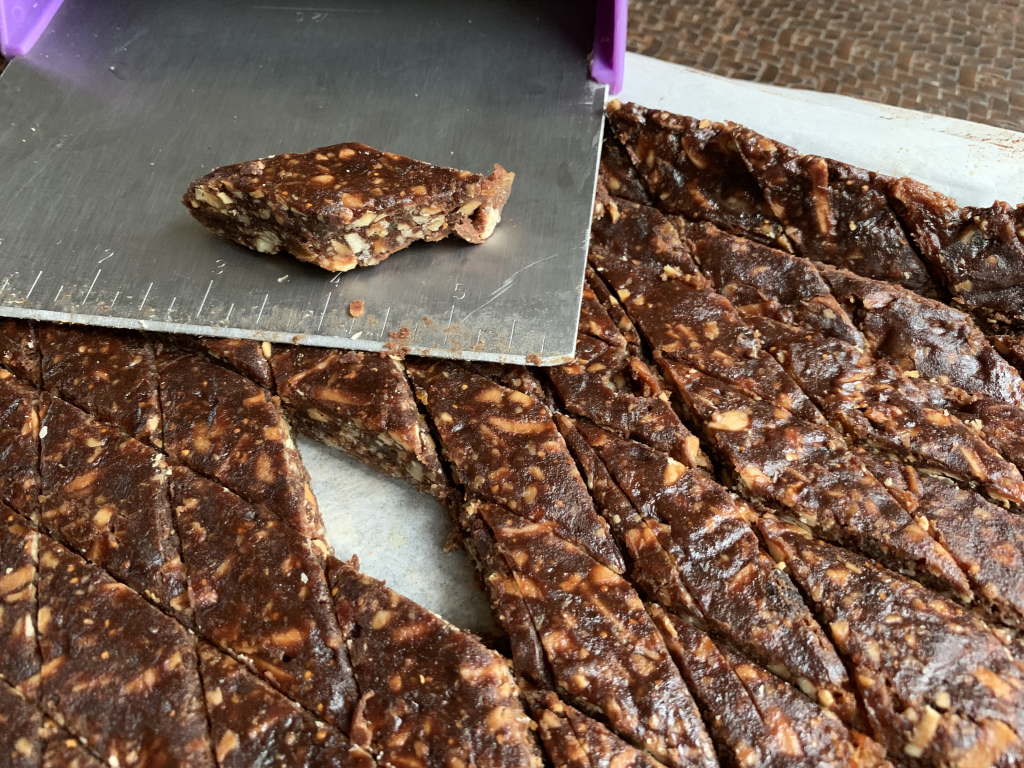
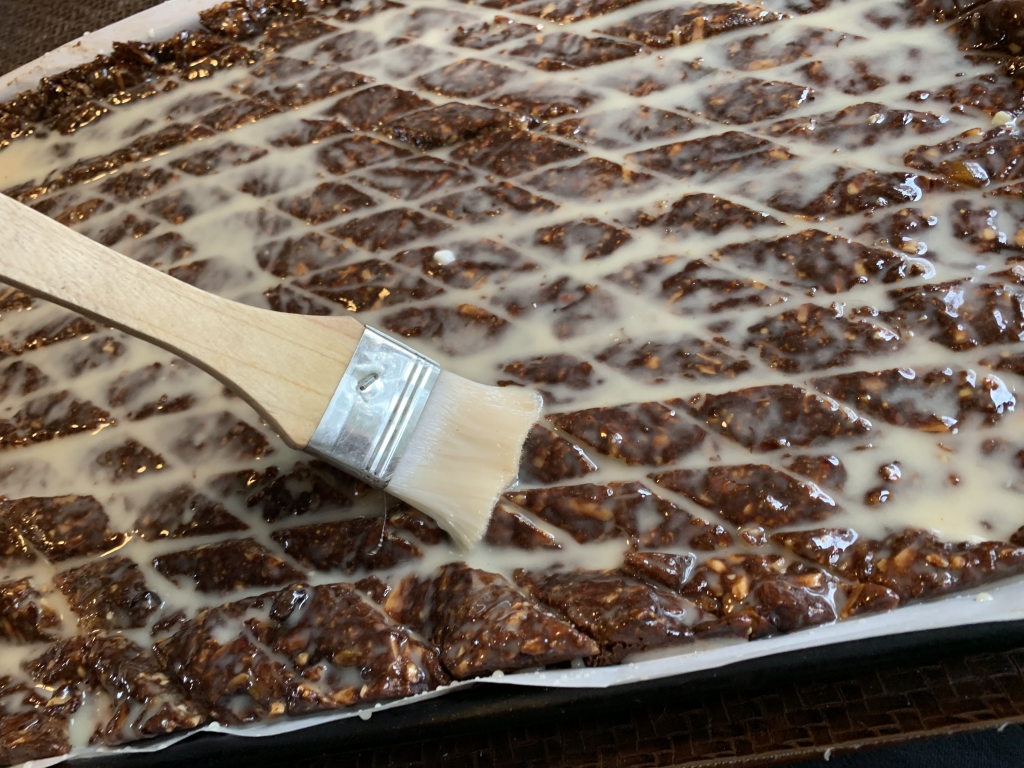
I know from earlier research that American immigrants often adapted their traditional waybreads to the new world by using a standard U.S. sheet pan in place of the specialty cake pans they’d left behind. Cut the sheet-waybread into cookie-sized pieces with a vertical line in one direction and a diagonal in the other, and voila! Diamonds, which are much prettier than little squares, much more “American” than big cake shapes, and have the added bonus of creating a series of little triangles by the edges for the cook and her helpers to “test the bake.”

SIDEBAR: Cookie bits have no calories if you’re nibbling for practical reasons like testing! Everyone knows that, right? Ask your own Baba or Nana or Grandma if you doubt me. Most of them will admit it, and the ones who don’t will huff up in that particular way that lets you know the truth.

So here’s the bottom line. This was some kind of ancient waybread or winter cake. It probably came from Italy, given Tom’s heritage. It was dark to the point of being black. It was heavy and probably unleavened. And the primary ingredients were a mix of various nuts, several fruits, and a solid hit of chocolate.

Which Waybread Was It?

Off to the Internet I went and it wasn’t long before my search returned a long series of hits for something called Panforte; a specialty of the ancient Italian city of Siena, in Tuscany, about an hour by car to the south of Florence. It hit on every category, even down to a series of American photos showing thin, cookie-sized diamonds.

Bullseye!

Our now-familiar development procedure followed after that. First I compiled as many recipes as I could to get a good feel for the variations and the flavor profile. Panforte is pretty common, so I had well over a dozen to choose from.

This research confirmed the mix-of-nuts approach Tom had described, with almonds and hazelnuts being the most common. I balanced the fruit flavors in my head, adding dried apricots as a potential substitute for the surprising presence of candied pineapple in so many recipes. I rejected citron – the bane of fruitcake eaters everywhere! – for the equally common and much better tasting candied orange peel. All pretty standard. Alter as you wish.

The sweetener in the recipe turned out to be a mix of honey cooked together with sugar. No surprise there! One of the best waybreads in Volume I is called Leckerli, a sheet pan cookie centered on walnuts. Northern Italy and Switzerland aren’t that far apart, so it came as no surprise to see parallels in their cookies.ƒ

Next came the spices. These varied hugely, as you might expect. I sifted through a dozen variations and then settled on something more or less in the middle with two minor variations – chili powder and cardamom. Neither was unknown, so this wasn’t a true heresy, but neither were they common. Still, the combination made sense in my head, and offered a side benefit. They gave the flavor profile a little twist compared to all our other recipes. Again, modify as you desire.

Time For Attempt #1, And… Wow.

Mega wow. Ridiculously absurd, over the top, odes-to-the-cookie-gods wow. These darned things were awesome! We almost couldn’t believe it. Were all Panforte this good?

Aye, there’s the rub.

Kate and I can tell good from bad easily enough. And these were certainly good. But how could we tell if they were “right”? Neither of us comes from an Italian background. We had no internal target to aim for.

This, my friends, called for a trip to the Strip District.

Always Find Native Testers

The Strip is a narrow piece of land in Pittsburgh about 2-3 blocks wide and 6-8 blocks long, located just up the Allegheny River from the Downtown triangle where the Al and the Mon meet to form the O. It’s been our favorite part of the city since we moved here because the two main drags (Penn Ave. and Smallman) are lined with wholesale/retail ethnic stores. These include a number of different Italian places with histories going back close to 100 years, and a veritable bevy of first generation immigrants. Just the people to test our new cookie!

First up: Giuseppe at Penn Mac a/k/a the Pennsylvania Macaroni Company. This is our go-to stop for nuts, dried fruit, and other staples, and we bring them a tin every year.

“Giuseppe, we know these are good. That’s obvious. But are they Right? We need someone from the Old Country to give a reality check. Would you mind?”

No, not at all. He took a bite… and then looked at us like we we’d left our brains in the street. “You think there’s something wrong with these? They could be straight from Italia! They’re perfect! Just let me have a couple more pieces before you go… [munch, mumble, mumble, munch].”

Wait a sec. That never happens. Not ever! I had to visit the Strip three different times when I was working up South America’s famous Alfajores, and those are a simple, childhood shortbread. Maybe Giuseppe was just being kind.

No problem. There are other Italian stores in the Strip. On to Enrico’s Biscotti, whose owner, Larry, teaches traditional Italian baking to full houses several times per year. He’s a generous man with both his goods and his knowledge, but also one who believes in sharing the hard truths too.

“They’re perfect! What are you worried about? I especially like that little hint of heat at the end. And that floral note. It’s fantastic [munch, mumble, mumble, munch].”

Chili powder and cardamom: check. Let’s try Colangelo’s around the corner, another wonderful Italian bakery/restaurant.

“You could sell these anywhere in Italy and they’d call them Panforte. And believe me, they’d buy them, too! [munch, mumble, mumble, munch].”

The pattern continues! Sunseri Brothers? Ditto. And on it went, up and down the Strip. The answer was always the same. These weren’t just authentic Panforte, they were among the best Panforte that anyone had ever tasted. Stop worrying. Start bragging. And don’t mess with success. [Munch, mumble, mumble, munch].

Conclusion

I heard back from Tom about a week later.

“You got it! You nailed it! After all these years it’s just like sitting in my mother’s kitchen again.”

I love cookies.

NOTE: You can convert this to the traditional Italian winter cake with a few easy adaptations:

  • First, bake it in a tall cake pan instead of a sheet pan.
  • Second, sandwich the result between special wafers you can buy online.
  • Third, feed the cake version with brandy over time just as people do with fruitcakes; a thin brushing once per week for a month or two.
  • And FWIW… We also found an online note suggesting that Tom’s great-to-the-Nth-Nana would have stored her Panforte in chestnut leaves back in the day. How cool is that?

Panforte cakes should be served it in slivers (not slices) as a special treat to enjoy all the way into early Spring. A little goes a long way.

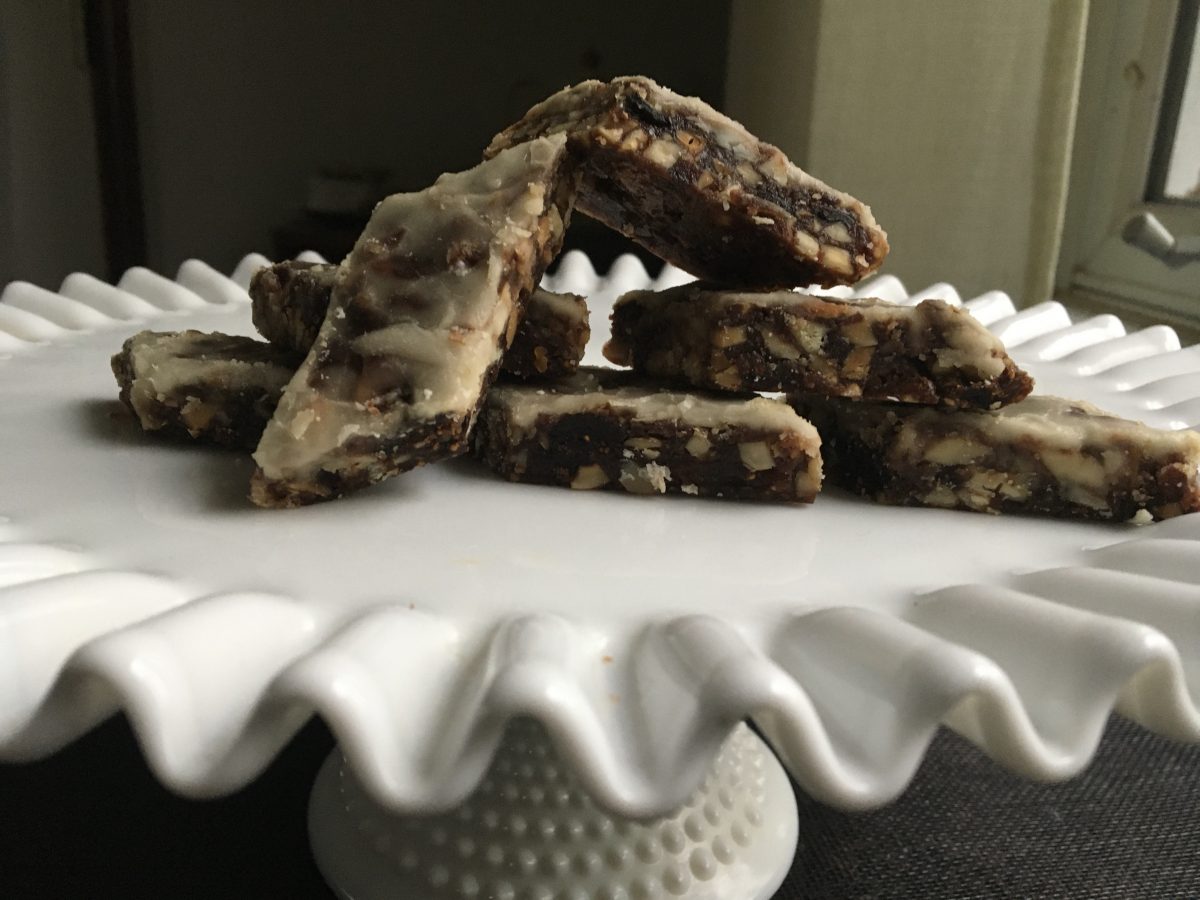
BUTTER JELLIES, SPITZBUBEN, & MAILANDERLI – The one that everyone loves

When you make as many high quality cookies as we do, you get used to a couple of standard questions. The top two have to be, “What are your favorite cookies?” and “What is the favorite cookie overall?” The answer always disappoints: there are no real, statistical favorites because individual tastes end up dominating. But one thing we can say for sure is this:

People adore filled cookies.

There’s just something very “extra” about treats inside a treat. And that’s extra “extra” for Butter Jellies, because the jam in the middle (a) makes them spectacularly pretty, and (b) adds a series of bright berry flavors that cannot be baked into a dough. Yes, you can now find freeze dried berries in a lot of supermarkets. And yes, they add a bit of true berry flavor into your dough that people can taste even through all the butter and other ingredients. But it isn’t the same because the full berry flavor includes a lot of things that don’t come through, such as all the bright high notes.

Those require either an icing or, as in this case, a filling. The combination of tart/sweet jam and buttery cookie is irresistible. If these aren’t the #1 favorite on our annual tray, they probably count in the top three for a vast majority.

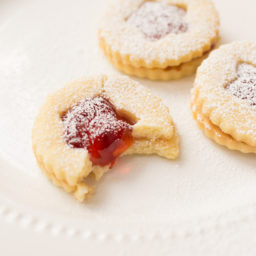
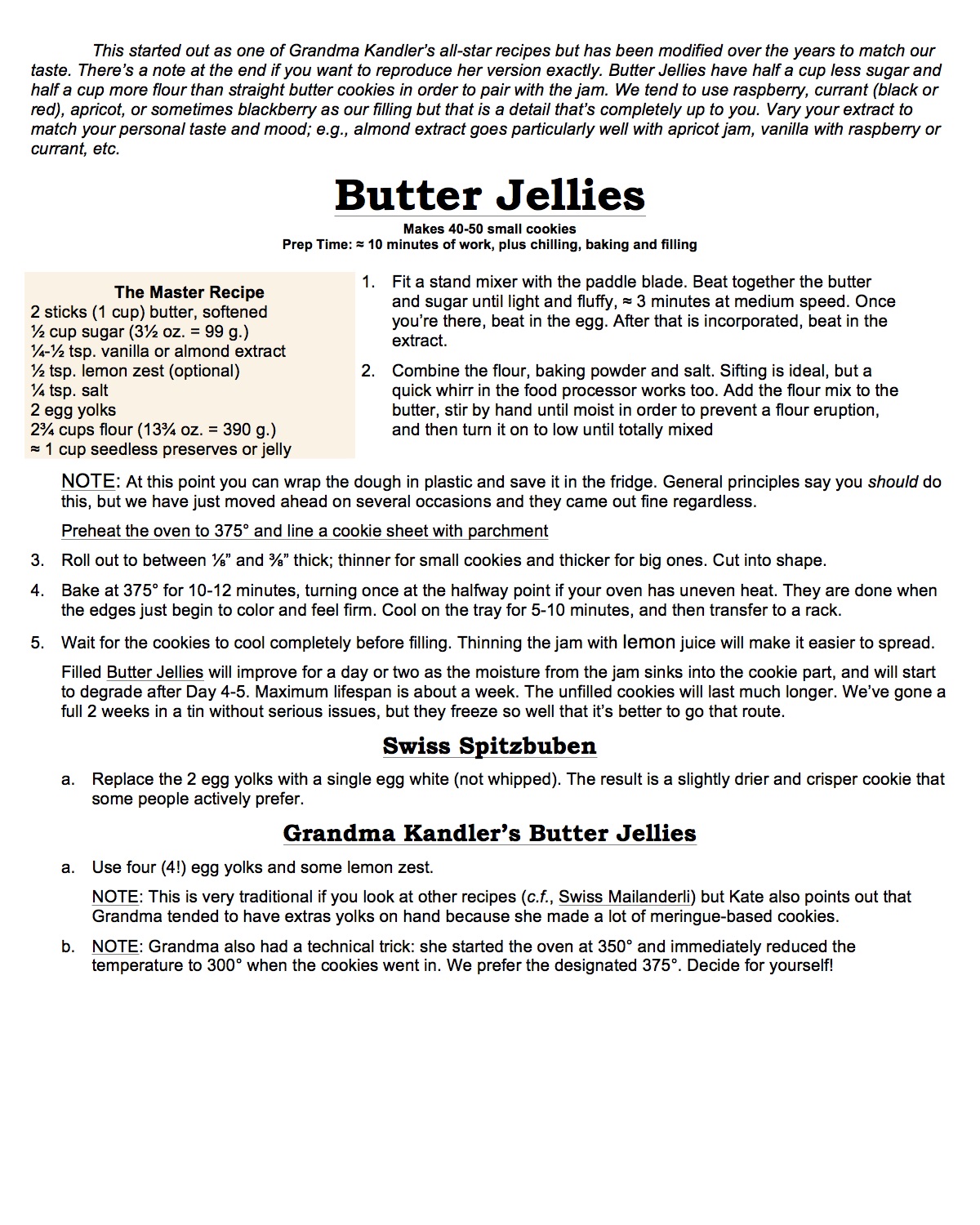
It’s really a simple cookie. Butter Jellies and their variations are a basic, roll-and-cut, shortbread/butter cookie with just enough flour to hold together for a few days after they’re sandwiched around liquidy jam. The variations are subtle, and amount to either more egg yolks (Grandma Kandler’s version, which is known in Switzerland as star shaped Mailanderli), or the use of egg whites instead of yolks for a drier mouthfeel (Swiss Spitzbuben). What about whole eggs? We tested it of course, and they work fine from the sturdiness point of view, but we ended up preferring either the rich chew of yolks alone or the dry counterpoint from using only whites. Your mileage may vary.

The jam is up to you. We used to adore rose hip jam, but it became unavailable 5-10 years ago. Nowadays it’s currant jam or blackberry because we reserve raspberry for Linzer Tarts.

And no! These are not Linzer Tarts! That is a name that comes from a classic, pie-sized Austrian Torte made from a fragrant hazelnut/lemon piecrust. No nuts, no Linzer. Thus Sayeth The Lord! So do not blaspheme. These are Butter Jellies.

Make Linzers too. That’s our solution, and if it’s good enough for our family, it’s good enough for yours!

BONUS FREEBIE! To convert Grandma’s version into true Mailanderli:

  1. Use 3-4 yolks in the dough.
  2. Increase the amount of lemon zest to a full 1-1/2 tsp.
  3. Increase the amount of vanilla to a full 1-1/2 tsp.
  4. Cut the dough into stars
  5. Coat the top before baking with an egg wash made from 1 whole egg thinned with a bit of water.

You can follow Grandma’s cooking technique but we’ve had equal success with a constant 325.° Either way, they will want to cook longer because of the lower temperature. 20-25 minutes should be about right.

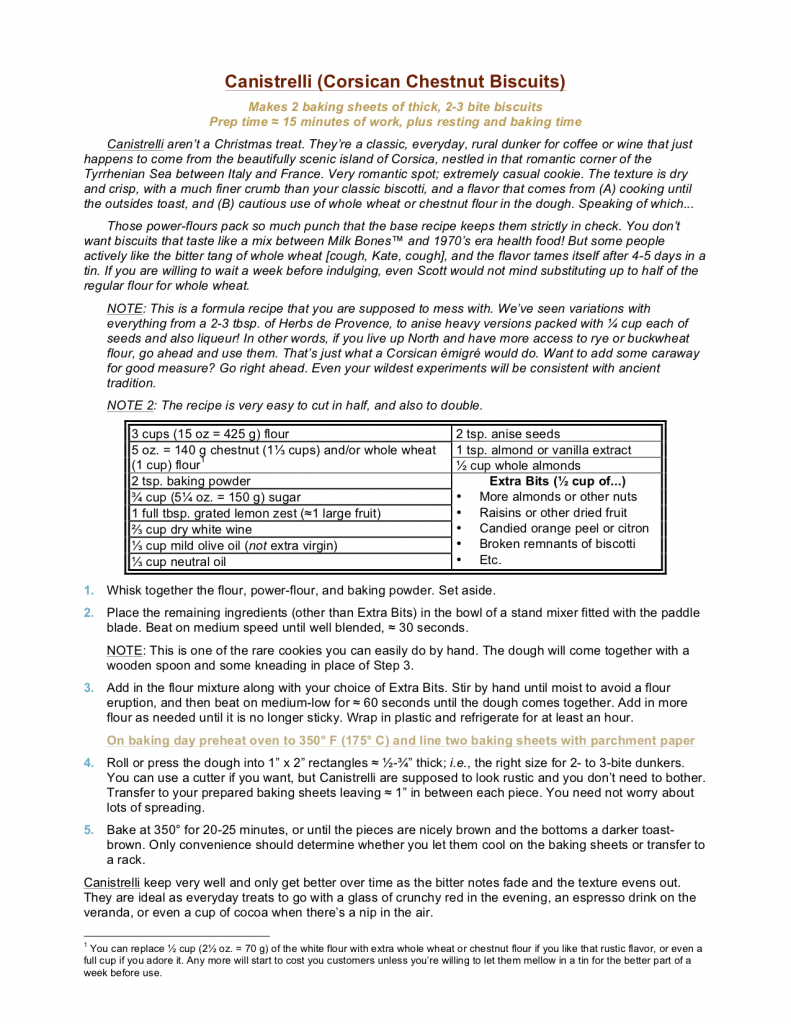
CORSICAN CANISTRELLI – From dog biscuits to dunkers

It’s Autumn, which means I am already in the early throes of cookie baking. The annual checklist has been pinned by the calendar to keep track of the various cookies, and their status. These will be for giveaway; those for the house; those others for giveaways at book signings; etc. It’s all part of a well established system.

First, everyone in the family goes through our entire list of primary recipes. Each member picks five cookies that no one else has selected, making a total of 20 since our Labrador gets no say. Those go above the line.

Next, the parents/primary bakers slide in a few recipes to “balance the tray.” Have we covered citrusy, chocolaty, nutty, fruity, and dry-fruity? Did crunchy, light, chewy, fancy, and melty all get their due? We have to be fair, you know [eyes roll].

And then we get to step #3: cookies that I want to test. It isn’t official, but it happens every year so I may as well own up to it. You see, the research may continue year round, but we really do very little baking before October or after January. The recipes pile up until the [ahem] weight becomes hard to resist. And thus every Fall includes a certain amount of nagging requests for input about which ones the feminine component are [ahem] most eager [a/k/a willing] to try.

We probably average 2-4 of these every season, with January devoted to another 2-3 that I couldn’t get authorized during the Holiday extravaganza.

This year’s first experiment involved a Corsican specialty called Canistrelli, a famous wine-or-coffee dunker with several odd ingredients like olive oil and some white wine in the dough. The mix also had a hit of what we call “poverty flours;” those highly flavored, lower gluten flours that got replaced by standard white flour once technology made it cheap enough. Whole wheat (the precursor of white) is standard around the word, but this broader category includes anything that was a cheap substitute in pre-industrial times. In some parts of the world it was buckwheat. In Scandinavia it would have been rye. In central Europe, acorn flour. The Mediterranean nations used a lot of chestnut flour. Etc.

So… Canistrelli are ancient, regional, well loved, and unique? And they feature earthy chestnut and whole wheat flours? What could be more perfect target for Heritage Cookies Volume II?

As always, skip to the bottom if you only want the recipe. The rest of this post is devoted to the stumbles made and lessons learned along the way.

I quickly set to work and put together an initial test recipe emphasizing the rustic notes. The main elements had Kate all but jumping around with excitement. Whole wheat that she’d picked up the other day; chestnut flour we saw on sale in the Strip District; olive oil, white wine, lemon zest, and brown sugar. Several online recipes also included anise seeds and either whole or slivered almonds, but we decided that would create too much overlap with other cookies, and might make it harder to focus on this rural core. I opted to keep them out for the initial test, and to instead rely on the flours for flavor. Those touches could wait for the later versions. Maybe some raisins or chocolate chips to add a few sweet pops, but that would be it.

I showed the test recipe to Kate for her input, which only made her more excited. “This one! You definitely need to do this one for the first experiment.” No butter? Great. Limited sugar? Fantastic! And ooh, it’s jam packed with heart healthy grains that measure high on the virtue spectrum. With all that in their favor, what could these be but…

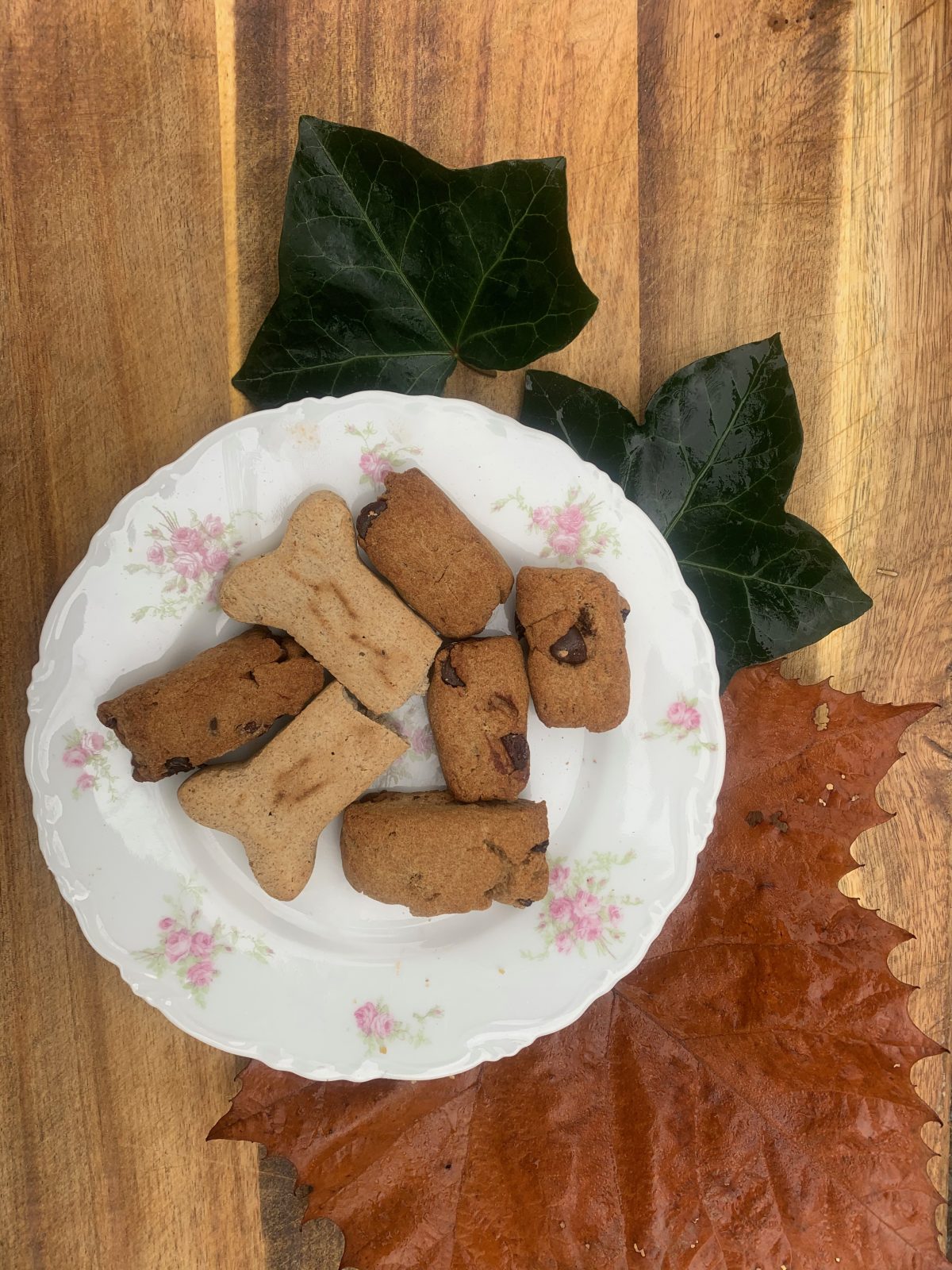
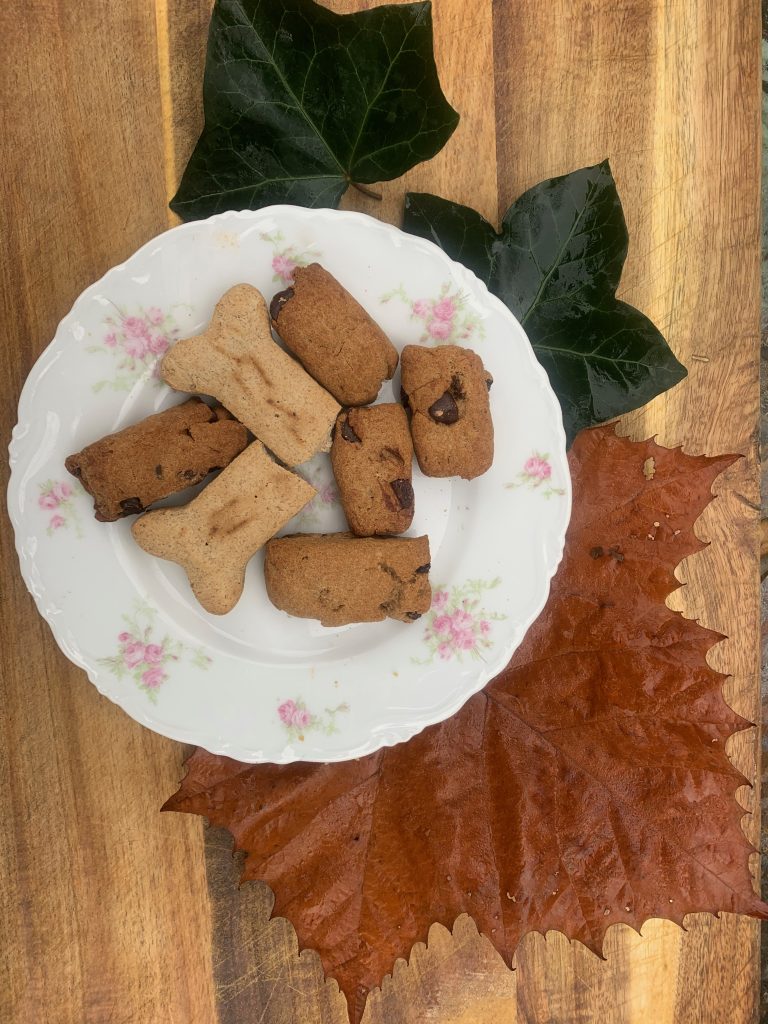
Dog biscuits. Hand to heart, that’s what they taste like. Dog biscuits with sweet little pops.

One from Corsica and the other from Alpo! One must admit that the Corsican one improved over time.

Admit it: you know that flavor. Every child in America has sneaked a biscuit or two. What is that makes Fluffy, Spanky, and Rex sit there drooling each night? They had to be good, right? The dog isn’t a fool. And then you learned. Dog biscuits are plain, crunchy, vaguely bitter, and just not worth the effort to finish. Sort of like whole wheat bread from the 1970’s.

Our teenager wondering, “What is it that labrador sees in these things?”

Plain? Check. Crunchy? Check (about as expected TBH). Vaguely bitter? Definitely.

Healthy? Well, that sort of depends on how much credit you give to those slim, thin diet gurus who stay that way by filling their plates with pseudo-food that isn’t worth eating in the first place. Maybe that’s how these should be marketed! Whole grain desserts perfectly suited to follow a dressing-on-the-side, chicory-sprouts-and-tofu salad.

Sorry folks. Virtue points go only so far. Even for Kate. And you know the worst part? Even our lab got stiffed on this one, because I did add those raisins and chocolate chips, and both are bad for dogs!

Epic fail. Post it on Facebook as a funny story and a lesson about just how badly an experiment can go wrong.

Still, we knew there had to be a version of this recipe that works. It’s just too popular to be this actively bad. Besides, the texture came out just as we’d hoped. So, duly chastened and just a bit traumatized set back to work with the reminder that poverty flours lost out to white for very good reasons. They’re only romantic in myth, age-dimmed memories, and very limited amounts. Hints are intriguing. More than that is… not.

Version two changed the recipe by trying a 4:1 ratio of white to “other” flour, with the olive oil cut 3:1 by a flavorless vegetable oil. That was much better. Yes, they were a bit plain and somewhat boring, and it became clear that chocolate chips were just a bad idea. But it was getting close.

So version 3 would be… Wait a sec! Something strange just happened! Kate found the old tin of Version 1 dog biscuits, and came running over in excitement. “These are way better than they used to be!” And they were. Even I, traumatized and doubting as I was, had to admit that the worst of the bitter, acrid flavors had gassed out over the past three days. They still weren’t something I’d serve to company, but Kate was actually willing to eat them. [Her stance on health based brownie points being a lot more generous than mine]. Marital harmony was restored and, more to the point, it became clear that something was going on at a level I hadn’t considered.

I suspended the baking and went back to search through the Internet for a bit more background. The first effort had been based off four different versions, with a slant toward the poverty flours. We don’t have access to someone from Corsica to tell us about the norms, so research would have to substitute.

Some 14 recipes later, I emerged with a clearer view of what was going on.

1. The further you get from Corsica, the lower the amount of poverty flour. Two English versions were all the way down to zero! That made sense in a way. Corsica has never been what you’d call wealthy. Beautiful, yes. But not wealthy. So a higher percentage of poverty flours made sense, especially when reinforced by the way people get used to the taste of whole wheat flour. The more you eat, the more you can get away with.

Kate really, really wanted to come out of this with a cookie that would feature a distinct poverty flour tang. It just had to contain that tang enough to be friendly for rookies who hadn’t become accustomed to those notes. We’d start by simply cutting the amount of tangy product, with notes that bakers should increase it as tolerance and taste permit.

2. The amount of variation in added flavors said something too. My research showed some absolutely huge variations. This recipe reeked of anise. That one included no anise, but had a full two tablespoons of aromatic herbs. This other centered on smoked paprika. That fourth one piled in whole nuts, with walnut oil and almond extract. On and on.

You’d think all that variation would make it even harder to nail down the pattern, but the third observation tied it all together:

3. Canistrelli inevitably get described in romantic terms that basically amount to, “That treat we enjoyed while sitting on the veranda of our hotel, watching the scenery with a glass of wine/espresso as we talked…”

Step back and you’ll see the pattern. Hotel = chefy variations, restrained only by a strong tradition that defined the texture and the purpose. But at the same time, those variations were all very intense in their own way. Whole wheat and chestnut flavors dominated the dog biscuit version. Anise, herbs, smoke-and-spice, nuts, and what-have-you clearly did the same to the new ones. Got it! Anything goes, so long as it’s dialed up to a “10”. That was enough to finalize the target.

  • Canistrelli are supposed to be right on the dividing line between savory and sweet, with much less sugar than the things you’d see on a wedding table or holiday tray.
  • They must be very crunchy, on the dry side, and are intended to be a dunker.
  • They usually have a bitter element, but it’s always balanced against the baker’s choice of flavor.
  • That flavor can be anything, so long as it’s strong enough to fight through the dryness, and clear enough to complement whatever drink you’re serving on that veranda.
  • And some of that flavor really ought to come from oil, wine, and/or liqueur in the dough.

Day 6. I went back to the drawing board, properly armed, to the music occasional snarfing noises as Kate dug into the no-longer-dog-biscuits beside her morning coffee, and sometimes her evening glass of wine. [Objection from the peanut gallery: “Kate does not ‘snarf’!”] [Of course not dear. Poetic license. What words would you use to describe the sound?] [“Just zip it, okay?”]

Let’s try this again. Day 6. Kate has decided she likes the original version, and keeps saying, “Don’t change it too much…” Listening attentively with nary a twitch of brow nor roll of eye, I manfully forge again. Don’t worry my love, I’ve got this!

And this time… it works. These aren’t my personal favorites. I’m not going to hide that fact. But they have become one of Kate’s, and she has put her flag in the ground to defend her plan of keeping a regular supply on hand. So the bottom line is this: The recipe below will produce something the natives of Corsica would call a Canistrelli every time, even if those who don’t know the story would be hard pressed to understand how they all fit together. If you have a taste for whole-grain tang, you’re likely to fall into Camp Kate and find this to be one of our greatest triumphs.

If you lack that taste, you’ll be off in Camp Scott, shaking your head in a confused state evenly spaced between wonder, delight, horror, and some culinary word to invoke my inevitable wince. But I’m man enough to admit that my taste isn’t “right;” it’s just mine. Your mileage may vary.

Enjoy!