Welcome to another long article, which obviously has nothing to do with a wordy author! Blame it on the combination of a stubborn cookie with a lot of noteworthy tricks and a fascinating tradition. Many thanks up front to Mirtill Seregély, a wonderful Hungarian baker we met online. She’s the one who published the original recipe, and was also our primary source for the cultural background that turned out to be essential. Essential how, you ask? Read on.
As always, skip to the bottom if you only want the recipe. That covers the “what.” The rest of this article goes into the underlying “why.”
What Are We Talking About Here?
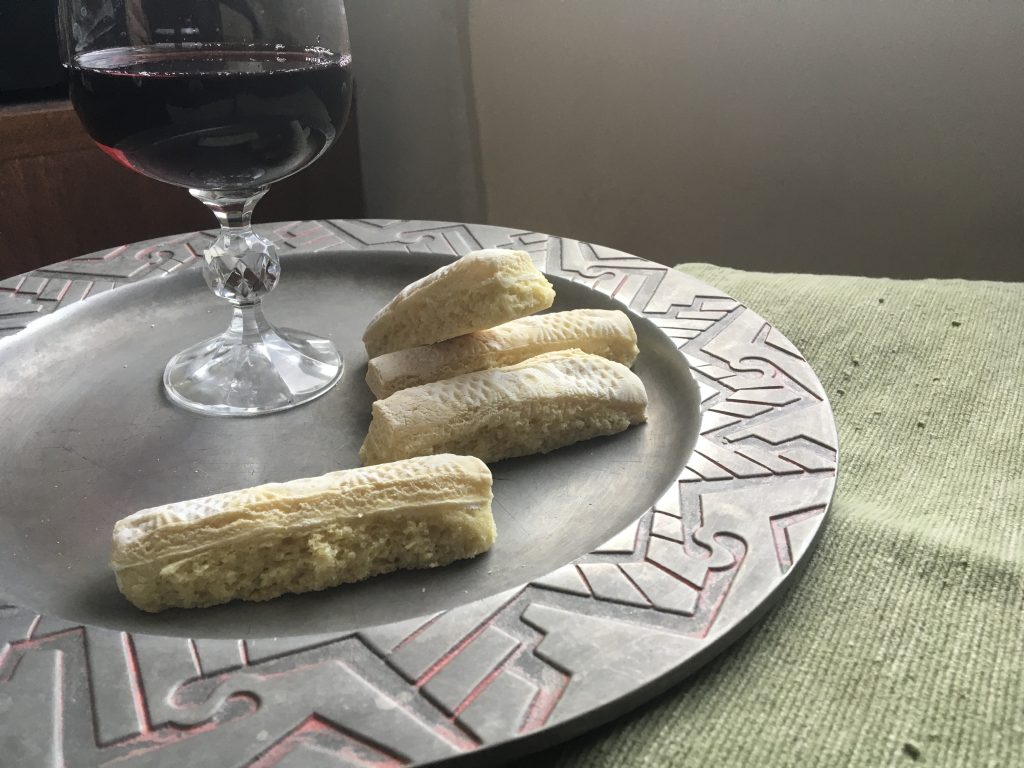
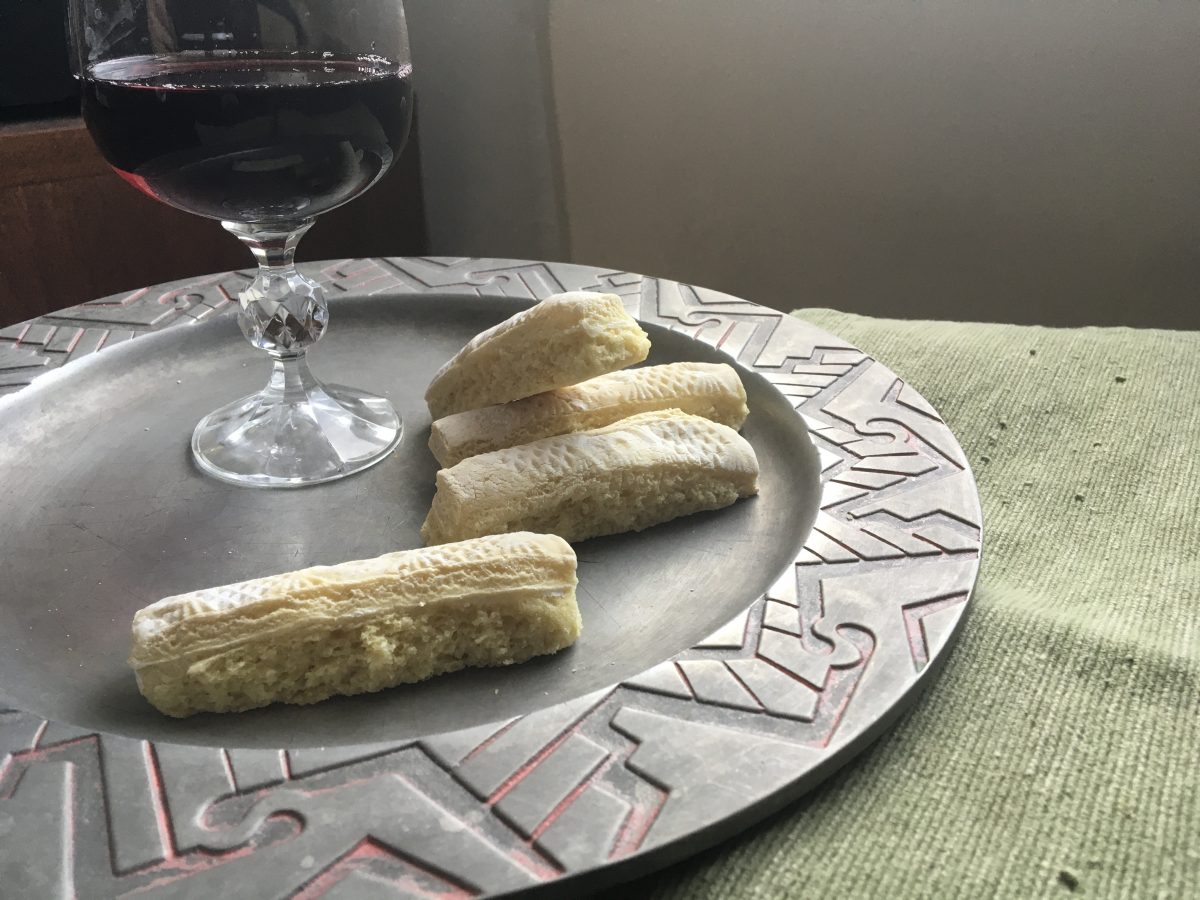
Kvircedli are a rectangular molded cookie that holds good impressions but does not get painted. It has a texture like crunchy, chewy sponge cake, a nondescript but familiar flavor that will remind you of Ladyfingers, and an almost unique profile that displays the airy texture inside.
The recipe itself looks like a classic Springerle, with 25% less sugar, lemon as the only flavor, and a whopping eight (8) times as much leavening. That last is the elephant in the room. Normal Springerle use ¼ tsp. of Hartshorn (baker’s ammonia) for a 3-egg recipe. Kvircedli use a full 2 tsp. Two bloody teaspoons!
That enormous amount of leavening requires a lot of little tricks that are hard to figure out, but turn out to be directly tied into the cookie’s history, tradition, and purpose. So let’s turn to that front next.
Kvircedli History and Tradition
The former Hapsburg Empire left behind a legendary baking tradition that pervades every one of the varied corners to which it stretched. Austria in the west? Ever hear of Linzer Torte or Strudel? The Balkans to the south? They may hate each other politically, but the Serbs, Croats, Bosnians, Albanians, etc. have nothing but respect for their respective baking traditions. We do too. The Czechs and Moravians to the north? Awesome. The Czech tradition of Christmas sweets is what drove us into baking so much in the first place.
The Hungarians in the east use their ovens every bit as well as their former Imperial brothers. Kifle, the filled flaky cookies we called “Kolachy” in Volume I; the famous Esterhazy and Dobos Tortes; the Poppy Seed and Nut Rolls found in half the bakeries of America; it doesn’t end. You could probably list dozens of absolute classics that either originated in Hungary, or get made there with as much skill as anywhere else in the world. So when we saw the Hungarian folk recipe that Mirtill shared, which took dense Springerle in a whole new direction, we knew it had to be tried.
You’ll read below about some of the troubles we ran into. Those didn’t get solved until Scott went back to Mirtill for a lesson on the sort of deeper background that often gets ignored.
The Hungarian people go back to Attila the Hun and his wild tribesmen from the vast steppes of Asia, who invaded the Roman Empire more than 1500 years ago. After his death in 453 they settled in the land that now holds their name, with a hauntingly beautiful language related to nothing in Europe except Finnish and Estonian – three peoples who trace their history to common roots.
The following centuries naturally saw a certain amount of immigration from other areas, leading to several ethnic minorities. The German speaking minority are known as the Swabians. Somehow or other that group (apparently with the aid of some Capuchin monks) became big players in Hungary’s winemaking tradition, with a major center in the little town of Mór (population just under 15,000). Think of it as Hungary’s Napa Valley and you’ll get the idea. Other parts of the country specialize in rich reds or aromatic dessert wines, but Wikipedia says that Mór built its reputation on dry white wines similar to sauvignon blanc.
Kvircedli come from that region, and are best known as the treat that winemakers still serve whenever they open the doors for a tasting. Mirtill tells me the cookie also shows up at special events like baptisms and weddings, though I suspect you’d get into a flavored variation for those. More on that below.
Stop and think about that. This is a cookie designed and used in a small, immensely scenic part of the world for the express purpose of vineyard tours and celebrations. How awesome is that? But it gets even more quaint if you dig a little deeper!
Legend holds that local women created Kvircedli to get around a religious law that forbade them from drinking alcohol. Some ignorant, almost-certain-to-be-a-bachelor really thought he could expect the wives to sit there quietly while their husbands quaffed the local product? Even in the name of religion? Riiiight. The ladies responded by inventing this airy, absorbent cookie with a convenient rectangular shape that’s perfect for dipping into unwatched cups. And thus they “ate” their wine instead of “drinking.”
Problem #1: Is the Flavor Too Bland?
The history and the story both help to explain the flavor profile. Traditional Springerle have a distinct anise flavor that would not play well at a wine tasting. Okay, it might not ruin a well balanced red, but after that you’re looking at some potentially ugly clashes. A nice, neutral, vaguely lemon profile makes a much better palate cleanser, while the crunchy-outside, chewy-inside texture does the exact same thing for your other senses. It makes an ideal reset button to move from one wine on to the next.
Pretty smart! If you’re a winemaker looking for a fantastic and proven gimmick, I offer Kvircedli at your tastings as suggestion #1.
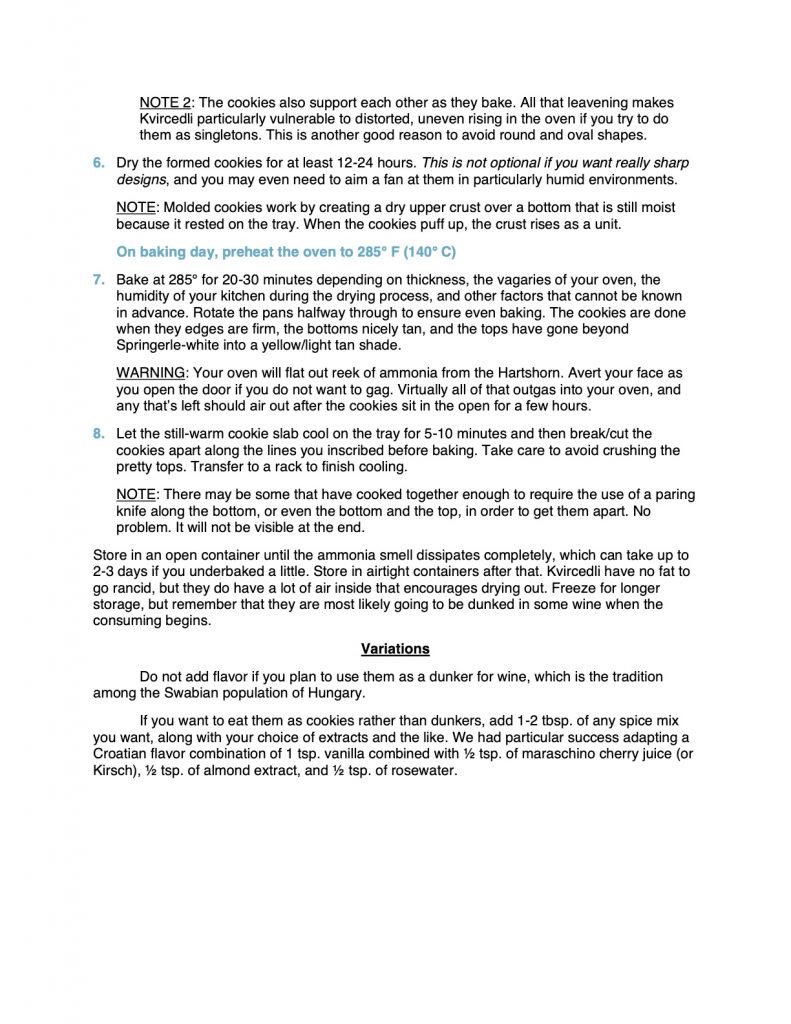
But what if you just want to enjoy the cookie in some other setting, like one of those baptisms or weddings? Well… I guess my first answer would be that celebrations often involve a lot of wine, and simple flavors tend to be child friendly too. That said, it takes almost nothing to jazz this dough up with whatever interesting flavor may strike your fancy. We did a batch with that Croatian flavor profile that worked so well for Dalmatinski Rafioli, and the result was all we could have hoped. A spice or spice mix would work every bit as well. We put a suggested proportion in the recipe if you’re interested.
Problem, if it is a problem, solved.
Problem #2: Stick to Simple Patterns
Springerle taste fine and all, but their glory lies in the amazing, painted patterns that make people say, “That looks way too pretty to eat.” We went into this hoping that Kvircedli would offer a similarly result with a very different texture. The strong similarities between the two doughs gave us a lot of hope in that regard. But it was not to be.
It took a while for us to realize it, but that rectangular shape is actually a major key to making this recipe work. Here is a picture of some traditional molds that Mirtill Seregély shared:

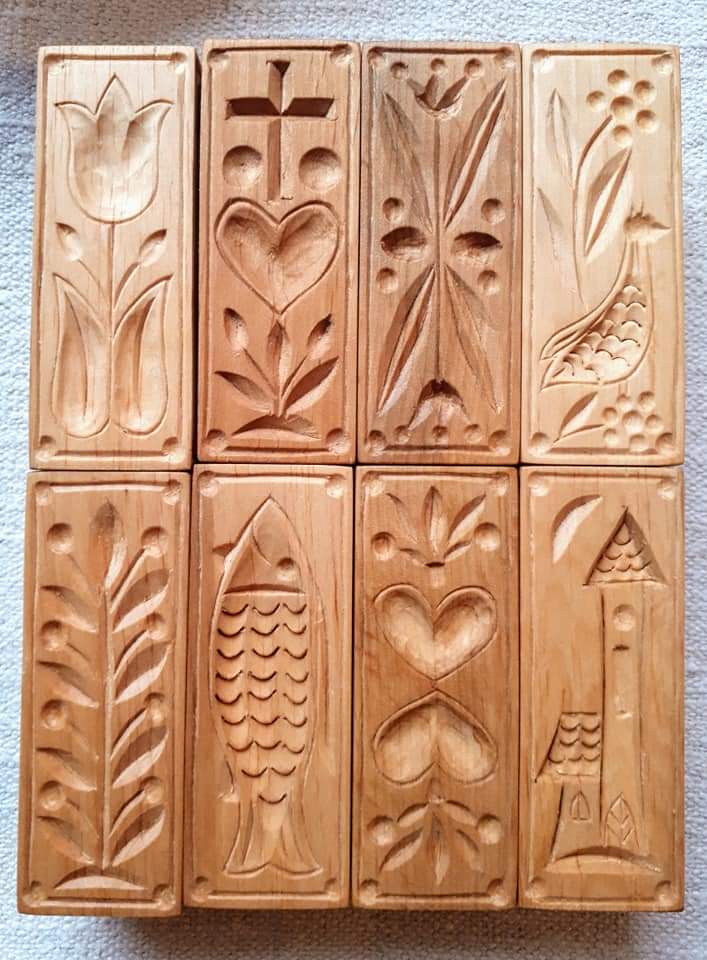
That rectangular shape turned out to be important.
Kvircedli stray from the traditional Springerle recipe by using an enormous amount of leavening to change the internal structure of the cookie. That’s the core idea. When we used a traditional Springerle mold, particularly a round or oval one, the pretty surface patterns held up fine, but the cookies baked into uneven, lopsided shapes tilted as much 45º off the level. The dough puffed out randomly to one side or the other, and occasionally even heaved up unevenly in two directions.
Looking a little closer at the recipe, and at some online examples, showed us why. One of the key features in a traditional Springerle is the “foot”; a ring of dough that puffs out sideways as the cookie bakes. You see this in Macarons too. The cause is the same in both cases.
First you make the dough, and then you stamp it with a fancy shape (for Springerle) or pipe it into a neat circle (for Macarons). Then you let the dough rest on a counter long enough for the outside surface to dry out into a skin. That takes up to 2 hours for Macarons, and 24 hours for Springerle. The bottom, of course, does not dry out because it is resting on a parchment-lined tray.
When you bake the cookies, the bottom and core expand as heat turns the inside moisture to steam and/or activates the leavener to create CO2. Boyle’s law says those gases need to expand in all directions, but they can’t go up through the dried out skin. So instead you get extra vertical rise combined with a horizontal “foot” as dough puffs out around the bottom.
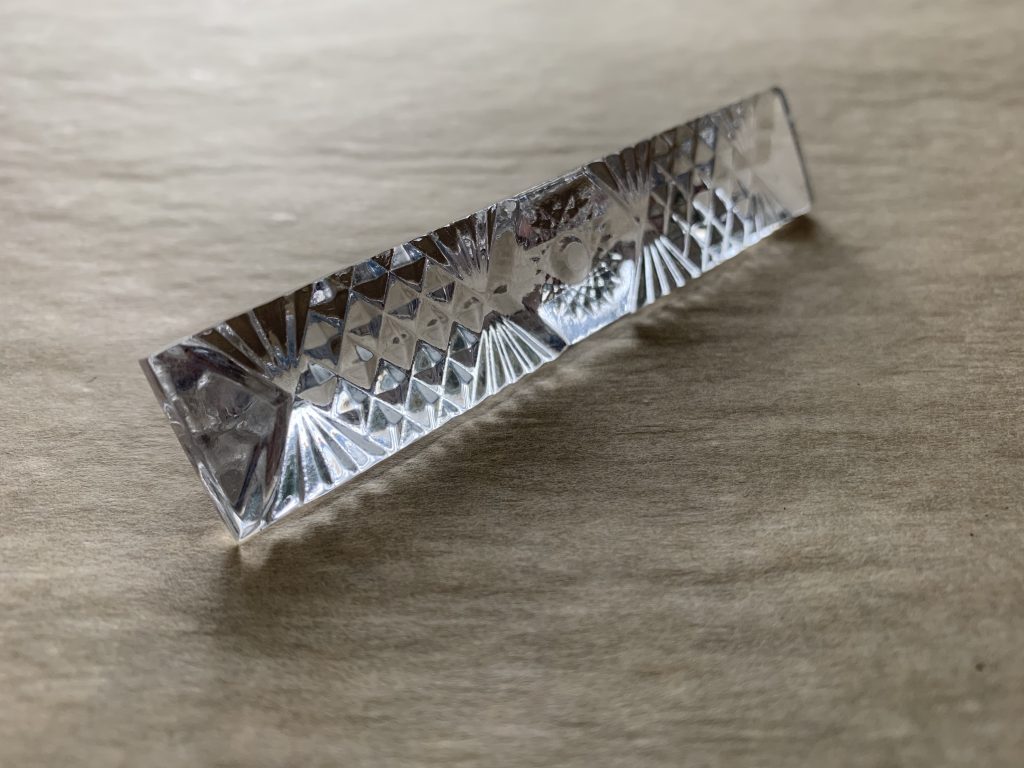
A pan of Kvircedli packs the unbaked cookies close enough together (about 3-4 mm = ⅛” apart) for the feet to expand into each other. The result? Each cookie supports its neighbors from the side as they bake, adding a little extra rise while also preventing a tilt in any one direction. Have a look at the tray we just baked for this article (stamped with the bottom of a crystal knife rest since we do not have one of Mirtill’s special molds to play with):
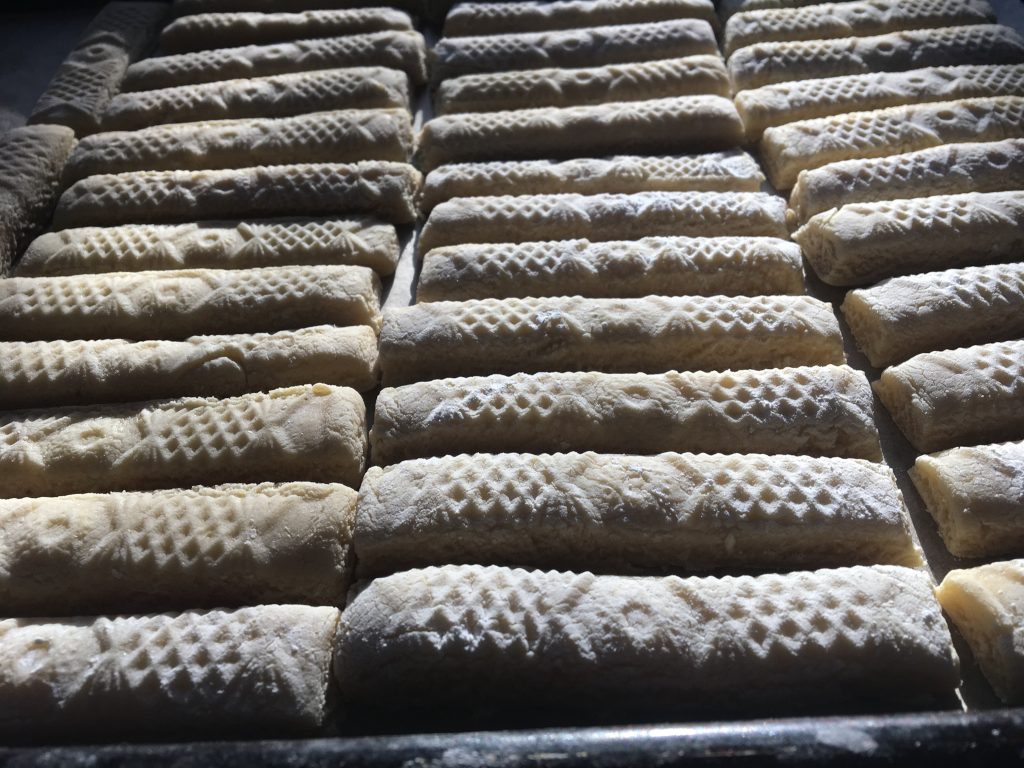
That is the raw dough.
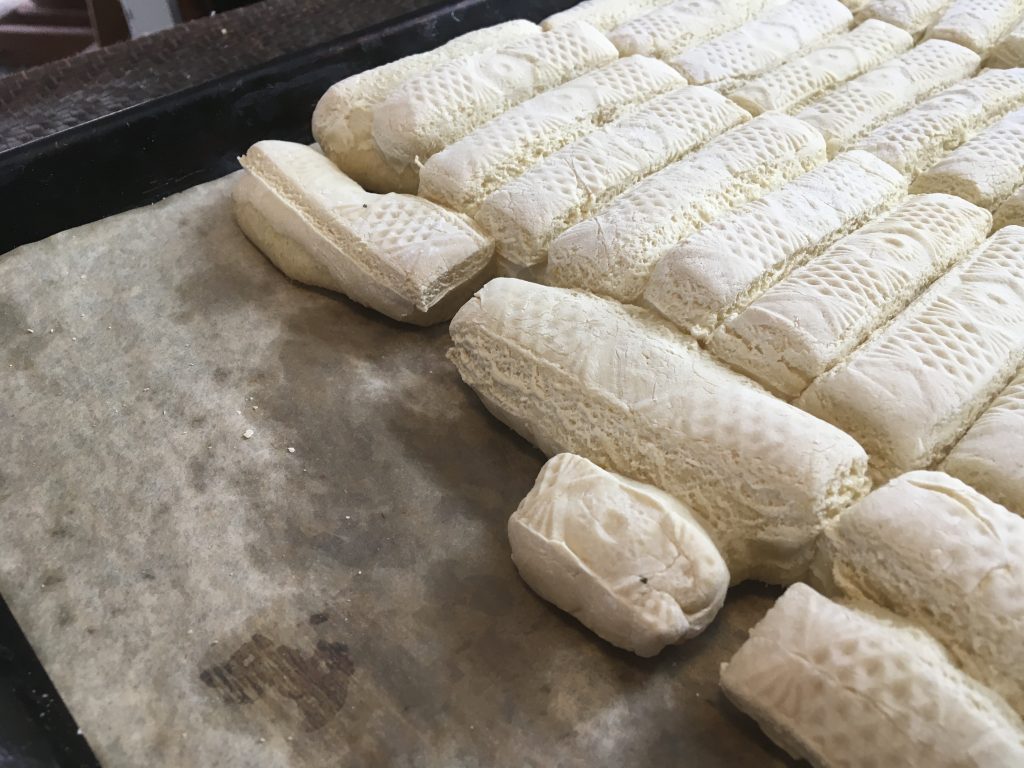
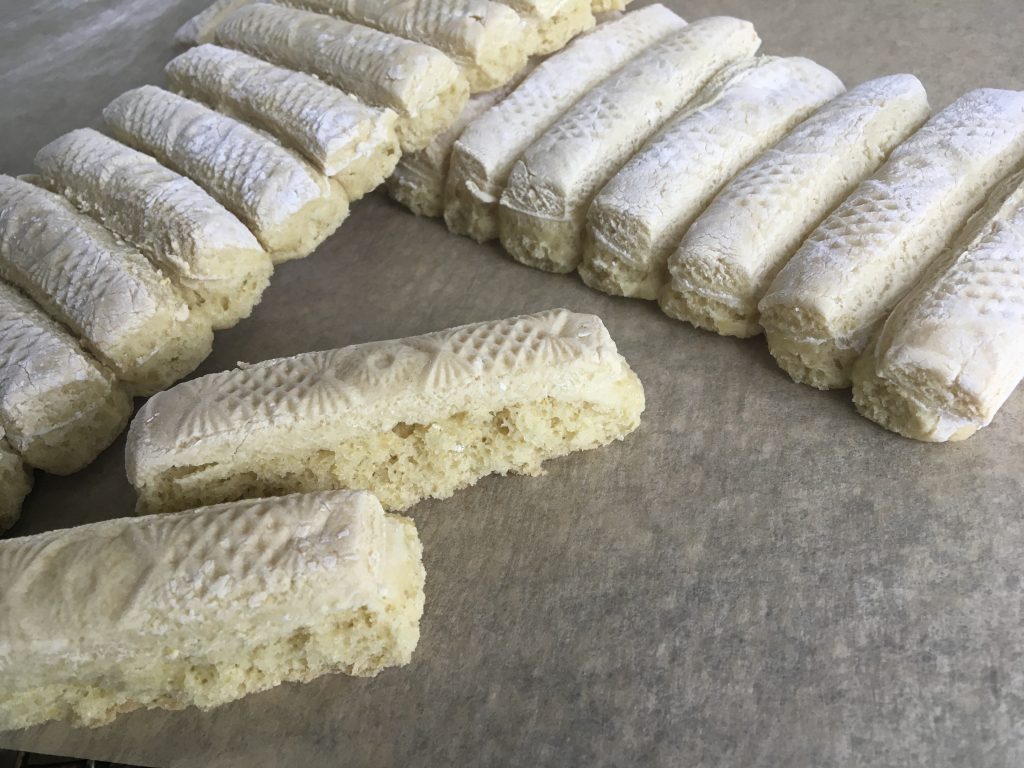
Here is the same tray after baking. The middle ones are nice and even, and have puffed from ⅜” up to a full 1″ tall. The ones on the edge got lopsided because they received no support from a neighbor. FWIW, this process also results in a much desired side effect. Kvircedli are a breakaway cookie that gets divided along those pre-inscribed lines. Doing so reveals the uniquely beautiful, spongy interior.
Problem #3: The Evil, Cat Box Reek of Ammonia
But there was a joker in the deck! Hartshorn a/k/a Baker’s Ammonia a/k/a Ammonium Carbonate has yet a fourth name: Smelling Salts. And believe me, they work. If your beloved should ever swoon in a most dainty and Victorian manner, one good whiff of this stuff will quickly break the trance. Blech.
Hartshorn works by breaking down into ammonia and CO2 when heat is applied. The ammonia bakes off, while the CO2 provides the lift you wanted. Springerle recipes use a bare ¼ tsp. in the dough for this volume of eggs and flour. That amount is enough to leave a foul odor in your oven, but won’t be noticed in the final product over all the anise notes. With Kvircedli you’re going to wince when you open that oven, and sticking your nose against the fresh baked cookies is not going to make you happy. Indeed, our recipe contains an explicit warning to avert your face when you open the oven door in order to spin the baking trays, and again when you remove the finished cookies.
Some of that odor inevitably ends up embedded inside the freshly baked cookies.
We tried a few things to fix this. First, we cut the amount of Hartshorn in half and replaced that portion with baking powder at our normal ratio of 3 parts baking powder for every 2 parts of Hartshorn being replaced. That was the batch mentioned above, where we used proper Springerle molds in addition to the knife-rest stamp. The results were uneven. Literally, and sometimes at multiple angles inside the same piece. It was worst in the oval Springerle that baked in splendid isolation, but the phenomenon showed up in the square ones we baked side by side. So was it the leavener? The much more varied heights of the pattern? Or the fact that “side by side” meant a nice even row, that only gave mutual support from one direction?
Bad science on our part. There’s a reason why each experiment is supposed to change just one variable at a time. But we never did go back to finish looking at the baking powder idea because Scott paused to talk things out with Mirtill. Understanding the history and purpose showed us that Kvircedli were meant to have a plain flavor, and were not a medium for display like Springerle. Who would want to dunk a work of art? Why would you want to distract from the wine you’re sampling, especially with brilliant, jewel tone colors? And if the rectangular shapes served a purpose, that meant the breakaway effect was deliberate, which in turn…
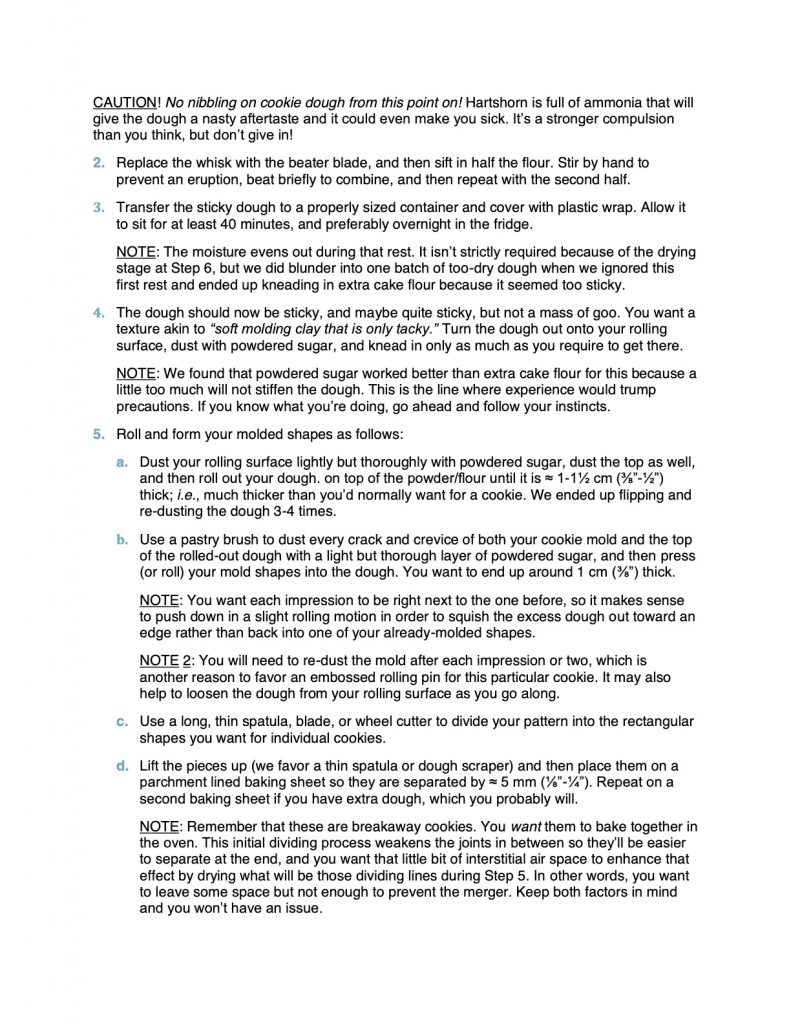
You get the idea. It made more sense to go back and tweak the original recipe for a longer and lower cooking time that would allow more of the ammonia to bake off. The original formula called for 12-20 minutes at 150º C, which is 300º F. We reduced the temperature to 140º C (285º F) and left them in for the full 20 minutes, with a single spin at the 10 minute mark to avoid hot spots.
The result? A little less browning on the bottom, which we missed; the exact “yellow” tone described in the original recipe, which hadn’t been as clear before; and about 75% less reek in the finished cookies. Mirtill had also told us that she’d done enough casual research to believe that true Swabian bakers solve the problem by simply leaving the baked cookies out for a day before eating. Another baker we met on Facebook confirmed this in a conversation with her Hungarian relatives. And, sure enough, that leftover smell disappeared after a few hours on a plate once we instituted the longer baking time.
And so you get to our final verdict. For shaped and dried cookie dough that is ⅜” thick (1 cm), bake at 285º for 20-25 minutes instead of 300º for 12-20. That’s what you will read in the recipe below. Here in private we will use less exact numbers and call it 18-30 minutes to allow for differing ovens and the erratic moods of your household gremlin. We’ve all got one, and they have a notoriously fickle sense of humor.
Problem solved, at least well enough to avoid going back for a new round of experiments with baking powder. Let us know if you try it, however. We’d love to know if there is a way to make the recipe without having to deal with the cat box effect.
Conclusion
Molded cookies involve some extra work to stamp in the pattern, and extra time because of the overnight rest that forms the required crust. There is no getting around that. But if you are the sort of baker who likes that process, we 100% believe you ought to give Kvircedli a try. That goes double if you happen to own a traditional 4-sided mold that can be conveniently rolled-and-pressed, or one of those patterned rolling pins. Either way, target a final thickness of around ⅜” (1 cm), which will be cut into nice, rectangular shapes. Array on your tray about ⅛” (3-4 mm) apart, and then proceed.
Go with the classic lemon-only profile if you want to stick with tradition and/or use them in a wine tasting. They really work that way, and yes: we did make sure to test it. [Hic!]
Add flavor to the dough if you want to eat the cookies out of hand (although Kate loves everything lemon and adores them as they are). Flavored, eating cookies can be painted if you so desire, but do not do so for dunkers. It serves no purpose and distracts from the wine itself.
Here is a final photo, and a copy of our updated recipe. Enjoy!