Most of the cookies that Americans would consider ‘obvious’ and ‘normal’ made their way into the original Heritage Cookies of the Old and New World. We are, after all, Americans. That is our world view, like it or not, so the things that have become traditional for the U.S. qualify by definition. But every so often you hit one of those “Doh!” moments when you’re reminded of a recipe everyone knows, that somehow slipped through all nets to lie there waiting for Volume II.
Case in point: Sour Cream Molasses Spice Cookies.
The moment happened in this case when a Facebook friend published an odd version of Speculaas – the great Dutch molded cookie – that included sour cream in the dough. Sour cream is a uniquely American ingredient, created in the U.S. as a version of Europe’s crème fraiche that could be produced on an industrial scale. She wrote that the recipe came from family friends who presumably brought the recipe back to Europe after visiting the States; reverse immigration at its best!
We’ll probably work up a version of that recipe for some future article, but the important thing here was Scott’s reaction: “Oh, I know where that comes from; this is that soft molasses spice cookie we had growing up… DOH!!”
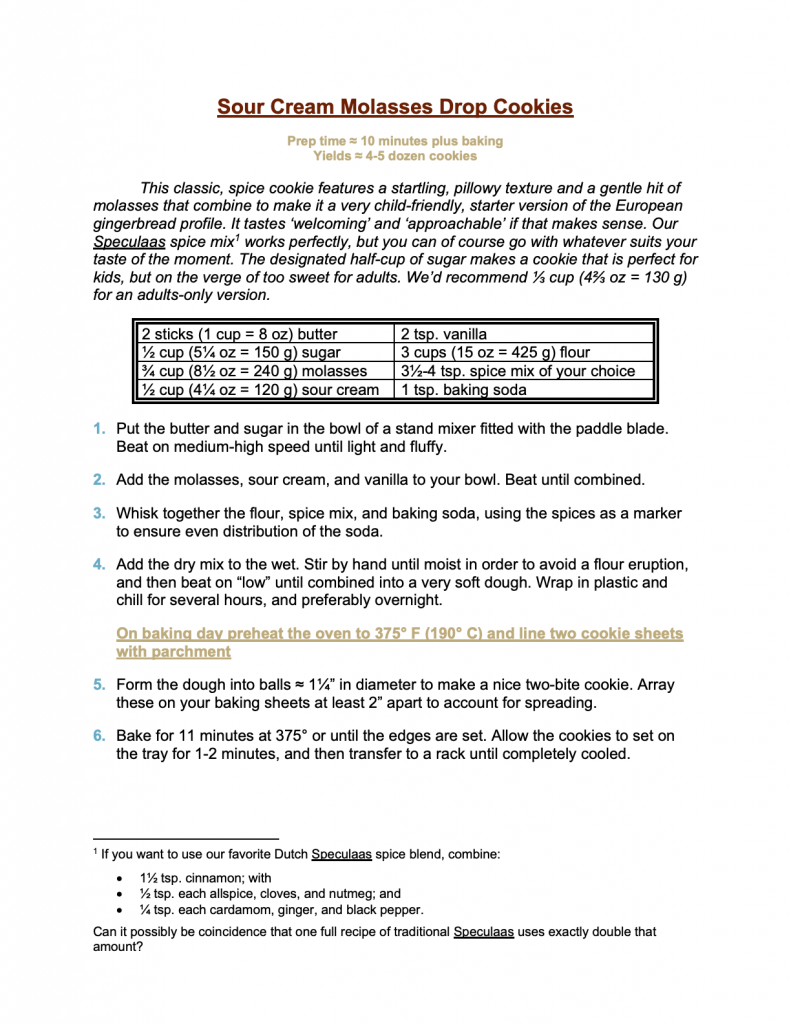
There’s really not much more to say. This is a cookie you knew as a child; as warm, comforting, and familiar as Grandma’s lap. It’s a classic American drop cookie, made extra tender and pillowy by the addition of a little sour cream, and interesting by the addition of some sweet gingerbread spices. Bing, bang, boom: done. They really are just that easy.

There are only two notes we’d like to emphasize before closing. First, please customize these by using your favorite spice mix. We went with our Speculaas mix for the recipe in deference and thanks to Hayden for bringing the memory back to life, but the cookie will work just as well with anything that suits your particular, mood, taste, and spice cabinet. Pumpkin pie spice; classic. Apple pie spice; classic. Your mother’s gingerbread mix; classic. Just make it balanced, and maybe weighted a little bit toward the cinnamon since this is, after all, an American cookie and we are obsessed by that particular spice in our baking.
Second, have a source ready to receive your largess because these things won’t last in the house. They are high powered, superconducting hand magnets, and once the cookie reaches your fingers, you know where it is going to end up. On the plus side, this is also a perfect way to get the children in your life started on a lifelong enjoyment of the wonderful world of spiced breads, cakes, and other treats. And to teach them basic courtesy. “Please” and “thank you” are easy concepts to learn when there are cookies in the jar.
Enjoy!