CHINESE RESTAURANT ALMOND COOKIES, Now More Than A Century Old

Chinese immigrants in America, from a cookie’s point of view

You may have noticed that many Chinese restaurants in the U.S. have an out of place dessert tucked away on the menu: a peculiarly tender almond cookie. Research (a/k/a the 2020 Nom Wah Cookbook) shows an interesting history.

The oldest Chinese restaurant in New York, Nom Wah Tea Parlor, began in 1920 as a bakery focused on standard American fare like cakes, tarts, and of course cookies. These Almond Cookies were a popular creation of the Chinese immigrant owners. Matters changed because that little bakery had a sideline operation selling tea and various traditional savory snacks from Hong Kong; small plates that sparked the NYC love affair with Dim Sum. The sideline restaurant business swallowed up the bakery, and the rest is history. But this particular cookie was too popular to die! It may have stood out like an American sore thumb against all that traditional fare, but the customers insisted. They wanted all those little dumplings, noodle dishes, skewers, soups, and meats most of all… but they wanted Almond Cookies too. It survived every challenge.

Your customers insist!

Other restaurants ran into the same issue when they began to copy the Nom Wah success story. ‘In the know’ customers simply wouldn’t go if a Dim Sum restaurant wasn’t [ahem] authentic enough to include Chinese Almond Cookies on the menu. Never mind that the recipe had no Asian roots.

The cookie itself is a simple shortbread that uses lard instead of butter, a lot of almond extract, and an exceptional number of egg yolks. The proportions are pretty standard beyond that. It’s the history, texture, and flavor that make this cookie such a different, delightful, and (to certain Pavelle family females) indispensable treat.

“Melted” Means Melted

Kate, a long time aficionado of almond cookies, handled the testing on this one. It’s a very old and very well established recipe, so she only ran into two challenges.

First, a certain husband of hers who shall remain nameless, blameless, and in all ways sacrosanct, wrote “lard at room temperature” in the first version instead “melted lard cooled to room temperature.” This made the dough extremely stiff and hard to work with.

Consider yourself warned.

NOTE FROM KATE: Now that I have tried the melted method, the dough seems less “short” and easier to handle. Before, I had to add a teaspoon of water, thinking that our flour became extra dry over the winter. Surprisingly, the end product has the same, identical texture! The only catch: I found it best to let the lard melt ¾ of the way, and then take it off the heat as I prepared the other ingredients. It finished melting in the residual heat, and then cooled just enough to start solidifying again when I was ready to use it. The food processor will handle the solid bits – just make sure you don’t inadvertently cook the egg yolks that are already waiting! (Barely melted lard is warm to touch, but not hot.)

The cookie forming goes like this:

  1. Divide dough in half.
  2. Divide each half into 18 portions (I like to square up the dough using my bench scraper, then I eyeball the sections.)
  3. Roll each portion into a ball in your hands, press the almond into the center, and then squish lightly. Don’t worry about fixing small cracks, it will bake up nicely and the texture, highlighted by the yellow egg wash, is part of cookie’s appeal.

To Soda Or Not To Soda, That Is The Question
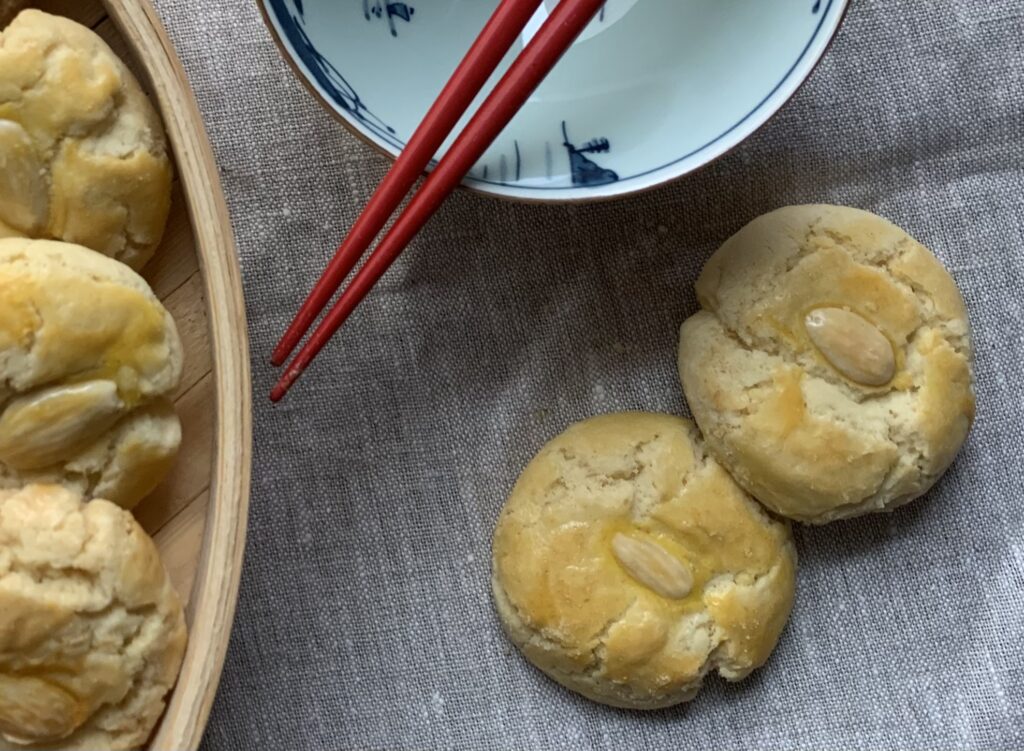
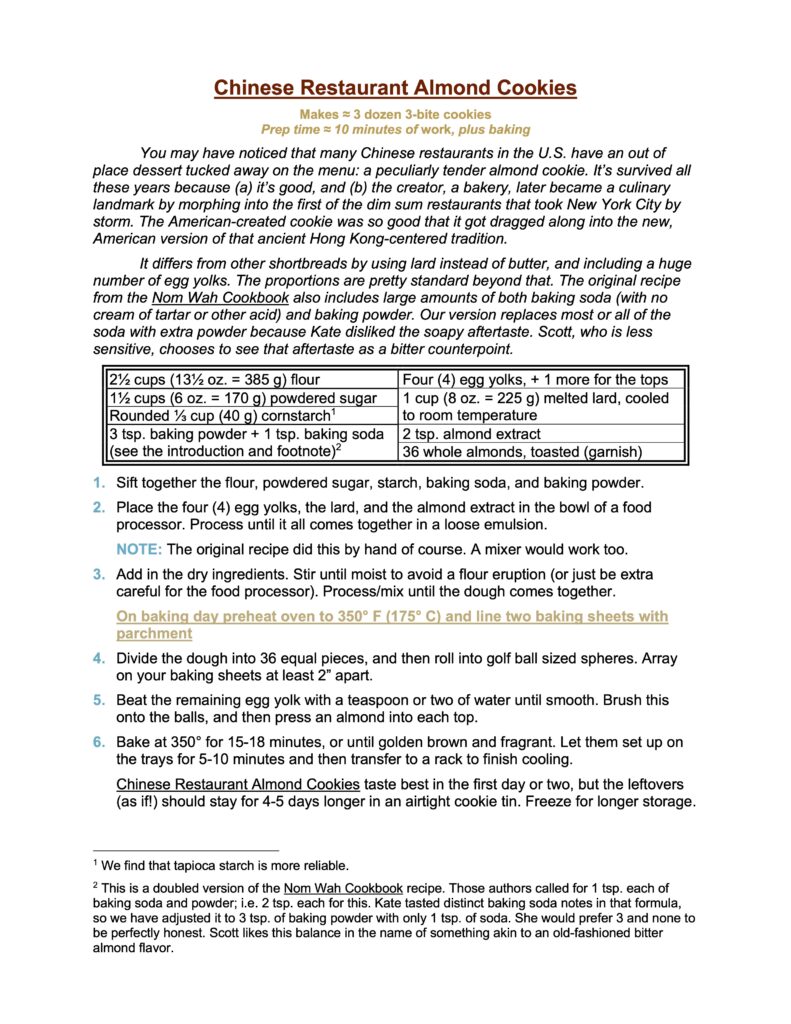
We decided to write this up as a doubled version of the recipe in the Nom Wah Cookbook. Those authors called for 1 tsp. each of baking soda and powder; i.e. 2 tsp. each for our version.

Kate tasted distinct baking soda notes in that formula, though Scott (who is much less sensitive to bitter flavors) was willing to give it a pass. So we tried a second version, with two teaspoons of cream of tartar to react with the baking soda byproduct. Those cookies still tasted a bit soapy to her extra sensitive palate, and were a bit too puffy for Scott – a fact which proved she was correct in tasting unreacted baking soda still in the dough.

Do you know that story about the recipe testers who met up with Goldilocks?

Four teaspoons of baking powder with no soda would have eliminated the soapiness for sure, but now we had to deal with the unwanted extra rise. And so we settled 3 tsp. of baking powder. Except… A certain angelic, blameless, and nameless husband pointed out that almond extract originally came from purifying bitter almonds to remove the cyanide. So maybe that baking soda flavor was actually a feature instead of a flaw? Was it possible that a certain recipe tester was being too sensitive? [NOTE TO SELF: Married men should know better than to use the words “too” and “[you-know-what]” in close proximity. Thank goodness the nameless and blameless husband at issue would never, ever make such a rookie mistake.]

NOTE FROM KATE: Scott may be onto something with that touch of bitter almonds. The batch below (3 tsp baking powder, 1 tsp baking soda) leavened about the same (the cookies puff up and deflate a bit with cooling.) A side-by-side taste test revealed that the “soapier” cookie is more authentic! It has that certain something. I like it toned down a bit, but not all the way. But now you have options and see how “soapy” a cookie you prefer.

Suffice it to say that we leave things up to you. It’s a matter of taste. Do you want the bitter edge? Or do you find it revolting enough to point fingers at your entirely innocent spouse, who only wrote down what the original authors required? Almond, or bitter almond? Tradition, or improved?

There’s really no way to lose.

Enjoy!
HARTSHORN CRACKERS, A Beautiful and Tasty Illusion Cookie

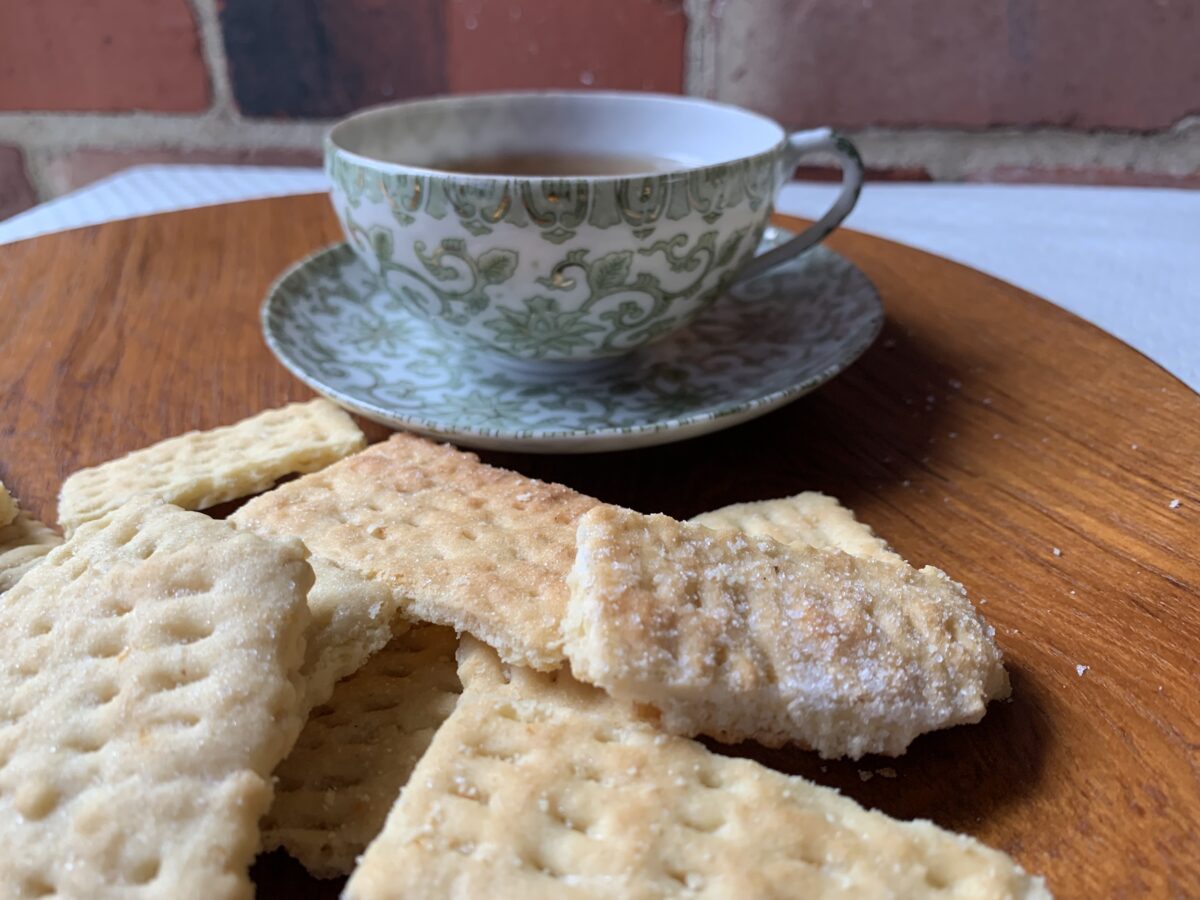
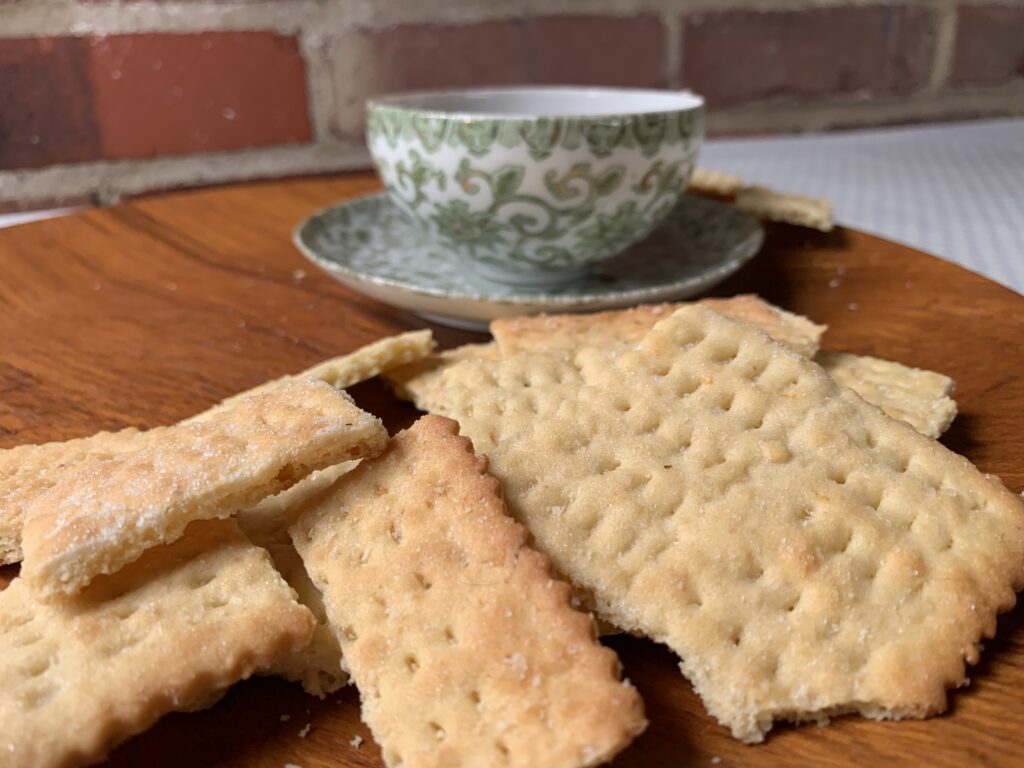
Appeance? Cracker. Texture? Cracker. Taste? Sugar cookie. Gotcha!

We often discover something new and exciting as we experiment when odd or exotic recipes appear on the radar. We expected no less with this one. “Crackers?” It had to be a European version of those crispy, crunchy Mediterranean tea cookies. Right?

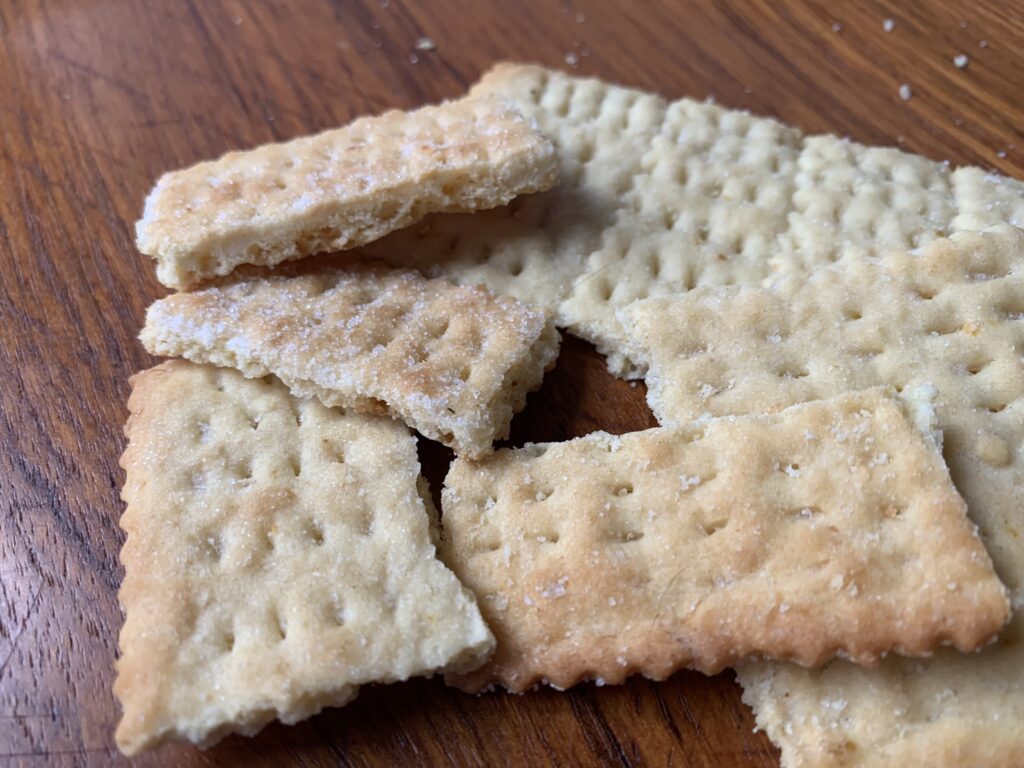
Nope. These taste like a standard sugar cookie, and earned their name by mirroring the appearance and texture of a classic saltine a/k/a soda cracker. They are eminently snackable too. Dangerously so. Each piece is so small that you will find yourself innocently popping five or ten at a sitting, which actually adds up to more than that regular sized sugar cookie you would have been able to resist.

Unique, fascinating, and familiar all at once. How cool is that?

Click here if you only want the recipe without the discussion

Saltines, right? Gotcha!

The Things You Learn When You Do The Math…

The past few months have uncovered several new recipes that rely on baker’s ammonia, including a few that feature a crisp, crackery texture achieved through the use of an antique leavening agent called baker’s ammonia a/k/a hartshorn. See, e.g., Norwegian Pretzel Cookies (Kringla), Greek Olive Oil Cookies (Ladokouloura), and Lebanese Anise (Yansoon) Cookies. So we were kind of excited to try this one, which promised to be a more classic European version.

The Mediterranean recipes both start with oil. The older versions of this recipe start with lard or shortening. Seems like an obvious connection, right? The only unusual thing was the math. All the classic Ammonia a/k/a Hartshorn Cookie recipes ended up with a really odd amount of fat when normalized to a reasonable amount of flour. A bit more than three tablespoons. At the same time, the flour measurements got weird if we tried to normalize things from the fat or sugar point of view.

Version 1.0

I decided to plan out my first test recipe by weight since the numbers weren’t that far off. 100 grams of lard, 100 grams of sugar, and 250 grams of flour. 1 to 1 to 2½, spread over two baking sheets. The result? Extraordinarily thin crackers that tasted like a cookie, but with a very distinct flavor from the fat. They were also a little greasy.

NOTE FROM KATE: They were a fun kind of greasy! Sometimes, using an animal fat you already have saved from a roast can give this kind of a cookie a very interesting character. Flaky tenderness and a hint of other flavors add to the gustatory experience. I like knowing that you’re eating a natural product and not a highly processed shortening. Scott will disparage that from time to time as “virtue points,” but they matter to me.

Fair enough. 250 grams of flour equals 1¾ cups of flour. The next batch would increase the flour to an even two cups. That would take care of the greasiness. The sugar level was about right. But what about that very lard-heavy flavor? What could I do for people who prefer something less distinctive and more common? Shortening, yes… but the flavor wasn’t loud enough to do with a totally neutral fat. So why not clarified butter?

How much butter would I need? Butter is about 16-18% water… Assume that’s been cooked that off, and account for a little more weight from the milk solids… And you end up with…

Son. Of. A. [cough]! You end up with exactly 4 ounces, dead on the nose. And what is 4 ounces? Exactly one standard stick of butter, or and even ½ cup.

And was I wasting effort and cleaning time by assuming the recipe called for two baking sheets? I had carefully rotated the pans midway through because thin dough and high heat are a bad combination. But even so we ended up with one tray browned more on the top, and the other tray more on the bottom. Annoying. And there was an awful lot of room around the dough on each tray, so…

Version 2.0

(A) Clarified butter instead of lard. (B) A little more flour. (C) Roll it all out to fit on a single sheet pan, and see if it’s still thin enough to be a “cracker.” (D) Adjust the cooking time to account for the extra thickness, and having only one pan in the oven.

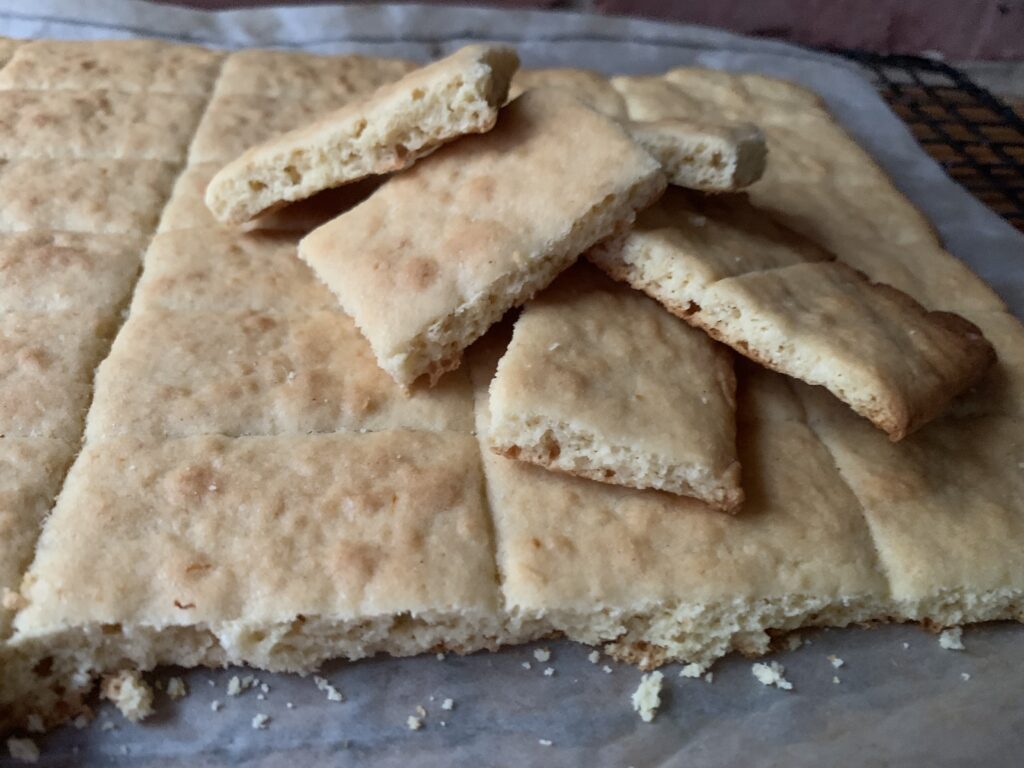
This is how they come out of the oven. See the uneven break by the bottom right? That’s what happens if you merely cut the lines without giving the wheel/blade a little wiggle to add an extra hint of separation.

This experiment told us (almost) everything we needed to know.

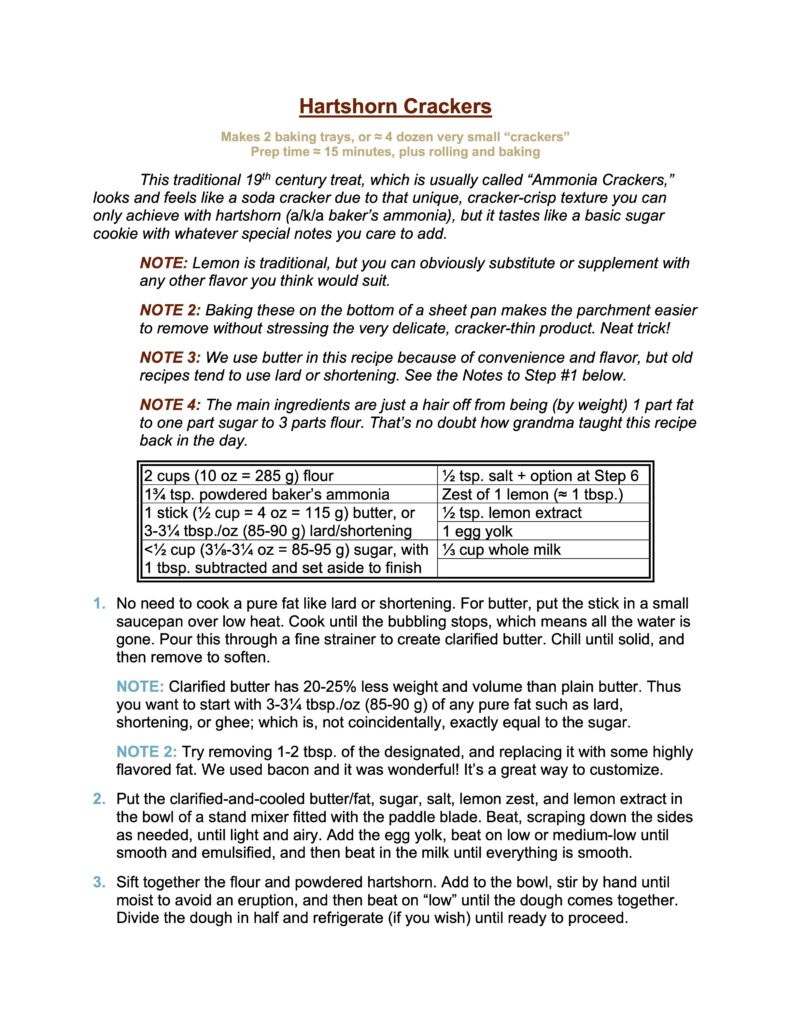
  1. I had the proportions nailed. The dough was easy to make, easy to handle, and just plain worked.
  2. This amount of dough rolls out thin – something on the order of ⅛” when all is said and done – but that’s still a big difference from “roll until you can roll no more.” The final result ended up being just under 3/16“, which definitely gave more of a cookie vibe than a cracker.
  3. The flavor changed radically. Lard notes versus butter notes were extremely clear when we tasted them side by side.
  4. The butter version does indeed taste standard. Just like a sugar cookie. But is there anything easier to vary than a sugar cookie? Tea, chai, cinnamon, other spices, herbs… This is clearly a cookie that bakers can play with to an all but infinite extent.
  5. Those darned lines aren’t always clean enough when the cookie comes out of the oven.
    Thick indeed! These come off as more “cookie” than “cracker.” Note how the lack of docking adds to that.

This cookie was, quite honestly, good enough to publish. But we weren’t done just yet! Could we customize this into a true illusion cookie with a taste that would complement a cookie tray instead of just fitting right in with so many other tastealikes?

Digression: Revisiting The Ratio Of Ingredients

Remember how odd the ingredient list seemed at the start of this project? And how the fat didn’t work out evenly until we figured out that it equaled a 4 oz. stick of butter that’s been clarified? But the overall ratios still didn’t work out to even numbers by weight, as experience taught they should in such an old recipe?

But now, with some extra flour and a more limited amount of fat… Aha! These changes created something very close to a 1:1:3 ratio of fat:sugar:flour. Gotcha!

Version 3.0 (see below) established our preference for a little less in the way of both fat and sugar, and that is what the recipe now says, but we have no doubt how Grandma taught the recipe by that ratio back in the day.

Version 3.0

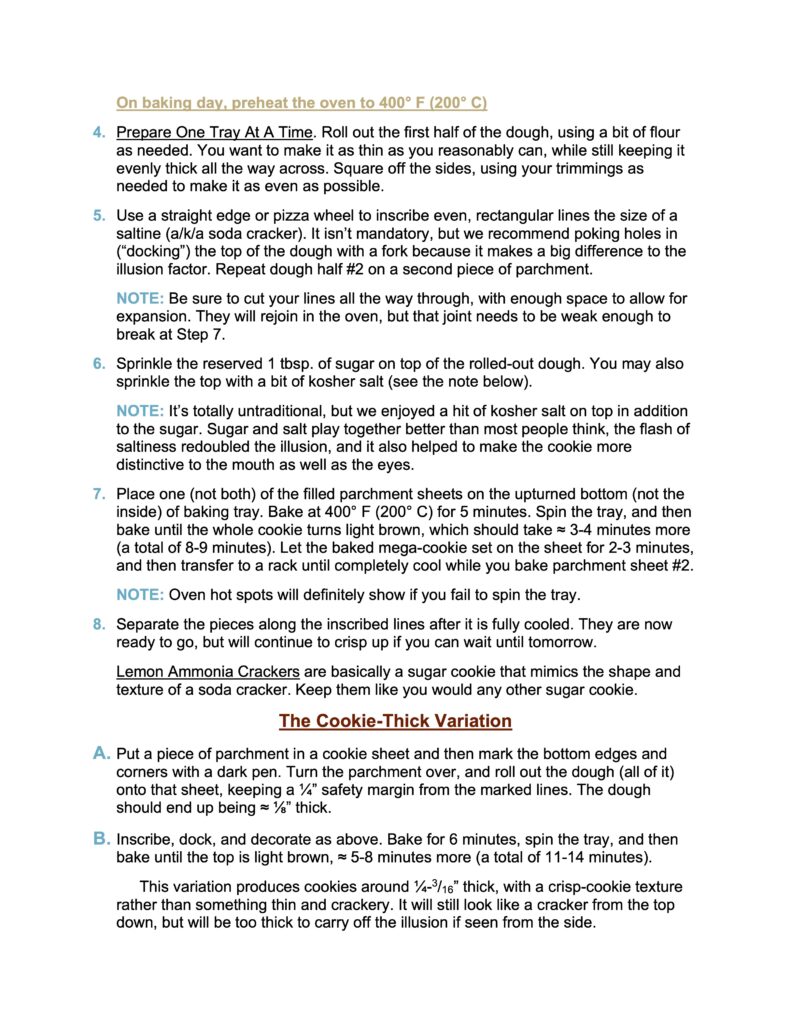
  • Use the 1:1:3 ratio of ingredients;
  • Add some bacon fat in place of butter (we ended up with 2 tablespoons after I rendered four slices in a pan);
  • Roll out two trays as thin as possible, and only bake one at a time;
  • Dock the dough to make the final product look more like a saltine; and
  • Move some of the sugar from the inside to a sprinkling on top that would mimic the salt on an actual cracker.

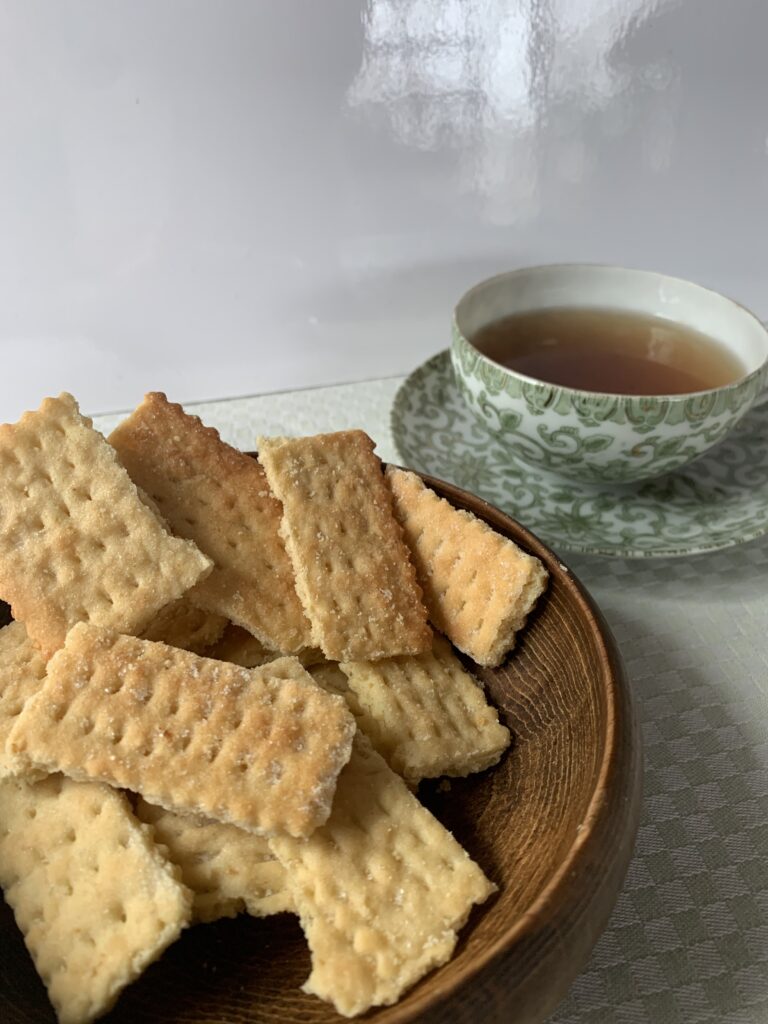
The result? Have a look!

[Shakes head]. I don’t know how I missed it, but this is a marvelous illusion cookie. It actually fooled our real life daughter when she stopped in to visit! That docking made a much bigger difference than I ever imagined.

We could taste the bacon, but only because we knew it was there. The bacon also added a healthy hit of extra salt that we both enjoyed – enough to bump the basic salt level in the recipe up from ¼ to ½ teaspoon (though we might revert to the reduced amount if we work with salty bacon fat again). I even enjoyed sprinkling the tops with a little bit of extra salt to enhance the effect. It now appears as an option in the recipe. Here, among friends, I will admit to recommending that option because it makes the cookie taste more distinctive. But that’s taste, not tradition.

IMPORTANT NOTE: We also learned, to our chagrin, that simply marking the lines with a fluted wheel isn’t enough. We lost several “crackers” because they baked together too firmly, and wouldn’t snap along the lines. Even more than we did with the thick cookie (see photo above).

LESSON LEARNED: Don’t just mark those lines; mark them clearly and emphatically, with a little wiggle of the wheel or blade to be on the safe side. You need the pieces to bake together in order to have that crackerish center show, but you also need the separations clean enough to be sure they will break evenly.

The only other adjustments came down to fine tuning the ratio. Hark! Can you hear your great-great Grandma speaking from the beyond? “It’s a simple ratio dear. Three parts flour, to one part sugar, and one part lard. But here’s the secret… They taste even better if you take back a spoonful of the sugar and fat.”

Grandma is great. Grandma is wise. Listen to your great-great Grandma.

Conclusion

This is one of those cookies where we started out thinking “A,” only to discover it was really a “B.” This is not one of those cracker-crisp Mediterranean tea cookies. It’s more like a good, cracker-crisp sugar cookie designed to create a convincing, extremely snackable illusion.

NOTE FROM KATE: Be careful with these – they are quite more-ish! The texture is a lot of fun. You will easily snack on five cookies when you would’ve said a “no, thank you” to a similar cookie in its one-piece form.

Here’s a summary of the lessons learned:

  1. The dough follows a 1:1:3 ratio of fat to sugar to flour, with a spoonful taken back from the first two.
  2. The cookie changes in wonderful ways if you mix and match different fats in place of the clarified butter. We tried them with lard alone, butter alone, and butter mixed with bacon fat. The last was the best, partly because we liked the extra salt.
  3. The illusion part matters, so roll the dough out super thin, take the time to dock them with a fork, and sprinkle on a bit of sugar to fully recreate the saltine look. Sprinkling on some kosher salt will also help the illusion, and has the side effect of making the cookie taste more distinctive.
  4. Maintain an even thickness. Smeared edges cook faster than rolled centers.
  5. Mark the dividing lines emphatically, with a little wiggle of the wheel/blade to add some room. The helps the “crackers” to separate cleanly.
  6. Just don’t separate them too much, because those broken-open sides show off the crackerish interior, which is both pretty and useful for the illusion.
  7. Bake only one tray at a time, and spin the tray just after the estimated halfway point. Two trays won’t cook evenly, and oven hot spots really show.
  8. The bake is done when the top turns cracker-tan brown. Go by that, not the designated baking time.
  9. Hartshorn is mandatory. Baking soda/powder yield a standard cookie texture.

All in all? A very successful experiment, and a cookie we will gladly add to the repertoire. Especially if we want something more on the snackable side than a proper dessert, or there’s someone coming over who’d be fun to fool…

Enjoy!