HARTSHORN CRACKERS, A Beautiful and Tasty Illusion Cookie

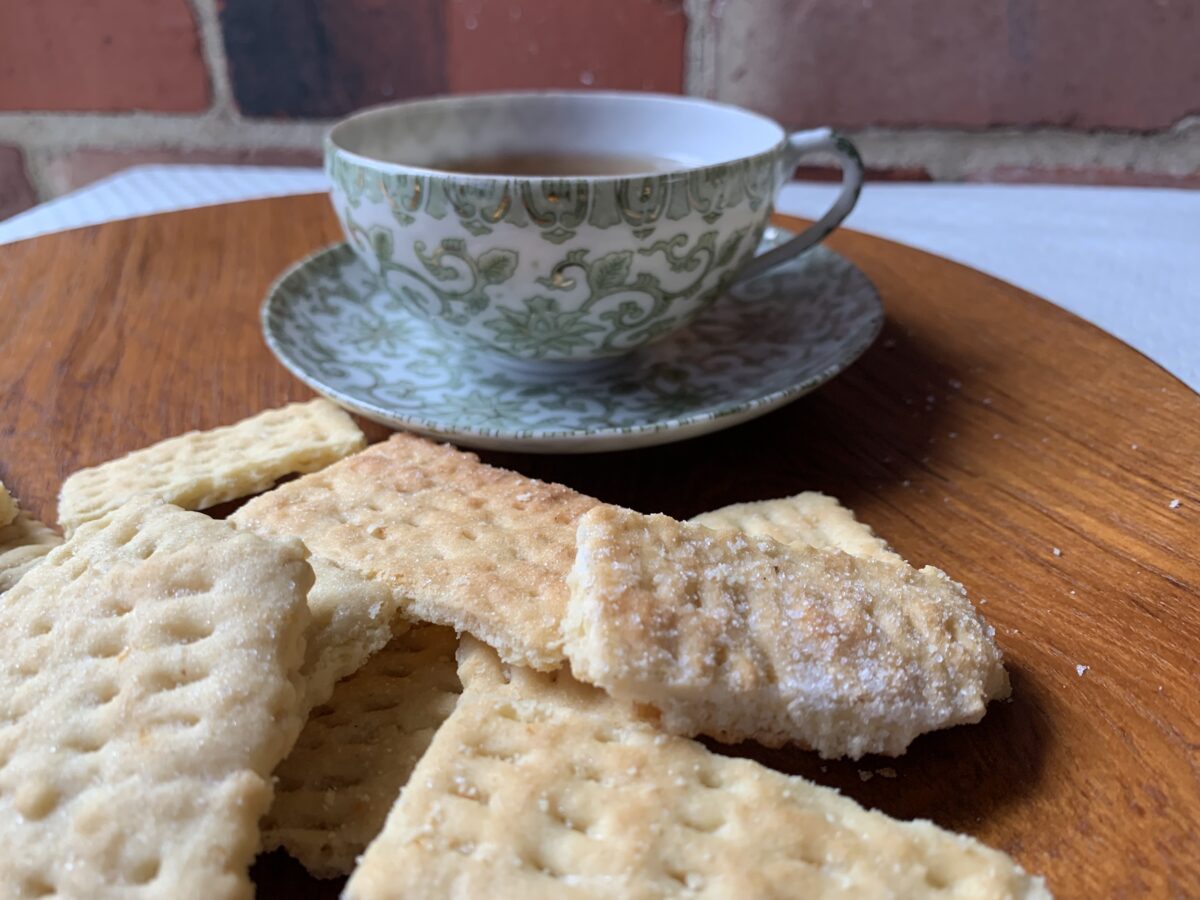
Appeance? Cracker. Texture? Cracker. Taste? Sugar cookie. Gotcha!

We often discover something new and exciting as we experiment when odd or exotic recipes appear on the radar. We expected no less with this one. “Crackers?” It had to be a European version of those crispy, crunchy Mediterranean tea cookies. Right?

Nope. These taste like a standard sugar cookie, and earned their name by mirroring the appearance and texture of a classic saltine a/k/a soda cracker. They are eminently snackable too. Dangerously so. Each piece is so small that you will find yourself innocently popping five or ten at a sitting, which actually adds up to more than that regular sized sugar cookie you would have been able to resist.

Unique, fascinating, and familiar all at once. How cool is that?

Click here if you only want the recipe without the discussion
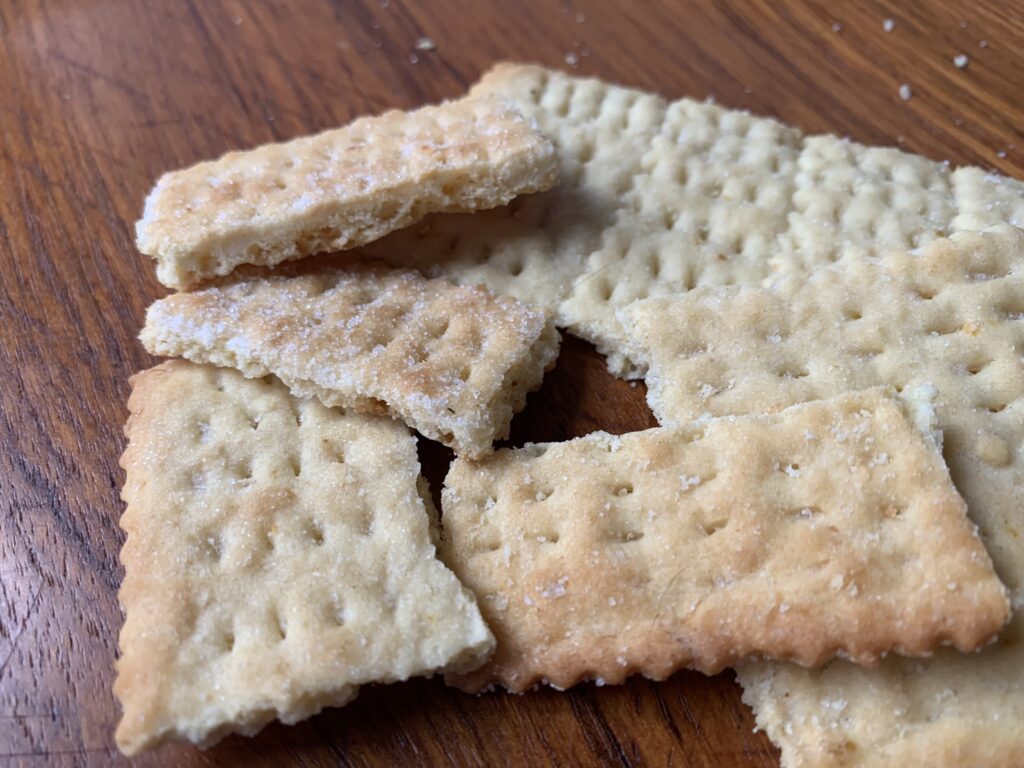
Saltines, right? Gotcha!

The Things You Learn When You Do The Math…

The past few months have uncovered several new recipes that rely on baker’s ammonia, including a few that feature a crisp, crackery texture achieved through the use of an antique leavening agent called baker’s ammonia a/k/a hartshorn. See, e.g., Norwegian Pretzel Cookies (Kringla), Greek Olive Oil Cookies (Ladokouloura), and Lebanese Anise (Yansoon) Cookies. So we were kind of excited to try this one, which promised to be a more classic European version.

The Mediterranean recipes both start with oil. The older versions of this recipe start with lard or shortening. Seems like an obvious connection, right? The only unusual thing was the math. All the classic Ammonia a/k/a Hartshorn Cookie recipes ended up with a really odd amount of fat when normalized to a reasonable amount of flour. A bit more than three tablespoons. At the same time, the flour measurements got weird if we tried to normalize things from the fat or sugar point of view.

Version 1.0

I decided to plan out my first test recipe by weight since the numbers weren’t that far off. 100 grams of lard, 100 grams of sugar, and 250 grams of flour. 1 to 1 to 2½, spread over two baking sheets. The result? Extraordinarily thin crackers that tasted like a cookie, but with a very distinct flavor from the fat. They were also a little greasy.

NOTE FROM KATE: They were a fun kind of greasy! Sometimes, using an animal fat you already have saved from a roast can give this kind of a cookie a very interesting character. Flaky tenderness and a hint of other flavors add to the gustatory experience. I like knowing that you’re eating a natural product and not a highly processed shortening. Scott will disparage that from time to time as “virtue points,” but they matter to me.

Fair enough. 250 grams of flour equals 1¾ cups of flour. The next batch would increase the flour to an even two cups. That would take care of the greasiness. The sugar level was about right. But what about that very lard-heavy flavor? What could I do for people who prefer something less distinctive and more common? Shortening, yes… but the flavor wasn’t loud enough to do with a totally neutral fat. So why not clarified butter?

How much butter would I need? Butter is about 16-18% water… Assume that’s been cooked that off, and account for a little more weight from the milk solids… And you end up with…

Son. Of. A. [cough]! You end up with exactly 4 ounces, dead on the nose. And what is 4 ounces? Exactly one standard stick of butter, or and even ½ cup.

And was I wasting effort and cleaning time by assuming the recipe called for two baking sheets? I had carefully rotated the pans midway through because thin dough and high heat are a bad combination. But even so we ended up with one tray browned more on the top, and the other tray more on the bottom. Annoying. And there was an awful lot of room around the dough on each tray, so…

Version 2.0

(A) Clarified butter instead of lard. (B) A little more flour. (C) Roll it all out to fit on a single sheet pan, and see if it’s still thin enough to be a “cracker.” (D) Adjust the cooking time to account for the extra thickness, and having only one pan in the oven.

This is how they come out of the oven. See the uneven break by the bottom right? That’s what happens if you merely cut the lines without giving the wheel/blade a little wiggle to add an extra hint of separation.

This experiment told us (almost) everything we needed to know.

  1. I had the proportions nailed. The dough was easy to make, easy to handle, and just plain worked.
  2. This amount of dough rolls out thin – something on the order of ⅛” when all is said and done – but that’s still a big difference from “roll until you can roll no more.” The final result ended up being just under 3/16“, which definitely gave more of a cookie vibe than a cracker.
  3. The flavor changed radically. Lard notes versus butter notes were extremely clear when we tasted them side by side.
  4. The butter version does indeed taste standard. Just like a sugar cookie. But is there anything easier to vary than a sugar cookie? Tea, chai, cinnamon, other spices, herbs… This is clearly a cookie that bakers can play with to an all but infinite extent.
  5. Those darned lines aren’t always clean enough when the cookie comes out of the oven.
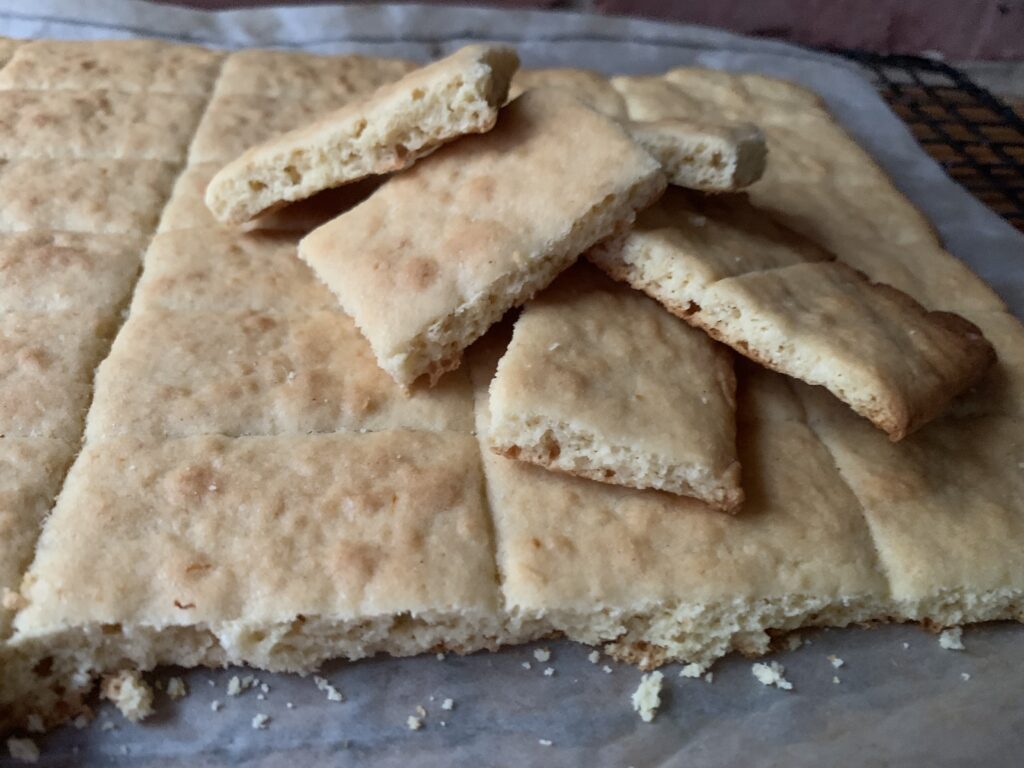
    Thick indeed! These come off as more “cookie” than “cracker.” Note how the lack of docking adds to that.

This cookie was, quite honestly, good enough to publish. But we weren’t done just yet! Could we customize this into a true illusion cookie with a taste that would complement a cookie tray instead of just fitting right in with so many other tastealikes?

Digression: Revisiting The Ratio Of Ingredients

Remember how odd the ingredient list seemed at the start of this project? And how the fat didn’t work out evenly until we figured out that it equaled a 4 oz. stick of butter that’s been clarified? But the overall ratios still didn’t work out to even numbers by weight, as experience taught they should in such an old recipe?

But now, with some extra flour and a more limited amount of fat… Aha! These changes created something very close to a 1:1:3 ratio of fat:sugar:flour. Gotcha!

Version 3.0 (see below) established our preference for a little less in the way of both fat and sugar, and that is what the recipe now says, but we have no doubt how Grandma taught the recipe by that ratio back in the day.

Version 3.0

  • Use the 1:1:3 ratio of ingredients;
  • Add some bacon fat in place of butter (we ended up with 2 tablespoons after I rendered four slices in a pan);
  • Roll out two trays as thin as possible, and only bake one at a time;
  • Dock the dough to make the final product look more like a saltine; and
  • Move some of the sugar from the inside to a sprinkling on top that would mimic the salt on an actual cracker.

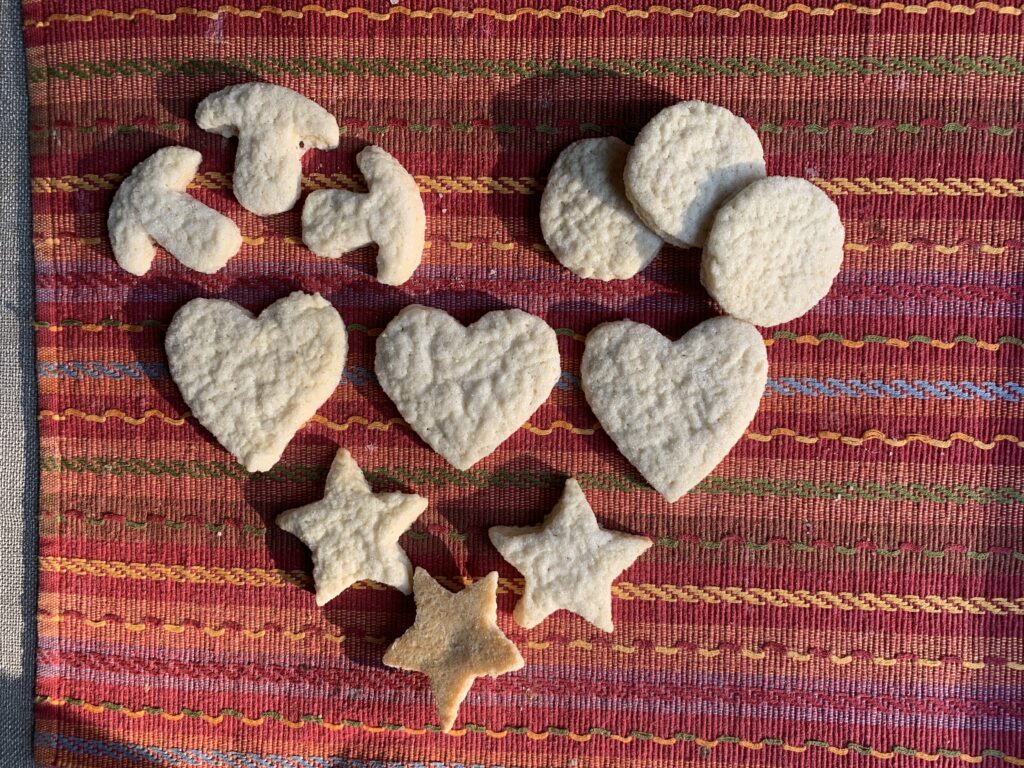
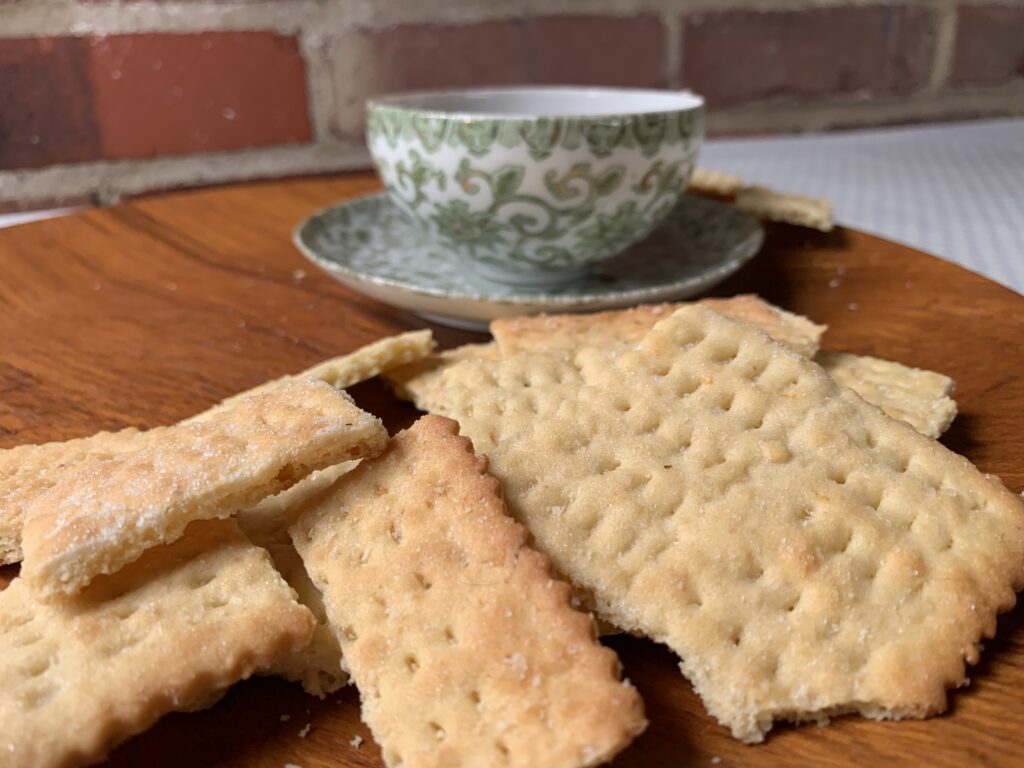
The result? Have a look!

[Shakes head]. I don’t know how I missed it, but this is a marvelous illusion cookie. It actually fooled our real life daughter when she stopped in to visit! That docking made a much bigger difference than I ever imagined.

We could taste the bacon, but only because we knew it was there. The bacon also added a healthy hit of extra salt that we both enjoyed – enough to bump the basic salt level in the recipe up from ¼ to ½ teaspoon (though we might revert to the reduced amount if we work with salty bacon fat again). I even enjoyed sprinkling the tops with a little bit of extra salt to enhance the effect. It now appears as an option in the recipe. Here, among friends, I will admit to recommending that option because it makes the cookie taste more distinctive. But that’s taste, not tradition.

IMPORTANT NOTE: We also learned, to our chagrin, that simply marking the lines with a fluted wheel isn’t enough. We lost several “crackers” because they baked together too firmly, and wouldn’t snap along the lines. Even more than we did with the thick cookie (see photo above).

LESSON LEARNED: Don’t just mark those lines; mark them clearly and emphatically, with a little wiggle of the wheel or blade to be on the safe side. You need the pieces to bake together in order to have that crackerish center show, but you also need the separations clean enough to be sure they will break evenly.

The only other adjustments came down to fine tuning the ratio. Hark! Can you hear your great-great Grandma speaking from the beyond? “It’s a simple ratio dear. Three parts flour, to one part sugar, and one part lard. But here’s the secret… They taste even better if you take back a spoonful of the sugar and fat.”

Grandma is great. Grandma is wise. Listen to your great-great Grandma.
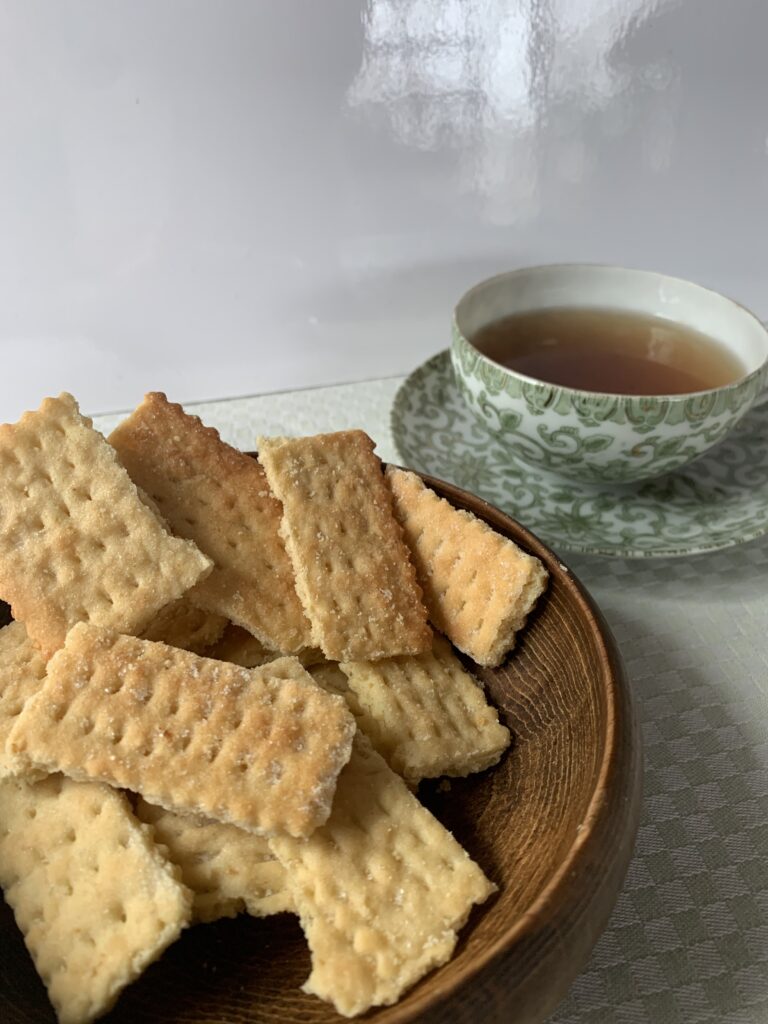
Conclusion

This is one of those cookies where we started out thinking “A,” only to discover it was really a “B.” This is not one of those cracker-crisp Mediterranean tea cookies. It’s more like a good, cracker-crisp sugar cookie designed to create a convincing, extremely snackable illusion.

NOTE FROM KATE: Be careful with these – they are quite more-ish! The texture is a lot of fun. You will easily snack on five cookies when you would’ve said a “no, thank you” to a similar cookie in its one-piece form.

Here’s a summary of the lessons learned:

  1. The dough follows a 1:1:3 ratio of fat to sugar to flour, with a spoonful taken back from the first two.
  2. The cookie changes in wonderful ways if you mix and match different fats in place of the clarified butter. We tried them with lard alone, butter alone, and butter mixed with bacon fat. The last was the best, partly because we liked the extra salt.
  3. The illusion part matters, so roll the dough out super thin, take the time to dock them with a fork, and sprinkle on a bit of sugar to fully recreate the saltine look. Sprinkling on some kosher salt will also help the illusion, and has the side effect of making the cookie taste more distinctive.
  4. Maintain an even thickness. Smeared edges cook faster than rolled centers.
  5. Mark the dividing lines emphatically, with a little wiggle of the wheel/blade to add some room. The helps the “crackers” to separate cleanly.
  6. Just don’t separate them too much, because those broken-open sides show off the crackerish interior, which is both pretty and useful for the illusion.
  7. Bake only one tray at a time, and spin the tray just after the estimated halfway point. Two trays won’t cook evenly, and oven hot spots really show.
  8. The bake is done when the top turns cracker-tan brown. Go by that, not the designated baking time.
  9. Hartshorn is mandatory. Baking soda/powder yield a standard cookie texture.

All in all? A very successful experiment, and a cookie we will gladly add to the repertoire. Especially if we want something more on the snackable side than a proper dessert, or there’s someone coming over who’d be fun to fool…

Enjoy!
POLISH HARTSHORN COOKIES (“AMONIACZKI”), An Edible Hug

Hartshorn (baker’s ammonia) creates a crisp, sugary crust around a pillowy heart

Click here if you only want the recipe without the discussion

Hartshorn a/k/a baker’s ammonia a/k/a ammonium carbonate a/k/a smelling salts is an old frenemy we recently studied in more detail. This was the chemical leavening agent from antiquity through medieval times and on into the 19th century, when it got replaced in most recipes by baking soda and powder. Why? Because it’s also known as “smelling salts,” and smells so foul that you can’t even nibble on dough samples before they bake. Not that I would ever do such a thing, but rumor has reached my ears… [Ahem]. The smell disappears during baking, but still. Who wants a product like that in their pantry where a spill can make your cat box seem friendly?

NOTE FROM KATE: You will only taste-test this dough once. At which point you will also spit the dough into the sink and reach for a glass of water. Yuck! The baked cookies, though, are as lovely and welcoming as they are versatile. Even better, they hold a basic shape and provide a lily-white canvas for any decorating ambitions.

In today’s age hartshorn has become a specialty leavener. And yet it is still around because it produces a different kind of rise than baking soda/powder; a lighter, crispier, more even texture that’s essential to recipes like Springerle, Swedish Drömmar, fine-featured molded gingerbreads, and texture-first specialties like Hungarian Kvircedli and Ammonia Crackers. Hartshorn has its flaws, but the upside can be spectacular.

Enter this cookie: Polish Ammonia Cookies (“Ciasteczka Amoniaczki”), which I hereby rechristen as Vanilla Puffs to reflect the remarkable effect of their magic ingredient. Plus variations like Peppermint Puffs, Anise Puffs, Lemon Puffs, etc. “Puffs” being the key word because that’s the closest I can come to describing the texture: a shatteringly crisp, sugary crust around an inside so pillowy and puffy that they have a universal appeal. Most cookies will have a few, recalcitrant protesters who just don’t get it. Everybody likes Ammonia Cookies. They may only be your third-favorite on the tray, but I can 100% guarantee they’ll be gone at least as fast as the ones you would choose for yourself.

Try this cookie and you will never again wonder why serious bakers remain willing to put up with hartshorn’s challenges. The cost is worth the payoff.

The Dough is Rough-Puff Pastry (A Flaky Cookie) In Disguise!

Want a laugh? I went through the whole recipe testing process on these with the niggling feeling that I knew the recipe from somewhere, even though I’ve never made anything like it. The penny dropped around five minutes ago.

The niggling finally got bad enough for me to run back to Volume I for a scan of the ratio tables at the start of each chapter. And sure enough, there it was. The proportions of flour, butter, sour cream, and sugar are an all but perfect match to flaky cookies made from our Faux Puff Pastry recipe (a/k/a “rough puff”). The only real differences are the handling and the addition of a massive amount of hartshorn.

You make rough-puff dough by cutting butter into a combination of flour and a small amount of sugar, in order to achieve the “pebbly” texture of a piecrust with extra-large butter chunks. Then, instead of cutting it finer, as you would for that piecrust, you roll the dough out in a few “envelope turns” before finally rolling-and-cutting your cookie shapes. It’s a minor P.I.T.A., yes, but much easier than the major P.I.T.A. of traditional puff pastry.

This dough? Just cut the butter down to piecrust-texture in a food processor, include a generous amount of hartshorn, and presto! Something that tastes like puff pastry, and has a crispy outside, but has the pillowy interior you can only achieve with baker’s ammonia.

Peppermint trees. See the contrast of crispy crust to center puff?

The Sugar Crust

Stark white from the sugar crust, and just as good as they are pretty

There’s a pretty well established pattern for flaky cookies of all types:

  • Palmiers a/k/a Elephant Ears? Roll out some puff pastry (or other flaky-cookie dough), coat it generously with cinnamon sugar, roll it back into a tube like a jelly roll a/k/a roulade, and then slice-and-bake.
  • Dutch Krakelingen? Cut off strips of that same dough, roll in cinnamon sugar, and then shape them into pretzels before baking.
  • Rugelach? Do the jelly roll thing with a layer inside made from a fruit-and-nut filling, and then coat with cinnamon sugar before baking.
  • Goose Feet a/k/a “Gusine Tlapki”? Roll, sprinkle with spice-sugar (not necessarily cinnamon), and then cut out large circles which you fold into quarters.
  • Kolache? Roll, cut out squares, dab with fruit filling, fold up two corners, and then sprinkle with plain sugar.

Get it? Ammonia Cookies aren’t any different except you (a) can readily flavor the dough, and (b) can roll-and-cut any shape of cookie, and (c) should, not just can, coat the outside in sugar alone. The snowy, extra-crunchy outer crust is part of the experience.

We did test cinnamon sugar in case you’re wondering, and it works perfectly well, but it also standardizes the whole experience. Both Kate and I preferred these with sugar alone.

The Baking and Fumigation Times

The flaky cookies listed above typically bake at 350° F (175° C) for about 15 minutes, give or take according to thickness. Ammonia Cookies work a little better if you cook them at the same temperature for only 12-13 minutes. The shorter baking time helps to preserve that pillowy interior, whereas the flaky cookies want to emphasize their crispness.

The combination of a moist dough and a shorter baking time can cause a problem, however: a residual whiff of ammonia left over in the baked cookies, even after they cool. It usually isn’t all that strong, and it only happens about 75% of the time, but that’s still an issue you need to keep in mind.

The solution couldn’t be easier. Leave the baked cookies out for an hour or two. That should be all it takes for the dissolved ammonia gas to dissipate into the air. If they were really bad? Still simple. Wait a little longer.

Hartshorn giveth, and hartshorn taketh away.

The Cut Outs

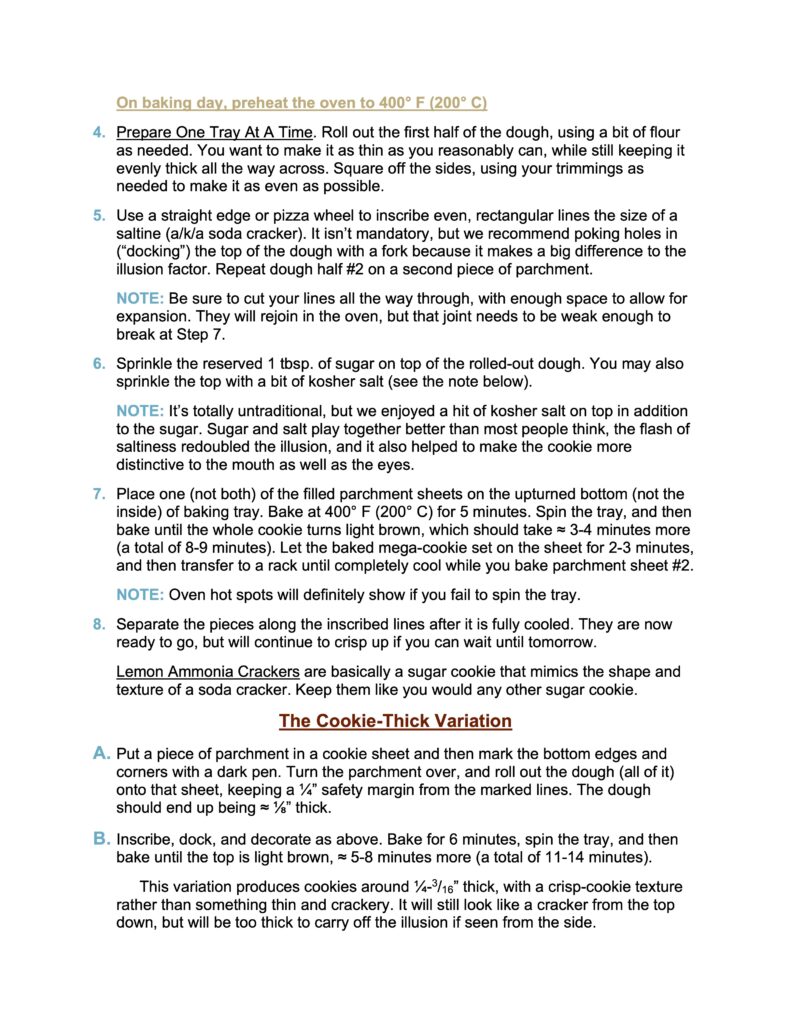
Ammonia cookies work with almost any basic shape, but expand too much for anything with features. I tested stars, hearts, circles, a mushroom shape, fluted ovals, snowmen, and a Christmas ornament shape. Everything worked except the ornaments, snowman, and the fluted ovals. Those could still be recognized by someone who knew what they were supposed to be, but they lost the outside details that make them more than just shapes.

Anise hearts and peppermint trees. “High note” flavors show particularly well in this cookie.

Feel Free To Customize!

Do some research on cookies made with hartshorn and these basic proportions. You will quickly find several much loved variations. These include:

  • Peppermint Ammonia Cookies (add in peppermint oil), which are very popular in the American Midwest, and generally attributed to German immigrants;
  • Anise Ammonia Cookies (add in anise oil), same thing with what seems to be inspiration as much as tradition;
  • Ginger Ammonia Cookies (add in a generous amount of dried ginger), with some optional extras for those who want to try a popular Slovak variation.

We tested all of the above, and they all worked just as well as the standard vanilla version. I’ve no reason to believe other spices wouldn’t be just as good. These may be my new favorite when it comes to featuring one particular flavor.

FWIW, our 2024 Christmas tray is going to include the Peppermint version because we have nothing else even close to that flavor profile, and I may throw in a few vanilla ones too. Not that a spice version will find any protesters. Hmmm…

Can You Simply Put The Sugar In The Dough?

We tried it, and the answer is “Yes.” The cookie works fine. But we really like the showy, snowy white crust that comes from following the recipe, and it enhances that wonderful contrast between the inside and outside. The most I would actually recommend is the addition of something to show an inside flavor. Perhaps some anise seeds, or some bits of peppermint-green sugar.

Those flavored versions carry a significant odor, but who wants to eat the cookie I just sniffed and then put back on the tray?

Sour Cream? Is That Traditional?

Is it fair to answer that with a “Yes, but…?” Sour cream per se has been around for most of human history. After all, the root definition is nothing more than fermented cream. Some say it traces back to the Mongol hordes that made kumiss from mare’s milk, but I personally find that hard to believe. Not because the Mongols didn’t do just that, and helped to spread the idea. I just doubt that no one in human history came up with such an obvious idea before that. It certainly predates the arrival of Europeans in the new world.

I won’t speculate about the reasons, but research shows that sour cream has always been more common in central and Eastern Europe than over by the Atlantic. This enters into the history with the great migrations of Czechs, Poles, Slovaks, Germans, etc. into the U.S. from the mid 1800’s on. They brought sour cream with them, where it met the rising force of the Industrial Revolution and morphed.

What had been a hand crafted, fairly regional staple became an industrially produced, properly pasteurized dairy product sold in every market across the land. Dips made with sour cream became a capital-T Thing. Baked potatoes began to look naked without it. Mexicans used it every bit as much. And it became a common, if relatively minor ingredient in the baking repertoire of the North American continent. At which point it traveled back to Europe, and began to expand in the old world too.

You will note that we call this a Polish cookie (“amoniaczki”), because that seems to be ground central for where it is enjoyed in Europe, and was such a major part of the immigrant population that filled the American midwest, where this cookie centers in North America. So… did the original European version use sour cream, or was it a case of American ingenuity improving on the original, which then made its way back to Poland along with industrial production?

I cannot answer that. I can only confirm that European variants using eggs instead of sour cream are easy to find; that we tested them; and that sour cream is definitely the way to go. It just works better.

Can I use Baking Powder or Soda For Convenience?

We liked this cookie so much that I felt compelled to test this, and the answer is, “Only if you must.” Texture is major part of this cookie’s appeal. The baking powder ones looked okay, and tasted fine, but they simply weren’t the same. The almost-crispy crust diminished down to a mere sugar-crust, and the exciting fluff-honeycomb interior became a standard, soft one.

Would we make them in a pinch using baking powder or soda? Hmmm. I suppose we might. Particularly if we wanted a softer cookie with a distinctly clear peppermint or anise note. But to be honest, we would only do it as a giveaway cookie because now that we’ve had the real thing, they would be too disappointing for either of us to really enjoy.

Conclusion

This is a fun cookie. Kate got a bit old grin on her face at the first bite, and said “It tastes like a hug!” I had to agree. But it’s not a hug from your Grandma, or spouse, or parent, or child. Nor anyone else you deeply love. Those have too much emotional freight. Ammonia Cookies are a hug from that friend you’re meeting for lunch, or one of your daughter’s little playmates.

Simple, companionable, and yet somehow special at the same time – from both a baker’s perspective, and a human one. And that’s just the vanilla version. The cookie’s flexibility as a base for other and custom creations only makes it that much better.

Enjoy!