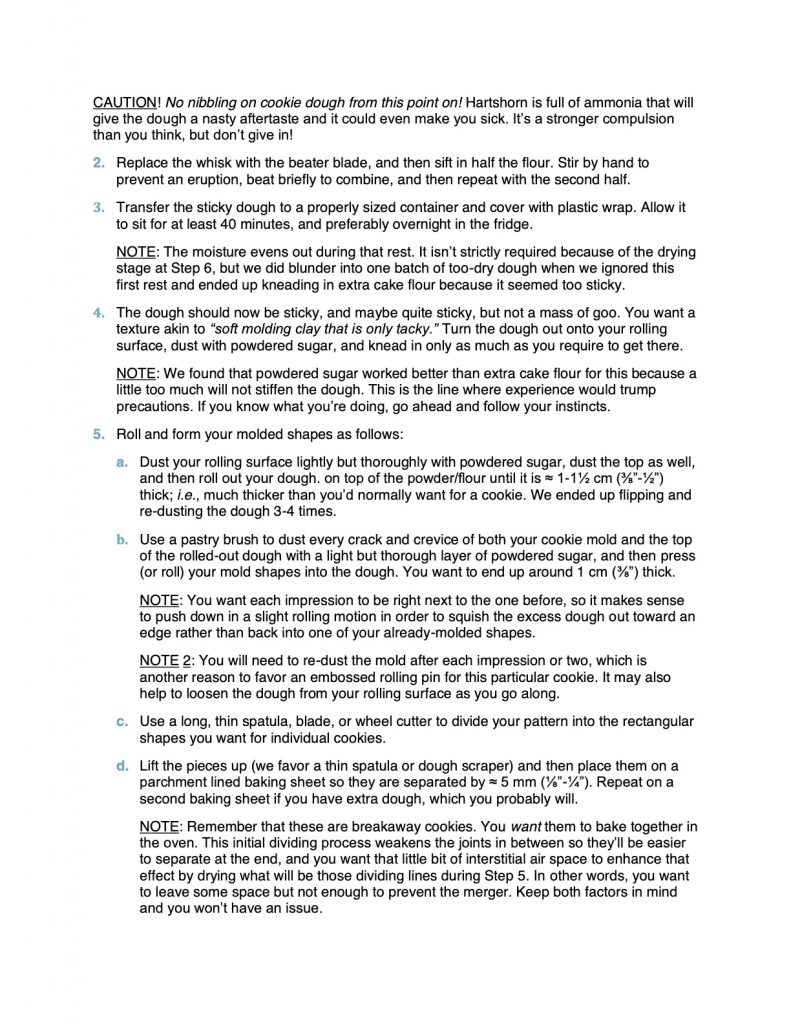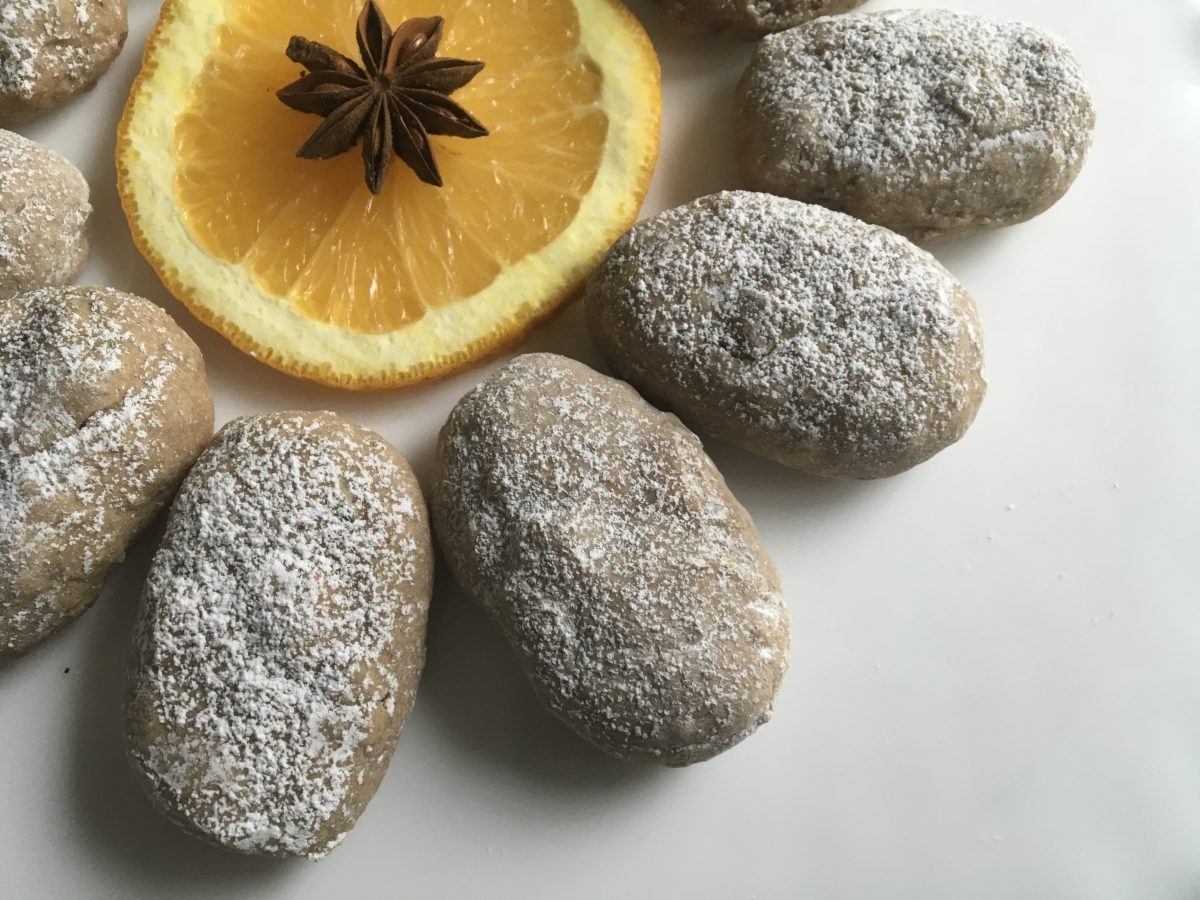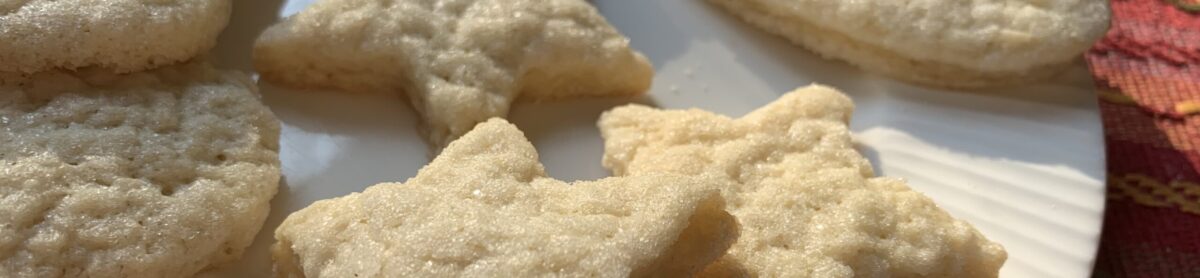
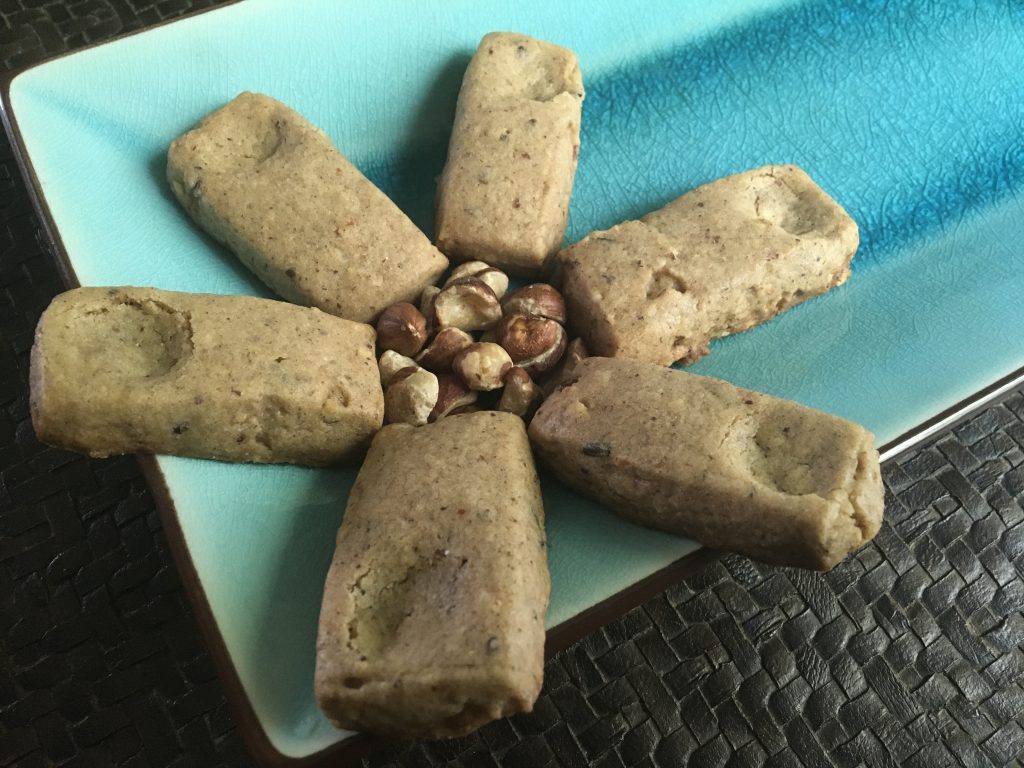
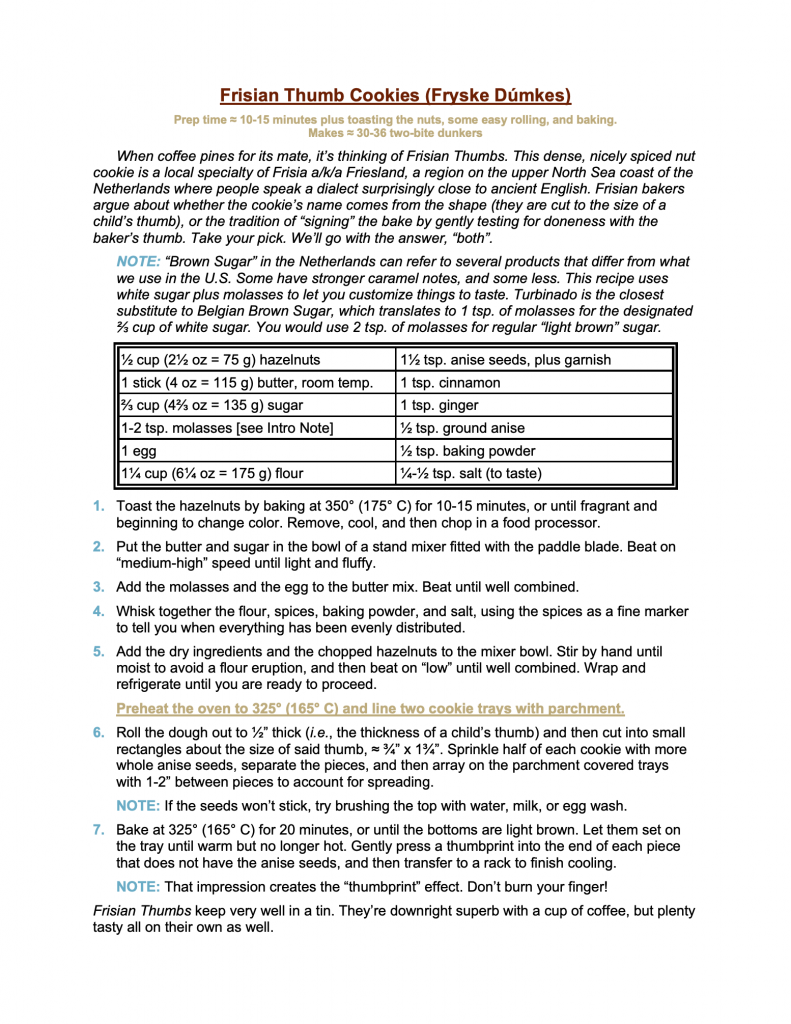
FRISIAN THUMB COOKIES (Fryske Dúmkes)

A buttery, hazelnutty, spice cookie dunker from the Netherlands’ Viking province that has become our new favorite to pair with a cup of good coffee.

It’s been a busy few weeks and that’s cut into cookie testing, but to be entirely honest the delay also comes from my perpetual fidgeting with a new recipe for the Ultimate Butter Cookie. Another batch or two and I’ll have it out… but all of that is just an explanation for why I’m now publishing something totally different. [Talk about a teaser!]

That butter cookie comes from the Middle East, so I wanted to go back to Europe for a break. Clearing my head for the final assault on the ramparts, as it were. I keep an ongoing “cookies to test” list, so I pulled that out and asked Kate to choose one that caught her eye. She marked off a few possibilities and then paused.

“Frisian Thumbs? What in the world?”

I smiled. “Top 10 on the great names list, right? It’s a Kate Cookie too – they describe it as a dunker made with a lot of hazelnuts and some spice. Butter too, I’m afraid.”

She asked to see the initial recipe I’d downloaded, approved both the idea and the incursion into her monthly butter allowance, and then waved me away to work some magic. Magic done; mischief managed. This is a good one.
As usual, I’m about to run long with the full description of the whys, wherefores, and what-abouts. Skip to the bottom if you’re only here for the recipe.

Getting the process started

By this point I have a pretty well established pattern for working on new cookies. I usually find them in the first place by wandering through the Wide World of Google doing searches like, “regional cookies of [This Place]” or “local baking traditions of [That One].” E-tourism, cookie style. Potential targets pop up in various locations: regional promotion sites, historians looking through an oddball lens, memoirs from tourists, émigré groups sharing memories, other bakers, etc. I mark down the names, look up the recipes, pick an example for the files, and then put it on the “cookies to test” list with a brief description for later.

When it’s time to look deeper – now, in the case of Frisian Thumbs – I go to the next level in two different ways. First there’s the recipe. I start on that by searching out every possible version the Internet contains. This gives a firm idea of the parameters, from which I’ll write something up using round figures and my experience with other projects.

Then there’s the heritage part. That also begins with the Internet, but then moves on to a search for actual humans who know the cookie, and can provide some context. Those two steps provide the raw ingredients: a recipe to work from, and a heritage to explore. And the follow up question: How did these two meet and marry? Which is where the test batches come in, followed by gifts for my sources to sample, and adjustments to account for both my reactions and theirs.

ASIDE: There are few things more satisfying than developing my version of a beloved childhood treat for someone who knew it back in the Old Country. Life doesn’t have many perfect moments. Two strangers exploring a cookie together, on truly neutral ground? That is one.

STEP 1: Creating the initial test recipe

So, off I went and found no less than eleven (11) different recipes, most with photos and descriptions. These taught me a lot about the underlying issues. Here are my notes:

  • Almost every recipe centered on anise, supported by a background of cinnamon and ginger in roughly equal amounts. What an odd combination! But it works. Taste it in your head and you’ll see.
  • The hazelnuts bring it all together. Remember to toast them first. No two ways about it.
  • The cookies bake low and long. 325° for 20 minutes. Interesting.
  • The recipes are pretty close together after normalizing…

“Are you done yet?” I stop and look up. It’s Kate, back from her writing lair. “Those thumb cookies sounded really good, and I’m going to make a pot of coffee. Any chance you’ll have some ready for me to try?”

My friends, this never happens! Don’t get me wrong. Kate is a certified cookieholic. She’s at least as bad as I am. But her addiction gets triggered by proximity. See cookie; snitch cookie; savor cookie; repeat. I’m the one who gets entranced by recipes alone. But not this time, apparently. I wasn’t the only one getting hit in the, Oh that sounds good! spot.

I promised to get her something in the next day or two and then went back to my research.

  • … normalizing to a single stick of butter (½ cup = 115 grams). Which is a surprisingly small amount; most cookies start with two sticks. Hmmm. One stick of butter yields three dozen cookies? Definitely on the small side.
  • The big difference between the recipes comes down to the amount of flour. Anywhere from 130 grams all the way up to 250. What’s going on? Aha! The ones with more flour have some baking powder added, and the ones with very little look slumped in the photos.
  • The flour also ties in with eggs. Most of the recipes include an egg on the inside, excluding only the ones with very little flour. The recipes with both an egg and some milk have the most flour. Got it.
  • But there is not a lot of flour in any of these by the standard of other dunkers! Corsican Canistrelli have a good 50% more in the flour to fat ratio, plus a cup of chestnut flour to push the ratio even further. The hazelnuts in this recipe are chopped, not ground. They won’t act the same. So Frisian Thumbs may be dense, but they shouldn’t be hard, dry, or crispy.
  • And that flavor profile! Hazelnut, hazelnut, spice, and hazelnut. That’s what we’re after here! No extract, either. Very elegant even if they are kind of plain to look at. One for bakers rather than bakeries.

Time to check in on the heritage part of the equation.

STEP 2: What’s the story behind all this?

I knew going in that the Frisians were a big deal back in the Viking Age. Why would someone name a cookie after their thumbs? It turns out there’s a string of small islands off that coastline called – look at that! – the Frisian Islands, with the modern Netherlands province of Friesland right in the sheltered area behind them. The name “Frisia” goes back to Roman times, but modern Frisians descended from a Viking tribe who settled in the region after a series of environmental disasters had emptied out most of the original inhabitants. These new Frisians (they adopted the name) were closely related to the Angles and the Saxons who settled in England, only to be conquered in 1066 by the even fiercer Norman Vikings who had settled 400 miles further south.

The Frisians who didn’t travel to England with their Anglo-Saxon cousins settled down and became famous for breeding the finest warhorses on the continent. Including, ironically, the mount used by William the Conqueror. Cool! Their descendants maintain a fierce pride about their particular roots, with a regional dialect that is sort of like ancient English mixed with Dutch and German.

There’s no way I was going to find a group of Frisian émigrés here in Pittsburgh! But as it happens, I do know several Dutch bakers through a Facebook group devoted to the molded cookie Speculaas. Thanks go out to one and all. And to Google Translate, since the recipes they pointed me to were written in Dutch, with notes on particular Frisian words.

The material from my online friends brought me up to 14 versions, which led to a modified master recipe while also answering a lot of questions. First, Frisian Thumbs are a true specialty of modern day Friesland, and little known outside its borders. They are not an extension of other Dutch cookies. Second, Frisians are a lot more culturally distinct than Americans would tend to assume. So much so that road signs in the province appear in both Dutch and Fries. Thus it may be inevitable that Frisian bakers will start from normal Dutch ingredients when it comes to flour and sugar (see below), but they wouldn’t be caught dead using a standard spice mix from the store with some extra anise.

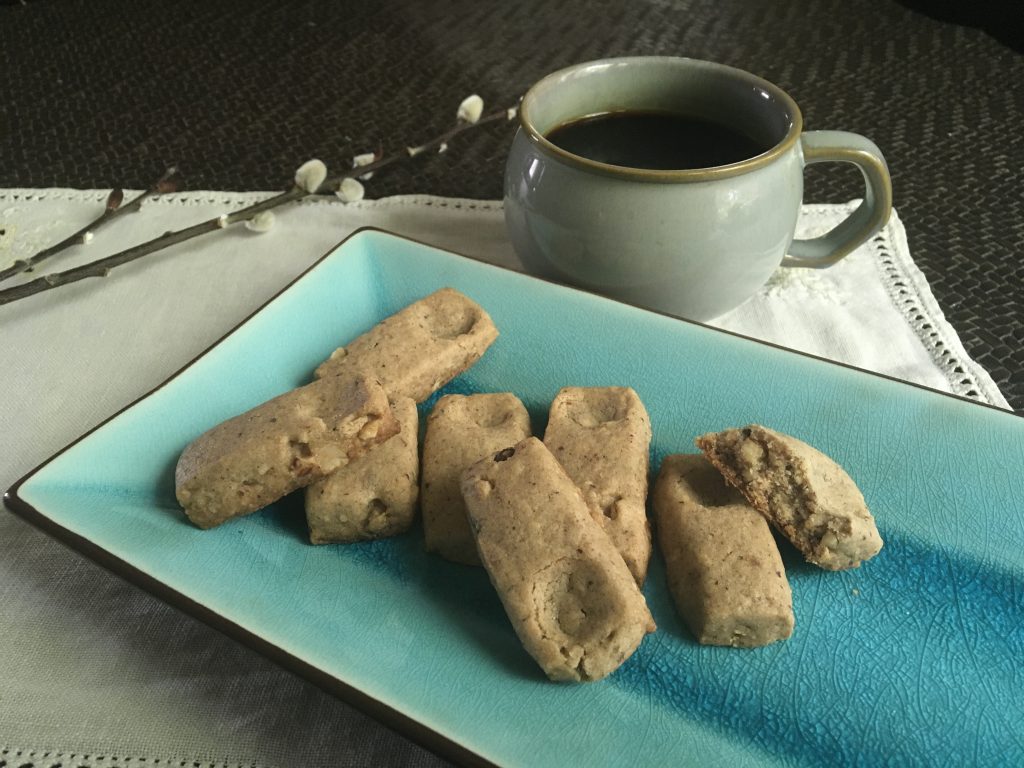
Third, the photos make it clear that these cookies are supposed to be small, thick rectangles, not oblong drop cookies. They must have enough flour to more or less hold their initial shape. That evocative description about, “the size of a child’s thumb” actually makes a good deal of sense. Pull out the ruler and… ½” thick x ¾” wide x 1¾” long.
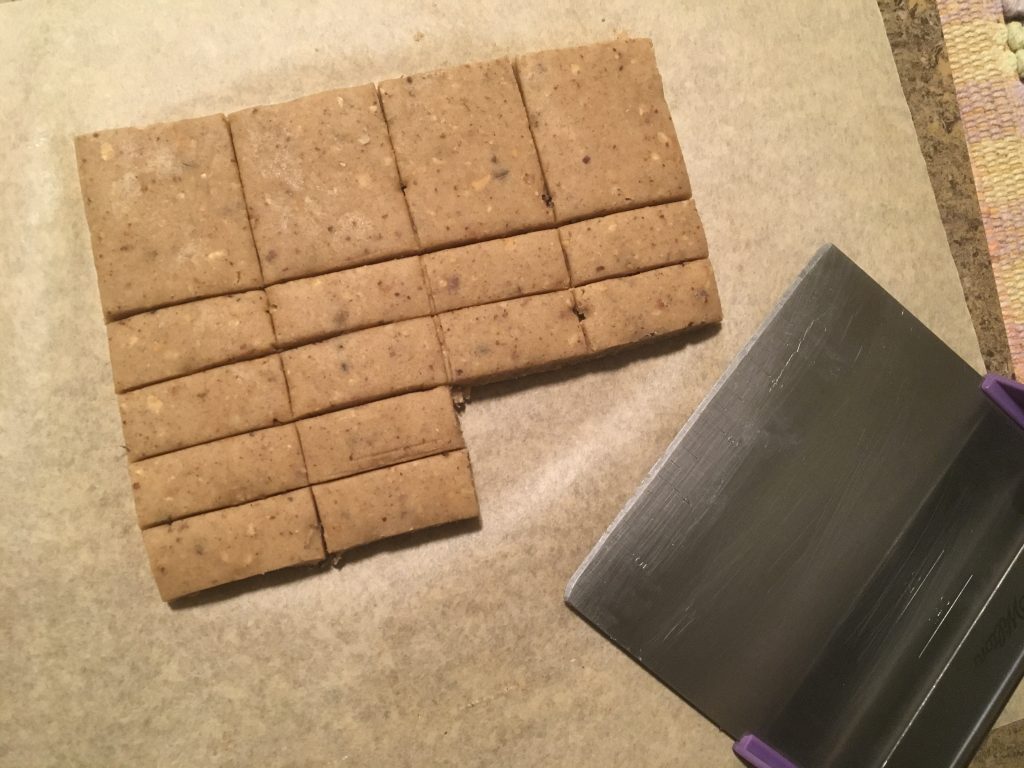
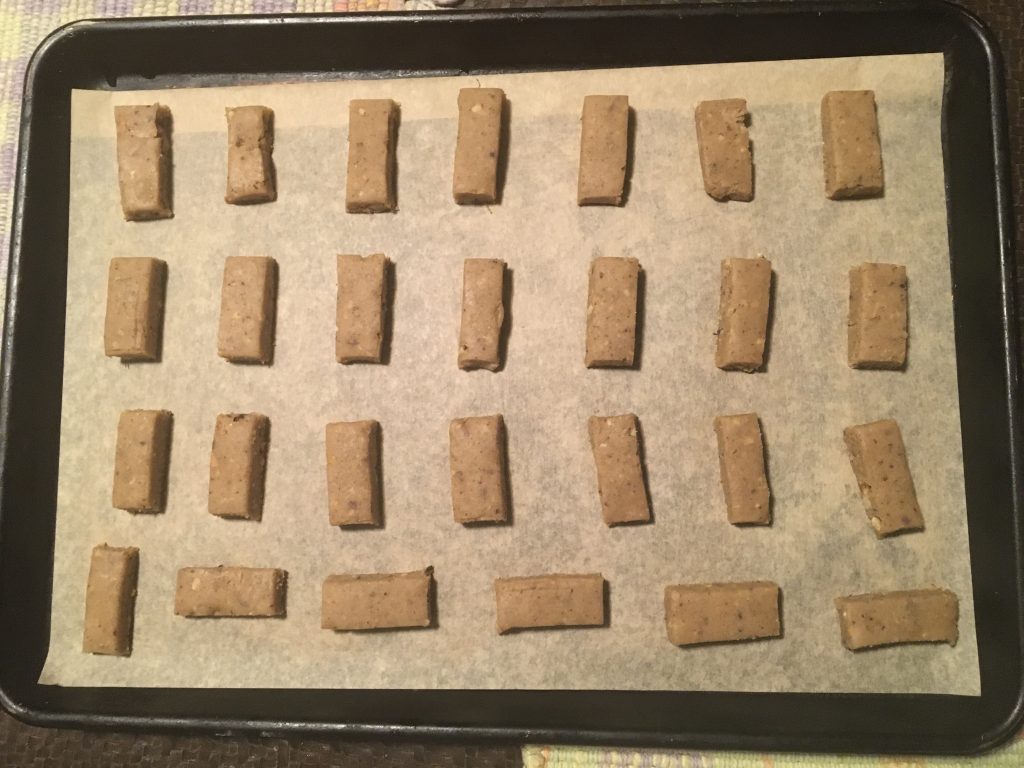
Just roll out a slab and slice to shape. Nothing fancy. This would be the point to put anise seeds on top as fair warning. They are all buried inside this particular dough.

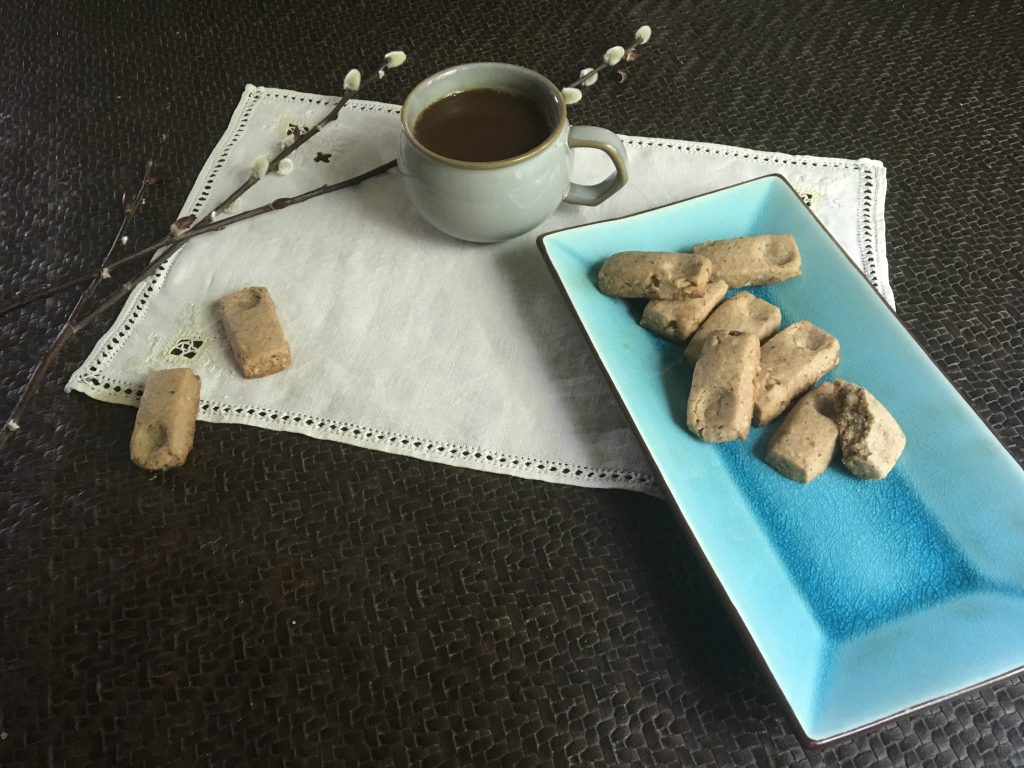
Fourth, not a single one of the Dutch photos contain the thumbprint mark. They’re all plain old rectangles. But I did see several others that had the dent, and you know what? It creates an effect that looks a lot like a thumbnail! I like it.

What’s a thumb without its nail? They are just as tasty plain as they are with the decoration, but it does add a certain distinction. Press the shape in when they are warm and fresh from the oven. I was too eager and got a little burn. Next time I will press in using the tip of a spoon.

Next, I wanted a chewy and somewhat dense texture, but not excessively so. Too much flour, especially with no leavening, would make little bricks. Balance is everything.

Speaking of which, those websites convinced me that balancing the spices had to be job one. Spice cookies are normal for the Netherlands, and don’t raise eyebrows over there like they often do in the U.S. On the other hand, Dutch cooking incorporates a very particular sense of poise and restraint. It shows up on the savory side too. Any cookie that Amsterdam writers would praise as “well rounded” had to be exactly that. So my target was clear: a nut cookie enhanced by anise, rounded out with cinnamon and ginger, chewy but not dense, and ideal when paired with a cup of coffee.

DIGRESSION: A primer on Dutch ingredients

Dutch ingredients can differ a bit from their counterparts here in America. To start with, bakers in the Netherlands have a different type of flour than you find in the U.S. Here in America we grade our flour according to protein content, going from low protein cake flour all the way up to high protein bread flour. On the Continent they grade their flour more by grind size. The best Speculaas, e.g., use something called TIP-00 flour, an Italian product that is ground to a spectacularly fine level “similar to baby powder.” That doesn’t matter for the recipe at hand, but it makes a real difference for a molded cookie where the features are a key difference between good and better.

In this case we need to look at the sugar. U.S. sugar is made by grinding sugar cane to a pulp, extracting the sweet syrup, and then removing the impurities to leave only pure sucrose. Those impurities are sold separately as “molasses.” Mix a generous tablespoon of molasses back into a cup of white sugar, and you get “light brown sugar.” Mix in two tablespoons and you’ll have “dark brown sugar.” Half a tablespoon yields “turbinado sugar.” [NOTE: you technically want to add a little bit more than just 1 tbsp. Hence the word “generous.”]

Not so in the Netherlands. Their basic ingredient comes from sugar beets rather than sugar cane, which creates some differences you’d notice if the two were used side by side. Speculaas use something called “Belgian Brown Sugar,” which is made by taking regular sugar, gently caramelizing a small portion, and then mixing it back in with the white kind. Stella Parks published a great essay and recipe on this at SeriousEats.com if you want to learn more. This goes to the second part. Then there’s a “brown sugar” made by mixing some actual cane molasses into beet sugar; and another “brown sugar” that’s made by mixing in a cooked sugar syrup that Dutch families use on pancakes instead of the U.S. maple syrup. And…

You get the point. The recipes all used “brown sugar,” but those words don’t mean the same thing in the Netherlands as they do in America. Fortunately enough, I’m told by people who have lived on both sides of the pond that these differences are real, but subtle, and not enough to alter the cookie’s character. The recipe you’ll find below starts with white sugar and adds just enough molasses to turn it into turbinado (i.e., identical to splitting the total 50/50 between white sugar and light brown sugar). Add more molasses to taste. That’s a great spot to customize.
STEP 3: Putting it all together to reveal a Heritage Cookie

After all that research, and a second “are we there yet?” episode from my beloved, the final test recipe came together quickly. I stayed up late to make a batch for the morning coffee, went out of the kitchen to head upstairs… and discovered She Who Must Be Obeyed waiting on her reading chair, drawn from her aerie by aromas of cooking hazelnuts, butter, and spice.

“They smell fantastic. Are they ready for testing?”

“It’s a dunker. They’ll be all soft and warm fresh out of the oven. It won’t be a fair way to judge.”

She cocked her head and gave me a look. “How many are there in a recipe?”

“Almost 40 for this batch. They’re actually kind of small.”

“Then there will be plenty left for tomorrow, won’t there?”

“I don’t know. My photographer gets awfully picky…”

“I’m the photographer! If you want to see picky, keep standing there in the way and you’ll learn about picky!”

I am a man. A mere man. I can’t even translate that sentence. I certainly didn’t want to experience it. So I stepped aside. But I spoke up even as I deferred. “I do want to press in the thumbprints, at least on some. Then we can sample any ugly ones.”

And so we did. I burned my thumb. She did not. I will make my thumbprints with the tip of a spoon next time. She will laugh when I do. We both think it’s a great look. And yes, we both had a taste. And then another. They were goooooood.

FOLLOW UP NOTE: This batch produced 39 cookies. We ate two that evening, and Kate put ten aside for the photography. There were exactly 20 left when I put them in a tin for my “get thee out of the house” sharing trip. Cookie gremlins are a thing in this house, and I can’t exactly blame them. Frisian Thumbs are goooooood.

NOTE FROM KATE: Scott is a talented writer of fiction. I categorically deny all of the above. Except the part about Frisian Thumbs being good. No one can deny that.
Final touches

Some cookies take a ton of fidgeting. Others just slide together all on their own. This was one of the latter. They were great warm, and the ones that survived our gremlins were even better the next morning. I’m noshing on some of the rapidly vanishing leftovers even as I type. So there weren’t a lot of changes in this one. But there are a few decision points beyond the recipe that our readers should know about in advance. Knowledge is power, and this way so you can make your own choices.

  1. About the flavor. The first thing you taste is a combination of butter and hazelnut, which changes as the ground spices kick in, and then changes again when you crunch through one of the whole anise seeds. It’s definitely a spice cookie, and definitely a hazelnut cookie, and definitely unique, but at the same time there’s nothing here that is “strange”. We’d have no problem serving this to kids of all ages with no warning other than, “Here’s a cookie you’ve never had before…”
  2. About the anise. No warning unless you dislike anise, that is. Some people don’t. My Dad hated licorice flavor, and our younger daughter is lukewarm at best. This isn’t a cookie for them. No, it isn’t an “anise cookie.” Anise is just a component flavor. But it is a clear and distinct component.
  3. About the whole anise seeds. Whole seeds can get annoying when a hull gets caught in your teeth. It isn’t a big issue, and the whole seeds add a late-hitting pop of flavor that both of us enjoy. Kate would keep them buried inside the dough for the sake of simplicity, but you’ll see that I wrote the recipe in a way that sets half of the seeds aside to be placed on top. I only did it to remind people that the seeds are there, and to expect the occasional chewy bit. Don’t bother if you don’t care.
  4. About the salt. Using the full ½ teaspoon of salt gives this cookie a noticeable kick that I enjoyed, but I also prefer salted nuts over plain for eating out of hand. The salt level might have been a tad too much on some other day. The cookie definitely wants some salt to bring out the nutty flavors, but we recommend that you start at the ¼ teaspoon level and then add more as desired. Make a note of your preference on the recipe.
  5. About the coffee, and the dunking. I have never come across a cookie that pairs better with a cup of coffee. Not ever, anywhere, in any form. It’s almost stunning to write those words, but they are true. At the same time, it really is a “pairing” rather than a case where one side needs the other. Together, they are more than the sum of their parts. But separated they’re still darned good on their own. Frisian Thumbs have enough texture to hold up well as a dunker, but they also have enough moisture and suppleness to eat out of hand. Frisian Thumbs are goooooood.

That’s about it. Sorry to run on so long. This is an easy cookie to fall in love with, and both of us have. Head over heels. Let us know if you feel the same.

Enjoy!
KVIRCEDLI – an extra-leavened Springerle variation from Hungary’s wine country

Welcome to another long article, which obviously has nothing to do with a wordy author! Blame it on the combination of a stubborn cookie with a lot of noteworthy tricks and a fascinating tradition. Many thanks up front to Mirtill Seregély, a wonderful Hungarian baker we met online. She’s the one who published the original recipe, and was also our primary source for the cultural background that turned out to be essential. Essential how, you ask? Read on.

As always, skip to the bottom if you only want the recipe. That covers the “what.” The rest of this article goes into the underlying “why.”

What Are We Talking About Here?

Kvircedli are a rectangular molded cookie that holds good impressions but does not get painted. It has a texture like crunchy, chewy sponge cake, a nondescript but familiar flavor that will remind you of Ladyfingers, and an almost unique profile that displays the airy texture inside.

The recipe itself looks like a classic Springerle, with 25% less sugar, lemon as the only flavor, and a whopping eight (8) times as much leavening. That last is the elephant in the room. Normal Springerle use ¼ tsp. of Hartshorn (baker’s ammonia) for a 3-egg recipe. Kvircedli use a full 2 tsp. Two bloody teaspoons!

That enormous amount of leavening requires a lot of little tricks that are hard to figure out, but turn out to be directly tied into the cookie’s history, tradition, and purpose. So let’s turn to that front next.

Kvircedli History and Tradition

The former Hapsburg Empire left behind a legendary baking tradition that pervades every one of the varied corners to which it stretched. Austria in the west? Ever hear of Linzer Torte or Strudel? The Balkans to the south? They may hate each other politically, but the Serbs, Croats, Bosnians, Albanians, etc. have nothing but respect for their respective baking traditions. We do too. The Czechs and Moravians to the north? Awesome. The Czech tradition of Christmas sweets is what drove us into baking so much in the first place.

The Hungarians in the east use their ovens every bit as well as their former Imperial brothers. Kifle, the filled flaky cookies we called “Kolachy” in Volume I; the famous Esterhazy and Dobos Tortes; the Poppy Seed and Nut Rolls found in half the bakeries of America; it doesn’t end. You could probably list dozens of absolute classics that either originated in Hungary, or get made there with as much skill as anywhere else in the world. So when we saw the Hungarian folk recipe that Mirtill shared, which took dense Springerle in a whole new direction, we knew it had to be tried.

You’ll read below about some of the troubles we ran into. Those didn’t get solved until Scott went back to Mirtill for a lesson on the sort of deeper background that often gets ignored.

The Hungarian people go back to Attila the Hun and his wild tribesmen from the vast steppes of Asia, who invaded the Roman Empire more than 1500 years ago. After his death in 453 they settled in the land that now holds their name, with a hauntingly beautiful language related to nothing in Europe except Finnish and Estonian – three peoples who trace their history to common roots.

The following centuries naturally saw a certain amount of immigration from other areas, leading to several ethnic minorities. The German speaking minority are known as the Swabians. Somehow or other that group (apparently with the aid of some Capuchin monks) became big players in Hungary’s winemaking tradition, with a major center in the little town of Mór (population just under 15,000). Think of it as Hungary’s Napa Valley and you’ll get the idea. Other parts of the country specialize in rich reds or aromatic dessert wines, but Wikipedia says that Mór built its reputation on dry white wines similar to sauvignon blanc.

Kvircedli come from that region, and are best known as the treat that winemakers still serve whenever they open the doors for a tasting. Mirtill tells me the cookie also shows up at special events like baptisms and weddings, though I suspect you’d get into a flavored variation for those. More on that below.

Stop and think about that. This is a cookie designed and used in a small, immensely scenic part of the world for the express purpose of vineyard tours and celebrations. How awesome is that? But it gets even more quaint if you dig a little deeper!

Legend holds that local women created Kvircedli to get around a religious law that forbade them from drinking alcohol. Some ignorant, almost-certain-to-be-a-bachelor really thought he could expect the wives to sit there quietly while their husbands quaffed the local product? Even in the name of religion? Riiiight. The ladies responded by inventing this airy, absorbent cookie with a convenient rectangular shape that’s perfect for dipping into unwatched cups. And thus they “ate” their wine instead of “drinking.”

Problem #1: Is the Flavor Too Bland?

The history and the story both help to explain the flavor profile. Traditional Springerle have a distinct anise flavor that would not play well at a wine tasting. Okay, it might not ruin a well balanced red, but after that you’re looking at some potentially ugly clashes. A nice, neutral, vaguely lemon profile makes a much better palate cleanser, while the crunchy-outside, chewy-inside texture does the exact same thing for your other senses. It makes an ideal reset button to move from one wine on to the next.

Pretty smart! If you’re a winemaker looking for a fantastic and proven gimmick, I offer Kvircedli at your tastings as suggestion #1.

But what if you just want to enjoy the cookie in some other setting, like one of those baptisms or weddings? Well… I guess my first answer would be that celebrations often involve a lot of wine, and simple flavors tend to be child friendly too. That said, it takes almost nothing to jazz this dough up with whatever interesting flavor may strike your fancy. We did a batch with that Croatian flavor profile that worked so well for Dalmatinski Rafioli, and the result was all we could have hoped. A spice or spice mix would work every bit as well. We put a suggested proportion in the recipe if you’re interested.

Problem, if it is a problem, solved.

Problem #2: Stick to Simple Patterns

Springerle taste fine and all, but their glory lies in the amazing, painted patterns that make people say, “That looks way too pretty to eat.” We went into this hoping that Kvircedli would offer a similarly result with a very different texture. The strong similarities between the two doughs gave us a lot of hope in that regard. But it was not to be.

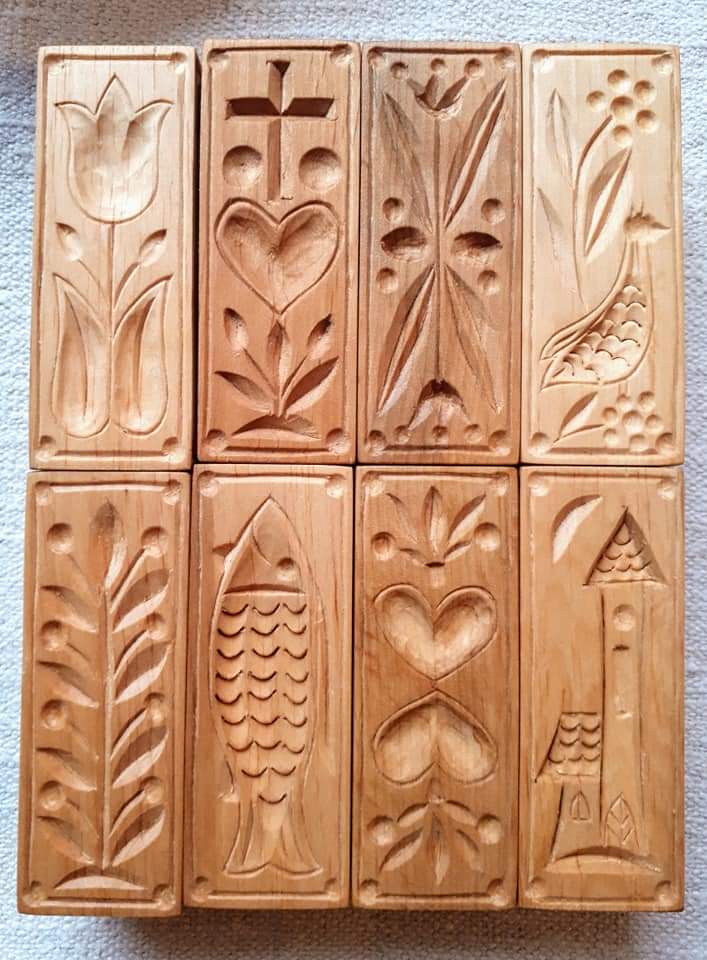
It took a while for us to realize it, but that rectangular shape is actually a major key to making this recipe work. Here is a picture of some traditional molds that Mirtill Seregély shared:

Traditional Kvircedli molds carved from alder wood by Zsuzsanna Sáriczné. Note how the impression comes from rolling the mold over the dough, side after side so the pictures end up touching. Read below and you’ll see why that matters! Photo Copyright 2021 by Mirtill Seregély, and used with permission.
A fuller array of traditional Kvircedli molds carved from alder wood by Pál Szarka. Photo Copyright 2021 by Mirtill Seregély, and used with permission.

That rectangular shape turned out to be important.

Kvircedli stray from the traditional Springerle recipe by using an enormous amount of leavening to change the internal structure of the cookie. That’s the core idea. When we used a traditional Springerle mold, particularly a round or oval one, the pretty surface patterns held up fine, but the cookies baked into uneven, lopsided shapes tilted as much 45º off the level. The dough puffed out randomly to one side or the other, and occasionally even heaved up unevenly in two directions.

Looking a little closer at the recipe, and at some online examples, showed us why. One of the key features in a traditional Springerle is the “foot”; a ring of dough that puffs out sideways as the cookie bakes. You see this in Macarons too. The cause is the same in both cases.

First you make the dough, and then you stamp it with a fancy shape (for Springerle) or pipe it into a neat circle (for Macarons). Then you let the dough rest on a counter long enough for the outside surface to dry out into a skin. That takes up to 2 hours for Macarons, and 24 hours for Springerle. The bottom, of course, does not dry out because it is resting on a parchment-lined tray.

When you bake the cookies, the bottom and core expand as heat turns the inside moisture to steam and/or activates the leavener to create CO2. Boyle’s law says those gases need to expand in all directions, but they can’t go up through the dried out skin. So instead you get extra vertical rise combined with a horizontal “foot” as dough puffs out around the bottom.

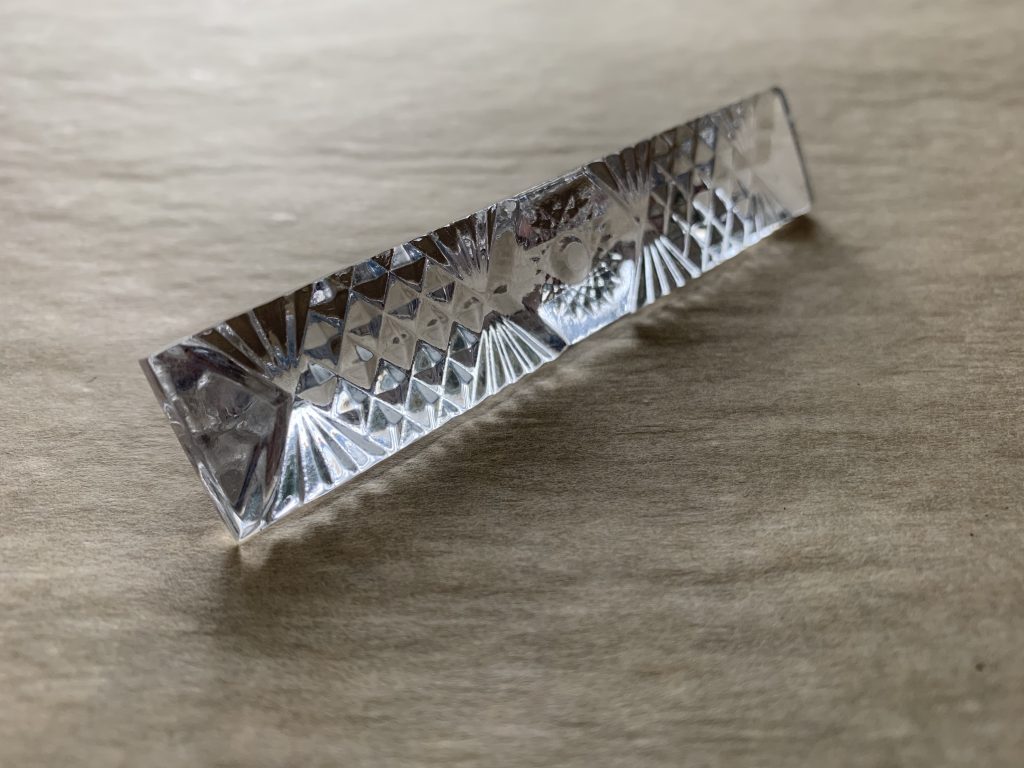
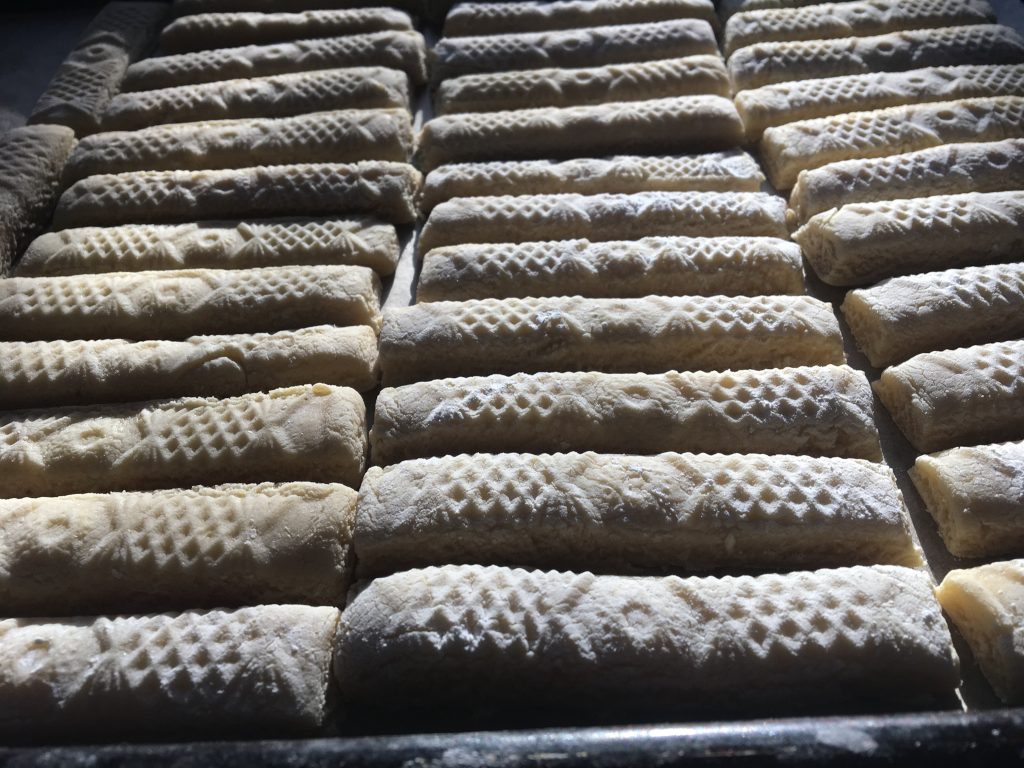
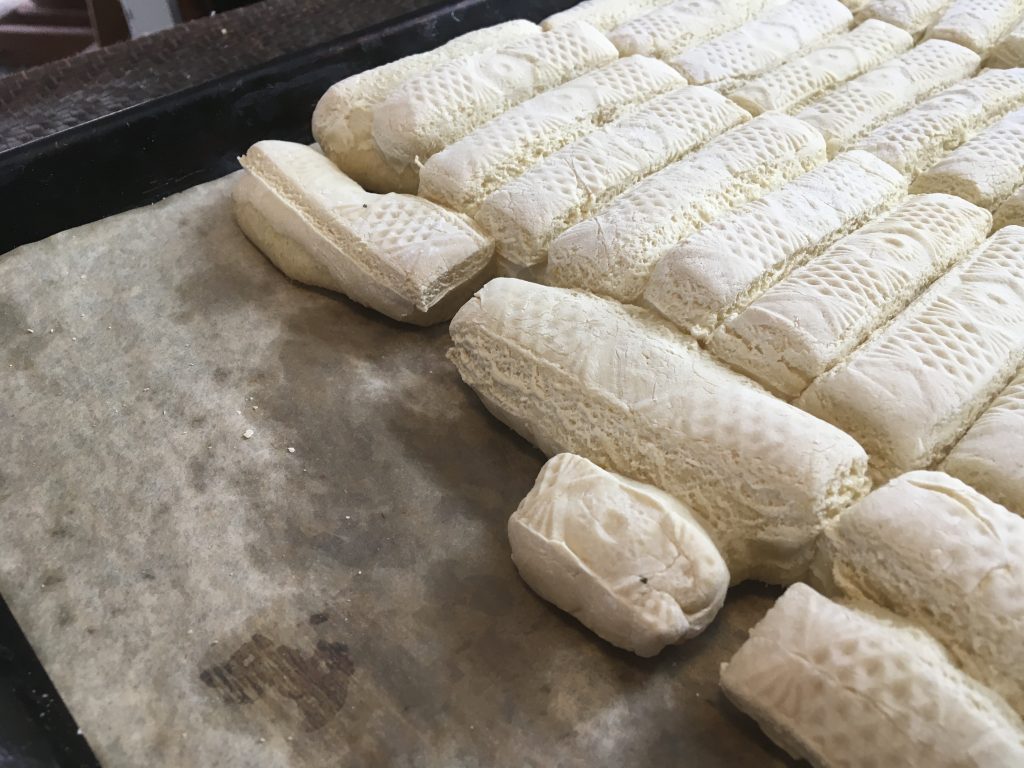
A pan of Kvircedli packs the unbaked cookies close enough together (about 3-4 mm = ⅛” apart) for the feet to expand into each other. The result? Each cookie supports its neighbors from the side as they bake, adding a little extra rise while also preventing a tilt in any one direction. Have a look at the tray we just baked for this article (stamped with the bottom of a crystal knife rest since we do not have one of Mirtill’s special molds to play with):

There are would-be cookie molds all over the house!
Soldiers lined up and waiting to bake. The dough is ⅜” thick after being impressed with the pattern, but not yet puffed.

That is the raw dough.

See how the ones on the edges have puffed unevenly?

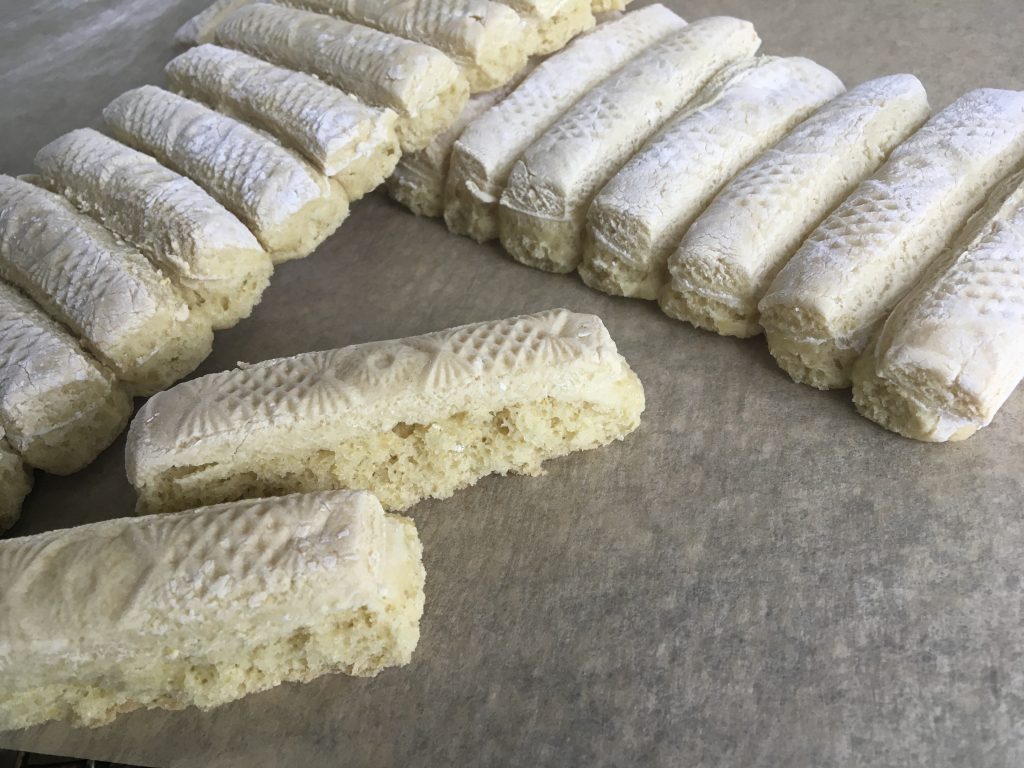
Here is the same tray after baking. The middle ones are nice and even, and have puffed from ⅜” up to a full 1″ tall. The ones on the edge got lopsided because they received no support from a neighbor. FWIW, this process also results in a much desired side effect. Kvircedli are a breakaway cookie that gets divided along those pre-inscribed lines. Doing so reveals the uniquely beautiful, spongy interior.

Showing the lovely sponge cake texture. Just be careful not to crush your pattern as you pull. There is nothing wrong with using a paring knife to get things started if the cookies started out a little too close together on the tray.

Problem #3: The Evil, Cat Box Reek of Ammonia

But there was a joker in the deck! Hartshorn a/k/a Baker’s Ammonia a/k/a Ammonium Carbonate has yet a fourth name: Smelling Salts. And believe me, they work. If your beloved should ever swoon in a most dainty and Victorian manner, one good whiff of this stuff will quickly break the trance. Blech.

Hartshorn works by breaking down into ammonia and CO2 when heat is applied. The ammonia bakes off, while the CO2 provides the lift you wanted. Springerle recipes use a bare ¼ tsp. in the dough for this volume of eggs and flour. That amount is enough to leave a foul odor in your oven, but won’t be noticed in the final product over all the anise notes. With Kvircedli you’re going to wince when you open that oven, and sticking your nose against the fresh baked cookies is not going to make you happy. Indeed, our recipe contains an explicit warning to avert your face when you open the oven door in order to spin the baking trays, and again when you remove the finished cookies.

Some of that odor inevitably ends up embedded inside the freshly baked cookies.

We tried a few things to fix this. First, we cut the amount of Hartshorn in half and replaced that portion with baking powder at our normal ratio of 3 parts baking powder for every 2 parts of Hartshorn being replaced. That was the batch mentioned above, where we used proper Springerle molds in addition to the knife-rest stamp. The results were uneven. Literally, and sometimes at multiple angles inside the same piece. It was worst in the oval Springerle that baked in splendid isolation, but the phenomenon showed up in the square ones we baked side by side. So was it the leavener? The much more varied heights of the pattern? Or the fact that “side by side” meant a nice even row, that only gave mutual support from one direction?

Bad science on our part. There’s a reason why each experiment is supposed to change just one variable at a time. But we never did go back to finish looking at the baking powder idea because Scott paused to talk things out with Mirtill. Understanding the history and purpose showed us that Kvircedli were meant to have a plain flavor, and were not a medium for display like Springerle. Who would want to dunk a work of art? Why would you want to distract from the wine you’re sampling, especially with brilliant, jewel tone colors? And if the rectangular shapes served a purpose, that meant the breakaway effect was deliberate, which in turn…

You get the idea. It made more sense to go back and tweak the original recipe for a longer and lower cooking time that would allow more of the ammonia to bake off. The original formula called for 12-20 minutes at 150º C, which is 300º F. We reduced the temperature to 140º C (285º F) and left them in for the full 20 minutes, with a single spin at the 10 minute mark to avoid hot spots.

The result? A little less browning on the bottom, which we missed; the exact “yellow” tone described in the original recipe, which hadn’t been as clear before; and about 75% less reek in the finished cookies. Mirtill had also told us that she’d done enough casual research to believe that true Swabian bakers solve the problem by simply leaving the baked cookies out for a day before eating. Another baker we met on Facebook confirmed this in a conversation with her Hungarian relatives. And, sure enough, that leftover smell disappeared after a few hours on a plate once we instituted the longer baking time.

And so you get to our final verdict. For shaped and dried cookie dough that is ⅜” thick (1 cm), bake at 285º for 20-25 minutes instead of 300º for 12-20. That’s what you will read in the recipe below. Here in private we will use less exact numbers and call it 18-30 minutes to allow for differing ovens and the erratic moods of your household gremlin. We’ve all got one, and they have a notoriously fickle sense of humor.

Problem solved, at least well enough to avoid going back for a new round of experiments with baking powder. Let us know if you try it, however. We’d love to know if there is a way to make the recipe without having to deal with the cat box effect.

Conclusion

Molded cookies involve some extra work to stamp in the pattern, and extra time because of the overnight rest that forms the required crust. There is no getting around that. But if you are the sort of baker who likes that process, we 100% believe you ought to give Kvircedli a try. That goes double if you happen to own a traditional 4-sided mold that can be conveniently rolled-and-pressed, or one of those patterned rolling pins. Either way, target a final thickness of around ⅜” (1 cm), which will be cut into nice, rectangular shapes. Array on your tray about ⅛” (3-4 mm) apart, and then proceed.

Go with the classic lemon-only profile if you want to stick with tradition and/or use them in a wine tasting. They really work that way, and yes: we did make sure to test it. [Hic!]

Add flavor to the dough if you want to eat the cookies out of hand (although Kate loves everything lemon and adores them as they are). Flavored, eating cookies can be painted if you so desire, but do not do so for dunkers. It serves no purpose and distracts from the wine itself.

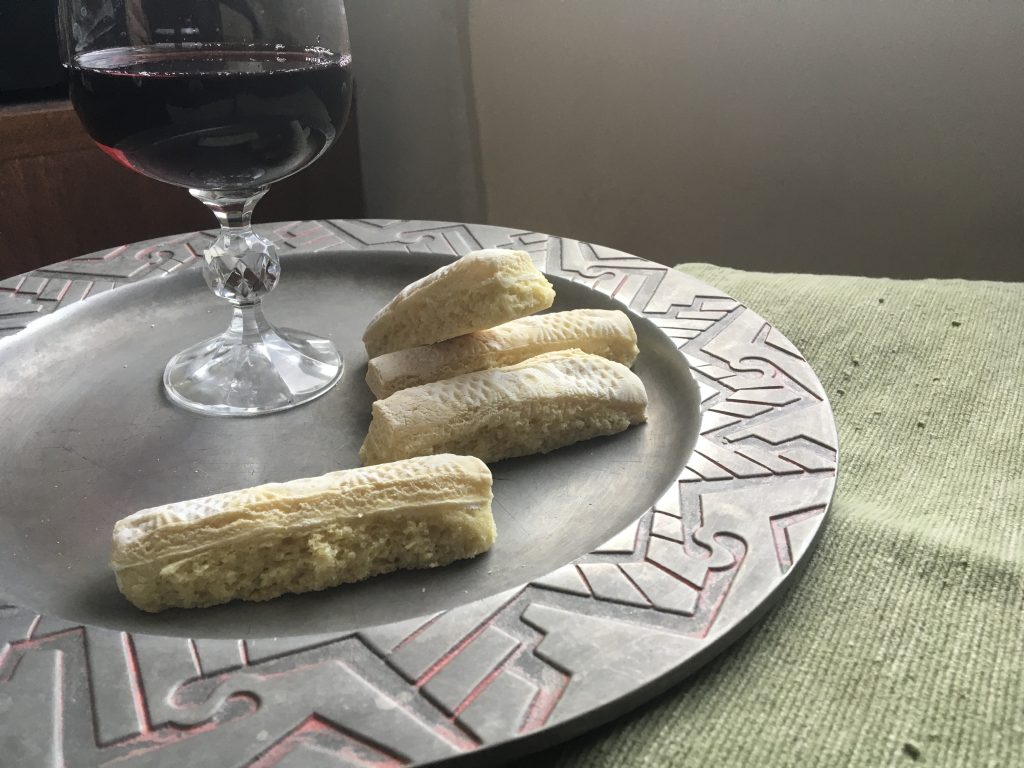
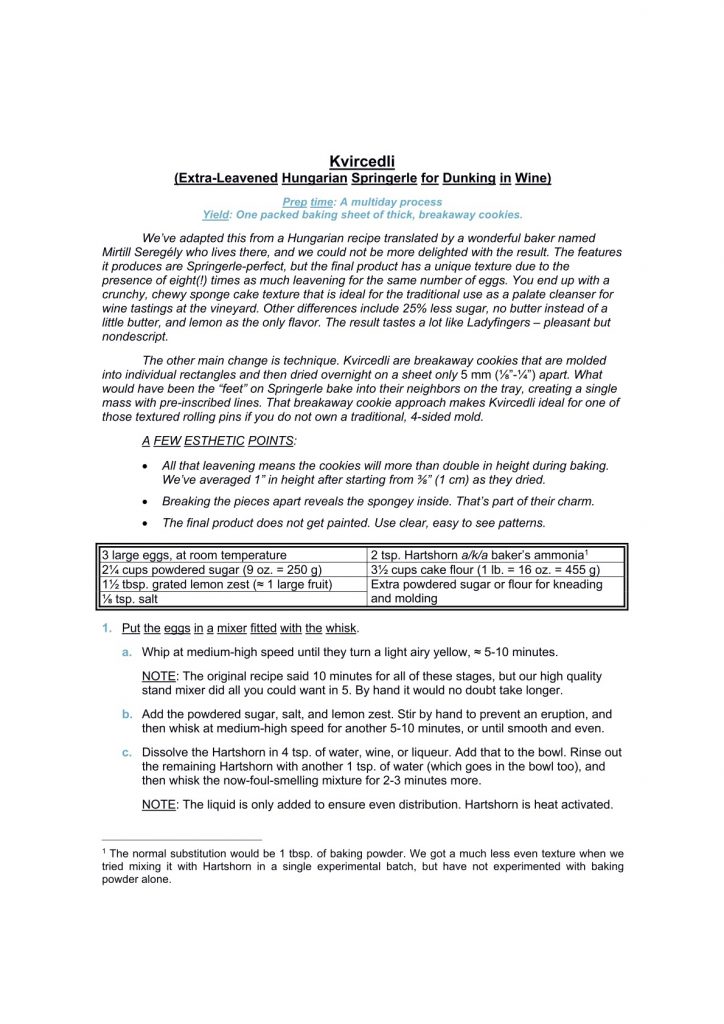
Here is a final photo, and a copy of our updated recipe. Enjoy!

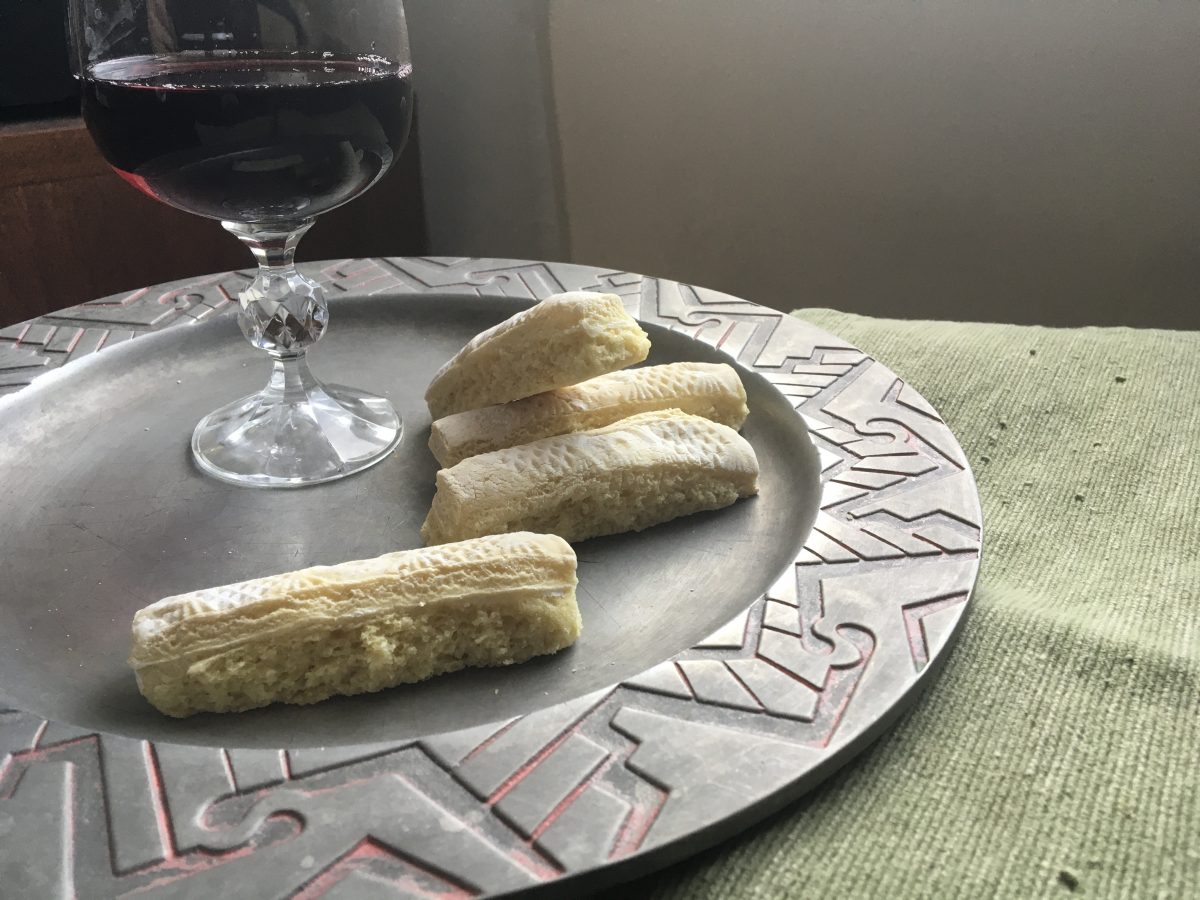
It should be a dry white wine, of course. That is the style of Mór, whence Kvircedli originate. The photographer, however, responds that white wine may be correct, but red is more photogenic. That answers that.

CAVALLUCCI – A Honey Biscuit from the mountains of Tuscany

Okay, yes. That is star anise from China rather than regular anise from Italy. Live with it. This makes the prettier picture.

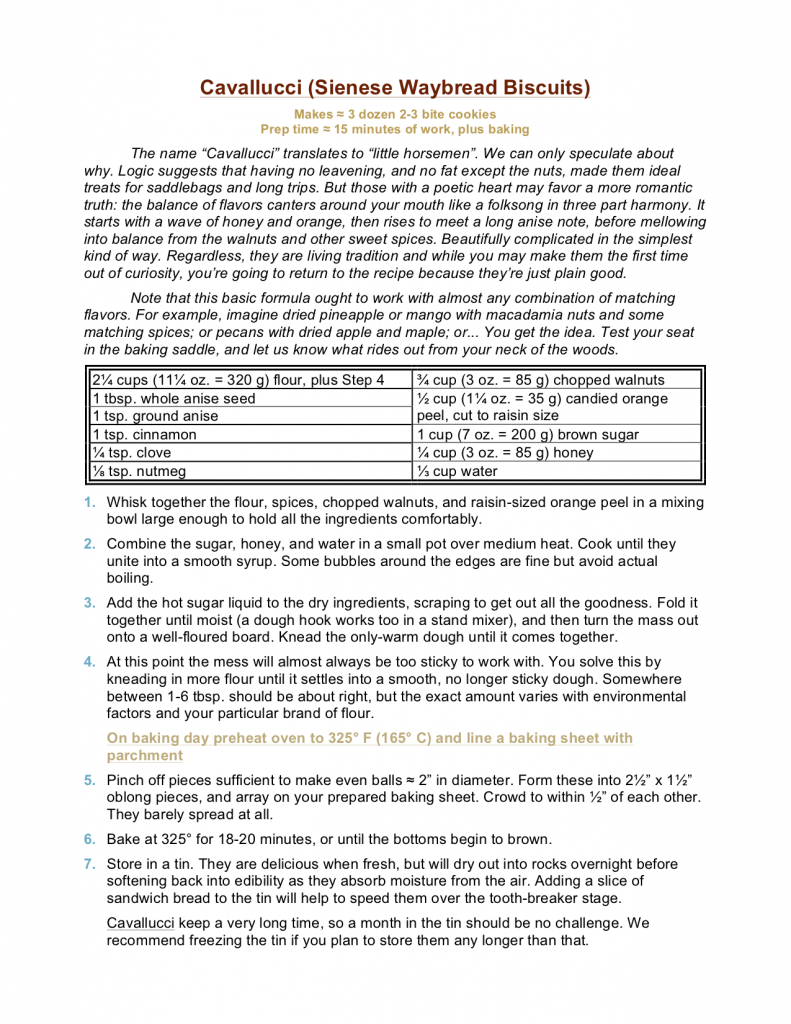
Such a romantic name for such a plain little critter! “Cavallucci” translates to “little horsemen,” which I suspect comes from the fact that having no leavening, and no fat except the nuts, made them ideal treats for horsemen riding through the Tuscan hills. Probably in search of some well grown evergreens, where the elusive porcini can be found. I’m sold right there.

But Cavallucci also have some modern romance. This, and its soft almond lookalike Ricciarelli, are the treats of Sienna, a smaller city about 50 miles south of Florence. You will not escape a visit without getting to experience the unique, chewy balance of honey, orange, anise, and other spice that these are all about. So why not visit from the comfort of your own home kitchen?

As always, skip to the bottom if you want the recipe without any discussion

It’s All About Balance

Moving on, it’s that key word – “balance” – that catches the essence of what these are really about. Our friends and family will attest that your humble authors are better as cooks than we are as bakers. Especially me. Kate does cakes too, but my baking really begins and ends with three categories: (1) heritage cookies, (2) lemon curd, and (3) anything made with chocolate.

Both of us find Northern Italian cuisine particularly intriguing because it’s such a challenge. There’s such delight to be found in achieving perfection through skill and nuance alone. Think of recipes like scaloppini or piccata. They have what, three or four ingredients plus salt and pepper? And yet the results can vary from shlock to divine. It’s a culinary balance beam trick. Impressive as heck if you get the balance right, and embarrassing if you don’t.

Cavallucci should be approached with that same sensitivity. The core of the recipe is little more than flour held together with lots of honey, plus orange peel and walnuts with a healthy shot of anise. Honey, orange, and anise; three flavors that love each other. So what could go wrong? Lots, as it turns out. You’ve got to get the balance right, and that balance has to include texture as well as flavor.

Balancing The Texture

This cookie begins with a trick you see often when honey gets used in bulk. You don’t use the raw material on its own. Rather, you mix it with some added sugar, thin it with some water, and then simmer until everything comes together into a syrup. Candies take it a little further, cooking the sugary liquid up toward the soft-crack, hard-crack, and caramel stages depending on what you intend to do. No need to worry about that here. All you’re after is a nice, smooth syrup. It’s a trick we first learned with German Lebkuchen and Swiss Leckerli. It seemed strange and special at the time, but by now it’s become a standard part of the toolkit. Every one of the dozen or so Cavallucci recipes we looked at started in just that way.

The texture then expands in both directions – chewier and lighter – with the addition of candied orange peel and larger bits of walnut. Nothing to it, right? But it’s easier to fall off the balance beam than it is to stay erect.

A VALUABLE NOTE: There wasn’t enough room in the recipe to emphasize how important it is to get the size of your pieces right. That may sound obsessive but it isn’t. Balance, balance, balance! Candied orange peel has a stick-to-your-molars texture that totally takes over if you let the pieces get any bigger than a raisin, and that disappears in between your teeth if you cut it down to peppercorn size. Both can be annoying. As for the walnuts, they just vanish if you get them down to “finely chopped,” and break the product into sections if you leave them whole. Again, chopped just to raisin size is the perfect compromise.

Balancing The Flavor

That covers the texture. Next up, flavor. What have we got already? Honey (yum) and orange (yum). Two flavors that love each other. But… they’re obvious. No style. That slight bit of bitterness in the walnuts just isn’t enough to round things out. There are a lot of ways you could handle this in theory. Bakers in the walnut loving Balkans and Black Sea regions might grind up a great, big handful of walnuts to use as a bitter nut flour. Health conscious bakers might try substituting in a bit of whole wheat flour. The most common trick in Siena, and the cheapest for American bakers, is to round out the honey with a small hit of molasses.

NOTE: Our favorite page in the entire book – the conversion table! – should can be your friend here. One cup of white sugar plus one tablespoon of molasses equals light brown sugar. Two tablespoons of molasses equals dark brown sugar. We specify light brown sugar in the recipe, but every baker deserves to claim each cookie as his or her own. Those numbers tell you the basic amounts you’re working with, and should empower you to adjust as your palate suggests. The textural properties of molasses will not be an issue because they overlap with the honey. Knowledge is power!

So now the honey works, and the texture is right. The next element to turn these into true Sienese Cavalluci comes from the anise. This recipe contains a whopping four (4) teaspoons of anise seed. Holy. Friggin. Cow. That, however, isn’t strange for the region. Italians adore anise in the same way that Americans love cinnamon. But that much… well, it is another case where you need to work on the balance.

Fortunately enough, the native bakers agree. I do not think we saw a recipe that did not try to soften the licorice flavor with a bit of this and a bit of that. We ended up with a background mixture of other sweet spices, led by cinnamon of course since we are, after all, Americans.

The bottom line here is a waybread biscuit (they aren’t pretty enough to deserve the exalted title of “cookies”) with a distinctive, chewy texture and a sweet, addictive flavor that hits you in waves. It starts with the honey and orange, and then evolves to include the anise. All those rounding-out touches (the walnuts, molasses, and other spices) keep any of those three from dominating the composition, and show up on their own in the aftertaste.

Conclusion

It really is like a good Veal Scaloppini, or Chicken Marsala. Simple food, done very well, and adding up to more than the sum of it’s parts. Serve with coffee, tea, or an aperitif that can handle the sweetness. They are better when they’re not alone, at least in our opinion. But you won’t be disappointed regardless, and a plateful of Cavallucci is much less expensive than a ticket overseas.

A FINAL NOTE: Cavallucci fall in the category of waybreads because all that honey acts as a preservative. They may dry out but they aren’t going to get stale or go rancid unless you lock them in a drawer and forget about them for more time than any of us care to imagine. There is also an easy fix if they do dry out. Put the little bricks in a tin or other tightly sealed container with a slice of sandwich bread. Wait a day or two, and the moisture will move out of the bread and into the cookies; drawn there by the hygroscopic (water loving) power of the honey. Hey presto, Bob’s your uncle. Repeat as needed.

A REALLY, TRULY FINAL NOTE: We haven’t tried it, but this is pretty obviously a formula recipe that ought to work with almost any combination of matching flavors. Honey, orange, and anise typify northern Italy. Do something with dried pineapple or mango, and macadamia nuts, and you ought to get a wonderful treat for drinks on the lanai. Pecans, dried apple, and maple would pair well with a hoppy ale or hard cider on a front porch rocker. Or maybe… You get the idea. We tend to focus on cookies that come with deep historical roots, and a story to match. But there is nothing more American than taking a great idea from the old country and turning it into something new, and maybe even better. So please: test your seat in the baking saddle, and let us know what rides out from your neck of the woods.

CORSICAN CANISTRELLI – From dog biscuits to dunkers

It’s Autumn, which means I am already in the early throes of cookie baking. The annual checklist has been pinned by the calendar to keep track of the various cookies, and their status. These will be for giveaway; those for the house; those others for giveaways at book signings; etc. It’s all part of a well established system.

First, everyone in the family goes through our entire list of primary recipes. Each member picks five cookies that no one else has selected, making a total of 20 since our Labrador gets no say. Those go above the line.

Next, the parents/primary bakers slide in a few recipes to “balance the tray.” Have we covered citrusy, chocolaty, nutty, fruity, and dry-fruity? Did crunchy, light, chewy, fancy, and melty all get their due? We have to be fair, you know [eyes roll].

And then we get to step #3: cookies that I want to test. It isn’t official, but it happens every year so I may as well own up to it. You see, the research may continue year round, but we really do very little baking before October or after January. The recipes pile up until the [ahem] weight becomes hard to resist. And thus every Fall includes a certain amount of nagging requests for input about which ones the feminine component are [ahem] most eager [a/k/a willing] to try.

We probably average 2-4 of these every season, with January devoted to another 2-3 that I couldn’t get authorized during the Holiday extravaganza.

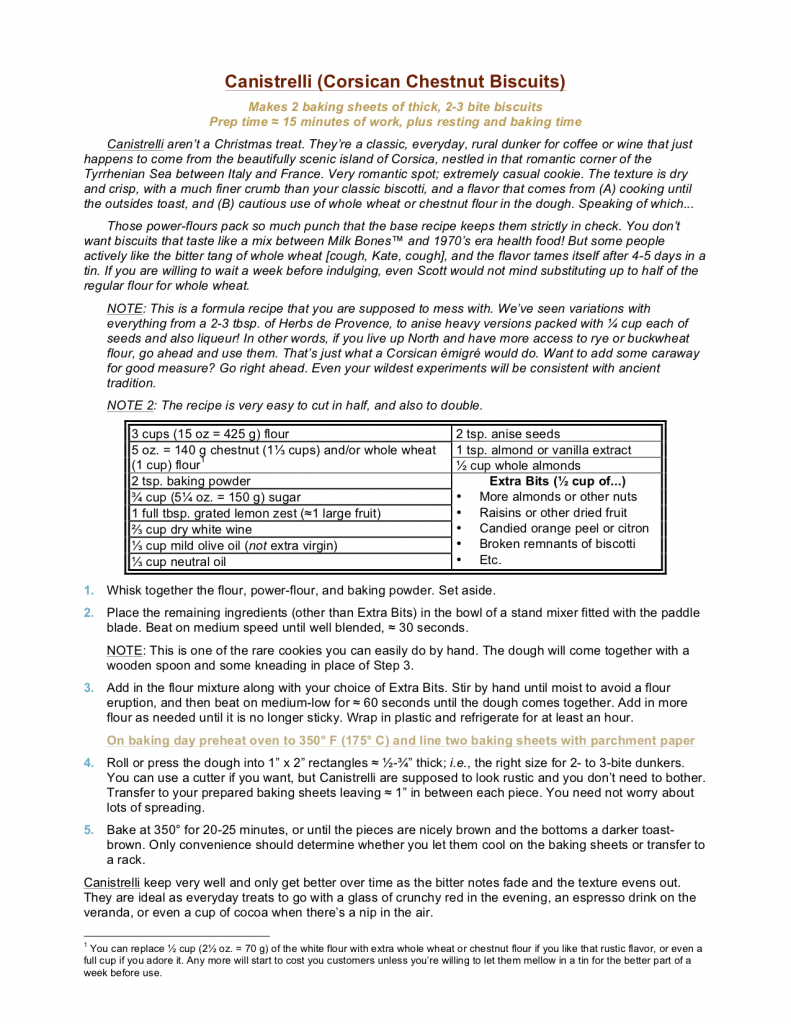
This year’s first experiment involved a Corsican specialty called Canistrelli, a famous wine-or-coffee dunker with several odd ingredients like olive oil and some white wine in the dough. The mix also had a hit of what we call “poverty flours;” those highly flavored, lower gluten flours that got replaced by standard white flour once technology made it cheap enough. Whole wheat (the precursor of white) is standard around the word, but this broader category includes anything that was a cheap substitute in pre-industrial times. In some parts of the world it was buckwheat. In Scandinavia it would have been rye. In central Europe, acorn flour. The Mediterranean nations used a lot of chestnut flour. Etc.

So… Canistrelli are ancient, regional, well loved, and unique? And they feature earthy chestnut and whole wheat flours? What could be more perfect target for Heritage Cookies Volume II?

As always, skip to the bottom if you only want the recipe. The rest of this post is devoted to the stumbles made and lessons learned along the way.

I quickly set to work and put together an initial test recipe emphasizing the rustic notes. The main elements had Kate all but jumping around with excitement. Whole wheat that she’d picked up the other day; chestnut flour we saw on sale in the Strip District; olive oil, white wine, lemon zest, and brown sugar. Several online recipes also included anise seeds and either whole or slivered almonds, but we decided that would create too much overlap with other cookies, and might make it harder to focus on this rural core. I opted to keep them out for the initial test, and to instead rely on the flours for flavor. Those touches could wait for the later versions. Maybe some raisins or chocolate chips to add a few sweet pops, but that would be it.

I showed the test recipe to Kate for her input, which only made her more excited. “This one! You definitely need to do this one for the first experiment.” No butter? Great. Limited sugar? Fantastic! And ooh, it’s jam packed with heart healthy grains that measure high on the virtue spectrum. With all that in their favor, what could these be but…

Dog biscuits. Hand to heart, that’s what they taste like. Dog biscuits with sweet little pops.

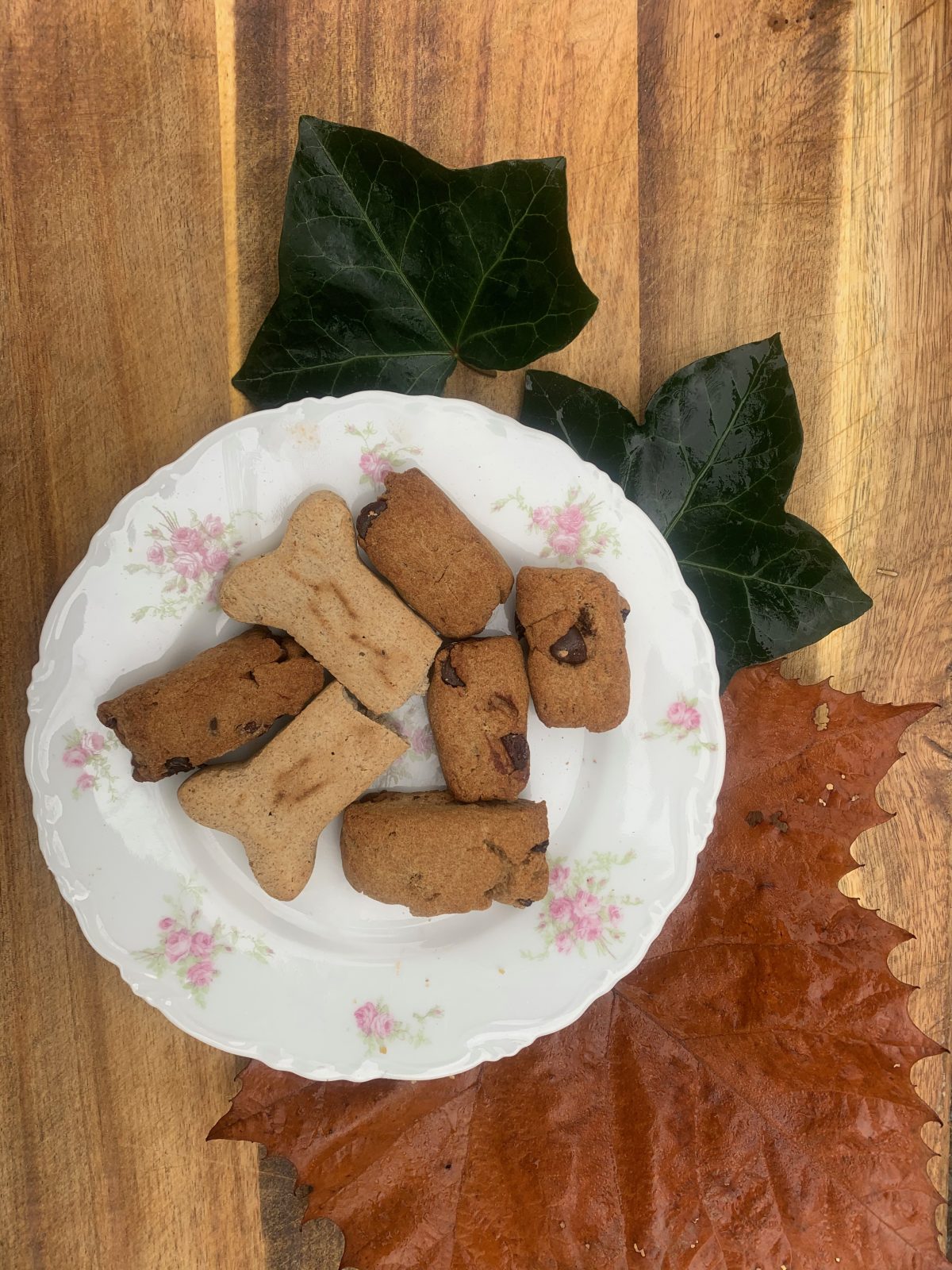
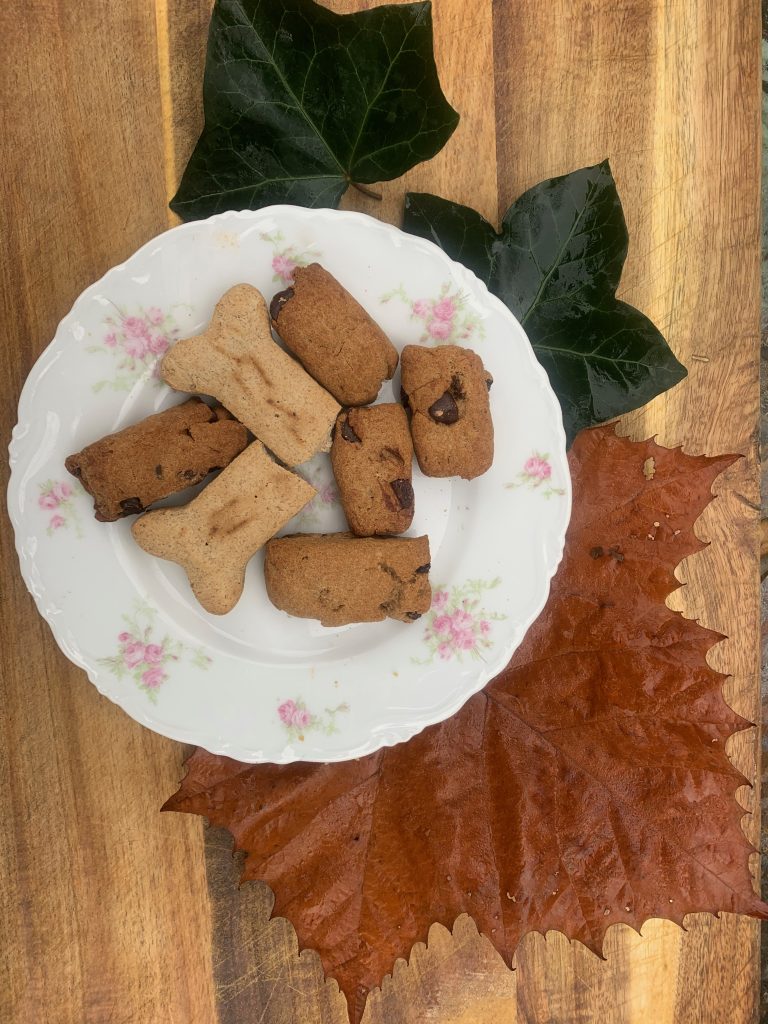
One from Corsica and the other from Alpo! One must admit that the Corsican one improved over time.

Admit it: you know that flavor. Every child in America has sneaked a biscuit or two. What is that makes Fluffy, Spanky, and Rex sit there drooling each night? They had to be good, right? The dog isn’t a fool. And then you learned. Dog biscuits are plain, crunchy, vaguely bitter, and just not worth the effort to finish. Sort of like whole wheat bread from the 1970’s.

Our teenager wondering, “What is it that labrador sees in these things?”

Plain? Check. Crunchy? Check (about as expected TBH). Vaguely bitter? Definitely.

Healthy? Well, that sort of depends on how much credit you give to those slim, thin diet gurus who stay that way by filling their plates with pseudo-food that isn’t worth eating in the first place. Maybe that’s how these should be marketed! Whole grain desserts perfectly suited to follow a dressing-on-the-side, chicory-sprouts-and-tofu salad.

Sorry folks. Virtue points go only so far. Even for Kate. And you know the worst part? Even our lab got stiffed on this one, because I did add those raisins and chocolate chips, and both are bad for dogs!

Epic fail. Post it on Facebook as a funny story and a lesson about just how badly an experiment can go wrong.

Still, we knew there had to be a version of this recipe that works. It’s just too popular to be this actively bad. Besides, the texture came out just as we’d hoped. So, duly chastened and just a bit traumatized set back to work with the reminder that poverty flours lost out to white for very good reasons. They’re only romantic in myth, age-dimmed memories, and very limited amounts. Hints are intriguing. More than that is… not.

Version two changed the recipe by trying a 4:1 ratio of white to “other” flour, with the olive oil cut 3:1 by a flavorless vegetable oil. That was much better. Yes, they were a bit plain and somewhat boring, and it became clear that chocolate chips were just a bad idea. But it was getting close.

So version 3 would be… Wait a sec! Something strange just happened! Kate found the old tin of Version 1 dog biscuits, and came running over in excitement. “These are way better than they used to be!” And they were. Even I, traumatized and doubting as I was, had to admit that the worst of the bitter, acrid flavors had gassed out over the past three days. They still weren’t something I’d serve to company, but Kate was actually willing to eat them. [Her stance on health based brownie points being a lot more generous than mine]. Marital harmony was restored and, more to the point, it became clear that something was going on at a level I hadn’t considered.

I suspended the baking and went back to search through the Internet for a bit more background. The first effort had been based off four different versions, with a slant toward the poverty flours. We don’t have access to someone from Corsica to tell us about the norms, so research would have to substitute.

Some 14 recipes later, I emerged with a clearer view of what was going on.

1. The further you get from Corsica, the lower the amount of poverty flour. Two English versions were all the way down to zero! That made sense in a way. Corsica has never been what you’d call wealthy. Beautiful, yes. But not wealthy. So a higher percentage of poverty flours made sense, especially when reinforced by the way people get used to the taste of whole wheat flour. The more you eat, the more you can get away with.

Kate really, really wanted to come out of this with a cookie that would feature a distinct poverty flour tang. It just had to contain that tang enough to be friendly for rookies who hadn’t become accustomed to those notes. We’d start by simply cutting the amount of tangy product, with notes that bakers should increase it as tolerance and taste permit.

2. The amount of variation in added flavors said something too. My research showed some absolutely huge variations. This recipe reeked of anise. That one included no anise, but had a full two tablespoons of aromatic herbs. This other centered on smoked paprika. That fourth one piled in whole nuts, with walnut oil and almond extract. On and on.

You’d think all that variation would make it even harder to nail down the pattern, but the third observation tied it all together:

3. Canistrelli inevitably get described in romantic terms that basically amount to, “That treat we enjoyed while sitting on the veranda of our hotel, watching the scenery with a glass of wine/espresso as we talked…”

Step back and you’ll see the pattern. Hotel = chefy variations, restrained only by a strong tradition that defined the texture and the purpose. But at the same time, those variations were all very intense in their own way. Whole wheat and chestnut flavors dominated the dog biscuit version. Anise, herbs, smoke-and-spice, nuts, and what-have-you clearly did the same to the new ones. Got it! Anything goes, so long as it’s dialed up to a “10”. That was enough to finalize the target.

  • Canistrelli are supposed to be right on the dividing line between savory and sweet, with much less sugar than the things you’d see on a wedding table or holiday tray.
  • They must be very crunchy, on the dry side, and are intended to be a dunker.
  • They usually have a bitter element, but it’s always balanced against the baker’s choice of flavor.
  • That flavor can be anything, so long as it’s strong enough to fight through the dryness, and clear enough to complement whatever drink you’re serving on that veranda.
  • And some of that flavor really ought to come from oil, wine, and/or liqueur in the dough.

Day 6. I went back to the drawing board, properly armed, to the music occasional snarfing noises as Kate dug into the no-longer-dog-biscuits beside her morning coffee, and sometimes her evening glass of wine. [Objection from the peanut gallery: “Kate does not ‘snarf’!”] [Of course not dear. Poetic license. What words would you use to describe the sound?] [“Just zip it, okay?”]

Let’s try this again. Day 6. Kate has decided she likes the original version, and keeps saying, “Don’t change it too much…” Listening attentively with nary a twitch of brow nor roll of eye, I manfully forge again. Don’t worry my love, I’ve got this!

And this time… it works. These aren’t my personal favorites. I’m not going to hide that fact. But they have become one of Kate’s, and she has put her flag in the ground to defend her plan of keeping a regular supply on hand. So the bottom line is this: The recipe below will produce something the natives of Corsica would call a Canistrelli every time, even if those who don’t know the story would be hard pressed to understand how they all fit together. If you have a taste for whole-grain tang, you’re likely to fall into Camp Kate and find this to be one of our greatest triumphs.

If you lack that taste, you’ll be off in Camp Scott, shaking your head in a confused state evenly spaced between wonder, delight, horror, and some culinary word to invoke my inevitable wince. But I’m man enough to admit that my taste isn’t “right;” it’s just mine. Your mileage may vary.

Enjoy!