MARZIPAN & ALMOND PASTE – the recipe beneath the recipes

A few weeks ago we put up recipes for a set of Five macaroon recipes we’ve come to love – which could be described as marzipan suspended in an egg white meringue. And I am now working busily on a special Croatian treat called “Rafioli”, which is basically an exotically flavored almond paste wrapped inside a baked pasta shell. [Watch for it!]

German Mandelhörnchen and a Greek equivalent are also on our “to do” list after Kate took an initial whack that wasn’t too far from being right. Those amount to a flavored marzipan or almond paste lightened with fewer egg whites than you’d use for macaroons, formed into crescents, and then dipped in chocolate.

EXTRA SPICE FROM KATE: We have no photos of the Mandelhörnchen because a mysterious cookie gremlin raided our kitchen before anyone could add the chocolate part. Skeptical spouses have wondered if “doppelganger” would be a more accurate than “gremlin,” but I admit nothing. He only suggests such an outrageous thing because they are one of my all time favorites, both tasty and toothsome.

And then… Hmm, a pattern seems to have formed! There are dozens, if not hundreds of baked goods that start with a base of finely ground almonds, mixed with sugar and then bound by egg whites. That ingredient is called “Almond Paste” when left loose and a little sticky, or “Marzipan” when you add enough extra almonds to make it solid. We wouldn’t call either one a “cookie” all on its own. Commercial marzipan is actually marketed more like a not-so-sweet candy (with U.S. and English versions tending to be sweeter), and almond paste as an ingredient. But the basic concept gets used in so many true cookies, and cookie fillings, that it’s only fair to give our version.

Besides, Valentines Day is coming next month and you can earn some major brownie points by making Marzipan treats and forming them into something romantic. And double-besides, the recipe for Marzipan contains a couple of surprises that many people don’t know about, such as a tiny bit of rosewater used as everyone’s not-so-secret ingredient.

Anyway, here is our version for your education, edification, and delight.

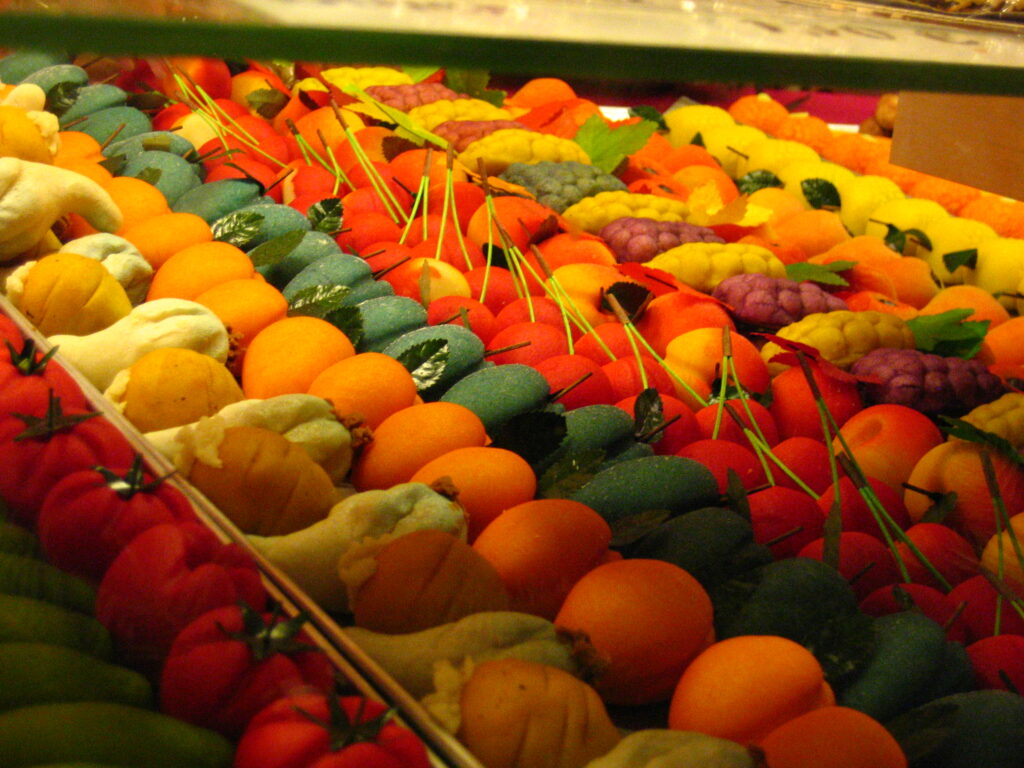
This lovely photo of Marzipan Fruits at the Nuremberg Christmas Market is available under a Creative Commons Attribution-Share alike 2.0 Generic license at the linked website. Many thanks to the author for his or her generosity.

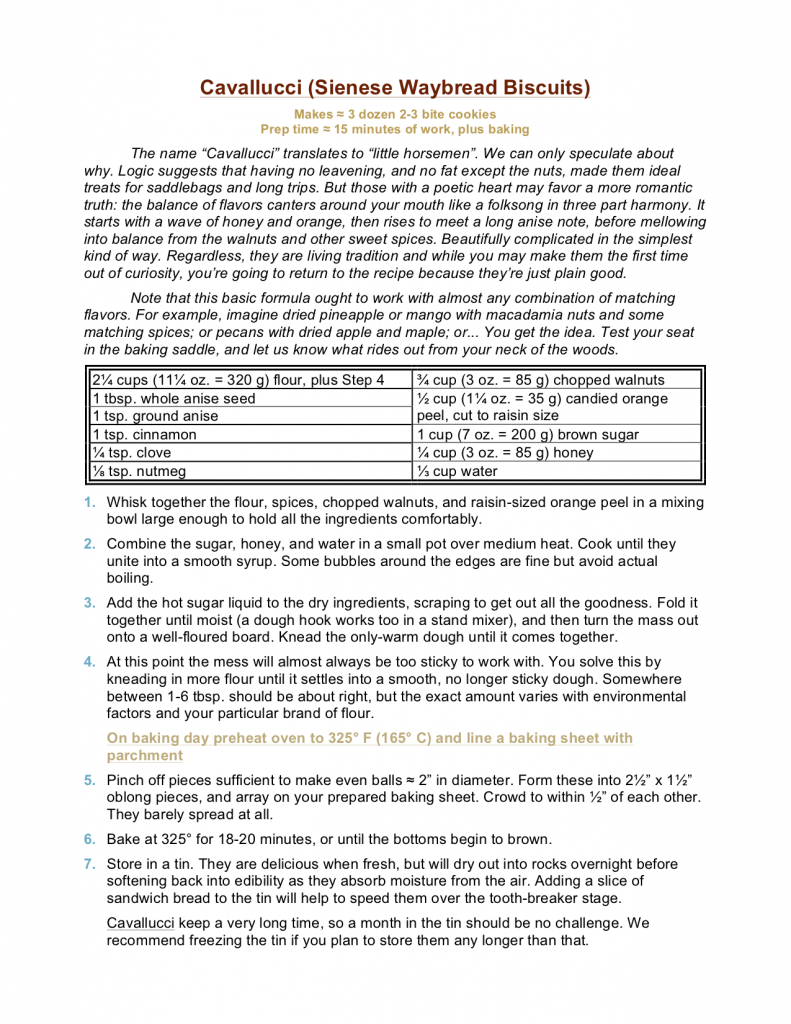
CAVALLUCCI – A Honey Biscuit from the mountains of Tuscany

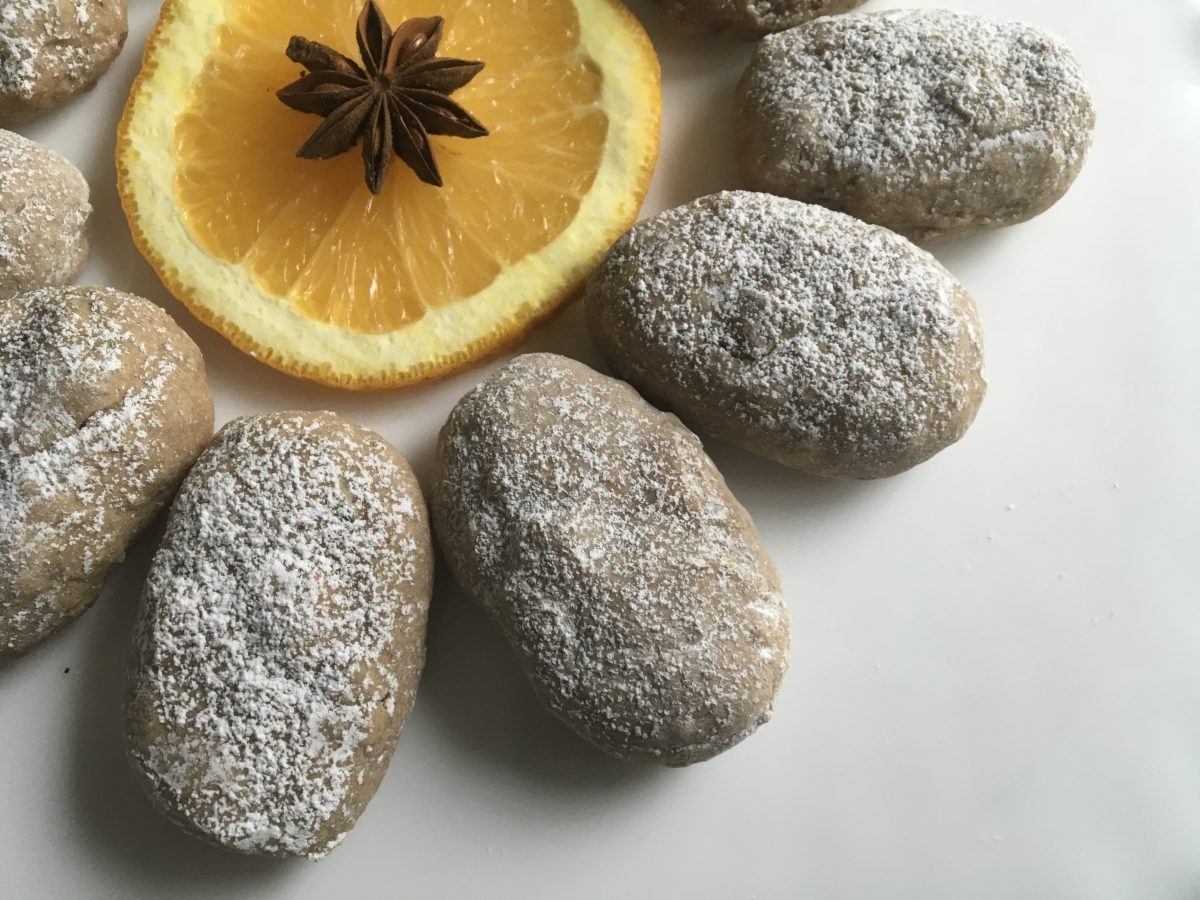
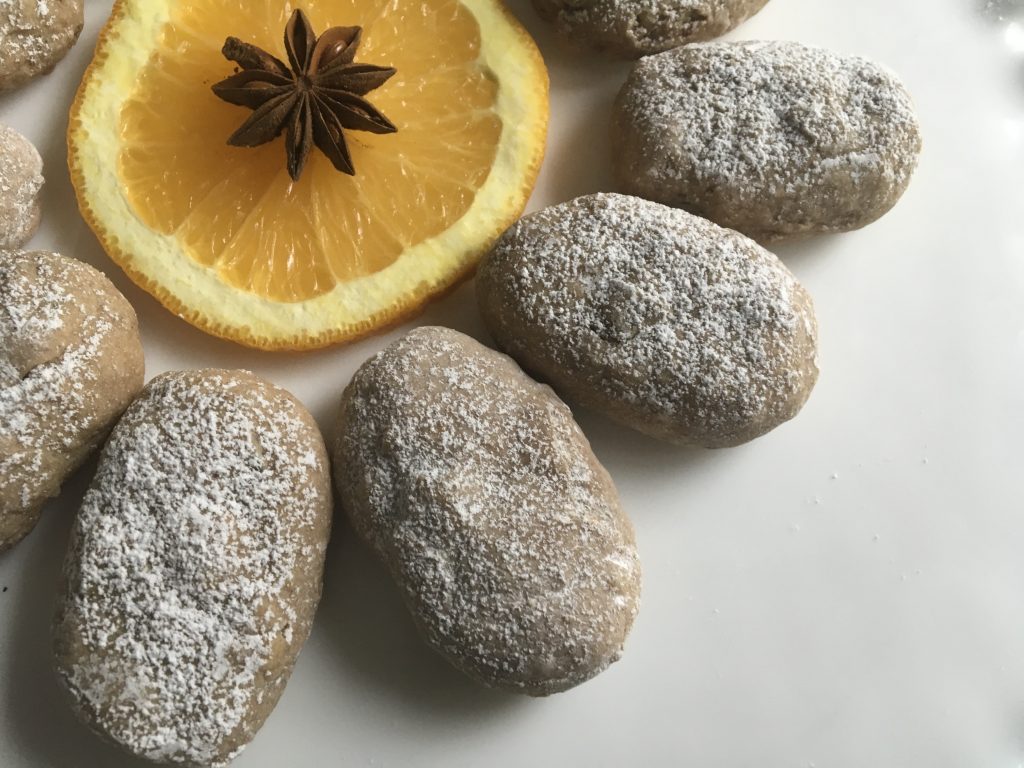
Okay, yes. That is star anise from China rather than regular anise from Italy. Live with it. This makes the prettier picture.

Such a romantic name for such a plain little critter! “Cavallucci” translates to “little horsemen,” which I suspect comes from the fact that having no leavening, and no fat except the nuts, made them ideal treats for horsemen riding through the Tuscan hills. Probably in search of some well grown evergreens, where the elusive porcini can be found. I’m sold right there.

But Cavallucci also have some modern romance. This, and its soft almond lookalike Ricciarelli, are the treats of Sienna, a smaller city about 50 miles south of Florence. You will not escape a visit without getting to experience the unique, chewy balance of honey, orange, anise, and other spice that these are all about. So why not visit from the comfort of your own home kitchen?

As always, skip to the bottom if you want the recipe without any discussion

It’s All About Balance

Moving on, it’s that key word – “balance” – that catches the essence of what these are really about. Our friends and family will attest that your humble authors are better as cooks than we are as bakers. Especially me. Kate does cakes too, but my baking really begins and ends with three categories: (1) heritage cookies, (2) lemon curd, and (3) anything made with chocolate.

Both of us find Northern Italian cuisine particularly intriguing because it’s such a challenge. There’s such delight to be found in achieving perfection through skill and nuance alone. Think of recipes like scaloppini or piccata. They have what, three or four ingredients plus salt and pepper? And yet the results can vary from shlock to divine. It’s a culinary balance beam trick. Impressive as heck if you get the balance right, and embarrassing if you don’t.

Cavallucci should be approached with that same sensitivity. The core of the recipe is little more than flour held together with lots of honey, plus orange peel and walnuts with a healthy shot of anise. Honey, orange, and anise; three flavors that love each other. So what could go wrong? Lots, as it turns out. You’ve got to get the balance right, and that balance has to include texture as well as flavor.

Balancing The Texture

This cookie begins with a trick you see often when honey gets used in bulk. You don’t use the raw material on its own. Rather, you mix it with some added sugar, thin it with some water, and then simmer until everything comes together into a syrup. Candies take it a little further, cooking the sugary liquid up toward the soft-crack, hard-crack, and caramel stages depending on what you intend to do. No need to worry about that here. All you’re after is a nice, smooth syrup. It’s a trick we first learned with German Lebkuchen and Swiss Leckerli. It seemed strange and special at the time, but by now it’s become a standard part of the toolkit. Every one of the dozen or so Cavallucci recipes we looked at started in just that way.

The texture then expands in both directions – chewier and lighter – with the addition of candied orange peel and larger bits of walnut. Nothing to it, right? But it’s easier to fall off the balance beam than it is to stay erect.

A VALUABLE NOTE: There wasn’t enough room in the recipe to emphasize how important it is to get the size of your pieces right. That may sound obsessive but it isn’t. Balance, balance, balance! Candied orange peel has a stick-to-your-molars texture that totally takes over if you let the pieces get any bigger than a raisin, and that disappears in between your teeth if you cut it down to peppercorn size. Both can be annoying. As for the walnuts, they just vanish if you get them down to “finely chopped,” and break the product into sections if you leave them whole. Again, chopped just to raisin size is the perfect compromise.

Balancing The Flavor

That covers the texture. Next up, flavor. What have we got already? Honey (yum) and orange (yum). Two flavors that love each other. But… they’re obvious. No style. That slight bit of bitterness in the walnuts just isn’t enough to round things out. There are a lot of ways you could handle this in theory. Bakers in the walnut loving Balkans and Black Sea regions might grind up a great, big handful of walnuts to use as a bitter nut flour. Health conscious bakers might try substituting in a bit of whole wheat flour. The most common trick in Siena, and the cheapest for American bakers, is to round out the honey with a small hit of molasses.

NOTE: Our favorite page in the entire book – the conversion table! – should can be your friend here. One cup of white sugar plus one tablespoon of molasses equals light brown sugar. Two tablespoons of molasses equals dark brown sugar. We specify light brown sugar in the recipe, but every baker deserves to claim each cookie as his or her own. Those numbers tell you the basic amounts you’re working with, and should empower you to adjust as your palate suggests. The textural properties of molasses will not be an issue because they overlap with the honey. Knowledge is power!

So now the honey works, and the texture is right. The next element to turn these into true Sienese Cavalluci comes from the anise. This recipe contains a whopping four (4) teaspoons of anise seed. Holy. Friggin. Cow. That, however, isn’t strange for the region. Italians adore anise in the same way that Americans love cinnamon. But that much… well, it is another case where you need to work on the balance.

Fortunately enough, the native bakers agree. I do not think we saw a recipe that did not try to soften the licorice flavor with a bit of this and a bit of that. We ended up with a background mixture of other sweet spices, led by cinnamon of course since we are, after all, Americans.

The bottom line here is a waybread biscuit (they aren’t pretty enough to deserve the exalted title of “cookies”) with a distinctive, chewy texture and a sweet, addictive flavor that hits you in waves. It starts with the honey and orange, and then evolves to include the anise. All those rounding-out touches (the walnuts, molasses, and other spices) keep any of those three from dominating the composition, and show up on their own in the aftertaste.

Conclusion

It really is like a good Veal Scaloppini, or Chicken Marsala. Simple food, done very well, and adding up to more than the sum of it’s parts. Serve with coffee, tea, or an aperitif that can handle the sweetness. They are better when they’re not alone, at least in our opinion. But you won’t be disappointed regardless, and a plateful of Cavallucci is much less expensive than a ticket overseas.

A FINAL NOTE: Cavallucci fall in the category of waybreads because all that honey acts as a preservative. They may dry out but they aren’t going to get stale or go rancid unless you lock them in a drawer and forget about them for more time than any of us care to imagine. There is also an easy fix if they do dry out. Put the little bricks in a tin or other tightly sealed container with a slice of sandwich bread. Wait a day or two, and the moisture will move out of the bread and into the cookies; drawn there by the hygroscopic (water loving) power of the honey. Hey presto, Bob’s your uncle. Repeat as needed.

A REALLY, TRULY FINAL NOTE: We haven’t tried it, but this is pretty obviously a formula recipe that ought to work with almost any combination of matching flavors. Honey, orange, and anise typify northern Italy. Do something with dried pineapple or mango, and macadamia nuts, and you ought to get a wonderful treat for drinks on the lanai. Pecans, dried apple, and maple would pair well with a hoppy ale or hard cider on a front porch rocker. Or maybe… You get the idea. We tend to focus on cookies that come with deep historical roots, and a story to match. But there is nothing more American than taking a great idea from the old country and turning it into something new, and maybe even better. So please: test your seat in the baking saddle, and let us know what rides out from your neck of the woods.

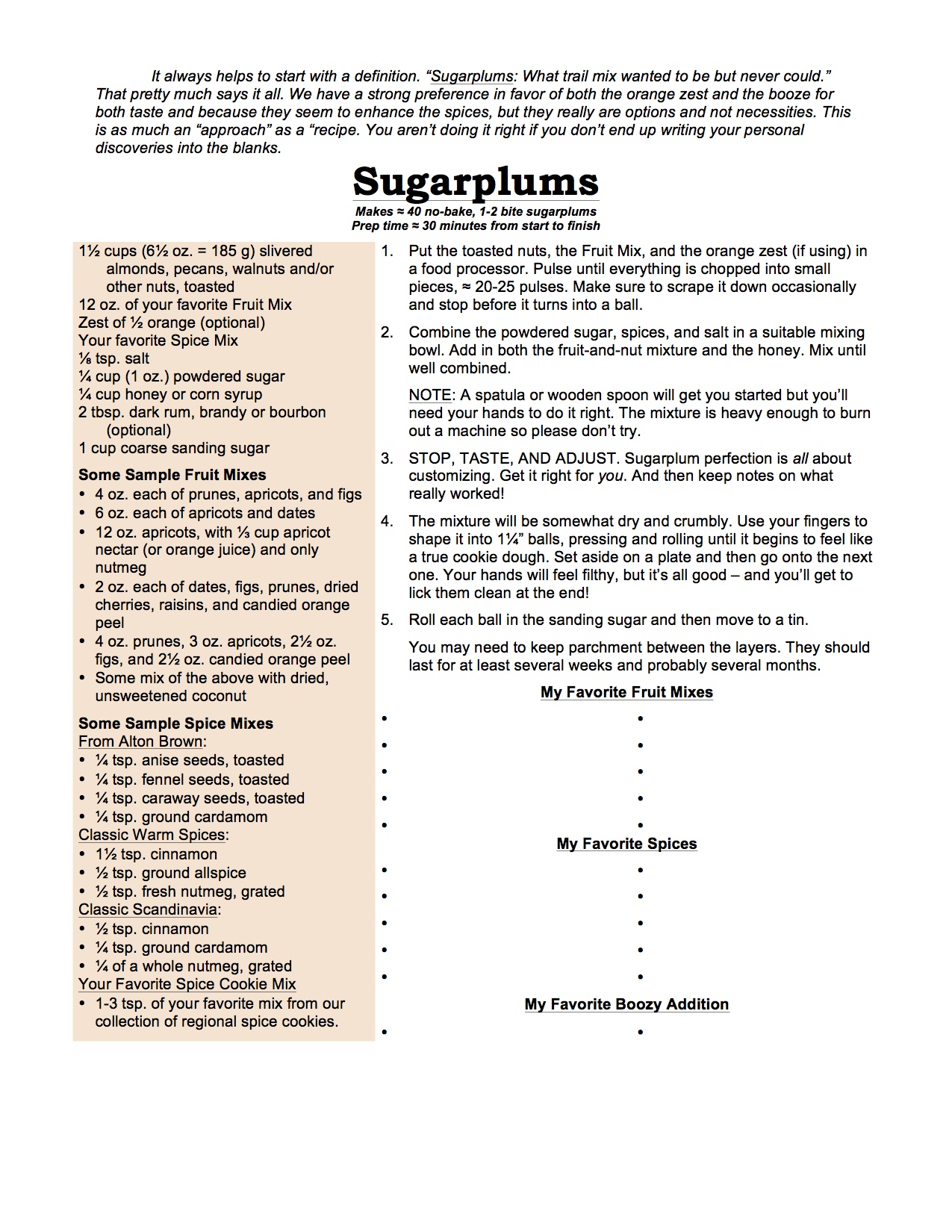
SUGARPLUMS – Kate’s new love. Make them, and make them your own!

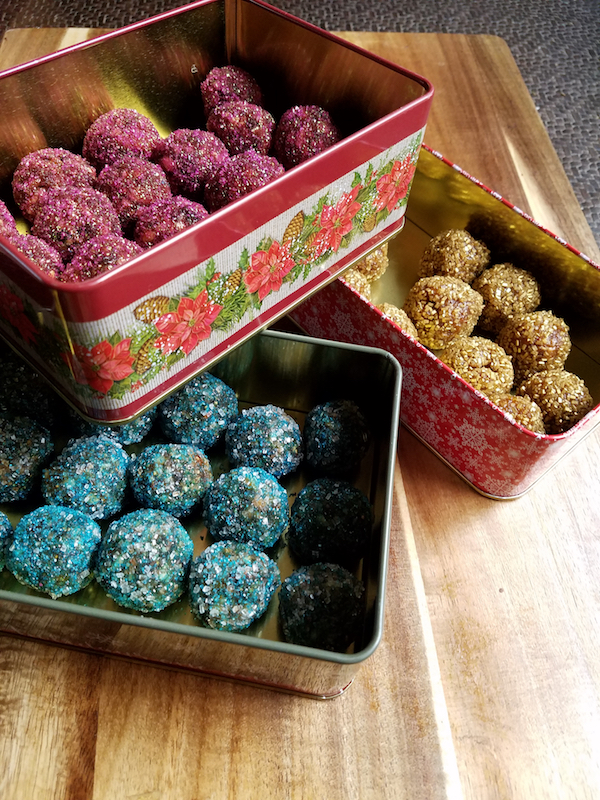
Three different Sugarplums from our 2017 tray. The red ones are made with pecans and almonds for the nuts; 2 oz. each of dried cherries, dates, figs, raisins, and candied orange for the fruit; Kirsch for the booze; and the Warm Spices mix. The gold balls are made with almonds for the nuts; dates, apricots and candied orange peel for the fruit; brandy; and the Scandinavian spice mix. The blue ones have walnuts & almonds; candied ginger, figs and a couple of dates; gin; and a combination of lemon zest, cardamom, and pepper, much less clove, and a touch of cinnamon. Kate got to play!

Kate writes:

“I never took the concept of no-bakes seriously at all until we tried making Sugarplums. Sugarplums! Dried fruit and nuts and spices, tied together with a bit of honey. Highlighted with candied or grated orange zest and a bit of brandy. Coated in sparkling colored sugar, they look as festive as they taste. And if you excuse the sugar coating, which can be substituted by finely chopped nuts, you’ll even get a treat that consists of wholesome ingredients!

Thus it was the humble, ancient sugarplums that turned my eye, changing my mind about the concept of no-bake cookies. Because a cookie can be perfectly delicious despite being easy to make. These are part of our ‘easy’ category.”

Scott adds:

If you don’t have the paper book, I urge you to print this recipe out, put it in a plastic sheet protector, and start keeping annual notes on your various experiments. There is no “right” Sugarplum! That is their basic and most fundamental charm. They are all about what YOU like, and what YOU come up with.

And if you have out paper book, for heaven’s sake feel free to start writing on the pages. It isn’t holy writ! We put those blanks and “My Notes” pages in for a reason. We wrote our book to be that one you will use to death and then pass on to the next generation. How will they be able to reproduce what [Grand] Mom and Dad did if you don’t record your own special tricks and observations?

It’s not like you need our permission, but you have it. Permission and active encouragement. Make that copy your own! Nothing would make the authors happier.

FIVE (5!) MACAROONS – Renaissance recipes for the modern world

It’s hard to get more “heritage” than the early Renaissance, and that’s what we have here: four famous cookies that grew into maturity along with the likes of Leonardo, Michelangelo, Donatello, Botticelli (with whom Leonardo supposedly founded a restaurant), Verrocchio, Raphael, and the rest of them. And Columbus for that matter. What can inspire artistic brilliance more than a really good cookie? The answer is obvious: Nothing!

We’re talking about classic macaroons, a cookie dating back to the trade boom that followed the Black Death’s destruction of medieval civilization. Arab traders introduced a variety of products to eager consumers in the trade centers of Italy and Spain. Two main ones in turn led to the creation of macaroons: refined sugar and marzipan a/k/a almond paste. Yes, those ingredients had been around forever, but they’d never been cheap enough to turn into everyday treats. Now they suddenly were, and Renaissance Europe was ready to adopt new ideas their grandparents would have scorned.

Italian and Spanish cooks started the process by incorporating the new ingredients into quick and easy baked goods using methods known since antiquity. The basic formula couldn’t be simpler. First whip some egg whites with sugar to make a meringue, using a more generous amount of sugar than before since it was now more affordable. Fold in some imported almond paste, and then bake. And there you have it! The first macaroons, commonly known as “Marzipanetti in Italy.

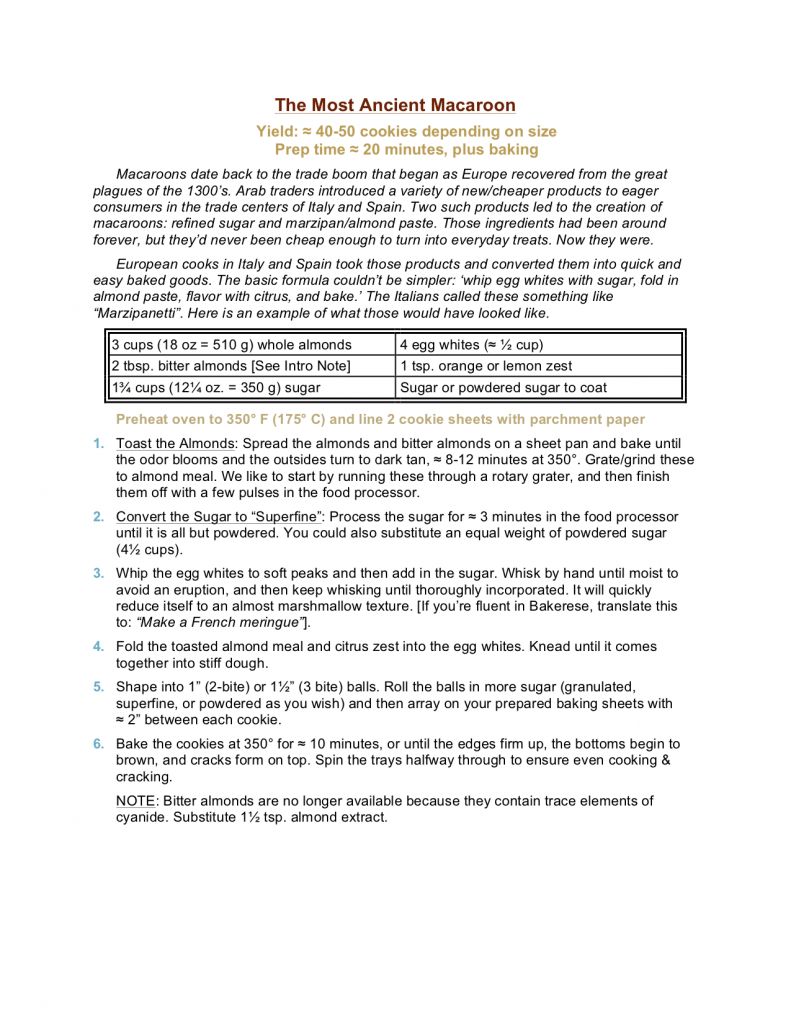
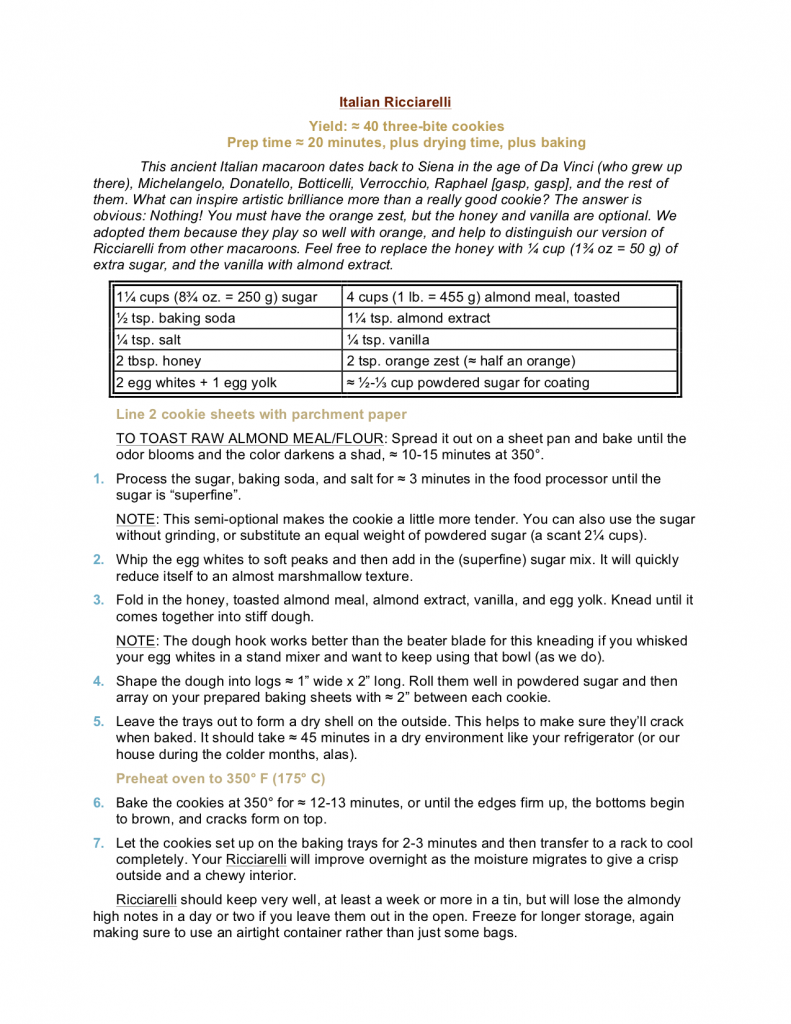
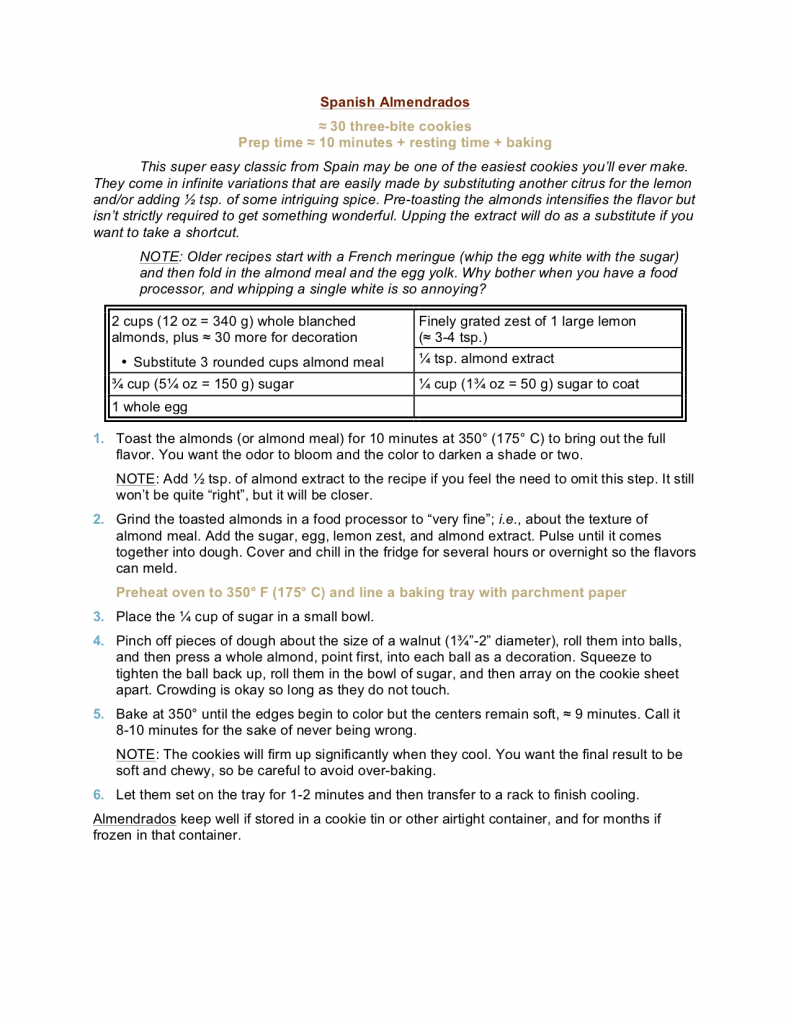
Matters evolved from there, with bakers slowly adopting the regional variations that eventually hardened into recipes. We have now worked up four versions of that basic recipe, distinguished by relatively small changes in the way they’re flavored and presented. Here is a table to more-or-less compare the four recipes, normalized to an even one pound of almonds. [NOTE: The different egg sizes occur because those recipes start from a different amount of almonds].

Most Ancient Macaroons

* 450 g almond meal

* 300 g sugar

* 3 XL egg whites

* No zest

* ½-1 tsp. almond extract

* 350° for ≈ 10 minutes
Ricciarelli


* 450 g almond meal

* 300 g sugar or 150 g honey
* 2 egg whites + 1 yolk
* Orange zest

* 2 tsp. almond & vanilla

* 350° for ≈ 12-13 minutes
Alemandrados


* 450 g almond meal

* 265 g sugar

* 1 jumbo egg

* Lemon zest

* ½ tsp. almond extract

* 350° for 8-10 minutes
Amaretti


* 450 g almond meal

* 290 g sugar

* 4 egg whites

* No zest

* 9 tsp. almond extract

* 350° for ≈ 12 minutes
See also the Walnut Macaroon Orehovki

Not a lot of differences, are there?

  • The Most Ancient Macaroon included a hefty amount of sugar and some bitter almonds. We were forced to substitute almond extract for the latter. Bitter almond extract would be even better if you can find it. This cookie is super simple, focused on those new imports, and consistent with the oldest macaroon recipes we could find after a week or two of search. NOTE: Scott believes it may be even more authentic to replace the sugar and almonds with premade almond paste, because that product would have been easier to ship back in the day.
  • Italian Ricciarelli, a specialty of Siena, must have orange zest but vary from there. We reviewed more than a dozen variations before settling on a version that includes an elusive hint of vanilla, some honey to enhance the sugar, and a single egg yolk to give them some richer chew. The cookies would still be Ricciarelli without those additions, but they help to distinguish this cookie from its macaroon peers. And they’re good. We also adopted the trick of adding some baking soda into the dough, because it creates attractive cracks in the powdered sugar crust.
  • Spanish Almendrados add lemon zest instead of orange, use whole eggs, and ignore the initial meringue step. Throw it all in a food processor and go! This methodology, combined with the shorter baking time, gives the cookie a fabulous chew you’ll particularly enjoy. They come with a classic almond-on-top decoration, and a granulated sugar crust.
  • You can find Amaretti in our cookbook, Heritage Cookies of the Old and New World. The recipe looks very similar to the Most Ancient Macaroon except for a monstrous hit of almond extract, and the candied cherry on top. Our reference to “Rudolph’s Nose Cookies” wouldn’t have made much sense in 15th century Italy. Neither would reindeer if you think about it.

Continue your travels around the Mediterranean and you’ll see extremely similar cookies such as those flavored with rose water (a favorite in Turkey), or with walnuts and walnut extract in place of almonds. Move north and things begin to differ more, with roll-and-cut meringues such as Basler Brunsli (mix of almonds and hazelnuts, cocoa powder, and cherry liqueur) or German Zimtsterne (mix of almonds and hazelnuts, cinnamon, other spices, and lemon icing).

But here’s the bottom line. Macaroons go so deep into the roots of modern Europe that there’s really nothing older except the extant waybread recipes. They’re also simple to make and easy to modify into infinite variations. It’s an invitation to play, and we encourage all you creative people to do so!

Here are our recipes for all four, plus a bonus recipe from the Balkans: a terrific macaroon based on walnuts instead of almonds.

Enjoy!

Ricciarelli, the ancient macaroon of Sienna, Italy that Leonardo and the rest grew up on
Spanish Alemandrados
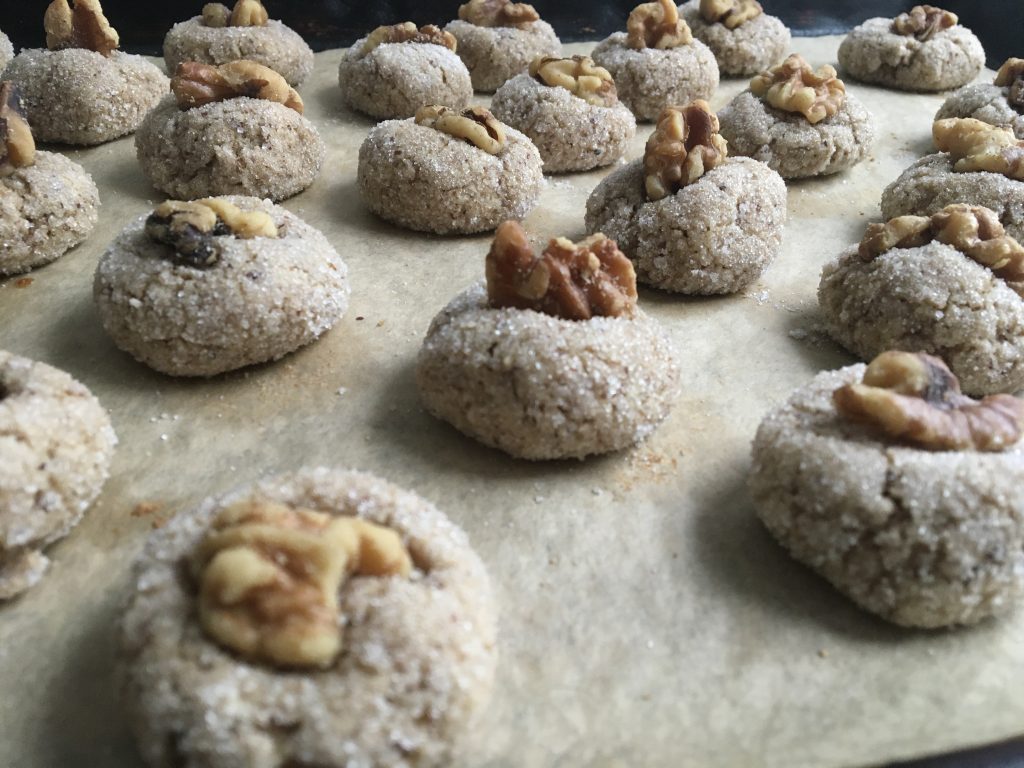
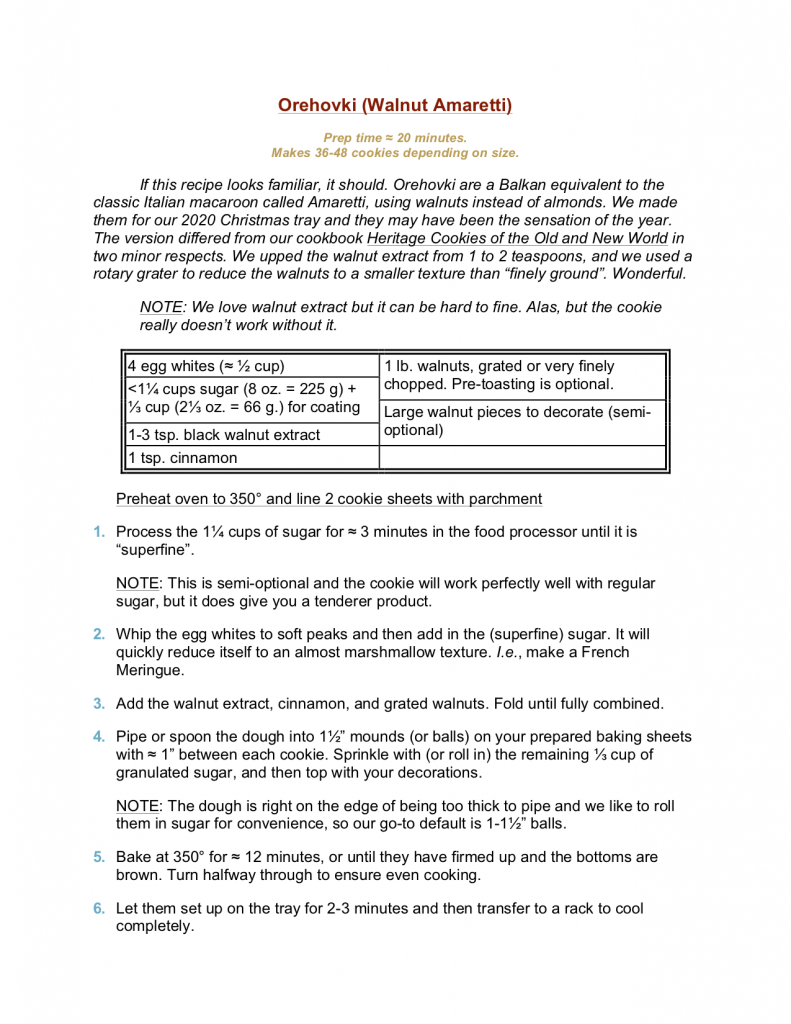
Orehovki, a/k/a Walnut Amaretti from the Balkans

CINNAMON STARS (“ZIMTSTERNE”) – Strange, wonderful, & familiar all at once


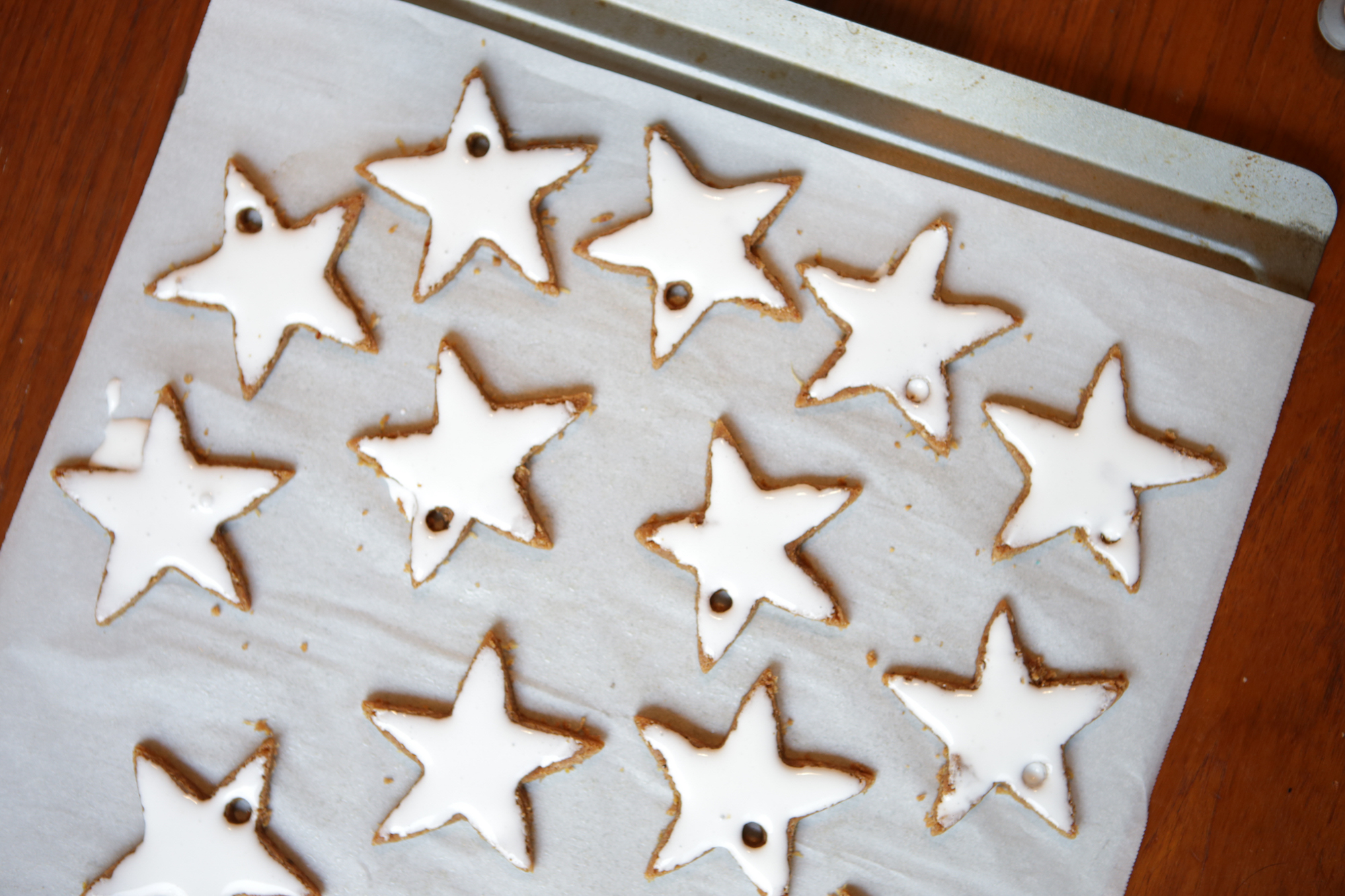
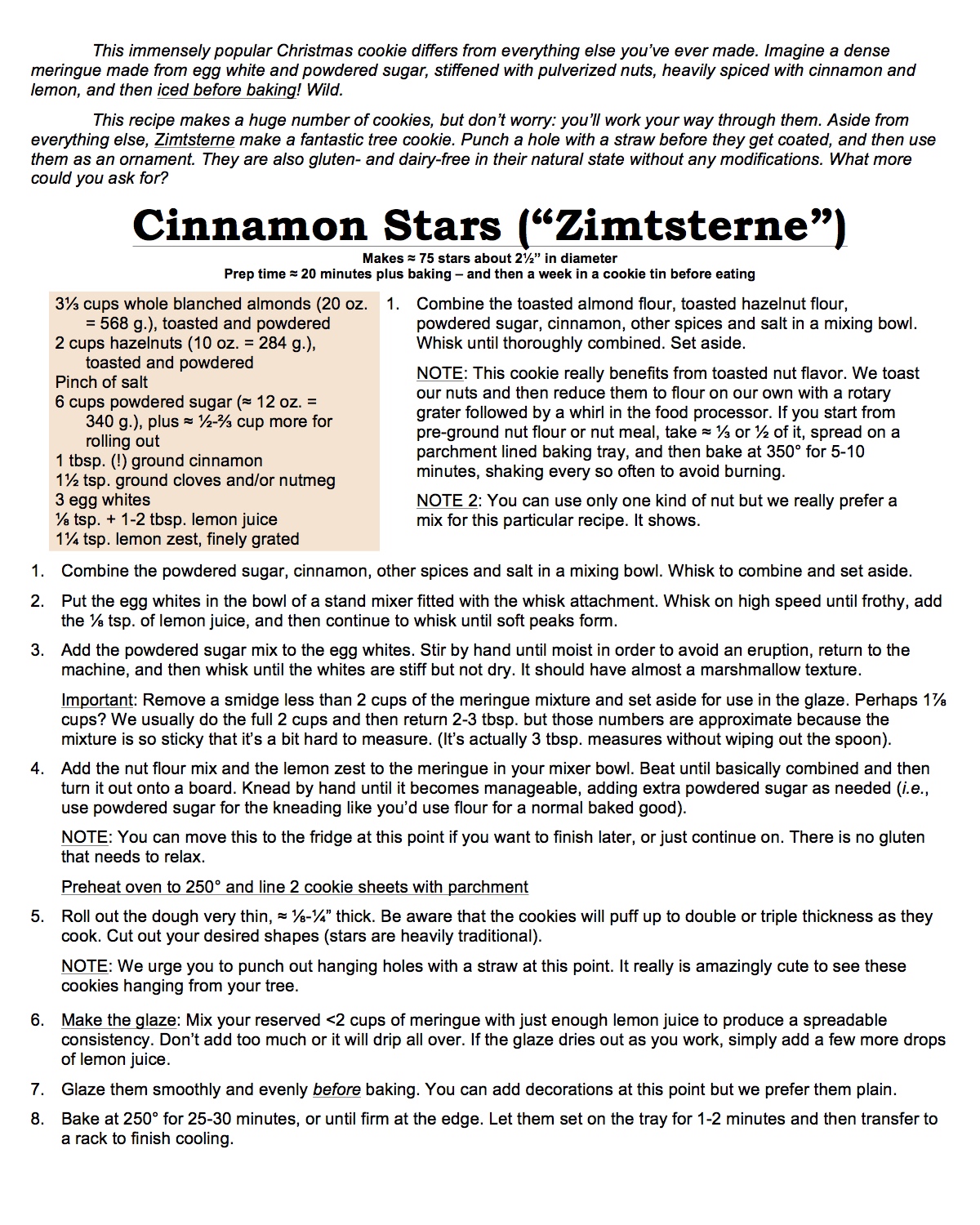
Cinnamon Stars, complete with a hole for hanging them off your tree.


This is the cookie we point to when people ask for an example of what we mean by a “heritage” cookie. There aren’t many Americans who are familiar with Zimtsterne (zimt = cinnamon, sterne = stars), but you’d be hard pressed to find anyone in a German speaking country who does not know them. Or in a country that borders on one of those nations. They are as common and ubiquitous in that part of the world as Chocolate Chip Cookies in the U.S.

The fact that people need to learn about them is one part of the “strange”. The other lies in how the cookies are made.

As always, skip to the bottom if you only want the recipe.

If you’re reading this, we assume that you’re a baker. Have you ever seen, anywhere, a cookie where you bake on the icing? It’s brilliant!

At their core, Cinnamon Stars are nothing more than a very refined version of a dense macaroon. You grind up nuts (in this case using a mixture for added complexity), flavor those nuts (in this case with spices for yet more complexity), mix that with a French meringue (egg whites whipped with superfine or powdered sugar), and then bake (in this case using a very low oven for color and texture. Change the type of meringue with a higher percentage of whites, and you’ll end up with a flavored Macaron. Change the spices to metric ton of almond extract with an average 350 F (175 C) baking temperature, and you’ll have Amaretti. Make that a bit of citrus with almond meal instead of flour, and you’ll get the antique Renaissance versions like Sienese Ricciarelli or Spanish Almendrados.

It’s a simple concept. But… whoever heard of rolling out your macaroon dough before baking? Or baking on the icing?

It works because the icing is just that same French meringue mixed with added lemon juice. Meringue bakes well. Obviously. And that lemon juice works wonders, because being in the icing preserves all the high notes. That is one of the tricks we learned along the way. Lemon zest works great inside a cookie because the zest holds all the essential oils (the perfume of the fruit). But the tang of the lemon juice will disappear. If you want to catch those sharp, acidic notes you need to put them into an icing.

That covers “strange.” Wonderful comes from the overall flavor, and a Northern European tradition we’ve adopted for years: the Tree Of Gifts.

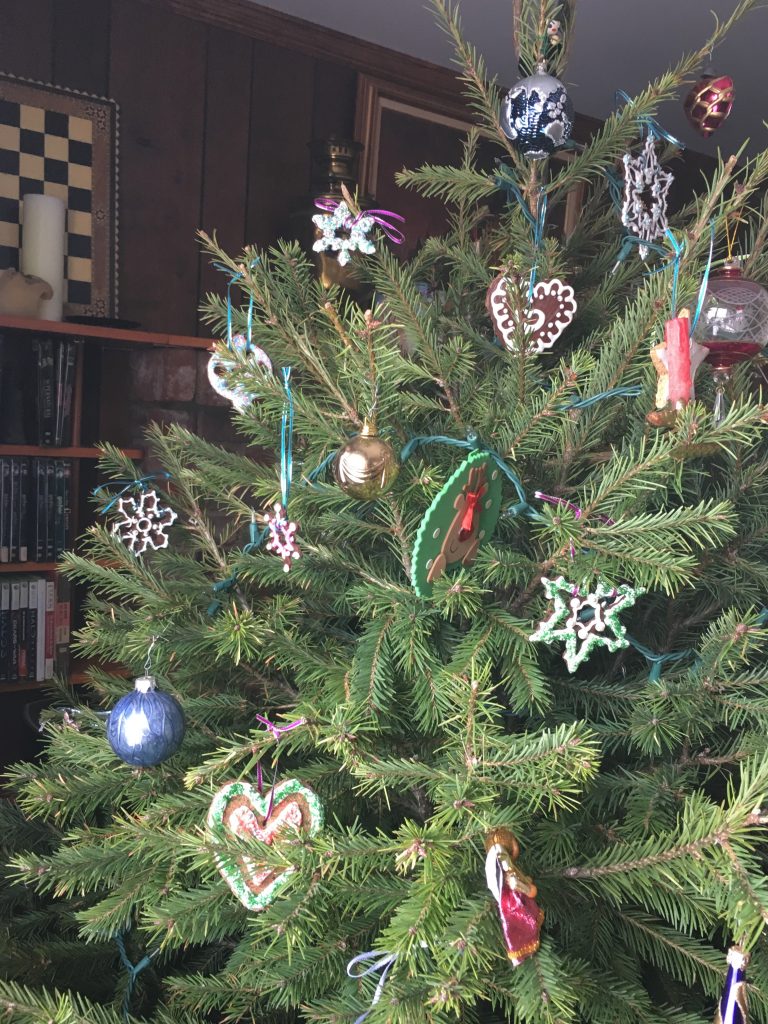
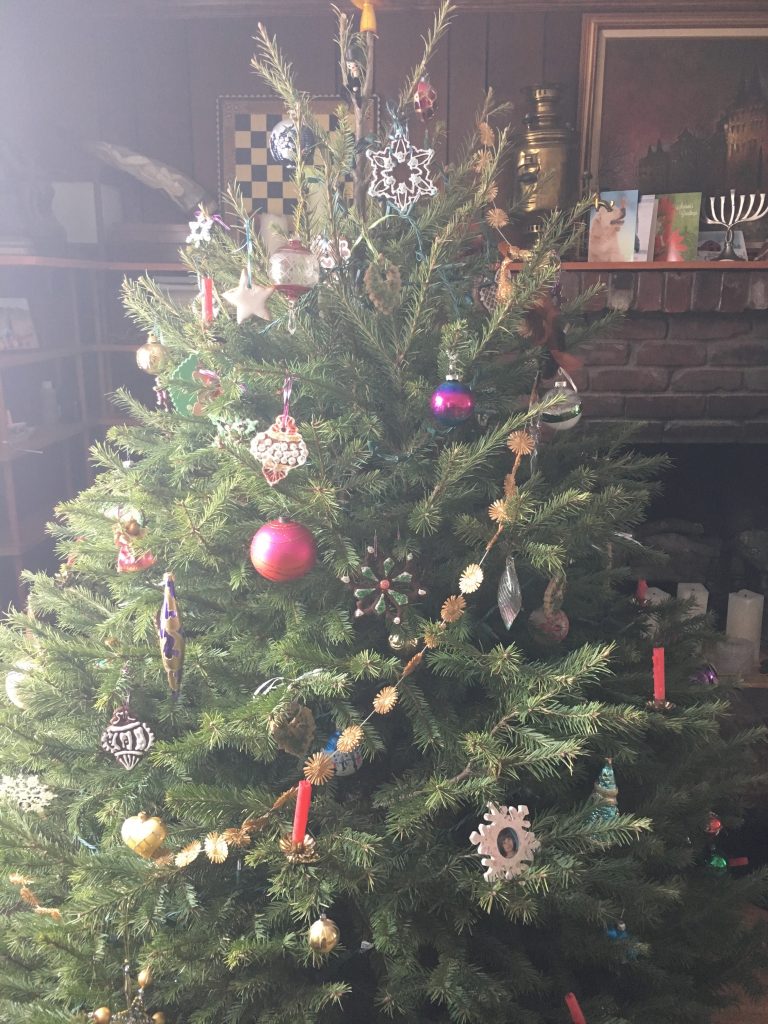
Moravian Snowflakes, Polish Gingerbread (Pierniczki), a chocolate angel (on the bottom), and a Cinnamon Star hiding behind the candle on the upper right.
Another view, with the Cinnamon Star on the upper left. Note that all the cookies are on the upper half of the tree. That’s essential if you have either small children or, in our case, a labrador retriever in residence.

A guest arrives during the holiday season? Invite them in, and say “Please have a treat off the tree!” It captures the spirit of the holiday like nothing else. Tree; decorations; sweets; cookies; and all topped off with hospitality.

Cinnamon Stars make great decorations because they’re sturdy enough to last through the holiday season. Snowflakes have no rival when it comes to appearance, but any humidity in the air will soften them up enough to sag an break through a ribbon. (Don’t even think of hanging them with a metal wire). And gingerbreads tend to be so thick and heavy that they make the branches sag if you aren’t careful. Cinnamon Stars are ideal.

You can decorate Cinnamon Stars by tinting the dough, the icing, or both. Or by standard decorating after they’re baked using royal icing, dragees, luster dust, etc. We tend to keep them plain, but that’s a question of taste.

As for “familiar”, there is absolutely nothing in this cookie that will surprise or offend the most tender of American palates. Cinnamon Stars taste like dense, chewy, lemony Snickerdoodles with a fantastic appearance, and a lot of fragrant nuts. It’s a no risk experiment.

A FINAL BONUS: THREE FREE TIPS THAT AREN’T IN THE BOOK:

  1. The recipe calls for three egg whites. That works, but things get tight when you try to toe the line between reserving what you want for the icing, and still having enough to hold all the nuts. You’ll gain safety margin if you use size XL egg whites instead of the standard U.S. “large”.
  2. Add a tablespoon of molasses to the dough if you want a higher contrast between the base and the bright white icing. It changes the flavor a bit, but not unpleasantly. Our book includes a standard variation on this recipe (Vanilla Sticks), and that is more different than the effect of a little molasses.
  3. Remember that you don’t need to spread your icing all the way to the edge. The cookies look just as good, and arguably better, if you leave a gap between the edge of the icing and the edge of the cookie. To be completely honest, we only avoid that because our decoration skills aren’t up to that level of precision. Baking, yes. Precision artistry? Not so much.

And now, on to the recipe. Enjoy! This was the very first Pavelle addition to the Stoy family collection of every-year cookies. Don’t be at all surprised if it turns out to be mandatory for your family too.

NOTE: If the cookies dry out, put them in a tin with a piece of bread and leave it overnight. Come the next day they’ll be perfect all over again.

PANFORTE – Sometimes you get it right

Our adventure with this extraordinary cookie began in 2019 when I met an old friend in the local supermarket – a former partner at the firm I joined out of law school. He had a cart full of baking supplies, I had just finished the initial version of our book, and Christmas was in the wind, so you can guess what happened next. I asked a question, he enthused, and we ended up in a discussion about family baking traditions. Who knew that Tom had a reputation going back for decades as the Great Baker of his circle? Birthday cakes, holiday cookies, even the occasional wedding table… just like us.

Tom gave the credit for his skill and passion to his Italian mother and grandmother. And he absolutely *loved* our cookbook project! “That reminds me of the one cookie I never managed to learn,” he said. “I don’t even know the name. It was black, dense, diamond shaped, and filled with chocolate, fruits, and nuts. Never any other shape. I wish I knew what it was.”

You know what? I did. Sort of.

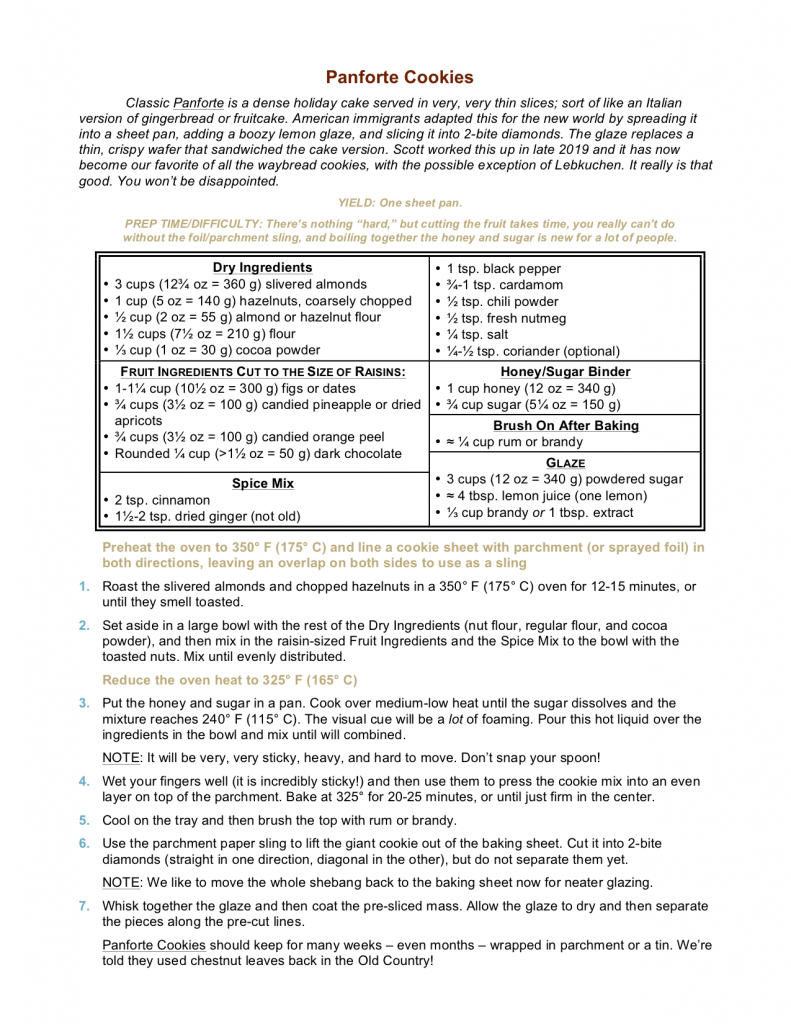
As always, skip to the bottom if you only want the recipe. Most of what follows is the winding process of how we got there, and the tricks we learned along the way.

It Had To Be A Waybread a/k/a Winter Cake

We used to follow a public radio program called The Splendid Table, hosted by a scholar of Italian cooking traditions named Lynn Rosetto Kasper. She had done a segment on something she called “winter cakes;” meal-sized Italian equivalents of what we call “waybreads” in our book. It’s a category populated by dense, ancient treats that your great-to-the-Nth ancestors prepared at two different times: (A) during the holidays, to enjoy in slivers all the way through April, or (B) for a loved one to take on some extended journey. The common denominator? Winter cakes (waybreads) last basically forever from a practical point of view, being packed with so much sweetness, dried fruits, nuts, and often booze that they won’t go stale.

The old English version is fruitcake, inherited into the U.S. tradition with a great deal of snickering and jokes. But other versions abound across Europe, and I knew this had to be one of them. The diamonds gave it away.

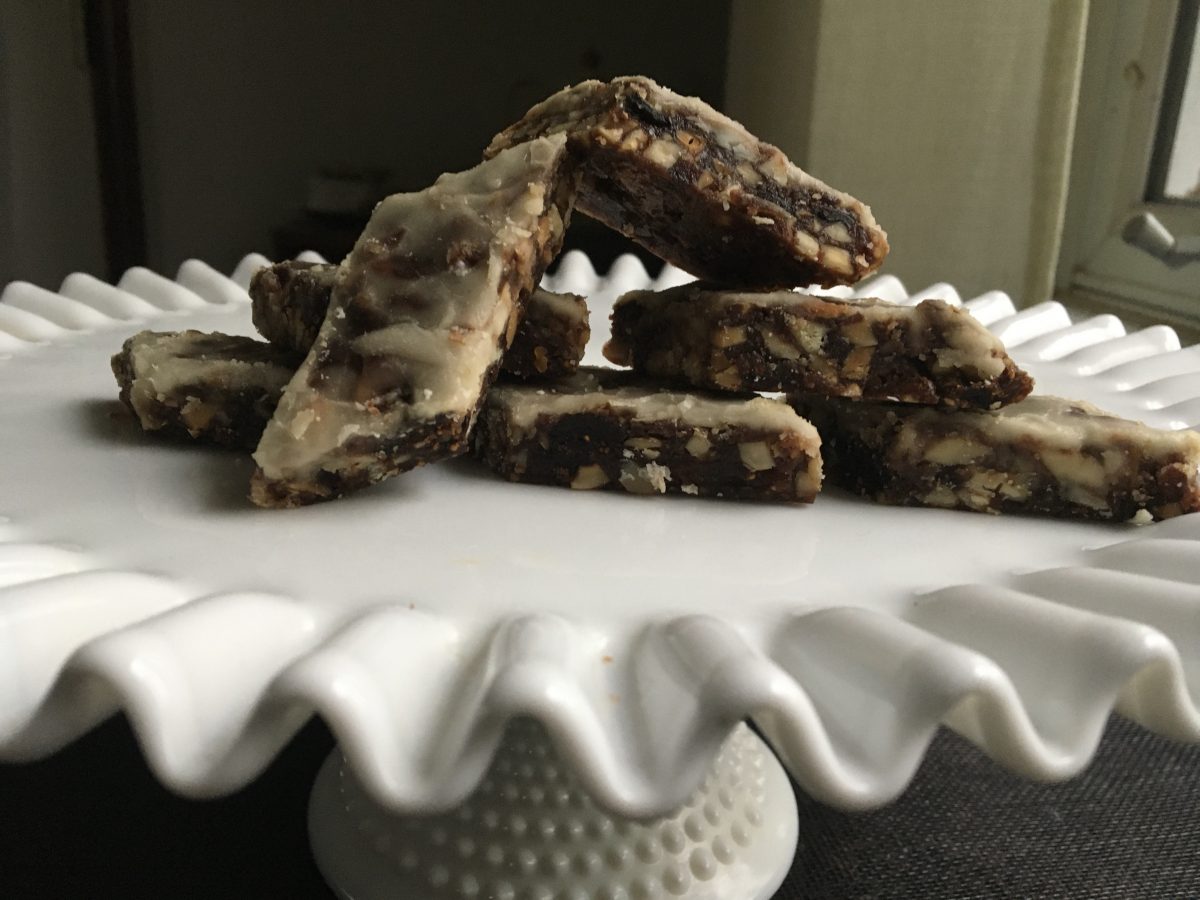
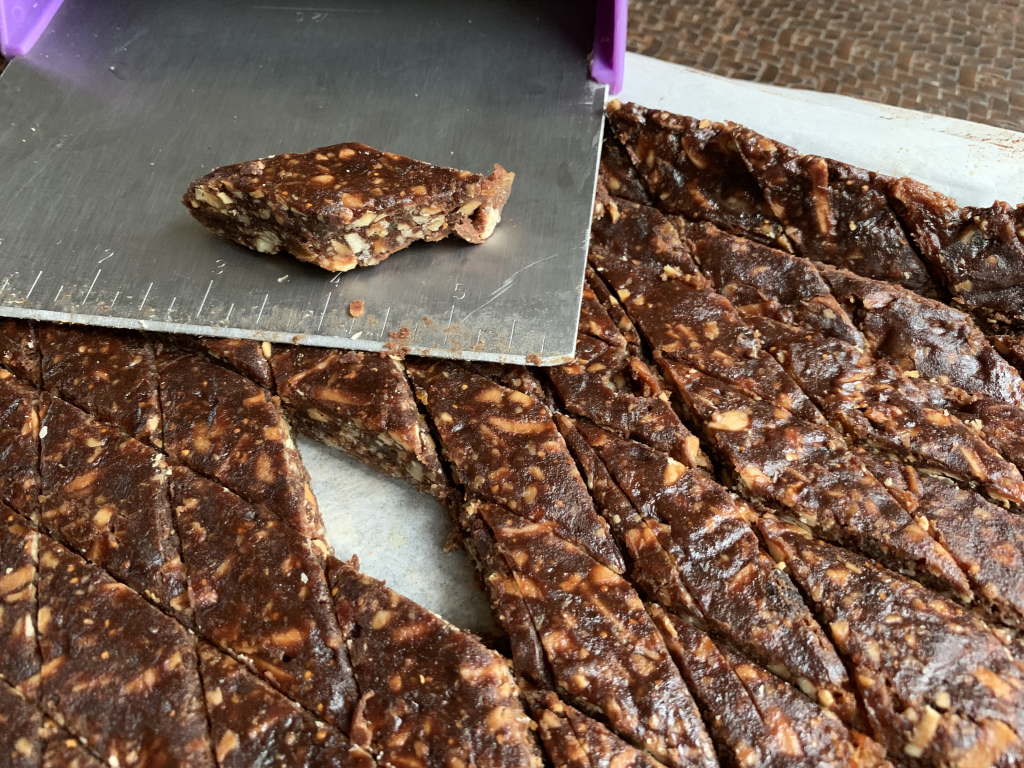
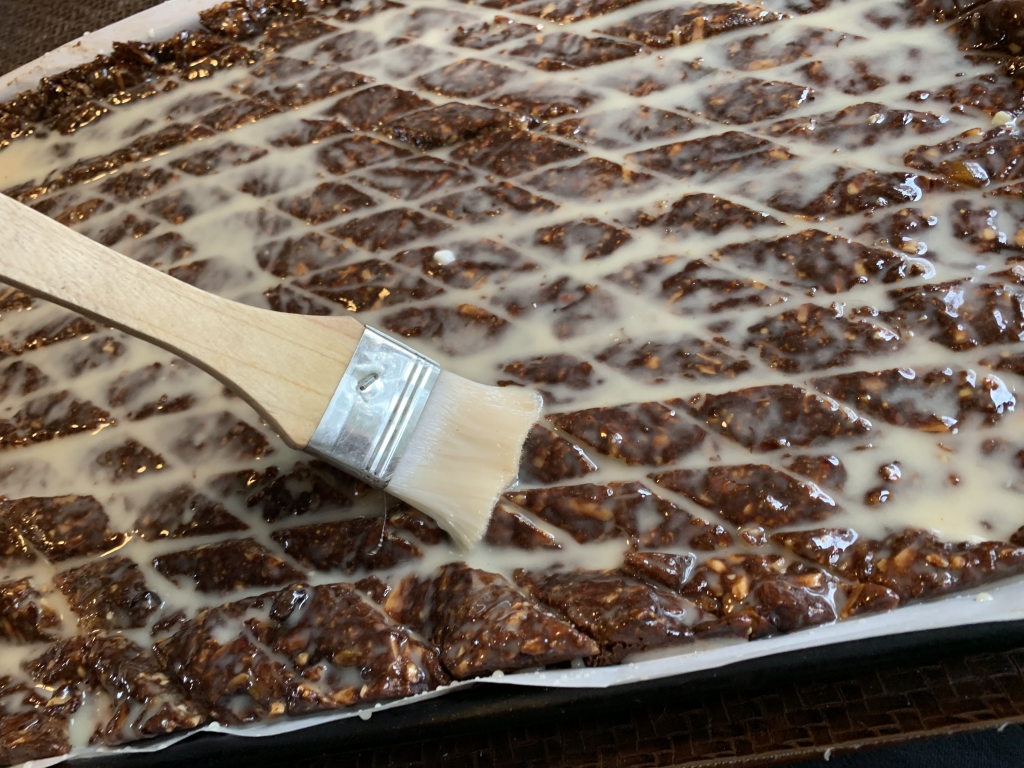
I know from earlier research that American immigrants often adapted their traditional waybreads to the new world by using a standard U.S. sheet pan in place of the specialty cake pans they’d left behind. Cut the sheet-waybread into cookie-sized pieces with a vertical line in one direction and a diagonal in the other, and voila! Diamonds, which are much prettier than little squares, much more “American” than big cake shapes, and have the added bonus of creating a series of little triangles by the edges for the cook and her helpers to “test the bake.”

SIDEBAR: Cookie bits have no calories if you’re nibbling for practical reasons like testing! Everyone knows that, right? Ask your own Baba or Nana or Grandma if you doubt me. Most of them will admit it, and the ones who don’t will huff up in that particular way that lets you know the truth.

So here’s the bottom line. This was some kind of ancient waybread or winter cake. It probably came from Italy, given Tom’s heritage. It was dark to the point of being black. It was heavy and probably unleavened. And the primary ingredients were a mix of various nuts, several fruits, and a solid hit of chocolate.

Which Waybread Was It?

Off to the Internet I went and it wasn’t long before my search returned a long series of hits for something called Panforte; a specialty of the ancient Italian city of Siena, in Tuscany, about an hour by car to the south of Florence. It hit on every category, even down to a series of American photos showing thin, cookie-sized diamonds.

Bullseye!

Our now-familiar development procedure followed after that. First I compiled as many recipes as I could to get a good feel for the variations and the flavor profile. Panforte is pretty common, so I had well over a dozen to choose from.

This research confirmed the mix-of-nuts approach Tom had described, with almonds and hazelnuts being the most common. I balanced the fruit flavors in my head, adding dried apricots as a potential substitute for the surprising presence of candied pineapple in so many recipes. I rejected citron – the bane of fruitcake eaters everywhere! – for the equally common and much better tasting candied orange peel. All pretty standard. Alter as you wish.

The sweetener in the recipe turned out to be a mix of honey cooked together with sugar. No surprise there! One of the best waybreads in Volume I is called Leckerli, a sheet pan cookie centered on walnuts. Northern Italy and Switzerland aren’t that far apart, so it came as no surprise to see parallels in their cookies.ƒ

Next came the spices. These varied hugely, as you might expect. I sifted through a dozen variations and then settled on something more or less in the middle with two minor variations – chili powder and cardamom. Neither was unknown, so this wasn’t a true heresy, but neither were they common. Still, the combination made sense in my head, and offered a side benefit. They gave the flavor profile a little twist compared to all our other recipes. Again, modify as you desire.

Time For Attempt #1, And… Wow.

Mega wow. Ridiculously absurd, over the top, odes-to-the-cookie-gods wow. These darned things were awesome! We almost couldn’t believe it. Were all Panforte this good?

Aye, there’s the rub.

Kate and I can tell good from bad easily enough. And these were certainly good. But how could we tell if they were “right”? Neither of us comes from an Italian background. We had no internal target to aim for.

This, my friends, called for a trip to the Strip District.

Always Find Native Testers

The Strip is a narrow piece of land in Pittsburgh about 2-3 blocks wide and 6-8 blocks long, located just up the Allegheny River from the Downtown triangle where the Al and the Mon meet to form the O. It’s been our favorite part of the city since we moved here because the two main drags (Penn Ave. and Smallman) are lined with wholesale/retail ethnic stores. These include a number of different Italian places with histories going back close to 100 years, and a veritable bevy of first generation immigrants. Just the people to test our new cookie!

First up: Giuseppe at Penn Mac a/k/a the Pennsylvania Macaroni Company. This is our go-to stop for nuts, dried fruit, and other staples, and we bring them a tin every year.

“Giuseppe, we know these are good. That’s obvious. But are they Right? We need someone from the Old Country to give a reality check. Would you mind?”

No, not at all. He took a bite… and then looked at us like we we’d left our brains in the street. “You think there’s something wrong with these? They could be straight from Italia! They’re perfect! Just let me have a couple more pieces before you go… [munch, mumble, mumble, munch].”

Wait a sec. That never happens. Not ever! I had to visit the Strip three different times when I was working up South America’s famous Alfajores, and those are a simple, childhood shortbread. Maybe Giuseppe was just being kind.

No problem. There are other Italian stores in the Strip. On to Enrico’s Biscotti, whose owner, Larry, teaches traditional Italian baking to full houses several times per year. He’s a generous man with both his goods and his knowledge, but also one who believes in sharing the hard truths too.

“They’re perfect! What are you worried about? I especially like that little hint of heat at the end. And that floral note. It’s fantastic [munch, mumble, mumble, munch].”

Chili powder and cardamom: check. Let’s try Colangelo’s around the corner, another wonderful Italian bakery/restaurant.

“You could sell these anywhere in Italy and they’d call them Panforte. And believe me, they’d buy them, too! [munch, mumble, mumble, munch].”

The pattern continues! Sunseri Brothers? Ditto. And on it went, up and down the Strip. The answer was always the same. These weren’t just authentic Panforte, they were among the best Panforte that anyone had ever tasted. Stop worrying. Start bragging. And don’t mess with success. [Munch, mumble, mumble, munch].

Conclusion

I heard back from Tom about a week later.

“You got it! You nailed it! After all these years it’s just like sitting in my mother’s kitchen again.”

I love cookies.

NOTE: You can convert this to the traditional Italian winter cake with a few easy adaptations:

  • First, bake it in a tall cake pan instead of a sheet pan.
  • Second, sandwich the result between special wafers you can buy online.
  • Third, feed the cake version with brandy over time just as people do with fruitcakes; a thin brushing once per week for a month or two.
  • And FWIW… We also found an online note suggesting that Tom’s great-to-the-Nth-Nana would have stored her Panforte in chestnut leaves back in the day. How cool is that?

Panforte cakes should be served it in slivers (not slices) as a special treat to enjoy all the way into early Spring. A little goes a long way.