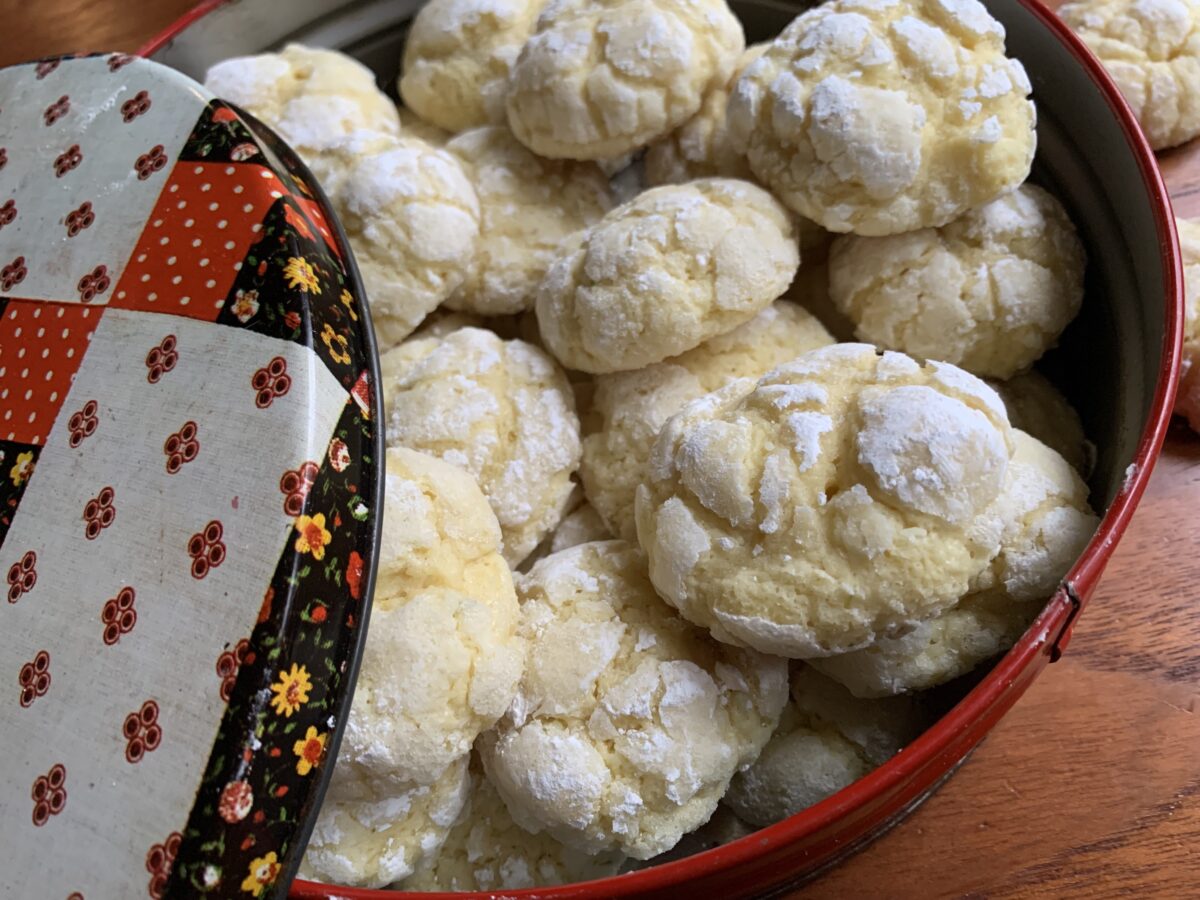
Do you like citrus cookies? If so, read on because we spent a massive amount of time trying a few tricks designed to enhance the lemon intensity. So much so that we ended up with four different recipes! Two for texture, each of which can be tailored for beauty or taste.
Click here if you only want the recipe without the lessons
“Citrus Flavor” Usually Requires An Icing
Here’s an unpleasant fact about baking lemon, lime, and orange cookies: you can fill the dough with the gentle, round notes by stuffing it full of grated zest, and then fill them out by adding in some oil or extract. But you can’t get those lovely, sharp high notes without some kind of icing or other coating that’s full of fresh juice (or a trick as described below). Bright citrus flavors come from the acid in that juice, and that acid dims to nothing on the inside of a dough. Omit the coating and your cookie won’t – can’t – taste “lemony,” “limey,” or “orangey” any more than an yellow, green, or orange gummy bear really tastes like fruit.
In fact, gummy candies are a perfect way to make the point. The plain ones are nice enough, but they’re basically just sweet with some kind of flavor. The sour ones taste vastly more like actual fruit because that sour powder on the outside -usually citric acid – adds the missing high notes.
Heritage Cookies of the Old and New World (Volume 1) has a recipe for Lemon/Lime Sugar Cookies which has become all but mandatory in our annual holiday extravaganza. The cookie part is nice enough. It’s packed full of grated zest, and you can tell. But the magic part comes with the extra-tart icing that’s equally packed with fresh juice from the zested fruits.
But… does it really have to be an icing?
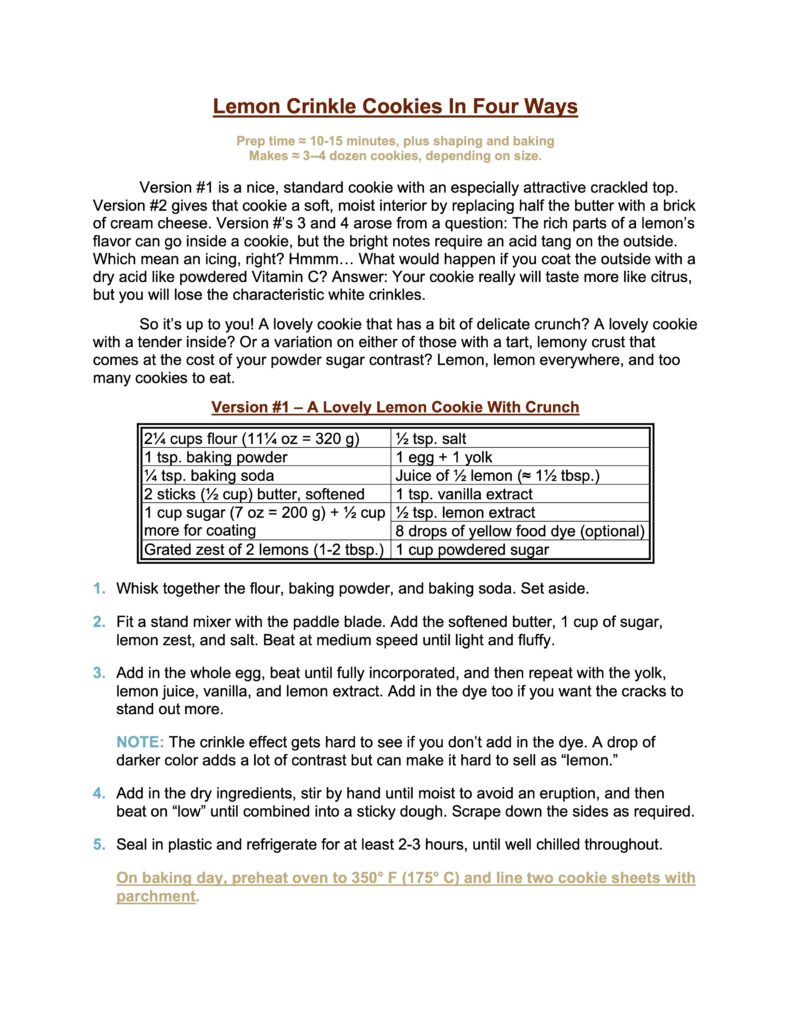
A Very Standard Recipe To Start
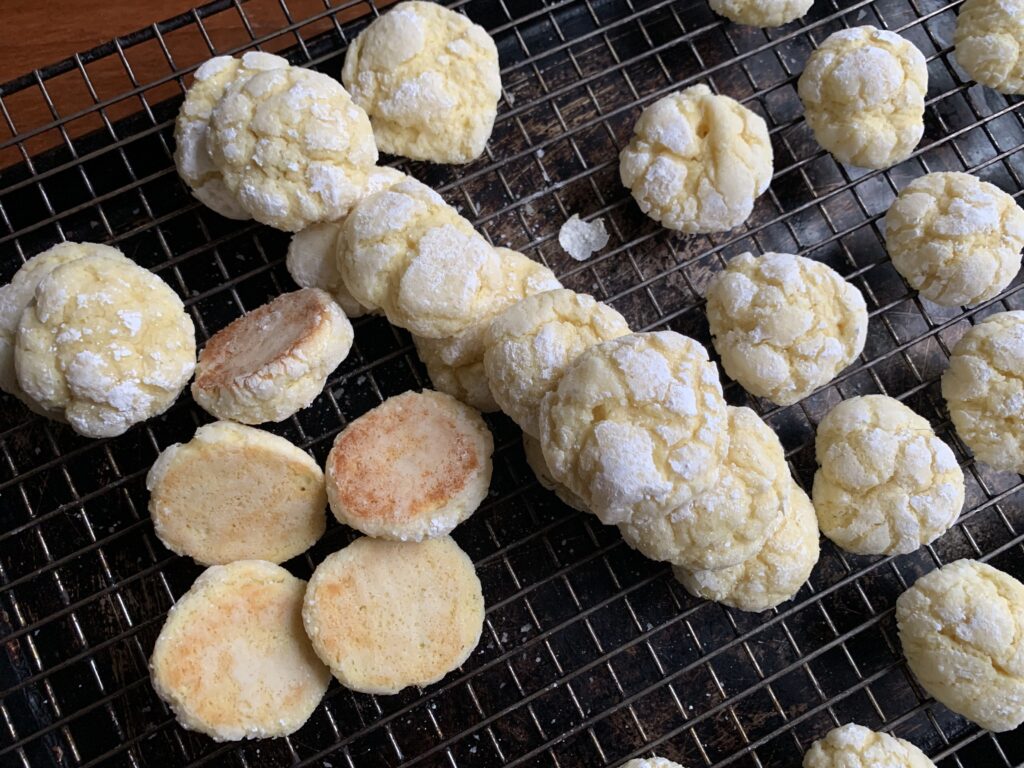
It took very little to develop a working recipe that would produce a nice crinkle effect. As you probably know already from Chocolate Crinkle Cookies, the magic trick is to (a) roll the balls of dough in granulated sugar, and then (b) roll them again in powdered sugar. The first layer insulates the second layer, which allows the cookie to expand in the oven leaving deep cracks of cookie-color surrounded by powdery white.
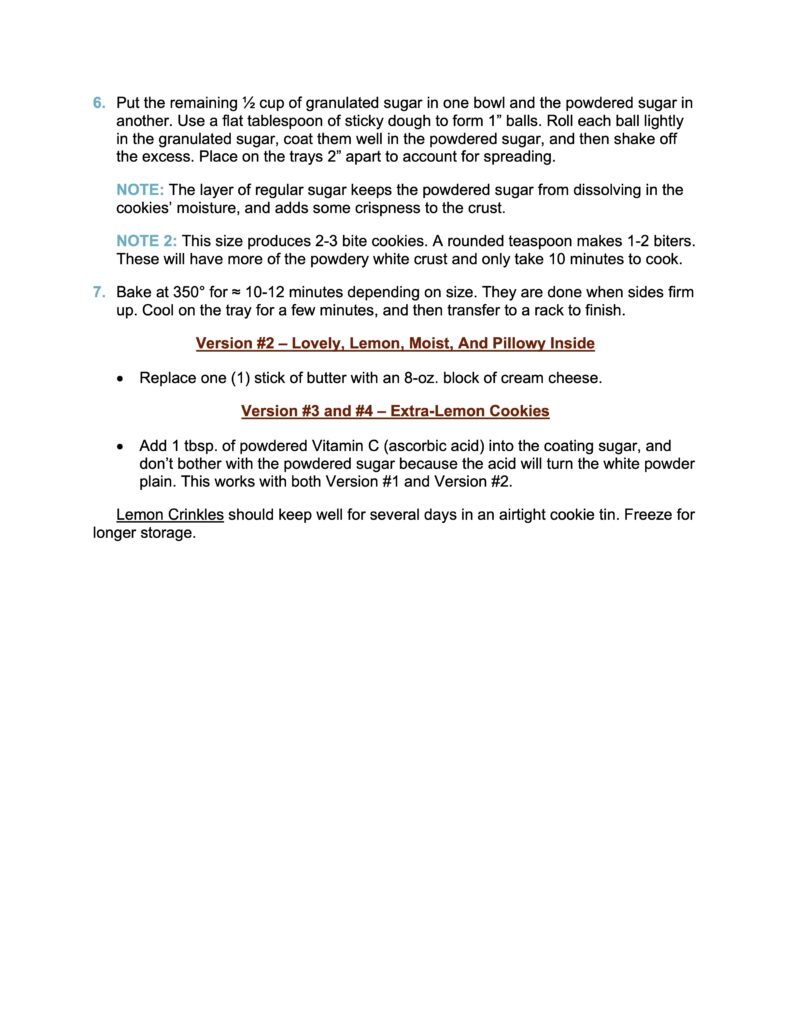
I initially wanted to make a lemon cookie that would imitate the ultra-gooey texture of Chocolate Crinkles, but that’s one I couldn’t figure out. The experiments did prove fruitful nevertheless, because we ended up with two variations for people to choose from. The first uses two sticks of butter and produces a fairly standard drop cookie texture with a gentle crunch. The second replaces one of those sticks of butter with an 8-ounce brick of cream cheese. These turn out soft and cakey on the inside. Not quite the ooey-gooey target, but in the same general arena.
The only hard part came from accepting the amount of yellow food dye required to make a sharp contrast between the cracks and the coating. We really wanted these to look startling and photogenic; a deep, lemony yellow that would really contrast against the bright white of the powdered sugar crust. Physics got in the way.
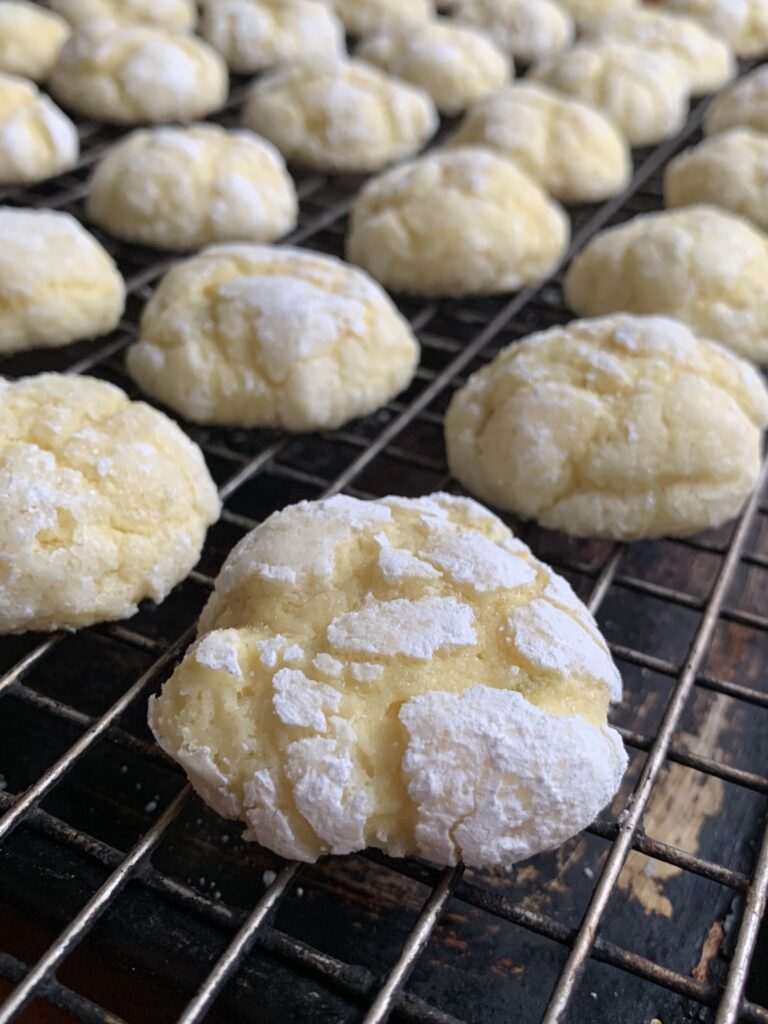
The dough is very yellow, especially with the added food dye. But it’s an inescapable fact that colors fade when you spread them out, and puffing cookies up to create a crackled exterior means the inside will end up dimmer, especially if you add in a bit of browning. C’est la vie.
Experiments With Powdered Vitamin C
We used to crush a Vitamin C pill or two in our mortar (uncoated, please) to boost the acid bite of some of our glazes. Now have one kilogram of powdered l-ascorbic acid (Vitamin C) in our pantry.
NOTE FROM KATE: My younger brother and I are both children of the Cold War. Back in Czechoslovakia, we learned how to use our personal gas masks in 1st grade, knew not to throw water on napalm by 6th grade, and shot our first AK-47 machine guns by 7th grade. Once our family came to America and the talk of intercontinental cruise missiles heated up the news, my brother made it his business to learn everything he could about nuclear disaster survival.
When the war in Ukraine broke out, he surprised me with a preventive care package which included, among other things, a 1 kilo package of granulated l-ascorbic acid, i.e. Vitamin C. (A lot of us former Easter European types got “triggered” by all this. When I told my Ukrainian friend over lunch, she offered some of her iodine pill stash without blinking an eye.) So: yes, you can buy powdered acids, and they will do wonders for your cookie and candy experiments!
Our experience with the need for an icing to enhance citrus flavors, together with my love of those sour gummy bears, provoked a genius idea: Since we need to roll the balls in sugar anyway, why not mix in some vitamin C at the same time?
[NOTE: We happened to have the powdered vitamin C handy, but it’s simple to make by grinding up some supplement tablets in a mortar and pestle.]
We tried it immediately, and it worked exactly as we’d hoped. The cookies had a brightly flavored crust that transformed them from “sweet and lemony” to “that tastes like good, tart lemonade!” Not a single one of that batch made it out of the house to our normal cadre of taste testers.
But there was a problem. I’d thought it would be easy to create the white-on-yellow crinkle crust, but these cookies showed now sign of it except for a few that had vague evidence of a pattern on top. [Sigh] So my wife was a flavor genius, while I was an incompetent boob. Par for the course.
I tweaked the recipe for batch #2. Same result. Grrr.
So I went back and researched every version I could find on the Internet, only to discover that every one was pretty darned close to my working recipe. The only difference? Others use a profligate amount of yellow food dye to make the crinkles stand out.
Okay, so batch #3 would include some food dye to enhance the contrast. Same result yet again, except the cookie was slightly yellower than the first two batches. Check. “It isn’t ‘some’ food dye, it’s an ‘are you kidding?!’ amount of food dye.”
Batch #4, I added the larger amount in, and added a single drop of red on the theory that it would help with the contrast. I can recommend this if you want a pink lemonade color, but learn from my disappointment if you’re after lemon-yellow. Oh yes… and there was next to no white left after baking even though I was now producing the exact level of surface crackling and fissuring we were aiming for. Aaaaaargh!
Only then did I begin to wonder if Kate’s beautiful flavor trick might be interfering with the whole crinkle creation process. We still had half of the batch #4 dough left, so I did a formal experiment: same baking sheet, but half with vitamin C in the sugar and half without. Behold!
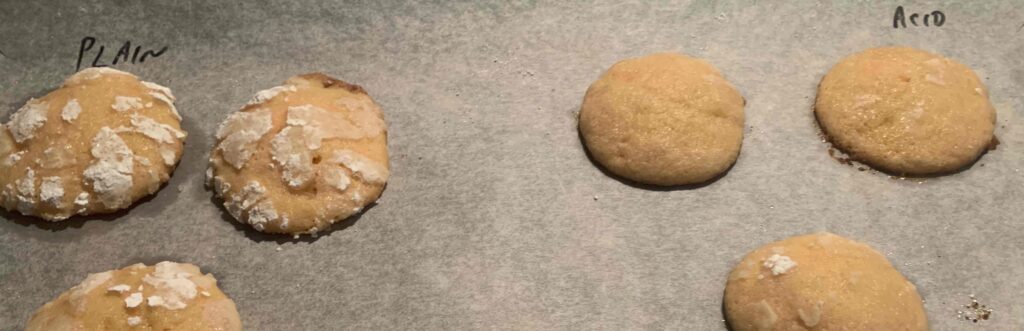
This batch had a single drop of red food coloring along with 8(!) drops of yellow. You can see how big an effect it had.
Kate refused to believe it.
NOTE FROM KATE: Yep, I did. I kicked hard against leaving out our doomsday Vitamin-C ! With my chemistry background, I didn’t think there was enough time for the acid to mess with the leavening agents. The acid didn’t penetrate all the way through, after all. Oh, hubris! Oh, woe! Now I have egg on my face. (And a cookie in my mouth – these are seriously good!)
Scientific method to the rescue! I whipped up a half batch and repeated the experiment two more times. Yep. The plain half came out with deep crinkles every time, while the acidulated half had almost none.
Why? It’s obviously because… because… well, I’m not exactly sure. At this point I’ve done enough research to know that ascorbic acid will decay at oven temperatures, with two big leaps at 140° F (60° C) and at 170° F (77° C), and an even bigger leap as it passes 200° F (95° C). The degradation takes some time, which is why 10 minutes in the oven isn’t enough to destroy it completely. Thus the still-sour tang to the impregnated crust. Perhaps the byproducts are enough to wet the powdered sugar, and destroy it’s snowy whiteness? That’s my working theory, but it’s still no more than that.
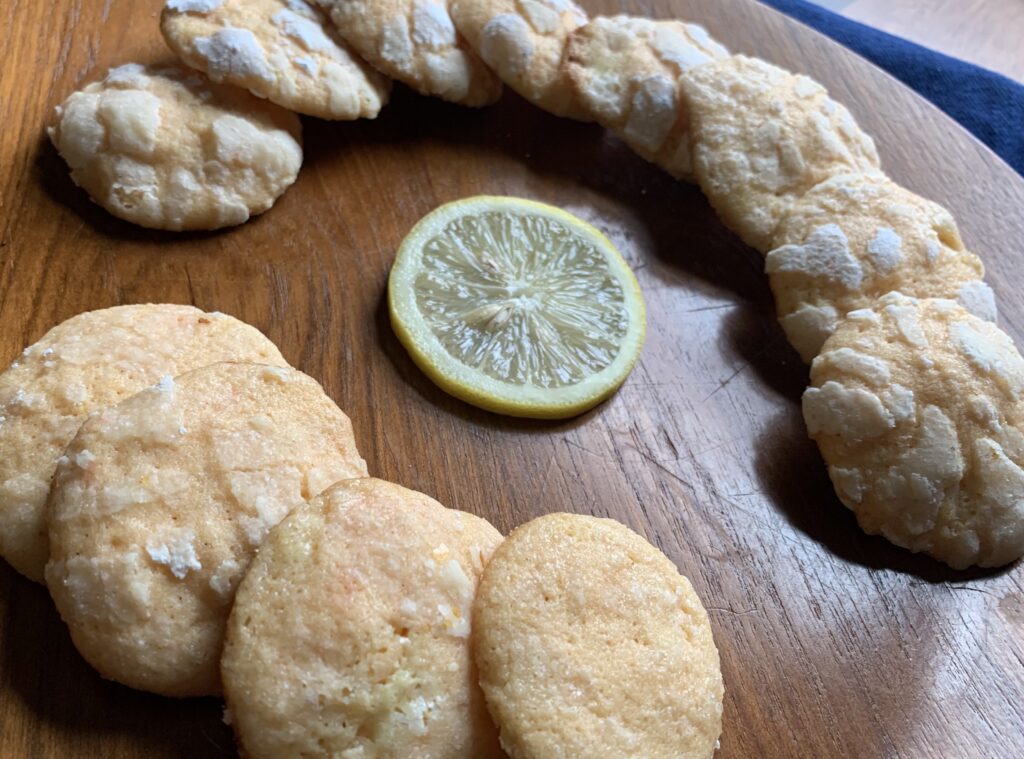
The straight recipe (with that drop of red food dye) on top. Cookies with Vitamin C in the sugar crust underneath.
NOTE FROM KATE: I’d like to point out that despite being a lawyer, my beloved husband instinctively baked three test batches, with three comparison samples in each. That’s your standard Quality Control Protocol – any fewer and the result would lack statistical significance. He also varied only one variable at a time, so we’re golden. (Well, he is. He could have been an excellent engineer, too.)
Frustration set in until I changed my point of view. It wasn’t a flaw; it was a variation! Two cookies for the price of one. Or four if you look at it right! The first two, crunchy or cakey, will be targeted by everyone who grabs something pretty off the tray. Then you have the lemon-lover Versions #3 and #4, which will taste better to those who prefer to eat with their tongues rather than their eyes. Not that they’re ugly. Just plain when compared to the more lovely but shallower sister.
Opinions? Me? Never.
Enjoy!