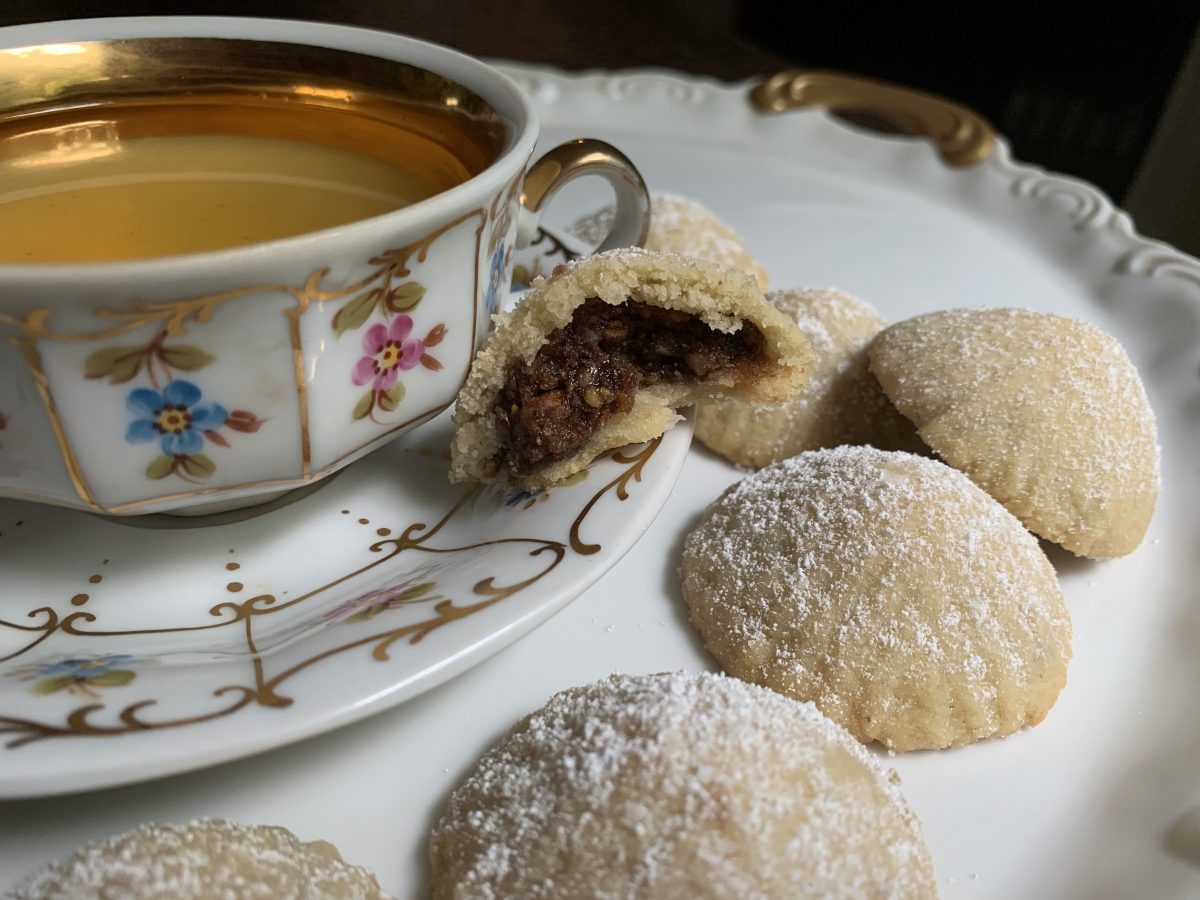
Ma’amoul is the cookie of the Middle East; the one that crosses every cultural division. Muslim, Christian, or Jew, it doesn’t matter. One cannot celebrate Eid, Easter, Purim, or any other big ceremony without this treat any more than you could stage a U.S. wedding without a cake.
What you have here is a very good Ma’amoul that replaces some Mediterranean baking staples (mastic, mahlab, and sandalwood powder) with readily available American substitutes (vanilla, almond, anise, and ginger). The result is an amazing cookie that everyone adores – at least if you’ll accept the testimony of close to 100 taste testers, including several dozen from the local mosque who grew up with the genuine article. The recipe below is one of our proudest successes.
How good is it? Let’s put it this way. Every person in the family – on their own – fell back on poetry when asked for a description. Scott offered antique Arabian Nights phrases like, “the fragrant breeze that wafts from the garden of the Sultan.” Kate produced, “elegant, perfumed Fig Newtons dressed up in flowered bonnets.” Our daughters insisted on “parasols, sun dresses, and corsets bound by ribbons of scented silk.” No one reacted with anything less.
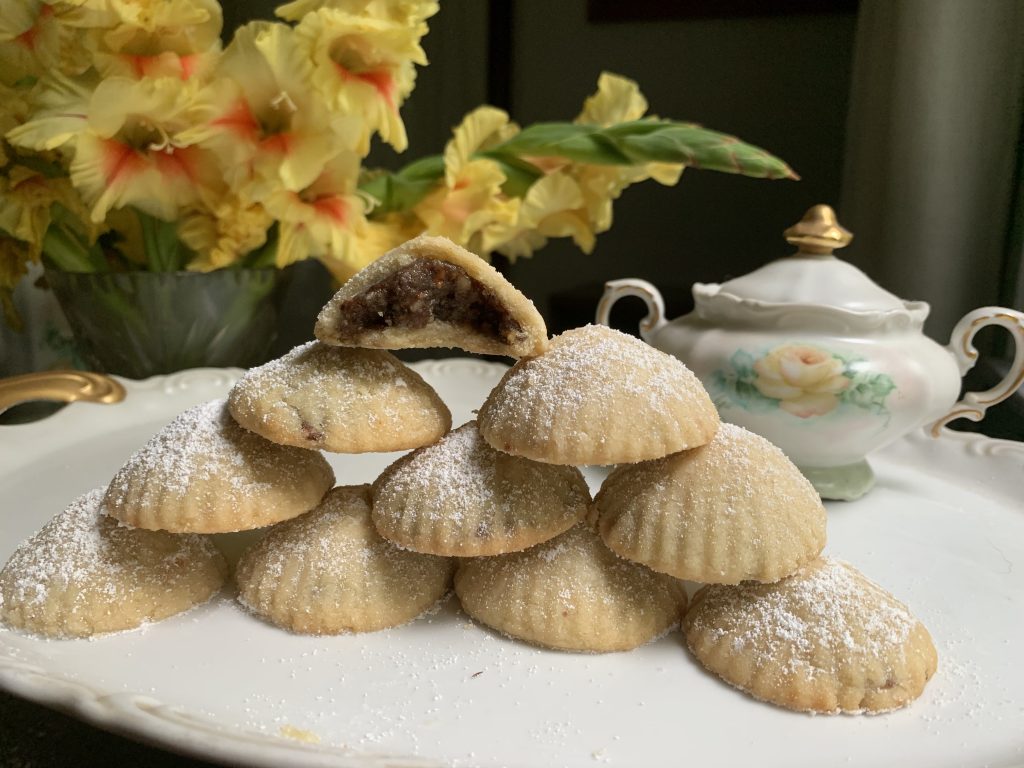
This has to be the most evocative set of flavors we’ve ever come up with. They are fantastic. Awesome. Amazing. Magnificent. I cannot urge them on you any more. Not for Christmas. This is a spring and summer treat, not a winter one. But it’s definitely a cookie you need to experience at least once in your life.
At the same time, do not be tempted to “test” the product by picking up one of those dreadful commercial versions from your local Middle Eastern market. We did, and our sheer dismay almost killed the project before it got started. Calling them “awful” would be too kind. Our daughter, a camp counselor, refused to inflict them on her kids! No, you need to do this one right if you want to see what all the fuss is about. I promise: they’re worth the effort.
As always, skip to the bottom if you want the recipe without the discussion
First Step: What Is The Target?
Do some research and you’ll see that every region, country, city, town, and home claims its own unique twist on Ma’amoul. The sheer number of variations makes it hard to pin down a central theme. I had to read through almost 30 recipes (!) before I could nail things down clearly enough to even work on a recipe. Even then I ended up with a pretty vague description. The target was:
- A filled, molded cookie;
- A buttery, slightly crunchy crust with some elusive, sweet-spice accents;
- A filling made from nuts and dried fruits; and
- A healthy dose of rose water to import the Mystery Of The East.
None of those targets was particularly hard to achieve once we figured out what all the exotic ingredients were for, but it took some research to get there.
Bringing The Ingredient List Under Control
The recipes I’d been reviewing called for a number of ingredients that many American bakers could view as exotic. The bulk of the crust is made from:
- Semolina flour;
- Clarified butter;
- Rose water (mandatory);
- Orange blossom water (less so); and
- In some cases yeast instead of baking powder.
None of those ingredients posed any special challenge. The yeast could simply be ignored as an option for ultra-purists, since modern Middle Eastern recipes tend to use baking powder anyway. The two flower waters are readily available in modern supermarkets, and certainly in ethnic markets or baking specialty stores. As for semolina and clarified butter, they are even more available than rose- or orange blossom water, and we’d developed some experience on how to use them during our work on the recipe for Ghraybee (the great Middle Eastern shortbread). But then came the little touches to enhance the crust. These were:
- A spice called mastic a/k/a mistika (whosis?);
- A spice called mahlab (whatsis?); and
- Sandalwood powder (in a baked good?!).
None of the recipes used those spices in any significant amount. They were clearly accent flavors, not core ones. But that kind of thing can matter when you want to get the flavor “right” in addition to “good.” That sent me to Internet library… which greatly eased my mind. It turns out that all three are used in ways that American bakers will find both comforting and familiar, and can be replaced by substitutes you already own.
Mastic is a quintessentially Greek spice made from the dried sap of a local tree, commonly used in baking in the same way that Americans use vanilla… Whoa! Hold it right there. Stripped to its core, Ma’amoul is simply a flavored crust wrapped around a fruit-and-nut filling. What could fit a cookie like that better than a touch of vanilla? And vanilla is missing from the ingredient list! Duh. Substitution #1: check. [For what it’s worth, the exchange rate is two parts of vanilla extract for every one part of ground mastic. Reverse engineer as you desire if you keep ground mastic on hand.]
That was easy. What about Mahlab? This, it turns out, is a spice made from the seeds of a shrub related to cherries. It’s typically used as an accent for fruits, and has a flavor that people compare to almond extract mashed up with sweet-spice notes such as cinnamon, anise, and/or cardamom. This makes just as much sense as the first one! You’d have to search long and hard to find a fruit-and-nut filling that doesn’t have some almond extract with a sweet-spice accent. [We ended up at ¼ tsp. of almond extract plus a healthy pinch of star anise to replace ¼ tsp. of mahlab. Reverse engineer as your pantry allows].
On to the… Sandalwood Powder?! Okay, let’s put this on the table. I have a horrible reaction to the smell of sandalwood. One whiff of incense or scented candles can give me a migraine, and one woman in sandalwood perfume is enough to make me flee the elevator in panic. I’m getting a headache now at the mere thought of this noxious toxin showing up in my food.
At the same time, I can see what it’s supposed to do. The same thing that powdered ginger does in other dried fruit recipes. Substitution #3: check that one off as well. [That said, we tried some ginger and ended up leaving it out. You’ll see it in in the recipe as an option for those who like to gild their lilies.]
Getting The Filling Right
All that research proved that the flavor profile in the crust is a lot more standard than you’d think from reading the list of ingredients. The same is even more true of the filling. It’s basically the standard fruit-and-nut filling from Heritage Cookies of the Old and New World, plus a healthy amount of flower water. The only challenge would lie in perfecting the exact proportions for this particular case.
First the nuts. What could be more Middle Eastern than pistachios? The answer is… walnuts, at least in this case. The bulk of this filling requires a softer nut, and the slight bitterness of walnuts fit in perfectly. Pistachios did taste better, but the texture didn’t work. Maybe a mix of the two…? Oh yeah. That’s the way to go. Better than either one standing on its own.
Next, I have to admit that dates aren’t exactly my favorite fruit. They’re just so… meh. But that was not to be. Dates are 100% required if you want to make a proper Ma’amoul. They are the blank canvas for everything else, and no amount of fidgeting can change that basic fact. That said, we once again preferred the multidimensional, sophisticated effect of a mixed fruit filling over something made with dates alone. Figs turned out to be our favorite addition; apricots and raisins our least favorites; and cherries acceptable, but only when used with so much restraint that I left finally left them off the recipe completely. Consider that a secret tip for online readers only!
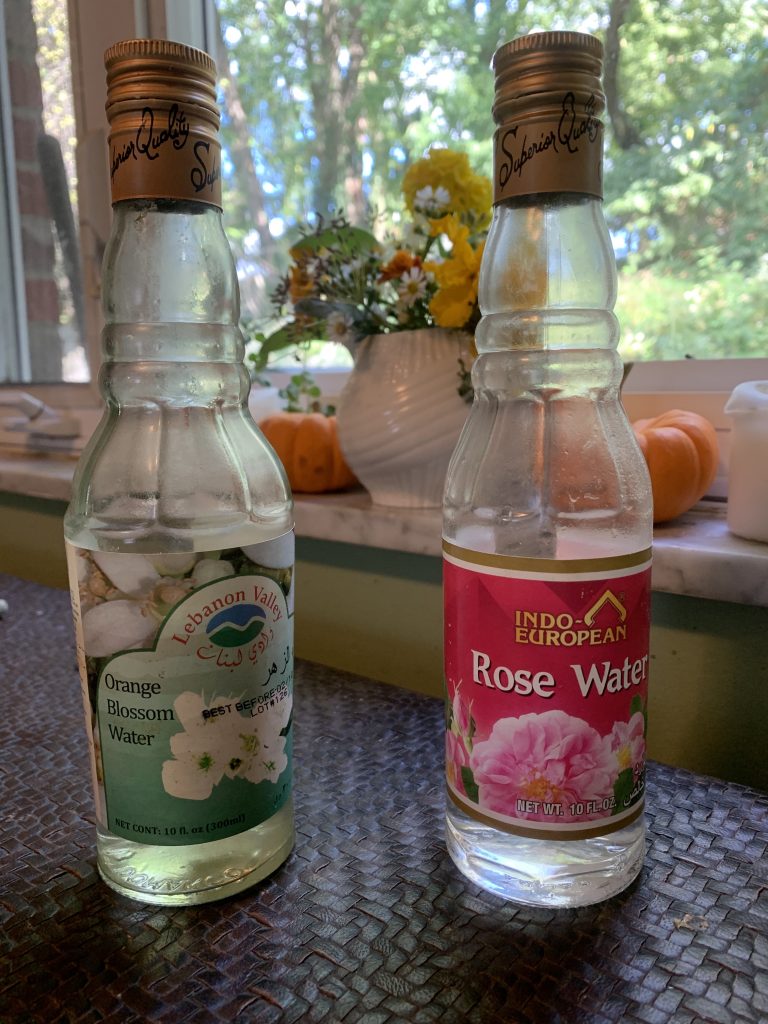
That left only the elephant in the room: rose water. This is, to put it mildly, a controversial ingredient. Those who like it tend to use it with abandon. Those who are not fans (like me) tend to respond with phrases like “Grandma’s eau de toilette.” If you’re in the first category, please note that many of the recipes I researched use up to three times what you see in ours. Have at it if you will. We, emphatically, will not.
Indeed, my aversion to rose water is strong enough that I tried a version using only orange blossom water, which is much less pushy, and even penciled in a plan to work on a custom version with “more acceptable” aromatics. The test results scotched both of those ideas, but also reassured this rose-water critic that it wasn’t going to be as rough as I feared.
Yes, this is a recipe that requires a certain amount of rose water to do the heavy lifting. You can’t do without it. And yes, up to 50% of that can be replaced with orange blossom water, with fantastic results that all of us preferred. But we also found that these ingredients, and the baking process, tamed the perfume overflow that Kate and I had feared so much. Indeed, consider that as Free Tip #2: You will be surprised how many of the aromatic compounds cook out during the baking, even though the filling is wrapped in a crust.
A version made with 50/50 blends on both the nuts and fruits, plus 2 tbsp. each of rose- and orange blossom water turned out great. More than enough to trigger requests for the next batch. But there was some room for refining.
First I replaced the bulk of the sugar with honey. A fantastic idea you should embrace. Then I adjusted the salt level, and… O.M.G. Words cannot express the magic embodied by how these ingredients come together, marry, and create a whole that is vastly more than the sum of its parts. Ma’amoul really are an experience straight out of the Arabian Nights.
Forgetting A Part, Aren’t We Scott? What About Putting The Cookie Together?
Oh. Yeah.
I’m not going to kid you: forming the Ma’amoul is the most time consuming part of the recipe. In fact, it’s by far the most time consuming part of the recipe, because the dough and the filling are as simple as a cookie gets once you have the ingredients ironed out.
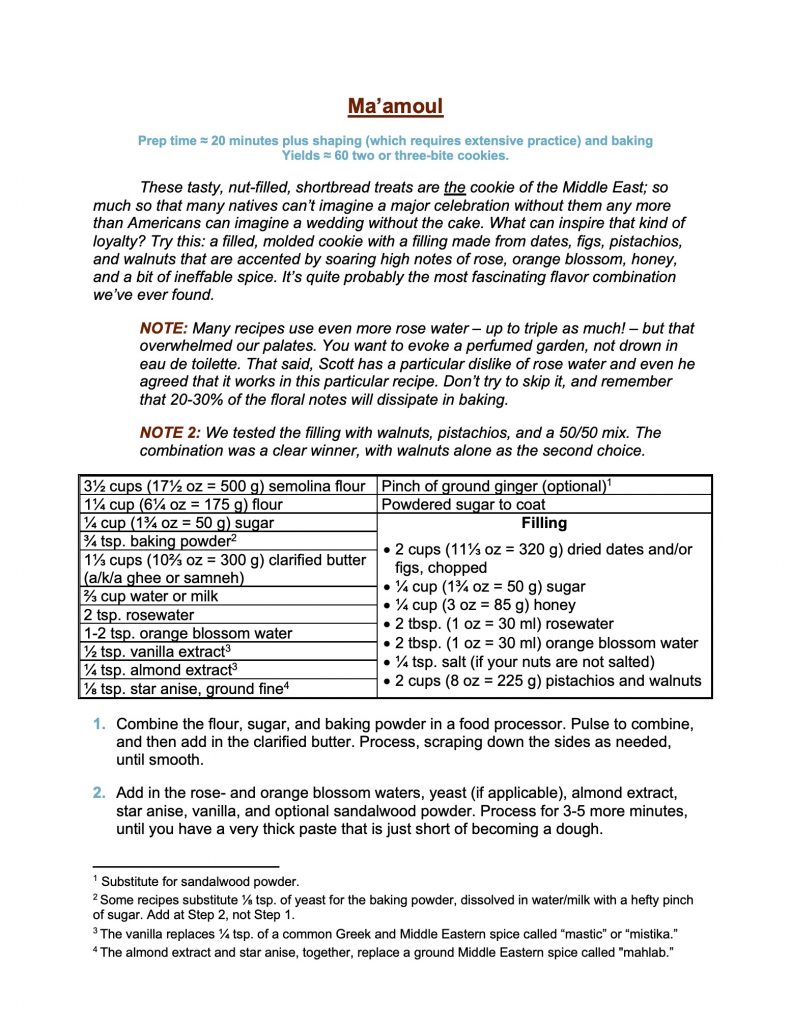
- For The Dough: Whirl the dry dough ingredients in your food processor to distribute, and then process in the wet. Remove, wrap, and refrigerate until you’re ready to form.
- For The Filling: Put everything but the nuts into your food processor, whirl until smooth, and then process in the nuts until they are ground to your satisfaction. Remove, wrap, and refrigerate until you’re ready to form.
It honestly couldn’t be any quicker or easier.
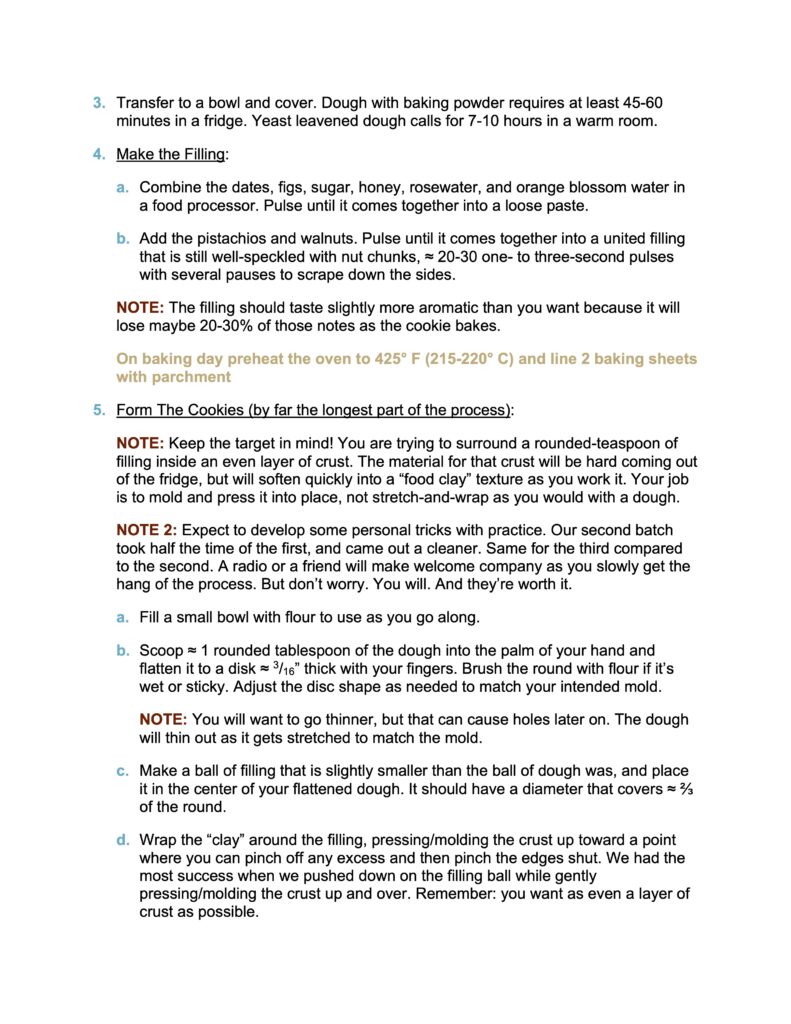
Forming the cookies isn’t all that hard either, but it does take some fidgety technique you can only develop with practice. The recipe contains good, step-by-step instructions. Both Kate and I took careful notes. But nothing is going to replace a bit of practice. Grow up in the Ma’amoul Zone and you’d probably master the process after 500 cookies under the careful eyes of your mother. We’re aiming to get that number down to 200. But that’s still a solid couple of batches. Just enjoy the fact that making your Ma’amoul definitely gets easier and faster as you go along, and is a fine thing to do with company.
I also want to emphasize that Ma’amoul are easier to form than other filled products such as Trogirski Rafioli, filled Gingerbread, and savory foods like tortellini, pierogies, etc. That’s because those have actual doughs that you need to roll out. The Ma’amoul “dough” is more like a very thick paste once it warms up from a stay in the fridge. You can wrap it around a ball of filling with nothing more than a bit of dedicated work to pinch the thick areas over to where the crust is thin.
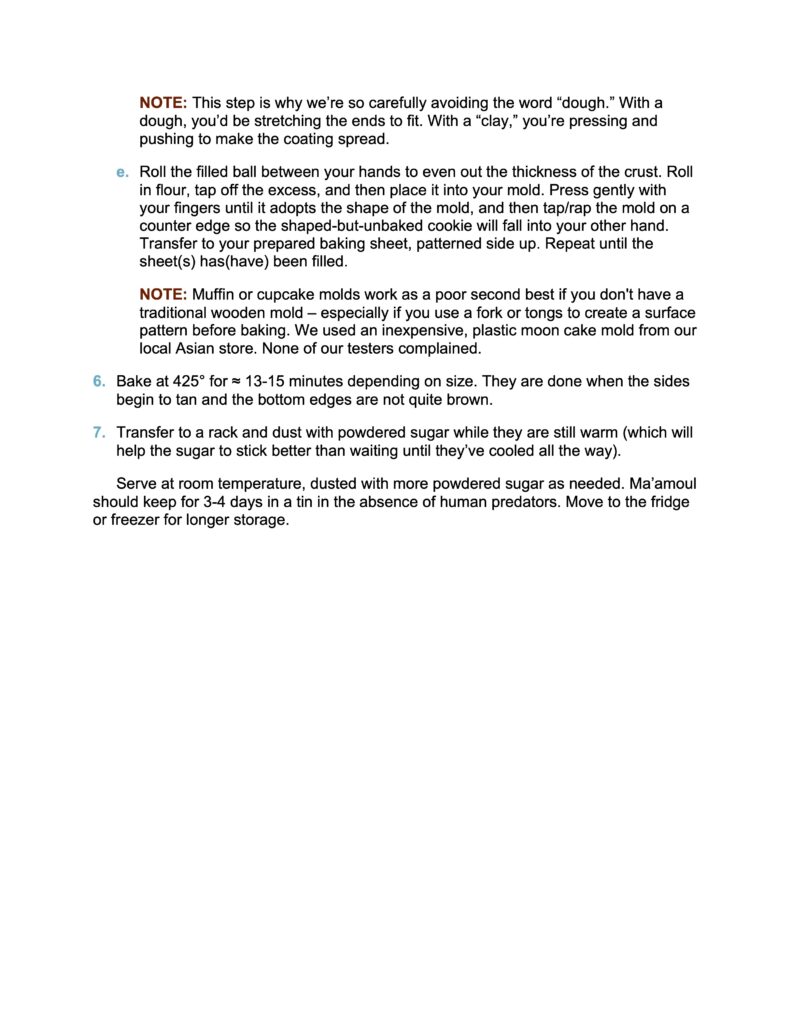
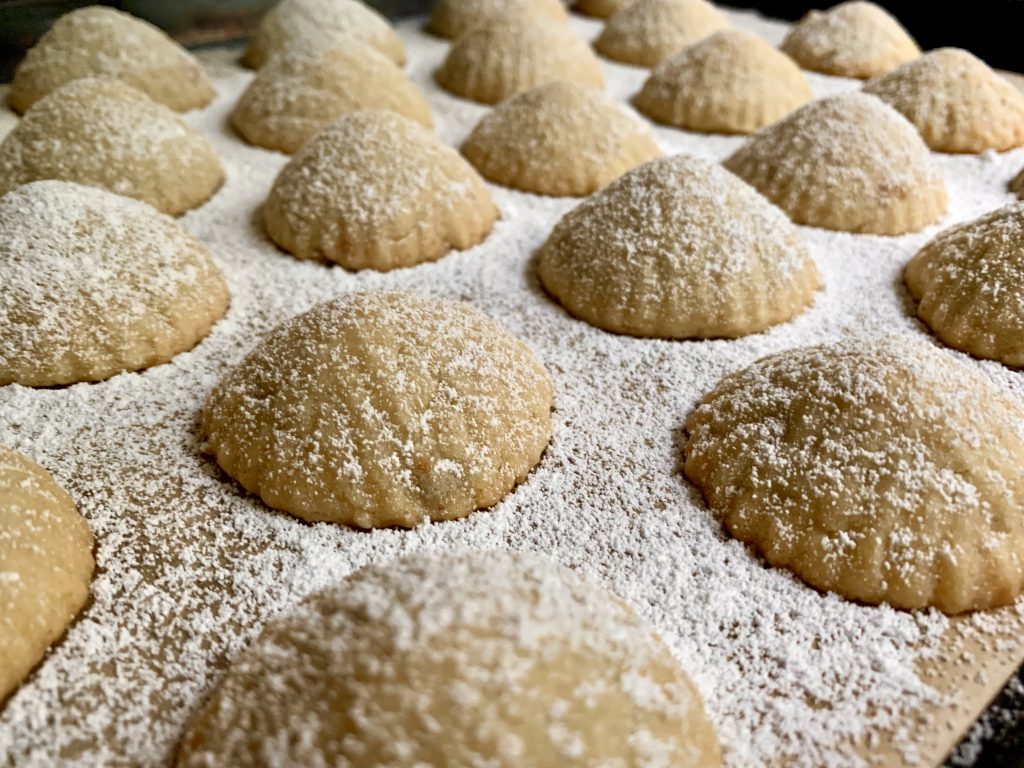
Next, you can leave them plain, and they will taste just as good but why shy away from that final touch which makes them extra, extra special? Home bakers typically shape their Ma’amoul with a neat little mold that comes with a handle. This is a much easier tool to master than Europe’s elaborate Gingerbread, Speculaa, and Springerle molds. The cookies come free with nothing more than a few whacks on the counter if you’ve got it properly floured. Kate bought me the inexpensive plastic mold below just for our Ma’amoul testing, but I promise that we will both be using it for a great many European cookies in the years to come.

Final Observations, Wisdom, and Lessons Learned
Anyone who loves the idea of Heritage Cookies should make this cookie. How many recipes are there that trace their roots back to the time of the pharaohs? How many can claim to be as central in their culture as wedding cake to a U.S. ceremony? How many will inspire an ode, or transport your imagination to a fantasy world you haven’t summoned up since childhood? I can only think of one, and this is it.
Ma’amoul are a fabulous treat that I guarantee you’re going to enjoy. G.U.A.R.A.N.T.E.E. But they are ever so much more than that, too. This cookie is a cultural ambassador. No matter your point of view – taste, texture, romance, culture, or history – it is a recipe that has it all. “Special” barely scratches the surface.
A NOTE FROM KATE: My grandmother used the word “maamul” in Czech to denote a person who begs shamelessly, and the verb “maamulit” to describe the act of begging until I got my way. It is a colloquial slang. I have heard others use it too. But there is no Czech etymology that would tie the word to begging as such. My best guess is that the frequent trade between Czechoslovakia and the countries of the Middle East introduced a new cookie that people loved to eat, but didn’t know how to make. Translation? If you want a cookie that will reduce your family to begging for more, you have found it!
POSTSCRIPT
Many thanks go out to the kind folk at the Islamic Center of Pittsburgh, who put up with a long pair of visits, including one on their sabbath, and provided invaluable feedback on what a good Ma’amoul is supposed to be.
Speaking of which… This may be the best takeaway I can provide about what we mean by a “proper heritage cookie.” The Islamic Center of Pittsburgh has an intriguing mix of parishioners from many different backgrounds. There’s the Middle Eastern contingent, the Indian Subcontinent group, the African group, and various homegrown American Muslims, all wedded into a unique and welcoming mélange. I, of course, was looking for the Middle Eastern natives. I knew the cookies were good – any moron could tell they were good! – but I needed feedback on whether they were capital-R “Right.” That had to come from people who grew up eating them.
I got my help, sure enough. But there’s a story that goes along with that help.
If I watched it once, I watched it twenty times. A gentleman from Lebanon, Syria, Palestine, Morocc0, Libya, etc. agrees to lend me a hand. He tastes a sample, nods sagely, and says something along these lines: “These are good. Very good! Not as good as my mother’s, of course, but they aren’t too sweet, and yes: they are definitely a true Ma’amoul. Nice job.”
Then someone he knows from one of the other groups looks over his shoulder and innocently says, “What are those?”
“You don’t know Ma’moul? How is that possible? You have to try one!”
Three more samples disappear from the tin. There follows the sound of munching, an ecstatic exclamation, and then a buzz of excited conversation and delighted laughter as the group passes out of range.
Cookies have a power that nothing else can match.