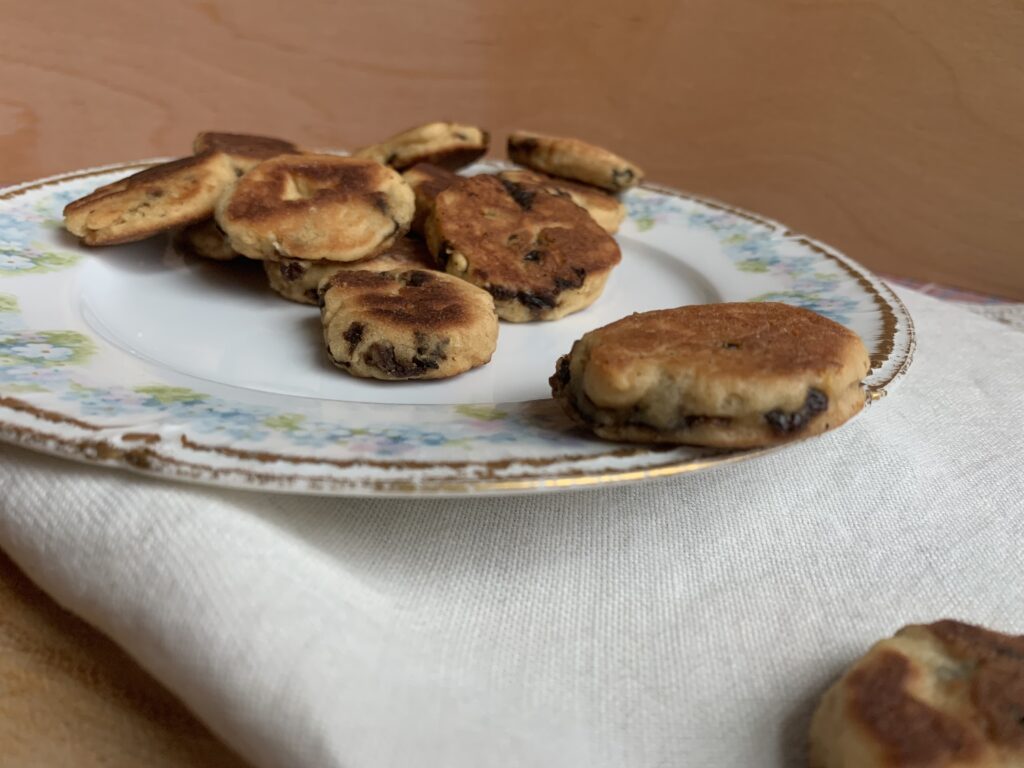

I’ve got some money to bet! You either (a) know and love Welsh Currant Cookies/Cakes, or (b) have only the vaguest impression that such a thing exists. We fell in the latter category. Yes, I have a number of friends who chimed in with, “Oh, you’ve got to research currant cookies!” So we knew they existed. But I’d honestly never tasted one until we got into the recipe testing.
You may now put us in category #1. They’re wonderful.
NOTE FROM KATE: When this intriguing cookie came up for trials, I was of two minds about it. First, leaves were falling and we were carving pumpkins. For most people, October 31st is just Halloween, cosumes, and candy bars. The holiday originated as Samhain, a Celtic New Year. One Samhain tradition is thanking the warm part of the year for its bounty, and greeting the cold hibernation with its hunting season. Traditional offerings include bannocks, biscuits, or, indeed, cookies. I was all in favor of this concept: we would try a recipe and I would have some genuine griddle cookies to share with the garden.
And yet… pan and griddle means oil. Have I mentioned that we fry have not researched a single fried cookie because I loathe even the idea of the cleanup? If you’re like me, fear not. The amount of butter or oil is minimal, and these curiously enticing cookies are well worth the effort.
The brits have a wonderful word that catches the essential appeal of Welsh Currant Cookies/Cakes: they are moreish. It means they’re one of those foods that don’t taste “special,” but trigger that mysterious need to just keep noshing until there is nothing left in range. Simple, tasty, accessible, and fun.
“But are they a cookie or a pancake?” That’s a whole other debate. They have one foot firmly planted on each side of the line. Thus their assignment into our category for Not Quite A Cookies. Another perfect description.
As always, click here to jump to the recipe without any discussion.

Currants?
Linguistically, yes. Biologically? No.
To a naturalist “currants” means one of two species in the genus Ribes, both of which produce small, round berries that look like itty bitty grapes (which are in the unrelated genus Vitus). There’s Ribes rubrum, which can be red, pink, or white (my favorites are the classic reds), and then there’s Ribes nigrum, the black currant species favored by our daughters. Kate’s favorite would be Ribes uva-crispa a/k/a Gooseberries.
Red currants have that classic sweet/tart flavor profile you find in currant jam. The black ones have a unique, musky flavor. Gooseberries are sort of like a sour blueberry with the size and texture of a very firm grape. All three are delicious once you acquire the taste. Heck, we grow them all in our yard! But they’re only good when eaten fresh or turned into some kind of jam, preserves, or compote.
HISTORICAL NOTE: America has a fascinating history of actively destroying these crops. It happened because currants and gooseberries are required species for the spread of blister rust, a fungal disease capable of wiping out entire forests of white pine. White pines were a major U.S. natural resource in the early 20th century, so both state and federal authorities felt compelled to fight it off. The easiest solution? Eradicate the vector. And so they did. Currants and gooseberries disappeared from American soil for many decades, and are only now making a comeback due to the fact that resistant white pines have evolved to take over the forests. Mostly. Ribes of all kinds are still illegal in Maine and several other states.
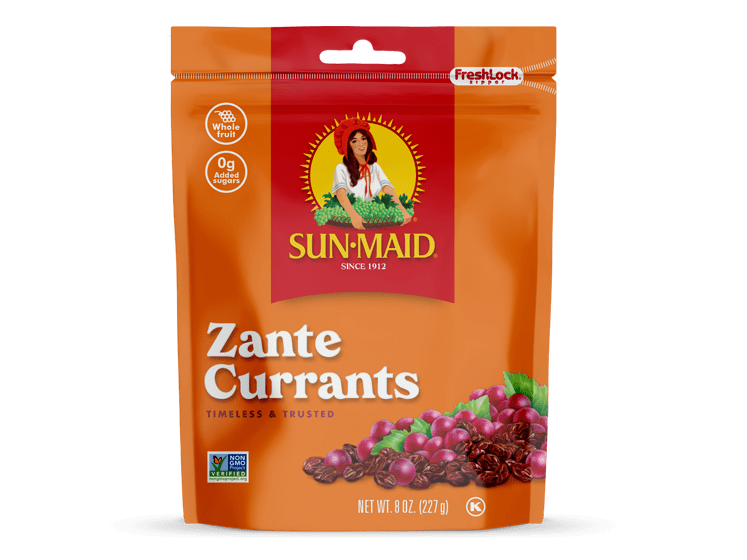
Getting back to the point, culinary “currants” are not currants at all. They are miniature grapes that dry into extra small raisins, which are then sold under names such as “Corinthian grapes,”Zante raisins,” and “Zante currants.”
ANOTHER HISTORICAL NOTE: Those names have their own history worth reading about. The grape varietal originated in Greece and became a significant export crop. The main shipping point was the city of Corinth, a major seaport in the country’s northeast. The actual farms were, and largely still are, located in the Greek southwest, on an island called Zakynthos f/k/a Zante. Hence the descriptive words Corinthian and Zante. The name “currants” gets used because the berries aren’t much bigger than actual currants.
Those miniature raisins are what the recipe refers to. We’ve never had a problem finding them in any large supermarket.
Getting at the “dough”
Research showed surprising consistency in the ingredients and amounts. The dough contains (by weight):
- 3 parts flour;
- 1½ parts butter, lard, or shortening (which you can stretch to 2 parts if you want);
- 1 part sugar;
- 1 part Zante currants (see above);
- 1 part egg combined with dairy (buttermilk, soured milk, yogurt, whole milk, etc.); and
- A surprising amount of baking powder, with some nutmeg and grated orange zest to tie it all together.
Yes, there are some bakers who view the orange zest as an option rather than a requirement, and I’m sure that most of them are perfectly nice people, but in this case they are wrong. You’ll see. ‘Nuff said.
Those proportions vary a bit from recipe to recipe, but never by enough to change the basic pattern in a fundamental way. It’s so consistent that I now believe old country Grandmas passed the recipe down more or less as follows: “Use these proportions and then vary according to taste.”
If it’s good enough for Grandma, it is good enough for you and me.
The method varies more than the ingredients. Our recipe adopts the most common, cut-in-the-butter approach. Almost as many recipes use a creaming method, and more than a few call for melted fat. We didn’t bother to try them all because the message is clear. Pick whatever method you want so long as it gives you a rollable dough.
Yes, that’s right: a dough. Pancake batter has much, much more liquid in it than what you use to make Welsh Currant Cookies. It really does feel and act like a cookie dough, albeit one with too much leavening to yield a normal cookie texture.
Roll to ¼” thick, and cut out rounds or other basic shapes
The dough holds its shape surprisingly well, but you want to stick with basic shapes nevertheless. We tried making a few animal shapes in addition to rounds, hearts, stars, and the like. The problems occurred halfway through the cooking process, when we had to flip each cookie/cake over. The animals inevitably lost their heads, tails, and/or legs. Feel free to try, but we will stick to the basics.
Cook on a skillet or griddle
Up to now we’ve had cookie technique in making the dough; cookie technique in the rolling; and more cookie technique in the cutting. From here on it looks much more like a pancake. Heat a skillet or griddle over a medium-low flame just like you would for pancakes, butter/oil it as you would for pancakes, and then cook the cut-outs as if they were miniature pancakes; i.e., until both sides are a light, golden brown. The exact timing will vary tremendously because of tiny factors ranging from the color and weight of your pan/griddle, to the thickness of your cookie and the fraction by which your flame leans toward medium- or low heat. You’ll be fine if you exercise a bit of touch and cooking experience, especially since (a) the ones that go too far will still taste great, and (b) a dusting of powdered sugar will cover all sins.
What you get will taste like a raisiny, not-too-sweet cookie with the texture of a pancake. Absolutely delicious, and incredibly moreish.
NOTE FROM KATE: Just like with pancakes and crepes, griddle cookies take its own bit of practice. A few of my observations are as follows:
- SIZE MATTERS: Both of the pan, and of the cookie. Every pan holds heat differently, and a larger and thicker cookie will require more time.
- CONTROL YOUR HEAT: A relative of the pie crust, the raw cookie will soften if left waiting in the hot kitchen for too long. Pop the sheet in the fridge between pan-batches in order to retain cookie shapes. As the cookies hit the pan, they will want to set, not burn. They will warm up and turn flaccid. For an easy and cooperative flip-over, use a tool the width of the cookie (offset spatula works well) and make sure its bottom is set. It will be darker than you think it should be.
- ENJOY THE PROCESS. This is a very zen, in-the-moment activity as compared to more precise baking. Imperfections happen. Eat them.
Shelf Life
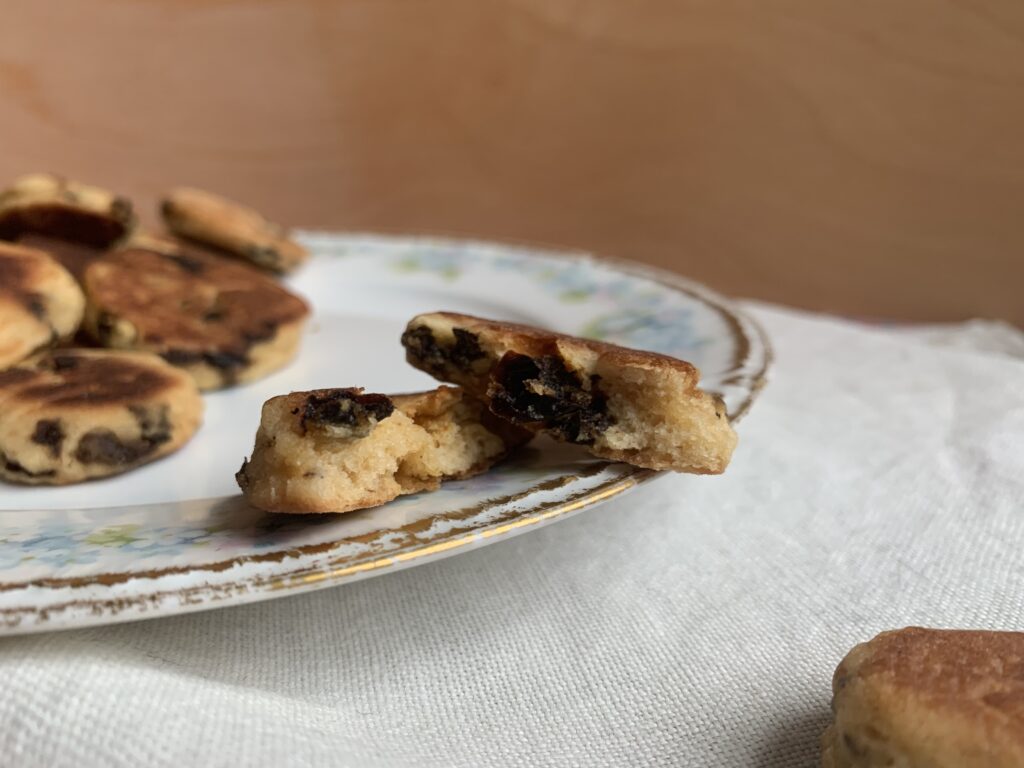
Even moreish cookies end up having leftovers now that our nest is emptying out. We stored those leftovers in an open bowl, an airtight container on the counter, and an airtight container in the fridge. None were as good on Day 2 as they’d been on Day 1, but they didn’t actually go stale. They just went meh. And they stayed at that same level of meh day, after day, after day. More than that, meh turned right back into yum as soon as we refreshed the cookie/cakes on a pan/griddle or through a few seconds in the microwave.
LAB REPORT FROM KATE: Side-by-side testing has shown that a fresh-made and frozen cookie, when brought to room temperature, will taste just as good upon thawing as a fresh-made cookie cooled to room temperature. Furthermore, these cookies don’t go stale as much as they simply dry out. Older ones are just fine with coffee or tea as-is, or you can revive them with a judicious 5-15 second microwave burst.
So the moral of the story is this: Welsh Currant Cookies keep like pancakes. They change very quickly, but they also store extremely well, especially when frozen, and will taste basically as good as new once you get them warm again.
Conclusion
How good is this “cookie?” We have a local diner near our house called Pamela’s (one of a Pittsburgh chain). They are famous for their hotcakes. The owners were even invited to the White House to make brunch for the first family! They are also good people we like enough to treat as our go-to place for a diner breakfast.
I’ve already stopped by with samples and a recipe, and will almost be surprised if they don’t leap at the chance to add Welsh Currant Cakes to the menu after doing some testing of their own. So my bottom line answer is this. They are good enough that some of you readers will bless this article for a great many years to come, and your heirs for that much longer.
Enjoy!