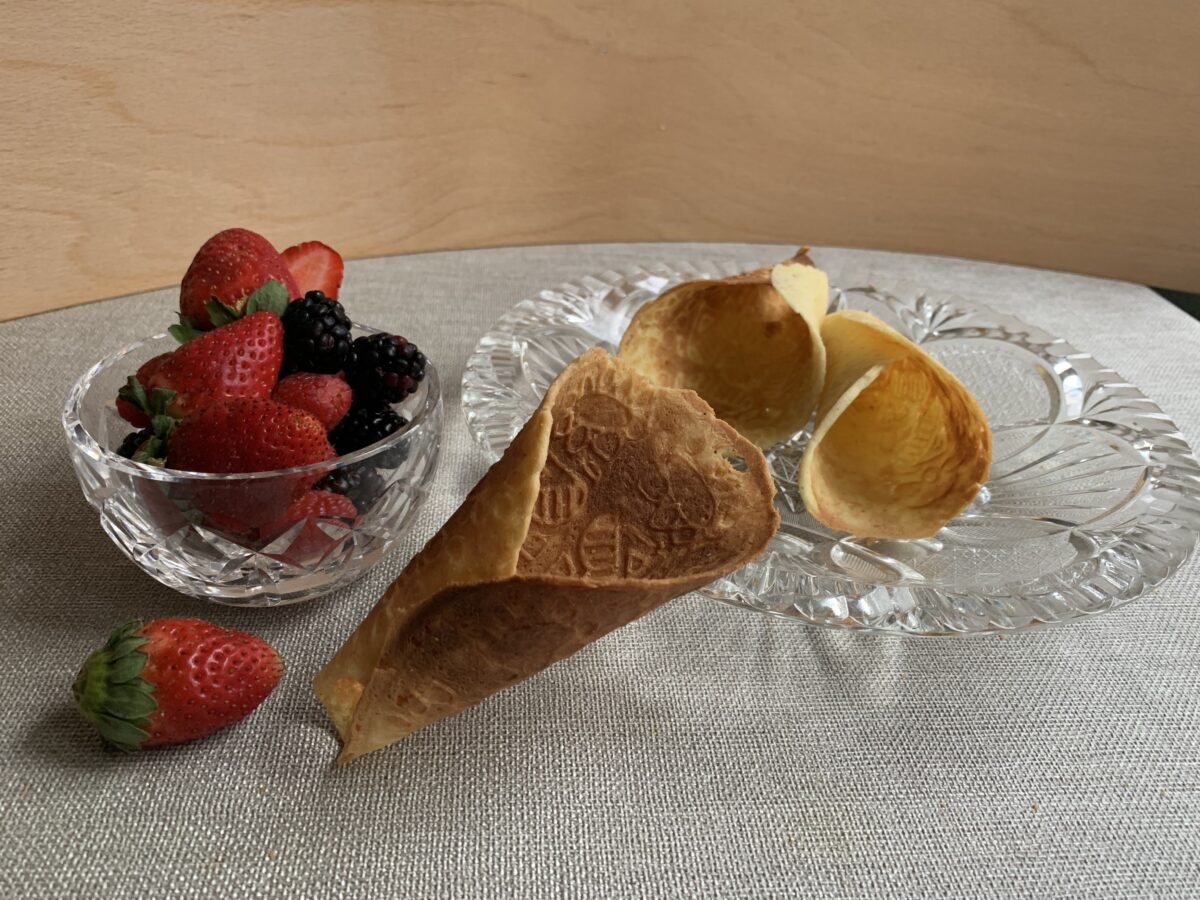
Krumkake are one of those cookies that keep improving with every new batch you try. I can’t honestly say we’ve mastered it yet – which is a little scary when you realize they’ve gotten nothing but rave reviews from guests, spouse, and even a certain stubborn daughter on a low sugar kick who only gave it a taste because Dad did a comic begging routine. (And who then had somewhere between two and several more in order to decide that strawberries were her favorite berry inside. And then had to be restrained to save some for her sister who was out of town. But admittedly had the good grace to only laugh and agree when confronted with this description).
In other words, the Krumkaker we’re already making are Good with a capital G and are still getting better as our skill improves. They are as much fun to serve and eat as any other cookie we know, and have the potential to be even better than all that once we start to explore all the ideas for a filling beyond berries and cream.
Yes Virginia, there is a Santa Claus who lives up by the North Pole, and travels south every year – making his first stop in Norway to get his allotment of Krumkake.
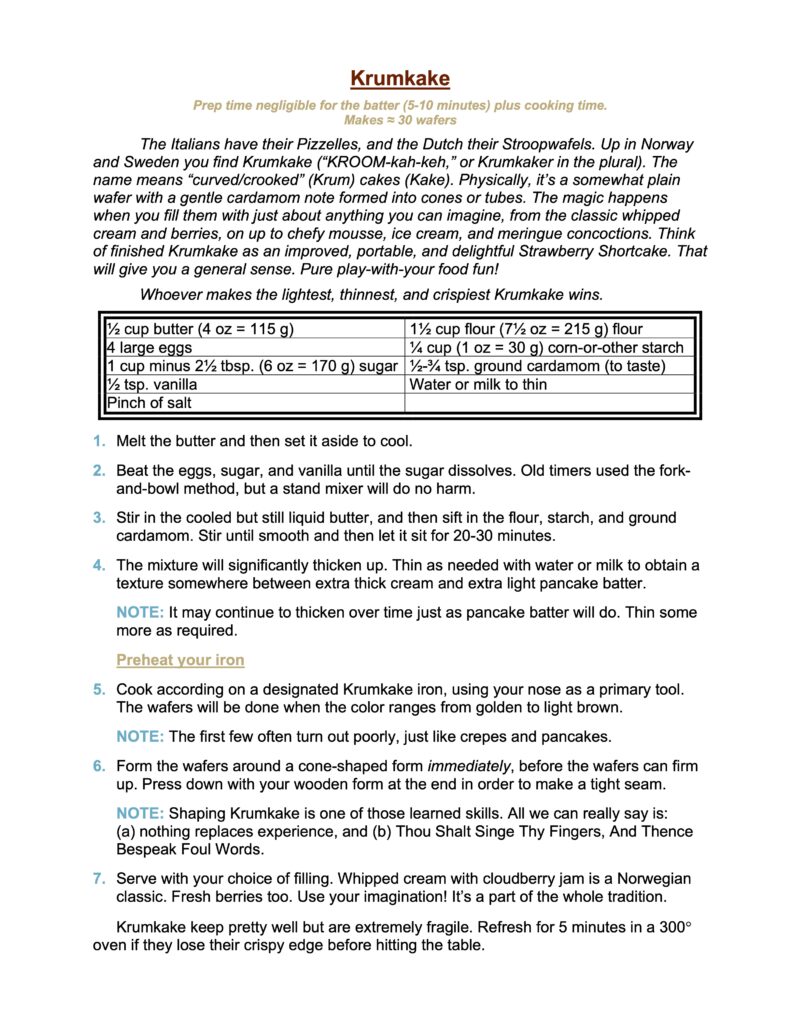
Click here if you only want the final recipe without lessons learned.
FIRST THINGS FIRST: WHAT IS A “KRUMKAKE”?

Krumkake (Krumkaker in the plural) is a light, crisp, Norwegian waffle cookie made as follows:
- Start with an unleavened batter made from melted butter, eggs, flour, and sugar,
- Season it with vanilla and cardamom,
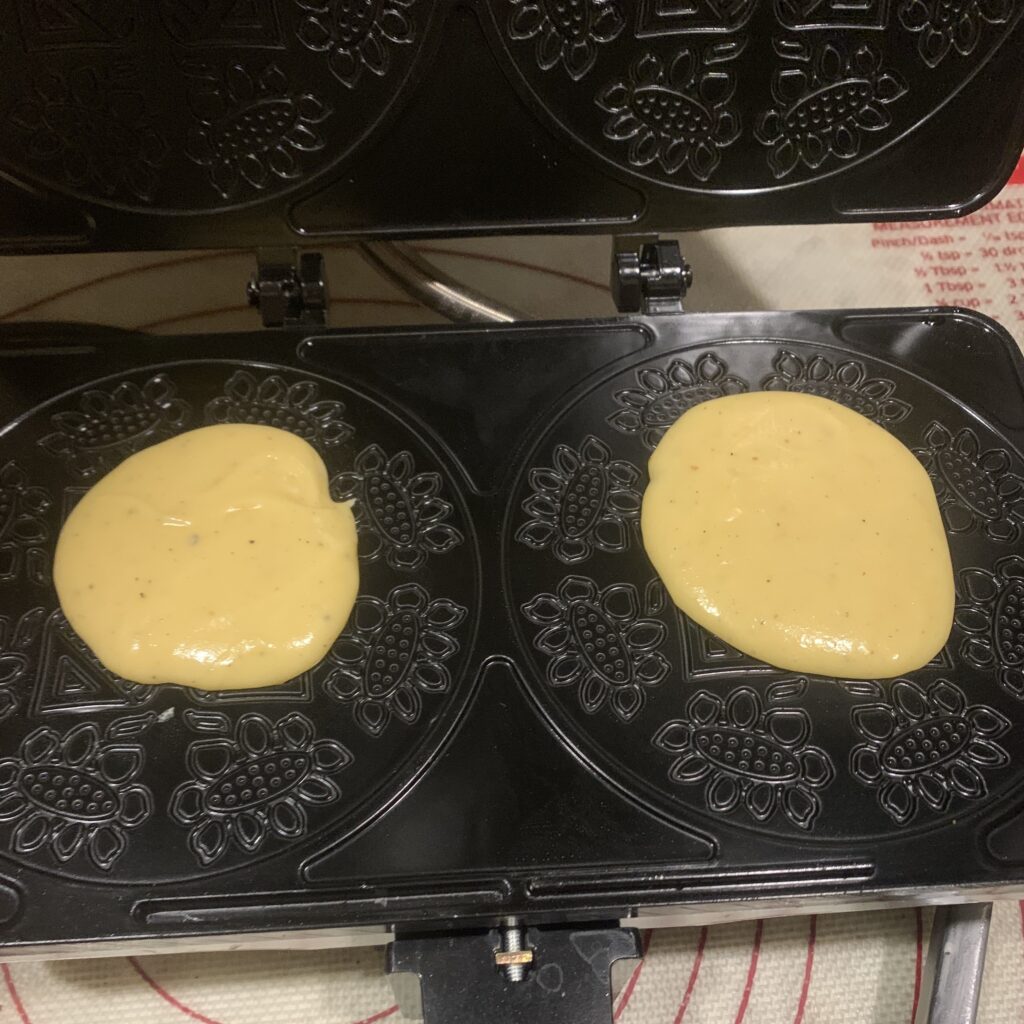
- Use a special waffle iron to make wafer thin cookies,
- Form those wafers into cones or tubes while hot, and then
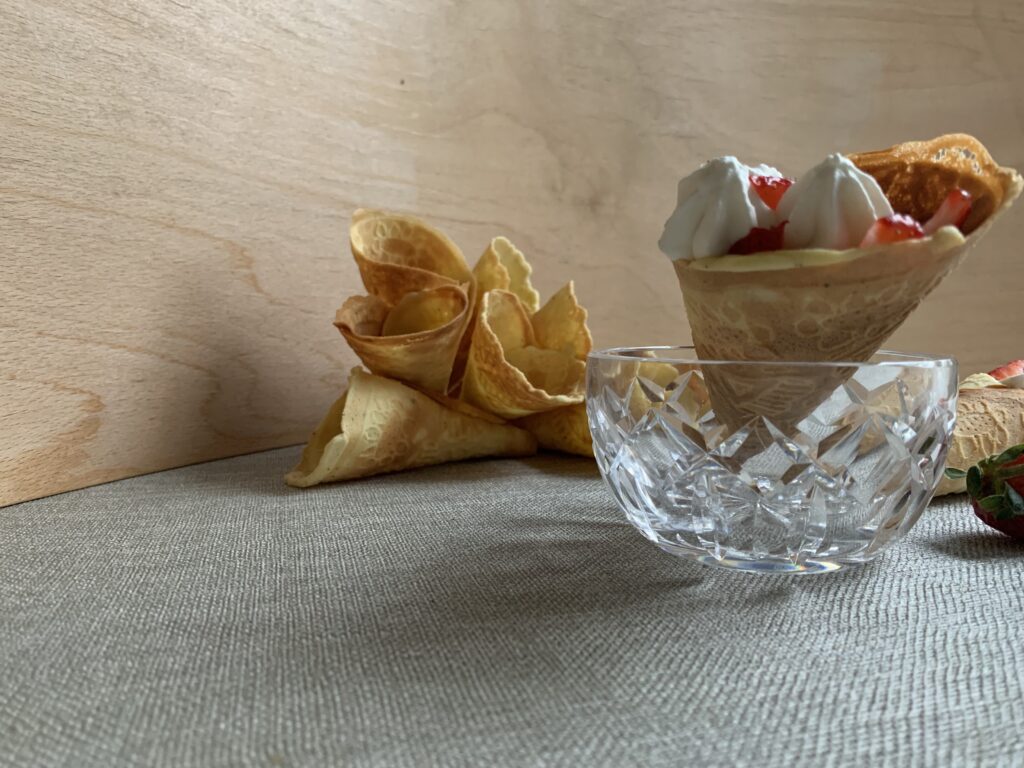
- Serve with a filling such as the classic whipped cream and berries.
Whoever makes the thinnest, lightest, crispiest Krumkake wins. Sounds simple, right? And it is, except for hidden subtleties in every one of those five basic points.
About #1, why do they need to be unleavened? Especially when a bit of baking powder ought to make them that much lighter?
Krumkake irons aren’t quite the same as pizzelle irons. The space between the two halves is noticeably thinner; enough so that any puff from the baking powder would be squeezed out by the brute force of pressing the top and bottom. You’d think people would try it anyway, but I failed to find a single recipe that reinforced the batter with baking powder.
OTOH, every recipe requires a fairly generous portion of starch to lighten the flour, and that serves a similar purpose.
For #2, why be so specific about vanilla and cardamom? Aren’t people allowed to play around?
This is the one that’s going to get me in trouble. Our Internet friend Libby is the finest Krumkake baker we know – the culmination of at least three generations of tradition, with 30+ years of expertise. She has faced and conquered every challenge that Krumkake can present… and she makes her Krumkake with vanilla and almond extract alone. No cardamom in sight. [NOTE: She has subsequently admitted to using ground mace in half of her batter, which may perhaps be blamed on her roots being Swedish instead of Norwegian.]
I stand by my guns nevertheless for at least three reasons:
- Every native Norwegian recipe I could find specified cardamom, usually with a grudging note that some people prefer nutmeg (or mace, I guess).
- Scandinavian bakers are as free with their use of cardamom as Americans are with cinnamon. It’s a cultural trait, and I wanted to produce an Old Country recipe rather than an American adaptation.
- My family really liked how that delicate, background spice enhanced the berries.
So cardamom it is. That is the norm, and doing without is the variation.
On #3, why do I need to spend extra money on a new device? Can’t I use my pizzelle iron instead?
Yeeessss… you can, so long as you understand that your final result won’t be as thin as it should be, won’t shape as cleanly, and will therefore be tasty but not “right.” FWIW, we tested this with a certain amount of diligence because (a) I am nothing if not cheap, and (b) my beloved wasn’t exactly fond of adding yet another large, single purpose tool. I wanted to find a different answer, but the darned wafers just wouldn’t cooperate. I ended up with tasty shards and crumbs, not pretty cones or tubes.
Thoroughly daunted, I went back to consult with Libby about this (consulted, not whined, no matter what she says). She replied with an electronic shrug. “I’m afraid you can’t get around it. Krumkake are supposed to be super thin, and pizzelle irons have too much space between the plates. I give them an extra squeeze even in my Krumkake iron just to be sure. But don’t worry about the extra machine. It won’t be a once-per-year waste. I use my Krumkake iron all year long to make crackers.”
Crackers? Okay, that works… And it’s hard to ignore the voice of experience when that’s why you’re asking for help in the first place. So I bit the bullet, searched around for a deal, and found one right away. Brand new irons retail for around $45.00 as of the end of 2022. That’s well within a household budget no matter what, but an hour of additional searching found me a technically used iron, still in its unopened box, for half that price even after accounting for the cost of shipping. $23.00. So I made the purchase, and discovered that Libby was 100% right. The Krumkake wafers really do come off the iron significantly thinner, and it really does make a difference in the final product.
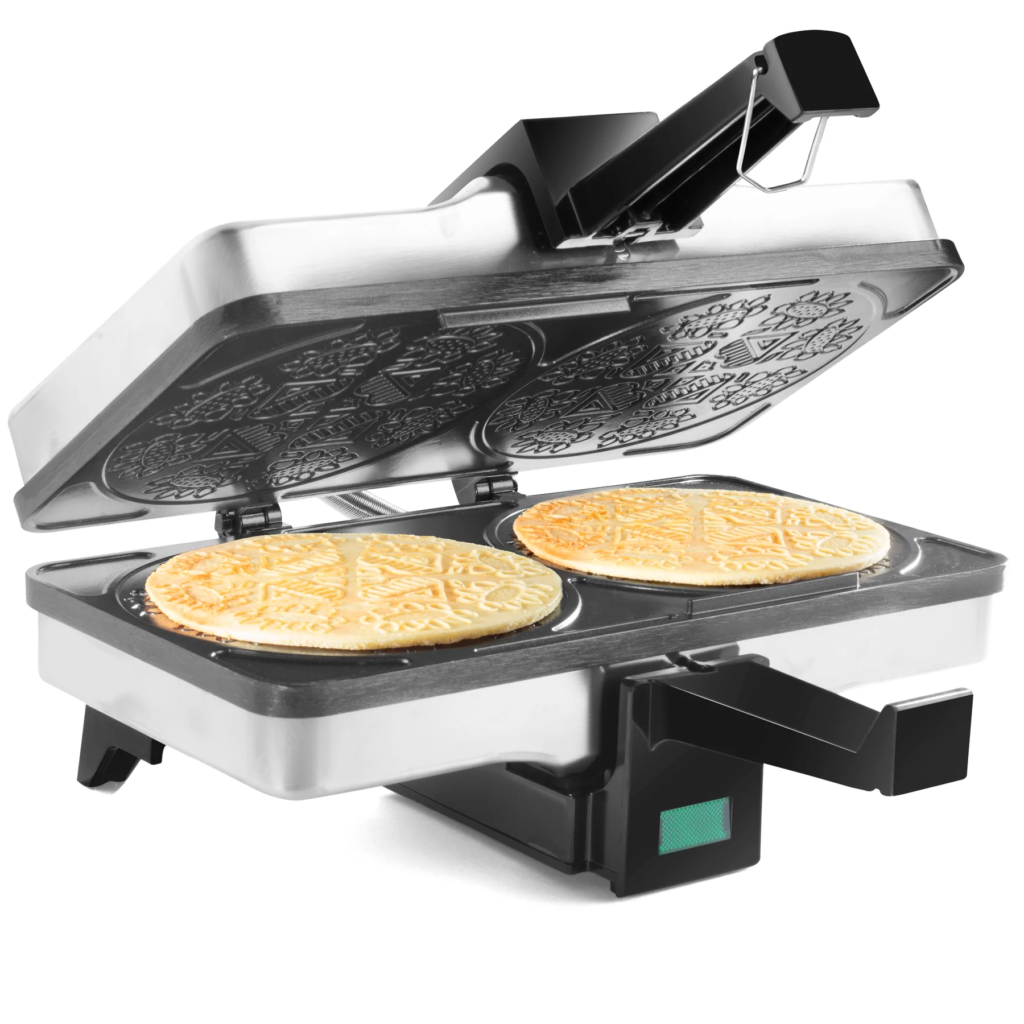
That search came with a side benefit too. We bought a standard electric iron, and it works great, but now I learned that traditional stovetop versions are still being sold as well! How cool is this?
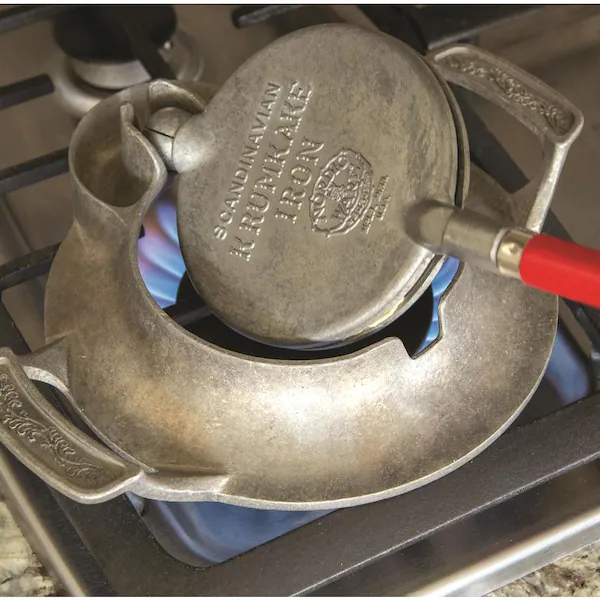
Krumkake recipes existed long before electrical power, and you can actually reproduce that experience if you choose. “Heritage” indeed!
For heaven’s sake, #4 has to be excessive. I like flat pizzelles just fine and I’m perfectly willing to have “topping” instead of “filling.” Why go to the hassle of burning my fingertips to form these into shapes?
Let’s start with the name. “Kake” means cake or cookie, and “krum” translates to ‘curved’ or ‘crooked’; so Krumkaker are by definition “curved cookies.” Cones are the most traditional shape, with tubes close behind, but I couldn’t find a single recipe where the author left them flat. Our casualties irregular results used for taste testing confirm that wafers taste just fine, but you won’t be getting the full experience, and it will matter once you get to the final touches. More on that below.
Okay, Let me have it. What’s the big deal behind requirement #5? I eat my pizzelles plain. Why not Krumkake?

This is actually the most important piece of the puzzle!
We had plenty of “irregular results” as Kate and I struggled with portioning, timing, shaping, and my desire to somehow make this work with a pizzelle machine. Casualties = nibbling. And the nibbling proved, beyond any doubt, that straight Krumkaker are… inoffensive. Nothing wrong with them, just ho hum. Uninspiring. Even disappointing, to be totally honest. Pizzelles have character. Stroopwafels incorporate a caramel filling the gods use to enhance their ambrosia. These Krumkake fragments had neither.
So you can imagine my surprise at the startled cries of delight that came from the other room as guests and family went in to try them out. “Well, they’re certainly pretty enough… Ssshhhhpritz! (From the can of whipped cream)… And oooh, berries. I think I’ll try… Oh. Good. Lord. Jim, you’ve got to come here! You’re missing out on the good stuff! These things are amazing!”
Maybe I ought to try one too… And yes, that was when the penny dropped.

Plain, unfilled Krumkaker are like a light, crispy, and extra fun version of that plain cake underneath a Strawberry Shortcake. [Yawn] Everything changes when you add the cream and berries. Hody hum to holy cow in one quick instant.
That, my friends, is the frame you need to complete the picture. Krumkaker, like Cat Tongues, are a platform rather than a standalone cookie. They aren’t complete until they are filled. But trust me on this. Once they are completed, you will be H.A.P.P.Y.
NAILING DOWN THE RECIPE
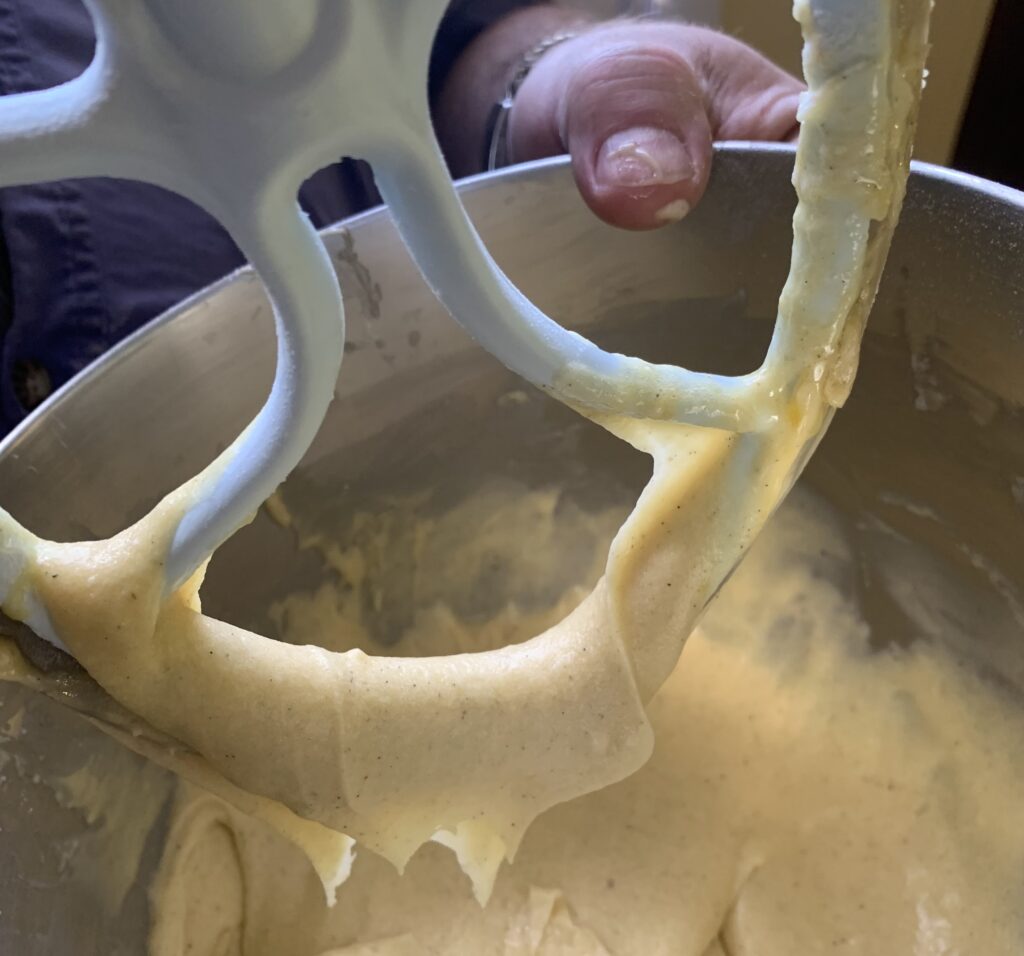
Recipes for the Krumkaker shells. I did a great deal of research for this recipe because it’s so well loved in Scandinavian tradition, and found that the recipes all followed the same basic pattern. First you mix together eggs and sugar until the sugar dissolves; then you add in melted (and cooled) butter; then you stir in some flour mixed with starch (potato, corn, etc.); and then you thin the batter as needed to get to a consistency somewhere between an extra-thick cream and an extra-light pancake batter. The recipes only differ in their proportion of eggs, sugar, butter, and shortened flour, and those group loosely into three basic categories:
- Recipes made 1-2 eggs, standard flour, and a lot of whole milk, half and half, or cream.
- Libby’s recipe, which uses 3 eggs, shortens the flour with a lot of starch (1 cup and ½ cup respectively), has a small amount of sugar (½ cup), and then thins the result with water.
- The recipe that came with our machine (the most common by far), which starts with 4 eggs, flour with just a little bit of starch (1½ cups and 2 tbsp.), a full cup of sugar, and then thins the already looser result with your choice of water, milk, etc.
We tested all three. The first one disappointed. It came out as a nice, thick batter but cooked up a little tough. In the ideal world I would have gone back to test this again later on, because it probably suffered from both our lack of technique and my insistence on trying to a pizzelle iron. I never did, however, because the egg-heavy recipes ended up working so well. Thus I won’t call this approach a “failure,” just an alternative that got abandoned early on.
Libby’s 3-egg recipe worked, but had two issues I felt compelled to refine. First, it wasn’t quite sweet enough for our admittedly American taste, and second, it kept thickening up into something that could barely be called a batter at all. Adding water would thin it out for 10-20 minutes, and then it would thicken up yet again. Fixable issues, beyond any doubt, but first I wanted to try the 4-egg recipe since it promised to be both thinner and sweeter.
This one worked quite well. Yes, it was a little on the sweet side. And yes, it still needed some extra liquid. But it wasn’t over the top sweet, and it needed less liquid than Libby’s. A compromise between the 3- and 4-egg approaches looked like an obvious way to go. Or would have if my itch to experiment hadn’t intervened.
COOKIE NERD MOMENT
The Unwise Diversion
I know from general baking principles that egg yolks tend to add structure and cakiness to baked goods, while egg whites make things a little drier and crispier. Whipping the eggs/whites also makes things lighter and crispier. And weren’t “light” and “crispy” the very targets we were after? So logic said the path toward an Ultimate Krumkake might actually lie in separating the eggs and playing around with longer mixing times, rather than fussing with the ingredients alone. “Most innnterestink…” says he in a cartoon Dr. Freud voice.
But here’s the thing. Our work isn’t really about finding the Ultimate Version. We’re after the Best Traditional Version that can be made with standard U.S. ingredients and materials. All of which forbade something as radical as separating eggs… unless I could dig up traditional versions that followed the same logic.
Eyes aglow I went back to my research, and found [crickets]. The deeper I looked, the clearer it became. Krumkake is an ancient treat that Grandma’s grandmother made by whisking whole eggs and sugar with a fork until the sugar dissolved, adding shortened flour, and then thinning with liquid. That evolved over time to make use of better tools, but only because they achieve the same result a little quicker. Chefy variations and techniques? Not a one to be found.
The batter part came together quickly after that. I added some extra starch for tenderness, cut back on the sugar by a few tablespoons, et voila. This was the recipe that went out for an initial public test, and yielded all those rave reviews. Could I make it even better? What if I…
Sometimes it’s good to have a wife. (Okay, okay: most times.) Kate looked at me and said, “Perfection is overrated. These aren’t just ‘good enough,’ they are good enough that I want to call over company just to show them off, and get them out of the house where I won’t be tempted any more. Leave well enough alone.” So be it.
The recipe down below still tends to thicken up over time, but only by a little, and isn’t that just as true of pancake and crepe batters? It’s the nature of the beast. Consider it a trick of the trade.
Finding the ideal Krumkake filling.
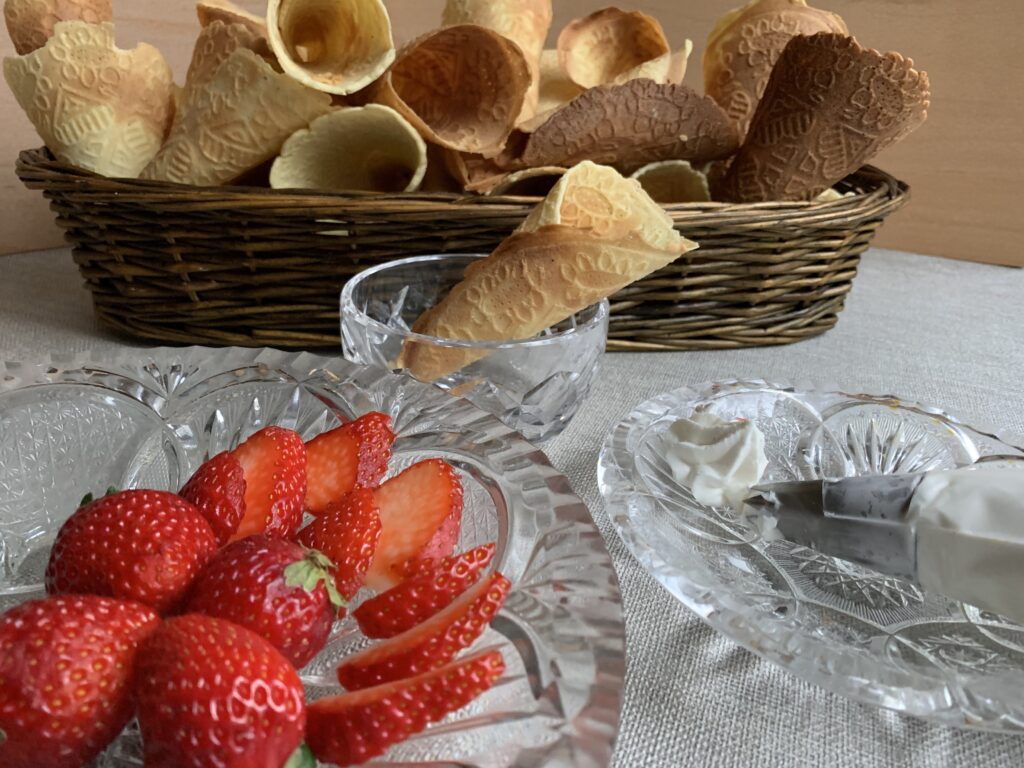
There is no such thing. End of story.
The simplest, most basic filling is berries or preserves served with whipped cream. Lingonberries or cloudberries if you’re in Scandinavia; and something like fresh strawberries here in the U.S. But that is just the starting point.
Novel fillings are a significant part of the Krumkake tradition. Ice cream? Yes, and I can personally attest to how well they go with a little Häagen-Dazs coffee. Custards and thickened creams? Yes. Berries or jam alone? Yes. Other fruit, be it cooked, raw, preserved, fresh, northern, or tropical? All of the above. Pudding, mousse, caramel drizzles, chocolate dips, meringues, etc. ad infinitum? Ditto.
If tradition limits the shell to a basic approach, that same tradition says that only a baker who lacks inspiration (or has demanding family members) would trot out the same kind of filling every time. Krumkake must be filled with something. That’s a fact. But “something” is about as specific as it gets.
Just keep the fragility factor in mind as you ponder what to use. Super thin, crispy-but-tender shells are going to shatter in your hands somewhere between bites one and two. There’s no way around it. When (not if) that happens, there’s nothing to do but laugh, catch the crumbs, and then lick your fingers. We can’t recommend the use of any filling where that would present a problem. After that, anything goes.
FORMING KRUMKAKE CONES
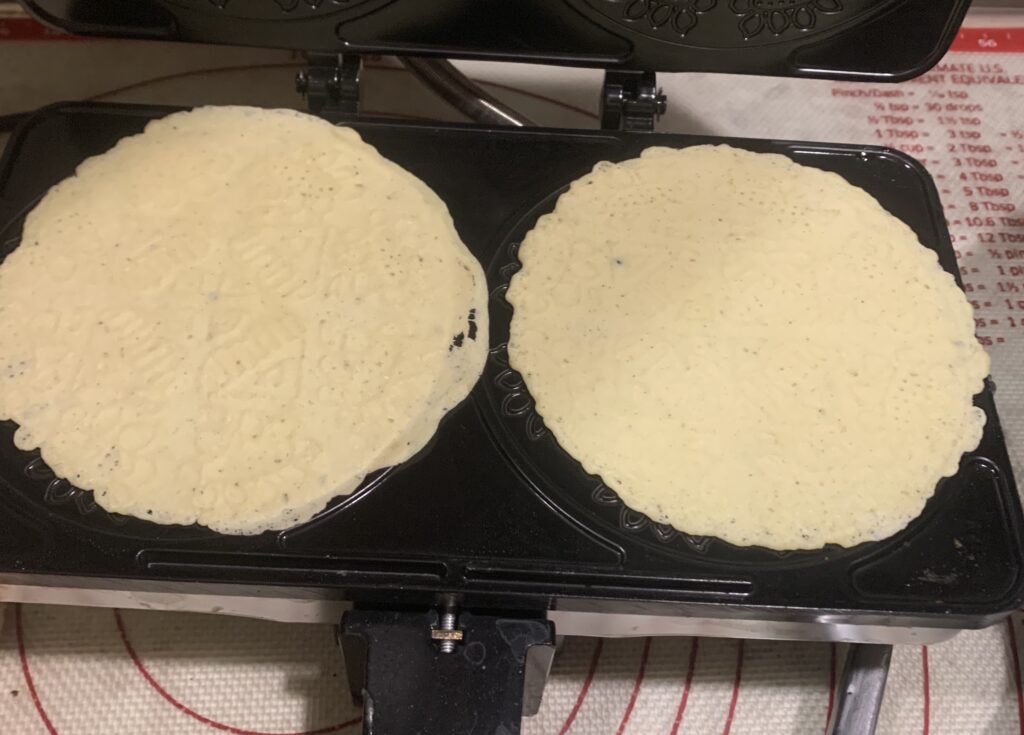
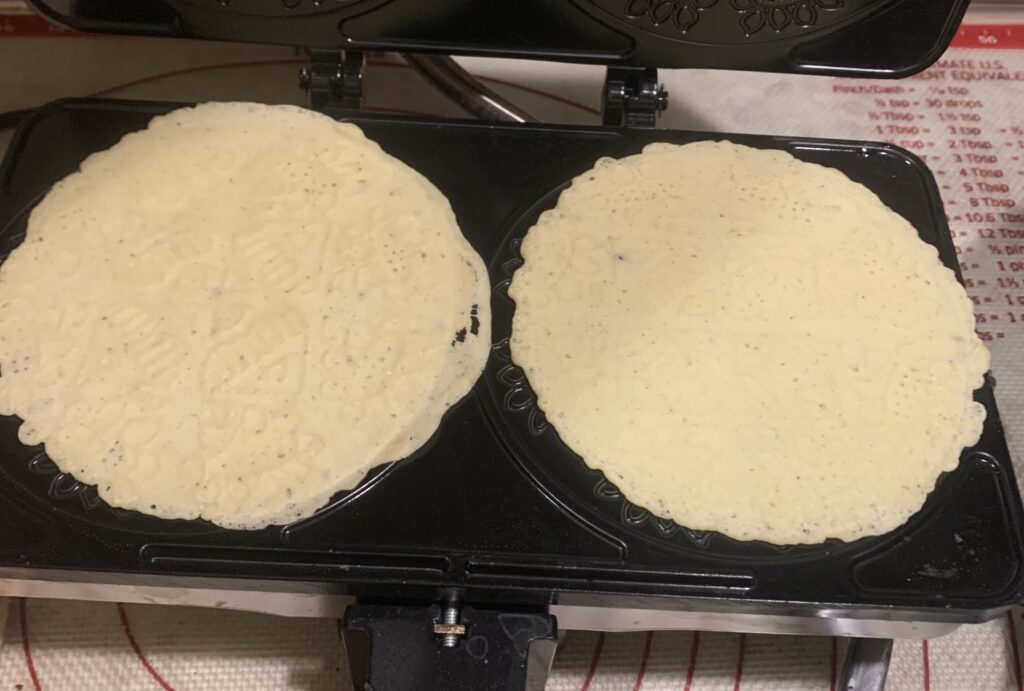
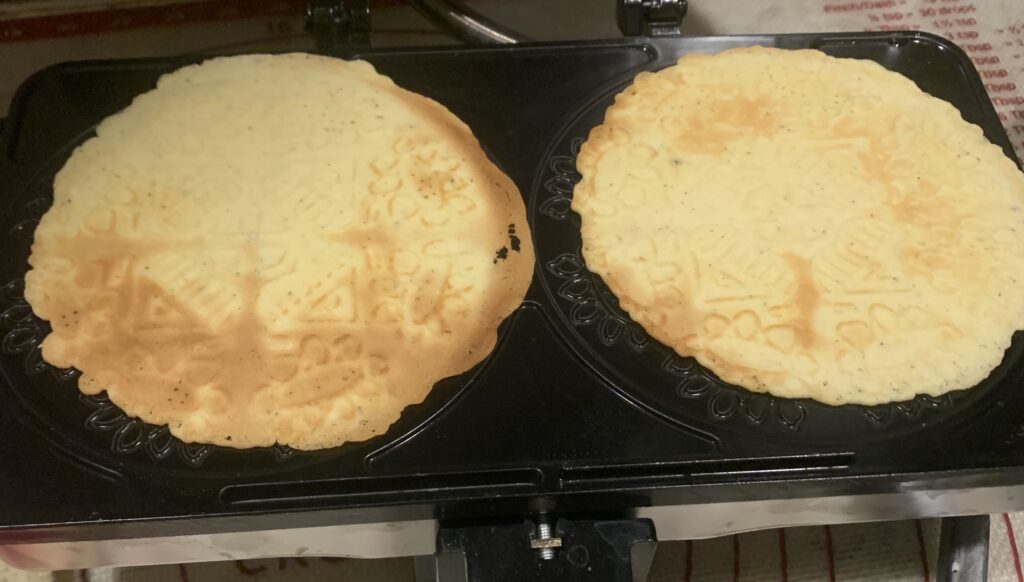

I don’t know what to tell you. The only advice I can give is both obvious and doesn’t offer a whole lot of help.
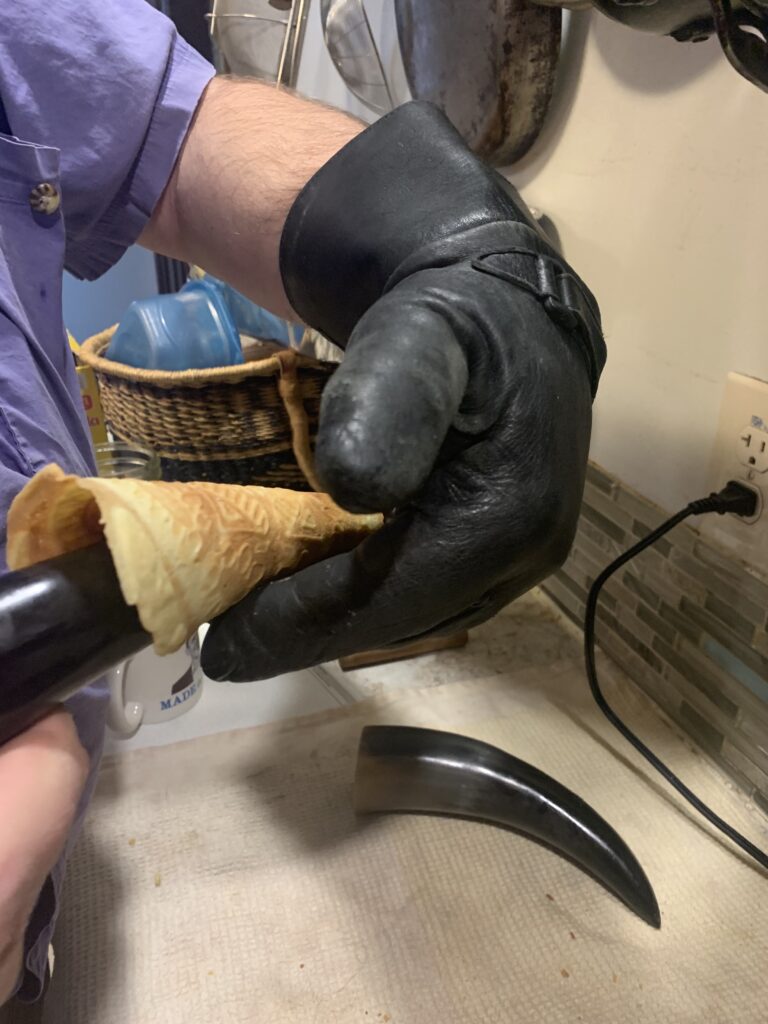
- Thy Fingers Shalt Get Singed. The wafers can only be shaped when they’re piping hot, which makes the ouchies are unavoidable.
- Wearing a glove will help. Same with rolling on a clean towel, which can double as a pseudo-glove for handling. But it’s going to happen. Just remember that you’re doing it for love, and be creative with how you curse.
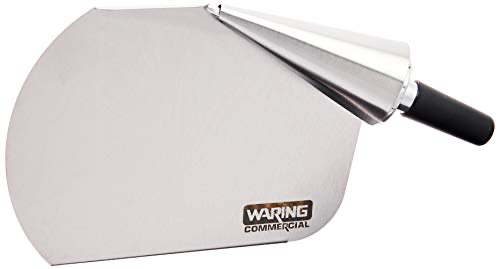
- A good, solid cone mold makes everything easier. Those tools exist for a reason, and they work. There is a tool good enough to solve all problems (pictured below), but at that point you’re talking about something used for industrial production.
- Kate likes to keep a bowl of cold water standing by to cool her fingertips. (NOTE FROM SCOTT: Being a big, tough, manly man I obviously scorn such sensible comforts). [NOTE FROM KATE: And use a manly biker glove instead].
- But the bottom line is simple: nothing will ever replace experience. Experience makes you quicker and more efficient, and turns the race against ouchies into a private challenge rather than a looming threat. Nothing replaces experience.
All of which explains why war stories are so big a part of the Krumkake experience, both for the rueful memories and the times you cut loose with some [ahem] appropriate words, not realizing who was standing right behind you.
NOTE FROM KATE: We had a lot of fun with this recipe, and it’s easier than it sounds. In this, it reminds me of macarons: You end up learning a new technique, and you will make some misshapen, too-light, or too-dark pieces. But they will still taste pretty good, and by the end of your first batch, you’ll find you are making very respectable cones.
We engaged in all kinds of foolishness before Scott ordered that wooden cone shape. We tried a cardboard roll shaped into a horn and covered in aluminum foils (an epic fail – you really need to press on the ‘seam’ where the edges of your cone meet.) We tried bovine horns, carved and uncarved (a remnant of an old hobby – I don’t carve anymore.) That sparked a promise of how good it could be, if we only had a straight horn. Like, y’know, one made of wood for the purpose. The gloves were a massive overkill. You don’t need to touch the hot wafer except for that one edge, and you can do it through a clean tea towel. [SCOTT RESPECTFULLY DISAGREES. There is no such thing as overkill when it comes to tools. If you’re going to make a thing, why not make it from stainless steel?]
Filling the horns is a lot of fun. You will eventually want to start making your cream (or cream-based fillings) ahead to keep in the fridge. The spray cans are fun but inelegant. The higher end approach is to stabilize your cream with gelatin and powdered sugar. Here’s what I did, and it worked like a charm:
- 1 cup of cream
- 1 tsp. powdered gelatin
- 2-4 tbsp. hot water
- 1-4 tbsp powdered sugar.
- Bloom the gelatin in hot water, let it cool, and then add it into half-whipped cream. Finish whipping until you get soft peaks.
We served this in disposable pastry bags, with jam and pre-sliced berries on the side. [Sigh] It was wonderful. Several berries, in fact, so people could create their own combinations. Every one was delicious, and our guests enjoyed competing for whose would be best. Oh yes – remember to serve with extra napkins on the side. Trust me on this.
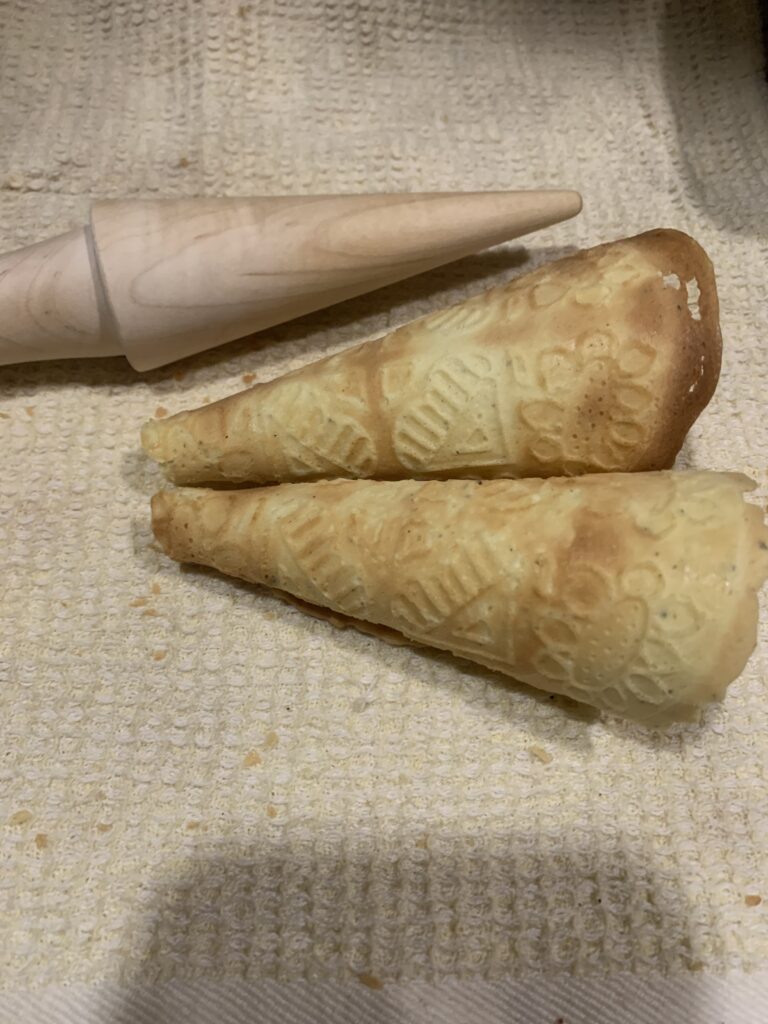
Or you can get really traditional…
CONCLUSION
Enough with the ouchies! War stories, remember? They’re a part of the fun. But the best part of all is this:
Krumkake are so good, and so much fun, that they are going on our short list for favorite desserts to make whenever guests come by. Not just for the holidays either, but all year round. The whole experience adds up to a solid “10.” Your guests and loved ones even get to play with their food! What could be better than that?