Confession: I love crossword puzzles, and I’ve done enough to learn certain words that writers can’t seem to do without. Here are some examples of recent clues I’ve seen:
- Clue: “Treat that is often twisted”
- Clue: “Crispy, pull apart snack”
- Clue: “Cookie eaten from the inside out”
Oreos! Duh. Everyone knows that, right? Yes… if you’re from the U.S.A. People who grew up in Ukraine, Russia, Poland, or other countries of central and eastern Europe might well stare at a clue like that with nothing but bewilderment that “Oreshki” doesn’t fit in the grid. What else could the writer possibly be thinking about?
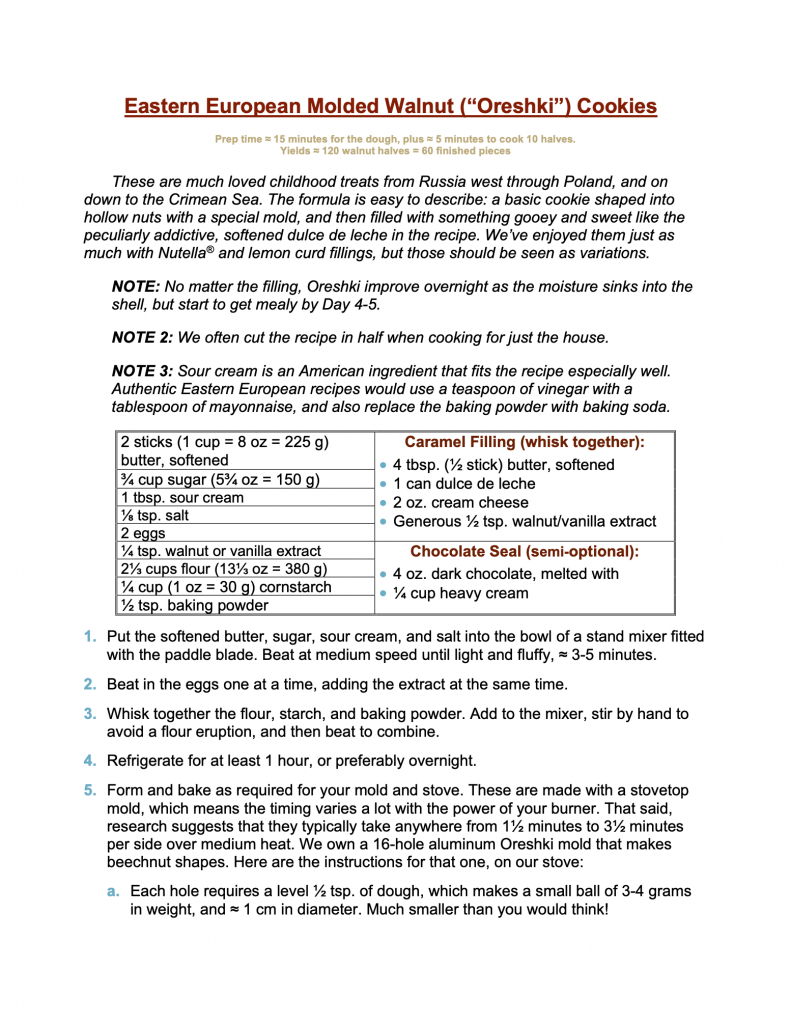
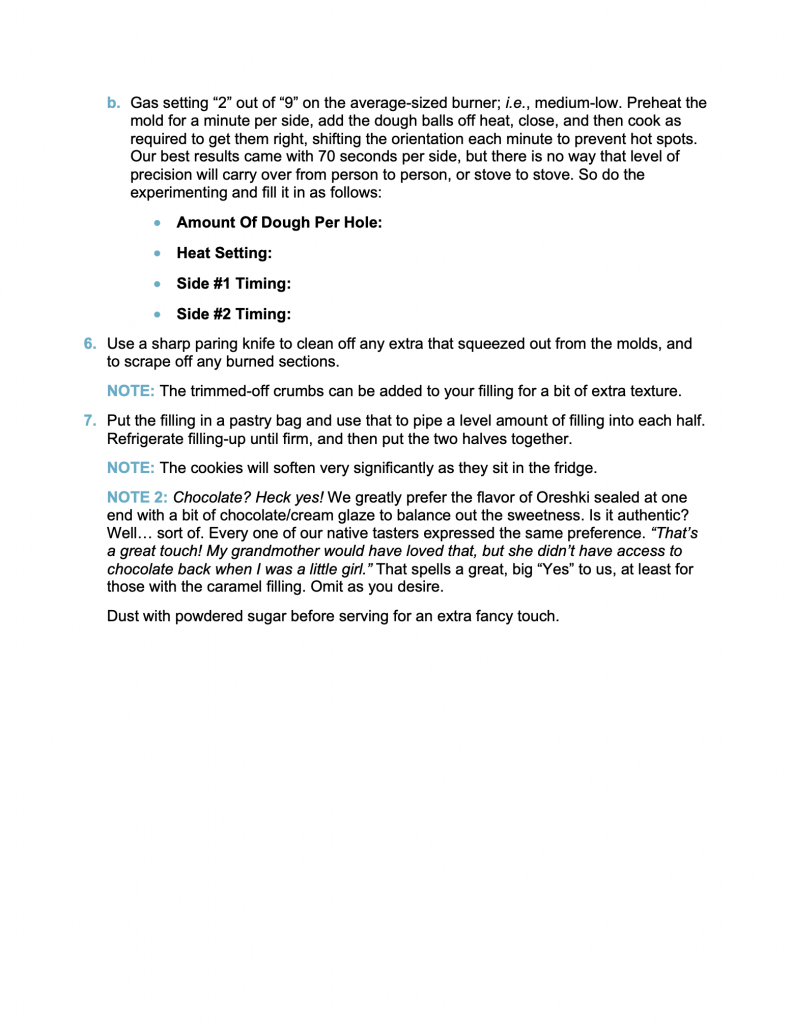
As always, skip to the bottom if you only want to read the recipe. And what the heck. This link will take you to the Dulce de Leche recipe in the middle.
Oreshki are a classic treat that are known and loved from Russia to the east, through Poland and the Czech Republic to the west, all the way down to the Crimean Sea. The formula is easy to describe: start with a very basic cookie dough, shape it into hollow nuts, and then fill the nuts with something gooey that children will love. Subtle? Bah. Sophisticated? Hah! Adult with a capital “A” like spice cookies or ginger snaps? Not in the slightest.
Nice, sweet, and simple. That’s your ticket. This is the cookie of childhood.
Working On The Cookie
If you’re here doing research, let me give you a tip as someone who’s actually read through and pondered several dozen online recipes. Don’t overthink it!
Your problem is easy to state: natives adore their Oreshki to the point that innumerable Eastern European families have now shared their “secret” methods to get them just, exactly right. There’s a lot to go through. The wonders of online translators, combined with a wife who can translate what those will not, allowed me to put together a humongous file of different trips, tips, options, and formulae. It was a true brain buster! But do you know what I found when I averaged things out, and then compared the results to other cookies?
Your target crust is a plain, light, crispy wafer that won’t fight with the filling. Period. Keep that in sight and you won’t have any problems.
Yes, you will be a little confused by how some of the common ingredients get used. I certainly was. But there is a pattern to the strangeness: those “touches” all add up to (i) a hint of acid, and (ii) a bit of “other” fat to supplement the butter. I don’t know why they do it. The amounts are so small that it’s hard to see how these additions could change the result. Nevertheless, it is a clear pattern, our work is about “heritage” just as much as “right,” and so I made a point of testing the variations.
The most common version marries a touch (½-1 tsp.) of vinegar with a tablespoon of mayonnaise, and then uses baking soda instead of powder. I ended up going with 1 tbsp. of sour cream paired with baking powder. Feel free to pursue either route as you wish. The differences will be subtle at best because you aren’t really supposed to notice the crust in the first place. It’s the filling that make Oreshki special.
These crusts get cooked in a special stovetop mold (electric versions being available in some countries). Here is ours, which is made from aluminum and available for a very low price from various sources:
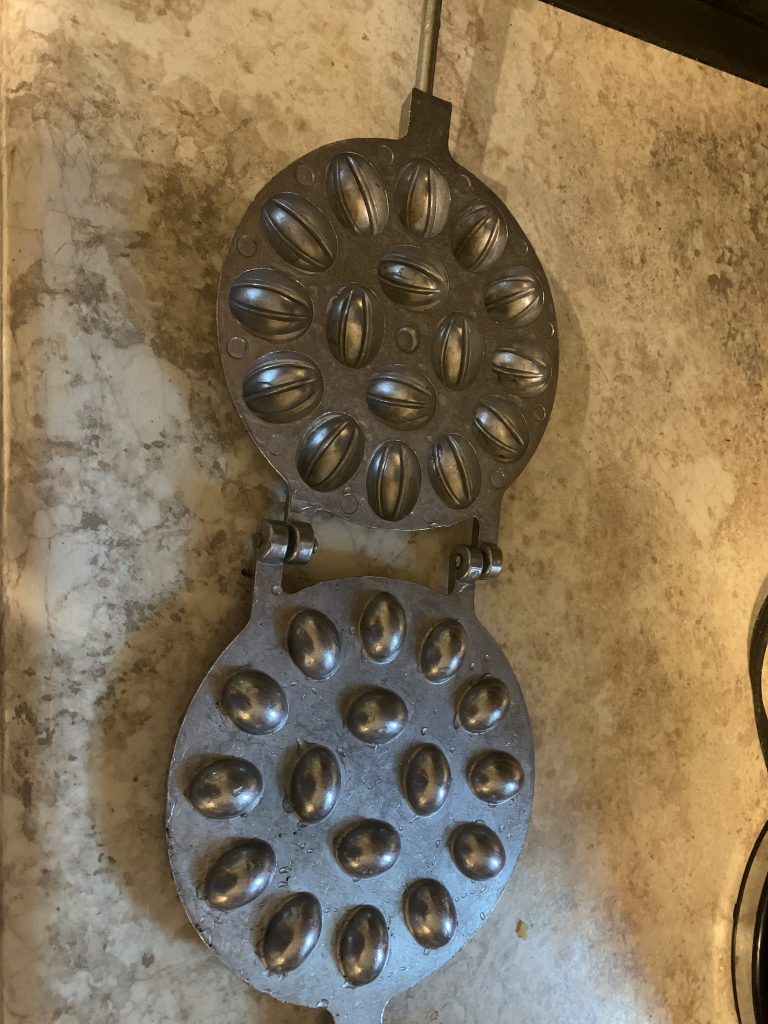
You’ll need to fidget a bit to get the timing right. We ended up at 65-70 seconds per side on our average-sized burner with the gas set to a “2” out of “9.” Don’t expect that to match up with your burner! We also noted that molds filled with fewer cookies toasted faster than ones which were completely full.
Make an effort to keep the inside cookie-tan, like a shortbread, rather than nut brown. That was the one critique we got from our taste testers, and when I went back to do the final batch with that correction all of us noted that the new and lighter-colored cookies were also a bit airier and crisper when eaten.
Finally, you’ll need to trim the shells when they come out of the mold. It’s impossible to get the sizes right every time! A sharp paring knife is the perfect tool. Just don’t throw those trimmings in the trash! Most people simply add them into the filling for a bit of texture. We prefer to recycle them into crumbs for a leftovers-cookie or pie crust (think of how many recipes you know that begin with the instruction, “Grind up some vanilla wafers and then use the crumbs for…”). Do as you will, but please don’t waste what ought to be used.


Nailing Down The Filling
The all time classic Oreshki filing is a peculiarly addictive caramel made from dulce de leche. More on that below. But honestly, anything that’s sweet, sticky, and a little bit runny will do. Nutella® works like a charm. So does lemon curd. It’s hard to go wrong, and none of my native taste testers had anything bad to say about those variations. Playing with your filling is fair game. But there’s that ‘heritage’ thing again, so we really ought to discuss the original version that left so many millions of 8 year old addicts in its wake.
Let’s start with an overview. You’ve seen this flavor profile before! When push comes to shove, this is just another plain shortbread being paired with rich, gooey caramel. In South America that takes the form of Alfajores. In the U.S. it’s a Twix® bar. In the U.K. it’s Millionaire’s Shortbread. Western Europe has it’s Stroopwafel. Got it? There’s nothing complicated about it. We’re only going to tweak things a little to match the Eastern European palate.
You can start from a true caramel if you wish, but native recipes follow the South American approach by starting with tins of sweetened condensed milk, and then boiling them for a few hours.
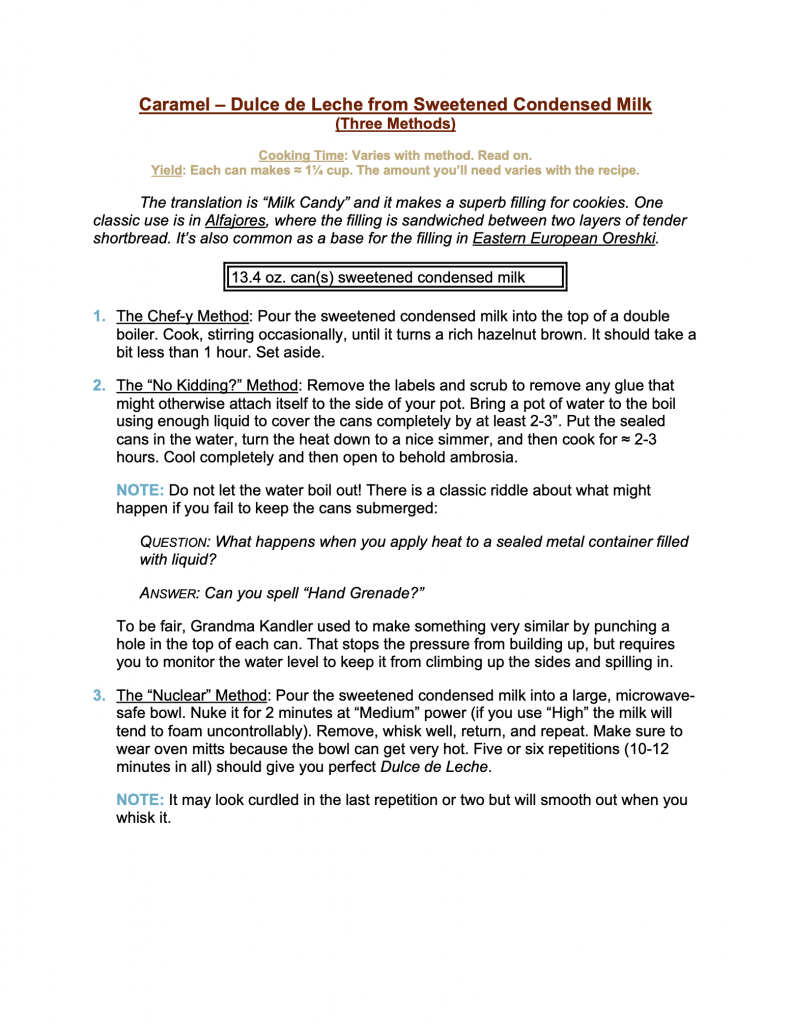
After that it’s easy. Soften this up with a bit of butter, add some cream cheese for a mild sour tang, and you’re done. Most recipes suggest the addition of crumbs from the crust-trimmings, and some will also add ground nuts, but those are both optional steps. It really comes down to whether you’re after pure, luscious smoothness on the inside, or luscious smoothness offset by a little bit of crunch.
How To Fill Your Oreshki
It took a few tries, but I’ve now got the system down pat.
- Take one shell. Top it off completely with your filling. Use a second shell to scrape that level. Set aside for the moment.
- Add filling to the second shell, and scrape that level with a third shell.
- Put shell half #1 on top of shell half #2, and then repeat the process until all your shells are done.
- NOTE 1: It’s not a bad idea to overfill a bit, and then squeeze the halves together so the excess filling will squish out the sides. Wipe it off with a finger, and then set aside your perfectly filled nuts for further decoration as desired. [What do you do with your filling-dirtied finger? Come on. Really? Being the baker has its upside!]
- NOTE 2: Oreshki with a runnier filling may want to go in the fridge to set up.
The only question left is, “to seal or not to seal.” These shortbread-and-caramel treats often come with a chocolate coating. Think of the aforementioned Twix® bars and Millionaire’s Shortbread. Heck, it’s common to coat Alfajores too in recipes that don’t add coconut. So it makes perfect sense to seal those two halves together with a bit of chocolate, right?
The answer is both yes and no. We liked the caramel ones better with a chocolate seal. No doubt about it. And every one of our native tasters expressed the same preference. “That’s a great touch!”
But then they’d add something like this: “My grandmother never did that. Of course, she didn’t have much access to chocolate back when I was a little girl.”
Again, it’s entirely up to you. A simple dusting with powdered sugar works just as well for chocolate-free versions, and better for those with an alternative filling.

Conclusion
This is a really fun cookie so long as you don’t try to fight its basic core. Oreshki are designed for children, and adults who loved them as children. Sharing them with those children, old and young, is why American bakers will want to make them.
That said, you really, really do want to make them. I can pretty much guarantee a downright special reaction from the actual children in your life, and an even stronger one from adults who grew up in the Oreshki Zone. It’s like dropping a puppy in the lap of their inner child.
First comes the delighted grin. Then the delighted cry, “Oreshki!” Then some insight into a delighted childhood soul. Everyone who eats Oreshki has his/her own special technique. Some pop them in whole and crunch. Others twist them in half, and then crunch. There’s a twist-and-stretch school too; twist, scrape, and crunch; twist, stretch, and lick in midair… You get the idea. Pure, childish glee.
Think that’s going too far? Head on back to the beginning of this article, and the analogy to Oreos®. Imagine your typical American expat who has moved overseas and built a life somewhere that knows nothing about their childhood treats. Get him or her in a friendly environment, like visiting your home or receiving a tin as a gift. Now open it up and reveal a crispy, black-and-white, twist-apart cookie. What will happen? The exact same thing.
That memory is what Oreshki are really about. That, and creating a similar memory for future generations. It will work, I promise. There’s nothing that Littles enjoy more than something gooey, sweet, and crunchy that looks like something it isn’t. Oreshki are flat out fun at every level.
Enjoy!