
First things first. This is a delightful cookie, and is much easier to make than you might think from Scott’s tale of woe toward the end.
The dough is super simple: throw it all together and knead until smooth. The filling is just as simple: mix the dry ingredients and then fold in whipped egg whites. Then you wrap “A” around “B”, seal, and bake. It’s nothing more than a classic, fine grained macaroon with special flavors that is wrapped inside an easy crust.
The challenges only exist for people (like us) who’ve never learned how to seal a filled dumpling like pierogies or one of the Italian pastas. If you have that trick down, you’re golden. Easy peasy. If not, blame the difficulties on your (our) lack of skill at issue, not the recipe. We have no more right to complaint someone with no knife skills can object to instructions like, “dice the onions.”
As always, skip to the bottom if all you want is the recipe. Most of this post is about the legend, history, influences, and cultural importance behind this cookie – the “heritage” part that we find so interesting. That will require some time. No need to slog through the story if that isn’t your thing.
PART I: WHAT’S SO SPECIAL ABOUT THE STORY?
First we need to set the scene. Croatia is a small country in the Balkans with an enormous coastline on the eastern side of the Adriatic Sea (that’s the one between the Italian and Greek peninsulas). This coastline has a natural beauty to rival anywhere on earth. Those legendarily lovely Greek islands and coasts you see in glamour shots? Same geography and part of the world.
The region of Dalmatia (from whence the dogs are named) nestles into the most scenic part of that beautiful coastline. There are no bad spots, but the most beautiful of them all may be around the untouched medieval town called Trogir (a Unesco world heritage site since 1997), which lies just above the legendary Isle of Vis; a place so lovely that they moved some of the Mamma Mia II filming there for extra flavor.
Adjectives fail.
Vis and Trogir are ground central for the most famous of all Croatian desserts: a sweet, filled cookie called “Rafioli”. Every village and grandma in the country claims its or her own special variation, of course, and serves it for every baptism, wedding and holiday feast in the year. We found a good dozen translatable recipes on the Internet with names starting from the largest region (“Croatian”), and working on down through Dalmatian (“Dalmatinski”), Trogir (“Trogirski”), and a few others.
Fortunately enough, the devil lies in the details. The basics are always the same. Rafioli start with a lot of eggs. Our recipe uses half a dozen. You then (A) make a sweet pasta dough with the yolks, (B) make a sweet filling by combining the whites with finely ground nuts and various floral notes, and then (C) wrap A around B and bake. The result is a perfect compromise between Italian desserts and the more rose- and flower-water notes of the Ottoman Empire. But more on that later. First we have to finish the story.
Life in Trogir has been repeatedly shattered over the millennia by invasion and war from every direction. It started with the ancient kingdom of Dalmatia. That fell to Rome in a famously bloody conquest. Rome lasted a while, but then split in two with this region right on the dividing line. It ended up going with the eastern half under the sway of Constantinople, but only after some more fighting. The Saracens came through and left the town ashes during the 1100’s, which led to 300 years of semi-life comparable to an old jalopy that backfires every few miles. This went on until 1420, when the Renaissance city state of Venice absorbed the town as part of its trading empire.
That golden age, such as it was, lasted until the Hapsburgs (Austria) took over Venice itself in 1797. It gets no better after that, but we don’t need to continue. Rafioli were born in that 400-year period of Venetian rule.
Now you may think the name is nothing more than a bastardization of “ravioli”, a word that derives naturally enough from the Italian verb “to wrap.” It’s a natural enough assumption, but don’t say that in Croatia unless you want to start a fight! They insist that the name actually derives from a maiden called Rafiola, the Croatian equivalent to the French, Spanish and Italian names Rafaela, Rafiela, and equivalents with different spellings like a “ph” for the “f”, and/or multiple L’s. Think “a feminine version of the famous Renaissance artist’s name.”
What’s the true answer? I’ve spent more time thinking about it than anyone should, and my guess would be that the cookie name is and always was a pun designed to include both of the competing word origins. It only matters for us because the lady comes with a legend! It goes like this.
Once there was a beautiful young maid who got herself locked in the famous tower of Trogir Castle, which rises above the sea up to the present day. There she waited, like the maiden Rapunzel (named after an herb if you want more puns), for her lover to come to her rescue. But Rafiola did not sit idle, braiding her magical hair! No, she was much more productive. She studied the arts of nigh-on-magical baking, so she’d be ready to delight the young lord who’d come to her rescue.
To make a long story short, he eventually found her, she continued her baking, and they lived happily ever after. The end. Or rather the beginning, for the great creation that took on her name: Rafioli (the plural of Rafiola). Talk about “heritage”! It doesn’t get any better than that.
Your Honors, please accept our nomination for Valentine’s Cookie of the Year: Croatian a/k/a Dalmatian a/k/a Trogirski Rafioli.
PART II: WHAT’S SO SPECIAL ABOUT THE COOKIE?
We wrote a gigantic doorstop of a cookie book with more than 250 recipes, most of which came from Europe and few of which are just variations on a classic theme. It wasn’t just 80 Versions Of A Drop Cookie With Different Ingredients. That’s a fact that makes us very proud. Instead it covered every different type and approach to cookies that we could find. This recipe has no real parallel in any of the ones we studied before.
The cookies in this blog will eventually yield Volume II if we can ever get enough of them tested. So far a lot of those new recipes have come from looking deeper into baking traditions across the Mediterranean. Corsica gave us Canistrelli. Sardinia, Pappassani. The areas around Florence yielded Ricciarelli and Cavallucci. Ancient medieval trade routes broadened our repertoire of macaroons. The Middle East is yielding secrets such as Persian Nan-e Berenji, Egyptian Ghorayebah, Israeli Tahini Cookies, and others. Etc.
This cookie is almost unique in that context too. The only analogy we’ve come up with – and it is a loose one – is this: Rafioli are something like an East-Meets-West marriage of the most refined Italian coffee house sweets with Maamoul, the ubiquitous, rosewater scented, filled cookie that’s across the entire Muslim world. In short, you are reading about a culinary missing link that differs from everything else you’ve ever made, and is marvelous enough to stand with the best of them. That’s what we call special.
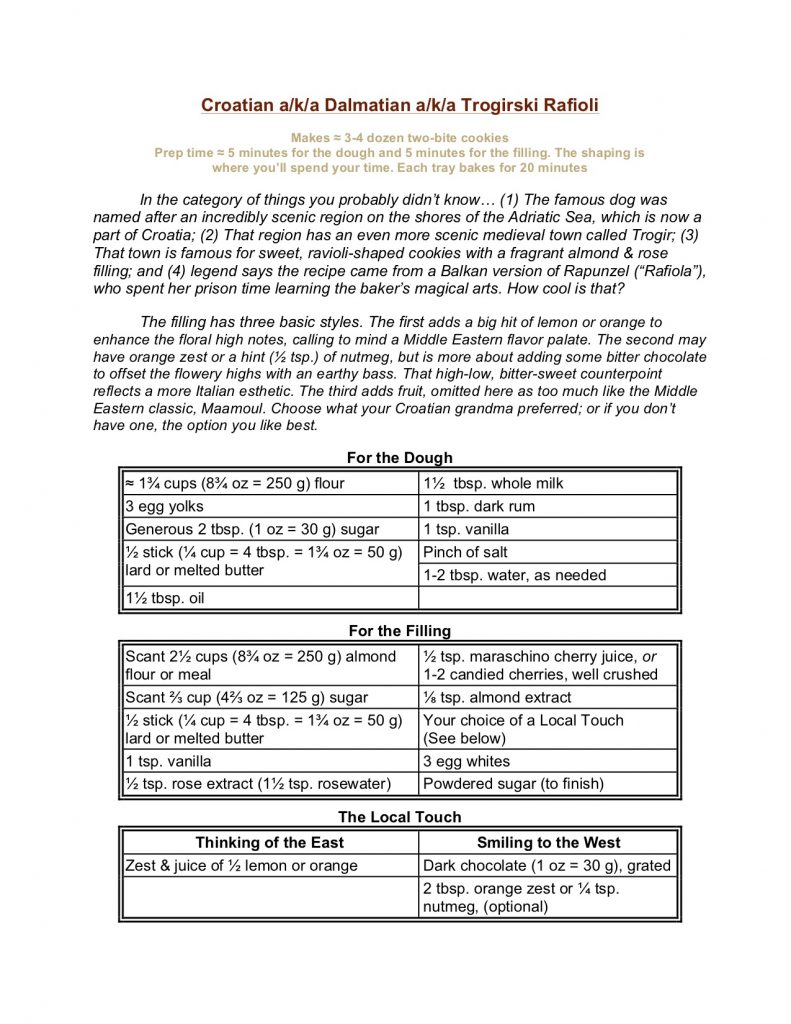
The filling starts with a base of sugar and powdered nuts; usually almonds, but occasionally pine nuts or pistachios. We recommend almond flour. Flavor that base with rosewater, vanilla, maraschino cherry juice/liqueur, and your choice of the Local Touch that suits your taste and mood (see below). That’s about it. Fold in the whipped egg whites and you’re done.
The cherry part is nothing short of brilliant, by the way. It marries amazingly well with the rose, which would be overwhelming on its own. Consider the vanilla (another flower if you think about it) as your chaplain to bind the two together. It’s one of those combinations you’d never imagine on your own, and will never forget once you’ve tried it. We’ve seen versions that add in some cherry jam as well, but did not test them. Let us know if you do. It sounds like that could work.
It’s the Local Touch that divides Croatian bakers into their respective camps. Some recipes (a clear minority) add in raisins, dates, or figs to create a filling almost identical to what you see on the Mediterranean’s eastern shores. We’ve omitted that option on the grounds that Maamoul the Great deserves its own post. No copycats allowed.
The next two variations are where we focused our attention. The clear #1 for genuine Rafioli from Trogir adds a hefty shot of lemon or orange to enhance the floral high notes. That combination has a more of a sunrise eye, calling to mind a Middle Eastern flavor palate. The sunset version may have orange zest, but never the juice because you don’t want the acid. This Local Touch centers on some bitter chocolate that offsets the flowery highs with an earthy bass. That balance of bitter against sweet reflects the Italian side of the Adriatic.
We include both options because only a fool would stick his nose into a fight among Balkan partisans. Choose the one that matches your personal taste. But if you’ll accept some free advice, do not argue with the Croatian grandma who tells you that you’ve got it wrong.
PART III: AND THEN CAME THE CRUST
We have struggled with finding the best solution for these filled Mediterranean cookies. Our book includes a fantastic recipe for Flaky Foldovers, but that is a very north-European recipe that’s more similar to a buttery piecrust or French puff pastry than what you see around the Mediterranean. The Italian crusts for filled cookies like Tortelli tend to add a little bit of egg white into the dough. They taste okay, but the texture is too dry for American palates (even though we’ve been assured by natives that this is normal for Italy). Maamoul, mentioned above, is made with a crust that uses clarified butter a/k/a ghee a/k/a samneh to create a moldable paste more than an actual dough.
What they do in Croatia is totally different. Remember how the filling starts with what’s essentially a flavored almond paste, and then lightens it up with whipped egg whites? Croat bakers add those egg yolks to the cookie’s crust. The result is surprisingly close to an actual pasta dough! We kid you not.
- The recipe below uses 6 egg yolks, 500 g. of flour, 12 tbsp. of oil, and 50 g. of sugar (plus some extra flavors).
- Reduce the flour to 350 g., the oil to 3 tbsp., and strip out the sugar and flavors. You now have a standard, if yolk-heavy, ravioli dough of the sort you’d wrap around meat or cheese.
Rafioli to ravioli in one easy step. Coincidence? Probably not. It’s far more likely to be yet another example of how east meets west in this unique little cookie.
PART IV: FILLING, CHECK. CRUST, CHECK. FILLING… NOT SO MUCH
We said it above, and will say it again down here. Nothing about this cookie was “hard” until it came to getting the filling inside its wrapper of dough. That will no doubt be easy for those of you who grew up making ravioli, tortellini, or pierogies. You have the tools, and you have the knowledge. Knowledge is power.
We came to this project with neither. The instructions are easy enough.
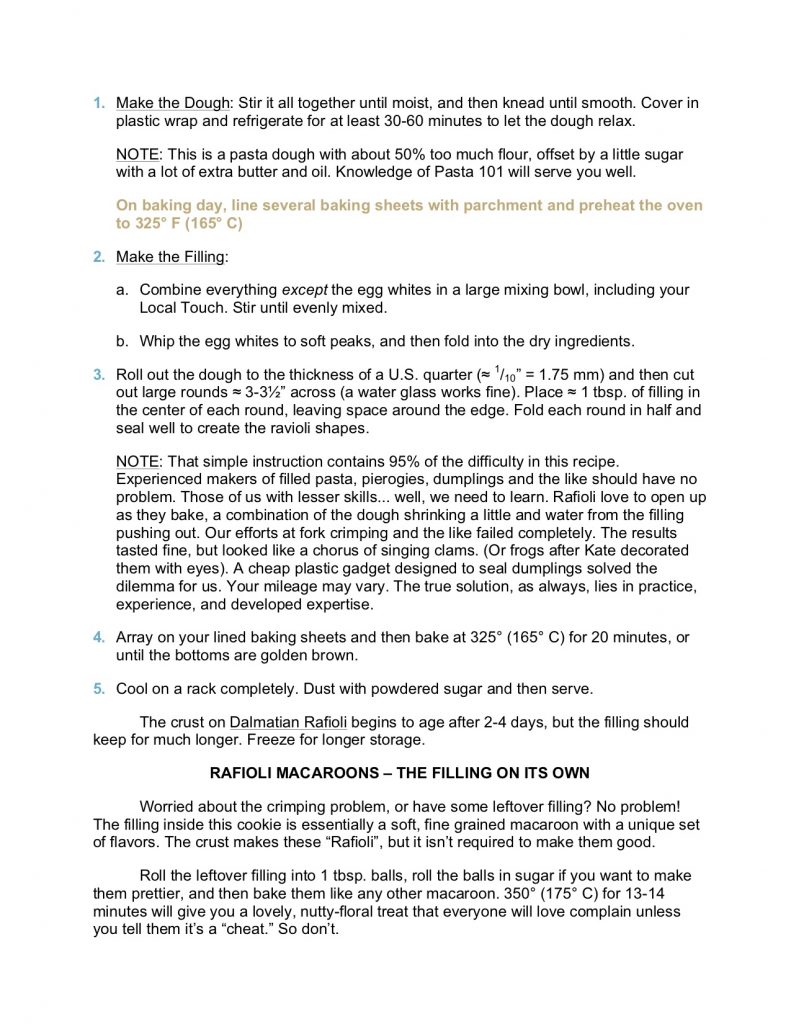
First you want to roll the dough out thin. A pasta machine would make this simple, but we don’t own one. And we weren’t about to invest in yet another device that would occupy already overcrowded shelf space. That left rolling by hand. The dough really, really likes to snap back, but that wasn’t where we ran into the problem. Sealing the edges turned out to be… problematic.
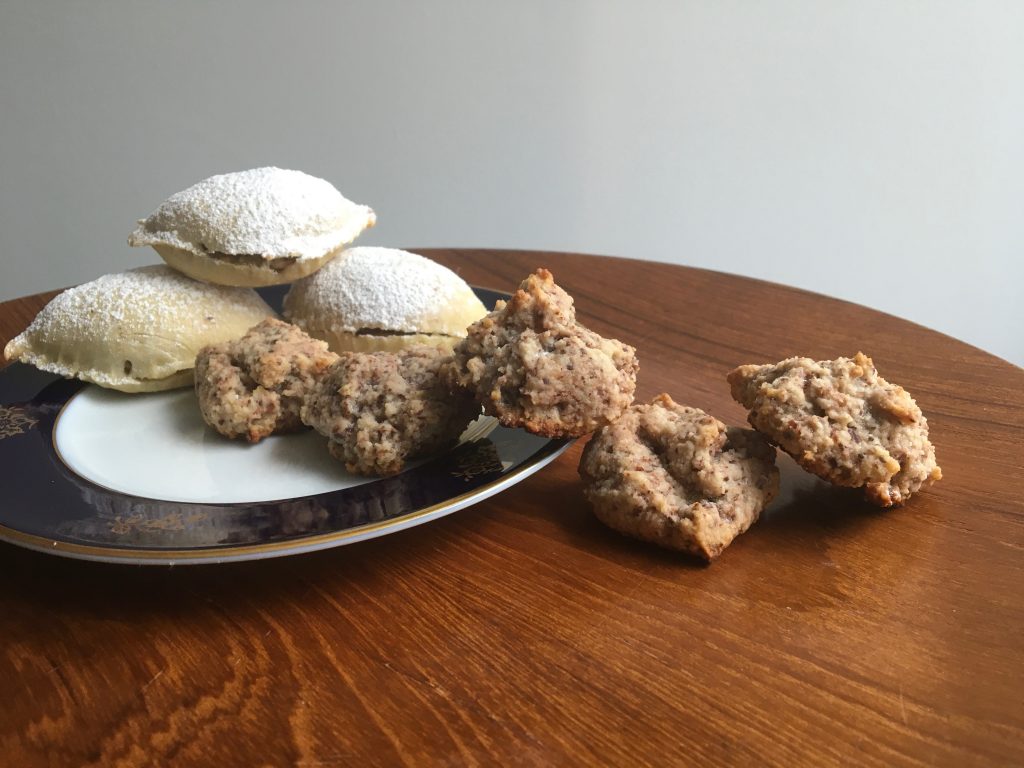
There’s no way to sugar coat it. This was our test batch #1 after Kate got through playing with it:

[Sigh].
EXTRA SPICE FROM KATE: I love my husband dearly, but he is an obsessive perfectionist when it comes to these cookie recipes. We are not a commercial bakery! We are not required to have every cookie come out looking like it belongs inside a window display on the paradise island of Vis! Those cookies were smiling because they tasted just as good as their prim and proper counterparts. Maybe even better. They were not, Not, NOT “failures”! They just had a special character all their own.
My wife is wise. My wife is right. But obsessive perfectionists have our place as well! I was not about to be defeated by something that people with a little extra experience do hundreds of time per day with nary a flaw. The solution, at least for me, lay in two tricks. The first cost exactly $1.29 and looks like this:

That gadget, and learning that you want to roll the dough out to exactly the thickness of a U.S. quarter (1/10” = 1.75 mm), finally got us to this:

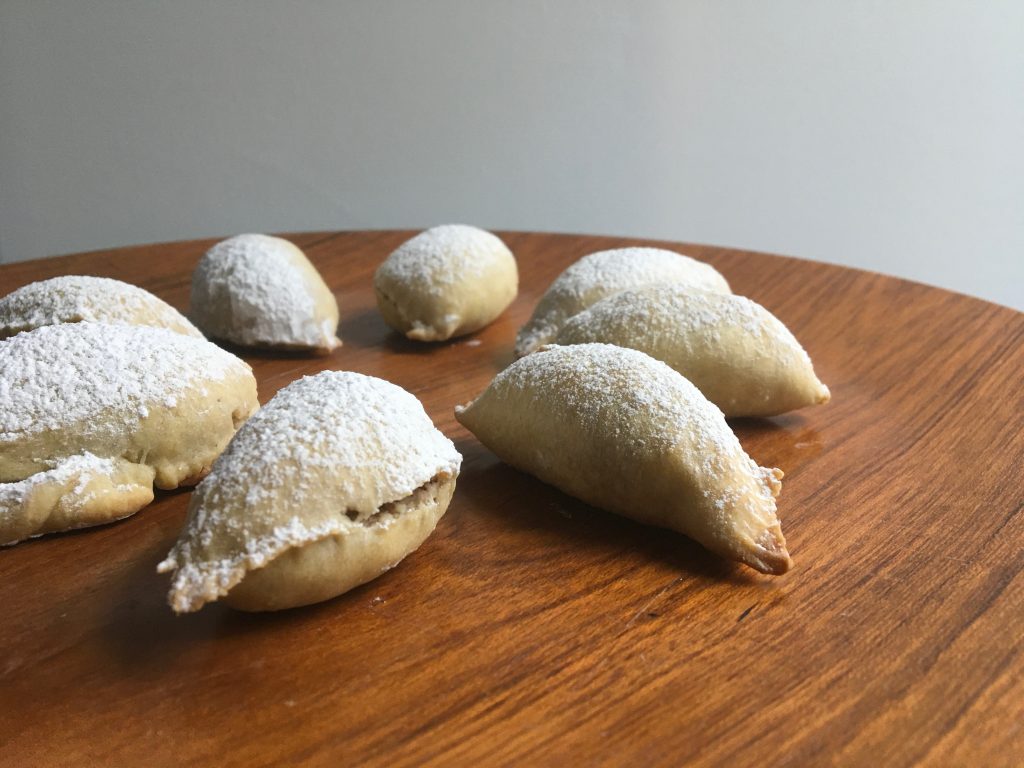
So the moral of the story is clear. The cookies taste just as good if the seals burst open. It’s your home, and anyone who complains will only leave more for you. Right? But $1.29 and a little attention will solve the issue, and prevent your spouse from making jokes about choruses of singing frogs and, god forbid, car lashes.
Don’t ask. You don’t want to know. If that isn’t a line to end on, I don’t know what is. Happy baking to you all!
P.S. Note the end of the recipe. The leftover filling makes absolutely delicious macaroons when cooked on it’s own.