Admission: poppy seeds are not my thing. They don’t offend me or anything, but my world would be no worse if poppy seed desserts simply disappeared. Kate? For Kate that would be a disaster on the same level as a plague to destroy the worldwide apple crop. My beloved wife adores poppy seeds, to the point where that’s one of her favorite bagels. [Shakes head].
NOTE FROM KATE: Poppy seeds! Oh my, they are…well…strangely addictive. I’ve loved them since childhood.
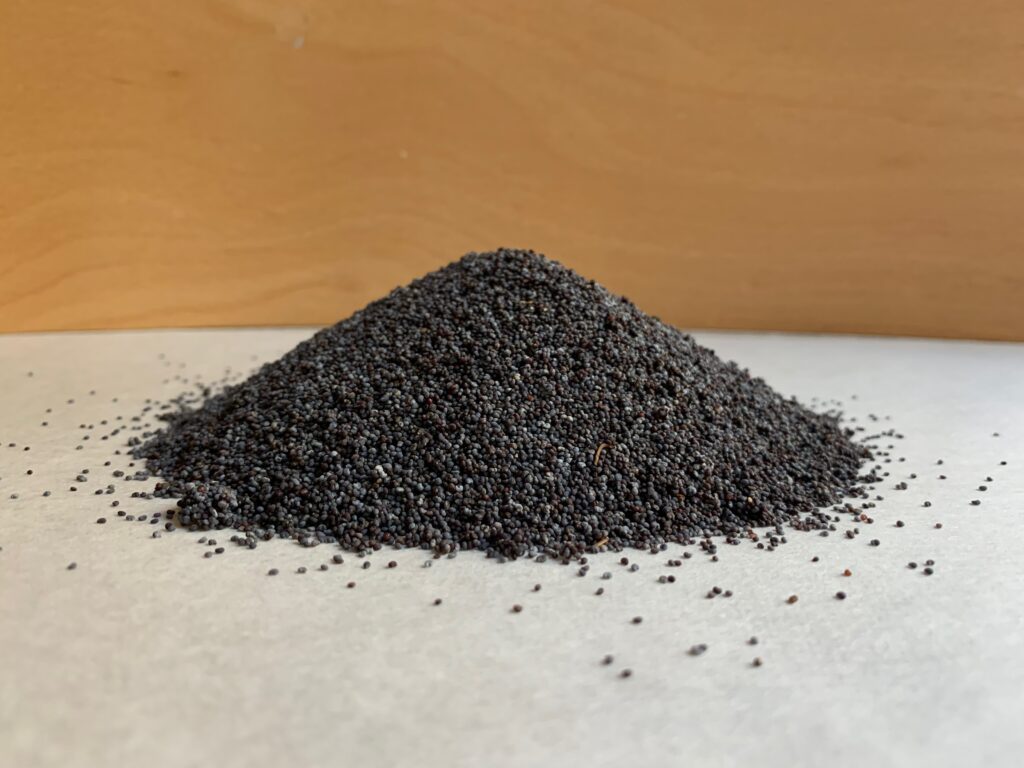
It turns out she’s not alone. Poppy seeds are one of those flavors that some people put at the very top of the food pyramid. My guess would be somewhere between one in five or one in ten based on recent conversations. Calling them “devoted” barely scratches the surface! And you know what? Almost everyone else is like me. We don’t dislike the flavor, it’s just the sort of thing we’re happy to leave to those who care.
Common? Check. Beloved by a lot of people? Check. A significant part of the culture from the Baltic States down through Turkey? Absolutely.
Sounds like the sort of thing we need to discuss.
But here’s the thing: poppy seeds are an ingredient more than a concept. They’re used in almost endless ways. So this article is going to focus sharply on cookies where poppy seeds are the central theme. I count four basic categories, plus a few that fall outside our scope:
- Poppy seed roll-and-cut cookies, like the Queen Esther Cookies down below; and
- Poppy seed drop cookies, like Poppy-Lemon Cookies.
Those are the subject of this article. Then there’s
- Poppy Seed Filling;
- Cookies made with Poppy Seed Filling, like Hamantaschen and Kolachy; and
- Other beloved treats that cannot be called a “cookie”.
Those will get addressed in Part 2 of The Great Poppy Seed Adventure.
As always, skip to the bottom if you’re only after the recipes.
ROLL-AND-CUT-COOKIES

I’m going to ignore the infinite versions that use poppy as an ingredient (Poppy Snaps, Lemon-Poppy Icings, etc.), and get to the meat of the question. What is the best fancy-looking cookie to make for friends and family who are [ahem] addicted to the flavor of poppy seeds?
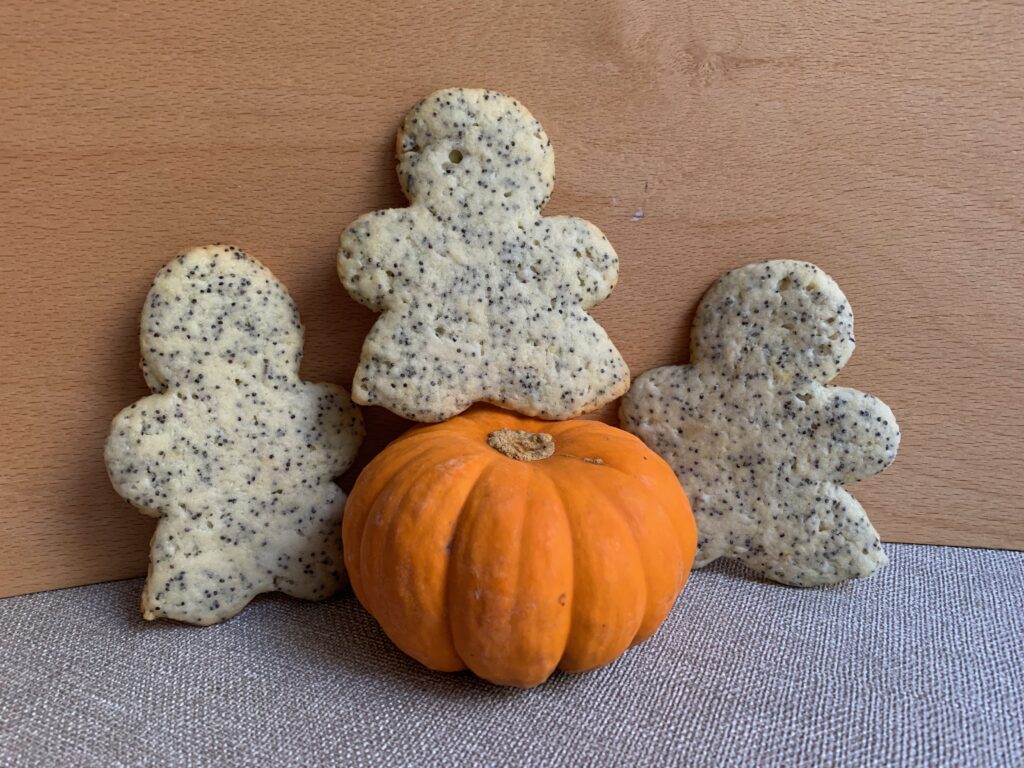
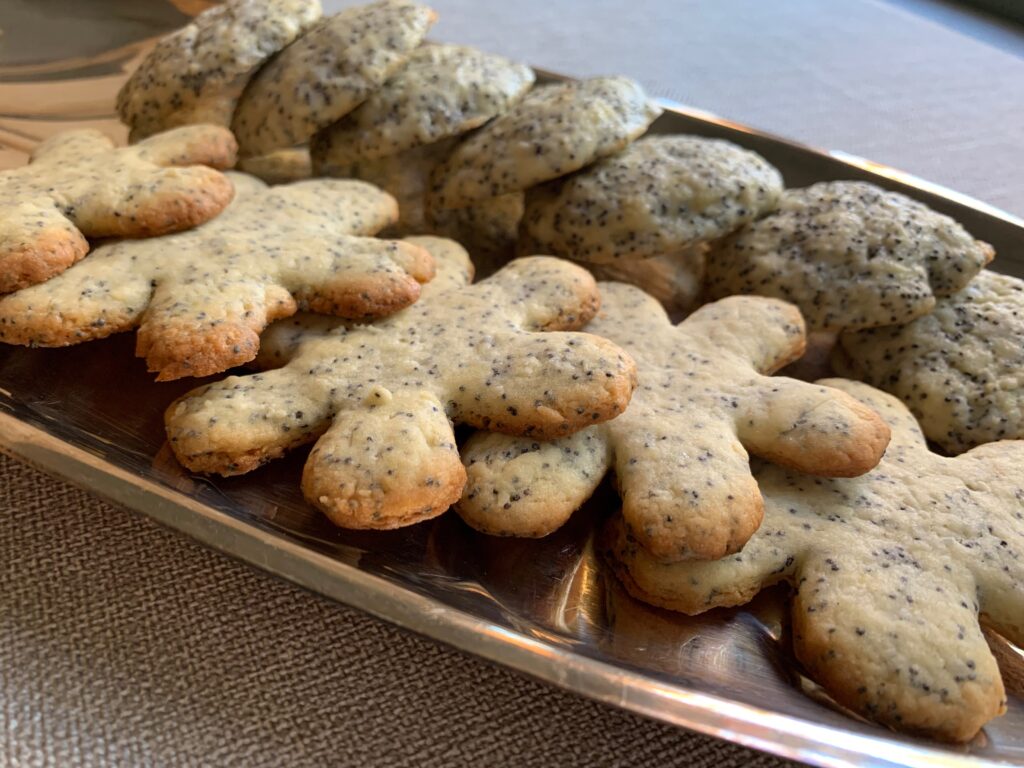
The best answer we have found are Queen Esther Cookies, a treat from the Jewish tradition that’s often paired with Poppy Seed Hamantaschen.

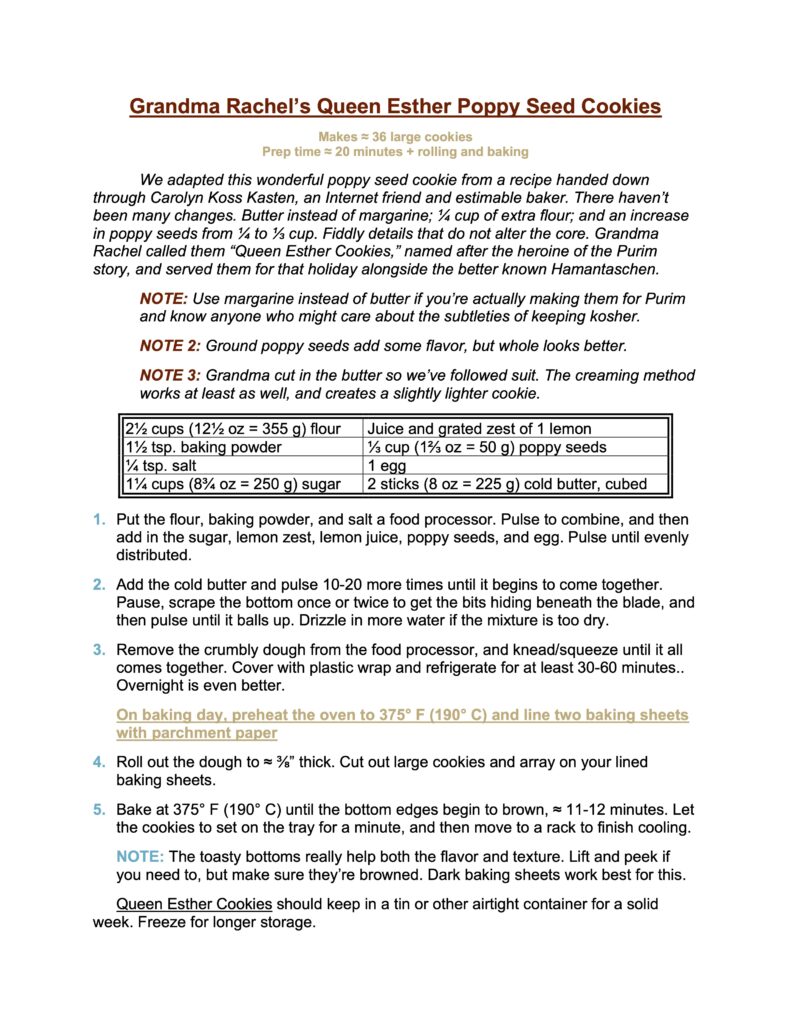
It’s an easy cookie to make, and the development process was even easier because we started from a century-old family recipe. Not our family. This one comes from our online friend Carolyn, an estimable baker, who received it in turn from her grandmother. Here’s the original recipe for the sake of full disclosure and free giveaways:
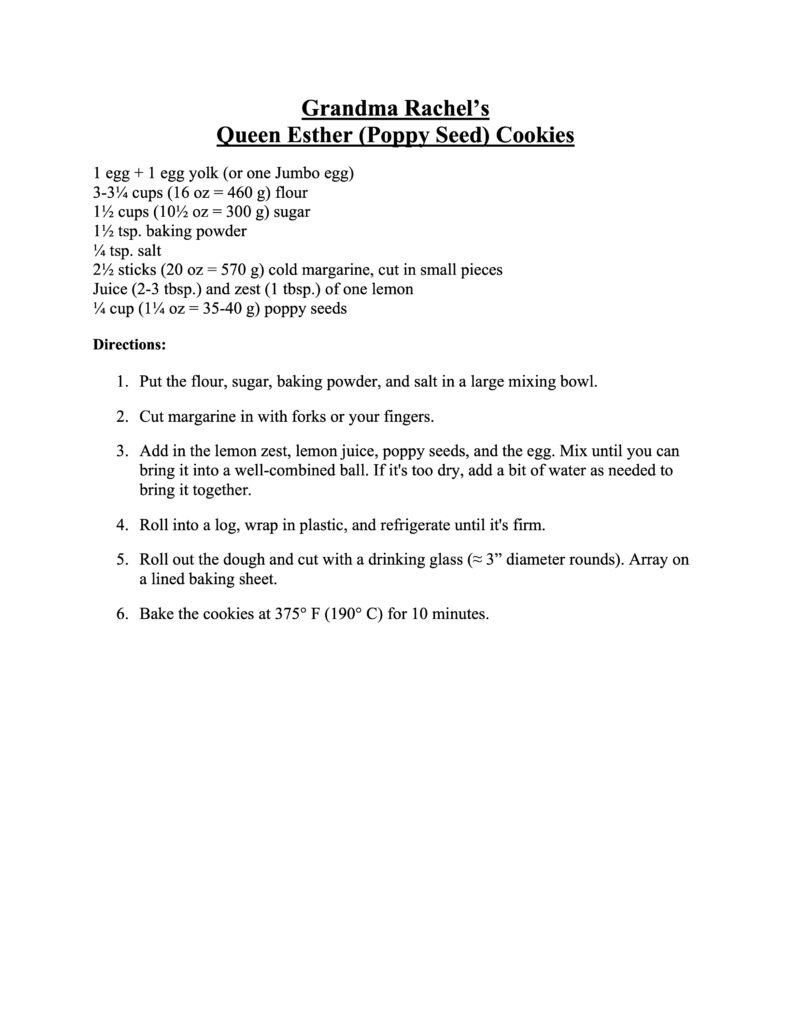
Grandma made these for Purim, the Jewish early-spring holiday, and used margarine to avoid any potential issues with the kosher laws on a holiday. We have specified butter instead, and normalized the recipe to an even 2 sticks of butter. We also increased the amount of poppy seeds because, well, Kate. [NOTE: My beloved even wanted to try a full ½ cup! I put my foot down, but you might too if you fall in that camp.] (NOTE FROM KATE: It would’ve worked. While experimenting with a Lithuanian recipe, I baked up cookies the color of asphalt. Yum! Usually, we give away our trial runs. Not this time-these are bagged in the freezer for “emergencies.”)
Two flavor notes: First, we found over and over again that the best cookies were the ones with the browner bottoms. That little bit of toastiness enhanced both the lemon and the poppy seed flavors.
We also choose to go with baking powder instead of soda, because we enjoyed the bright hit of lemon as a counterpoint to the cookie. If you want it more restrained (and Carolyn did say the lemon flavor should be subtle), try using baking soda instead. It’s an easy 3:1 conversion; exchange ½ tsp. baking soda for the designated 1½ tsp. baking powder. That will remove some of the extra acid from the lemon juice? [N.B. You can make baking powder at home by using two parts cream of tartar to one part baking soda. Thus baking soda makes up one-third of the designated 1½ teaspoons of powder; or to put it another way, is 3x as strong]
As you might expect, the recipe was nigh unto perfect. We did play around a bit, and found that the standard creaming method in a mixer works as well as cutting the butter in with a food processor. Does it work as well as doing it by hand? Try it and let us know. We are children of the machine age.
We also tested ground poppy seeds versus whole. The first has slightly more flavor and is a lot less gritty, but makes for a gray cookie with darker specks. The whole seeds make a vastly more attractive cookie that’s black-on-pale, but you do end up with seeds between the teeth. I’d go with the whole because I’m not eating them anyway, but She Who Snarfs [Ow! That hurt!] thinks it is a much closer call. (NOTE FROM KATE: I won’t kick whole-poppy seed cookies out of bed, but I prefer the more developed bitter edge of ground seeds. They may look a bit modern and abstract, but the flavor is superb. Also, there’s no danger of getting seeds stuck between your teeth.)
So that’s the first. Queen Esther’s Roll and Cut Poppy Seed Cookies. Check.
POPPY SEED DROP COOKIES

For good or ill, this is a cookie where I had to get a bit creative. We had just finished developing our version of the roll-and-cut Queen Esther cookies, and wanted to do a parallel, poppy-heavy drop cookie. Online recipes are all over the place; cutting back on the amount of flour would have been too easy; and I wanted to use the basic Queen Esther flavor balance while creating something with a very different, more pillow-like texture. So I started by noodling around in the world of online drop cookie formulae until I happened across a recipe for Sour Cream Cookies. Aha!
We haven’t written that recipe up because they’re heartlessly plain, and aren’t common enough to demand a spot on the list. But I have baked them, and knew they would perfectly match the target texture. Besides that, the flavor of sour cream would enhance both the lemon and the poppy flavor, while shifting the focus just sideways enough to really distinguish them from the roll-and-bake recipe. So I set to work, did a sample batch, and [Insert Proud Daddy Preening].

Are you a married man? If so, you know that moment when your wife gets that look of surprised, big-eyed delight, and then looks at you with pride and admiration. It’s rare. It’s precious. And I got just such a look when my beloved gave the test run a sample. “OMG Scott. You’re goooood. [Munch, munch, reach].”
I don’t know what else to tell you. Is it a “heritage” recipe? Debatable. The two halves are, but the combination is original. But as they say in Paris, c’est la vie. And who cares? They’re goooood!
NOTE FROM KATE: Unlike the Queen Esther cookies, which soften in the tin, the drop cookies tend to harden overnight. Adding a slice of bread in the morning restored them by mid afternoon.
NOTE: We haven’t tried it, but this should be a cookie where you can replace the actual poppy seeds with a commercial poppy seed filling. Our homemade filling (see below) is somewhere close to 65% poppy seed, 20% milk, and 15% sweetener if you measure by volume. Assuming a comparable proportion in the canned versions… [click, click, click]… the math says one should get an almost identical product by replacing the ⅓ cup of poppy seeds with ½ cup of filling, and then reducing both the sour cream and the sugar by 2 tbsp. each. It won’t be perfect (experiments never are), but it should be close enough for the second batch to be just about right if you keep good notes.
CONCLUSION
So much for Part 1 of our poppy seed adventure. Part 2 will cover the tips, tricks, and secrets to making the world’s best Poppy Seed Filling, along with a couple of sample recipes for how to use it, and some discussion of the poppy desserts world beyond just cookies.
Enjoy!